Sex and the City (SATC) came to our small screens in 1997, based upon the novel of the same name by ex-New York Observer columnist Candace Bushnell. This television series and its depiction and ‘celebration’ of women not only appealed to a mass female audience but attempted to dispel the so-called – thanks to Betty Friedan -“feminine mystique” by dismissing repressive female stereotypes which had seemingly dogged popular culture in the years before. These were (white) women talking, writing about, and more importantly, having sex (as they maintained from the very first episode) “like men”[1]. At the heart of this series was the feminist ideology that all women have a right to sexual pleasure and live in a place of complete independence where women have ownership of the, albeit narcissistic, ‘gaze’ and men are the sex objects.
Quite simply, without second wave feminism, a show like Sex and the City would fail to exist and creator Bushnell describes the Foucaultian confessional as depicting “female choice, not female rejection […] women viewers get the naughty thrill of seeing their gender portrayed for once as sane, sentient, and decent.”[2] With this sweeping statement there is an implication that all television and/or film texts gone before had negatively depicted women and that by seeing this positive, even verisimilar portrayal, the female population are engaging in illicit activity. Bushnell never considers the representation of women within the text or the fact that the characters have been rewritten by a man. An audience requires more than gender in order to negotiate identification and, unfortunately, for the female viewer there is little to identify with. SATC depicts women as over-consumers and seems to believe its own propaganda; that in order to be liberated and successful, a woman has to be white, heterosexual, rich, thin, and self-obsessed. Is this really what modern womanhood has been reduced to? The representation of women and the evolution of these characters have enforced further limitations and new stereotypes that women are measured against. The motion pictures which were born from the success of the series have taken the ‘sane, sentient and decent women’ with choice and replaced them with four dolls bridging the gap between feminine and sexy, artificial and empowered. It utilises the Beauty Myth[3] and defines a woman’s sexuality against the clothes (and shoes) she wears to create a Serious/Sexual dichotomy[4] in which liberation and promiscuity merge. A woman’s voice has now been replaced with a body, however, because these women choose sexual freedom and choose to “act like men”, we find ourselves in a culture which appears to resurrect stereotypes of female sexuality that feminism endeavoured to banish.[5]
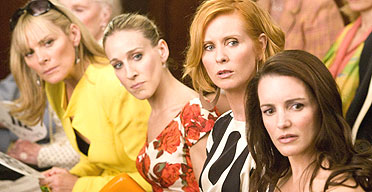
In a term coined by Feona Attwood (2009) Sex and the City ‘mainstreamed’ sex and used it ‘as a source of self-definition and a means of self-expression’[6]. They were, in accordance to Rosalind Gill, sexually confident and autonomous – “knowing, active and desiring subjects”[7] but as the series progressed the women chose their respective Mr. Rights over their independence and sexual freedom and this has, since, been repeated within the narratives of the first and second film[8]. Despite, second wave feminism informing women that Prince Charming is a patriarchal fiction designed to render them passive and in need of rescue. It went on to furthermore state that they did not need him to define their happiness or create the so-called “happily-ever-after”. Sex and the City chose to perpetrate the myth and reinforce, as David Greven argues, “the ideology that heterosexual sex is forever [while homosexual] sex is transitory, fleeting, [and] intangible.”[9] The filmmakers response to this was to take the two male homosexual characters and marry them off. To each other. With Liza Minnelli officiating! So, if the whole purpose of Sex and the City was to make these women sexually independent and to break stereotypes, why then do we see three out the four characters re-enforcing patriarchal ideology by getting hitched?

The last beacon of hope is Samantha Jones (Kim Cattrall), who, on the surface, appears to be the exception to the ‘Mr Right’ rule, preferring to settle for ‘Mr Right-Now’ (conveniently, she is potentially too old to procreate). Her views on marriage, monogamy and sex transgress the heteronormative ideologies, she truly believes she can do anything a man can do, even experimenting with Viagra[10]. Like most transgressive women before her she is ‘punished’ with the discovery of breast cancer.[11] There has even been a suggestion by some critics that she transgresses the female gender altogether given that she is encoded as a homosexual, Greven writes,
[…] Samantha, most explicitly of all the women, acts, speaks and cavorts like a stereotypical gay man, her femaleness a safeguard against both homophobic retaliation and an explicit admission of a gay agenda, to use this cruelly overused phrase only to suggest that the show about sex in Manhattan has to use female characters as a cover […][12]
If a woman is sexually confident, even aggressive, successful, ambitious, and appears to not require a man ‘she’ of course must be a ‘he’! Once again, female sexuality is defined by patriarchy. Interestingly, Candace Bushnell, in 2001 agreed with Greven and declared that Samantha is, in fact, a gay man[13]. So, are women getting the ‘naughty thrill’ from seeing their gender portrayed as ‘sane’ or as a gay man?
Sex and the City: The Movie saw Carrie – the woman without the bride gene[14] – agreeing to marry ‘Big’, now known as the less phallically aggressive John. The proposal of marriage is a business transaction to ensure that, should their relationship fail, Carrie will not be left with nothing. Charlotte has the ‘; perfect’ marriage to Harry and in addition to their adopted daughter she finds herself defying medical odds and falling pregnant. Miranda is coping with Steve’s infidelity and Samantha finds she is rapidly falling out of love with Los Angeles and being in a relationship with a man whose name she says more times a day than her own.[15] John, then jilts* Carrie on their wedding day and the girls accompany her on the honeymoon to Mexico; a suite she booked in the names of Mr and Mrs Preston – a thrill which made her forget her ‘true self’.[16]
The Beauty Myth informs is that there is ‘no right way to look’[17], however, SATC (a programme that Wolf endorses as “funny, clever and thinks women are important[18]) portrays a uniformity in women, they may have different hair-styles but essentially all the attributes they own, situations they find themselves in, men they deem attractive can be applied to just one woman; in fact one could argue that Miranda, Carrie, Charlotte and Samantha are the four (patriarchal and ideologically enforced, of course) facets of one woman; the cynic, the optimist, the Madonna and the whore. This uniformity is ever more prevalent in the racial make-up of the cast.


Carrie hires an assistant to help her ‘come back to life’ (because obviously, losing a man brings serious health risks, one is suddenly are unable to open mail, unpack, etc.) after the ‘devastation’ and ‘humiliation’ of being jilted. Louise (Jennifer Hudson) is a curvaceous black woman from St. Louis who is never legitimised with a surname, and only in her depiction as the single African-American character does the viewer realise the full extent of Sex and the City’s whiteness.[19] She is immediately encoded as the social minority because she is a St. Louis native and subverts the whiteness/virtuousness ideology[20] because Louise is the innocent, naïve in her pursuit of love, even crossing state lines to seek out the love of her life.
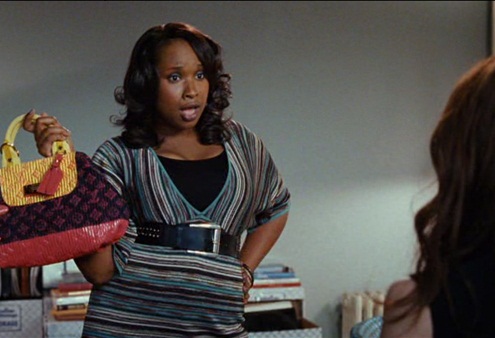
Louise starts out, albeit tenuously, with similarities to Donald Bogle’s ‘Mammy’ character; “she is sweet, jolly and good tempered”[21] and serves Carrie, helping her complete the most basic tasks – answering letters and e-mails, replacing a mobile phone and unpacking boxes and boxes of clothes. She does, however, evolve from the stereotype – although one could argue she becomes the “Magical Negress” bringing Carrie back to life and all – and gains some autonomy just in time for her ex-boyfriend to propose marriage. She begins to show more flesh, specifically cleavage, her clothes become tighter and more streamline, slimming her down; the voice is replaced by the body. Although, her screen-time is not sufficient enough to explore the character in depth, it is hinted at that her change in physicality does have the desired effect on men (coincidentally, Hudson herself lost a substantial amount of weight and married and gave birth following her role in SATC). Louise’s curly natural hair is straightened and coloured a lighter brown, and it can be argued that she, essentially, is white(r) when she leaves New York, complete with a diamond engagement ring and Louis Vuitton handbag hanging from her wrist. Using Dyer’s model she becomes colonised; from St. Louis to Manhattan – black to white(r). Dyer writes that, “white women are [after all] constructed as the apotheosis of desirability, all that a man could want, yet nothing that can be had, nor anything that a woman can be [an] everything-and-nothing quality.”[22]

Racial difference is also explored in the sequel, its release date in 2010 to coincide with the football World Cup – another occasion in which there is a divide the sexes; all women HATE football, obviously. Samantha is invited to a Sheik’s private hotel in Abu Dhabi on a PR trip and extends the invitation to her three friends. This trip is used as a distraction from the womens’ respective problems at home. Carrie and ‘Big’ are married (following a vomit-inducing Cinderella-alluding proposal at the end of the last film) and ‘making their own rules’ but according to Carrie, their relationship is getting ‘too Mr-and-Mrs-Married’. Charlotte is felling oppressed by the demands of motherhood and is beginning to obsessively believe that Harry is having an affair with their twenty–something Irish nanny, Erin (the girl doesn’t wear a bra so of course, she must be sleeping with her boss). Miranda, having no inclination to confront her sexist boss, quits her position at the law firm, an action which is completely inexplicable and out-of-character.
Throughout the scenes shot in Morocco (doubling for Abu Dhabi), the Americans, understandably, never fully assimilate into Middle Eastern society; their ignorance seemingly the main problem. Miranda is constantly berating Samantha for leaving her shoulders or legs bare and on display. Even after her arrest she falls foul of a group of Muslim men on their way to prayer. Her bag then bursts during an altercation and condoms are scattered at the men’s feet and then, as this is Samantha, the prophylactics are waved in the crowds’ faces and thus as Lindy West so eloquently writes in her scathing review:
Traditional Middle Eastern sexual mores are upended and sexism is stoned to death in the town square. At sexism’s funeral (which takes place in a mysterious, incense-shrouded chamber of international sisterhood), the women of Abu Dhabi remove their black [burkas] and [niqabs] to reveal – this is not a joke – the same hideous, disposable, criminally expensive shreds of cloth and feathers that hang from Carrie et al’s emaciated goblin shoulders. Muslim women, under those craaaaaaaa-zy robes, they’re just as vapid and obsessed with physical beauty and meaningless marital concerns! Feminism! Fuck yeah![23]

West is a Seattle-based film critic who despised the movie with every fibre of her being, it would seem. She describes SATC2 as “tak[ing] everything I hold dear as a woman and as a human […] and rapes it to death with a stiletto that costs more than my car.”[24] A horribly violent, almost anti-feminist metaphor but she really hated it…
Georgina Isbister, on the other hand, writes, that the reason that SATC resonates with an audience is that “its narratives are dominated by the challenges faced by protagonists in achieving their ideals and the subsequent anxieties surrounding them […] trying to conform to an expectation that women can have it all.[25] This is not so much an expectation as patriarchy rearing its ugly head again. Women are lead to believe that they can have liberation and everything that men are entitled to as long as they revert back to the patriarchal ideal of ‘wifedom’ and motherhood. SATC not only highlights the anxieties and challenges but exacerbates them.
Sex and the City has shamed women into believing that acquisition is the pathway to freedom. While the post-modern feminist text contains heroines who are much more active than the bygone eras of the 70s and 80s and, as Rosalind suggests,
[they] value autonomy and bodily integrity and the freedom to make individual choices […] [Yet] they seem compelled to use their empowered positions to make decisions that would be regarded by many feminists as problematic located as they are in normative notions of femininity.[26]
Carrie chooses marriage with the man who treated her badly for ten years. She and Miranda changed who they were for men, the latter hell-bent on a career kept her hair short and dressed in power-suits in order to make it in a ‘man’s world’ only to fall pregnant, marry and throw her career away for a family-life. Charlotte also gave up a career and her single independence for a husband and children while Samantha maintained she had sex like a man, believing that behaving as a man provided liberation and empowerment whereas sex as a woman does not. For her trouble, she is described as channelling as ‘homosexual man’. These successful women have, over the last decade, communicated that a career, financial security, looks and ostensibly, intelligence are nothing compared to doing anything to get (and keep) a man, including compromising the essence of who you are in order to secure the man you love.
There is little doubt that SATC made a cultural impact; yet at no point is there an attempt at a realistic portrayal of a modern-day woman. She has been thwarted by product placement and shoe iconography and manipulated into thinking that because she is privileged over the male(s) in the diegesis she has been gifted with choice. The film texts, in particular, are responsible for repackaging the patriarchal ideology of normative femininity in shinier, more expensive wrapping, marketed to the richest, skinniest and whitest women; content to allow Capitalism’s oppression keep them content and submissive.[27]
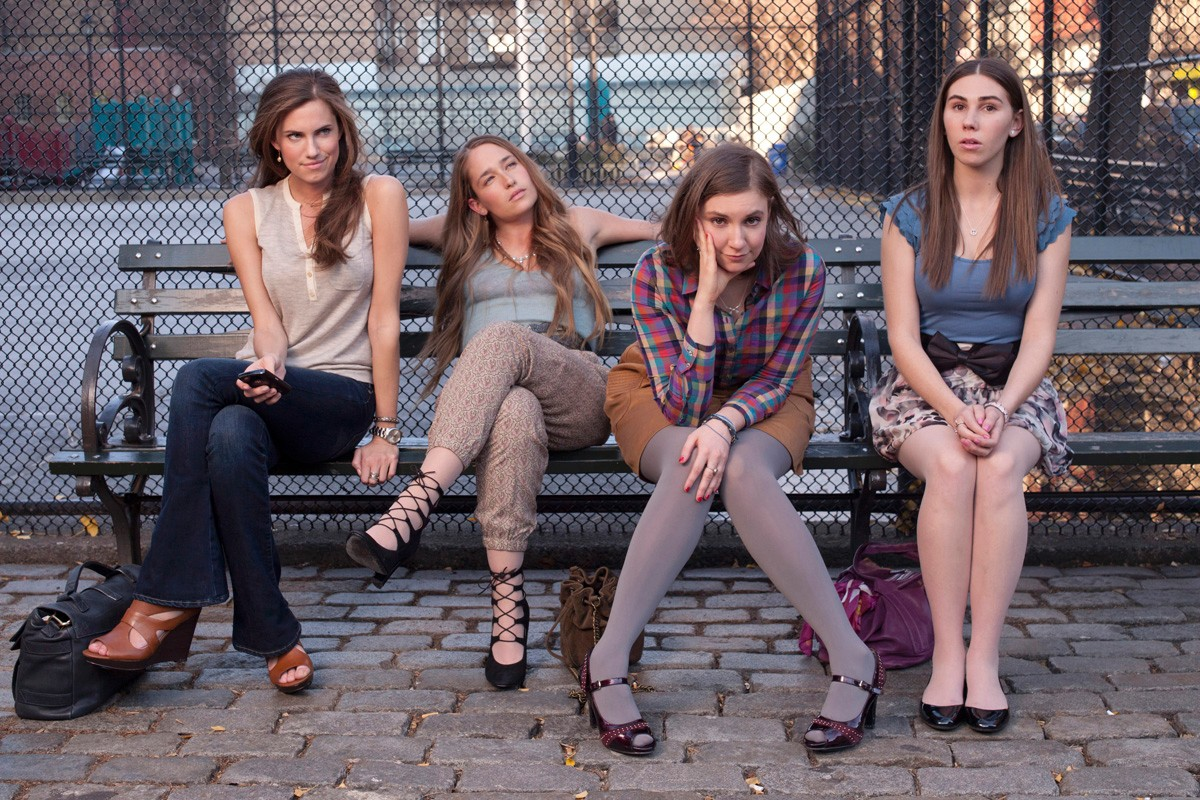
In an attempt to implore sexual freedom the text(s) reaffirms the male – female divide and this apparently gives the cast and writers’ license to incite sexism, misogyny and female chauvinism[28]. Sex and the City appears to return to a repressed state – it is still men who rule their world. Mr. Big allows Carrie to believe that they are creating their own rules and sharing the relationship power, when, in fact, she always compromises herself and comes around to his way of thinking, in the end, even without realising it. This may be somebody’s reality but please do not attempt to use it as a form of celebrating the twenty-first century woman. She is, one would like to think, less-consumer obsessed and vacuous. Her right is not only to shoes but to a voice, freedom, power and to transgress male notions of femininity. Within the media forum would seem like the ideal vehicle for such a premier, however, given the complexities and humanity of the female gender would anybody be up to the task. Lena Dunham has taken up the mantle with Girls[29], a series not unlike SATC which deals with four friends and their quest for all the things that the former programme initially set out to do – a survivable place in the world. She has full creative control, stars, writes, produces, directs and while Ms. Dunham has given a voice to the younger woman, one who is not preoccupied with becoming a wife, mother or trying to ‘take over’ from men, these ladies are still white and privileged.
[1] SATC Season 1: Episode 1 ‘Sex and the City’ Samantha insists the girls try “Hav[ing] sex like men, you know, without feeling.” HBO, 1997-2003.
[2] Candace Bushnell cited in Leupold, Julie “Sex and the City Screw with Feminism” (2003). http://journalism.nyu.edu/publishing/archives/portfolio/leupold/Sex_and_the_City.html
[3] Wolf, Naomi, The Beauty Myth: How Images of Beauty Are Used Against Women (Vintage Books, [1992] 2007).
[4] Ibid. 1992, p273.
[5] Levy, Ariel, Female Chauvinist Pigs: Women and the Rise of Rauch Culture (Pocket Books, 2005) pp4-5. Levy suggests that not all women of this generation are imbued with the feminist agenda and “if this bawdy world of boobs and gams we have resurrected reflects how far we’ve come, or how far we have left to go.”
[6] Attwood, Feona, Mainstreaming Sex: The Sexualisation of Western Culture (I B Tauris, 2009).
[7] Gill, Rosalind, Gender and the Media (Polity Press, 2006) pg103.
[8] Samantha finally chooses herself over a man at the end of film one.
[9] Greven, D “The Museum of Unnatural History: Male Freaks and Sex and the City in Akass, Kim. & McCabe, Janet. (eds) Reading Sex and the City (I B Tauris, 2003) p42.
[10] SATC Season 3: Episode 7, ‘Drama Queens’.
[11] SATC Season 5 Episode 15 Catch 38.
[12] Greven, D (2003) p44
[13] Declared during an interview in The Independent, 5 February 2001.
[14] SATC Season 4: Episode 15 ‘Change of a Dress’.
[15] SATC: The Movie. Samantha ends her relationship with Smith by telling him that although she loves him, “I love me more, I’ve been in a relationship with myself for 52 years and that’s the one I need to work on.”
[16] Ibid. “If I met myself ten years ago, I wouldn’t know me.”
[17] Wolf (1993), p275
[18] Naomi Wolf cited in Wignall, Alice “Can a Feminist Really Love Sex and the City” (2008)http://www.guardian.co.uk/lifeandstyle2008/apr/16/women.film
[19] Dyer, R. The Matter of Images: Essays of Representation (London: Routledge [1993] (2002) p128.
[20] Ibid. Dyer examines silent star Lillian Gish and her screen whiteness to argue his case for superiority on screen for white stars.
[21] Bogle, D. Toms, Coons, Mulattoes, Mammies and Bucks: An Interpretative History of Blacks in American Films, Continuum (1991) p9.
[22] Dyer [1993] (2002) p146.
[23] West, Lindy “Burkas and Birkins” (2010) http://www.thestranger.com/seattle/burkas-and=burkas/Content?oid=4132715
[24] Ibid.
[25] Isbister, Georgina, “ Sex and the City: A Post-Feminist Fairy Tale” http://www.unisa.edu.au/cil/minisites/csaa/files/Isbister_edited_version.pdf p11
[26] Gill, R (2006) p269
[27] As suggested by Eliza Tozzi in her article “Sex and the City: Feminism and Mass Culture (Empowerment & Consumerism) “[SATC] suggests that empowerment is attainable through consumption” p64
[28] A term used by Ariel Levy and described as “women who make sex objects of other women and [them]selves” 2006, p4.
[29] Girls premiered on HBO in 2012 and is now on its fourth season.