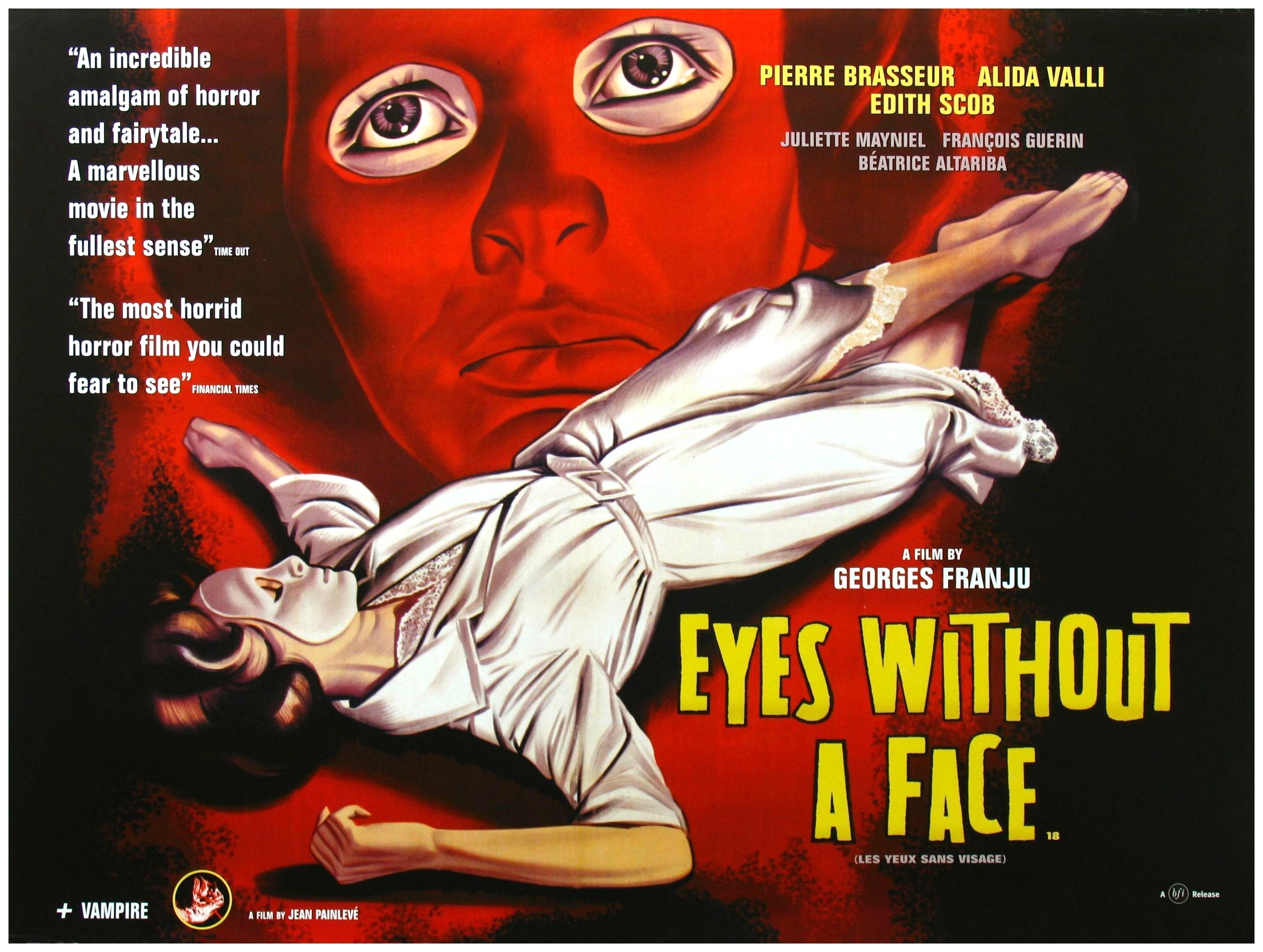
Georges Franju has a thing for masks. Both figurative ones and literal ones are dotted throughout his work, most notably in Thérèse Desqueroux (1962), Judex (1963) and Nuits rouges (1974). However, it is in his 1960 work Eyes Without a Face (Les yeux sans visage) that the literal mask plays a more prevalent role.
The BFI has lovingly restored the film and crafted a plethora of extras to release it on Blu-ray for the first time in the UK and it doesn’t disappoint. Picture quality is outstanding and the sound perfect. The film opens with Maurice Jarre’s carnivalesque, jaunty yet haunting score as a female (The Third Man’s Alida Valli) manoeuvres her car down dark winding country roads at night; the tension building as a person in a mackintosh and hat sits in the backseat. Something is not quite right and all unease is confirmed when the driver hoists the body from the backseat and dumps it into the local river. Louise works for Docteur Génessier (Pierre Brasseur) a prominent scientist and researcher in facial reconstruction, the viability of living tissue grafts and necrosis – the operation scenes of which are horrific thanks to Georges Klein’s make-up and Charles-Henri Assola’s special effects. The police have their suspicions about the good doctor but fail to act before the film’s climatic denouement.
Inside the Doctor’s home, silence is juxtaposed with the tweeting of birds and barking of dogs. It is eerie and foreboding, shot with low camera angles and a static camera is interspersed with the odd tracking shot. The use of chiaroscuro is stunning and shadows add to the atmosphere of the allegorical fairy tale. Darkness gives way to light the higher the stairs climbed until the bedroom of Christiane (Edith Scob) is reached. The camera work and lighting design is a real testament to Eugen Schüfftan’s cinematography. Director of Photography Schüfftan had previously worked with Lang, Siodmak, Ophüls and Pabst and had a three dimensional way of lighting a scene, alternating each first and third shot which is great for adding atmosphere, angst and anticipation.
Christiane appears to be a young girl in her white room but the deep velvety tones of a woman amid the caged doves cooing is a real surprise; an adult prisoner being harder to subdue. Two mandolins hang above her bed arranged like a butterfly; she is in a chrysalis awaiting transformation after a car accident causes facial disfigurement. Forever incarcerated in the old dark house of creaking doors and balustrades of the staircase casting bar-like shadows on the wall, all mirrors are covered and Christiane is forced to wear a mask. A mask of brilliant white frozen beauty that only allows the eyes to be visible and they are the windows to a tortured lonely soul. After a while we forget it’s a mask, it’s gentle and soothing, the fact that Scob glides within each scene makes her appear as if an apparition or marionette doll. She is the caged dove, the constant reminder of her father’s guilt and the feeder of his hubris.
Eyes Without a Face is Franju’s masterpiece, an austere and elegant horror-based fairy tale. It deals with scientific ethics, solitude and loneliness; never has human torture been so romanticised, so cruel, tender and lyrical. Edith Scob, perhaps it is fair to say one-time muse of director Franju having worked with him on five pictures, is the star. She provides such a nuanced almost delicate (yet powerful) performance, her Christiane is as beautiful as she is strange, objectified beyond expression. Well, almost…
Notoriously incongruous, Franju is quoted as saying he subscribed to images and “my images are my fleurs maladives [evil flowers]”. Eyes Without a Face is one evil flower that all must see, at least once in their lifetime.
Arrow Video’s new restoration of David Cronenberg’s Videodrome (1983) follows in the footsteps of Rabid (1977) and Shivers (1975) also restored and re-released on dual format this year. Each film with its disc-filled extras is clearly a labour of love.
Just preceding the Video Nasties Act of 1984, Videodrome, I’m sure would have gotten Mary Whitehouse’s knickers in a twist with the film’s provocative, paranoiac and altogether pleasure-seeking premise. The narrative centres on Civic TV executive Max Renn (James Woods) and his quest to find the next ‘big thing’ in sensationalist programming. His station is responsible for “soft core pornography and hard core violence” which Renn unapologetically justifies as a result of economics. Moral questions arise surrounding the over-stimulation of the consumer following exposure to dehumanising images via the media. These questions are depicted through metaphor, potential Freudian imagery and the former protégé of Dick Smith, multi-Oscar winning make-up effects Wizard Rick Baker (Smith famously created the exploding head in Scanners). Fellow Canadian, composer Howard Shore, yet again, provides the score (Shore and Cronenberg have worked together on all but The Dead Zone) and employs the use of a Synclavier II synthesiser alongside an orchestra. This electronic sound adds a dark, ominous, even metallic, tone to the film and aids with the 80s nostalgia along with the coiffed hair, shoulder pads and leather ties.
Renn stumbles upon Videodrome – a pirate television station which depicts the torture, brutality and eventual death of its subjects. Becoming obsessive to continually transgress social boundaries, Renn shows the footage to his girlfriend Nicki Brand (a hypnotic Deborah Harry) who, by her own admission, is the perfect over-stimulated test audience. She is sexually free (connoted by her costume, both cut and colour) and is immediately enamoured at the premise of the snuff sequences. Her enthusiasm for all things dark and painful grows and she even disappears to audition in Pittsburgh upon hearing the show is filmed there. Left alone, Max begins to suffer hallucinations; disturbing, intriguing visions which only seek to feed his need to consume the morally ambivalent visual media and further blur the line between fantasy and reality. His interactions with the Marshall McLuhan-inspired Brian O’Blivion (velvet-voiced Jack Creley, only ever visible via a television screen) increase the bizarre especially when we learn O’Blivion’s history to Videodrome. It is an aesthetically pleasurable film; body parts are fetishised, Betamax tapes pulsate and television undulate and literally swallow the flesh.
Anybody familiar with the articulately intense septuagenarian director will immediately recognise the body consciousness which is prevalent in a large percentage of his oeuvre. The man, who has cited Bergman, Fellini and Kurosawa as main inspirations, presents the limitations of the human body within his own artistic nihilism. Ideologies are often invasive and monstrous, the embodied becomes disembodied whilst sex and violence surrounds, causes, or indeed invades the diegesis. There can be contradictory readings of Cronenberg’s films; does he fight for the patriarchal pleasures he depicts and stray dangerously close to misogyny or destroy said pleasures while reinforcing the fragility of the physical body and mind? While the male consciousness is seen in crisis and at odds with the social world around him, it is the female body which appears abject and the site of disgust. In Videodrome, the male mind becomes more abhorrent through feminine imagery; Renn’s torso is repeatedly violated via the vagina-like opening. Or perhaps, it is like the man himself stated a few years ago; he plugs into the zeitgeist, examines and plays around with it. In simple terms Cronenberg’s films are about life and death yet he cleverly uses the horror and prosthetics as a distancing tactic. He questions who or what we are and presents, albeit through social paranoia and viscera, the evolutionary limitations of the human body and the emotional terror of the waking nightmare.
Videodrome has never been more relevant in the face of the current media and image appropriation. It is disorientating, visually audacious and presents an ideology which is fascinating, wholly original but is, perhaps, one of the more convoluted Cronenbergs. That said, as a first time viewer (yes, I know…) the experience of it was exhilarating.
Blu-ray Extras
Never one to scrimp on material, Arrow has collected an array of goodies and following the film, there are numerous options for the viewer to take, although do yourself a favour and hit them all.
Cinema of the Extreme – The 1997 BBC documentary featuring Repo Man director, Alex Cox, David Cronenberg and George A. Romero briefly discuss cinema extremes. These verbal tidbits are intercut with clips of Shivers, Dawn of the Dead (1978) Videodrome and Crash (1996). It is a slight, fairly insignificant documentary which never goes into great detail but Cronenberg’s thoughts on censorship are always worth a listen (Cox’s on Seven, not so much).
Forging the New Flesh – Visual Effects artist Michael Lennick narrates (and stars) in the first of his four contributions to these extras and discusses the techniques used in the making of the film. This, unfortunately, short but fascinating featurette contains behind-the-scenes footage and interviews Rick Baker, Bill Sturgeon, David Cronenberg and star James Woods.
Fear on Film – One of the highlights of the disc extras is a roundtable discussion originally aired in 1982; presented by Mick Garris and featuring David Cronenberg, John Carpenter and John Landis in tweed, flared jeans and big hair respectively. The conversation centres around the horror genre, what scares the filmmakers, films, as well as their individual takes on censorship and ratings. Although, less than 30 mins long, it is a highly entertaining and lively chat and well worth watching.
Samurai Dreams – The complete and uncensored Japanese series Samurai Dreams with optional commentary by Michael Lennick who is still revelling in the Videodrome/Samurai Dreams experience some 32 years later.
Helmet Camera Test / Why Betamax? – Bite-sized early test footage showing Max Renn’s virtual hallucination chamber head-gear and a second segment which very briefly details why Betamax was the format of choice.
Promotional Featurette – This is an extension of Forging the New Flesh documentary although written and directed by Mick Garris and features behind-the-scenes footage and the making of Videodrome. Interviews include: Cronenberg, Harry and Woods As with the previous featurettes, these are brief but still interesting.
Audio Commentary is provided by author Tim Lucas (Videodrome: Studies in the Horror Film).
Cronenberg: Early Works Blu-ray
Transfer of the Future – The ever entertaining and jovial Kim Newman discusses, examines and critiques Cronenberg’s early career and labels him a child of Romero and genre auteur along with fellow underground directors Brian De Palma and Tobe Hooper.
The Early Works – Restored by the Toronto Film Festival, Criterion Collection and Arrow Films respectively, these films show the progression of Cronenberg as an art student and his shorts through to the first feature film which was made some five years before Shivers.
Transfer (1966)
From the Drain (1967)
Stereo (1969)
Crimes of the Future (1970)
In Transfer, shot on a snowy Canadian landscape, an analyst (Mort Ritts) and his patient Ralph (Rafe McPherson) thrash out their doctor/patient relationship via farce and Freudian speak; while in From the Drain, two men (Mort Ritts and Stephen Nosko), seemingly war veterans sit clothed in a bathtub awaiting something ominous which may or may not come out of the drain. Stereo was the first short feature film shot on 35mm and has an establishing shot reminiscent of Fellini’s La Dolce Vita (1960) and appears to be heavily influenced by Bergman. It stars Ronald Mlodzik (later seen in Shivers and Rabid) whose costume looks deliciously Hammer-House-of-Horror-like. This is the best of the bunch, definitely my favourite; shot in black-and-white, silent save for a voiceover, the canted camera angles add to the general creepiness and sterility of the sanatorium set amidst the Ontario north woods. Subjects are placed in isolation and operated on, telepathic ability and extra sensory perception is monitored through sexual interaction. Finally, the last feature is Crimes of the Future a potential follow-up to the preceding film. Restored exclusively by Arrow Films from a new 4k scan of the original 35mm negative, again starring Mlodzik (as Adrian Tripod), and again silent but for the added commentary, only this time in colour. In the House of Skin all women are extinct and Tripod is in search of the enigmatically named Antoine Rouge.
It is fascinating to see the early attempts of an artist, to witness how he develops and to note his visual interests and motifs even back then. There’s the Freudian terminology (which all eventually came to a head in A Dangerous Method [2012]), themes of consciousness, sexual experimentation, telepathy and the oddly monikered characters which have all been seen over the Cronenberg oeuvre at one time or another. They may not, necessarily, be to everybody’s taste but they are revelatory in their style, content and deserve to be seen in all of their restored loveliness. All-in-all, Arrow has produced a beautiful box set which cannot be recommend highly enough.
Somebody once sang that love was a battlefield (okay, it was Pat Benatar in 1983) and it immediately sprung to mind when watching Thomas Cailley’s feature debut survivalist melodrama Les Combattants, as it has moments in which it is quite literally the case. This multi César award winning film is a surprising delight and one surely to feature on many a film-fan’s end of year list. The film opens in a small French coastal town with brothers Manu (Antoine Laurent) and Arnaud (Kévin Azaïs) incredulously arguing with an undertaker about the inferior grade of wood used and extortionate price of their father’s coffin. Although Manu is older, he looks to his younger sibling for help and at times guidance but it would appear that Arnaud is just as lost; unsure what his future holds but happy to help out in the family carpentry business over the summer. Apparently, in France following the recession the second largest recruiter (after McDonald’s™) is the Army. Cue stoic men in fatigues setting up their mobile office and offering anyone who will listen to their drafting spiel, an inflatable lilo and tips on focus and self-defence. During these beach combat sessions, Arnaud is pitted against Madeleine (Adèle Haenel) whom he initially refuses to fight because she’s a girl. He needn’t worry for she can handle herself.
A chance shed-building leads Arnaud to the Beaulieu’s home and their daughter… Madeleine is an only child; an avid swimmer who drinks raw mackerel smoothies for breakfast and is determined to join the army. Her view of the world and its eventual destruction is rational and profound but labels her ‘weird’ and yet her preoccupation with survival attracts Arnaud and in true romantic fashion, he attempts to impress her by impulsively signing up to the Army training camp she is enlisted on. If Madeleine is impressed she makes it impossible to tell with her increasing deadpan expression. There is something incredibly convincing about both characterisations but it is Madeleine who produces the laughs, much like a 30s film dame only quirkier. Sensitive, nature-loving, amiable Arnaud and sullen, sporty, survivalist Madeleine make a strong team. The camp comes as a surprise to both of them and their capabilities.
Cailley’s film is an unusual one in the sense that it doesn’t quite fit a genre; to call it a romantic-comedy is to do it a disservice. Nothing is forced. It is slight, wry and a little odd but wholly persuasive in not only its gender roles but resounding in its depiction of a country coming out of a recession, heading for ruin and a race of people to (eventual) extinction. The cinematography provided by David Cailley (brother of Thomas) is beautifully simple and while he manages to depict so much physical gorgeousness, there is always a sense of foreboding present, an atmosphere which pays off strikingly pre-denouement. Its electro soundtrack by Hit ‘n’ Run keeps things relatively upbeat amidst the threat of melancholia and existential crisis.
Visually, it has a very simplistic palette; mostly greens, greys and muted blues which is complimentary to not only the camouflage colours of the army uniform but also the organic elements of nature which are so often shot – water, sky and foliage with occasional sunshine yellow warmth. Cailley’s direction, his brother’s cinematography and Lilian Corbeille’s almost carefree editing serves the narrative well; natural lighting gives way to gloomy grey by the end. Given the integral use of colour, a Blu-ray release of the film would serve it greatly especially enhancing the already picturesque mise-en-scéne. Sadly, there are no extras on the disc either.
Les Combattants makes for an intelligent, sweet-natured, amusing film. Figuratively speaking, Madeleine and Arnaud could be the last two humans on earth (or indeed animals), passing the time without thinking, engaging in aggression and affection of equal measure and above all surviving but when you’re in the early throes of love, isn’t that how it’s supposed to be?
In case anybody missed it, I adore Wonder Woman. I love what she stands for and let’s face it female superheroes are pretty rare not least because they tend not to get a shot at the big screen. Times be a’changing with the pencilled-in film releases of WW, Captain Marvel, and Supergirl on the small screen. I wrote to DC (in one of those attention-seeking, open letter type things) outlining why Wonder Woman is integral to DC but also, more importantly, why the film needs to be done right…
Dear DC,
It is only logical (and fair) that the third major player in the League and indeed the DC Universe gets their standalone origin film. I am, of course, referring to Wonder Woman and now, it appears I am getting my wish albeit in the most bizarre order imaginably. It has been 74 years without so much as an attempt and yet we have had a substantial tally of Superman (6) and Batman (7) films. So, forgive me for being somewhat pessimistic. A Wonder Woman genesis film has been expected nay deserved for a very long time but she gets described as “controversial” and “complicated”. And? Show me a woman who is not.
Created in 1941 (following appearances by Superman in ’38 and Batman in ’39) by William Moulton Marston; I know, I know A MAN but a progressive feminist who created the character as “psychological propaganda for the new type of woman”. A woman who he believed should rule the world. He saw a great deal of potential in the women’s movement, surrounded himself with strong, intelligent women, hell, he even believed that by 2037 the world would be governed by a Matriarchy. He reckoned that while the feminine archetype lacked “force, strength and power” girls wouldn’t want to be girls or submissive. “The obvious remedy [was] to create a feminine character with the strength of Superman plus all the allure of a good and beautiful woman.” (WMM, 1943)
One can argue that the man was wrong, although it is 2015 and do we not have the same issues surrounding gender on film? I could argue that he had a slight preoccupation with bondage (he was also a huge fan of the truth too). This was an academic who shared his marital home and life with a MA graduate wife and PhD educated mistress, transgressive sexuality pervaded his personal life, why not his work? Patriarchy is the oppressor to which Wonder Woman is enslaved after leaving Themyscira and is often bound – sometimes figuratively – nearly always literally, forced into passivity by the ties/rope/chain that binds before breaking loose and reciprocating with her lasso. Yes, Moulton Marston’s idealistic feminism is problematic, he believed in domination and sexual enslavement but I digress, I’m sure you’re not even considering *that* type of storyline…
Word on the grapevine is that a big action film is not on the cards, you want a more character-driven piece and the search for a male lead/love interest is currently taking place. Rumours have it that you don’t want a strong feminist message…erm, an Amazonian woman-of-steel born from clay outside of the restrictive realms of patriarchy who lived, for most of her life, on a Utopian island devoid of men. You don’t see this as problematic? Hold on. Forgive me. I forget, you are using the New 52 storyline so her origins have been revised so she is now the daughter of Zeus (ugh). I remember that time when Superman and Batman’s origin story was revised and changed. Oh no wait…
I often get asked why. Why do I idolise her, why her above the others? For the record, I love all those other guys too but there will always be a special place in my heart for Wonder Woman. I like what she stands for: strength, intelligence, capability, kindness, wisdom, confidence, courage, sisterhood. Plus, her costume’s really cool; dressed in the red, white and blue standard of freedom and democracy. Batman isn’t the only one with an arsenal of goodies, she wears a tiara which is razor-sharp and can be hurled like a boomerang, the bracelets at the wrist can deflect bullets and serve as a reminder of the shackles once worn when the Amazons were the prisoners of Ares. She carries Hestia’s golden Lasso of Truth; tiny chain-links with limitless length, indestructibility and of course, anybody bound in it are compelled to tell the truth. The lady has the ability to fly (although not soar high), can spin at blurring speed – usually to shed her civvies – is able to communicate with most animals and beasts and has numerous vehicles at her disposal, all invisible.
Not to mention that fact that she is just as physically strong and special as Supes. Their similarities are actually hard to ignore. They are both on Earth separated from their familial roots both have an alias to protect and while they don’t fully comprehend the planet they inhabit they wish to shield and, wherever possible, protect the humans living on it. Yet still she has not been immortalised on the big screen but Superman’s genesis gets regurgitated every decade or so. Why am I telling you all of this when you gave her a home in 1941? Because I don’t want you to forget that there is more to her than just a pretty face.
She will, as it has been made very apparent, make an appearance in Dawn of Justice in the form of Fast and Furious alum Gal Gadot (I’m still in denial about that) before FINALLY getting her own film. The pre-production of which has been hmm, interesting to say the least; female director, no script, creative differences, new female director, six scripts…Why does it need a female director? Well, why not? And hey, DC, if you’re struggling with the script, why not ask Dr. George Miller, he could teach all of you a thing or two about writing a woman. Just don’t fall into the trap Marvel did with Elektra. Good grief that film sucked.
We all know female heroes (some super, some not) are not quite as scarce as they once were; however, they still get a raw-deal. The Age of Ultron / Black Widow storyline furore will attest to this or the severe lack of female-led merchandise which fails to adorn toyshop shelves and don’t get me started on the slut-shaming or name-calling on/offscreen. Supergirl’s even getting in on the (TV) action albeit in a seemingly cutesy way. I get it. I do. Too many females transgressing the boundaries of the norm have and will continue to cause issues for some. It will encourage women wanting to be women and expecting the world, just as Gloria Steinem said, to change for them.
Perhaps, a decent depiction of the Amazonian attesting to the strength and influence of the feminine archetype will be a huge commercial success? Or perhaps, in spite of Joss Whedon’s utter condemnation of the notion that (some) men aren’t interested in the exploits of female she-roes, there is actually some truth in it? No, that can’t be right, not given the popularity of the likes of Buffy, Alien and Terminator franchises and HAVE YOU SEEN Max Mad: Fury Road? Furiosa (Charlize Theron) proves that she can fight toe-to-toe with any man and still be hard, vulnerable and feminine.
Anyway, back to the subject at hand. As you will know Wonder Woman’s current filmic/televisual legacy is largely fan-made. There is that animated film from 2009 which is really rather good and the (now) kitsch and fabulously camp television series made in the 70s which ran for three seasons and saw former Miss USA, Lynda Carter, don the girdle and fight for our rights in satin tights. She was wonderful in it; strong, fearless, savvy, intelligent and beautiful, a Goddess on Earth instilling hope and convincing the world of compassion, humility and generosity – all the while kicking ass. Carter is 63 now and will forever be a wonder woman but it’s time for a change, the character needs to be brought into the twenty-first century while still retaining her roots. David E. Kelley did attempt it in 2011 with Adrianne Palicki in the titular role. Elizabeth Hurley was the villain along with a supporting cast that included Cary Elwes and Tracie Thoms. His pilot was never optioned probably due to the hideous SFX, tacky PVC-costume, or the fact that he portrayed the peace-loving princess as a sexually frustrated spinster who curls up in front of The Notebook and obsesses over her Facebook profile when she’s not ripping out people’s throats. As soon as Diana pulls out the merchandise and dolls at a board meeting, it all gets a little too meta.
I think the point I’m trying to make is I really love Wonder Woman. I have seen a billionaire playboy take to the sky dressed as a giant bat, I’ve witnessed a super alien male don a red cape and protect a city and now I want to see an Amazonian, wearing a tiara attempting to educate mankind. It is time for her to have a go at saving the world.
Sarah (Alex Essoe) resides in LA, the sunshiny place of dreams and superficiality and is an actress, or at least wants to be one; is resolute to be one yet throughout Starry Eyes the line between determination, desperation and ultimate destruction is crossed, blurred, eventually rubbed out – and bloodied – altogether. Sarah tirelessly auditions for role after role in between working at fast-food restaurant Big Taters for sleazy, loser-ly manager Carl (a moustachioed Pat Healy). She has friends, none of whom are particularly close except maybe her roommate Tracy (Amanda Fuller). There is Danny (Noah Segan) who lives out of his mini-van and is ‘determined’ to make it as a director and Erin (Fabianne Therese) a wannabe actress who has had minor success and relishes in being well, a bit of a “bitch”.
Gamine in appearance, Sarah has ‘issues’, she suffers from nightmares, self-harms and is extremely body-conscious. She teeters on the precipice of insanity, is emotionally raw and literally tears her hair out at the roots to ease her anxiety. Her vulnerability does not necessarily make her weak but her hunger to be somebody does, it is easy to empathise with her – that yearning; she could be your sister, or daughter. Hell, she could even be you. Desires, primal or otherwise, push people in all kinds of directions. Then comes the call-back from a successful, if odd, audition for an Astraeus feature (the company taking its name from the Titan God of dusk, creator of winds and wandering stars) and the casting directors’ insistence that she lose her inhibitions has surprising results on the leading lady – “If you can’t ever let go, how can you fully transform into something else?”
Starry Eyes is Faustian in nature, a satirical, abject, allegory about the grim underbelly of Hollywood and the true price of fame (there is even a sly swipe at Scientology too). It is emotive in its execution and (bloody) ambition. An almost melodramatic beginning gives way to a glorious and stomach-churning body horror; Matt Falletta and Hugo Villasenor’s practical make-up effects are visceral, disturbing and quite disgusting, in the best possible way, and displayed amid a synth-heavy musical score which sets the mood perfectly. Alexandra Essoe is astonishing as Sarah, she even at the most grim and a gruesome moment, manages to humanise the character and create a filmic-female that breaks the boundaries of the horror genre’s ‘monstrous feminine’.
There is a moment when ‘The Producer’ (Louis Dezeran) refers to the film industry as a plague; a festering pestilence: “hollow be thy name, shallow be thy name.” – Thankfully, Kevin Krolsch and Dennis Widmyer’s unsettling cautionary tale is anything but.