Categories
Film Festival film review

Housewife of the Year (Dir. Ciarán Cassidy, 2024)

This documentary opens with a citation of article 41.12 of the Irish Constitution in which it states that no mothers will be “obliged by economic necessity to engage in labour to the neglect of their duties in the home.” The marriage bar would remain until 1973 three years after second-wave feminism hit Ireland. Preceding both, in 1968, was the launch of the annual contest Housewife of the Year.

Described as a “friendly competition”, women across Ireland would be judged on how effectively they budgeted and prepared meals. As well as their sense of humour, appearance, personality, sincerity, and civic mindedness – think Miss World sans swimwear segment. It would be televised from 1982 with beloved broadcaster Gay Byrne (1934-2019) as host with the winner getting £300 in cash along with £300 in white goods, usually a “beautiful cooker.”

Director Ciarán Cassidy uses the backdrop of this derisive, surreal and sexist competition to interrogate the role of women in Irish society over the years. There is mention of the Magdalene Laundries, the Catholic doctrine and rigidity surrounding contraception, poverty, the Ann Lovett tragedy of 1984, the Divorce Referendum of 1986 (which was eventually overturned in 1995). Yet, the real meat on the bones is the present day interviews with some of the contestants (and winners).

These extraordinary women – Margaret, Ena, Ann, Sally, Patricia, Miriam, Ellen, Bernie and Philomena – and their stories are fascinating and kind of shattering in equal measure. Their lack of choice and how they adhered to a life of wife and mother, their confinements lasting far beyond the forty weeks of pregnancy. Interned not only in the marriage itself but many quite literally pregnant for decades. Ann was married at 20 years old and by 31 had thirteen children (including four sets of twins). Patricia had to juggle her housework, child-rearing and fulfil her duties as a postal worker when her husband fell ill and unable to work. Miriam sacrificed her career as a Nurse in London just as soon as she uttered her vows, while Bernie was petrified that she’d be found out, her eldest child’s illegitimacy exposed, that her subsequent marriage and further five children would render her disqualified.

On the surface, Cassidy’s film questions the conformity perhaps just not quite as much as the women themselves. Many lament that the decisions made for them, this lack of choice was ridiculous but yet, somewhat paradoxically, credit the competition with giving them the confidence and self-esteem to speak up and question if there was more to life than what was expected of them. Or, in the case of Ellen, the impetus to survive when her husband walked out on her.

Housewife of the Year does not reinvent the wheel in terms of documentary style, combining a lot of talking head interviews with archival footage, however, it is beautifully edited by Cara Holmes and having the former contestants introduced via a spotlight on stage is a lovely touch. It leans heavily into nostalgia, is always sympathetic but never delves too deeply or rages quite hard enough, in the way that many an audience member will upon viewing. While it is pretty wonderful that these women are here to tell their tales, it is always at the forefront of your mind that many, many more are not. Women and girls abandoned by blatant misogyny and a deplorable system, which would have sooner seen them dead than accept a teenage pregnancy or fill a prescription for a diaphragm (without a court case). Not so far removed from where the USA is headed today.

During its run, the contest gave face to a generation of women who in spite of it all kept going and while the State endeavoured to make them second-class citizens, it was their resilience which ensured that, eventually, they would endeavour to make the State work for them. That they could achieve something, there was possibility in the future and change would come. Eventually.

Housewife of the Year plays this year’s Irish Film Festival, London which runs from 13-17 November.

Categories
Film Festival film review

Memory Box (Dir. Khalil Joreige and Joanna Hadjithomas, 2021)

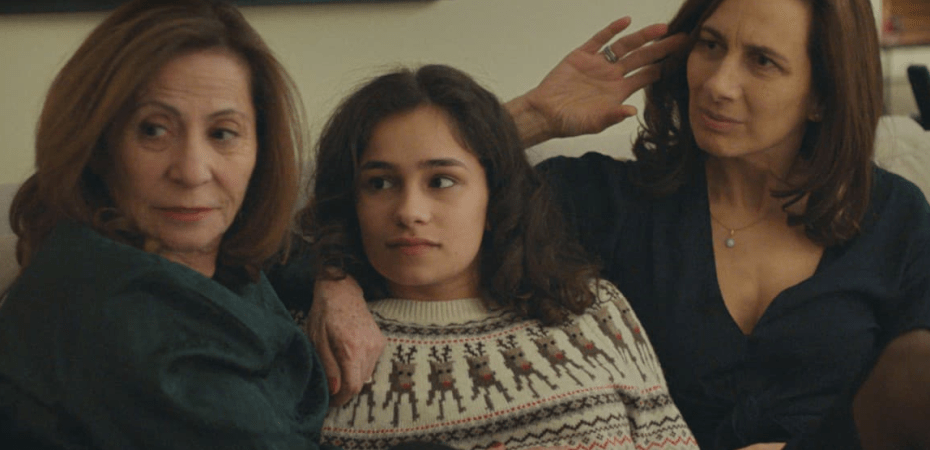
On Christmas Eve as the snow blankets the ground and buries car wheels deep in Montreal, Alex (Paloma Vauthier) and her Téta (Clémence Sabbagh) open the door to a parcel from Beirut. The delivery – addressed to Alex’s mother Maia (Rim Turkhi) – is initially turned away by the oldest matriarch who declares that “the past stinks”. The box contains cassette tapes of a life suppressed; Maia’s teenage years of the 70s and 80s in the wake of the sender’s death. Liza was Maia’s best friend and her dying wish, it appears, was to be reunited with her friend albeit through their memories, photos, notebooks and audio files. While Maia is too bereft to embrace her past, Alex finds the perfect opportunity to connect with a country she has never visited and a woman, her own mother, whom she barely knows.

With the aid of the box the audience learns, along with Alex, what a life is like during war – for most of us, we have not had to experience it – and bridging the generational divide however possible. Images literally come to life and interact with the music playing from the cassette recordings, for example, a memorable time-lapse sequence sound-tracked to Visage’s “Fade to Grey” while, you’ve guessed it, fading to grey. It may sound trite but it’s far from it as real-action bombs and gunfire burn holes in negative strips, and a potentially simplistic premise is fleshed out. It is incredibly evocative of a country ravaged by war and visually impressive, beautifully edited by Tina Baz.

Shifting between fantasy and reality, and with the help of flashbacks Alex enters her mother’s adolescence, her dreams and nightmares during the Lebanese Civil war and the loves and losses overcome during a tumultuous time. Alex, with the help of the late Liza, her Téta and the memory box is able to embrace the most important relationship of her life and see her mother not only as a woman and friend but with new understanding. The same goes for Maia and her own matriarch.

With such heavy hitting themes surrounding death, trauma, and abandonment, it is often the case for films depicting this sort of conflict to do so with earnestness and solemnity, however, Memory Box doesn’t do that. There were some 120,000 fatalities during 1975-1990 but not all perished in Beirut, many survived, lived and thrived and it is these people who are celebrated, the dead honoured in this intergenerational tale with women at the heart of its narrative.

To go forward, one must go back and sometimes reunite with your trauma and, in this case, a homeland which has been suppressed, wartime survival which has been denied, tragedy which has been compartmentalised, like a photo film that has never been processed in over thirty years. There is a compassion to Joreige, Hadjithomas and Gaëlle Macé’s screenplay which is non-judgemental and forgiving, especially in relation to Raja’s reappearance as an adult (Rabih Mroue). The first half may rely of a visual inventiveness and the image, yet, the second still manages to hit with emotional resonance and be deeply moving brimming with moments of levity.

Memory Box is a handcrafted gem by experimental filmmakers, Khalil Joreige and Joanna Hajithomas. Utilising their own photographs and journals written between 1982 and 1988 they create a visually inventive and accessible film which re-writes personal history, questions memory, its unreliability, and how it shapes the present. While visuals are particularly pop-arty and magazine-like, there is an overpowering resonance and meaningful juxtaposition. This is their memory box, made for their children, for whom the film is dedicated.

Memory Box is available to rent from all the usual places you can stream from.

Categories
film review

Animals (Dir. Sophie Hyde, 2019)

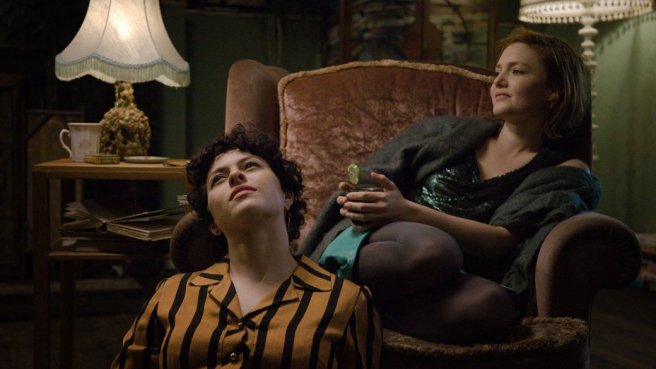
Laura is 32 (Holliday Grainger) and has spent the last decade writing a novel, and still only achieved ten pages of content. It’s about a spider caught in its own web and the woman – one in love with the idea of being in love – who tries to rescue it. An analogy for the ages it has to be said. Laura lives with her best friend, Tyler (Alia Shawkat) who learns of her father’s death at the start of Animals (and just prior to her thirtieth birthday). While we never learn much more, it’s safe to assume there is no love lost there.

Taking its inspiration from the pages of Emma Jane Unsworth’s Manchester-based novel of the same name (she adapted her own work for the screen), the film plays out like a long extended night out complete with wraps of coke, gallons of Sauvignon and several brain-mushing hangovers. As for plot, there isn’t much of one per se as Laura and Tyler navigate their drunken, oft directionless way through life and the pressures that society places upon women (and ergo themselves) to conform to this ideal model of womanhood, i.e. successful, a wife, a mother, settled, and that darn necessity to ‘behave’.

Gladly, neither do, and what could have been a one-note comedy about women seeking love – Laura flirts with it briefly after meeting talented pianist Jim (Fra Fee) – children, marriage and ‘finding their way’ actually becomes that little bit darker. Do women have to settle for all of these things if they’re not deemed successful in a career? This film says nope, and acts instead as a celebration of women, their flaws – bad decisions and all – the complexities of female friendship and a glorious defiance against expectation.

While the novel’s location is replaced by the fair city of Dublin – Manchester is represented in the form of screenwriter Unsworth and Grainger – it loses nothing as the Irish capital is a wonderful alternative, fusing art, nightlife and creativity, and is just as inspirational as the themes it presents. It also acts as a perfect city buffer/juxtaposition to the suburbs; a place which has no sound; “they sell it as peace but really it’s death.” The recurring images of foxes and cats also fail to be seen in the suburbs – animals which nod not only to the film’s title but also act as visual representations of our leading ladies; on the prowl, sometimes feral, independent creatures surviving.

There’s a wonderful moment when Laura, Tyler and Marty the Poet (Dermot Murphy) are standing against a wall outside of a house and he asks the question: “What’s an animal’s primary need?” All three answer differently – food, sex and safety. That’s what the film is about, searching for your primary need outside of expectation, looking for shelter within yourself and longing to be exactly who you are without of all the exterior noise, whether that be ‘society’ or the unsolicited opinion of your best bud.

The film depicts loneliness and the pathos that goes with it in a compelling way; as a fight for independence and inspiration while embracing hedonism.. It’s funny and furious and led by a couple of splendid performances. Grainger proves she has more than (lovely) cheekbones and a pout to her repertoire and quite the emotional dexterity to inhabit a leading role and Shawkat, who is widely known for more comic roles brings a poignancy to Tyler’s acerbic wit. The character is a staunch feminist who refuses to acknowledge how lost she actually is, while ensuring her thoughts on everything are expressed and heard. There’s even an old Hollywood glamour to her character and her costumes (gorgeously designed by Renate Henschke), as if she is lost in time in this, a delightful depiction of modern femininity.

Animals is a breath of fresh air. It depicts fully rounded characters who are empathetic and credible in a current climate where women are having to defend their rights to choose how they live. It’s an insightful, fun and defiant celebration of female friendship and creativity (made by a largely female crew under Sophie ’52 Tuesdays’ Hyde’s direction), finding your place in the world and not settling. Emma Jane Unsworth’s next novel is called Adults. Although not a sequel, perhaps the animal phase comes after tween, coming-of-age with full maturation (allegedly) hitting at, say, 40.