Categories
Article film review

Viggo is King: Part II

Full disclosure, I haven’t written anything in well over a year – it’s probably closer to two if I’m being completely honest – for a multitude of reasons: a severe lack of confidence, general work-related inability, the pandemic, or just general disgruntlement at the world around me. Inspiration took me by complete surprise when I began looking back over this blog space and I allowed myself to briefly reminisce about the enthusiasm I once had, and the encouragement I received from two wonderful souls. Both of whom are, devastatingly, no longer with us. Anyway I digress… although I’m sure there is something to add about the fragility and futility of life. Do what you love. So, I figured I’d try and write about a subject I love, a bit of an obsession* if you will.

One of the first pieces I published was way back in 2012 for a long-defunct film-site and it got me thinking of my onscreen main squeeze, Viggo Mortensen. Eleven years later, he is still somewhat of a King (and technically a Knight having been bestowed with the honour back in 2010 by Queen Margarethe II of Denmark) and continues to work, thankfully, choosing roles that are fascinatingly complex, interesting, and most of the time utterly unique to him.

“I have no plan. Maybe I should have a career plan but I don’t. I usually wait and hope the right thing will find me.”

The Evening Chronicle

Now a spritely 65-year-old (come October), the dimple-chinned deity has received countless SAG award noms, Golden Globes, EFAs, recognition at TIFF, the Goyas, BIFA, and BAFTA. Plus, wins at Stockholm FF and San Sebastian for his directorial debut, Falling, and a second and third Oscar nom (for Captain Fantastic and Green Book respectively). I can’t say I was a fan of Green Book to be perfectly honest – it was fine, j’adore Vig and Mahershala Ali but I kind of loathed Tony Lip. Thankfully, there has been plenty to enjoy since 2013 (which is where my original Viggo is King piece left off).

The Two Faces of January (Dir. Hossein Amini. 2014)

Based on Patricia Highsmith’s 1964 novel of the same name, Viggo is Chester McFarland, a con-artist married to Colette (Kirsten Dunst), who has to quickly rely on Oscar Isaac’s perfect stranger Rydal Kenner to get him out of a sticky sitch. Cue: frustration, jealousy, paranoia and a slow unravelling. As leading men go, few have looked finer in this tragic murder-flight-redemption mystery thriller. There is an almost Oedipal theme running throughout despite the link to Janus, and with filming taking place in Athens, Crete, Knossos, and Istanbul the emphasis is on heat, sand, and bright light (there are few shadows to hide in). Chester’s Man From Del Monte suit begins to look rather grubby by the end.
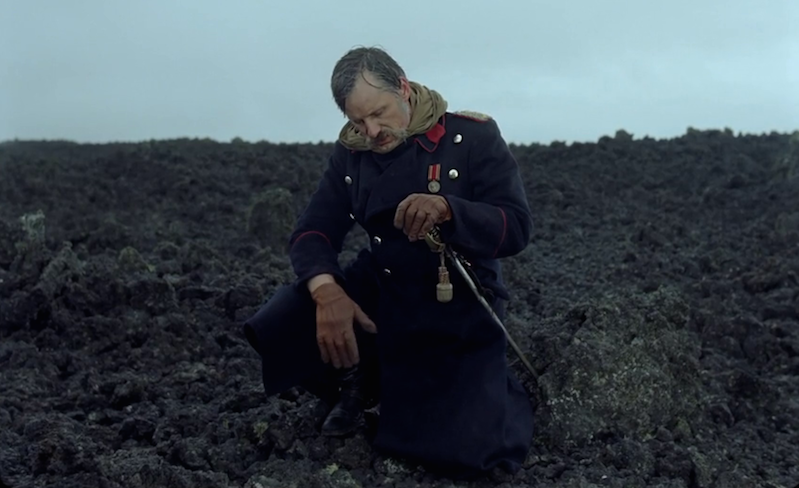
Jauja (Dir. Lisandro Alonso, 2014)

In 1880s Argentina, Danish Captain Gunnar Dinsen (Mortensen) is there with his daughter Ingeborg (Viilbjørk Malling Agger) who wants a dog, falls in love with one man, and has to spurn the affections of another… to reveal anything more of the plot would spoil the experience. This is a slow-burn and magical piece of cinema, its gorgeous visuals shot in a 4:3 aspect ratio (Mortensen also served as the film’s composer). The title, Jauja, refers to the once capital of Spanish Peru known as ‘never never land’ and the ‘land of milk and honey’; a mythical El Dorado of sorts. The film itself is existential in tone, hypnotic, and haunting and has me excited for Lisandro Alonso’s next film Eureka – a recent Special Screening at Cannes – which is also anchored by Mortensen.

Captain Fantastic (Dir. Matt Ross, 2016)

Ben Cash (Mortensen), his wife Leslie and their six, uniquely named children live deep in the wilderness of Washington State, “off-grid”. The kids are home-schooled, they hunt, fish, read Noam Chomsky and can be more than a little wild. When Leslie takes her own life, Dad and the kids have to shun isolation and venture into mainstream society, the first time for a lot of them. Vig continues his run of ‘out-of-time’ men, male characters on the cusp of, well, somewhere else. His Ben exudes a childlike simplicity and whimsy but he’s a limiting, almost dangerous, father; selfish, imperfect, and deeply flawed. It’s an incredibly honest and raw performance.

Falling (Dir. Viggo Mortensen, 2020)

Mortensen’s most personal project to date – a work of auto-fiction – based on his own childhood, his parents’ love story, and the last few years of their lives. He directed the film, wrote the screenplay, and composed the film’s score as well as starring as John, a Pilot charged with looking after his father Willis (Lance Henriksen), an unflinching and uncouth, bad-tempered old bastard of a man whose brain is slowly surrendering to dementia. This film is the antithesis of Florian Zeller’s The Father and one which looks at memory, communication, forgiveness, and is evidently made with love.
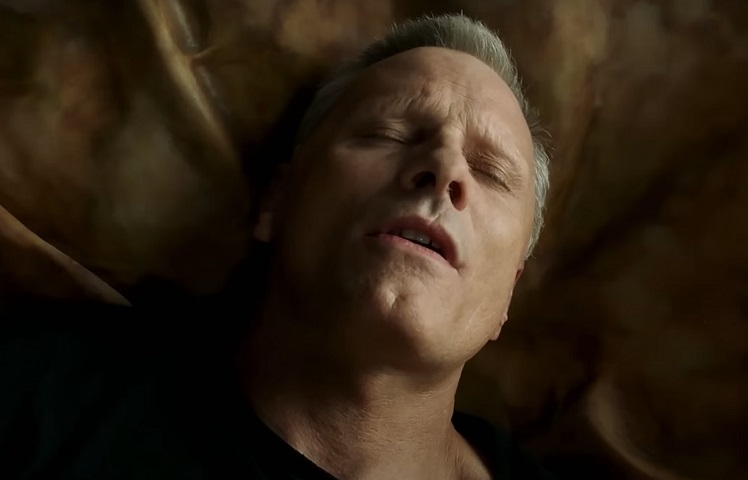
Crimes of the Future (Dir. David Cronenberg, 2022)

David Cronenberg’s 2022 body horror is the fifth time he has worked with his favoured leading man (a safe assumption by now, right? For anyone questioning the five films, Cronenberg plays a staid proctologist in Falling). After Tom Stall, Nikolai Luzhin, and Sigmund Freud comes Saul Tenser, he of tender soul – and still a man ‘undercover’ or in hiding. This is a vulnerable Vig. His Saul is a performance artist whose body leaves him in constant pain – he has the ability to produce multiple new body organs, which are then removed during a live show by his partner Caprice (Léa Seydoux). He is then approached to go undercover to infiltrate some radical evolutionists. The world is changing (again) and “surgery is the new sex”. There are visual nods to The Man Who Laughs (1928), The Passion of Joan of Arc (1928) and call-backs to Videodrome (1983), Crash (1996) and Existenz (1999). Viggo is, as ever, compelling but I think the women of the cast, Seydoux, Kristen Stewart (who is fantastic), and LifeFormWare Techs played by Nadia Litz & Tanya Beatty shade him at times.

My admiration goes way back to The Indian Runner (Dir. Sean Penn, 1991), I was 15 when I discovered the DVD in 1998, I’d just seen him in another directorial debut (ugh) Albino Alligator (1996) and wanted to see more, beyond the bespectacled and besuited moustache he played. Aside from the obvious aesthetically-pleasing exterior, there’s a quiet intensity, and nuance to his performances. He’s not a method actor but I find him as mesmerising as Brando (unsurprisingly, I’m a huge fan of Bud too). 27 years later, Mortensen is still my go-to, one of a select group of actors who I’ll watch anything and everything they churn out.

This has resulted in a wealth of work to look back on and dip in and out of from the multi-hyphenate artist. As well as the new projects he completes to look forward to. Perhaps, I will even, finally, get to those elusive three that I have yet to watch – La pistola de mi hermano (1997), On the Road (2012) and Far From Men (2014).

It’s rare for him to give a bad performance even if the film itself is a dud. Whether he’s onscreen for one brief scene or the King of a 682-minute trilogy, he tends to bring his kind of magic to it which keeps you enthralled or at least pique your interest. Next, however, will be his sophomore outing behind the camera, The Dead Don’t Hurt, an 1860s-set western love story, in which he will play Danish immigrant Holger Olsen opposite Vicky Krieps’ Vivienne Le Coudy. Can’t wait.

*“Without obsession, life would be nothing.” – John Waters

Categories
Blu-ray film review

Videodrome (Dir. David Cronenberg, 1983)

videodrome-1

Arrow Video’s new restoration of David Cronenberg’s Videodrome (1983) follows in the footsteps of Rabid (1977) and Shivers (1975) also restored and re-released on dual format this year. Each film with its disc-filled extras is clearly a labour of love.

Just preceding the Video Nasties Act of 1984, Videodrome, I’m sure would have gotten Mary Whitehouse’s knickers in a twist with the film’s provocative, paranoiac and altogether pleasure-seeking premise. The narrative centres on Civic TV executive Max Renn (James Woods) and his quest to find the next ‘big thing’ in sensationalist programming. His station is responsible for “soft core pornography and hard core violence” which Renn unapologetically justifies as a result of economics. Moral questions arise surrounding the over-stimulation of the consumer following exposure to dehumanising images via the media. These questions are depicted through metaphor, potential Freudian imagery and the former protégé of Dick Smith, multi-Oscar winning make-up effects Wizard Rick Baker (Smith famously created the exploding head in Scanners). Fellow Canadian, composer Howard Shore, yet again, provides the score (Shore and Cronenberg have worked together on all but The Dead Zone) and employs the use of a Synclavier II synthesiser alongside an orchestra. This electronic sound adds a dark, ominous, even metallic, tone to the film and aids with the 80s nostalgia along with the coiffed hair, shoulder pads and leather ties.

Renn stumbles upon Videodrome – a pirate television station which depicts the torture, brutality and eventual death of its subjects. Becoming obsessive to continually transgress social boundaries, Renn shows the footage to his girlfriend Nicki Brand (a hypnotic Deborah Harry) who, by her own admission, is the perfect over-stimulated test audience. She is sexually free (connoted by her costume, both cut and colour) and is immediately enamoured at the premise of the snuff sequences. Her enthusiasm for all things dark and painful grows and she even disappears to audition in Pittsburgh upon hearing the show is filmed there. Left alone, Max begins to suffer hallucinations; disturbing, intriguing visions which only seek to feed his need to consume the morally ambivalent visual media and further blur the line between fantasy and reality. His interactions with the Marshall McLuhan-inspired Brian O’Blivion (velvet-voiced Jack Creley, only ever visible via a television screen) increase the bizarre especially when we learn O’Blivion’s history to Videodrome. It is an aesthetically pleasurable film; body parts are fetishised, Betamax tapes pulsate and television undulate and literally swallow the flesh.

Anybody familiar with the articulately intense septuagenarian director will immediately recognise the body consciousness which is prevalent in a large percentage of his oeuvre.  The man, who has cited Bergman, Fellini and Kurosawa as main inspirations, presents the limitations of the human body within his own artistic nihilism. Ideologies are often invasive and monstrous, the embodied becomes disembodied whilst sex and violence surrounds, causes, or indeed invades the diegesis. There can be contradictory readings of Cronenberg’s films; does he fight for the patriarchal pleasures he depicts and stray dangerously close to misogyny or destroy said pleasures while reinforcing the fragility of the physical body and mind? While the male consciousness is seen in crisis and at odds with the social world around him, it is the female body which appears abject and the site of disgust. In Videodrome, the male mind becomes more abhorrent through feminine imagery; Renn’s torso is repeatedly violated via the vagina-like opening. Or perhaps, it is like the man himself stated a few years ago; he plugs into the zeitgeist, examines and plays around with it. In simple terms Cronenberg’s films are about life and death yet he cleverly uses the horror and prosthetics as a distancing tactic. He questions who or what we are and presents, albeit through social paranoia and viscera, the evolutionary limitations of the human body and the emotional terror of the waking nightmare.

videodrome_04

Videodrome has never been more relevant in the face of the current media and image appropriation. It is disorientating, visually audacious and presents an ideology which is fascinating, wholly original but is, perhaps, one of the more convoluted Cronenbergs. That said, as a first time viewer (yes, I know…) the experience of it was exhilarating.

Blu-ray Extras

Never one to scrimp on material, Arrow has collected an array of goodies and following the film, there are numerous options for the viewer to take, although do yourself a favour and hit them all.  

Cinema of the Extreme – The 1997 BBC documentary featuring Repo Man director, Alex Cox, David Cronenberg and George A. Romero  briefly discuss cinema extremes. These verbal tidbits are intercut with clips of Shivers, Dawn of the Dead (1978) Videodrome  and Crash (1996). It is a slight, fairly insignificant documentary which never goes into great detail but Cronenberg’s thoughts on censorship are always worth a listen (Cox’s on Seven, not so much). 

Forging the New Flesh – Visual Effects artist Michael Lennick narrates (and stars) in the first of his four contributions to these extras and discusses the techniques used in the making of the film. This, unfortunately, short but fascinating featurette contains behind-the-scenes footage and interviews Rick Baker, Bill Sturgeon, David Cronenberg and star James Woods. 

Fear on Film – One of the highlights of the disc extras is a roundtable discussion originally aired in 1982; presented by Mick Garris and featuring David Cronenberg, John Carpenter and John Landis in tweed, flared jeans and big hair respectively.  The conversation centres around the horror genre, what scares the filmmakers, films, as well as their individual takes on censorship and ratings. Although, less than 30 mins long, it is a highly entertaining and lively chat and well worth watching.

Samurai Dreams – The complete and uncensored Japanese series Samurai Dreams with optional commentary by Michael Lennick who is still revelling in the Videodrome/Samurai Dreams experience some 32 years later. 

Helmet Camera Test / Why Betamax? – Bite-sized early test footage showing Max Renn’s virtual hallucination chamber head-gear and a second segment which very briefly details why Betamax was the format of choice.

Promotional Featurette – This is an extension of Forging the New Flesh documentary although written and directed by Mick Garris and features behind-the-scenes footage and the making of Videodrome. Interviews include: Cronenberg, Harry and Woods As with the previous featurettes, these are brief but still interesting. 

Audio Commentary is provided by author Tim Lucas (Videodrome: Studies in the Horror Film).

Cronenberg: Early Works Blu-ray 

Transfer of the Future – The ever entertaining and jovial Kim Newman discusses, examines and critiques Cronenberg’s early career and labels him a child of Romero and genre auteur along with fellow underground directors Brian De Palma and Tobe Hooper. 

The Early Works – Restored by the Toronto Film Festival, Criterion Collection and Arrow Films respectively, these films show the progression of Cronenberg as an art student and his shorts through to the first feature film which was made some five years before Shivers

  • Transfer (1966) 
  • From the Drain (1967)
  • Stereo (1969)
  • Crimes of the Future (1970)

In Transfer, shot on a snowy Canadian landscape, an analyst (Mort Ritts) and his patient Ralph (Rafe McPherson) thrash out their doctor/patient relationship via farce and Freudian speak; while in From the Drain, two men (Mort Ritts and Stephen Nosko), seemingly war veterans sit clothed in a bathtub awaiting something ominous which may or may not come out of the drain. Stereo was the first short feature film shot on 35mm and has an establishing shot reminiscent of Fellini’s La Dolce Vita (1960) and appears to be heavily influenced by Bergman. It stars Ronald Mlodzik (later seen in Shivers and Rabid) whose costume looks deliciously Hammer-House-of-Horror-like. This is the best of the bunch, definitely my favourite; shot in black-and-white, silent save for a voiceover, the canted camera angles add to the general creepiness and sterility of the sanatorium set amidst the Ontario north woods. Subjects are placed in isolation and operated on, telepathic ability and extra sensory perception is monitored through sexual interaction. Finally, the last feature is Crimes of the Future a potential follow-up to the preceding film. Restored exclusively by Arrow Films from a new 4k scan of the original 35mm negative, again starring Mlodzik (as Adrian Tripod), and again silent but for the added commentary, only this time in colour. In the House of Skin all women are extinct and Tripod is in search of the enigmatically named Antoine Rouge. 

It is fascinating to see the early attempts of an artist, to witness how he develops and to note his visual interests and motifs even back then. There’s the Freudian terminology (which all eventually came to a head in A Dangerous Method [2012]), themes of consciousness, sexual experimentation, telepathy and the oddly monikered characters which have all been seen over the  Cronenberg oeuvre at one time or another. They may not, necessarily, be to everybody’s taste but they are revelatory in their style, content and deserve to be seen in all of their restored loveliness. All-in-all, Arrow has produced a beautiful box set which cannot be recommend highly enough.