
Full disclosure, I haven’t written anything in well over a year – it’s probably closer to two if I’m being completely honest – for a multitude of reasons: a severe lack of confidence, general work-related inability, the pandemic, or just general disgruntlement at the world around me. Inspiration took me by complete surprise when I began looking back over this blog space and I allowed myself to briefly reminisce about the enthusiasm I once had, and the encouragement I received from two wonderful souls. Both of whom are, devastatingly, no longer with us. Anyway I digress… although I’m sure there is something to add about the fragility and futility of life. Do what you love. So, I figured I’d try and write about a subject I love, a bit of an obsession* if you will.
One of the first pieces I published was way back in 2012 for a long-defunct film-site and it got me thinking of my onscreen main squeeze, Viggo Mortensen. Eleven years later, he is still somewhat of a King (and technically a Knight having been bestowed with the honour back in 2010 by Queen Margarethe II of Denmark) and continues to work, thankfully, choosing roles that are fascinatingly complex, interesting, and most of the time utterly unique to him.
“I have no plan. Maybe I should have a career plan but I don’t. I usually wait and hope the right thing will find me.”
The Evening Chronicle
Now a spritely 65-year-old (come October), the dimple-chinned deity has received countless SAG award noms, Golden Globes, EFAs, recognition at TIFF, the Goyas, BIFA, and BAFTA. Plus, wins at Stockholm FF and San Sebastian for his directorial debut, Falling, and a second and third Oscar nom (for Captain Fantastic and Green Book respectively). I can’t say I was a fan of Green Book to be perfectly honest – it was fine, j’adore Vig and Mahershala Ali but I kind of loathed Tony Lip. Thankfully, there has been plenty to enjoy since 2013 (which is where my original Viggo is King piece left off).

The Two Faces of January (Dir. Hossein Amini. 2014)
Based on Patricia Highsmith’s 1964 novel of the same name, Viggo is Chester McFarland, a con-artist married to Colette (Kirsten Dunst), who has to quickly rely on Oscar Isaac’s perfect stranger Rydal Kenner to get him out of a sticky sitch. Cue: frustration, jealousy, paranoia and a slow unravelling. As leading men go, few have looked finer in this tragic murder-flight-redemption mystery thriller. There is an almost Oedipal theme running throughout despite the link to Janus, and with filming taking place in Athens, Crete, Knossos, and Istanbul the emphasis is on heat, sand, and bright light (there are few shadows to hide in). Chester’s Man From Del Monte suit begins to look rather grubby by the end.
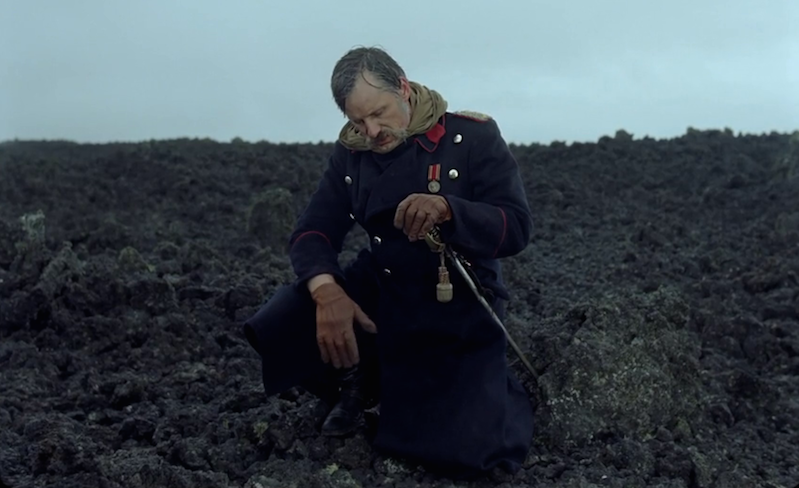
Jauja (Dir. Lisandro Alonso, 2014)
In 1880s Argentina, Danish Captain Gunnar Dinsen (Mortensen) is there with his daughter Ingeborg (Viilbjørk Malling Agger) who wants a dog, falls in love with one man, and has to spurn the affections of another… to reveal anything more of the plot would spoil the experience. This is a slow-burn and magical piece of cinema, its gorgeous visuals shot in a 4:3 aspect ratio (Mortensen also served as the film’s composer). The title, Jauja, refers to the once capital of Spanish Peru known as ‘never never land’ and the ‘land of milk and honey’; a mythical El Dorado of sorts. The film itself is existential in tone, hypnotic, and haunting and has me excited for Lisandro Alonso’s next film Eureka – a recent Special Screening at Cannes – which is also anchored by Mortensen.

Captain Fantastic (Dir. Matt Ross, 2016)
Ben Cash (Mortensen), his wife Leslie and their six, uniquely named children live deep in the wilderness of Washington State, “off-grid”. The kids are home-schooled, they hunt, fish, read Noam Chomsky and can be more than a little wild. When Leslie takes her own life, Dad and the kids have to shun isolation and venture into mainstream society, the first time for a lot of them. Vig continues his run of ‘out-of-time’ men, male characters on the cusp of, well, somewhere else. His Ben exudes a childlike simplicity and whimsy but he’s a limiting, almost dangerous, father; selfish, imperfect, and deeply flawed. It’s an incredibly honest and raw performance.

Falling (Dir. Viggo Mortensen, 2020)
Mortensen’s most personal project to date – a work of auto-fiction – based on his own childhood, his parents’ love story, and the last few years of their lives. He directed the film, wrote the screenplay, and composed the film’s score as well as starring as John, a Pilot charged with looking after his father Willis (Lance Henriksen), an unflinching and uncouth, bad-tempered old bastard of a man whose brain is slowly surrendering to dementia. This film is the antithesis of Florian Zeller’s The Father and one which looks at memory, communication, forgiveness, and is evidently made with love.
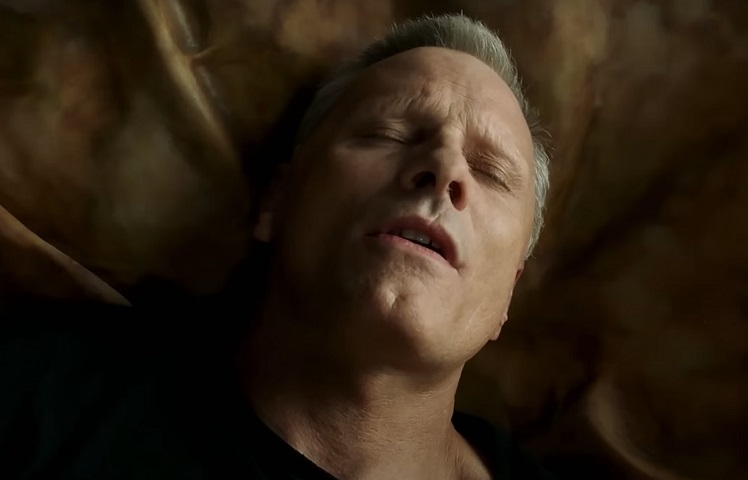
Crimes of the Future (Dir. David Cronenberg, 2022)
David Cronenberg’s 2022 body horror is the fifth time he has worked with his favoured leading man (a safe assumption by now, right? For anyone questioning the five films, Cronenberg plays a staid proctologist in Falling). After Tom Stall, Nikolai Luzhin, and Sigmund Freud comes Saul Tenser, he of tender soul – and still a man ‘undercover’ or in hiding. This is a vulnerable Vig. His Saul is a performance artist whose body leaves him in constant pain – he has the ability to produce multiple new body organs, which are then removed during a live show by his partner Caprice (Léa Seydoux). He is then approached to go undercover to infiltrate some radical evolutionists. The world is changing (again) and “surgery is the new sex”. There are visual nods to The Man Who Laughs (1928), The Passion of Joan of Arc (1928) and call-backs to Videodrome (1983), Crash (1996) and Existenz (1999). Viggo is, as ever, compelling but I think the women of the cast, Seydoux, Kristen Stewart (who is fantastic), and LifeFormWare Techs played by Nadia Litz & Tanya Beatty shade him at times.
My admiration goes way back to The Indian Runner (Dir. Sean Penn, 1991), I was 15 when I discovered the DVD in 1998, I’d just seen him in another directorial debut (ugh) Albino Alligator (1996) and wanted to see more, beyond the bespectacled and besuited moustache he played. Aside from the obvious aesthetically-pleasing exterior, there’s a quiet intensity, and nuance to his performances. He’s not a method actor but I find him as mesmerising as Brando (unsurprisingly, I’m a huge fan of Bud too). 27 years later, Mortensen is still my go-to, one of a select group of actors who I’ll watch anything and everything they churn out.
This has resulted in a wealth of work to look back on and dip in and out of from the multi-hyphenate artist. As well as the new projects he completes to look forward to. Perhaps, I will even, finally, get to those elusive three that I have yet to watch – La pistola de mi hermano (1997), On the Road (2012) and Far From Men (2014).
It’s rare for him to give a bad performance even if the film itself is a dud. Whether he’s onscreen for one brief scene or the King of a 682-minute trilogy, he tends to bring his kind of magic to it which keeps you enthralled or at least pique your interest. Next, however, will be his sophomore outing behind the camera, The Dead Don’t Hurt, an 1860s-set western love story, in which he will play Danish immigrant Holger Olsen opposite Vicky Krieps’ Vivienne Le Coudy. Can’t wait.
*“Without obsession, life would be nothing.” – John Waters




 The Framing Device