The tale of Snow White was published by Grimm brothers Jacob and Wilhelm in their Hausmärchen collection and has seen many a filmmaker make attempts to adapt the classic fairy tale to the big screen including Walt Disney, Michael Cohn and most recently Tarsem Singh and Rupert Sanders. Both directors released, respectively, very different versions, however, since literary publication in 1812 it has taken some 200 years for a truly original retelling to be produced and Blancanieves (2012, dir. Pablo Berger) not only pays tribute to silent cinema but also serves as a love letter to Hispanic culture and historiography.
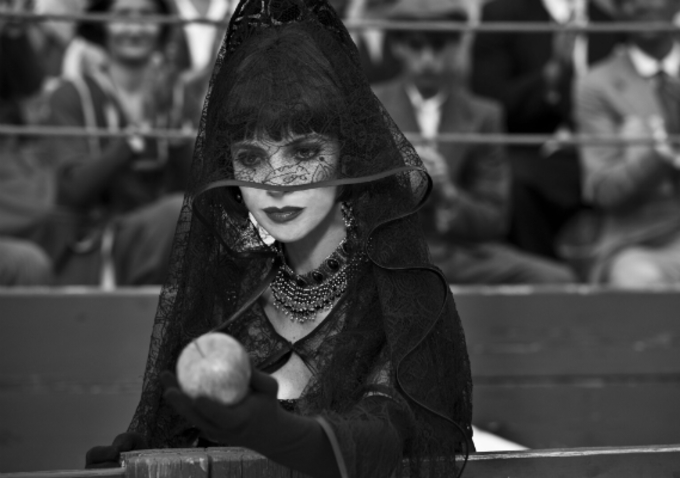
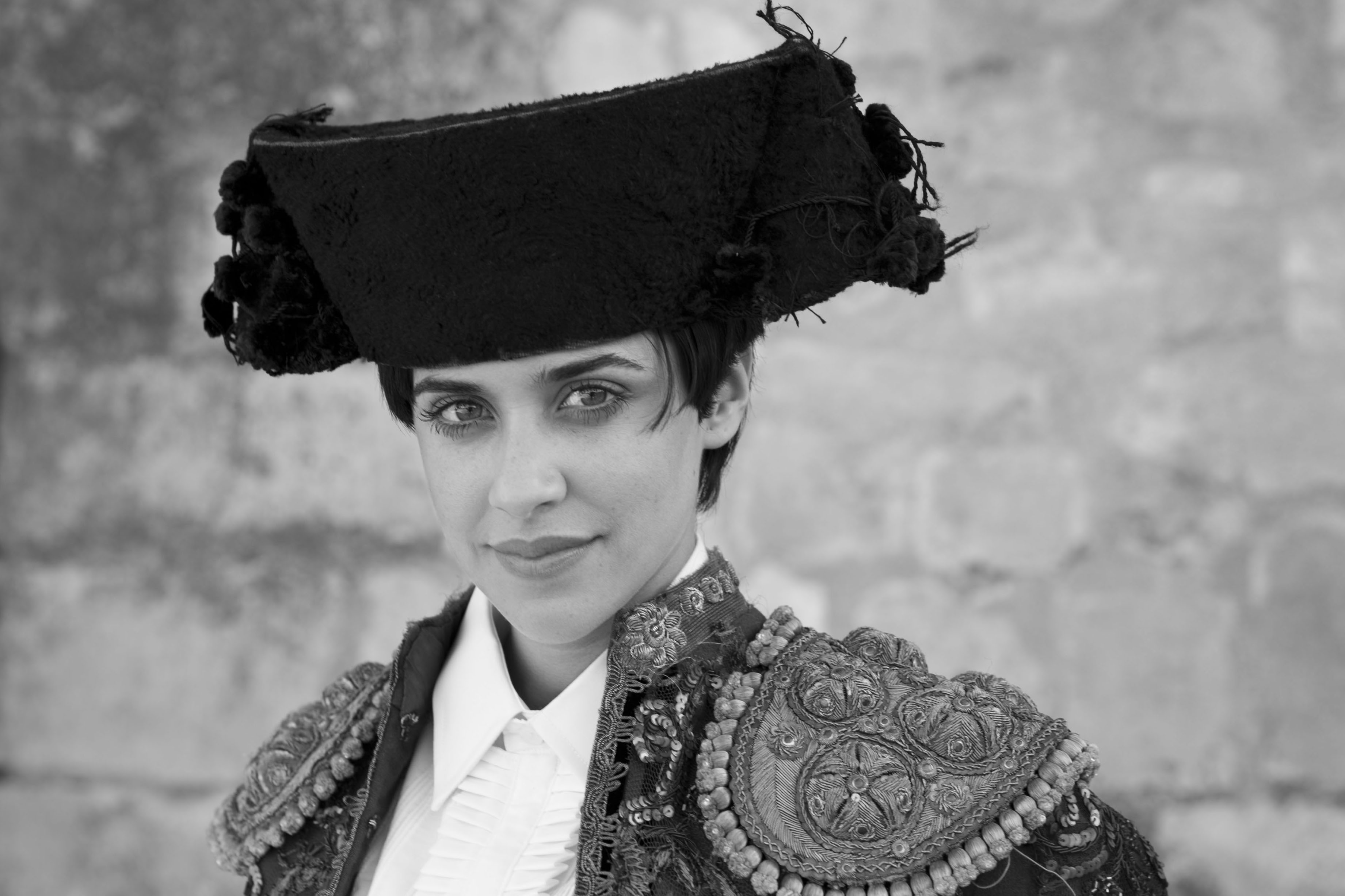
In 1910 Andalucia, Antonio Villata (Daniel Giménez Cacho) is at the height of his profession as a matador. His beautiful wife, and one time recording artist/flamenco dancer, Carmen (Inma Cuesta) watches from the crowd cradling their unborn child in her bulging belly. Tragedy strikes during the estocada and Antonio is gored by his opponent; the shock of which induces labour and baby Carmencita is born into the world motherless with a disinterested and bereaved father who, unable to fend for himself, soon remarries Nurse Encarna (Maribel Verdú). The woman’s disdain of the infant is apparent and her intentions clear from the moment she flutters her heavy kohled lashes at the fallen toreros and thus Carmencita (played in childhood by Sofia Oria) is raised by her grandmother Dõna Concha (Ángela Molina). When her grandmother passes away on the child’s Holy Communion day Carmencita is returned to her father and they can, albeit in secret, renew their relationship. A decade passes and Encarna’s villainy drives the adult Carmen (Macarena Garcia) out of the family home world and into the collective bosom of six bull-fighting dwarves, one of whom doubles, wonderfully, as Prince Charming.
This production was reportedly in development for several years before director-screenwriter Pablo Berger started shooting and nothing is left to chance. Verdú (Y tu Mamá También; Pan’s Labyrinth) who was Berger’s first choice to play Encarna clearly revels in the role; an evil stepmother she was born to play even sans magic mirror (here an artist’s interpretation of the wicked woman on canvas, in a multitude of costume changes, replaces the reflection motif). While this film takes the majority of its cues and sway from the Snow White tale – Blancanieves’ literal translation is SnoWhite – there are also intertextual signifiers to other Grimm tales along the way including Little Red Cap, Cinderella and The Sleeping Beauty via Tod Browning’s Freaks (1932). The mise-en-scène, as a whole, is an eclectic homage to the silent era of European cinema and the drama of the bullfight which includes the over-elaborate traje de luces (suit of lights) and black montera (hat), however, it is Alfonso De Vilallonga’s lush score, heavy on the flamenco beats, which is the real joy and builds emotion, tension and crescendo with each hand-clap of the non-diegetic sound.
In spite of the evidentiary early-20s influence Berger delivers a fresh spin on a female protagonist – often celebrated for her passivity and reliance upon a prince – which gives Carmen/Snow the edge needed for a 21st century heroine and reinforces this masterpiece’s declaration: that Blancanieves is, in fact, the fairest of them all.
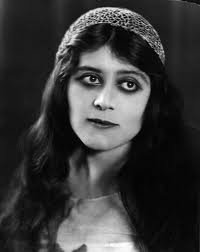
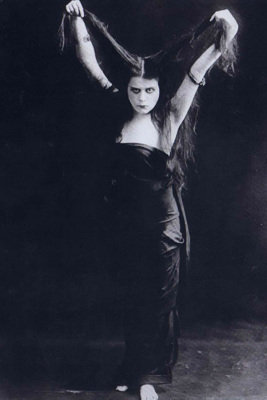
Theodosia Goodman was the eldest of three children born to a Polish father and Swiss mother in Cincinnati. The Goodmans lived in the leafy suburb of Avondale until 1905 when their daughter left for New York to become Theda Bara. The name an anagram of “Arab Death”[1], made Bara the epitome of exotic temptress known as the Vamp. She, at the time, allegedly used her sex appeal to manipulate and embodied voluptuous transgression – the exact attributes that Post-Code Hollywood attempted to make commodity and control. In total, Theda Bara made over forty films between 1914-1919 including Carmen[2], Cleopatra[3] and Salome[4], yet it was her first leading role which cemented her as The Vampire. I propose that it was this dichotomous ambivalence and marginalisation in both characters portrayed and persona[5] which started a promising film career but essentially the ideology could not last and ended it too soon. Taking inspiration from a Philip Burne-Jones painting and Rudyard Kipling poem in 1897, A Fool There Was[6] intercuts verses of Kipling’s poem with scenes which are, it would seem, an introduction to the lead characters. An iris reveals a male, who is later revealed to be Mr John Schuyler (Edward José), shot, sat behind a desk gazing at long stem roses, he looks directly into the camera before picking up the flowers and smelling them. After the second verse of the poem, The Vampire (Bara) stands haughtily next to a vase holding similar flowers and picks one out, smells it and then pulls the bud from its stem crushing the delicate petals between her palm. She is dressed in heavy, dark materials and fur, jewellery adorns every other finger perhaps symbolising living beyond her means, or as Molly Haskell describes them “emblems of her wickedness”.[7] The silent film is set within the melodramatic mode consisting of two dominant styles, as identified, by Roberta Pearson, “the histrionic and the verisimilar”[8]
John Schuyler and his family are white, in not only skin tone but within the mise-en-scène. His wife, Kate (Mabel Fremyear), daughter (Runa Hodges) and sister-in-law (May Allison) are nearly always shot outdoors in natural light and dressed head-to-toe in white costumes. The Schuyler’s daughter, who later is referred to as ‘innocence’, is fair-haired, her blonde ringlets bouncing as she runs. She is, physically, a Mary Pickford/Lillian Gish in miniature, perhaps an indicator of the next generation which will resemble America’s Sweethearts[9] and not the dark, mysterious threat of the Vamp. A dialogue intertitle introduces The Vampire (Bara) so called because she has the sexual prowess and potential occult ability to drain their life source and wealth. The uncanny is aligned with this predator to enhance her otherness in relation to the ‘norm’ – the white, faithful wife and as Sumiko Higashi writes, “implied that her powers were supernatural or that she was, at the very least, inhuman”[10] She is dressed almost exclusively in black, hypnotically so, with an occasional white accessory, as if she were trying to assimilate into “decent” society. The Vampire reads of Schuyler’s trip and Statesman honour while resting at home. She has a black housemaid and an Asian male in attendance and this simultaneously whitens her against their ethnic variations but in the same token reminds the audience that she herself is ‘othered’ when considered alongside the Schuyler family.
As she boards the ship two previous victims (as they are described in the intertitle text) attempt to get her attention; one is a tramp who gets lead away by a police officer, the other, Mr Benoit, pulls out a gun and threatens to shoot her. The Vampire merely laughs and knocks it away with a flower and coaxes Benoit to commit suicide offering him one last kiss; “kiss me, my fool” before he pulls the trigger at his temple. His death fails to move her and she is reported, by the ship’s porter, to have stood over his body “laughing like a she-devil”. When Schuyler first sees this woman she is framed by a porthole powdering her nose which suggests a subtle hint at female consumerism. She has one eye on her own reflection and the other on her “prey”.
Visible through this porthole and clearly comfortable on deck, The Vampire can be read as a symbol of xenophobic (American) fears of immigration. Numbers of immigrants increased dramatically during the years 1899-1910 and while there is an attempt to Americanise The Vampire. Full assimilation fails as her ethnic femininity and,
[the] vamp persona [situates] her at the intersection of two established representative tropes: the predatory female vampire and the immigrant whose assimilation skills and potential for economic and cultural contribution were uncertain[11]
As an ethnic ambivalent, The Vampire may well have been the all-desiring temptress, however, to describe her as the representation of “the [unleashed] male sexual instinct”[12] as Higashi does seem a little extreme. She and, in this instance, his wife personify the polar opposites constructed through Patriarchy with the wife and child further representing social and moral order, and The Vampire revelling in the destruction and exploitative chaos her ability to emasculate exacerbates. In a Post-Code Hollywood future, as the femme fatale[13], she would be contained, however, Pre-Code, in these early films she was a player in the “fallen man genre”[14]
Even when society turns its back on Schuyler, his mistress brazens it out and walks with her head held high. She, much like the name she is given, sucks the wealth and life from her victim gaining more audacity and strength from his, increasingly, alcohol-induced catatonic state. Schuyler’s gait, once upright begins to stoop and his hair whitens: “The Fool was stripped to his foolish hide”. While this representation of woman displays a level of sexual freedom and independence, it can be limiting to female actors merely providing another stereotype to play in a male world. Theda Bara’s enigma was open to many an interpretation was described by James Card in the following way:
Endless lure of pomegranate lips…red enemy of man…the sombre brooding beauty of a thousand Egyptian nights…black-browed and starry-eyed…infinite mystery in their smouldering depths, never to be revealed…Mona Lisa…Cleopatra…child of the Russian countryside…daughter of the new world…peasant…goddess…eternal woman[15]
Her persona was created and cinematically, as The Vamp, was seen to promote a cultural threat; that of female immigrant sexuality and as Diane Negra writes “was an ideal figure to manage cultural anxiety” and reflected a real need to regulate female sexuality (and the growing birth rate).[16] Bara seemed to be at odds with the direction her film career was taking and tried, somewhat unsuccessfully, to diversify the roles she signed up to, including Romeo and Juliet[17]. The virginal Juliet was an unlikely role for The Vamp archetype and some reviews were critical of her acting style. Like most of her contemporaries, Bara was a student of the Delsarte method. François Delsarte (1811-1871) was the founder of an applied aesthetics system which included rhythmic movement, kinesics and semiology.[18] This system would have given film audiences pause for thought as every emotion was rendered through an eye or bodily movement.
The real reasons why Theda Bara’s career failed at longevity are unanswerable. The Vamp and émigré artist still continued to make pictures, names like Naldi, Negri, Valentino, and eventually Garbo and Dietrich cemented their places as household names. Bara appeared to grow tired of the limitations that The Vamp construction placed on the film roles she was offered and often this would be evident in some of the newspaper and magazine interviews that she gave. She made a last short, comedic film in 1926 called Madame Mystery which was co-directed by Richard Wallace and Stan Laurel but then seemingly retired after marrying. Bara died on 7 April 1955, aged sixty-nine from abdominal cancer leaving behind a lasting cinematic legacy as the original screen Vamp.
Watch one the few surviving Bara films: A Fool There Was (1915, dir: Frank Powell)
[1] This anagram was alleged to have been the actresses’ own invention and the studio embraced it wholeheartedly creating a birth in the shadows of the Sphinx, a childhood in Egypt and exotic Parisian-Italian parentage. Tactics which enhanced the allure of the Cincinnati-born girl who wanted Hollywood to sit up and take notice.
[2]Carmen (1915, dir. Raoul, A. Walsh) Fox Film Corporation.
[3]Cleopatra (1917, dir. J. Gordon Edwards) Fox Film Corporation.
[4]Salome (1918, dir. J Gordon Edwards) Fox Film Corporation.
[5] Theda Bara functioned as a star persona serving as a ideological construct as detailed in Richard Dyer, Stars, (London:British Film Institute, 1998).
[6]A Fool There Was (1915, dir. Frank Powell) William Fox Vaudeville Company.
[7] Molly Haskell, From Reverence to Rape: The Treatment of Women in the Movies, (Chicago & London: The University of Chicago Press, [1974] 1987) p103.
[8] Roberta Pearson, “O’er Step Not the Modesty of Nature: A Semiotic Approach to Acting in the Griffith Biographs, in: Zucker, C (ed) Making Visible the Invisible: An Anthology of Original Essays on Film Acting (Metuchen: New Jersey, 1990) pp1-27.
[9] Richard Dyer, White, (London & New York: Routledge, 1997 ) p
[10] Sumiko Higashi, Virgins, Vamps, and Flappers: The American Silent Movie Heroine (Canada: Eden Press, 1978) p58.
[11] Diane Negra “The Fictionalized Ethnic Biography: Nita Naldi and the Crisis of Assimilation” in: Gregg Bachman and Thomas J. Slater (eds) American Silent Film: Discovering Marginalized Voices, (USA: Southern Illinois University Press, 1997) pp 176-200 (179).
[13] Mary Ann Doane, Femmes Fatales: Feminism, Film Theory, Psychoanalysis (London: Routledge, 1991) I.
[14] Janet Staiger, Bad Women: Regulating Sexuality in Early American (Minneapolis: University of Minnesota Press, 1995) p148.
[15] James Card, Seductive Cinema: The Art of the Silent Film (Minneapolis: University of Minnesota) p189.
[16] Diane Negra, “Immigrant Stardom in Imperial Stardom” in: Gregg Bachman and Thomas J. Slater (eds) American Silent Film: Discovering Marginalized Voices, (USA: Southern Illinois University Press, 1997)
[17]Romeo and Juliet (Dir: J. Gordon Edwards, 1916) Fox Film Corporation.
[18] E.T. Kirby, “The Delsarte Method: 3 Frontiers of Actor Training” in The Drama Review: TDR, Vol.16, No1, March 1972 pp55.69. http://www.jstor.org/stable/1144731?seq=1 [accessed 25 May 2012].
Man of a Thousand Faces begins with the following cue: “On August 27 1930, the entire Motion Picture industry suspended work to pay tribute to the memory of one of its great actors. This is his story.” Except, well, it’s not. It’s the ‘Hollywood’ version steeped in melodrama and all a little dull.
At the Universal studio lot, the flag flies at half-mast as Irving Thalberg (played by the late Robert Evans, sans perma-tan) makes his own tribute to “The phantom of the opera.” In actuality, work was not suspended but a two minute silence was conducted in the wake of Lon Chaney’s death – nor were his most successful films made at Universal… This film starts as it means to go on, dramatising and conflating the life of an extremely private man who, if history books are to be believed, would have shunned even this mediocre production.
The biopic begins with the obligatory flashback which will serve the overarching narrative and then loop back around; aligning childhood, trauma and tragedy which is seemingly how it wants to establish Chaney (James Cagney). It traces his career from the Vaudeville stage to the cinema screen and admirably attempts to squeeze 30 years into 122 minutes, perhaps had the film been cast differently it may just have worked.
As talented as Cagney arguably was, there’s no way he can pull off aged 22 at 56 convincingly. Not to mention the physical limitations; a tall sinewy figure with a distinctive growl never really translates to a chipper Irish-American barely reaching 5’7”. Star personas were prevalent during the studio system and it’s fair to say, Cagney was horribly miscast nor did he have the lithe grace Chaney exhibited or the creepy melancholy.
If there’s one word used to describe the tone of the film, it is tragedy, as it prefers to add weight to the man’s alleged suffering than his film career. Hammering home his deaf-mute parents, hitting child abandonment and the dissolution of his marriage along the way, to having to place son Creighton in an orphanage and then, well, death. It’s all rather dreary; at odds with the sweeping epic soundtrack and the man whose early career began in Vaudeville and making people laugh. Why his parents’ deafness defines him or them, for that matter, appears to be a sign of the times – as for when that is the film does little to quantify. Creighton (he who would become Lon Chaney Jr.) is the only real evidentiary passage of time as the part is split between four actors (Dennis Rush, Rickie Sorensen, Robert Lydon and Roger Smith) each older than the next. None of which is helped by the occasional fifties-looking costuming.
Before his ‘big break’ as a lead, Chaney worked tirelessly and took every job he could, often making himself over and disguising his natural attributes depending on what was required on the call sheet. His ground-breaking make-ups led the way for the likes of Jack Pierce. Bud Westmore, Dick Smith, and, of course, Rick Baker among many, many others. It was then that casting agents began to take notice and he was cast in The Miracle Man thanks to his ability to twist and coil his body into unnatural positions. This would lead to arguably his greatest roles: The Phantom of the Opera and The Hunchback of Notre Dame in which he gravitated, yet again, to the tortured and afflicted depicting the tormented empathy of Quasimodo. Cagney tries but it’s hard not to see Cagney playing ‘Cagney’ imitating Chaney, or ‘Chagney’ if you will.
Obviously, given the decades between meant different make-up processes and evolution of the prosthetic. The make-up recreations in Man of a Thousand Faces are pretty awful given that Westmore et al would have used more modern supplies and they are still nowhere as convincing as Chaney and his ‘crude’ materials. Eagle-eyed viewers will also notice that camera-angles vary in relation to the original films, they’re not quite as polished.
It’s not all terrible, there are some high points. The father-son relationship shines and the performances from the actors who played the young(er) Creighton are lovely. These moments highlight Chaney’s love of mime and character, donning wigs and a false nose to “show” his son a bedtime story. The use of sign language is refreshingly brilliant for a film as old as this, when communicating it’s all about the face which for Lon Chaney it was. His.
He worked in cinema from 1914-1930 with 100 of his 157 films either lost or destroyed. It’s a missed opportunity that the 2000 documentary, The Man of a Thousand Faces narrated by Sir Kenneth Branagh isn’t included in the extras here. However, if Chaney holds an interest for you, seek it out, it’s really informative and one gets to see the original performer rather than a shallow impersonation. While the film never quite reaches the heights expected, the transfer is stunning. It is clear and crisp with very little residing grain which serve the make-up replicas and those stark chiaroscuro shadows which ‘Chagney’ often lurks within.
Lon Chaney died from a throat haemorrhage brought on my complications from the cancer that he was diagnosed with years earlier. An almost karmic fate for a versatile entertainer who sought silence both on stage and screen – his last film (a remake of Browning’s The Unholy Three) was his only speaking role – and has been revered ever since.
Disc Extras
Commentary by Tim Lucas – this is highly informative and provides great education for those unfamiliar with Chaney and his work and those that are interested in their broadening their knowledge. Lucas provides lots of information and titbits, paying particular attention to historical context – something the film sorely lacks.
The Man Behind a Thousand Faces: Kim Newman on Lon Chaney (20:52) Filmed in a cluttered room full of DVDs and books, Kim in his signature red waistcoat and cravat discusses the silent stars of Hollywood’s heyday including Chaplin, Garbo, Valentino and of course Chaney. Newman’s brief foray into the topic is not overly focussed and feels more conversational in tone which is a great contrast to the slightly more scripted and academic commentary. He maintains that Chaney lingers long in the cultured memory “and without Chaney’s make up Karloff and Lugosi would have contrived to play gangsters, and never Universal monsters (though, I’m sure Jack Pierce would have argued with that). He also thinks Cyrano de Bergerac was the role Chaney was made for but never got the chance to play. The chat is intercut with clips from the films and sadly, ends rather abruptly.
Theatrical Trailer (1:33) – It’s always worth watching the film’s theatrical trailer if only to see the original footage prior to the restoration process, and the extent of the transfer and clean up.
Image Galleries – These include 82 slides of production stills which show the costumes and make-ups in greater detail (not always a pro) and give more opportunity to see Bud Westmore’s clunky recreations albeit all in black and white. In addition to the slides, there are 18 posters and lobby cards in both monochrome and colour from all over the world including France, Spain, Germany and Russia.



 The Framing Device