Categories
film review

I Am Not a Witch (Dir. Rungano Nyoni, 2017)

Dramatic strains of Vivaldi strings play over the mini-bus crawling along as a tour guide announces to his passengers that they have arrived at their destination. Out everyone pours around the van to view whatever it is they have clearly paid to see, “so exciting, once you see the witches.” The what now? The camera captures what can only be described as a human zoo; behind metal barriers sits a group a women, dressed in blue, partially painted in white, their clownish make-up made more apparent as they howl and pull faces for the benefit of their visitors.

Shula (Maggie Mulubwa) – though she has no name until much later on – is an orphan who’s accused of witchcraft. Evidence is patchy at best, she has the ability to ‘curse’ water, make people trip and fall, and hack off a man’s arm (it miraculously grew back). The fact that she refuses to confirm or deny the charge means she is “cunning and deceiving” and before she knows it, she’s shipped off to government worker Mr. Banda (Henry B. J. Phiri) who oversees the small witch camp as seen as the start of the film.

After consulting a witch doctor who “proves” witchcraft, the little girl is fitted with a spindle and spool of white ribbon, the length of which varies from woman to woman, all to “prevent them flying away”. Shula is then offered the choice of either accepting her label and joining the women or cutting the ribbon and being transformed into a goat. It’s not difficult to realise which she will choose, she’s eight.

While the rest of the colony work tending the fields and hoping for rain, Shula is “witchified” and dressed in a frilly sack, twigs and leaves in her hair, white make-up adorns her face as she taken from village to village condemning thieves i.e. choosing the one she thinks is guilty. It’s ridiculous. The rewards she earns she shares amongst the women and that’s what is so bittersweet, there’s genuine camaraderie and affection between them and Shula now has a family, full of grandmothers – as all of these women are considerably older – sorrow, time and circumstance etched into their lived-in faces.

What strikes most about Rungano Nyoni’s first feature is how strong and self-assured it is. I Am Not a Witch is completely unique and striking in its gendered social critique and satirical rendering of persecuting patriarchal control. Thankfully, the comedy does not overwhelm but punctuates perfectly. The central performance which is mostly a silent one, by Maggie Mulubwa is rendered beautifully, her largely impassive and gorgeous face is often shot in close-up and the slightest expression is subtly mesmerising. The use of colour, which tends to be the odd swatch whether white, blue, red, purple, or the bright orange of the transporting truck is set against the dusty greys, and dirty sepia tones of the earth superbly. The impossible point-of-view shots, long languid takes, and narrative ellipses provide a visual erudition and subtle sophistication to the magical realism and that final shot is absolutely breathtaking.

I Am Not a Witch is a stunning debut, an amusing if poignant fable critiquing a very real social problem and making the Zambian-born Nyoni a filmmaker to watch out for in the future.
Categories
Film Festival film review

Chevalier (Dir. Athina Rachel Tsangari, 2015)

LFF 2015

chevalier (1)

Economic crisis birthed a Greek New Wave with Athina Rachel Tsangari leading the fore. Historically, she has written, produced and/or directed many of the films associated with the Greek film industry resurgence – Dogtooth, Alps, Attenberg (and acted in Before Midnight too with her lead actor Panos Koronis). She and fellow Greek director Yorgos Lanthimos (The Lobster) screened at this year’s LFF.

Tsangari’s last cinematic outlets Attenberg (2010) and her 2012 short The Capsule heavily featured females and their place in – and on the periphery of – the world around them; the director’s next concentrates on the adult male. In spite of its gallic sounding name, Chevalier is very much Greek. Set upon a yacht amid the Aegean Sea and a palette of pale greys and marine blues, it is like Attenberg in that the look is minimalist playing against the backdrop of the Aegean and the insular interior of the boat.

Chevalier_PyrpassopoulosPapadimitriou

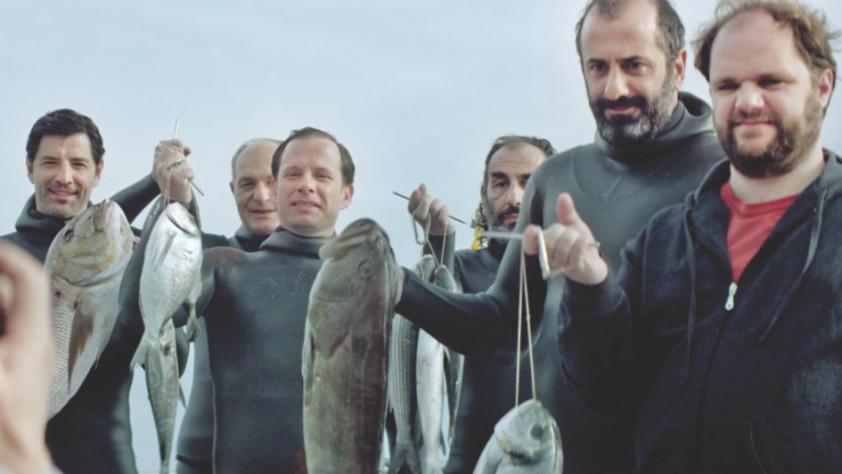
We never find out what brought these men together, or why they decided on a boat-trip. There are indications as to how they know each other: the Doctor and his handsome predecessor, the Insurance salesman nudist son-in-law, and his loner-genius brother who cannot go into the water (although, we never find out why), the one who spends an inordinate amount of time on his hair, and his pal; they are all friends of sorts. Growing tired of the tedium of card playing and incongruity of asking each other what fruit they see each other as, they decide to make things interesting and create a new game – who is the best in general? They start marking each other on everything, from sleeping posture, the ability to make an IKEA shelving unit, to the size and girth of their erections. The Chevalier of the title is referenced by a signet ring, often worn by French nobility and although its meaning varies depending upon which culture it inhabits, it is also a decoration given by a Patriarch of the Orthodox Church/Knight/Nobleman. You get the gist.

Co-written by Efthymis Filippou (Alps, Dogtooth) which may give an indiction the absurdist direction the film will veer. As to the journey, we’re all along for the boat-ride. To see these men primp and preen is a riot and even I relished (and perhaps snorted) at the male insecurity and ludicrous machismo on display as characters start to examine themselves in the mirror and bemoan the size of their thighs; an anxiety usually associated with female culture.

panos

There is little guidance in relation to interpretation; the film can be read in socio-political terms especially when the game catches on with the boat’s chef and porter but Tsangari never leads one way or another.  Friendships will be tested and manipulated, blood bonds broken and formed as the best man overall is discovered.

Chevalier is a rebellious, brilliantly mordant and shrewd satire of the male ego. It is absurdist, surreal in parts, and hilariously droll from start to finish. It takes an astute filmmaker to hold a mirror up to society and provoke laughter and it will make you laugh. A lot.

Categories
film review

Starry Eyes (Dir. Kevin Krolsch and Dennis Widmyer, 2014)

starry_a

Sarah (Alex Essoe) resides in LA, the sunshiny place of dreams and superficiality and is an actress, or at least wants to be one; is resolute to be one yet throughout Starry Eyes the line between determination, desperation and ultimate destruction is crossed, blurred, eventually rubbed out – and bloodied – altogether. Sarah tirelessly auditions for role after role in between working at fast-food restaurant Big Taters for sleazy, loser-ly manager Carl (a moustachioed Pat Healy). She has friends, none of whom are particularly close except maybe her roommate Tracy (Amanda Fuller). There is Danny (Noah Segan) who lives out of his mini-van and is ‘determined’ to make it as a director and Erin (Fabianne Therese) a wannabe actress who has had minor success and relishes in being well, a bit of a “bitch”.

starry-eyes-5224

Gamine in appearance, Sarah has ‘issues’, she suffers from nightmares, self-harms and is extremely body-conscious. She teeters on the precipice of insanity, is emotionally raw and literally tears her hair out at the roots to ease her anxiety. Her vulnerability does not necessarily make her weak but her hunger to be somebody does, it is easy to empathise with her – that yearning; she could be your sister, or daughter. Hell, she could even be you. Desires, primal or otherwise, push people in all kinds of directions. Then comes the call-back from a successful, if odd, audition for an Astraeus feature (the company taking its name from the Titan God of dusk, creator of winds and wandering stars) and the casting directors’ insistence that she lose her inhibitions has surprising results on the leading lady – “If you can’t ever let go, how can you fully transform into something else?”

starry-eyes

Starry Eyes is Faustian in nature, a satirical, abject, allegory about the grim underbelly of Hollywood and the true price of fame (there is even a sly swipe at Scientology too). It is emotive in its execution and (bloody) ambition. An almost melodramatic beginning gives way to a glorious and stomach-churning body horror; Matt Falletta and Hugo Villasenor’s practical make-up effects are visceral, disturbing and quite disgusting, in the best possible way, and displayed amid a synth-heavy musical score which sets the mood perfectly. Alexandra Essoe is astonishing as Sarah, she even at the most grim and a gruesome moment, manages to humanise the character and create a filmic-female that breaks the boundaries of the horror genre’s ‘monstrous feminine’.

There is a moment when ‘The Producer’ (Louis Dezeran) refers to the film industry as a plague; a festering pestilence: “hollow be thy name, shallow be thy name.” – Thankfully, Kevin Krolsch and Dennis Widmyer’s unsettling cautionary tale is anything but.

Categories
Blu-ray film review

The Congress (Dir. Ari Folman, 2013)

congress header

Robin Wright (the actress playing a version of herself) has made some lousy choices when it comes to her film career and men, or so she is forcefully told by her agent Al (Harvey Keitel) at the beginning of Ari Folman’s The Congress.

congress

Her son Aaron (Kodi Smit-McPhee) has health problems, her daughter Sarah (Sami Gayle) thinks she should ‘do’ a Holocaust film as she can perfectly encapsulate ‘Nazi and victim’. These chalk-and-cheese children are just two of the reasons listed why character Wright ultimately chose life over the film offers and now Miramount Studio executive Jeff (Danny Huston) wants to offer her the chance to sign away the pressure. They wish to own “[the] thing called Robin Wright”; to create an image they manipulate and render in any filmic form as long as she retires from acting altogether. Any initial reluctance is given way to an affirmative and Wright is scanned; every emotion , every line, twinkle and wrinkle (a sequence that is particularly breath-taking, if completely isolating). The viewer is then transported twenty years into the future and the pension-age Wright is thrust into Abrahama City – the animated zone where she meets a 2D Disney-fied Jon Hamm.

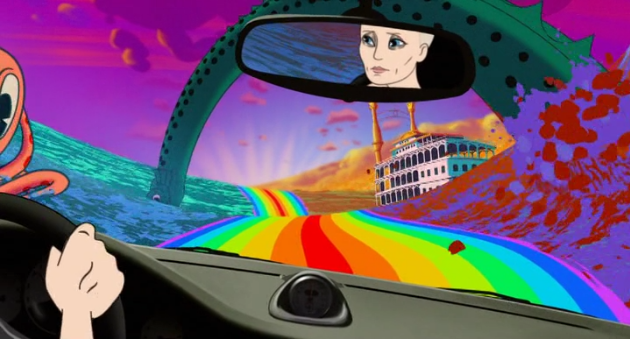
The Congress, based upon a Stanislaw Lem story, is relevant, provocative, thematically rich – often to its detriment – and is almost impossible to categorise; part sci-fi, fantasy, family drama, there’s even some speculative dystopian fiction thrown in for good measure. However, what begins as a stinging critique and almost sly satire aimed primarily at the commodification of celebrity disappointingly loses its anger and gestates into something else entirely. The animated world is hallucinatory and disconcerting, a sinister Disney World™ where eagle-eyed viewers can spot Michael Jackson as a restaurant waiter, Grace Jones as a nurse or an exaggerated toothsome caricature of Tom Cruise. It is exhilarating, mesmerising and a little tiresome but perhaps this is the point in a post-avatar, digital-obsessed world? The questions of mortality our protagonist faces are replicated in our own manipulated interpretation; we should beware of the image. While its plethora of ideas and ambition feels relentless and even a little confusing, The Congress finally finds its humanity amid an existential denouement.

congress2

In any other actor’s hands, The Congress could have been a huge failure but the luminous Robin Wright delivers a stunning performance thanks, in part, to an excellent supporting cast of Keitel, Hamm, Huston and Paul Giamatti but mainly due to the fact that she is just that damn good. There is one scene in which the forty-plus Wright gazes at herself as Buttercup on a Princess Bride film poster, perhaps nostalgic for youth or the career she might have had, yet aside from the hair and the odd wisdom line, she appears exactly the same. If this film is one of her lousy choices, let’s hope she keeps on making them.

Categories
film review

Calvary (Dir. John Michael McDonagh, 2014)

calvary

In the name of the Father.

Forgiveness is a tricky business especially when religion is thrown into the mix. For Father James Lavelle (Brendan Gleeson) everyday duties amid his often troubled, sometimes inexplicable, parishioners, take a sinister turn when, during confession, one of them tells the Priest that he will be murdered within the week. Father Lavalle is instructed to put his affairs in order because killing a Priest, and on a Sunday, “That’ll be a good one.” Given John Michael McDonagh’s last cinematic outing, you would be forgiven for expecting a punchline; The Guard was blackly comic, even laugh-out-loud chucklesome, and here – reunited again with leading man, Gleeson – one would expect much of the same. There are comic moments, however, the tone of Calvary is much darker; still amusing but angry.

calvary4

This tragically woven satire has much to say about a country; fractured as it is amid financial ruin and governed, in part, by a disjointed religious institution as well as commenting on the themes of life, death, and faith – what is to be saved and what is to be damned. Using topical issues which have dogged the Catholic Church for decades, this is a who-will-do-it as opposed to a who-dunnit which unfolds like a subversive Western, rural Ireland an unlikely, yet perfect substitute for America’s Wild West with Gleeson as the ‘good’ hero attempting to save the deeply flawed town from themselves and, in doing so, himself from the lone gunman. Among the cast of characters there is the quirky atheist doctor (Aiden Gillen), the supercilious, smarmy banker (Dylan Moran), the cynical, religiously lapsed pub licensee (Pat Shortt), the imprisoned serial killer (Domhnall Gleeson), the cuckolded butcher (Chris O’Dowd), and even a village idiot (Killian Scott); all of whom Father Lavalle tries to steer onto the path of righteousness or dissuade from the life-choices they insist on pursuing, in addition to comforting his own self-destructive daughter (Kelly Reilly), before his day of reckoning. These people are deeply flawed, fallible, clearly as bad as each other and by-and-large vile products of the world they live in.

calvary3

It is a film that re-envisions the Stations of the Cross albeit through a Parish Priest in County Sligo and while it is not quite perfect – the script meanders a little – Calvary is wonderful; original, modest, and bleakly dramatic with an outstanding performance by Brendan Gleeson who can convey so much with so very little; a big-bear of a gentle man who wears the cassock and clerical collar with aplomb – it is satsifying to see a decent Priest depicted, it feels like it has been far too long The film’s denouement is dramatic, grand, even operatic in scale, some may argue that it is misjudged but, gut-wrenching as it is, there is no other way it could have ended. With its biting satire, surprising comedy and sheer contemptible anger, Calvary delivers a body-blow that resonates long after the credits roll.

Out on DVD, Blu-ray and available via VoD on 11th August 2014