Categories
Film Festival film review

Peacock (Dir. Bernhard Wenger, 2024)

©NGFGeyhalterfilm-CALAfilm-AlbinWidner

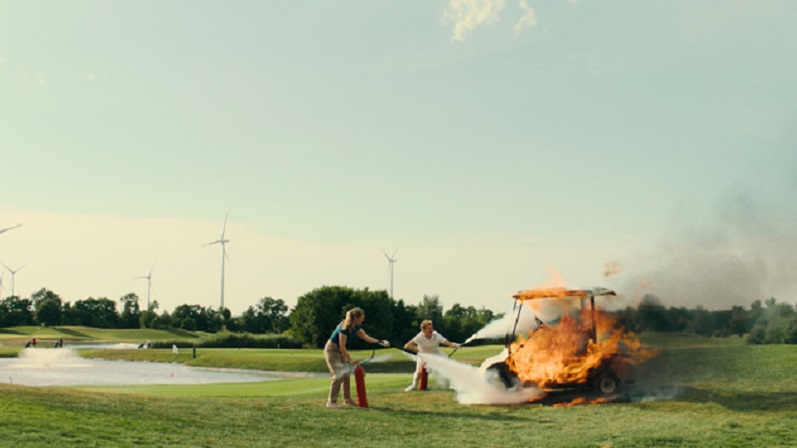
Bernhard Wenger’s feature debut begins completely out of context as a golf cart is engulfed in flames. Two people run into frame unleashing fire extinguishers until the blaze is out and golfers slowly walk over commending the duo on a heroic job well done.

We will soon learn the man is Matthias (Albrecht Schuch, All Quiet on the Western Front, System Crasher) and he works for a company called My Companion, not your regular ‘friend for hire’ agency headed by his boss and friend David (Anton Noori). Matthias fulfils the needs, wants and desires of complete strangers, whether putting out inexplicable golf fires, attending outdoor concerts with older women or posing as the pilot father of a small child, moustachioed Matthias is the star of the company, his success evident in the glowing reviews he receives for his “work” and obvious wealth symbolised by the immaculate house he shares with girlfriend Sophia (Julia Franz Richter).

The problem is Matthias is so good at his job that he ceases to exist beyond a surface level in everyday life, he needs cueing up for everything, when to speak, when to appear sympathetic and when to act. Everything is a construct and performative and Sophia has had enough – “You don’t seem real anymore” – and leaves him. What follows is an existential calamity onscreen. The male in crisis here is handsome, polite, patient, considerate, professionally adept and yet socially inept it is laugh-out-loud hilarious and so cringeworthy, the whole body flinches, also a little heart breaking. Matthias is played to perfection by Schuch whose comic timing is sublime made all the more inviting by Albin Widner’s pristine cinematography, visual humour coolly framed and aesthetically pleasing.

©NGFGeyhalterfilm-CALAfilm-AlbinWidner

Wenger’s assured and absurdist satire takes a swipe at corporation and capitalism. The unpredictability of technology beautifully depicted during the scene when Alexa fails to understand his request for a specific song and declares it will chose a song for him and decides upon ‘Clap Your Hands’ which, of course, interferes with the electricity and clap-activated overhead lights.

Here, the world is a microcosm and life is just one long performance while posing “serious” questions about what constitutes as art – if that happens to be a naked man dousing himself in paint and throwing himself head first into a blank canvas on stage, then fill your boots. To watch the almost-perfect albeit passive man – which in itself is a breath of fresh air from, what feels like, the multitude(s) of male toxicity onscreen – regress and slowly unravel is heart-stinging and, though it’s kind of mean, a laugh-out-loud joy in a film that is tonally perfect from that opening sequence on the green. The dénouement of which is *chef’s kiss*.

Peacock, visually, is reminiscent of Joachim Trier’s work – complete with a Norwegian love interest – shot through with the dead-pan sensibility associated with other Scandi cinema specifically early Östlund or even Lanthimos (when there was a Greek ‘weird’ Wave stirring). Though, by the end, it feels as excruciating (and amusing) as something like Toni Erdmann (2016), whereby the lead is resigned to a specific way of life but then experiences a rebirth, of sorts, which presents a whole new approach to navigating the world.

Matthias can be a your hero, companion, a son, everything for you… but just not as himself.

Categories
Film Festival film review

Andrea Gets a Divorce (Dir. Josef Hader, 2024)

Policewoman Andrea (Birgit Minichmayr) wants a divorce. Her ex-husband Andi (Thomas Stipsits) is the life and soul of any (birthday) party but they want different things. He wants her back, to continue drinking excessively, embarrassing her in public and she wants a divor… well, you get the picture. A new job awaits her in the capital St Pölten, she’ll be a Detective Inspector interacting with “real criminals” and not wasting time on the side of the road catching speeding violators.

After celebrating partner Georg’s (Thomas Schubert) birthday in which Andi makes yet another desperate attempt at getting her back, this time imploring her to arrest him, revving his car engine while intoxicated. She confiscates his car keys and makes him walk home. Later, while she’s driving home her father calls and she takes her eyes off the road for a second and accidentally mows down Andi. She tries to save him and when it is futile, she gets back in her vehicle and drives off. Only when Georg hammers on the door to tell her that her estranged husband is dead at the wheel of RE teacher and ex-boozer – now an imbiber of black tea and milk only – Franz Leitner (Josef Hader) does Andrea realise that she may just get away with it.

Andrea Gets a Divorce is a quietly charming little film, an Austrian dramedy which actually has much to say beyond its humour (though not quite the biting satire we have come to expect from Austria) and dose of melancholy. Whether commenting on the effects of alcohol – Austria changed its alcohol laws in 2019 – without being judge and jury, casual racism within a rural town, or the sly inherent sexist commentary a woman faces, and a police officer at that. Andrea’s weight, marital status, biological clock are all up for discussion, at one point she is even likened to an SS officer. She’s a single woman bearing the burden of responsibility for everything it seems and not merely straddling her new role as a law-breaker. Finding balance and prioritising themselves is not always the natural way of things for a woman and this film depicts the push, pull and self-doubt beautifully. Or as remarked early on, “the women are moving away and the men are getting weirder.”

Minichmayr is excellent as the closed-off lead, she who rarely smiles while struggling with her guilt and sense of justice. Writer-director Hader follows up his 2017 debut Wild Mouse with this and is delightful in support as forgetful Franz whose ill-gotten culpability threatens to ruin him in a haze of late-night disco dancing and G&Ts. While it could have been easy to write off these people as simpletons from a small town, Hader avoids leaning into clichéd stereotypes. There is some complexity and layering to these characters who are settled in their mundane provincial little lives, somewhat fearful of change which tends to be true of most quaint little places.

All roads are paved with good intentions, or just the one in and out of town which is shot perfectly and bookends a sweet film. Andrea Gets a Divorce is a wonderfully wry and sensitive piece of storytelling about life and friendship, forgiveness and guilt surrounding a divorce and bereavement at losing a whole person or that sense of self. It is woven together with an amusing if deadpan sense of humour, often callous but rarely alienating. The joke punchline being the very film title itself.

Categories
Film Festival film review

My Wonderful Wanda (Dir. Bettina Oberli, 2020)

East and West Europe clash in Bettina Oberli’s sly satire My Wonderful Wanda which was included in Glasgow Film Festival’s stellar line-up, and given special mention in the Nora Ephron Award category at Tribeca.

Wanda (Agnieszka Grochowska) arrives by coach from Poland – and does so at the start of each chapter of the film’s structure – clutching as much of her life as she can pack into two pieces of luggage. The most important parts, her two sons, are left behind and cared for by her parents while she earns a wage. She is employed by the Wegmeister-Gloor family (yes, really – translate it) and cares for patriarch Josef (André Jung) who has been left debilitated by a stroke.

His wife Elsa (Marthe Heller) and adult children Sophie (Birgit Minichmayr) and Gregi (Jacob Matschenz) are unwilling to lift him, place him on the commode chair or shower him, their lives either too full or too empty to truly care one way or another. Wanda does it all. Even when Manuela goes back to Portugal, Wanda is asked to take on extra cooking and cleaning. The Wegmeister-Gloors are far from poor with their stunning lakeside home that it makes the fact that she must barter for her wages all the more galling to watch.

Josef starts paying Wanda for sex as another way to supplement her income. Their business transaction satisfying both as his needs are met and she is able to send more money home. Almost predictably, she is then accused of stealing the money and her passport threatened with confiscation. Make no mistake, these are not likeable people but you will have to wait until the final few moments as to whether any of them are redeemable.

When Wanda falls pregnant by the ‘infertile’ Josef that’s when the fun really starts as panic and horror sets in and the realisation of what this may cost the family, both in monetary terms and to their prided reputation. There’s an element of schadenfreude as one watches white privilege implode in a drunken haze and Nancy Sinatra, a protection of assets and a taxidermy funeral (an art installation in the snow), while Wanda remains the taciturn and rational one. Choices are made but not by her – the poor tend not to have those – and Gregi, the youngest Wegmeister-Gloor, finally takes his creepy bird noises with him and flies the nest.

Oberli’s film is nuanced and empathetically shot – the family as microcosm – with its greens and blues symbolising all that is in nature, the façade beneath the picturesque, as well as the cash and the bloodline. Its tone is perfectly measured as it deftly comments on class, the immigrant experience, motherhood, family dynamics (including the multitude of human neuroses that comes with it) and legacy, however, does it with a sense of self-awareness and humour. The inclusion of the cow is genius – both as cast member and visual metaphor – and provides ever more light relief.

My Wonderful Wanda’s strength lies in its direction, screenplay, biting satire, and ensemble cast, with standout performances from Grochowska and Heller. Perhaps, we are all just prisoners of circumstance whether rich or poor.

Categories
film review

Selah and The Spades (Dir. Tayarisha Poe, 2020)

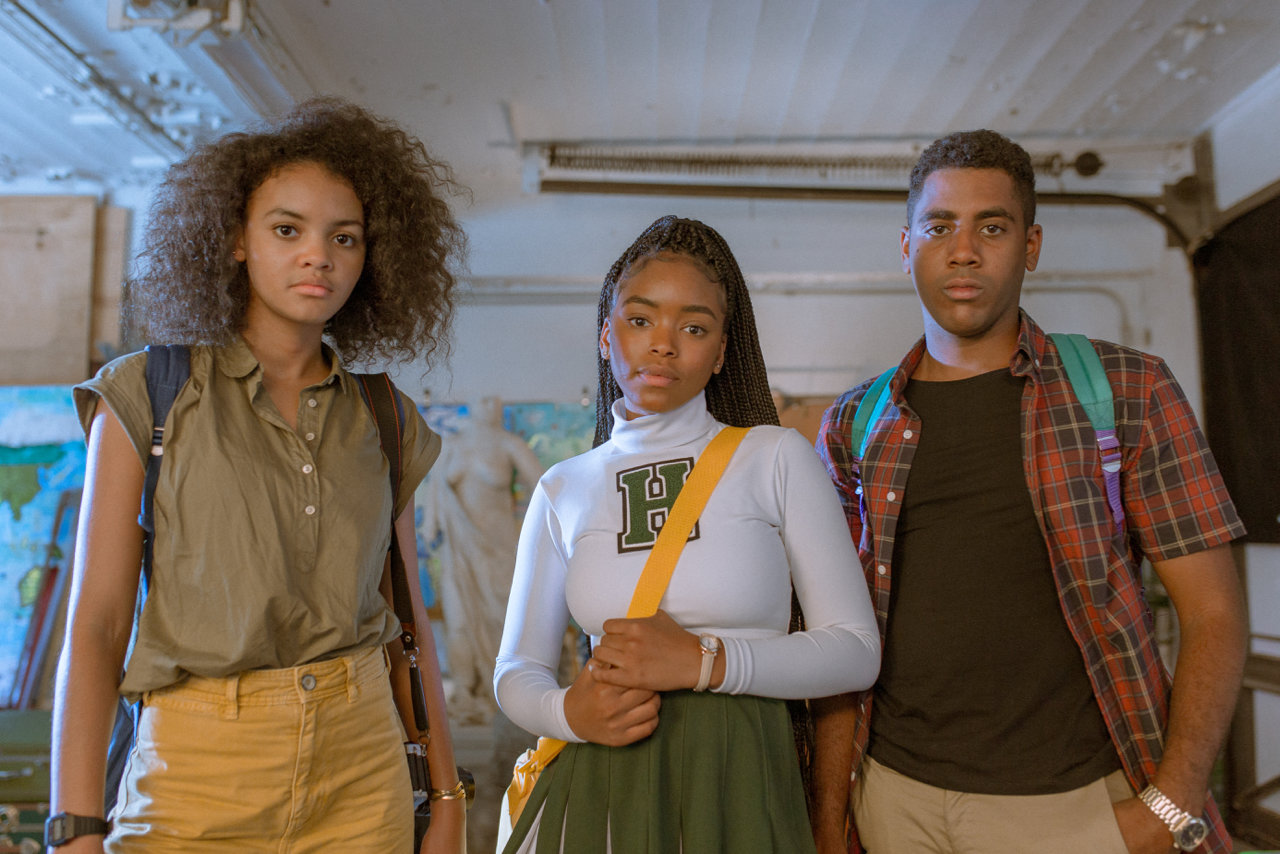
Pennsylvania’s Haldwell School sits on vast green grounds on the edge of a wooded area, away from civilisation and governance – although, bless his heart Headmaster Banton (Jesse Williams) tries. He attempts to push School Policy and assert authority but tends to, more often than not, falls short. The elite boarding school is in the hands of five factions (gangs are against the rules): The Sea, The Skins, The Bobbies, The Prefects, and The Spades. The Spades provide the ‘booze, pills and powders’ and business is booming. They all run the school but the most power appears to be in the hands of Queen bee Selah Summers (Lovie Simone) and her closest ally and associate Maxxie Ayoade (Jharrel Jerome).

Selah is in her senior year and should be thinking of college. It turns out it’s only her mother (Gina Torres) with whom she has a terse relationship who actually is, seeking an institution which will “keep you in your place, save you from yourself. Something has to.” The young entrepreneur would rather concentrate on her business and leaving it to a worthy protégée. Enter new scholarship student and keen photographer Paloma Davis (Celeste O’Connor) who appears to take it al in her stride and quickly aligns herself as a Spade.

Near the film’s beginning, The Spirit Squad (cheerleaders) perform one of their routines and it is here that several facts are laid out for us. “They never take the girls seriously… when you’re 17, everybody is telling you what you do with your bodies…” The crux of it is, The Spirit Squad took back that power, they decide the uniforms, routines and how much skin to show. Selah uses that power and runs with it. The control intoxicates with a fine line drawn between leaving behind a legacy and being erased from history, and it during those moments of fear that Selah exhibits the real darkness of her character, and where Lovie Simone comes into her own as we start to see that perfect façade begin to crack.

First time writer/director Tayarisha Poe makes an impressive and memorable feature debut – and a perfect jumping-off point for an original TV series (handy since one has already been commissioned). Selah… is an extraordinary and unique look at young adult life encapsulating satire, surrealism and style in a world of teen politics with razor-sharp dialogue and noir character study. It’s part Lord of the Flies, and Brick (ish) by way of Dear White People, Heathers and Ozma of Oz – that opening quote and the world it belongs to is hinted at throughout via the ruling princess (AKA the one true monarch), school colours, props, costumes even the location within the mise-en-scène, the Factions stand-ins for the Land of Oz’s quadrants.

Certainly Haldwell gives off the feeling of a world far from the emotional ties of home. This is thanks mainly to Jomo Fray’s hypnotic cinematography and Aska Matsumiya’s eclectically composed soundtrack replete with contemporary music and mystical dreamcatcher-like chimes adding an ethereal quality to an already uncanny setting. Colour is vibrant and varied, the use of light sublime and heightened. Make no mistake everything here is, it’s school (eye roll) – despite never actually depicting any lessons or classrooms. While the almost bored-sounding voiceover narratives ground in verisimilitude.

However, the film’s strength lies in its ensemble of characters – “a film by us all” as the credits declare – from poised perfectionist Selah to diet-Margo Tenenbaum Bobby (Ava Mulvey Ten), peacekeeper Paloma, loved-up Maxxie (Jerome continuing his run of multi-faceted characters and solid performances), and immaculate, yet inept, Headmaster. Whether these characters and their respective players turn up in the TV series remains to be seen but Selah and The Spades is an impressive, if fraught, first term in the halls of Haldwell.

Selah and The Spades is available now to stream through Amazon Prime Video.

Categories
Film Festival film review

Make Me Up (Dir. Rachel Maclean, 2018)

LFF 2018

For those unfamiliar with Rachel Maclean’s work, the Edinburgh-born multimedia artist created one of the 50-feet portraits of Billy Connolly which adorned the streets of Glasgow for The Big Yin’s 75th birthday. She also submitted a short: Spite Your Face to last year’s London and Venice film festivals. This piece focussed on a Pinocchio-type character – played by Maclean – who chases the lure of wealth within an abusive patriarchal power. It was made as a response to Britain’s decision to leave the EU and Trump’s presidential campaign. Within the mise-en-scéne its colours of choice were (Tory) blue and (Trump) gold.

The artist’s first full-length feature – included in the BFI’s 2018 festival programme – uses bubble gum pinks, violets and blues in every frame, and like its predecessor zones in on the post-Brexit zeitgeist in a similarly confrontational and acerbic manner. Make Me Up begins with the familiar aural tone and visual most Apple users attribute to the Siri application, when a disembodied male voice asks, “Siri, when is the world going to end?” before a woman screams “I don’t know!” and her cries resonate over the black screen.

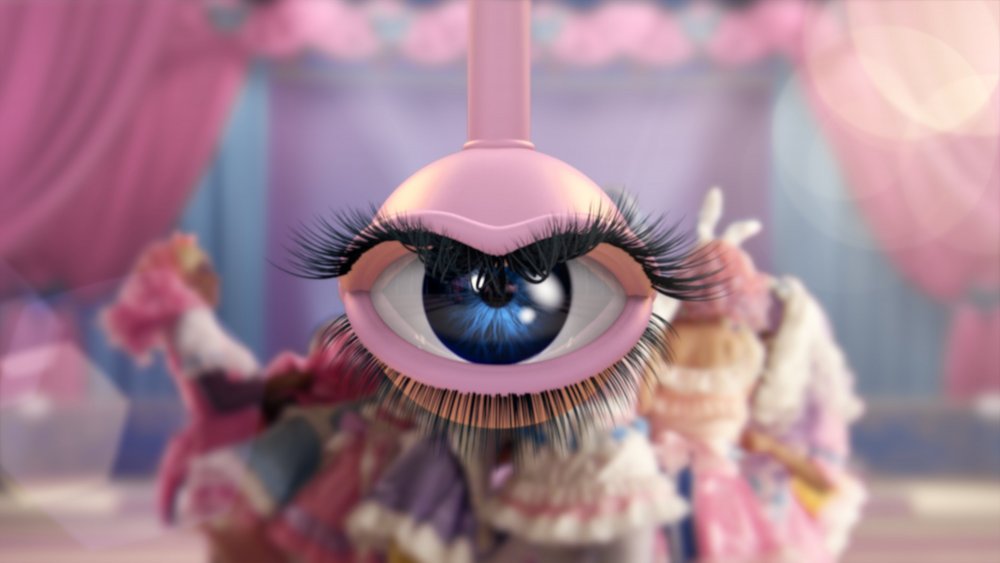
Siri (Christina Gordon) in this case is a woman, pink of hair, born of a gelatinous lump of flesh. Unsure of how she ended up in such an inexplicable place, she becomes allies with Alexa (Colette Dalal Tchantcho) and is forced to compete against several other women (there’s even a Cortana too) in a hyper-real game show of sorts. All under watchful Orwellian eye(s) which fall from the ceilings and monitor everything and everyone via facial expressions and status updates.

In charge is the Figurehead (Rachel Maclean). An equally magenta-haired woman who schools her audience on the role of women within civilisation and through the history of art. Like her ‘pupils’ she has no voice of her own but is a conduit for the dulcet tones of historian Kenneth Clark, and specifically his 1969 BBC TV series Civilisation. She has other voices in her arsenal, namely those belonging to Andrew Graham Nixon and critics E.H. Gombrich and Robert Hughes, all stored within a device embedded in her arm. Her mannerisms scream Thatcher as her lips sync to the pomposity of the white, male patriarch. The girls before her know to mind their Ps and Qs and if they don’t? Well, naughty girls are punished, pitted against one another before elimination. The winner gets to eat.

Every inch of the film is aesthetically pleasing – although some may find it on the kitsch-side (when is that ever a bad thing?) – from Maclean’s production and costume design (she is also editor and responsible for the compositing and 2D effects) to Grant Mason’s prosthetics and Scott Twynholm’s score; it is all substance and style. Maclean asks us to consider the toxicity of social media, the depiction of women in politics, art iconography and beauty culture. The use of The Woman of Willendorf and the Venus de Milo is particularly powerful to illustrate the evolution of the female image, with nods to the works of Michelangelo, Botticelli, and Munch later on.

Make Me Up is a biting and thought-provoking satire which could not be more timely, not least in its celebration of the Suffragist Movement. It presents the violent and submissive fears, desires, control and pressures surrounding women. It asks questions of the role of women in contemporary feminism and art, as well as realigning the male gaze albeit sardonically amid Freudian visuals (the breast-shaped door handles and phallic dinner meat are particularly delightful). It has aspects of Alice in Wonderland by way of Sucker Punch via Hartbeat.

There is, however, no all-encompassing decorative pink bow of a conclusion – as Siri plots her escape thanks to the support of the sisterhood, you will recognise a few – and some may even find the final shot dispiriting but thankfully women persist. Director/Writer/Artist and all-round multitasker Rachel Maclean has put together something highly intelligent and imaginative. It deconstructs the beauty myth (perfection paint, anyone?) and reconsiders art history, criticism and all with a grin on its face and a knowing wink. More please.