Categories
Blu-ray film review

The Bells of St. Mary’s (Dir. Leo McCarey, 1945)

It was the film listed on the marquee of the local cinema as George Bailey (James Stewart) ran through a snow-covered Bedford Falls, and back into the bosom of his family. It was also the picture that Michael Corleone (Al Pacino) took Kay Adams (Diane Keaton) to see at Radio City Music Hall on their first date. Aside from being dearly beloved by filmmakers named Francis, The Bells of St Mary’s does what very few films have been able to do, and that is out-charm its cinematic predecessor (despite Bosley Crowther’s 1946 claims in The New York Times).
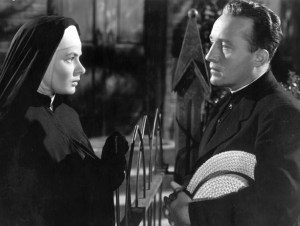
Father ‘Chuck’ O’Malley (Bing Crosby) was first seen in Leo McCarey’s 1944 hit Going My Way and is reintroduced here – wearing his straw boater on a jaunty angle – arriving at St. Mary’s in order to help Sister Superior Mary Benedict (Ingrid Bergman). She, who is fighting to keep the Parochial school open and out of local businessman Horace P. Bogardus’ hands. Bogardus (Henry Travers) has already purchased the adjacent building to St. Mary’s but is determined to secure the school grounds for his parking lot.

In the beginning, Father and Sister clash – albeit with a twinkle of the eye and a sly smile on the face, alongside quips like: “Did anyone ever tell you, you have a dishonest face? For a Priest, I mean.” Somewhat predictably, they – the American Priest and European Nun – realise they must come together to fight a common goal. Sound familiar? Okay, so it’s not fascism per se but the film was released in December of 1945 so it’s hardly a stretch to see its themes set against the war effort.

Director McCarey had a somewhat varied career, dabbling in slapstick (Duck Soup, 1933), melodrama (Make Way For Tomorrow, 1937), screwball comedy (The Awful Truth, 1937) and romance (An Affair to Remember, 1957). He would make four Priest-led films (Going My Way…St. Mary’sMy Son John in ’53 and The Devil Never Sleeps in ’62), which for a devout Catholic is hardly surprising, but in all and especially in this film he managed to humanise both Priests and Nuns, depicting them as flawed individuals and, crooner Crosby and the radiant Bergman take Dudley Nicholls’ script and run with it.
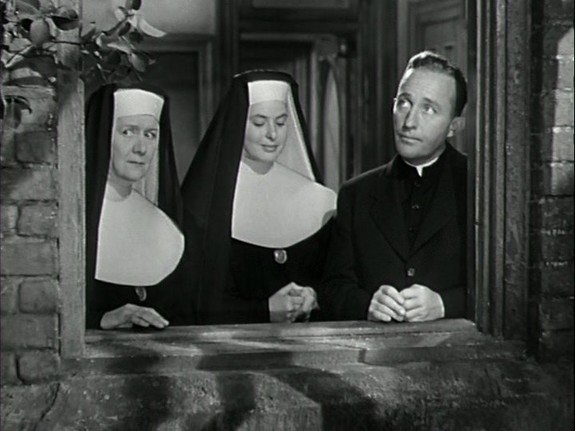
There are no villains of this piece – Travers best known for playing angel Clarence in Capra’s It’s a Wonderful Life is probably the most antagonistic, however, manages to convey sincerity and humour all the while attempting to chuck the Sisters and their young wards out of their school. While this is the overarching plot, there are minor, almost irrelevant arcs which provide the gentle comedy and at times offer the most laughs, which go to the heart of the film and viewer alike. Like, flunking student Patsy Gallagher (Joan Carroll) who leans on Father Chuck to help her pass the school year.

Patsy is left at St. Mary’s while her mother Mary (Martha Sleeper) weighs up giving caddish pianist Joe (William Gargan) – who left her pregnant and alone – another chance. Or, bullied Eddie Breen (Richard Tyler) who has been “turning the other cheek” as per Sister Superior’s advice until she decides to teach him, in one memorable and hilarious scene, to box. Even when Chuck and Mary Benedict do have a difference of opinion, it is all decidedly good natured.

It is these threads, and elements within the mise-en-scène, which show the passing of time as the seasons change and the school year progresses, culminating in the most adorable Nativity performance, in the history of Nativities. McCarey was all about improvisation and naturalism in his actors’ performances, and it is no more apparent than in the recreation of “Jesus’s birthday”. It was reportedly shot in just one take with the children encouraged to ignore the camera and crew, and approach their material as they saw fit.

This is an aspect of McCarey’s work ethic which admirer Yasujirō Ozu emulated in Tokyo Story – the 1953 retelling of Make Way For Tomorrow. It is a characteristic which make this film so utterly charming. There are of course – given Crosby’s presence – musical numbers, courtesy of composer Robert Emmett Dolan, such as the delightful “Aren’t You Glad You’re You?” and even Bergman stretches her vocal chords in her native Swedish for “Varvindar Friska” (Spring Breezes) and while musicals are not everybody’s cup of tea (I know, who doesn’t love a bit of Bing?) there are ample numbers to enhance the narrative yet few enough not to put people off completely.

Drill deeper and there are interesting depictions of the gendered approach to conflict which one may argue are outdated, however, some still ring true even today. Yes, it may offer an idealised, even sweet depiction of Catholic schooling but this assertion of patriarchal power is more than still relative especially in the institution of the Roman Catholic Church, and indeed, as discussed by Revd Steve Nolan’s analysis in the disc extras – the notion of paternalism. Made obvious in the way Dr. McKay (Rhys Williams) decides to withhold vital information of and from a (female) patient but discusses freely with ‘a man of the cloth’.

Although not necessarily a Christmas film, you can do a whole lot worse than including this film on your festive watchlist (if not before). It’s the perfect addition containing humour, charm and sincerity, and one which warms the cockles in much the same way as The Shop Around the Corner or Remember the Night. It may not be regarded as McCarey’s most cinematically satisfying film but its popularity is evident and understandable.

The performances are natural, subtle and nuanced especially Bergman who was rarely seen onscreen less than glamorous, and was loaned by David O. Selznick as part of a deal he struck with McCarey. Here she shines, quite literally, from the glow of her unmade-up face to the luminosity of her smile and the clever use of lighting which flawlessly renders her, hitting the eyes perfectly within her wimple. Made all the more noticeable here thanks Paramount’s restoration process which still contains some grain but which creates a beautiful monochromatic sheen to each frame, set within a 1:37:1 aspect ratio.

The Bells of St. Mary’s will charm your socks off – and it’s a well-known fact that this writer watches it every Christmas Eve without fail. It just ain’t Noël without that little boy, Bobby (Dolan Jr), knocking on a curtain introducing himself in one breath, “This is Mary and I’m Joseph, and we came to Bethlehem to find a place to stay.”

Special Features

It’s almost a given now that if it’s an Arrow Films release, the Academy label in this instance, there are always a few extras to enjoy after the credits have rolled… and only then.

Up to His Neck in Nuns (22 mins) – This visual essay by David Cairns is entertaining and informative as the writer dips into Leo McCarey’s filmmaking history, his early life, Catholicism and heavy drinking. It switches from film clips, stills, photos, archival interview quotes, and Cairns’ lovely Scottish lilt ensures it’s never boring.

Analysing O’Malley (19:48) – This appreciation by the Chaplain of Princess Alice Hospice, film academic, and author of Film, Lacan and the subject of Religions: A Psychoanalytic Approach to Religious Film Analysis, Revd Dr. Steve Nolan is a little dry in comparison to the previous essay. Nolan sits to the right of the frame and narrates; reading an essay from an autocue. It’s a fascinating analysis but one which would have worked just as well as a commentary (surprisingly lacking here).

You Change the World (32:07) – This short religious propaganda film was shot by Director McCarey in 1949 and features appearances by Bing Crosby, Bob Hope, Irene Dunne, William Holden, Loretta Young, and Jack Benny – all regarded at the time as ‘super Catholics’. It’s arguably some of the best acting any of them have ever done, and they’re playing themselves! It’s preachy, condescending, cringeworthy hypocrisy at its finest (and I say this as a Catholic). The purpose of the film was to persuade “good, decent, normal people” to join The Christophers. I stopped counting how often “The Declaration of Independence” is mentioned when I reached ten.

Two Screen Guild Theater Radio Adaptations: One from August 26th, 1946 (29:52) and the other recorded October 6th, 1947 (28:59). Both star Bing Crosby and Ingrid Bergman reprising their roles as Fr. Chuck O’Malley and Sister Superior Mary Benedict. The radio programmes are played over a slide show of film stills.

Musical Score Featurette produced by RKO Radio (22:28) – This was made to promote the film’s original release in December 1945, and is played over the same film stills as the radio adaptations.

Theatrical Trailer (1:51) – A perfect way to compare the film against this trailer and see the amount of work that has gone into the restoration process.

Image Gallery – This is slideshow of 35 images. There are gorgeous chiaroscuro snaps, candids, as well as magazine covers, set images and colour posters.

First pressing only: Fully illustrated booklet containing new writing on the film by Ronald Bergen.

Reversible sleeve featuring original and newly commissioned artwork by Jennifer Dionisio.
Categories
Blu-ray film review

George A. Romero: Between Night and Dawn

When George Romero sadly passed away in July of 2017, it is fair to say the news left film fans in mourning and specifically horror fiends. Famous for his flesh-eating and satirical Dead trilogy – which would eventually become a six-film anthology by 2009, he was a filmmaker who refused to be pigeon-holed (as the films in this set will attest). Before Dawn of the Dead (1978) and Martin (1978) he completed three other features. It is these  – There’s Always Vanilla (1971), Season of the Witch (1972) and The Crazies (1973) which were lovingly restored and presented in a box set by the wonderful folks at Arrow Films and their Video label.

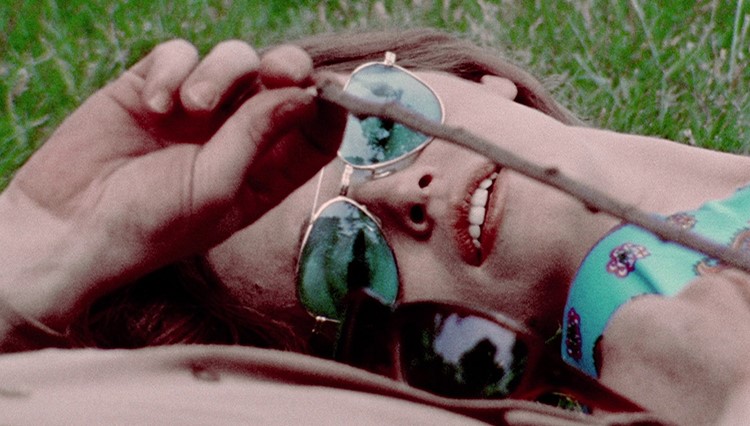
There’s Always Vanilla AKA The Affair was the first film made by the team behind Night of the Living Dead (1968) and was fraught with problems from the start of its troubled production. It is not so much a film directed by Romero – his style is barely recognisable – than superbly edited making the most of a flimsy plot. The film centres around a love story during the 70s in which sexuality was liberated and countercultural, clearly inspired by Mike Nichol’s The Graduate (1968) and Larry Peerce’s Goodbye, Columbus (1969) which had been released a few years before. Chris (Raymond Laine) loves Lynn (Judith Ridley) and she loves him until… they don’t, she’s a commercial actress and he’s struggling to find a niche following time served in the army.

The film was carved from a short showreel meant for Laine (a dead-ringer for a young Russell Crowe) and while the crosscutting and juxtapositions are rather heavy-handed, – and the first half feels somewhat aimless and laboured – Vanilla‘s an interesting look at the experimental cinematic mood – it captures an essence of the era. Granted, with some horrendously dated gender labels and stereotypes. There is a hint of the director during the sinister and sleazy abortion scenes in which canted camera angles and filters are employed and an ominous soundtrack plays.

There’s Always Vanilla, so named for the lead character’s father’s analogy for life – the more exotic flavours tend to be discontinued or hard to locate, you see but there’s always… well, you get the drift. The pretty metaphor within the ending which we also see at the film’s opening brings it full circle and attempts to convey the alleged freedom and liberty of the decade, or perhaps it’s also a state of mind; you’re only free if you believe you are – deeply philosophical questions for a film that started life as a showreel. While the film is dated and technically flawed, it really captures a mood and authenticity of a period and the beginnings of a filmmaker and his team at the genesis of their craft.

Season of the Witch AKA Hungry Wives (awful) or Jack’s Wife (working title) fares better. Made in 1972 and revolving around housewife Joan Mitchell (Jan White) and her eventual dabbling in the occult, courtesy of a few tarot card readings, before accepting her place in a coven. What strikes most with this film is the level of sophistication in comparison to …Vanilla. Still prevalent are some technical flaws however, from the Buñuelian and atmospheric opening to the depiction of female disillusionment within the narrative, this film is fascinating.

It isn’t necessarily about magic but rather how a woman – who wants more beyond marriage and motherhood – wishes to embrace her independence and sexual prime, and take back some power through witchcraft (almost depicted here as a completion of womanhood). One can see its distinct influence on Anna Biller’s fabulously feminist The Love Witch (2016). Using themes of oppression and transgression, it is no accident that this film’s existence stems from the period of women’s lib – patriarchy manifested as a demon-masked man on the prowl, personifying Joan’s fears, albeit within a recurring dream sequence – while fragile and toxic masculinity personified through the characters of Jack Mitchell (Bill Thunhurst) and Greg (Raymond Laine).

Season of the Witch is a gem of a film, from its avant-garde opening to the interesting depiction of gender roles coupled with the enigmatic and nuanced performance of Jan White. It feels like a primer for Martin with its political progression, religious motifs and the use of the colour red (although to differing effects).

This use of chromatic is also prominently used in The Crazies, a science-fiction-horror-thriller in which a small American town is quarantined following the accidental release of a biological weapon. The Army have “everything under control”, at least they certainly want everyone to believe they do – reinforced by a non-diegetic military drumroll punctuated sporadically throughout. We, along with the townspeople are on a need-to-know basis as all hell breaks loose and national security becomes a real concern.

We’re subjected to horrifying images as people are dragged from their sanctuary of Church or a small group of individuals are backed into a stand-off, threatened by gunfire. Then, there’s the scientist who makes a breakthrough with an antidote (the soldiers have all been inoculated first with what little antibiotics they have) only to be murdered, his vials of life-saving serum (red again) smashed around him. David (W.G. McMillan) and Judy’s (Lane Carroll) arc pulls at the heartstrings and, a few pacing issues aside, it is them we root for.

Watching the films in this boxset in chronological order shows a distinct progression in the New York native/Carnegie Mellon alum’s filmmaking. The man who made films (whether writing, directing or editing or a combination of all three) instinctively, was politically progressive, possessed a sense of humour and rarely wrote characters that weren’t multi-faceted. He depicted a rare equality within male and female characterisations and did not exploit or resort to sex.

Mr. Romero, George, you are sorely missed.

This box set of his early works between Night of the Living Dead and Dawn of the Dead – see what they did there? is replete with extras and special features and is a must-buy for any fan. He was still developing his style and craft and the films may not strike as much of a chord as the ones that followed*, however, there’s still much to enjoy and appreciate. Season of the Witch, and the Guillermo del Toro interview with George – which is a wonderful and joyous watch – are worth the purchase alone. Alternatively, all three are now available individually via Arrow.

*”My stuff is my stuff. Sometimes, it’s not as successful as my other stuff but it’s my stuff.” (G.A.R, 2011)

 
Categories
DVD Review TV

Channel Zero: Candle Cove

Based upon Kris Straub’s creepypasta short story, Candle Cove was the first anthology in Syfy’s Channel Zero series with the second No End House, Butcher’s Block (S3) and The Dream Door (S4) swiftly following before announcement of its cancellation. Its creator Nick Antosca and producers Don Mancini (Child’s Play) and Harley Peyton (Twin Peaks) brought a unique experience to the small screen, most of which are now available on DVD and Blu-ray.

Candle Cove opens during two months in 1988, five children: Jacob Booth, Sadie Williams, Carl Cutter, Gene Hazel and Eddie Painter go missing with four later found murdered. Only one – Eddie – was never returned nor remains discovered for burial. The Iron Hill Murders were never solved and now, 28 years later, Eddie’s identical twin brother Mike (Paul Schneider) a child psychologist is recovering from a breakdown and plagued by nightmares that eventually make him head home to mother Marla (Fiona Shaw) and the childhood home and friends he left behind. Once there, he realises that a TV show has started to air again called Candle Cove, an eerie puppet-led programme that only children seem to be able to see and which brainwashes them into participating in some deeply disturbing antics.

As more children go missing and start acting strangely, losing teeth along the way, Mike, – even finding himself a suspect at one point – must embrace his repressed memories, childhood traumas and nightmares head-on if he is ever going to discover the truth about Eddie. His creepy journey will see him recollect the bullying, the paralysing fear, and meet the mysterious Jawbone, its merry band of shipmates aboard the happy ship on the way to Candle Cove, and prevent history repeating itself.

While some shows tend to tell their stories from the child’s perspective, the world between adults and kids separated, here they interlink; childhood fear enforces adulthood and that trauma never leaves – all those things that grown-ups dismiss as an overactive imagination manifest and are all the more real and frightening. What makes Candle Cove so effective is its thoughtful and understated – even mundane – approach to horror. Yes, it uses tropes familiar in the world of Stephen King but there are also elements of The Twilight ZoneThe X-FilesAmerica Gothic and even Mystic River (2009), with additional (and repetitious) layers of intrigue. The fact that Winnipeg (doubling for Iron Hill) is so green, lush and naturally shot only enhances the supernatural.

There are nods to Treasure Island, The Muppets and an all-too terrifying version of the tooth fairy but not like you’ve ever seen. Childhood fears are its emotional backbone but it uses guilt, grief, dream logic and some surreal and whimsical imagery to really sell the deeply unsettling. The performances particularly those of Schneider, Shaw and two of the children, Abigail Pniowsky (Arrival) as Lily Painter and Luca Villacis, who portrays the Painter twins beautifully and skilfully relays two very separate personalities, elevates the subject matter. The thing about murderous children is that they are utterly terrifying; corrupted innocence disturbs and distresses on such a profound level. The lack of gratuitous violence is refreshing also, it’s not completely absent but tends to be distancing, quick and almost always off-screen.

Told over six episodes this anthology is an atmospheric and quietly unique experience, it builds the dread and truly unsettles staying with you long after the denouement. It’ll haunt your dreams especially the child made entirely of human teeth but never fear, head to bravery cave, all your secrets will be safe in Candle Cove…

Categories
film review

It (Dir. Andy Muschietti, 2018)

It feels idiotic to assume yet I expect most of the world is well-versed in the Stephen King novel and if not the book then the TV serial which surfaced in 1990. It’s back and, just like before children are disappearing and the adults are oblivious. Amidst a downpour in 1988, a little figure clad in a yellow slicker and green galoshes runs alongside the paper boat that his big brother and ‘bestest pal’ made for him. SS Georgie battles the raging seas i.e. gushing rainwater on the streets of Derry, Maine, until it slips from tiny grasp into the storm drain.

Twelve months later and still reeling from the loss of his little brother George (Jackson Robert Scott), Bill Denbrough (Jaeden Lieberher) and his group of friends: Richie Tozier (Finn Wolfhard), Eddie Kaspbrak (Jack Dylan Grazer), Ben Hanscomb (Jeremy Ray Taylor), Beverly Marsh (Sophia Lillis), Mike Hanlon (Chosen Jacobs) and Stanley Uris (Wyatt Oleff) known affectionately, as The Losers Club join forces to defeat school bullies and the evil thing that is devouring the town’s children.

Adapting any major work must be hard, not least when the original text is a magnum opus. Liberties were certainly taken in 1990 condensing nearly 1400 pages into a three-hour TV series but then I was a child, had yet to read a King novel, and was utterly horrified at the prospect of Pennywise the Dancing Clown and his shifting shape(s) of fear. This time round, and now well-read, it feels slightly more faithful in some ways and yet there are those damn liberties again. Despite early production problems, and the acrimonious departure which took with him, his Will Poulter-shaped Pennywise and director’s chair, Cary Fukunaga retains a writer credit alongside his writing partner Chase Palmer but it’s Gary Dauberman who takes the lead while Andrés (Andy) Muschietti (Mama) steers the ship.

The novel’s structure has changed and 50s Derry is transposed to the 80s – just as Regan handed over the keys of 1600 Pennsylvania Avenue to Bush – but that just gives the 15-rated film a Stand By Me meets The Goonies (and John Wayne Gacy) retro quality that actually really works. Splitting the film into two chapters and avoiding those flashbacks and forwards, means these kids are able to hook us entirely, we’re completely invested in their plight, their friendships and fears, and that emotional connection is made. This is their time and each of the main cast is a delight.

Richie’s still a motormouth and has the best lines, Bev – she of Winter fire hair – is great; kind and tough, hypochondriac Eddie is more verbose than I remember, Bill’s still a little bland, and Ben’s a sweetheart (with excellent taste in boybands). Stanley’s character is fleshed out a little more while, disappointingly, Mike’s is somewhat diluted. His interest in Derry history is sidelined and given to Ben for reasons unknown, and not, one hopes, just a way for the filmmakers’ to avoid the racial elements of the story. He is clearly painted as the outsider. Fingers crossed that come Chapter Two some of these issues will be addressed, and he receives the narrative pull that was expected. My point is, gripes aside, it’s like revisiting old friends.

Had I watched this version at 11 years old, I’d have been traumatised, It comes back every 27 years (in actuality, 25 for me) and now I’m the adult no longer afraid (well, ish). To be fair, Bill Skarsgård in the clown get-up is the stuff of nightmares. He’s less abrasive and wisecracking than Tim Curry, and there is an underlying innocence to his Pennywise which adds to the vile and creepy. His body movements are manic and frenetic, even a little awkward, like a child who has experienced a growth spurt overnight and boy, is he hungry (the saliva drenched lips and string of drool, a dead giveaway). He is terrifying and yet, for me, the scares throughout the film are somewhat lacking despite the gripping sense of unease felt from the start with poor Georgie. 

Visually, the film is stunning thanks largely to Chung Chung-hoon’s cinematography, Janie Bryant’s costumes, and the VFX and make-up provided, in part, by Stan Winston alums Tom Woodruff Jr and Alec Gillis. The sets are elaborate and striking and for horror fans it has a real kid-in-a-sweet-shop feel, especially the house on Neibolt Street. The set-pieces are thrilling and rich in detail, and littered with plenty of horror-themed easter eggs, the jump scares are fairly frequent and perhaps a little obvious but there was one that the two guys sat next to me didn’t see coming.

All-in-all, this is a thoroughly enjoyable adaptation, horrific, heartfelt, and not in the least bit hokey; a perfect trip down memory lane via childhood street and nostalgia way. By the time the credits roll, you’ll float too.

Categories
film review

Most Beautiful Island (Dir. Ana Asensio, 2018)

“Are you ready to receive the gift of salvation?” a street preacher asks lead character Luciana as she walks past him. It’s a running theme through the first half of Most Beautiful Island as Luciana discusses redemption with her mother. She has left her home country following an accident involving her daughter Sofia (we don’t know the specifics but there’s a shoebox containing baby clothes, sealed in plastic bags to preserve the newborn smell). In the US she must find the belief to survive and the faith that things will, have to, improve.

The film opens with a camera sweeping crowded streets, randomly honing in on unidentified women and briefly following them before moving onto the next, until it eventually finds Luciana (writer-director Ana Asensio). She is trying to see a doctor for the nausea, nightmares and nose bleeds which are becoming more and more prevalent, however she, like many undocumented individuals, has no health insurance nor the $75 spare to pay for the appointment. Her day made worse as she returns home to passive-aggressive notes from her roommate demanding rent and the Post-Its tacked to food items in the fridge reminding her that they are “Not Yours”.

What follows is a relentless pelting of lack of privilege and hardship, tightly framed and often in close-up to give a real sense of discomfort and entrapment as each situation becomes increasingly worse; living hand to mouth, the crappy jobs which include babysitting bratty children or dressing like a sexy chicken to advertise fast food (the latter something immigrant men are spared, presumably). While discussing the dismal prospects with friend Olga (Natasha Romanova) – another woman finding her way in the world – Luciana considers donating her eggs for the $8000 offered in a magazine ad, it’s either that or fully embrace the defeat she has been feeling. However, things look promising when Olga offers Luciana the opportunity to cover for her at a party, all she needs is a LBD and heels and in return she will earn $2000.

At some point, alarm bells must start ringing as Luciana is led to the bowels of a Chinese restaurant to pick up a handbag, a designer knock-off complete with a padlock and then onto the hastily scribbled address she carries on a scrap of paper. As a viewer, you’re internally screaming for her to turn back as her evening becomes more bizarre, she finds herself in a web of weirdness, and the significance of those women seen in the opening moments is made apparent. To say any more would be to spoil but suffice to say Jeffrey Alan Jones’ music comes into its own here, the jarring sounds adding to the tension as the voyeuristic handheld super 16mm camera bounces between close-ups and wide shots, most of the action taking place behind a closed door – we’re as much in the dark as Luciana.

Most Beautiful Island depicts the day and night, light and dark aspect of the American Dream, and the form the film takes is very much split in two as the day brings opportunity and the night brings the dastardly (and genre-favourite and the film’s producer Larry Fessenden in a very small role). Asensio’s deployment of those genre elements in the second half exaggerates an already increasingly hopeless situation and is particularly effective. The first-time director manages to communicate a great deal, harrowingly, in a taut 80 minutes and refreshingly doesn’t sugar-coat the human plight at the centre of her narrative.