Categories
Blu-ray film review

Under the Shadow (Dir. Babak Anvari, 2016)

In Two & Two (2011) – Babak Anvari’s BAFTA-nominated short allegorical film – a teacher (Bijan Daneshmand) attempts to re-educate his male pupils with some basic arithmetic, claiming that what they have always been taught is no longer true. The writer-director packs quite the punch with very little exposition and a whole lot of nuance when depicting the absurdity of an authoritarian regime/dictatorship. Which all bodes well when your next film – and first feature – is an effective little horror (and would become BAFTA award-winning in its own right). It is also a lovely touch to have that same actor play the University Dean who is responsible for shattering Shideh’s dreams of becoming a Doctor.

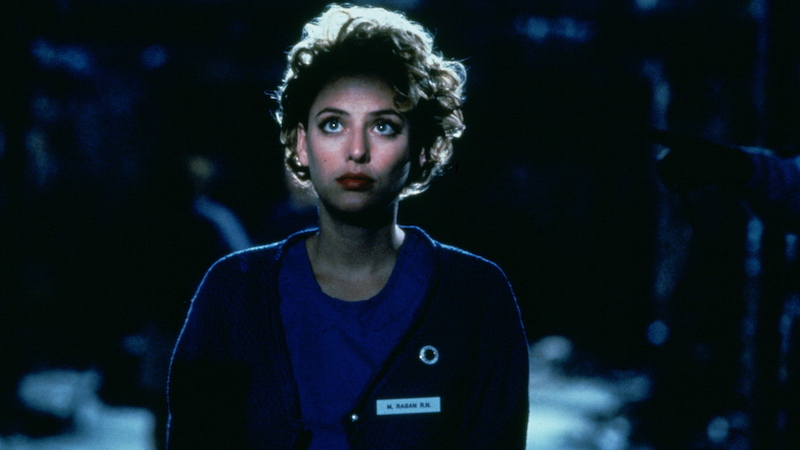
Under the Shadow is set in Tehran during the Iran-Iraq war of the 1980s and Shideh (Narges Rashidi) can no longer study medicine having been removed for her political beliefs. We are never party to what exactly her transgression is but suffice to say with the mention of ‘radical left groups’ she was – and probably still is – against the war that is currently waging in her country.

Once her chador is removed, we can ‘see’ some of her transgressions. Her hair cut (in a bob style), dress (westernised), and her autonomy around her home; the partnership with her husband, exercising to Jane Fonda. she’s also the only woman in the building who drives. This is a ‘modern’ woman, oppressed by external tradition and reduced to the confines of her four walls, and even those are not so secure with the shelling, daily explosions and air raids which can send residents into a panic at any given moment.
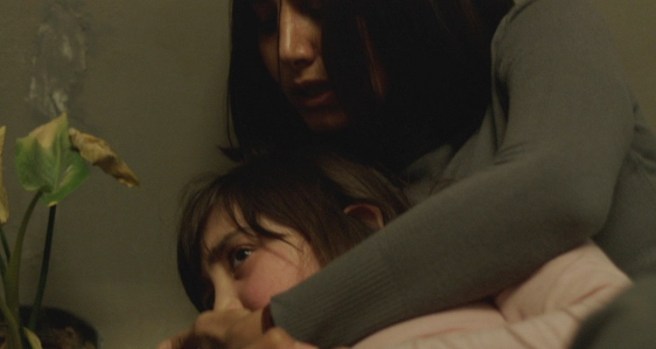
When her husband Iraj (Bobby Naderi) receives his draft notice, Shideh is left with her young daughter Dorsa (Avin Manshadi) as, one by one, all her neighbours pack up and move onto safety. The exacerbating factor a shell crashing through the roof of their building, killing the elderly resident within and leaving a gaping hole. The hole is covered with a sheet which appears to undulate in the wind like a bodily organ, flapping in and out like a heartbeat. A visual metaphor of a damaged culture, while the cracks in the ceiling – it can be argued – relate to Shideh’s psyche. Ever increasingly isolated, Shideh and Dorsa begin to experience things which may be the product of a child’s imagination or something altogether more supernatural.

Djinn is a malevolent spirit which has its history in Early Arabia and then later in Islamic mythology and theology. An entity that travels on the wind until it finds somebody to possess. Often dismissed as a superstitious belief, the spirit is reported to enjoy the souls of children (much like Krampus in European culture, or el Cuco in Latin America). It may explain Dorsa’s fever or not, after all Shideh was also once a child. Evil wants to hurt them alleges one neighbour while another, Mrs. Fakur (Soussan Farrokhnia), attempts to allay her friend’s fear: “people can convince themselves of anything if they want to”.

Tight framing adds to the oppressive atmosphere as mother and daughter’s fear and anxiety builds. Tension is slow-burning, and jump scares are few and far between yet effective when they do occur. There’s no score (music is only played during opening and closing credits) so is reliant upon diegetic noise and whistling winds. We’re never sure of the time of day given the constantly closed curtains and disturbed sleep patterns.

What appears to be mere moments gives the impression of hours. As people leave we can assume the passing of days and weeks yet the costumes of the leads mostly remain the same. Natural and artificial also play havoc with this, along with the production design: one location, open doors, hallways, and reflections in the television mean the constantly moving camera plays tricks with the eyes – was that something moving or not? Shideh’s lip is bruised from the constant biting, insecurity, anxiety, stress. Like all amazing genre films – nothing is ever quite how they appear and this film is all the better for it building beautifully the general sense of unease.
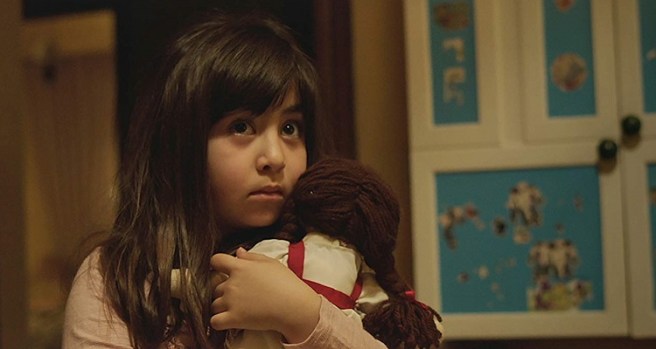
It seems apt that when she is preparing to fight, Shideh’s weapon of choice is a pair of scissors – as if tethered to a more domesticated past, her own mother’s apron strings or the chador in this instance. While the malevolent being appears to be set on persecution – even referring to the character as a ‘whore’ and ‘bad parent’ – it’s important to remember that Djinn is not inherently evil or good, and this entity could, at some point, be Shideh’s mother from beyond the grave.

A matriarch disappointed that her daughter will no longer practice medicine but needs to save her by forcing her to leave the building. Think back to the picture frame which houses Shideh’s mother’s portrait, the fractured glass obscuring the image within, it now laying down on the shelf hidden from view – but before that, the draped material serving as a backdrop in the photo is identical to the chador the entity embodies itself within. This reading further strengthens the mother-daughter links throughout, and the expectations a patriarchy levels at women, generally, but more so during the kind of regime in Tehran of the 80s.

As a first feature, Under the Shadow wears its influences well: Polanski’s apartment trilogy (Repulsion [1965], Rosemary’s Baby [1969], The Tenant [1976]) with a sprinkling of Hideo Nakata’s Dark Water via a domestic social realist drama in the ilk of Abbas Kiarostami and Asghar Farhadi. It’s a rich and visually arresting film which checks all of the above as well as featuring, at its heart, a really affecting horror fable. A 1980s Tehran-set horror film filmed entirely in Farsi – the first of its kind.

Finally, it has been given the kind of release it deserves courtesy of Second Sight that includes plenty of extra features, including five new interviews with the filmmaker, cast and crew, as well as a lively commentary between Director Anvari and film critic Jamie Graham, in which every aspect of the film’s genesis, production and release is covered.

Extras

Two & Two (8:48) – Babak Anvari’s BAFTA-nominated short film shown in its entirety. It’s the one extra which can be watched before the main feature.

Escaping the Shadow (23:53) – A long interview with Anvari who begins with his own childhood nightmares growing up in 80s Iran before his move to Britain. He talks at length about the filmmaking process, his cast, shooting in Jordan and expands upon things mentioned in the commentary. He’s a delightful interviewee, and while it is not the most imaginatively filmed featurette, Anvari’s charisma shines through.

Within the Shadow (12:52) – Star of Under the Shadow, Narges Rashidi discusses her own childhood in Iran and Germany and career now she is LA based. She describes the film as a ‘beautiful gift’, and again, static camera and a by-the-book interview reveals an excitable and rather lovely person.

Forming the Shadow (16:11) – Lucan Toh and Oliver Roskill talk all things ‘producer’, how they met Babak, the script, the film’s potential and their brief disappointment at not having to sell the film when it premiered at Sundance. A lot of their anecdotes are repeated in the commentary track.

Shaping the Shadow (13:29) – Anvari’s close collaborator and DoP Kit Fraser talks about his involvement from before the script was even written.

Limited Edition Contents – This set is limited to just 2000 copies, comes in a rigid slipcase featuring new artwork by Christopher Shy and with a soft cover book with new essays by Jon Tovison and Daniel Bird (unavailable at time of review). Plus behind-the-scenes photos, concept illustrations, and a poster with new artwork.

Categories
Blu-ray film review

Candyman (Dir. Bernard Rose, 1992)

It is interesting to note that the titular character of Bernard Rose’s 1992 film Candyman was a painter, an artist determined to leave behind a legacy; never to be forgotten: “I am the writing on the wall, the whisper in the classroom. Without these things, I am nothing…” The myth – dating back to 1890 – surmises that Daniel Robitaille (although we wouldn’t learn his name until the first sequel) was educated and enslaved, on account of his father’s invention which assisted in the mass production of shoes after the Civil War.

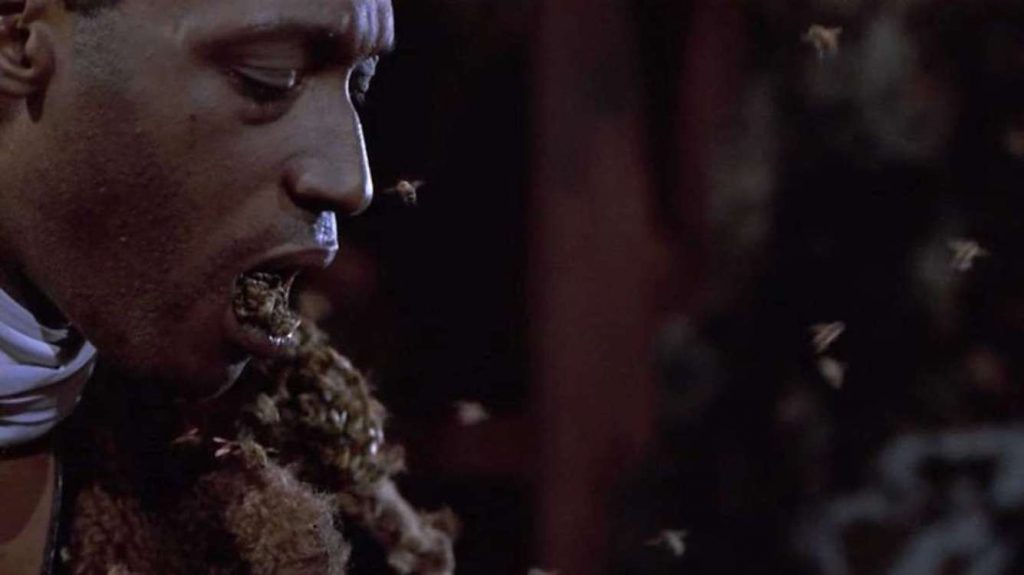
Robitaille was commissioned to paint the portrait of a wealthy landowner’s daughter. The two fell in love and when a child was conceived, fear of miscegenation led to a mob chasing the artist from town to the outskirts where his hand was sawn off, and his body smothered in honeycomb for bees to devour. 100 plus years later and, according to folklore, his soul and bloody hooked stump continues to haunt Cabrini Green, now home of the projects.

At least that’s what the legend suggests as it is told and retold, embellished by the storyteller, and those who believe in the Candyman (Tony Todd). For Helen Lyle (Virginia Madsen), the myth becomes a major part of her research. She and colleague Bernadette (Kasi Lemmons) are students at the University of Illinois researching urban legends as part of their thesis, within an academic department where being smug, white and male is a given. None more so than Helen’s own husband Trevor (an immensely slippery Xander Berkeley).

Helen discovers that there is a connection between her building and the apartments at Cabrini Green, after looking into the unexplained death of Ruthie Jean – a woman of colour who was mutilated in her bathtub by a killer who allegedly burst through her wall brandishing a hook. Helen interrogates the myth, and through her investigation we see just how limited her perspective is (in both literal and cultural terms), she is oblivious to anything outside of her area of interest until the myth has been appropriated. Only then does she (figuratively) wake up.

Rose – not unfamiliar with literary adaptations – has given audiences variations on numerous works of literature including his Tolstoy quintet of Anna Karenina (1997), Ivans XTC (2000), The Kreutzer Sonata (2008), Boxing Day (2012), Two Jacks (2012), and more recently his take on Frankenstein (2015). Candyman was his first authored screenplay, based on Clive Barker’s short story The Forbidden (which can be found within volume five of his seminal anthology Books of Blood). The Faustian-inspired story transposed Liverpool to Chicago, Helen’s surname became Lyle (from Buchanan), her thesis – which once centred around graffiti – now concentrated on urban legends, and class and race became intertwined in Rose’s vision. He kept the thematic material of the story but made it very much his own.

While the film is grounded in horror, part ghost story, part unconventional slasher by way of arthouse cinema. It plays with the tonal and generic shifts between the story and its retelling, building ambiguity before Candyman’s first full reveal to Helen (it’s well worth the wait), and their relationship as the film progresses.

Some have commented upon the fact that the film’s “villain” is a man of colour. True, however, he is not a typical “monster” (just like Helen is not a victim, despite his imploring her to be). Candyman is a tragic and romantic anti-hero, an eloquent and beautiful phantom who is seeking retribution from those who have wronged him. It’s an elegant performance by Todd who elicits as much empathy as scares, it’s hard to imagine anybody else embodying the handsome hook-man (although, what if the next is a white iteration or Yahya Abdul Mateen II*). He is led by an equally wonderful Virginia Madsen.

Her Helen is intelligent, determined and flawed, perhaps even unhinged. The line between the real world and the nightmare is completely blurred by the film’s midpoint. Is she responsible for the kidnapping of Anne-Marie McCoy’s (Vanessa Williams) baby boy? Is Candyman a figment of her imagination or is he the man who assaulted her? Has Helen lost her mind? There’s an old Hollywood glamour to Madsen/Helen, and yet she’s completely ordinary and easy to identify with. The choice of lighting her across the eyes is genius on the part of DoP Anthony B. Richmond (Don’t Look Now). It enhances those huge green windows especially when she appears in a trance, passively hypnotised by Todd’s velvet voice (in actuality, it was her director who was doing the mesmerising).

Richmond’s cinematography and Jane Ann Stewart’s production design have aged well. The graffiti and murals adorning the walls of Cabrini Green are still as effective – made all the more so by the careful 2K restoration from a new 4K scan of the original negative (supervised and approved by Rose and Richmond). Grain is kept to a minimum and the picture is perfect. Reds and petrol blues particularly bright and eye-catching along with that all important artwork on the walls leading to Candyman’s lair.

Bob Keen’s make-up FX is just as accomplished in a film that really was multi-layered and ahead of its time, (and still as timely today) even the bees are analogue with Todd pheromoned-up, standing in for the Queen. Apiculture has been practiced for a millennia, and given that bees are the creatives of the nature world, it’s a perfect extension of the art present. Philip Glass’ haunting, melancholic and melodic score brings the religious themes to the fore and is the aural icing on the cake.

By placing the film within a racial context, it polarises the worlds as they are depicted; white, middle-class academia and the poverty of the inner city African-American experience. Helen even spells it out: “A black woman is murdered and the police do nothing, a white woman gets attacked and they’re all over it.” However, as the film progresses it is evident that Helen and Daniel are linked rather than opposed. The racial and social commentary, however dated, opens up dialogue, not only holding up a mirror to an America of the past but what the future holds for people still living as a consequence of segregated housing. It will be fascinating to see how Nia DaCosta approaches the material in her version of the film.

Candyman continues to be an ambivalent and ambiguous arthouse horror film which depicts oppression and transgression, and manages to sustain the scares, even after 26 years. Bernard Rose and Tony Todd have created a legacy which will continue long after they depart.

Sadly, one of them now has… Rest peacefully Tony Todd (4/12/1954 – 6/11/2024)

Extras

Disc 1: US R-Rated Version

Audio Commentary with Bernard Rose and Tony Todd – The disc boasts not one but two audio commentaries. The first is provided by writer-director Rose and star Todd (his introduction is a particularly nice touch). The pair are obviously close, having reunited for Frankenstein, and cover a whole host of topics. Todd reviews Infinity War, A Quiet Place, and Halloween. We hear Rose’s opinion on sequels, the new Halloween and his favourite horror films (he has excellent taste). The two men tend not to pay much attention to what’s onscreen, choosing instead to talk about the cinematic essence of the horror genre, offer occasional anecdotes re: filming, what constitutes as “American”, politics and social media, and the notion of fear. This is highly entertaining and well worth listening to.

Audio Commentary with Stephen Jones and Kim Newman – The second places the film within critical context by writers/critics Jones and Newman. They discuss their friendship with Clive Barker and his stories which have been made into memorable films. They analyse the cast and their respective performances. Theirs is actual commentary accompanying the film as it unfolds and they offer several readings of the film and briefly consider the logic of nightmares (which allows for plot holes).

Be My Victim: Interview with Tony Todd ©2018 (9:38) – Todd discusses how he got the role, the romantic gothic horror elements of the film, and his approach to the role which included ballroom dancing. He likens Candyman to the Phantom of the Opera and speaks positively, not only, of the experience but of Rose who he describes as a “highly intelligent” filmmaker. He touches upon his costume, location shooting including the active gang members who agreed to be on film, and facing his fear of bees. It is evident that he has a great deal of affection for both Rose and the character. The racial aspects of the film are still open for discussion and Todd welcomes the conversation.

It Was Always You, Helen: Interview with Virginia Madsen ©2018 (13:00) – Madsen talks about her first action(s) following getting the role; going for tests as she was allergic to bee stings and eating a lot of pizza as Bernard wanted her a little rounder as Helen. It’s a lively and informal discussion, much like Todd, Madsen is clearly comfortable talking about the film, the experience and having a close working relationship with he cast/crew. She’s incredibly proud of the film, it remains one of the best experiences she has ever had, particularly enjoying waltzing with the “beautiful and gentle” Todd.

The Writing on the Wall: Interview with Jane Ann Stewart ©2018 (6:10) – Stewart worked as Production Designer on the film, and here discusses scouting for locations, basing her designs on truth and just how much fun she had working on Candyman, especially as a student of Art History.

Forbidden Flesh: The Make-up FX of Candyman ©2018 (7:49) – This featurette interviews (albeit separately) Bob Keen, Gary J. Tunnicliffe and Mark Coulier the three British make-up artists who were responsible for the FX of Candyman.  This is interesting especially as they describe “making” excrement for the walls of the public bathroom from a selection of biscuits, and the forging of the hook. “Proud” is definitely the verb of choice from everyone interviewed about this film.

A Story to Tell: Clive Barker’s The Forbidden ©2018 (18:28) – Critic/writer Douglas E. Winter critiques Barker’s seminal Books of Blood and original source story The Forbidden. Winter is an adorer of Barker whom he describes as the “finest horror writer of the [80s]”. He also discusses Rose as author and artist and briefly touches on the feminist aspects of the Candyman sequels: Farewell to the Flesh (1995) and Day of the Dead (1999).

Urban Legend: Unwrapping Candyman ©2018 (20:21) – This critical analysis of the film by UCLA Lecturer/writer Tananarive Due and author/screenwriter Steven Barnes is the highlight on the disc. They consider the film from a Black historical context and gaze. Their analysis is invaluable, intelligent and allows for the viewer to reconsider a film text they think they know. Subjectivity is a fascinating tool and representation matters, as well as diversity behind the camera. This is essential viewing, not least because, Madsen aside, Due is the only woman involved in this boxset as a whole.

Bernard Rose’s Short Films – Three films – newly restored in HD – which cement Rose’s filmmaking prowess. Fans will see techniques, themes, and motifs which continued through his entire oeuvre to date.

  • A Bomb With No Name On It [1975] (3:34) – Terrorism is approached with horror elements and a classical score (he had to start somewhere). The action takes place in a busy London restaurant with the bomb maker, a white middle-class male. Perhaps an allusion to the IRA bombings of the seventies.
  • The Wreckers [1976] (5:54) – A film depicting ‘youth’ and more specifically a teenage boy and the party he throws when parents his head out for a dinner party amongst their peers. The generational divide is seen through the juxtaposing of the two soirées. Sparkling water is the adult’s drug of choice as the teens spark up their joints. It’s brilliantly created, mixing contemporary music with classical before the evening descends into coloured-filtered horrific chaos.
  • Looking At Alice [1977] (27:24) – This is Rose’s black and white avant garde film (every director has one). He plays with voyeurism as his protagonist watches and stalks the object of his affection through her love and conquests. Rose, once again, utilises classical music, jump cuts and repetitive dialogue. All three films are a welcome extra on the the film that many consider Rose’s masterpiece.

Theatrical Trailer (1:59)

Image Gallery – A slideshow continuing 40 images including film posters from across the world, VHS covers, film stills, publicity stills and lobby cards. It’s interesting to note the different studios that have historically owned the rights to Candyman.

Disc 1: Original UK Theatrical Version

The Cinema of Clive Barker: The Divine Explicit ©2018 (28:00) – This in depth interview with author/director/visual artist Barker, who discusses his literary work and the subsequent film adaptations, including Rawhead Rex, Hellraiser (with his old school chum Doug Bradley), the connoted homosexuality of Nightbreed and, of course, Candyman. He talks about horror and what it does to us as a film audience, finding beauty in the darkest of things, celebrating difference, and his childhood. It’s a fascinating interview. Barker looks gaunt, ageing following operations to remove polyps from his throat. As Americanised as his accent is now, the Liverpudlian is still evident to the trained ear. On a personal note, it’s heartwarming to see and hear someone with a huge talent be a success in a field you love who also happened to go to your old school and sound a bit like you.

As if that wasn’t enough, there’s also:

  • Exclusive packaging featuring newly commissioned artwork by Gary Pullin (although, it appears that his hook in is the wrong hand).
  • 6 lobby card reproductions
  • Reversible fold-out poster featuring two artworks
  • Fully illustrated collector’s booklet featuring new writing on the film by festival programmer Michael Blyth (unavailable for review).
  • Limited Edition bound booklet reproducing the original hand-painted storyboards by Bernard Rose

Yes, it’s a little odd that Philip Glass isn’t featured amongst the extras at all, a copy of the score would have rounded off the boxset nicely. The severe lack of women is also disappointing, specifically in a critical capacity or interviews with the other women in the cast.

That said, Arrow Films courtesy of their Video label have immortalised Candyman and his mythology in a stunning limited edition box set, packed with extra features that will make any film lovers cling to their rapture. Buy it, if you dare, just avoid mirrors.

Categories
film review

Untouchable (Dir. Eric Toledano and Olivier Nakache, 2011)

In the same vein of adapted memoirs, The Sea Inside (Alejandro Amenábar, 2004) and The Diving Bell and the Butterfly (Julian Schnabel, 2007), Untouchable (AKA The Intouchables) too portrays a male protagonist living with a severe disability. While the aforementioned films attempted to encapsulate the struggle of locked-in syndrome, and a fight to end a life with dignity, this light comedy-drama provides the affecting story of two men trying to re-start their lives in light of personal circumstance. It is a surprising movie with a simplistic narrative and two great lead performances.

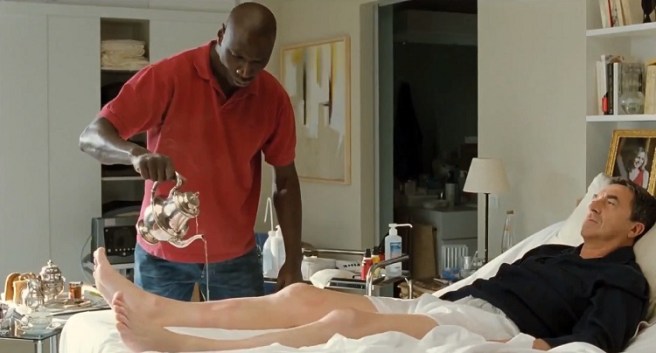
Widower, Philippe played by Dustin Hoffman-döppelganger François Cluzet (Little White Lies) lives an aristocratic lifestyle surrounded by staff on the outskirts of cosmopolitan Paris. Left quadriplegic after a paragliding accident he is without a male carer and has to interview for help several times a year, as no employee stays longer than a matter of weeks. Enter Senegalese-born ex-convict Driss (Omar Sy, Micmacs) from the projects; the only applicant in jeans, trainers and without experience or formal qualifications. The city’s Benefit Agency has organised a series of interviews as a formality; if Driss is refused three positions then, and only then, will they consider his claim and he can be supported by the state. He is large, loud and brash, in complete contrast to the staid Philippe, not least in class, race and musical taste.

When Driss returns to the rich man’s home the following day after their first meeting, he finds the necessary paperwork signed and the offer of a place to live and gainful employment; all he has to do is choose which and take the chance to make something of his rudimentary and, seemingly, directionless lifestyle. While Driss has to make these kind of decisions, in contrast, Philippe has not missed out on any aspect of his life. He has had no previous pecuniary restrictions but now his body and physical limitations have left him a prisoner, unable to do very little for himself. His most useful and powerful attribute is his mind and his articulation of language and expertise in the cultural arts has cemented a long-distance relationship with a woman in Brittany, albeit through the penmanship of another.

Driss, fabulously, dismisses aspects of Philippe’s disability which can be interpreted as both ignorance and innocence. He does not view the world as others do and often “forgets” his employer/friend is without the use of limbs and functions many take for granted. His pragmatism not only educates him but softens Philippe whose insistence on “no pity” is completely embraced by the younger man and it is this which charms most around him.

Chance is a recurring theme throughout this remarkable film, specifically, grabbing any and all that present themselves; this film depicts the opportunity to take a walk in a stranger’s shoes and touch their life, however briefly, is a rewarding endeavour. That said, this film never feels manipulative or overtly sentimental, it is a poignant reflection on living to the fullest, beyond mere existence and is portrayed through two extraordinary performances by the two leading actors, who manage to shatter any stereotype pertaining to class and race.

Cluzet is, as ever, outstanding as Philippe; the French veteran has, over the years, consistently proven his acting mettle. It is, however, relative newcomer Omar Sy (a 12-year-long career in comparison to his co-star’s 30 plus) who shines. His luminous grin lights up the screen and, along with his honesty, comedic timing, dreadful singing ability and love of 70s disco, is infectious. I defy anybody not to leave the cinema without a smile upon their face – in addition to damp cheeks – and a warm feeling in their heart; life affirmed, however briefly, from this inspiring, feel-good, crowd pleaser.

Categories
Blu-ray film review

Man of a Thousand Faces (Dir. Joseph Pevney, 1957)

Man of a Thousand Faces begins with the following cue: “On August 27 1930, the entire Motion Picture industry suspended work to pay tribute to the memory of one of its great actors. This is his story.” Except, well, it’s not. It’s the ‘Hollywood’ version steeped in melodrama and all a little dull.

At the Universal studio lot, the flag flies at half-mast as Irving Thalberg (played by the late Robert Evans, sans perma-tan) makes his own tribute to “The phantom of the opera.” In actuality, work was not suspended but a two minute silence was conducted in the wake of Lon Chaney’s death – nor were his most successful films made at Universal… This film starts as it means to go on, dramatising and conflating the life of an extremely private man who, if history books are to be believed, would have shunned even this mediocre production.

The biopic begins with the obligatory flashback which will serve the overarching narrative and then loop back around; aligning childhood, trauma and tragedy which is seemingly how it wants to establish Chaney (James Cagney). It traces his career from the Vaudeville stage to the cinema screen and admirably attempts to squeeze 30 years into 122 minutes, perhaps had the film been cast differently it may just have worked.

As talented as Cagney arguably was, there’s no way he can pull off aged 22 at 56 convincingly. Not to mention the physical limitations; a tall sinewy figure with a distinctive growl never really translates to a chipper Irish-American barely reaching 5’7”. Star personas were prevalent during the studio system and it’s fair to say, Cagney was horribly miscast nor did he have the lithe grace Chaney exhibited or the creepy melancholy.

If there’s one word used to describe the tone of the film, it is tragedy, as it prefers to add weight to the man’s alleged suffering than his film career. Hammering home his deaf-mute parents, hitting child abandonment and the dissolution of his marriage along the way, to having to place son Creighton in an orphanage and then, well, death. It’s all rather dreary; at odds with the sweeping epic soundtrack and the man whose early career began in Vaudeville and making people laugh. Why his parents’ deafness defines him or them, for that matter, appears to be a sign of the times – as for when that is the film does little to quantify. Creighton (he who would become Lon Chaney Jr.) is the only real evidentiary passage of time as the part is split between four actors (Dennis Rush, Rickie Sorensen, Robert Lydon and Roger Smith) each older than the next. None of which is helped by the occasional fifties-looking costuming.

Before his ‘big break’ as a lead, Chaney worked tirelessly and took every job he could, often making himself over and disguising his natural attributes depending on what was required on the call sheet. His ground-breaking make-ups led the way for the likes of Jack Pierce. Bud Westmore, Dick Smith, and, of course, Rick Baker among many, many others. It was then that casting agents began to take notice and he was cast in The Miracle Man thanks to his ability to twist and coil his body into unnatural positions. This would lead to arguably his greatest roles: The Phantom of the Opera and The Hunchback of Notre Dame in which he gravitated, yet again, to the tortured and afflicted depicting the tormented empathy of Quasimodo. Cagney tries but it’s hard not to see Cagney playing ‘Cagney’ imitating Chaney, or ‘Chagney’ if you will.

Obviously, given the decades between meant different make-up processes and evolution of the prosthetic. The make-up recreations in Man of a Thousand Faces are pretty awful given that Westmore et al would have used more modern supplies and they are still nowhere as convincing as Chaney and his ‘crude’ materials. Eagle-eyed viewers will also notice that camera-angles vary in relation to the original films, they’re not quite as polished.

It’s not all terrible, there are some high points. The father-son relationship shines and the performances from the actors who played the young(er) Creighton are lovely. These moments highlight Chaney’s love of mime and character, donning wigs and a false nose to “show” his son a bedtime story. The use of sign language is refreshingly brilliant for a film as old as this, when communicating it’s all about the face which for Lon Chaney it was. His.

He worked in cinema from 1914-1930 with 100 of his 157 films either lost or destroyed. It’s a missed opportunity that the 2000 documentary, The Man of a Thousand Faces narrated by Sir Kenneth Branagh isn’t included in the extras here. However, if Chaney holds an interest for you, seek it out, it’s really informative and one gets to see the original performer rather than a shallow impersonation. While the film never quite reaches the heights expected, the transfer is stunning. It is clear and crisp with very little residing grain which serve the make-up replicas and those stark chiaroscuro shadows which ‘Chagney’ often lurks within.

Lon Chaney died from a throat haemorrhage brought on my complications from the cancer that he was diagnosed with years earlier. An almost karmic fate for a versatile entertainer who sought silence both on stage and screen – his last film (a remake of Browning’s The Unholy Three) was his only speaking role – and has been revered ever since.

Disc Extras

Commentary by Tim Lucas – this is highly informative and provides great education for those unfamiliar with Chaney and his work and those that are interested in their broadening their knowledge. Lucas provides lots of information and titbits, paying particular attention to historical context – something the film sorely lacks.

The Man Behind a Thousand Faces: Kim Newman on Lon Chaney (20:52) Filmed in a cluttered room full of DVDs and books, Kim in his signature red waistcoat and cravat discusses the silent stars of Hollywood’s heyday including Chaplin, Garbo, Valentino and of course Chaney. Newman’s brief foray into the topic is not overly focussed and feels more conversational in tone which is a great contrast to the slightly more scripted and academic commentary. He maintains that Chaney lingers long in the cultured memory “and without Chaney’s make up Karloff and Lugosi would have contrived to play gangsters, and never Universal monsters (though, I’m sure Jack Pierce would have argued with that). He also thinks Cyrano de Bergerac was the role Chaney was made for but never got the chance to play. The chat is intercut with clips from the films and sadly, ends rather abruptly.

Theatrical Trailer (1:33) – It’s always worth watching the film’s theatrical trailer if only to see the original footage prior to the restoration process, and the extent of the transfer and clean up.

Image Galleries – These include 82 slides of production stills which show the costumes and make-ups in greater detail (not always a pro) and give more opportunity to see Bud Westmore’s clunky recreations albeit all in black and white. In addition to the slides, there are 18 posters and lobby cards in both monochrome and colour from all over the world including France, Spain, Germany and Russia.

Categories
Film Festival film review

Babyteeth (Dir. Shannon Murphy, 2019)

LFF 2019

Small-time drug dealer Moses (Toby Wallace) literally barges his way into Milla’s life while she is standing on the platform awaiting her train home from school. In the following moments, the jittery off-his-face-on-pharmacuticals nervous energy of the scruff-bag almost guarantees he won’t be going anywhere soon. He “saves her life” by stemming a sudden nosebleed with the shirt off his back. She offers to give him fifty bucks if he’ll do something for her, and as Moses hacks off her long hair with dog clippers, Milla (Eliza Scanlen) is smitten.

Meanwhile, across town (still in Sydney), therapist Henry Finlay (Ben Mendelsohn) is listening to Anna (Essie Davis) who is laying on an ottoman in the middle of the floor while he devours a sandwich. Only when they begin to awkwardly orchestrate sex on Henry’s desk do we realise that they are husband and wife and Milla is their daughter. Oh yes, and Milla has – although the word is never uttered once during the film’s 118-minute duration – a form of cancer.

Surrounding the Finlays – and Moses – are a cast of memorable and wonderful characters. There’s heavily pregnant Toby (Emily Barclay) who has recently moved into the house across the street, Latvian music teacher Gidon (Eugene Gilfedder) – he teaches Milla violin and was once Anna’s musical touring partner, Tin Wah (Edward Lau) – an accidental truant who’s a musical prodigy in the making, and Zachy (Zack Grech) Moses’ little brother. Each flesh out the story in their own memorable way but the film belongs to the four leads: Scanlen, Wallace, Davis and Mendelsohn.

To reveal more about the plot would spoil but suffice to say Shannon Murphy’s directorial debut feature is a little beauty. Based on Rita Kalnejais’ 2012 play – she adapts her own work for the screen – it thankfully has kept all the descriptors from the stage version. The film is chopped up into vignettes, each given a title which don’t always work, often only serving as a distraction, however, here are edited together flawlessly. They even help create a laugh before any action unfolds.

Murphy’s direction is subtle and natural – nothing feels forced. Light floods every frame even during night-time sequences, this is not a film about death despite its looming scythe but a celebration of life, first love and family achieved in such a beautiful way. Babyteeth is a bittersweet comedy and utterly unique. It’s not quite a coming-of-age story nor is it one of those heinous last-chance-at-love stories where the dying girl lies pale and clammy in her bed, or is accompanied by an oxygen tank in every scene. There is hope, joy and teen angst everywhere, and yes, the sobering fact that Milla may die is never far from the audience’s minds but her illness doesn’t define her.

Eliza Scanlen more than proved her acting mettle in Sharp Objects (a penchant for teeth too it seems) and creates a fully-rounded character in Milla. She’s not always likeable (what teenage girl is?) but we empathise with her, and can’t help but love her. Toby Wallace is brilliant as (almost) complete loser, Moses, who’s not beyond redemption, and nowhere near boyfriend material. Yet, there’s something so sweet and tragically melancholic about him. Which leaves the ‘olds’. If you’d like to see a masterclass in acting from two Australian legends of the large and small screen, look no further than Essie Davis and Ben Mendelsohn. They’re fabulous in most things individually but together something else entirely.

That’s one of things this film does so well, it’s not just about a diagnosis or how it effects the sick but those around them, and Davis and Mendelsohn convey so much with very little. It’s in the nuance of a sigh, a look, a nudge of affection, a kiss on the forehead, or getting exasperated at your wife’s ‘shower move’ just so she can get you naked. Let’s just say, Moses isn’t the only one self-medicating and dulling the pain, Anna hasn’t been able to play the piano at all since Milla’s news.

Music plays a huge part of this film, it’s what opens it – a string quartet hammer out a gorgeous version of “Golden Brown” while the remainder of the soundtrack – wonderfully put together by Amanda Brown – varies from electro, soul, cheesy pop to Mozart and Bach. Each piece conveys emotional heft and given that music means so much to the mother and daughter onscreen, it’s a really lovely way of exploring their relationship without unnecessary exposition.

Milla still has one of her baby teeth – hence the title – the perfect symbol for the childhood she wants to be free of and the adulthood she may never encounter. As a film, Babyteeth is a glorious joy from beginning to end; heart-aching and hilarious with an immensely talented cast who genuinely make this a special experience.

Quoted in the trailer! :)