
Never one to shy away from the confrontational, Amat Escalante’s follow up to the unflinchingly brutal Heli (2012) is available now on DVD and Blu-ray courtesy of Arrow Films and its Arrow Academy label.
Straddling science fiction, horror and a Mexican kitchen sink drama, The Untamed, begins with a lingering shot of a meteor hovering in space. Its crash to Earth occurs off-camera but leaves a large crater in its wake and t brought something with it. That ‘something’ has tentacles, presumably a respiratory system of sorts, despite having no visible organs or features, and has taken up residency in the barn of an ageing couple (played by Oscar Escalante and Bernarda Trueba). It has a regular visitor in the form of Verónica (Simone Bucio) who, well it’s never made implicit what or how she serves the alien form despite strong indications; only that on this occasion, she is injured and forced to leave and find aid.
Shocked and bleeding, she seeks refuge in a local hospital where her wound is treated by Fabián (Edén Villavicencio) and one thing leads to another and the lonely and somewhat mysterious Verónica inserts herself into the gay nurse’s life and by extension his sister Ale (Ruth Ramos) and her less-than-blissful domestic set-up with cheating, bullish homophobe husband Ángel (Jesús Meza) and their two small boys. The stranger convinces them that the life form which resides in that barn is the answer to their problems just prior to and even after devastating, irreparable tragedy.

Apparently made as a direct response to chauvinism, mainstream homophobia and the moral perception of tragedy, this fantastical allegory builds atmosphere with a literal humming buzz in the diegesis and taps into our basest primitive state, and the relationship between pain and pleasure. This dichotomy is beautifully depicted through Ale and Angel’s youngest son and his love of chocolate, he knows he’s allergic but can’t resist. Those moments of gratification are worth it, even if it means an angry-looking itchy red rash and a prodding injection. Seemingly, for the adults, pain and pleasure mature through sex and violence, however, this is never fully connected within the film’s narrative, the strange alien life force or the human subjects.
The Untamed deals with hefty subject matters and is a human drama within a sci-fi-erotic-horror film. Several scenes are clearly influenced by Andrzej Žulawski (the late filmmaker is even acknowledged in the closing credits), there are moments which feel Cronenbergian, and even includes a scene which reminded of von Trier’s Antichrist (2009). The horror aspects never feel forced and are fascinating, specifically the creature, one is drawn to it much like the lost souls in the film yet it’s not given that much screen time. Sadly, it is in the human drama aspect that the film falls down. There was an intensity, rage and heft to Heli and even Žulawski’s Possession (1981) (if we’re to take that as the main text of inspiration) which feels missing here; yes it’s subversive, intelligent, and well put together but overall muted and a little disappointing.
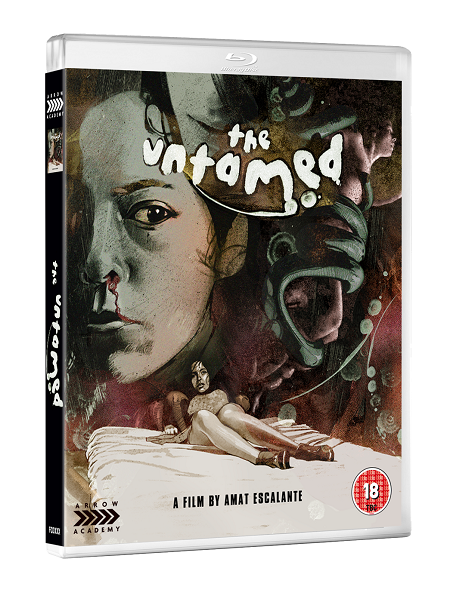
DISC EXTRAS
The Making of The Untamed (84 mins) – this in-depth footage takes us behind the scenes with the cast and crew of the film, shot by one the film’s composers and the director’s brother, Martín Escalante. There are fascinating moments, warm interludes between filmmaker and his collaborators – who seem to compromise of some long-term friends and family members – and laborious retakes in shooting. Amat Escalante is a perfectionist, that much is clear.
Amarrados (Tied Up) (15 mins) – Escalante’s first short which took first prize at the 2002 Voladero International Film Festival in Mexico and won him Best Short and Best Director at the Newport Beach International Film festival in 2003. Shot in black and white, the film centres around Niño (Abel Diaz), a young homeless boy who’s stuck in a vicious cycle of sexual abuse and glue-sniffing. There’s a beauty amid the misery in this short, in which class, race and religion are alluded to and Escalante’s follow-shot is included: a great edition to the disc.
First Pressing Only – Booklet featuring new writing on the film by critic and author Alexandra Heller-Nicholas, writing by critic Jonathan Romney, the director’s statement and extracts from the press book, illustrated with original stills (unavailable at the time of review).
Region: B/2|Rating 18|Language: Spanish|Subtitles: English/English SDH|Aspect Ratio: 1.66:1|Audio: Mono|Colour|Discs: 1
 The Framing Device