Categories
Film Festival film review

180° Rule (Dir. Farnoosh Samadi, 2020)

LFF 2020

It is not often that you hear women in Iranian cinema discuss abortion and rarely in the first twenty minutes of a film’s opening. It is the first indication that 180° Rule is a little different and that there’s a woman at the helm. Farnoosh Samadi, over the course of 83 minutes, subtly depicts a woman’s experience in a society fighting between tradition and modernity which renders women and girls without agency, and often leads to suffering and silence.
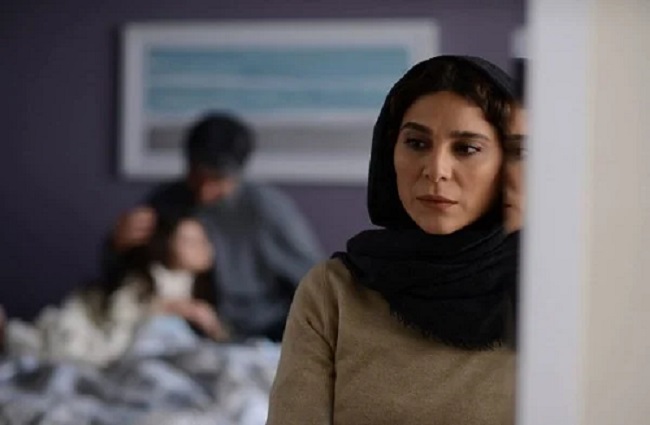
Sara (Sahar Dolatshahi) is a school teacher, well liked and preparing for a few days leave to celebrate a family wedding when one of her students, Yasi (Sadaf Asgari) admits to being pregnant (after swallowing pills to induce miscarriage). Sara offers guidance and advice where she can before heading home to pack. However popular she is at work, home life is a somewhat different matter – visually symbolised by the boiling, overflowing milk-pan on the stove in the opening frame – her husband Hamed (Pejam Jamshidi) is aloof, unfeeling, stoic and somewhat miserable. Criticisms come thick and fast and those that don’t are loaded in accusation.

She’s a nag, she smokes too much, she has allowed the cat on the bed again, she’s a bad driver, she’s responsible for his daughter being ill (it’s a cough and a temperature…) and then he’s claiming his workload will prevent him from accompanying her and daughter Raha to the upcoming nuptials. Which means that they have to stay behind lest travel unaccompanied or in the car with a ‘strange man’ (a taxi driver). This is made all the more disappointing by just how much his child has been looking forward to being the flower girl. Weighing up her options – and the expectations of her mother, extended family and daughter – Sara makes a choice and it is a decision that will change her life irreparably and we see the ripples for the remainder of the film.

During which time Samadi intentionally disrupts and disorientates the audience. The inclusion of Yasi’s subplot later on is purposeful and in keeping with the pace of the film and its reflection of reality. Change happens so quickly and impulsive, even inexplicable, decisions don’t always have time to reverberate or be made understandable – the plain and simple fact is that people, women can suddenly start acting strangely.

In a patriarchal society – like the one depicted so astutely onscreen – moral responsibility is placed on women, they’re conditioned to follow the rules, to do as they are told and avoid transgression at all cost. If they fail they’re expected to suppress their feelings and the pressures of secrets, lies, shame and guilt can often be their undoing, sadder still is that Samadi’s screenplay is loosely based on a true story. 

180°Rule is an evocative film that won’t necessarily be embraced by all but the juxtaposition of light and dark, black and white whether figuratively or in a lighting choice, a costume, or animal in frame is striking. Its mournful score, thanks to Amir Nobakht’s sound design only adds to the haunting melodrama and subtle social commentary.

It’s a technically impressive and visually arresting drama led by an extremely convincing lead in Dolatshahi. Were it not for her and the empathy she elicits, from what becomes a largely subdued and silent performance, it is doubtful the film would work quite so well. It will be likened to the work of Asghar Farhadi, somewhat understandably during one particular scene yet however flattering it is to be compared to a master filmmaker, and for a first feature no less (following short films: The Silence (2016), Grace (2017) and The Role (2018)), this piece of work is made all the more compelling, not in spite of but because of its female lens.

Categories
film review

Tranny Fag (Dir. Kiko Goifman and Claudia Priscilla, 2018)

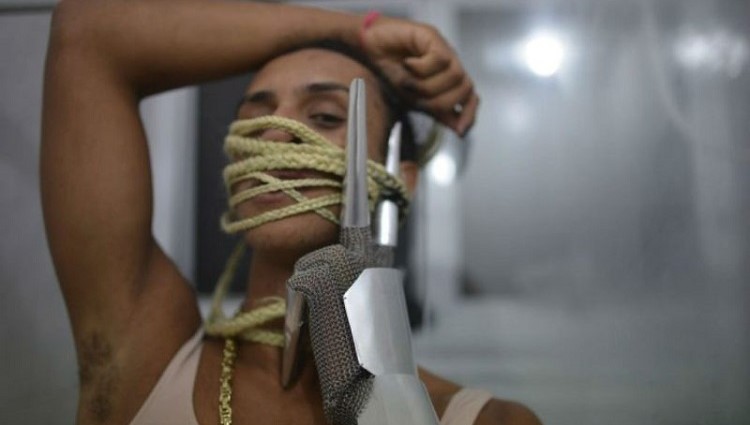
In the traditional Portuguese Tranny Fag translates as Bixa Travesty, a little less confrontational than the English but that’s just not the style of the documentary’s subject Linn da Quebrada – the self proclaimed “tranny fag”. Residing on the outskirts of São Paulo, she is marginalised economically before even considering the fact that she’s black and transgender, struggling to exist amid poverty and in a world that, for the most part, doesn’t comprehend her.

Rather than shy away from the public eye, Quebrada is taking the Brazilian funk scene by storm, alongside her partner-in-crime Jup do Bairro. Their songs – (performed throughout) providing a back story of sorts for the 27-year-old – contain abrasive coarse lyrics which pull no punches and berate society and the expectations it places on women, what it means to be a woman like her, and dismantling the patriarchy one bridge and chorus at a time. Her words are a weapon intent on holding the world accountable and paving a way of acceptance and understanding without inciting hatred.

As a subject, the singer-songwriter and spoken word artist is fascinating and inspiring. She’s pre-op and has yet to start hormones, consider breast implants or remove her facial hair because as far as she’s concerned she’d be pandering to society’s ideal of womanhood. Quebrada – who also co-wrote the script with directors Claudia Priscilla and Kiko Goifman – is a “black fag doll. Neither man or woman” embraces nudity, here and in her stage shows as an attempt to undermine, even recondition the collective mindset associating gender with genitalia and highlighting the façade of gender performance.

A real turning point in the documentary which jumps from talking head to music gig almost exclusively is the footage made during Quebrada’s treatment for testicular cancer, the physical effects and the profundity it had on the way she controlled her body. The scene which shows her literally pulling the lustrous locks of hair from her head, chemotherapy having ravaged her immune system is particularly powerful and in keeping with her persona, completely transgressive. This and the scenes with her mother offer a rare intimacy which is needed in an otherwise repetitive and prosaic documentary. The static camera and simplistic editing coupled with the pulsating combative stage performances start to feel isolating.

Tranny Fag is a LGBTQIA+ positive, important and transgressive, if slight, profile of a bold and beautiful artist who is unapologetically her confident self. She espouses her ideas and beliefs provocatively, is always interesting, and determined to not only stand out but belong in an accepting world.

Categories
Film Festival film review

Make Me Up (Dir. Rachel Maclean, 2018)

LFF 2018

For those unfamiliar with Rachel Maclean’s work, the Edinburgh-born multimedia artist created one of the 50-feet portraits of Billy Connolly which adorned the streets of Glasgow for The Big Yin’s 75th birthday. She also submitted a short: Spite Your Face to last year’s London and Venice film festivals. This piece focussed on a Pinocchio-type character – played by Maclean – who chases the lure of wealth within an abusive patriarchal power. It was made as a response to Britain’s decision to leave the EU and Trump’s presidential campaign. Within the mise-en-scéne its colours of choice were (Tory) blue and (Trump) gold.

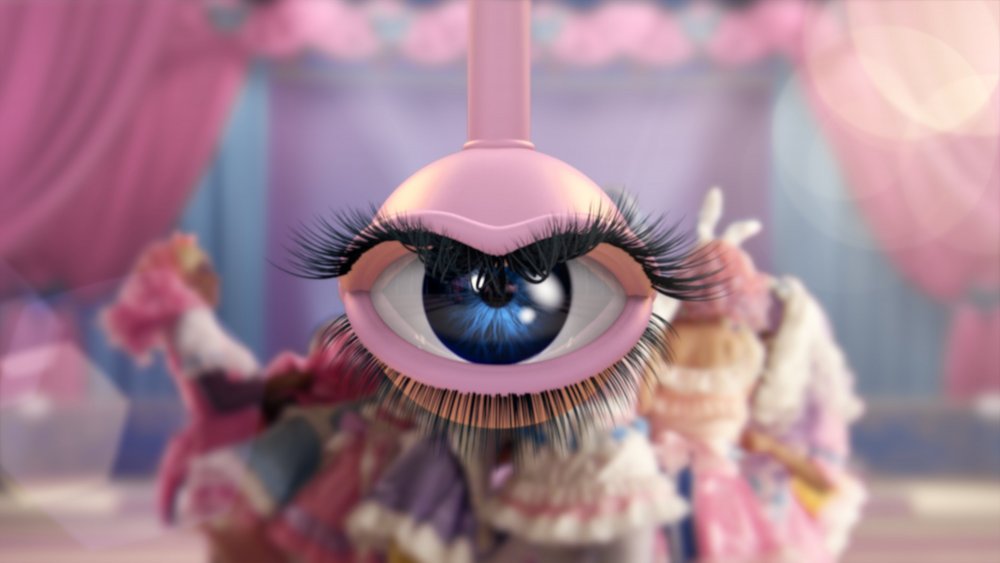
The artist’s first full-length feature – included in the BFI’s 2018 festival programme – uses bubble gum pinks, violets and blues in every frame, and like its predecessor zones in on the post-Brexit zeitgeist in a similarly confrontational and acerbic manner. Make Me Up begins with the familiar aural tone and visual most Apple users attribute to the Siri application, when a disembodied male voice asks, “Siri, when is the world going to end?” before a woman screams “I don’t know!” and her cries resonate over the black screen.

Siri (Christina Gordon) in this case is a woman, pink of hair, born of a gelatinous lump of flesh. Unsure of how she ended up in such an inexplicable place, she becomes allies with Alexa (Colette Dalal Tchantcho) and is forced to compete against several other women (there’s even a Cortana too) in a hyper-real game show of sorts. All under watchful Orwellian eye(s) which fall from the ceilings and monitor everything and everyone via facial expressions and status updates.

In charge is the Figurehead (Rachel Maclean). An equally magenta-haired woman who schools her audience on the role of women within civilisation and through the history of art. Like her ‘pupils’ she has no voice of her own but is a conduit for the dulcet tones of historian Kenneth Clark, and specifically his 1969 BBC TV series Civilisation. She has other voices in her arsenal, namely those belonging to Andrew Graham Nixon and critics E.H. Gombrich and Robert Hughes, all stored within a device embedded in her arm. Her mannerisms scream Thatcher as her lips sync to the pomposity of the white, male patriarch. The girls before her know to mind their Ps and Qs and if they don’t? Well, naughty girls are punished, pitted against one another before elimination. The winner gets to eat.

Every inch of the film is aesthetically pleasing – although some may find it on the kitsch-side (when is that ever a bad thing?) – from Maclean’s production and costume design (she is also editor and responsible for the compositing and 2D effects) to Grant Mason’s prosthetics and Scott Twynholm’s score; it is all substance and style. Maclean asks us to consider the toxicity of social media, the depiction of women in politics, art iconography and beauty culture. The use of The Woman of Willendorf and the Venus de Milo is particularly powerful to illustrate the evolution of the female image, with nods to the works of Michelangelo, Botticelli, and Munch later on.

Make Me Up is a biting and thought-provoking satire which could not be more timely, not least in its celebration of the Suffragist Movement. It presents the violent and submissive fears, desires, control and pressures surrounding women. It asks questions of the role of women in contemporary feminism and art, as well as realigning the male gaze albeit sardonically amid Freudian visuals (the breast-shaped door handles and phallic dinner meat are particularly delightful). It has aspects of Alice in Wonderland by way of Sucker Punch via Hartbeat.

There is, however, no all-encompassing decorative pink bow of a conclusion – as Siri plots her escape thanks to the support of the sisterhood, you will recognise a few – and some may even find the final shot dispiriting but thankfully women persist. Director/Writer/Artist and all-round multitasker Rachel Maclean has put together something highly intelligent and imaginative. It deconstructs the beauty myth (perfection paint, anyone?) and reconsiders art history, criticism and all with a grin on its face and a knowing wink. More please.

Categories
film review

Tag (Dir. Sion Sono, 2017)

When watching any film by Japanese filmmaker Sion Sono, it is safe to say no two films are ever the same. He can turn his hand to all forms of genre cinema and yet doesn’t conform to any. From his last, gang rap musical in Tokyo Tribe to the gritty noirish neon of Guilty of Romance through his masterpiece, the epic romantic opera Love Exposure to the wonderfully weird hirsute horror Exte, one is always guaranteed an aural and visual experience of radical proportions and Tag, which would make an excellent companion piece to Sono’s 2001 feature Suicide Club, is no different.

Opening on the road with two coaches full of schoolgirls on a class trip all – except Mitsuko (Reina Trendl) who’s writing poetry in her journal – engage in a playful pillow fight as girls are prone to, apparently (it also sets up the recurring motif of falling feathers). A supernatural event then leaves her as the only survivor and she’s stranded with only her legs to carry her. This invisible perpetrator chases her to a lake, leaving more victims in its wake, where Mitsuko can wash off the majority of the blood spatter covering her stark white school uniform. She replaces the outfit with a second variant of a uniform and takes refuge in another all-girls school where everyone seems to know her despite never being there before. It isn’t long before death and chaos follows Mitsuko and she is, once again, on the run to the next reality and the next uniform, this time with a different face as she races to survive.

Tag offers up some interesting and philosophical musings about life, death and destiny as Mitsuko (in a couple of guises) spends the majority of the film running away yet, towards something. Participating in the human race has us all running from/towards death and experiencing the absurdity of life; a concept which is taken very literally here but then, thankfully, subtlety has never been Sono’s forte when combining his arthouse sensibilities with bloody action and horror. Yet, this film seems to take some cues from mainstream culture like Alice in Wonderland via seventies comedy horror classic, House.

Keeping the cast predominately women until the very end leads us through a womanhood of sorts: adolescence, love, laughter, and freedom to marriage when everything, or so it appears, ceases – the Groom with the animal head who resides in a black coffin certainly signifies as much – cue more carnage. This then culminates to a meta end and one which can also be read as a deliberate and timely response to the GamerGate controversy. However, as Mitsuko battles the new realities and does finally enter The Male World, it all goes way beyond a 2014 harassment campaign. It’s a largely silent and grim place where, surprisingly, women are decorative objects and all for the playing pleasure of a wizened old man (astutely cast Japanese heartthrob Takumi Saito under convincing prosthetics). He is the personification of patriarchy bending the world to his will, playing with his dolls and twisting reality to suit.

Tag, (inspired by Yusuke Yamada’s Riaru Onigokko) is a highly intelligent and exhilarating ride. The creativity and aesthetic of Sono is the driving force behind this provocative and surreal little tale. It is a bloody riot yet beautiful in its macabre weirdness, not least in those first five minutes – only in something so very artificial and unconventional can reality resonate even louder. It is a shame that there are no extras on the disc as a featurette or director commentary could shed more light on the inspiration for it, however, the not knowing is also what makes Tag such a pleasing experience. You, just like Mitsuko, get to choose and decide its fate.

Categories
film review

Dances With Wolves (Dir. Kevin Costner, 1990)

The Western can be described as an opportunistic film genre[1], one often utilised as an ideological tool to re-write American history, and Kevin Costner has taken the occasion to create a mediocre revisionist Western fable. A cinematically, epic journey which is, admirably, the actor’s debut in the forum of directing. Costner has clearly taken inspiration from auteur John Ford and this is evident in Dean Semler’s sweeping cinematography of the Western frontier and surrounding landscape. Dances with Wolves[2] was born from an age of political correctness and post-Vietnam sensibilities and can be read as an apology for Westward expansion.[3] This film appears to be about righting wrongs, idealising and romanticising East/West history.

dww3

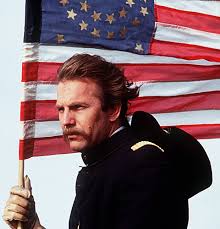
Much like Ethan Edwards (John Wayne) in The Searchers[4] following the end of the Civil War, Lt. John Dunbar (Costner) is on a quest to discover or re-cover his identity. The war has left him disillusioned and in search of change whether that be physically, emotionally or geographically. While The Searchers (and many more besides) depicted American racism, Costner attempts to propagate the notion of good and evil in the culture of Red and White, often seen as antinomies[5] of the Western genre – here, Sioux/Pawnee tribe(s) and Dunbar/Union Comrades. Both races are ignorant of difference and fear is driven by an ignorance of the respective worlds in which they reside. Dunbar embraces the tribe and attempts to assimilate into their world, offering his ‘White Man’ wisdom in an exchange of ideas.

dww5

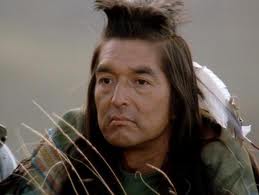
Michael Blake’s screenplay based upon his novel of the same name replaces the Comanche Indian with the Sioux tribe and each character performance delivers gravitas not least due to casting. White actors in ‘red face’ of the classical Hollywood era have, thankfully, been replaced with actors of Native American origin and defy stereotypes. Graham Greene, Rodney A. Grant, Wes Studi and Floyd ‘Red Crow’ Westerman depict the multi-faceted Native American and attempt to reconcile the ambivalence and ambiguity of the human spirit (something that the more-recently made Twilight Saga[6] has failed to do). They are, however, rarely shot alone within the frame and are often seen in groups; the ‘pack’ to Dunbar’s ‘lone wolf’. The same human ambiguity cannot be said for the female characters within the picture. There are two women who appear within the mise-en-scène, Black Shawl (Tantoo Cardinal) and the other, Stands with a Fist (Mary McDonnell). The latter is a white woman who has lived with the tribe since childhood and the only female who shares any prominence in the narrative – she is the means by which the two worlds of East and West/Civilisation and Wilderness can communicate effectively. When she is first introduced onscreen, she is in the same place of despair as Dunbar in the film’s opening shot; bloody, alone and without a reason to live.

dww

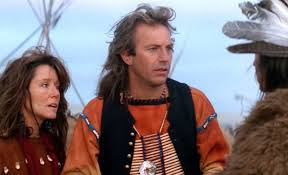
It comes as little surprise that Dunbar, now named Dances with Wolves, marries Stands with a Fist and by doing do re-enforces the white patriarchal ideology of the American identity. He has been the man caught between two cultures and attempts to birth a new identity – here alluded to by the removal of facial hair and Military dress. He grows his hair, wears Native dress and speaks in Native tongue, yet by marrying the only white woman in the tribe, miscegenation is avoided and the white race can continue to dominant the screen. Dunbar fights shoulder-to-shoulder with ‘his’ tribe in another Civil War, this time Sioux against Pawnee. This is a war he agrees with as the purpose is to make men free and is not ruled by political objectives.

First-time director Costner spends a slow-paced 114 minutes attempting to reproduce a version of the American ancestor, one that descendants can be proud of. One of racial inclusion, of understanding and empathy and yet the exclusion and absence[7] of the African-American race during the time of slavery and Civil War speaks volumes. Although, the subsequent release of films like Django Unchained[8] highlights the role of the African-American cowboy in history – the last film of note to depict a black character in such a film was Unforgiven[9] – there seems to be little room for a multi-ethnic American identity as the pre-dominant patriarchal white ideology still takes precedent and the ‘Frontier Hero’ will always, it would be appear, be white.

[1] French, P. Westerns: Aspects of a Movie Genre, UK: Carnacet Press Ltd [1977] (2005).

[2] Dances With Wolves (1990, dir. Kevin Costner).

[3] Barrett, J. Shooting the Civil War: Cinema, History and American National Identity (London: IB Tauris 2009, p81).

[4] The Searchers (1956, dir. John Ford).

[5] Kitses, J. Horizons West, London: BFI (1969).

[6] The Twilight adaptations have replaced the word Indian with Wolf but still depict Native Americans as angry young men waging war on the ‘White’ (Vampire) man.

[7] Cripps, T. ‘The Absent Presence in American Civil War Films’ Historical Journal of Film, Radio and Television, vol.14, no.4 (1994) p.367

[8] Django Unchained (2012, dir. Quentin Tarantino).

[9] Unforgiven (1992, dir. Clint Eastwood).