
“Our people once were warriors […] They were people with mana, pride… people with spirit.”
After his masterful directorial debut in 1994 – within which Rena Owen delivers the aforementioned line – Lee Tamahori found himself in Hollywood. Helming a multitude of thrillers and a Bond instalment before returning to his homeland, Aotearoa, and reuniting with Temuera Morrison for ’60s set period drama Mahana (2016), in which the Māori actor plays yet another terrifying patriarch. Morrison is the only thing missing from Tamahori’s latest project, The Convert.
In 1830, a decade before the Treaty of Waitangi (1843) was signed, lay minister Thomas Munro (Guy Pearce) is hoping for safe passage across the Tasman Sea to his new home of Epworth – a new colony taking shape on one of the islands. It’s a treacherous journey as a storm hits culminating in a fellow passenger being buried at sea, first-mate Kedgley (a fairly convincing ‘Northern’ Dean O’Gorman) isn’t worried. A quick stopover on a neighbouring island will enable them to restock supplies regroup before heading on their merry way.
Struck by its beauty, Munro wishes to camp there for the night – never considering it to be somebody’s home or what consequences his or the group’s presence will bring. It isn’t long before they find out. Having stumbled across a tribal war, Chief of the Ngāti Ruapu tribe, Te Akatarewa (Lawrence Makoare) pays his respects to King George before mercilessly killing Māori trespassers. Munro attempts to barter for the remaining lives, offering his horse as payment. Rangimai (Tioreore Ngatai-Melbourne) is saved but her husband perishes and she is forced to endure her grief aboard the settler’s ship until Epworth comes into view.
Things are not much better there. Self-appointed Mayor Beachamp (Mark Mitchinson) rents the land from the local chieftain, Maianui (Antoio Te Maioha) and has grand ambitions for the new homestead but only if his townspeople are white and English. Padgett (William Wallace) the Irish grocer and Scottish Hegarty (Jaqueline Mackenzie) – who happens to be the widow of a Māori warrior – are already shunned already and have no chance of integration. Sadly, it is no surprise how Rangimai’s presence brings the worst out of the locals who would rather let her die than supply medical aid. This, in spite of the fact they are visitors to her homeland and she also happens to be the landlord’s daughter.
Munro quickly finds his people – suffice to say it isn’t Beachamp and his cronies who deem anybody different from themselves ‘savages’ and yet murder with impunity while allegedly seeking justice. Who exactly is the savage, again? Munro, on the other hand, is an articulate and well-meaning man of God, happy to be guided by Hegarty who is able to speak te reo and teaches him about Māori culture, and never straying far from his notebook, within which he sketches portraits of all he meets and logs his identity, connections – his equivalent of tā moko.
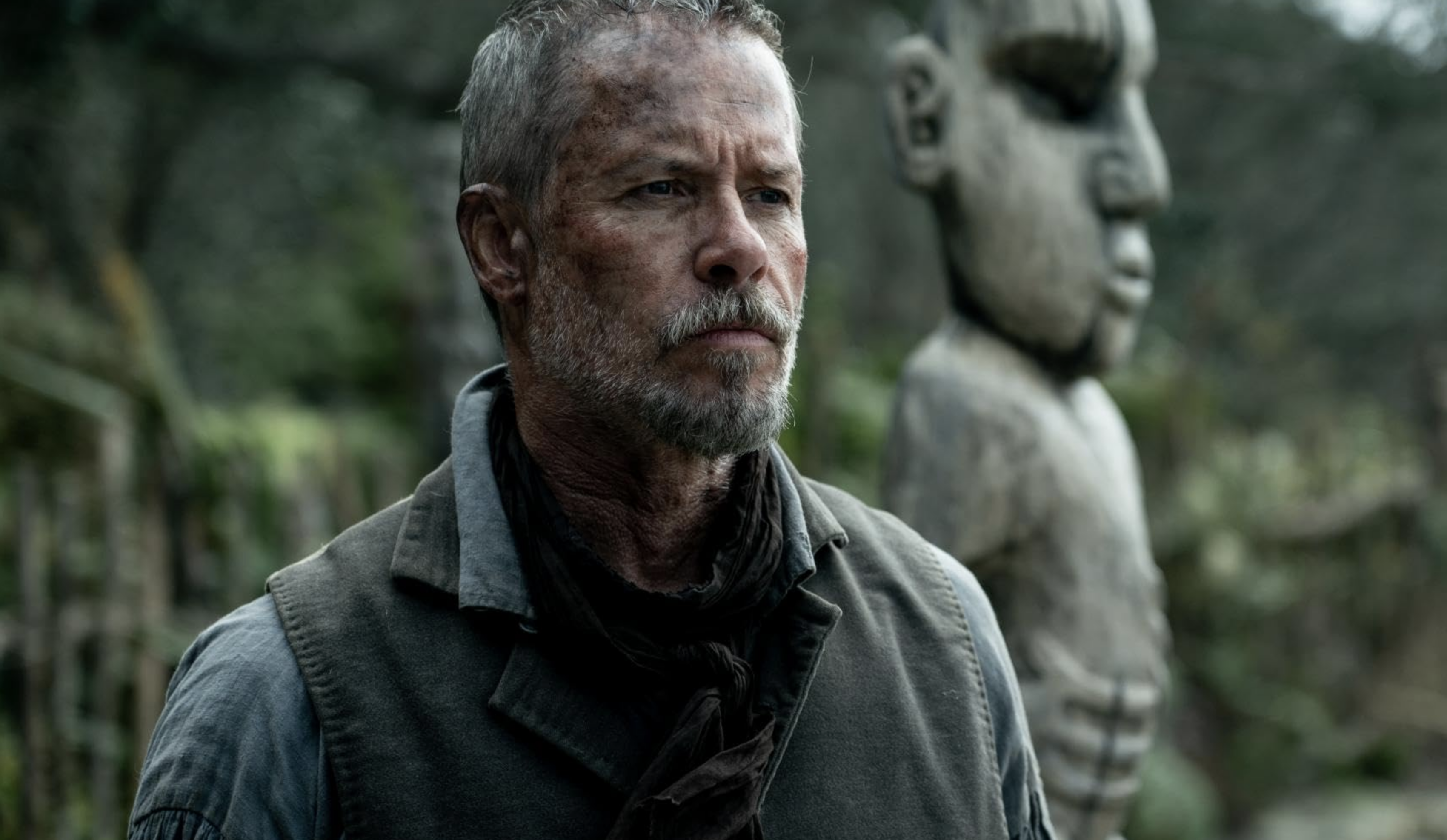
Inspired by Hamish Clayton’s Wulf, Tamahori depicts the messy complexity of Māori history, juxtaposing the Pakeha/Māori relationship with the interchangeable savage and civilised dichotomy often depicted in NZ Cinema. The brutality of the period in which irreconcilable cultural differences are ever present. Shifting allegiances and unstable male identity is shot in tandem, and within, the beauty of the land. The natural landscape is used here to heighten the dramatic sequences, darker sands shot against ominous skies overcast with clouds. While the greens of the majestic terrain are muted and cold, greys, browns and blues are punctuated with the occasional burst of red, white and/or black connoting the Māori flag – just like in Once Were Warriors.
The Māori depicted in this film are divided, partly on tribal lines but also between those who embrace utu and those who believe in a peaceful resolution, interestingly personified in daughter (Rangimai) and father (Maianui). Munro is the ‘man alone’ – but not for long – as male identities conflict, allegiances shift in and outside of cultural difference through tribal (iwi) or sub-tribal (hapu) groupings. Munro seems to have greater issue with white Europeans over anyone else and this level of self-hatred is made all the more clear once his own violent history is revealed. It’s a surprisingly emotional performance from Pearce whose jaw historically has always clenched, on the rare occasion grinned yet rarely have we seen him racked in sobs. He is deftly supported by Mackenzie but the real powerhouse is Ngatai-Melbourne. Her Rangimai is mesmerising and by far the most interesting character with a compelling arc.

The Convert is a sweeping historical epic, intelligently made and authentic in its depictions and performances. DoP Gin Loane does a tremendous job weighting the action onscreen in verisimilitude which goes hand-in-hand with Liz McGregor’s costumes and Gabrielle Jones’ make-up, the intricate ta moko beautifully recreated and replicated amongst the cast. While deemed (mostly) fictional, it is easy to place in a historical context. Munro appears to be a stand-in for Henry Williams (1792-1867) a man who was responsible for influencing several thousand Māori to convert and spread the word of a Christian God through much of the North Island. He also played an integral part in the translation of the Treaty of Waitangi too.
Over Tamahori’s trifecta of Māori films, he depicts a very specific timeline albeit not in the order of making. The events of The Convert and subsequent history paves the way for Mahana, concluding with Once Were Warriors working ever closer to encourage the authentic portrayal of Māori onscreen. More please.
The Convert is available to stream now.

 The Framing Device