Categories
Film Festival film review

Memory Box (Dir. Khalil Joreige and Joanna Hadjithomas, 2021)

On Christmas Eve as the snow blankets the ground and buries car wheels deep in Montreal, Alex (Paloma Vauthier) and her Téta (Clémence Sabbagh) open the door to a parcel from Beirut. The delivery – addressed to Alex’s mother Maia (Rim Turkhi) – is initially turned away by the oldest matriarch who declares that “the past stinks”. The box contains cassette tapes of a life suppressed; Maia’s teenage years of the 70s and 80s in the wake of the sender’s death. Liza was Maia’s best friend and her dying wish, it appears, was to be reunited with her friend albeit through their memories, photos, notebooks and audio files. While Maia is too bereft to embrace her past, Alex finds the perfect opportunity to connect with a country she has never visited and a woman, her own mother, whom she barely knows.

With the aid of the box the audience learns, along with Alex, what a life is like during war – for most of us, we have not had to experience it – and bridging the generational divide however possible. Images literally come to life and interact with the music playing from the cassette recordings, for example, a memorable time-lapse sequence sound-tracked to Visage’s “Fade to Grey” while, you’ve guessed it, fading to grey. It may sound trite but it’s far from it as real-action bombs and gunfire burn holes in negative strips, and a potentially simplistic premise is fleshed out. It is incredibly evocative of a country ravaged by war and visually impressive, beautifully edited by Tina Baz.

Shifting between fantasy and reality, and with the help of flashbacks Alex enters her mother’s adolescence, her dreams and nightmares during the Lebanese Civil war and the loves and losses overcome during a tumultuous time. Alex, with the help of the late Liza, her Téta and the memory box is able to embrace the most important relationship of her life and see her mother not only as a woman and friend but with new understanding. The same goes for Maia and her own matriarch.

With such heavy hitting themes surrounding death, trauma, and abandonment, it is often the case for films depicting this sort of conflict to do so with earnestness and solemnity, however, Memory Box doesn’t do that. There were some 120,000 fatalities during 1975-1990 but not all perished in Beirut, many survived, lived and thrived and it is these people who are celebrated, the dead honoured in this intergenerational tale with women at the heart of its narrative.
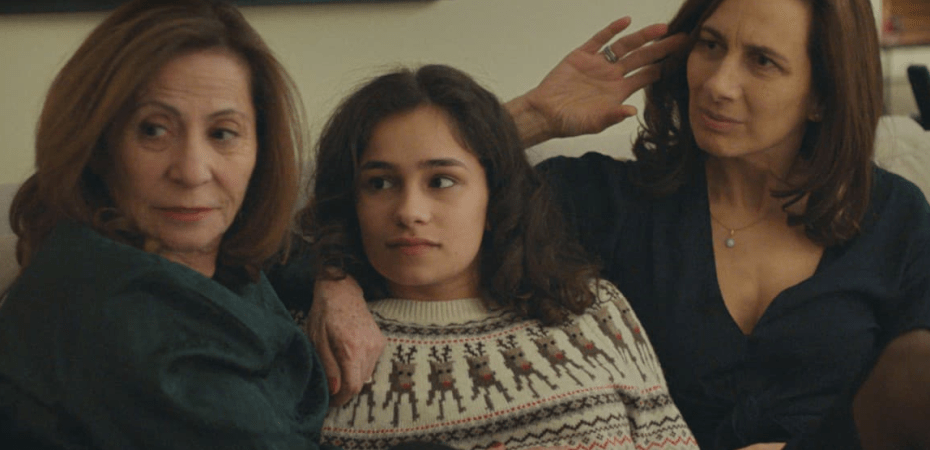
To go forward, one must go back and sometimes reunite with your trauma and, in this case, a homeland which has been suppressed, wartime survival which has been denied, tragedy which has been compartmentalised, like a photo film that has never been processed in over thirty years. There is a compassion to Joreige, Hadjithomas and Gaëlle Macé’s screenplay which is non-judgemental and forgiving, especially in relation to Raja’s reappearance as an adult (Rabih Mroue). The first half may rely of a visual inventiveness and the image, yet, the second still manages to hit with emotional resonance and be deeply moving brimming with moments of levity.

Memory Box is a handcrafted gem by experimental filmmakers, Khalil Joreige and Joanna Hajithomas. Utilising their own photographs and journals written between 1982 and 1988 they create a visually inventive and accessible film which re-writes personal history, questions memory, its unreliability, and how it shapes the present. While visuals are particularly pop-arty and magazine-like, there is an overpowering resonance and meaningful juxtaposition. This is their memory box, made for their children, for whom the film is dedicated.

Memory Box is available to rent from all the usual places you can stream from.
Categories
Film Festival film review

Petite Maman (Dir. Céline Sciamma, 2021)

“Shall we read?”

“No, I want to sleep to get to tomorrow.”

An elderly woman completes a crossword with a young girl – there is a brief assumption she’s her granddaughter but the child gets up to leave with an “au revoir”. The girl then goes into every room along the dimly lit corridor and bids farewell to the other female residents until she reaches her destination; the bright room at the end of the hallway. ”Mama, can I keep her stick?”

After the passing of her grandmother, Nelly (Joséphine Ganz) and her mother Marion (Gabrielle Sanz) drive to the latter’s childhood home to pack up belongings, keepsakes and transport furniture, as families are wan to do after a bereavement. Nelly feeds her mother from the backseat of the car, extends the juice carton to her lips and then reassuringly clamps her arms around her mother’s neck as they both follow Papa (Stéphane Varupenne) driving the white van in front. Nelly is every inch the little mother of the title despite the interchangeability of role throughout the taut 82-minute film.

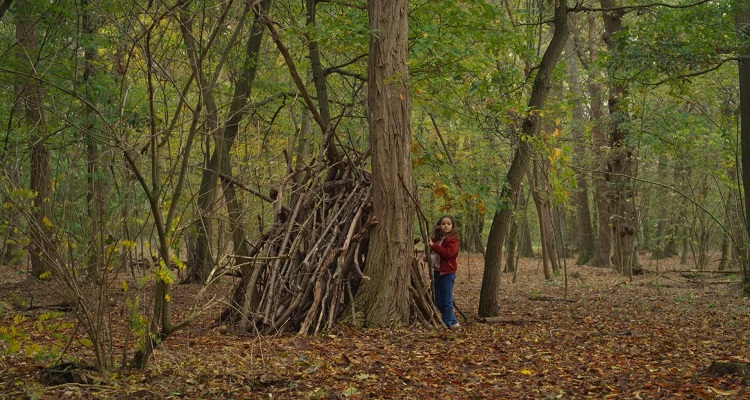
Nelly moves into her mother’s childhood bedroom and they both go through Marion’s note pads, school books and toys. The little girl chides her mother’s inability to spell but offers words of encouragement about a drawing of a fox. It’s an incredibly tender and loving relationship between the two. Despite being only eight years old, Nelly is wise beyond her years, empathy seeps from her every pore; she can sense her mother’s vulnerability and offers her narrow shoulders and small arms within which comfort can be sought. When Marion suddenly leaves, it is up to her daughter and partner to stay on and finish packing up. Nelly attempts to engage her father by bringing up the treehouse her mother built in the surrounding woods but the man merely shrugs and says he can’t recall anything about it. ” You don’t forget,” she scolds, “You just don’t listen.”

What happens next is so matter-of-fact that to go into detail would ruin the surprise (NB. Don’t watch the trailer if you wish to avoid spoilers) but it relies upon an open-minded audience and one which is willing to accept the ordinary and enchanted; the magic and imagination of a child. We all sought it once upon a time.

While Portrait of a Woman on Fire cemented Céline Sciamma as auteur, her earlier filmography has tended to forefront children and teenagers. Adults don’t really exist in the world she creates and she writes the world from their viewpoint whether they are eight-years-old, teenage girls, a tomboy, or a courgette. This film uses an autumnal colour palette full of lush browns and greens, and rich blues and burgundies; colours echoed between mother and daughter. Its costumes look to corduroy, woven jumpers and anoraks to weight the seasonal surroundings but also to give it a timeless quality. Transitions in time are slight but not insignificant – French language aside, this could be anywhere.

Childhood is a tricky thing to navigate while you’re experiencing it – although you tend not to realise just how much until you’re out the other side. Petite maman is extraordinary and enchanting, small and yet packs a punch. It is a thoroughly gorgeous film in which memories are tangible, maturation comes quickly, and a loving and assertive little woman seeks to renew her connection with her maman and say goodbye to her beloved grand-mère on her own terms.

Categories
Film Festival film review

Apples (Dir. Christos Nikou, 2020)

We are introduced to the nameless protagonist of Apples [Mila], played by Aris Servetalis, in his apartment, through a series of cuts (or polaroid snapshots) restlessly listening to the radio…staring impassively into space… banging his head against the doorframe before venturing out to buy the flowers himself much like the eponymous Mrs. Dalloway. Though there is no party in sight for Aris as he wanders aimlessly through the city and eventually falls fast asleep on a bus taking him from A to B. When the driver awakens him, Aris doesn’t recall where he should have alighted, his name or where he lives – his lack of identification only confirms it and he is packed off in an ambulance to the Disturbed Memory Department of the Neurological Hospital for evaluation.

From there, he is assigned a number (14842) and afforded a new life as an amnesiac. Sudden onset amnesia is not seen as unusual as the seemingly irreversible epidemic sweeps across a modern, yet strangely analogue Athens, with neither sight nor sound of a mobile device. All amnesiacs (at least those not claimed by family members) are given tape recorders and polaroid cameras. The cassette tapes containing prompts of how to manage their “new beginnings” and the cameras are to snap proof of how they spent their days; photos stored in albums for posterity.

Christos Nikou served as Yorgos Lanthimos’ AD on Dogtooth and it initially shows. His film – based on a screenplay he co-wrote with Stavros Raptis – does fit within the so-called Greek Weird Wave in which filmmakers and writers such as the likes of Panos H. Kontras, Lanthimos, Athina Rachel Angari, and Efthymis Filippou have given us some brilliantly strange pieces of work that have painted a unique, often ideological, versions of Greek society. Yet, while his predecessors liked the darker, mordant aspects of life, Nikou’s film is far more heartfelt and poignant.

Aris throughout plays it deadpan even when he meets fellow new beginner Anna (Sofia Georgovassili) and as he chomps his way through, roughly, an orchard. Servetalis is a combination of Daniel Day-Lewis and Buster Keaton, the line between bizarre and funny grows increasingly blurry as the film progresses, as to the linearity of the whole thing is anybody’s guess. The 4:3 aspect ratio harks back to the silent era and helps to further detach from reality – although the whole Athens-epidemic-as-narrative-device strikes close to home as we, like Aris, find a new weird normal – in our case remembering to smile with our eyes beneath the material which covers the rest of our face.

The film is a very quiet and wry allegory with several laugh-out-loud moments involving a Batman, and even a nod to an Outcast lyric. Its use of colour is gorgeous, the daylight palette tends to be muddy blues, greys and muted greens while the nights tend to be oranges and ochres much like the innards of a mouldy apple. The use of music is astute with all feeding into the theme of memory and remembrance: “Scarborough Fair”, “Seal It With A Kiss”, and “Let’s Twist Again” (although, this arguably has a dual meaning) – tenuous it may be but even “Ave Maria” mentions fruit!

Apples is a brilliant and absurdist rumination on loss, memory, identity and human connection. It ponders selective memory – the want to forget what’s in the memory bank, the fight to remember by heart and if there’s a difference, and what the hell did we do before the smart phone and documenting our days.

Apples will be available exclusively on Curzon Home Cinema from Friday 7th May.