
A predestined aspect of the construct of masculinity has always been associated with violence. Many critics and theorists have always maintained that violence is innately male, that to be a man is to be in charge[1] and to be masculine is “quite literally, to embody force”[2], while others have seen it as an action of the male in crisis, a loss of control and “a cultural construct [which] is a site of both struggle and resistance[3]. There is no definitive biological truth to substantiate that aggression and violence is more inherent to the male sex as opposed to the female but the depictions on film do lean more towards the former and perhaps serve as either commentaries on the act of violence itself or catharsis for the de-sensitised viewer[4].
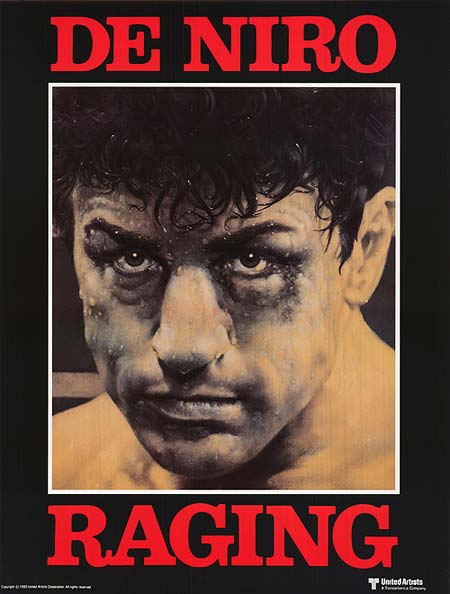
In the seventies and eighties the ‘hard body’ films showcased the activity and sinew of the male form, depicted an increase in the level of screen violence and resulted in the birth of the boxing/fight movie. A genre which valorised the sport and yet depicted the brutality inside of the ring, films like Raging Bull (Martin Scorsese, 1980) and the Rocky franchise[5]. This genre has seen a resurgence over the years following the success of Fight Club (1999, dir. David Fincher) where bodies are instruments – “flesh in the service of an objective or a desire”[6] and the induction of the professional wrestler into the world of cinema; Terry ‘Hulk Hogan’ Bollea, Dwayne ‘The Rock’ Johnson and Jon Cena, to name but a few, are names synonymous with wrestling and the movies – hyper-masculine individuals who carry the “ideal of toughness and dominance”[7]. Their sport offering, as Kath Woodward ascertains “a space in which masculinities are very visible and invoke associations with physicality, risk taking and even violence, [a place where] those who wish to buy into that masculinity but who are not participants in the sport have to accommodate in other ways”[8].
This ‘aggressive masculinity’ was made ever more visible in the 2009 Darren Aronofsky film The Wrestler and depicted the aftermath of a life after the fight. A visually and hearing impaired Randy ‘The Ram’ Robinson (Mickey Rourke), who aside from a body that is failing him at a rapid rate, has very little else in the world beside his fighting maleness that is in constant conflict with his role as a wrestler, father and lover. This filmic text has given way to a plethora of fight movies[9] including a foray into the world of female boxing[10]. It is, however, the male fight (connotations of which are vast) I am particularly enthused with exploring and I will consider a number of Twentieth Century theorists and apply them to the 2011 text Warrior. Specifically, in relation to the male-oriented sports arena and argue that the masquerade of masculinities is still a speculative subject and very much prevalent in the Twentieth First Century.

It is especially interesting to me that the A-Team [11] remake of 2010 chose to cast a former Ultimate Fighting Champion™, Quinton ‘Rampage’ Jackson as the stoic Mr ‘T’ who is so paralysed by a fear of flying and enclosed spaces, his comrades choose to knock him unconscious than attempt to wrestle him into submission. UFC as it is commonly referred is the more extreme equivalent of championship wrestling insofar as any Mixed Martial Arts move is allowed, gum shields and groin protectors must be worn and all footwear and hand-wear is prohibited.[12] Like boxing, the sport takes place within a ring usually encased in a metal cage and each competitor must compete in bouts and beat his opponent fairly; a would-be brutal spectacle without the flamboyancy or showmanship of wrestling. “If,” as Dane Miller writes in his 2007 article, “violence and brutality are inherent traits of the male gender, as they appear to be, then society, especially contemporary American society, has implemented significant sanctions to discourage these traits from being actively expressed”[13]. By definition, then, the cage allows these constraints, including “associated primal masculinity”[14] to be expressed in an established forum and by conclusion “[contain] the [same] traits [so that they] remain associated with masculinity but also become praiseworthy”.[15]

Warrior opens in Pittsburgh with Paddy Conlon (Nick Nolte) leaving an AA meeting and arriving home to find his youngest son Tommy (Tom Hardy) sat on his stoop. Estranged father and son have not seen each other for fourteen years and while Paddy may welcome a reunion, Tommy is only interested in his father’s previous incarnation as his wrestling trainer. Tommy has returned from Afghanistan, AWOL from his unit and, seemingly, dependent on prescription drugs needing money to provide for the family of his fallen ‘brother-in-arms’. Tommy fled, as a teenager, with his mother from abusive, drunk Paddy and his flying fists and is incredulous at his father’s sobriety and awaits a slip.

Meanwhile, in Philadelphia, Physics teacher Brendan Conlon (Joel Edgerton) is at the bank attempting to re-mortgage his family home, again, the payment of his youngest daughter’s medical bills proving too vast for the family to cope with financially. The bank manager simply tells Brendan that their house will be foreclosed upon in ninety days. With his wife working two jobs, Brendan tells his wife that he will take some evening shifts as a club bouncer to help pay the bills and only when he arrives home with bruised ribs and a black eye does she realise that he is fighting again, for cash, in the club parking lot. Unfortunately, Brendan is unable to cover up the bruises and the truth when he returns to his day job and is suspended without pay. Principal Zito (Kevin Dunn) explains that he cannot be seen to advocate such violence, and tells Brendan “you’re a teacher; you have no business being in the ring with those animals”. Brendan responds with “actually, I used be one of those animals, I fought for a living. I guess I forgot to put that on my application”. Brendan is the ‘big brother’ who abandoned Tommy as a teenager and the unfolding narrative sees both travel, separately, to Atlantic City to compete in the Sparta MMA tournament; the prize $5,000,000 and eventually, perhaps predictably, ‘face off’ in the final match.
Writing about organised sporting events, Michael A. Messner and Donald F. Sabo argue that “male aggression varies from individual to individual, within situations, and across cultures”[16]. The men depicted in this film text are both individuals and physically different, neither are particularly large or over-developed. They are white[17] have pretty, boyish, faces which do not hint at a violent past nor resemble the broken noses or swollen eyelids of the seasoned fighter, however, Tommy appears the physically stronger and more aggressive, with his dark clothing, swagger and shifty stance and yet for all the seething rage, he only ever chooses to unleash his demons in the ring. He is shot, for the most part, in close up so he fills the screen and the over-the-shoulder shots enhance his bulk.

The establishing shot of Brendan shows a family man at a birthday party, wearing a bonnet having his face painted “becoming a princess”. He appears slighter than his younger brother and by the fact that he is a Physics teacher he is almost immediately deemed as ‘less-than-manly’. His occupation is used to incite the wrath of his ring opponents and push them to beat the “physics teacher!” This is in addition to his choice of entrance music – Beethoven’s Ode to Joy ensures he is ridiculed by the ringside commentators. Brendan is further fetishised[18] by the use of the close-up. For the first part of the film Brendan is shown in medium shot in an attempt to make him appear smaller in relation to his brother and opponents and the close up makes to enhance his beaten face, the healing cuts and swollen bruises or perhaps serve as viewer manipulation. Tommy shuts down when confronted (apart from in the ring) while Brendan is an open book – his motives clear, it could be suggested that by making the viewer empathise more it facilitates identification.
Messner continues to describe the ‘Televised Sports Manhood Formula’ which not only teaches boys to pay the price “be it one’s body [but] gives one access to the privileges that have been historically linked to hegemonic masculinity – money, power, glory and women [and] provides a remarkably stable and concrete view of masculinity as grounded in bravery, risk-taking, violence, bodily strength and heterosexuality”.[19] This statement is directly conflicting with Messner and Sabo’s earlier observation, how can male aggression vary from man to man yet be combined to depict a uniformed hegemonic masculinity? Surely it is to suggest that masculinities also vary from man to man; that while there may be some similarity in the privileges and hegemonic history, each man is fighting for a goal known only to him.
This interrelation between the ‘action man’ and ‘real man’ is explored in Yvonne Tasker’s 1996 Spectacular Bodies… [20] and is present in Warrior. Tommy and Brendan are two ‘every-men’ who must overcome extraordinary odds to show their activity and solve their individual problems whilst addressing some of their shared emotional damage. I would further suggest that the man of the twentieth first century is a masculine and feminine amalgam, possessing attributes which have been historically linked to hegemony and patriarchy including domesticated and embodied masculinity, passivity and activity, crisis and transgression. “If the body drives the ‘action man’ of the 80s then the face, it would appear, drives the ‘new man’ of the 00s [and beyond] […] there has to be an acceptance of male power and powerlessness and a general recognition of the ambivalence surrounding masculinity and femininity in the male figure”.[21] This film text attempts to depict each protagonist’s ambivalent and transcendence from patriarchy, specifically, through the father figure of Paddy Conlon.
Conlon Snr., belongs to the era that Susan Faludi describes as, “manhood after victory […] the prevailing American image of masculinity”[22]. He is an ex-Marine who has seen war, perhaps, in active duty during Vietnam (1959-1975). The world Paddy imparted to his sons is one of hurt; he drank heavily and was abusive to both his sons and wife, womanised and eventually pushed his family away. The man introduced in the diegesis is a God-fearing man who has a thousand days sobriety under his belt and, aside from his Moby Dick[23] audio book, very little else. Even Tommy describes him as a castrated man – sexless, sober, sensitive and caring and wishes he had experienced this version of his father when he was a child. As an adult, Tommy has no need for this man, or so he claims.

Fatherhood is another construct of masculinity upon which patriarchal authority is born, an additional performance to, ultimately, fail at and Paddy Conlon is no exception. He is the protector and teacher of violence to two sons, they wrestle and compete and when they, or their mother, step out of line he beats them. Lynne Segal sums up the role of the father quite beautifully when she writes, “[those] gods that fail us bequeath diverse legacies to their sons and daughters”.[24] On the surface Paddy does appear to have failed his sons, he did not nurture and rather encouraged the kind of violence which has continued to encroach upon Brendan and Tommy’s lives in one form or another. Both men are controlled in their aggressive forum and yet while Brendan appears the more secure brother, Tommy is the one who is continually running away from the fierce situations he finds himself in, his childhood, his mother’s death and the violence of the war. He will fight but when he finds the fight is over, not necessarily on his terms, he flees.

The irony is Tommy is the most like his father – the epitome of Ronald Levant’s “angry white male”[25], specifically with his choice of occupation in the Marine Corp. He is also the only son who actually needs his father, despite his protestations; Paddy’s presence exacerbates Tommy’s rage and furthers his preparation training. Brendan, on the other hand, trains and wins his place in Sparta without the assistance of Paddy. We, the viewer are never party to the Paddy of old and yet draw the conclusion of the monstrous male; controlling, aggressive, violent and cruel. Upon the realisation that he has harmed his youngest child by his behaviour, Paddy grants Tommy’s wish and begins drinking again. Only this time, no violence ensues but deep sorrow and emotional regret and the father is able to admit his love for his son(s) and is cradled, like a child, in Tommy’s arms, mourning his failure, fear, vulnerability and “the lost opportunity to be loved by his children […][26]. As a side note, while Nolte gives a performance of American masculinity, Hardy and Edgerton’s performances can be called into question. That is not to say that they are not convincingly ‘American’ but the fact that they give such gravitas to the masculinity debate as non-Americans speaks volumes, perhaps American males have to fight harder to give performances of note while the ‘Aussie’ or ‘Brit’ have little difficulty in portraying amid poignancy, vulnerability and affect without speculation arising about their masculinity or sexuality.
Warrior, like many similar films is set within the realm of organised sports, a forum where men are almost exclusively the victims or perpetrators of violence and as Connell theorises there have always been more than one kind of masculinity[27] thus concluding that within the ring or cage there is not only competing men but masculinities. However, this is problematic as many of these sports are deep-rooted in preserving the hegemonic masculinity, specifically, in its gendered combatants and marginalisation of women[28]. Fighters embrace their masculine identity and some believe that affirming this masculinity is by and large rejecting the feminine and the norms of society.[29] By extension, there can be no pathos or empathy in a fight and yet when Tommy and Brendan step into that cage to fight each other that is all there is. These men have been conflicted since childhood – conflicted about their family life, the aggression and violence that was learned and duplicated and above all else their masculinity. Interestingly, both are shot through a ‘Lacanian’ mirror[30] reflecting upon their totality and identity before their final bout. I would argue that these men in taking in their reflection are accepting that their individual ‘wholeness’ will only occur in their sibling unity.

The beauty of this film text is that the final fight between the two brothers is gut-wrenching and really duly succeeds through viewer identification. Dane Miller maintains that these competitors have been ‘normalised’ and by accepting these ‘every-men’ as merely earning a living then, ideologically, the audience’s sins and guilt can also be purged[31]. The fighter is the viewer’s scapegoat and “[we] are vicariously vindicated and achieve redemption through the performance of the fighter”[32]. By the final scene there is little vindication, these men beat each other while crying in physical and emotional pain, they love each other and yet know that this was how love and masculine affirmation was instilled in their childhood. Only when one begs the other to yield, and acknowledge their mutual love for each other is a winner announced. As the crowds erupt both brothers refuse medical treatment or to speak, instead they stumble back to the dressing room, arms protectively around each other. At the final frame they resemble two bruised and devastated little boys. The viewer gains little redemption, there are no winners here only a resounding realisation of the performance(s) men have to sustain inside and outside of the ‘ring’; the conflict and ambivalence faced in today’s society.
I like to think these movie posters depict the male of the 20th and 21st century – the ‘raging bull’ battling with his exteriority and self-destruction. The male in crisis. While the ‘warrior’, contemplative and more accepting of his ambivalence and conflicting emotions. At first glance a male face similar to the previous, a second look depicts the duplicitous male – the male-female amalgam, the ‘action’ man and ‘real’ man binary; an indication that there is far more to ‘masculinity’ than meets the eye.

[1] Michelle Toomey, “The Price of Masculinity based on Violence” in Education Digest 58 (4) (1992) p44.
[2] R. W. Connell, Masculinities, 2nd Edn, Cambridge: Polity Press (2005) p87.
[3] Suzanne E. Hatty, Masculinities, Violence and Culture, Sage Publications Inc (2000) p12.
[4] Ibid, p52.
[5] Rocky (1976, dir. John G Avildsen), Rocky II, Rocky III and Rocky Balboa (1979, 1982, 2006, dir. Sylvester Stallone)
[6] Victor Siedler, Man Enough: Embodying Masculinities, London: Sage Publications Inc (1997) p21.
[7] R W Connell, Gender and Power: Society, the Person, and Sexual Politics, Cambridge: Polity Press (1987) p4.
[8] Kath Woodward, Boxing, Masculinity and Identity: The ‘I’ of the Tiger, UK/USA: Routledge (2007) pp14-15. One of these ‘other ways’ is through spectatorship, either through live events or through fight-films.
[9] Never Back Down (2008, dir. Jeff Wadlow), Fighting (2009, dir. Dito Montiel) and The Fighter (2010, dir. David O. Russell) to name but a few.
[10] Million Dollar Baby (2004, dir. Clint Eastwood) and Girlfight (2000, dir. Karyn Kusama).
[11] The A-Team (2010, dir. Joe Carnahan).
[12] http://www.ufc.com/discover/sport/rules-and-regulations – details of UFC rules.
[13] Dane Miller “A Real Man’s Game: Manipulations of Guilt and Rhetorical Displays of Masculinity by the UFC” in Comm-entary – The UNH Student Journal of Communication 2010-2011 p94.
[14] Ibid, p94.
[15] Ibid, p94.
[16] Michael. A. Messner & Donald. F Sabo, Sex, Violence and Power in Sports: Rethinking Masculinity, USA: The Crossing Press (1994) p71.
[17] “The hero’s body is superior, but his skin colour – […] white – also signals him as an everyman”. Richard Dyer, White, London and New York: Routledge (1997) p162.
[18] Steve Neale would argue that by eroticising Brendan, he is automatically ‘feminised’ cited in Yvonne Tasker, Spectacular Bodies: Gender, Genre and the Action Cinema, London: Routledge (1996) pp118-119.
[19] M Messner, M Dunbar and D Hunt “The Televised Sports Manhood Formula” in Journal of Sport and Social Issues 24 (4) (2000) p392.
[20] Tasker (1994) p117.
[21] Helen Jones, “The Male Body and Conan the Barbarian” (2011)
[22] Susan Faludi, Stiffed: The Betrayal of the American Man, Vintage Publishing (2000) pp5-10.
[23] Moby Dick by Herman Melville.
[24] Lynne Segal, Slow Motion: Changing Masculinities, Changing Men, UK: Palgrave Macmillan (2007) p24.
[25] Ronald Levant cited in Peter Lehman, Running Scared: Masculinity and the Representation of the Male Body, USA: Wayne State University Press (2007) p14.
[26] Segal (2007) p25.
[27] Connell, (1987) p4.
[28] Woodward (2007) pp10-11.
[29] Magnus Stenius “Shoot-Fighting, Bodies in Emotional Pain: A Translocal Study in Masculine Gendering of Violence, Aggression and Control” (2007) p43.
[30] Jacques Lacan cited in Segal (2007) p73.
[31] Miller (2010) p99.
[32] Ibid, p99.


 The Framing Device