Categories
Film Festival film review

Petite Maman (Dir. Céline Sciamma, 2021)

“Shall we read?”

“No, I want to sleep to get to tomorrow.”

An elderly woman completes a crossword with a young girl – there is a brief assumption she’s her granddaughter but the child gets up to leave with an “au revoir”. The girl then goes into every room along the dimly lit corridor and bids farewell to the other female residents until she reaches her destination; the bright room at the end of the hallway. ”Mama, can I keep her stick?”

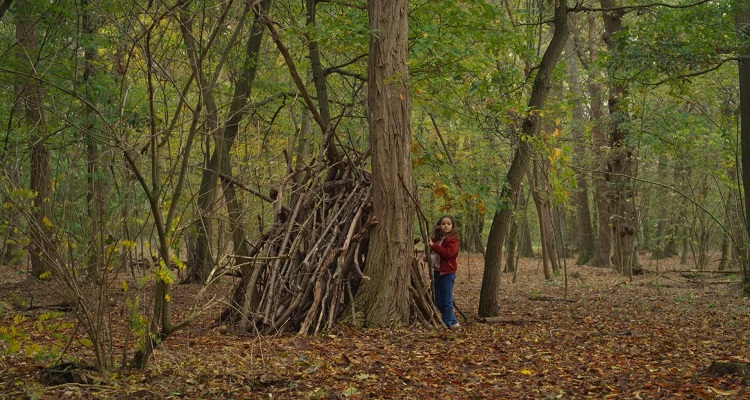
After the passing of her grandmother, Nelly (Joséphine Ganz) and her mother Marion (Gabrielle Sanz) drive to the latter’s childhood home to pack up belongings, keepsakes and transport furniture, as families are wan to do after a bereavement. Nelly feeds her mother from the backseat of the car, extends the juice carton to her lips and then reassuringly clamps her arms around her mother’s neck as they both follow Papa (Stéphane Varupenne) driving the white van in front. Nelly is every inch the little mother of the title despite the interchangeability of role throughout the taut 82-minute film.

Nelly moves into her mother’s childhood bedroom and they both go through Marion’s note pads, school books and toys. The little girl chides her mother’s inability to spell but offers words of encouragement about a drawing of a fox. It’s an incredibly tender and loving relationship between the two. Despite being only eight years old, Nelly is wise beyond her years, empathy seeps from her every pore; she can sense her mother’s vulnerability and offers her narrow shoulders and small arms within which comfort can be sought. When Marion suddenly leaves, it is up to her daughter and partner to stay on and finish packing up. Nelly attempts to engage her father by bringing up the treehouse her mother built in the surrounding woods but the man merely shrugs and says he can’t recall anything about it. ” You don’t forget,” she scolds, “You just don’t listen.”

What happens next is so matter-of-fact that to go into detail would ruin the surprise (NB. Don’t watch the trailer if you wish to avoid spoilers) but it relies upon an open-minded audience and one which is willing to accept the ordinary and enchanted; the magic and imagination of a child. We all sought it once upon a time.

While Portrait of a Woman on Fire cemented Céline Sciamma as auteur, her earlier filmography has tended to forefront children and teenagers. Adults don’t really exist in the world she creates and she writes the world from their viewpoint whether they are eight-years-old, teenage girls, a tomboy, or a courgette. This film uses an autumnal colour palette full of lush browns and greens, and rich blues and burgundies; colours echoed between mother and daughter. Its costumes look to corduroy, woven jumpers and anoraks to weight the seasonal surroundings but also to give it a timeless quality. Transitions in time are slight but not insignificant – French language aside, this could be anywhere.

Childhood is a tricky thing to navigate while you’re experiencing it – although you tend not to realise just how much until you’re out the other side. Petite maman is extraordinary and enchanting, small and yet packs a punch. It is a thoroughly gorgeous film in which memories are tangible, maturation comes quickly, and a loving and assertive little woman seeks to renew her connection with her maman and say goodbye to her beloved grand-mère on her own terms.

Categories
film review

Boy (Dir. Taika Waititi, 2015)

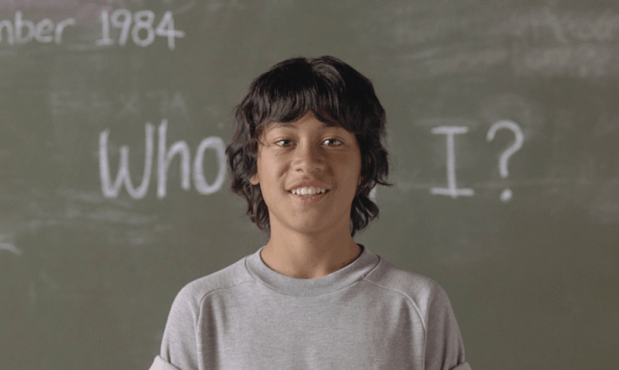
The year is 1984, and 11-year-old Boy (James Rolleston) welcomes us into his “interesting world” as he stands before his classmates and recounts who he is, what he likes (Michael Jackson), and who he shares his life with. There’s Nan (Mavis Paenga), cousins Miria, Kiko, Che, Hucks and Kelly, Aunty Gracey (Rachel House) who’s a tennis coach, the “mailman”, school bus driver and manager of the local shop; a pet goat named Leaf and a six-year-old brother Rocky (Te Aho Eketone-Whitu). Rocky thinks he has superpowers. Bless him, he doesn’t.

Boy’s interests include art (cue desk graffiti), social studies (getting picked on by older boys) and Michael Jackson. His other idol is his father, Alamein (Taika Waititi), a master carver, deep sea treasure diver, captain of the rugby team and holder of the record for punching people out with a single fist. The reality couldn’t be further from the truth but in Boy’s world, reality isn’t really the mainstay, he is a kid after all.

After Nan leaves to attend a funeral, he’s the man of the house and so he ensures all the younger children wash, eat and generally thrive, until Alamein Sr returns to Waihau Bay, fresh out of prison, seeking a “treasure” he buried in the field opposite the house. It gives him the perfect opportunity to reconnect with his estranged sons as long as they stop calling him Dad… it’s “weird”. Boy, initially thrilled by his father’s return, soon comes to the painful realisation that his father isn’t the hero he imagined. In complete contrast, Rocky’s reluctance to accept the man he has never known comes full circle and his doubt and suspicion turns to respect. The moment all three boys reach the point of transformation is a deeply moving and beautiful thing, and harks back to that opening quote perfectly – “You could be happy here… we could grow up together” (E.T., 1982). 

Boy is a thematically rich film and one which comments upon rurality, poverty, childhood, adulthood and grief while using magical realism, animation, mythology and a free-spirited style which also incorporates intertextuality and 80s popular culture to bring Waititi’s approach to identity and masculinity to the screen. That very specific form and unique Aotearoa voice has been so prevalent since those couple of Taika-written and directed episodes of Flight of the Conchords.

While including visuals of the sublime landscape, hostile terrain and open roads that have long been associated with New Zealand cinema, Waititi also gives us a Māori film rich in culture and beautiful hues of colour via a nostalgic trip to the eighties. The absentee father within a Māori family is just one of the thematic links Boy has to Once Were Warriors (1994) and Whale Rider (2002), however, here the comedy and pathos, drama and fantasy is – as one has come to expect following Eagle vs. Shark (2007), What We Do in the Shadows (2014) and Hunt for the Wilderpeople (2016) – charmingly measured.

Rolleston is wonderful in the titular role, however, one can’t help but fall in love with the largely mute and thoughtful, cape-wearing Rocky as both boys shine in this endearing and magical coming-of-age drama. Waititi is equally adorable as the misunderstood big boy of the trio, Alamein, a man who has yet to truly face his responsibilities or fully embrace adulthood but whose little men will help him pull his socks up. Boy is a big-hearted film – possibly even Waititi’s finest – poignant, funny, an effortless joy. Oh, and that Haka hybrid is genius.

Categories
Film Festival film review

Beasts of the Southern Wild (Dir. Benh Zeitlin, 2012)

LFF 2012

“Once there was a Hushpuppy and she lived with her daddy in The Bathtub…”

Hushpuppy (Quvenzhané Wallis) is six years old and the narrator throughout this fabled, fantasy drama. She lives, albeit in a separate abode, with her father Wink (Dwight Henry) in a marginalised area far beyond the levee walls in the Louisiana bayou. She is a ferocious little girl who spends her time yearning to be reunited with her absentee mother and listening to the heartbeats of the creatures around her. The Bathtub is a society largely separated by the necessities for consumerism and while the small close-knit community has little in the way of possessions or stable housing, they are happy living apart from the rest of the world; scavenging, socialising and surviving. Hushpuppy is schooled in lessons of self-sufficiency and encouraged to believe that everything and everyone is connected in the universe. Through the eyes of this feisty little character the viewer sees the effects of global warming as indicative of the resurfacing of a large mythical creature called an auroch and Hushpuppy’s adolescent reconciliation with what will try and, essentially, destroy her delta home.

Beast of the Southern Wild, based upon the play by Lucy Alibar, is a wonderfully made low-budget feature which highlights and embraces the metaphysical imagination of a child amid the harsh realities of a world before and in the wake of a connoted Hurricane Katrina. Hushpuppy, played by non-professional Wallis is unruly and yet balances moments of naiveté beautifully, her father’s tough love approach is, at times, cruel but his motives are clear – he needs his “boss lady” to survive and thrive beyond his lifetime; he wants her to face the world with fierce stoicism and strength and not need to rely upon anybody. Her gritty gumption is both heartbreaking and life affirming in equal measure. While some cynics will read this film as shot through an ideological lens it is an unpretentious rendering of magical realism and serves as modern fairy tale weighted in pathos. It delivers a sensory impact to the audience, boasting gritty and picturesque images via Ben Richardson’s cinematography and a majestic score courtesy of director Zeitlin and composer Dan Romer.