Categories
Film Festival film review

Burning Cane (Dir. Phillip Youmans, 2019)

LFF 2019

Much will be made of Phillip Youmans’ age when the writer, director, DoP, and camera operator made, this, his first film. Just look at Xavier Dolan following his debut, the ‘wunderkind’ label was bandied round for at least five years of the last decade. However, that surliness and juvenile (albeit brilliant) edge to I Killed My Mother is largely missing from Youmans’ debut Burning Cane; a mature Southern Gothic drama which belies the (then) High Schooler’s age (he’s 19 now).

Set in rural Louisiana, our leading lady Helen (Karen Kaia Livers) sits on her stoop smoking, her voiceover discusses her dog Giorgio. It has the ‘mange’ and she is attempting to prolong its life anyway she can. Helen has been surrounded by ‘diseased mutts’ most of her life – her late husband succumbed to an AIDS-related illness while her Pastor Reverend Tillman (Wendell Pierce) and only son Daniel (Dominique McClellan) are fighting with alcoholism. Tillman continues to drink on the job following the death of his wife and won’t accept any help, least of all from his flock, choosing instead to drive home each night after sermons, inebriated, his car swerving all over the road.

Daniel, on the other hand, has to contend with keeping house while his partner (Emyri Crutchfield) goes to work and supports their family. He cooks, cleans, and fixes things around the place but it’s taking its toll. He’s questioning his masculinity and is steadily on self-destruct mode; he’s the man and should be the one providing, not staying at home looking after son Jeremiah (Braelyn Kelly).

‘Looking after’ may be somewhat of a stretch, the boy is mute – presumably a nod to the weeping prophet he is named for – unable (or choosing not) to talk and accepts his father’s love in the form of an occasional meal and glasses of milk laced with whatever liquor the older male is guzzling down. There’s a hint at something darker going on between father and son but the level of abuse remains at the booze-pushing and never leads anywhere else, beyond the steady decline of a man who would rather use his fists in a drunken stupor than work through any of his issues.

Youmans utilises a number of camera angles and shots which suit the oblique storytelling, however, at times poor lighting and a literal lack of focus feel unnecessary especially when considered alongside the already slow pace. Being unable to see much within the frame is problematic, however intentional but it does help build mood with the extreme dichotomy of light and dark. As the claustrophobia hits its peak, the humidity and sweat are palpable. It’s a pensive narrative, and while its foundations are embedded within the art film, it is largely raw, grass roots filmmaking.

This is Helen’s struggle to reconcile her faith alongside her relationship with her son. It’s a film about sin, despair, drink and poverty. One which examines a mother’s love for her child, deep-rooted toxic masculinity – the definition of what it means to be a man – and the role religion plays within the black community onscreen. Many pray to a Father for guidance, and yet few have fathers to guide them. There is condemnation of the Church and yet at no point does the institution feel demonised.

Colours are kept to a minimum too, greys, greens, browns with the occasional flash of orange (courtesy of the fruit trees Jeremiah finds solace in or the burning umber of a lit cigarette). Daylight is also a rarity – while we’re so used to the depiction of a light, bright sunny South on film, in Helen’s world, everything is tinged with a dismal grey while heavy clouds hang in the sky. The film’s title relates to the annual process of harvesting sugar cane; fields are set alight before the valuable part of the crop is harvested, an apt metaphor for the film’s narrative.

While as a whole, the film never feels completely cohesive and ends somewhat abruptly, it is a promising vérité style debut which feels reminiscent of early Burnett and Malick. Following its trifecta of wins at this year’s Tribeca Film Festival, It’s safe to say there will be plenty of interest in what Youmans creates next.
Categories
Film Festival film review

Judy and Punch (Dir. Mirrah Foulkes, 2019)

LFF 2019

Despite origins in 16th century Italy and containing a character named Pulcinella, the concept of the traditional puppet show Punch & Judy would eventually make its home in Britain during the 17th century – historians say 1662, thanks to a diary entry by the Bridget Jones of his day, Samuel Pepys.

Within a hundred years ‘Pulcinella’ was anglicised to the much snappier and succinct ‘Mr. Punch’ and Joan, his wife also had a name change and took on the moniker ‘Judy’. Puppets on strings would pull a Pinocchio, only rather than becoming ‘real’ they would adorn the hands of the hidden human and entertain adults and children alike for more than 350 years – regardless of form or plot-line – usually at the seaside. Perhaps it was the sea air which rendered audiences immune to the repugnancy of the insidious Mr. Punch.

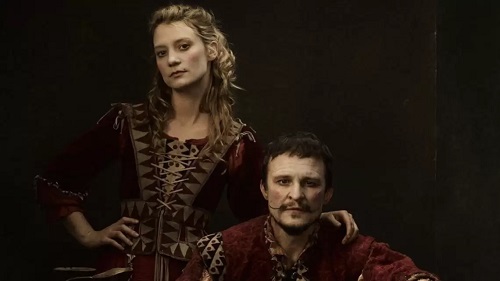
‘Seaside’ is the locale of Mirrah Foulkes’ debut feature, ‘somewhere in England’ and ‘nowhere near the sea’. A small cloaked figure steals into town to sneak into the evening’s show. Bottler Judy (Mia Wasikowska) shakes a tankard for coinage and entertains the crowd before announcing the main event: Professor Punch (Damon Herriman) and his puppets. He appears through crimson velvet drapery with a bang and cloud of smoke; caked in face-paint, jester-like in his stage costume complete with twirled moustache. Make no mistake, this – debatable when we see Judy’s puppeteering skills – is the star of the show. By the end of the elaborate opening credits we, just like the rowdy audience onscreen, are hooked.

Punch and Judy live in a beautiful home with their daughter, Baby (the cheek pinchingly adorable Scarlett and Summer Dixon), maid Maud (Brenda Palmer) and her husband Scaramouche (Tony Norris). They await the day that scouts arrive in Seaside to discover the magic of their talent and transplant it to The Big Smoke. He wants more fame and fortune – swanning around Seaside as a minor celeb is not quite enough for his ego – while she seems fairly content with their lot. Although, she does seek to tone down the ‘punchy and smashy’ aspect of the show, while imploring him to stop frequenting local watering hole McDrinkie’s, and ideally would like the community around her to be a little less… judgemental.

Townspeople are banished as heretics to the Black Forest, others are publicly hanged, and women are stoned daily for reasons that are utterly ridiculous but are, of course, to the folk of Seaside signs of witchcraft and (obviously) the work of The Devil. Leading the charge is the simpering and sneering Mr. Frankly (Tom Budge) who rewards the important men of town with casting the first stone and brings actual fanfare to the Gallows. New Constable Derrick (Benedict Hardie) has his work cut out; crimes and grievances bypass his office and result in quick confessions and executions. Then there’s his crush on Judy… while local prostitute Polly (Lucy Velik) only has eyes for Punch. Maud’s job is becoming harder as hubby Scaramouche’s memory worsens but as long as her master gets his sausages before Toby the dog gets his paws on them, all should be well.

Plot-wise, if you’re at all familiar with the show, then you can rest assured it’s all here. Foulkes gives us a bit of an origin story – albeit a subverted one – which looks at the historical context and celebration of (gendered) violence, as well as the notion of oral histories and storytelling in its earliest form, idiom and allegory. The film is darkly comic from the very beginning with a never-faltering tone which is perfectly pitched and often black. It’s hard to find the humour in heavy hitting themes such as domestic violence, alcoholism, adultery, murder, early onset dementia, and misogyny but writer-director Foulkes finds that twisted balance perfectly. Assisting her in some lovely cinematography is seasoned DoP Stefan Duscio, gorgeous period costumes designed by Edie Kurzer and a gloriously bizarre soundtrack courtesy of composer François Tetaz – there’s a theatricality to his music which simultaneously feels dated and contemporary when accompanied with the action onscreen.

Performances are solid from Hardie’s drippy Derrick to Gillian Jones’ dark, mysterious – and possibly necromantic – Dr. Goodtime. Terry Norris’ bumbling Scaramouche is a delight, Wasikowska is always worth the price of admission, and the currently ubiquitous Herriman is suitably deranged as maniacal Punch. It’s a charming collective of Australian actors – including Foulkes behind the camera (she can be seen in front of it in The GiftThe Turning, and Animal Kingdom) albeit with a multitude of British and Irish accents. Not every single one is convincing but it often adds to the hilarity – Herriman’s is of course flawless.

Astonishingly, the entire film was filmed on location in Australia and yet is so authentically ‘English-looking’. It all works brilliantly. As an origin story, comedy, and dark drama Judy & Punch is an assured, astute and compelling film. It’s one which offers up a lot and delivers on everything – History becomes Herstory and brava to that.