Dominic Brunt’s second feature Bait premiered at FrightFest* 2015 (following his debut Before Dawn in 2012), the tag line for which screams “Hell Hath No Fury”. However, within the first ten/twenty minutes it becomes apparent that there is a lot more going on than just a woman scorned – try a punch square in the face from a shovel-sized fist for starters.
Set in an unnamed Northern town amid financial ruin, poverty lurks on every corner and for single mother Dawn (Joanne Mitchell) and best friend Bex (Victoria Smurfit) life is hard. Their market-based coffee and cake stall needs to survive (and expand) and the only way that will happen is a loan; something the bank and building society are reluctant to accommodate. Enter camel-coated Jeremy (Jonathan Slinger) who is amiable, generous and determined to help the girls out… Yep, you have guessed it, the worm turns and there is more to Jezza than meets the eye, namely psychopathy and the need to bleed trusting, hardworking people dry and then to just, well, make them bleed.
Bait is an ambitious, twisted little tale; quintessentially British, highly topical and its subject matter will, no doubt, strike a chord with most. What is particularly interesting is the way in which fear effects people, their decision making and ability to perpetuate violence skewed from terror. The female characters are mostly well-written, although Bex feels a little one-dimensional as the token ‘gobby’ one, which is a real shame as Smurfit tends to be excellent in everything else. Mitchell is great and certainly delivers a credible performance, there is a real vulnerability to Dawn. Slinger, however, is the standout. His Jeremy is a fantastic incarnation, a sociopath prone to snapping, his lack of empathy renders him inhuman and his general sneering nature means he practically slithers off screen and yet remains wholly believable.
The girls’ retribution is slow in coming (although we know it will, given the opening moments of the film), however, when it does, oh boy, it is brutal. Everything is throw in, including the bathroom sink and for such a low-budget the make-up FX are suitably gruesome and gory. The angry spurts of violence throughout the film is somewhat ageless and genderless, often depicted through vignettes and shows the consequences of dealings with the loan shark and his hired muscle (Adam Fogerty) but by the end vengeance is grotesque, bloody and a tad indulgent; it stretches the credulity of even the most committed horror fan. Paul Blondell’s script is taut and Brunt has directed a nasty little monster movie albeit in a social-realist setting but this viewer grows a little weary of bloodied bra-clad women in jeopardy.
*FrightFest = the greatest horror film festival London has to offer.
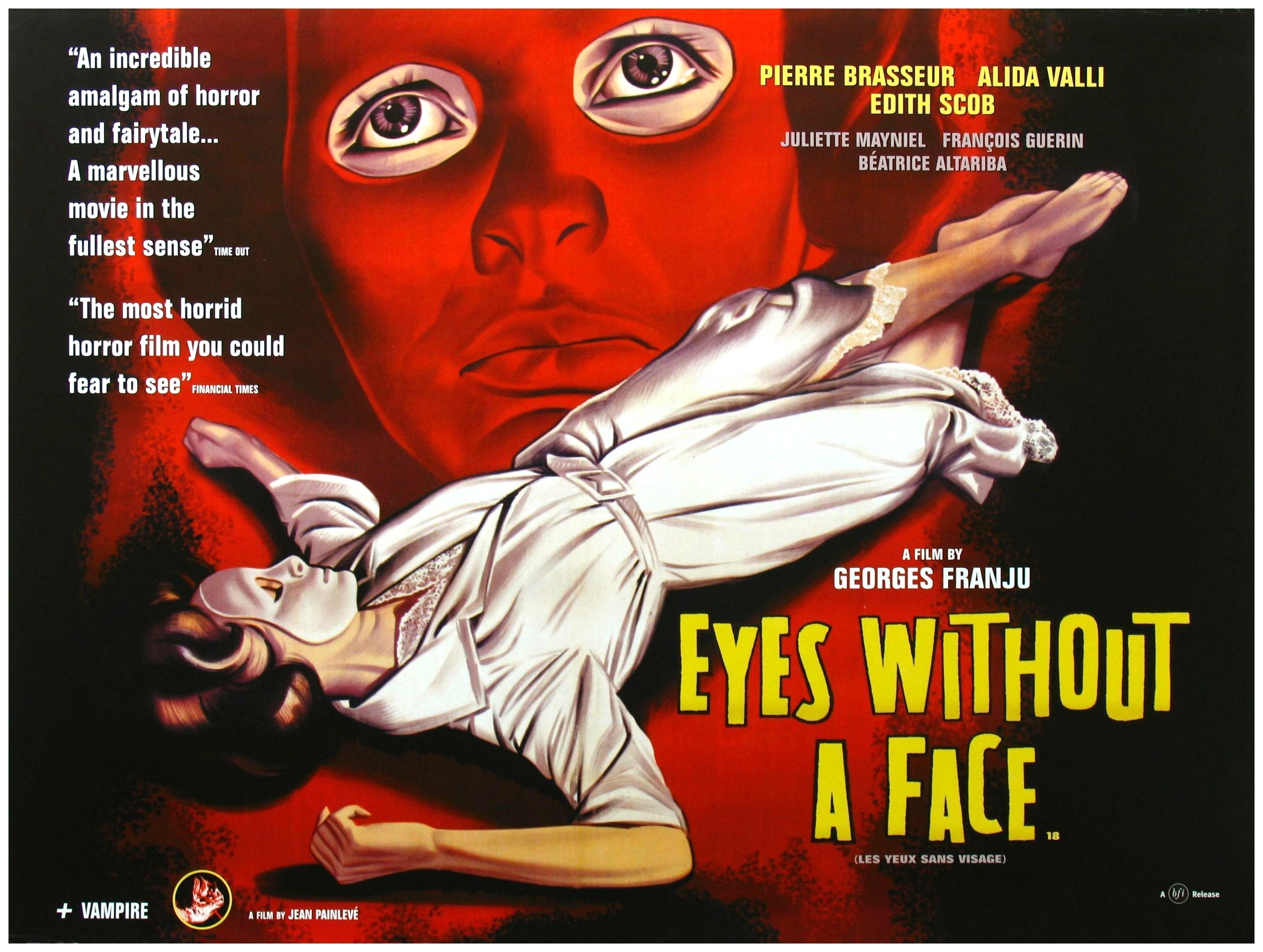
Georges Franju has a thing for masks. Both figurative ones and literal ones are dotted throughout his work, most notably in Thérèse Desqueroux (1962), Judex (1963) and Nuits rouges (1974). However, it is in his 1960 work Eyes Without a Face (Les yeux sans visage) that the literal mask plays a more prevalent role.
The BFI has lovingly restored the film and crafted a plethora of extras to release it on Blu-ray for the first time in the UK and it doesn’t disappoint. Picture quality is outstanding and the sound perfect. The film opens with Maurice Jarre’s carnivalesque, jaunty yet haunting score as a female (The Third Man’s Alida Valli) manoeuvres her car down dark winding country roads at night; the tension building as a person in a mackintosh and hat sits in the backseat. Something is not quite right and all unease is confirmed when the driver hoists the body from the backseat and dumps it into the local river. Louise works for Docteur Génessier (Pierre Brasseur) a prominent scientist and researcher in facial reconstruction, the viability of living tissue grafts and necrosis – the operation scenes of which are horrific thanks to Georges Klein’s make-up and Charles-Henri Assola’s special effects. The police have their suspicions about the good doctor but fail to act before the film’s climatic denouement.
Inside the Doctor’s home, silence is juxtaposed with the tweeting of birds and barking of dogs. It is eerie and foreboding, shot with low camera angles and a static camera is interspersed with the odd tracking shot. The use of chiaroscuro is stunning and shadows add to the atmosphere of the allegorical fairy tale. Darkness gives way to light the higher the stairs climbed until the bedroom of Christiane (Edith Scob) is reached. The camera work and lighting design is a real testament to Eugen Schüfftan’s cinematography. Director of Photography Schüfftan had previously worked with Lang, Siodmak, Ophüls and Pabst and had a three dimensional way of lighting a scene, alternating each first and third shot which is great for adding atmosphere, angst and anticipation.
Christiane appears to be a young girl in her white room but the deep velvety tones of a woman amid the caged doves cooing is a real surprise; an adult prisoner being harder to subdue. Two mandolins hang above her bed arranged like a butterfly; she is in a chrysalis awaiting transformation after a car accident causes facial disfigurement. Forever incarcerated in the old dark house of creaking doors and balustrades of the staircase casting bar-like shadows on the wall, all mirrors are covered and Christiane is forced to wear a mask. A mask of brilliant white frozen beauty that only allows the eyes to be visible and they are the windows to a tortured lonely soul. After a while we forget it’s a mask, it’s gentle and soothing, the fact that Scob glides within each scene makes her appear as if an apparition or marionette doll. She is the caged dove, the constant reminder of her father’s guilt and the feeder of his hubris.
Eyes Without a Face is Franju’s masterpiece, an austere and elegant horror-based fairy tale. It deals with scientific ethics, solitude and loneliness; never has human torture been so romanticised, so cruel, tender and lyrical. Edith Scob, perhaps it is fair to say one-time muse of director Franju having worked with him on five pictures, is the star. She provides such a nuanced almost delicate (yet powerful) performance, her Christiane is as beautiful as she is strange, objectified beyond expression. Well, almost…
Notoriously incongruous, Franju is quoted as saying he subscribed to images and “my images are my fleurs maladives [evil flowers]”. Eyes Without a Face is one evil flower that all must see, at least once in their lifetime.
Arrow Video’s new restoration of David Cronenberg’s Videodrome (1983) follows in the footsteps of Rabid (1977) and Shivers (1975) also restored and re-released on dual format this year. Each film with its disc-filled extras is clearly a labour of love.
Just preceding the Video Nasties Act of 1984, Videodrome, I’m sure would have gotten Mary Whitehouse’s knickers in a twist with the film’s provocative, paranoiac and altogether pleasure-seeking premise. The narrative centres on Civic TV executive Max Renn (James Woods) and his quest to find the next ‘big thing’ in sensationalist programming. His station is responsible for “soft core pornography and hard core violence” which Renn unapologetically justifies as a result of economics. Moral questions arise surrounding the over-stimulation of the consumer following exposure to dehumanising images via the media. These questions are depicted through metaphor, potential Freudian imagery and the former protégé of Dick Smith, multi-Oscar winning make-up effects Wizard Rick Baker (Smith famously created the exploding head in Scanners). Fellow Canadian, composer Howard Shore, yet again, provides the score (Shore and Cronenberg have worked together on all but The Dead Zone) and employs the use of a Synclavier II synthesiser alongside an orchestra. This electronic sound adds a dark, ominous, even metallic, tone to the film and aids with the 80s nostalgia along with the coiffed hair, shoulder pads and leather ties.
Renn stumbles upon Videodrome – a pirate television station which depicts the torture, brutality and eventual death of its subjects. Becoming obsessive to continually transgress social boundaries, Renn shows the footage to his girlfriend Nicki Brand (a hypnotic Deborah Harry) who, by her own admission, is the perfect over-stimulated test audience. She is sexually free (connoted by her costume, both cut and colour) and is immediately enamoured at the premise of the snuff sequences. Her enthusiasm for all things dark and painful grows and she even disappears to audition in Pittsburgh upon hearing the show is filmed there. Left alone, Max begins to suffer hallucinations; disturbing, intriguing visions which only seek to feed his need to consume the morally ambivalent visual media and further blur the line between fantasy and reality. His interactions with the Marshall McLuhan-inspired Brian O’Blivion (velvet-voiced Jack Creley, only ever visible via a television screen) increase the bizarre especially when we learn O’Blivion’s history to Videodrome. It is an aesthetically pleasurable film; body parts are fetishised, Betamax tapes pulsate and television undulate and literally swallow the flesh.
Anybody familiar with the articulately intense septuagenarian director will immediately recognise the body consciousness which is prevalent in a large percentage of his oeuvre. The man, who has cited Bergman, Fellini and Kurosawa as main inspirations, presents the limitations of the human body within his own artistic nihilism. Ideologies are often invasive and monstrous, the embodied becomes disembodied whilst sex and violence surrounds, causes, or indeed invades the diegesis. There can be contradictory readings of Cronenberg’s films; does he fight for the patriarchal pleasures he depicts and stray dangerously close to misogyny or destroy said pleasures while reinforcing the fragility of the physical body and mind? While the male consciousness is seen in crisis and at odds with the social world around him, it is the female body which appears abject and the site of disgust. In Videodrome, the male mind becomes more abhorrent through feminine imagery; Renn’s torso is repeatedly violated via the vagina-like opening. Or perhaps, it is like the man himself stated a few years ago; he plugs into the zeitgeist, examines and plays around with it. In simple terms Cronenberg’s films are about life and death yet he cleverly uses the horror and prosthetics as a distancing tactic. He questions who or what we are and presents, albeit through social paranoia and viscera, the evolutionary limitations of the human body and the emotional terror of the waking nightmare.
Videodrome has never been more relevant in the face of the current media and image appropriation. It is disorientating, visually audacious and presents an ideology which is fascinating, wholly original but is, perhaps, one of the more convoluted Cronenbergs. That said, as a first time viewer (yes, I know…) the experience of it was exhilarating.
Blu-ray Extras
Never one to scrimp on material, Arrow has collected an array of goodies and following the film, there are numerous options for the viewer to take, although do yourself a favour and hit them all.
Cinema of the Extreme – The 1997 BBC documentary featuring Repo Man director, Alex Cox, David Cronenberg and George A. Romero briefly discuss cinema extremes. These verbal tidbits are intercut with clips of Shivers, Dawn of the Dead (1978) Videodrome and Crash (1996). It is a slight, fairly insignificant documentary which never goes into great detail but Cronenberg’s thoughts on censorship are always worth a listen (Cox’s on Seven, not so much).
Forging the New Flesh – Visual Effects artist Michael Lennick narrates (and stars) in the first of his four contributions to these extras and discusses the techniques used in the making of the film. This, unfortunately, short but fascinating featurette contains behind-the-scenes footage and interviews Rick Baker, Bill Sturgeon, David Cronenberg and star James Woods.
Fear on Film – One of the highlights of the disc extras is a roundtable discussion originally aired in 1982; presented by Mick Garris and featuring David Cronenberg, John Carpenter and John Landis in tweed, flared jeans and big hair respectively. The conversation centres around the horror genre, what scares the filmmakers, films, as well as their individual takes on censorship and ratings. Although, less than 30 mins long, it is a highly entertaining and lively chat and well worth watching.
Samurai Dreams – The complete and uncensored Japanese series Samurai Dreams with optional commentary by Michael Lennick who is still revelling in the Videodrome/Samurai Dreams experience some 32 years later.
Helmet Camera Test / Why Betamax? – Bite-sized early test footage showing Max Renn’s virtual hallucination chamber head-gear and a second segment which very briefly details why Betamax was the format of choice.
Promotional Featurette – This is an extension of Forging the New Flesh documentary although written and directed by Mick Garris and features behind-the-scenes footage and the making of Videodrome. Interviews include: Cronenberg, Harry and Woods As with the previous featurettes, these are brief but still interesting.
Audio Commentary is provided by author Tim Lucas (Videodrome: Studies in the Horror Film).
Cronenberg: Early Works Blu-ray
Transfer of the Future – The ever entertaining and jovial Kim Newman discusses, examines and critiques Cronenberg’s early career and labels him a child of Romero and genre auteur along with fellow underground directors Brian De Palma and Tobe Hooper.
The Early Works – Restored by the Toronto Film Festival, Criterion Collection and Arrow Films respectively, these films show the progression of Cronenberg as an art student and his shorts through to the first feature film which was made some five years before Shivers.
Transfer (1966)
From the Drain (1967)
Stereo (1969)
Crimes of the Future (1970)
In Transfer, shot on a snowy Canadian landscape, an analyst (Mort Ritts) and his patient Ralph (Rafe McPherson) thrash out their doctor/patient relationship via farce and Freudian speak; while in From the Drain, two men (Mort Ritts and Stephen Nosko), seemingly war veterans sit clothed in a bathtub awaiting something ominous which may or may not come out of the drain. Stereo was the first short feature film shot on 35mm and has an establishing shot reminiscent of Fellini’s La Dolce Vita (1960) and appears to be heavily influenced by Bergman. It stars Ronald Mlodzik (later seen in Shivers and Rabid) whose costume looks deliciously Hammer-House-of-Horror-like. This is the best of the bunch, definitely my favourite; shot in black-and-white, silent save for a voiceover, the canted camera angles add to the general creepiness and sterility of the sanatorium set amidst the Ontario north woods. Subjects are placed in isolation and operated on, telepathic ability and extra sensory perception is monitored through sexual interaction. Finally, the last feature is Crimes of the Future a potential follow-up to the preceding film. Restored exclusively by Arrow Films from a new 4k scan of the original 35mm negative, again starring Mlodzik (as Adrian Tripod), and again silent but for the added commentary, only this time in colour. In the House of Skin all women are extinct and Tripod is in search of the enigmatically named Antoine Rouge.
It is fascinating to see the early attempts of an artist, to witness how he develops and to note his visual interests and motifs even back then. There’s the Freudian terminology (which all eventually came to a head in A Dangerous Method [2012]), themes of consciousness, sexual experimentation, telepathy and the oddly monikered characters which have all been seen over the Cronenberg oeuvre at one time or another. They may not, necessarily, be to everybody’s taste but they are revelatory in their style, content and deserve to be seen in all of their restored loveliness. All-in-all, Arrow has produced a beautiful box set which cannot be recommend highly enough.
It seems almost apt that the man who declared ‘hot patootie bless my soul, really like that rock and roll’ would wind up playing the director of a musical summer camp for kids. For Meat Loaf Aday – his film roles seemingly have come full circle from his Rocky Horror days and his theatrical stage performances – as his Roger McCall nurtures and mould the little darlings for their annual show in Jerome Sable’s directorial debut Stage Fright.
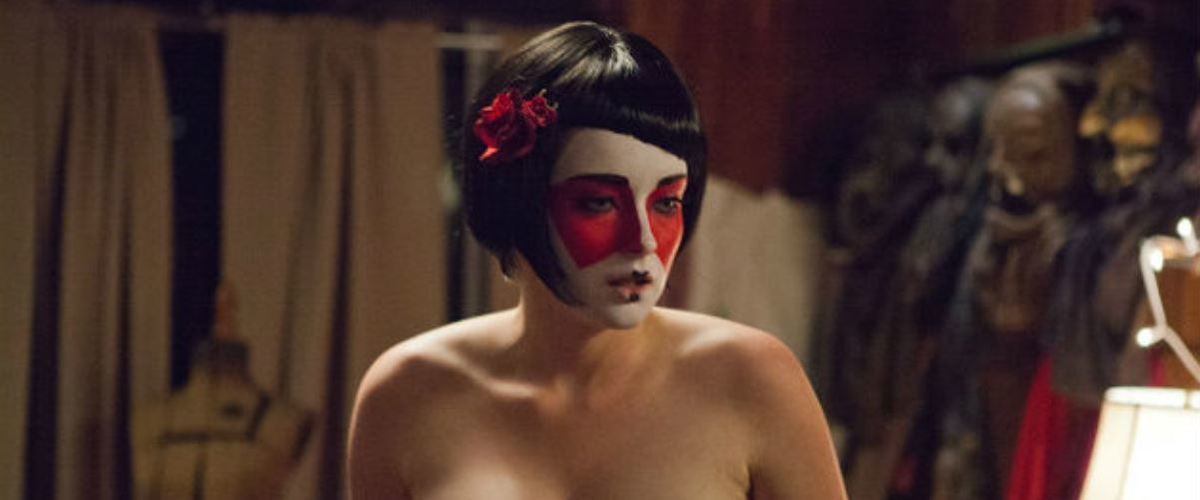
The film opens with the Minnie Driver’s primadonna Kylie Swanson ending her performance in The Haunting of the Opera to rapturous applause, her twins Buddy and Camilla take a tour of the auditorium, while their mother preens in front of her dressing room mirror. She is then savagely hacked to death by an unknown assailant wearing the mask of the Opera’s villain. Ten years later, the twins work at Center Stage Camp, a place where all misfits/theatre geeks love, laugh, sing, dance and, best of all, fit in. The Haunting of the Opera is chosen to be the musical book restaged (in keeping with the tragic anniversary), albeit relocating setting to Japan and replacing the plain white mask with that of a Kabuki, complete with top-knot. Camilla (Ally MacDonald) has always wanted to perform on the stage and despite being kitchen staff and not a student is allowed to audition. As pre-production begins, one-by-one cast and crew are picked off.
Okay, so it is not extremely difficult to see what, who, or how this film was inspired, it is painting a rock-horror-musical-by-numbers. It is an extended Glee episode (although the cast is by and large far more likeable) via The Phantom of the Opera and Friday the 13th. The score and song list is, however, original and fluctuate between eye-rollingly naff and grin-inducing, especially those songs sung by the supremely camp, foul mouthed villain who is, typically, dressed heed-to-toe in black brandishing a knife and electric guitar with murderous aplomb. In fact, one criticism is that he is not on screen nearly enough and an audience has to sit through more teen-angst than is absolutely necessary; where is the slicing and dicing?
There are enough sly allusions to other horror films to keep the seasoned genre-crowd satisfied (the sight of a twelve-year-old set designer wearing an apron whirling a hand-saw around made me chortle) and for those with a hatred or largely indifferent view of musicals there is a splendid rock and roll slayer to empathise with. Anyone with a sense of humour and a 90-minute window to fill should enjoy Stage Fright. It does exactly what it sets out to do, perhaps not quite frighten but it certainly entertains for the most part.
Fairy tales have been a part of oral and literary tradition for centuries providing society with entertainment, history and ambivalent moral life lessons. These have assisted, according to those within the psychoanalytical space (Bettelheim, 1978) (Von Franz, 1995, 1996), (Cashdan, 1999), with psyche development, often in children, and the use of enchantment.[1] The cinema has been pioneering in producing film versions of these tales, the first version of Cinderella was produced in 1899 (dir: Georges Mèliés) displaying what Ridvan Şentürk calls “the transition from textual culture to visual culture and the accompanying transition in the transformation of reality”.[2] This renovation of reality does attempt to encapsulate a sense verisimilitude within this real world and if an imaginary world exists within the diegesis there is some element of mimesis. These films juxtapose the real and fantastical and while it is clear that these screen fairy tales are made for adults with their dark visuals and themes of murder, sacrifice, fear and death, the use of the child protagonist is intriguing. If these stories told in childhood do provide psychological maturity to children too immature to deal with the situations around them then what purpose does the casting of a child in an adult version serve, if any, to the narrative? Perhaps it is as Bruno Bettelheim determines that “[e]ach fairy tale is a magic mirror which reflects some aspects of our inner world, and of the steps required for our evolution from immaturity to maturity. For those who immerse themselves in what the fairy tale has to communicate, it becomes a deep, quiet pool which at first seems to reflect only our own image; but behind it we soon discover the inner turmoil of our soul – its depth and ways to gain peace within ourselves and with the world, which is the reward of our struggles.”[3]
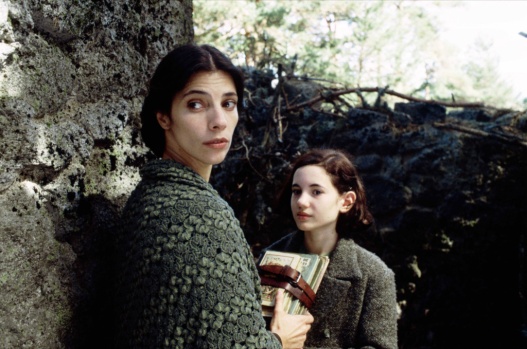
The screen fairy tale acts in much the same way bringing together elements of the fantastical and projecting them within a social setting which will allow for an ideological reading and therefore aid identification. Some screen tales which are aimed at young children contain clearly defined adult/child relationships whereas the texts explored in this project are more ambivalent. It can even be suggested that these characters are in fact mirror representations of the other; their individual anxieties, qualities, even physical features and respective journeys are transposable (see fig1.1-4).
fig 1.1 Mirror images: Kym (Katie Holmes) and Sally (Bailee Madison) in Don’t Be Afraid of the Dark.
fig 1.2 Jesus (Federico Lippi) and Aurora (Tamara Shanath) in Cronos.
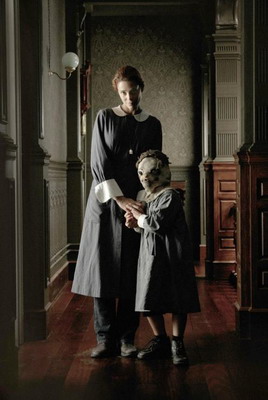
fig 1.3 Laura (Belén Rueda) and Tomás (Óscar Casas) in The Orphanage.
fig 1.4 Santi (Junio Valverde) and Jacinto (Eduardo Noriega) in The Devil’s Backbone.
On some level these adult characters who share screen time with their counterpart have lost a part of themselves; some innocence or element of imagination associated with their youth and now have the opportunity to embrace their ‘inner child’ in order to survive their current situation. In order to do so they must allow the child or shadow to impart the wisdom forgotten through maturation. In Jungian theory, fairy tales are regarded as symbolic representations of problems associated with adults and thus describes the shadow as the part of the psyche that the individual would rather not acknowledge. The greatest power is to accept the shadow parts (or daemons) and integrate them as components of the self.[4] These relationships are prevalent in adult fairy tales, and will be referred to as the shadow-child, this article aims to look specifically at Guillermo del Toro’s oeuvre and his vision of the fairy tale.
Guillermo del Toro’s first foray into Hollywood filmmaking was with Mimic (1997) in which an entomologist (Mira Sorvino) creates a genetically modified insect-human hybrid to save the nation’s children from deadly disease.[5] This mediocre sci-fi/horror text was not a commercial success, yet it enabled del Toro to make more “personal”[6] films, those which depict recurring themes related to the concept of childhood all present and displayed with visual relish in a very obvious adult diegesis and through the juxtaposition of beauty and the macabre. These dichotomous themes become more prevalent following Cronos (1993) and The Devil’s Backbone (2001), in which these horror texts, crucially, also contain young children despite the narrative(s) aim at an adult audience. These films still contain a certain mythology associated with the adult fairy tale and the adult/child pairing. However, it is in del Toro’s later work in the guise of writer, producer or director that greater encompasses the ambiguity of the adult fairy tale specifically alongside the film texts and his directorial works Pan’s Labyrinth (2006) and Hellboy II: The Golden Army (2008) that the extent of the screen fairy tale and the adult-child dual relationship will be explored. These films contain individual and distinctive aesthetics which make for some of the most memorable fairy-tales-for-adults in modern cinema.
Born in Guadalajara, Mexico on October 19, 1964 to Federico and Guadalupe and raised in a strict Catholic household the young Guillermo developed an early interest in the fantastical, monsters, make-up and special effects[7]. As a child, by his own admission, del Toro became enthralled with both bible stories and fairy tales and found what he refers to as “equal spiritual illumination”[8] in both sets of parables. Interestingly, now fifty, del Toro has rendered his religion indefinable and is now a self-proclaimed “lapsed Catholic”. He does, however, still believes in fairies and continues to avidly collect books and anthologies on the subject as well as incorporate traditional tales within the mise-en-scène of the filmic frame.[9]
Visually, Pan’s Labyrinth’s palette of colours are tonally neutral and cold (greens, greys, blacks and blues) in the real world; displaying the darkness of a country following a civil war. The fantasy world’s range of colours, in contrast, are reds and gold, warm inviting and what del Toro refers to as “uterine” in shape and density; this is, after all, a tale of a defiantly imaginative girl in her pursuit of re-birth.[10] Few scenes are shot in natural light and the majority of action occurs during dusk or deep into the hours of darkness when the world is asleep and twelve year old Ofelia (Ivana Banquero) can complete her quest. At the film’s opening a blackout slowly reveals a close-up image of a child which fills the frame, blood is pouring from her nose and she is gasping for breath, close to death. Intertitles set the scene, it is 1944 and following the devastation and stasis of the Spanish Civil War, guerrillas of the resistance are attempting to regain control of their country; rescuing it from the iron fist of Fascism left in the wake of General Francisco Franco’s reign. A fairy tale-style narration begins detailing the story of a curious princess named Moanna who escaped from her kingdom to quench her thirst for adventure. Over time Moanna loses her memory, forgets her true identity and eventually succumbs to the austerity of the real world and dies. Her father, the King, believes his daughter’s soul will return incarnated in another body and will await her. There is a sense of foreboding within Ofelia’s death scene, a child’s death is difficult to comprehend, perhaps due to their free association to innocence and mythology which surrounds childhood and suggests that children are inextricably linked to purity and are therefore to remain untouched. “[Y]ou do not”, according to psychoanalyst Serge Leclaire “single them out for hatred”.[11] Leclaire argues that through the stages of “primary narcissism” the individual must unconsciously and repeatedly kill and destroy the phantasmal image of a child projected onto them by their parents.[12] Surely then, the inference of death in the child is not quite as traumatic as he suggests but a projection of the spectator’s primary narcissism. The audience could ideologically view Ofelia as the ghost child of the individual psyche; she is an embodiment of the delusion which would render her death of little consequence in the opening segment. The fact that she is dying strengthens her humanity, interpellates subjectivity and thus facilitates viewer identification. Within minutes of this, however, the blood pool reverses and begins to seep back into the child and the next shot indicates the commencement of Ofelia’s journey.
The voice-over narration stops and an inlay of a volume of fairy tales fills the frame and then Ofelia. She is sat in the back of a car with her pregnant mother Carmen (Ariadna Gill) who is incredulous at the amount of books her daughter insisted upon bringing; tales that, according to her mother, Ofelia is too old for. Carmen, having spent a number of years as a widow, did not wish to succumb to loneliness and has married Captain Vidal (Sergi Lòpez) with whom she is now expecting a child. The depiction of the older female staving off pregnancy-induced illness and the young girl’s fascination with her stories shows the distinction between adult and child. Carmen becomes exasperated by the muddiness of her daughter’s shoes while Ofelia is excitable because she believes she has seen a fairy.
Vidal is cold, calculating and unapproachable. His only interest is his firstborn son, the older female is merely a vessel for his heir and the younger is an unnecessary inheritance from his marriage; women in his world are expendable. As long as Ofelia remains impassive and invisible, he is happy to ignore her: the disdain is mutual, made evident with the child’s stubborn refusal to call the man ‘father’. While Carmen wishes for her daughter to cast aside the childish fairy tales and books the act of storytelling itself is the way in which the two siblings, who have yet to meet, bond. Ofelia tells her brother tales of wonder while he is in utero and it is during this sequence that del Toro utilises one of many visual effects to show the unborn child and the response he has to his sister’s voice which carries tales of wonder and imagination. After showing the unborn son safe in the cocoon of the amniotic sac, the filmmaker cuts to Vidal – the opposing force to his child – he is the active, experienced adult who is far removed from innocence. He tortures and murders a father and son whose only transgression is killing hares for food; the violence displayed is unflinching as the Captain obliterates the younger man’s face with a glass bottle. This dichotomy of beauty and horror is essential to the on-screen fairy tale. Not least, according to del Toro, but to instil fear while some foster hope and magical wonder. All “have a quotient of darkness because the one thing alchemy understands, is that you need the vile matter for magic to flourish”.[13] Certainly, Ofelia’s world contains an element of darkness complete with a dying mother and a wicked stepfather. Her tales have honed an already active imagination yet precipitates her demise.
Ofelia is neither adult nor child in totality, she resembles a child on the cusp of sexual maturity and yet her experiences to date are perhaps limited to an association with an adult world: endurance of hardship, upheaval, heartbreak and death are difficult for any soul to bear regardless of their age. She follows her heart and while this may be construed, at times, as disobedience it is more accurate to describe her as independent. The child is, after all provided with copious amounts of freedom. Mercedes (Maribel Verdú), on the other hand, is subservient. She continues to serve Vidal and run the household; she may occasionally sneak out at night and visit her younger brother Pedro who is part of the resistance but her true defiance only occurs after, her shadow-child, Ofelia has paved the way. Interestingly, the items which Ofelia rescues during her trials: the key and the dagger find their way into Mercedes’ possession in the real world. In a sense the girl, in her ambivalent child state completes her tasks with determination and self-sufficiency and this, in turn, enables Mercedes to gain strength and daring. The self-proclaimed “coward” then rises up to Vidal to become a hero of her own making. There is an indication that Ofelia’s presence brings about a change to Mercedes within moments of arrival. When the girl chases the cricket, the woman watches intently, perhaps the presence of a child stirs maternal instincts or there is still some dormant magic within Mercedes. When Ofelia asks her if she believes in fairies, Mercedes answers that she used to, “I used to believe in a lot of things when I was a girl”. Ofelia confides in her new friend that she has met a faun and Mercedes tells her to be wary of it, there is no attempt to oppress the girl’s imagination but a voice of experience that could perhaps hint at previous dealings with the magical creature. The duality in representation of the two does not end there as costumes and colours remain similar in cut, style and tone of the two characters and they are often shot next to or in front of each other; an extension of the body (see fig2.1-3 ). The woods also hold great significance for both. The forest is a site of indifferent nature, a place where the two worlds (real and fantastic) merge, a location to both hide and get lost in.[14] this is the place where they are safest; where they are active, princesses of their own destiny.
Pan’s draws readers’ attention to intertextual signifiers throughout the mise-en-scène and the individual instinctively associates it with a fairy tale narrative that is innately familiar[15] and continues the fairy tale tradition. These signifiers are evident through allusions to Alice in Wonderland[16] (fig3.1), specifically through the style of the silk dress Ofelia is made to wear just prior to her first trial[17]. The Wizard of Oz is hinted at during the film’s finale when the princess finally gets home[18] and knocks her red booted heels together and lastly with her alabaster skin and ebony hair Ofelia resembles Snow White[19]. It is, however, at the commencement of her second task after rescuing a key from the stomach of a giant toad when intertextual layering is displayed to full visual effect in the Pale Man’s lair.
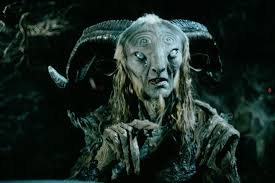
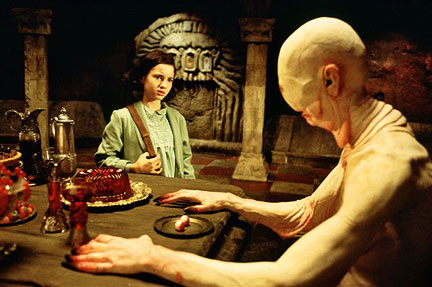
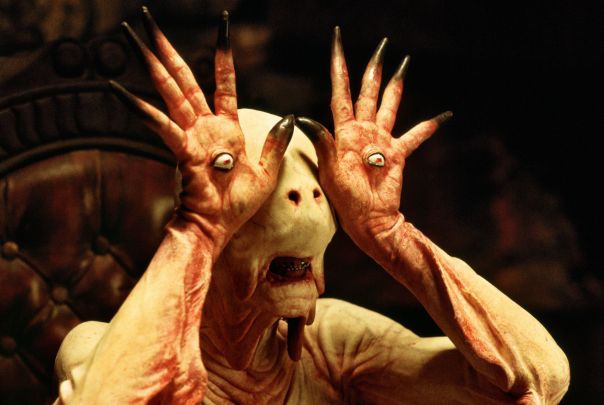
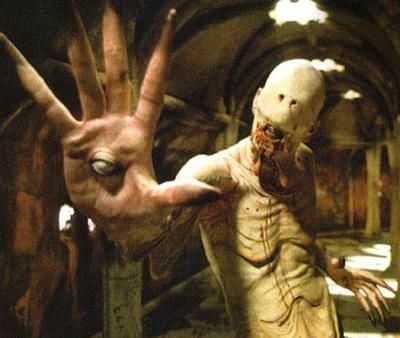
Ofelia is warned by the faun, before she leaves her bedroom, not to touch anything. The ogre sits at the head of a decadent banquet table with his palms pressed on the table top. Although alone Ofelia is Hansel and Gretel;[20] abandoned by her parents and trapped by a blind witch (the Pale Man has no eyes or sockets). She rescues a gilded dagger from one of the lock boxes on the wall and starts to leave. Here, religion and fairy tales meet within the mise-en-scène, del Toro hinting that despite his lapse of faith there are some aspects he remembers. There are murals and paintings across the wall reminiscent of the stained glass interpretations in any church, the Pale Man, however, does not display the Stations of the Cross but stations of his repugnancy as it were; the tens of small shoes in a pile by the fire makes clear the monster’s intentions. The ogre’s stigmata is in the form of sockets on both palms his eyes sit next to him on a saucer, an allusion to St. Lucy[21] and when Ofelia gives into temptation and steals a luscious-looking grape she is evocative of Eve stealing the forbidden fruit. Her transgression facilitates the fight for her life, the Pale Man’s eyes are popped into the sockets and his fingers act as surreal lashes. This marriage of religion and fairy tales links back to del Toro’s childhood and the age of enlightenment and furthers the angelic and demonic dichotomy which is scattered throughout each of his films (fig4.1-3).
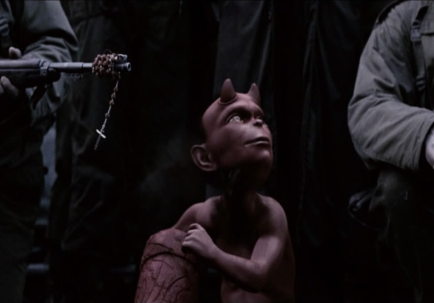
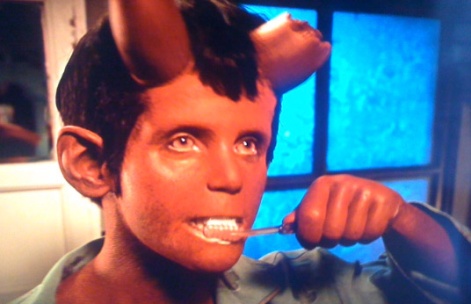
Who is more of an angel and demon amalgam than the character of Hellboy? In the second of the current franchise, The Golden Army, del Toro yet again screens the fairy tale through an adult world and repeats many of the rules displayed in Pan’s; the underworld, the king, a war with humans and all in a social setting which is identifiable and recognisable. The main character’s name is no accident – Hellboy is exactly that, a boy, albeit in an adult demon’s body. His childlike qualities are made more apparent by the fact that the audience view him as a child in the opening sequence, getting ready for bed, brushing his teeth and excitably awaiting a bedtime story from his father. These images can serve to assist with identification, after all, as adults the audience have one thing in common; they have experienced a childhood in one form or another. In later life, his love of candy, television and petulant, often simplistic way of viewing the world make him the innocent living “outside of society, pre-historical, pre-social, instinctual, creatures of unreason, primitive, kin to unspoiled nature”.[22] Del Toro describes the character as “a child [who] defines himself by choosing who he is and not who he is meant to be”[23] (fig5.1-3).
Following on from sequel and the loss of his father Professor Broom (John Hurt), Hellboy is now in a serious relationship with pyro-telekinetic Liz Sherman (Selma Blair) and they along with Abe Sapien (Doug Jones) continue to solve supernatural crime in the Bureau of Paranormal Research Defense (BPRD) and fight the creatures of the Underworld at odds with humanity rather than take their place among them. Elf-prince Nuada (Luke Goss) is discontent with humankind particularly with their treatment of his world. He is angry that his father refuses to act and that the King insists upon maintaining the armistice, signed centuries ago, between the Elves and humans. Nuada thus murders his father to initiate his rise to the throne and sets about collecting the three pieces of the crown which will grant him ruler and therefore enable him to awaken the golden army and destroy humans. Nuada’s twin sister Nuala (Anna Walton) becomes an unlikely source of resistance and seeks refuge from the BPRD to prevent Nuada’s quest. He awakens the army but Nuala ends his reign by making the ultimate sacrifice.
Nuala and Nuada are the literal double of each other with the two actors wearing prosthetic pieces to ensure their facial blemishes match. The subtle colour-difference in their make-up symbolising their juxtaposing natures, Nuala’s golden eyes and mouth soften her features, hinting at her warmth while Nuada’s severe black eyes harden him and the audience is left with little doubt who the ruthless twin is; the one with the darker soul. Like with Pan’s this duality of representation suggests that they are essentially the same person with Nuada symbolising Nuala’s Shadow which she has always accepted as a part of her personality before his murderous killing spree. Unable to fully accept her Shadow there is resistance. He awakens the army but Nuala ends his reign by making the ultimate sacrifice. Their bond is not only telepathic but biological and she drives a dagger into her heart knowing that it will surely end his life also.
The character of Hellboy is what Marie-Louise Von Franz calls a “shadow-hero”[24] and therefore offers a more complex reading. He is the aspect of the archetype which has been rejected by the collective consciousness, in this case read through literal societal rejection but also that he is “more primitive and more instinctive than the hero but not necessarily morally inferior. In some fairy tales, the hero […] has no shadow companion but displays himself with positive, negative [and sometimes] demonic traits”.[25] I would suggest, however, that there is a shadow-child within his psyche, in the figurative sense, especially in those moments when he forlornly pines his father. He displays a need to return to childhood or at the very least the return to dependency and being cared for while, in the same token, yearns for attention and general acceptance from the world he has not only attempted to save but assimilate into (as much as a six feet tall, bright red, hornless demon can). Certain aspects of Hellboy’s psyche are more complex than that of Ofelia, he is repressing the demon, his birthright, an evil he keeps at bay with religious iconography – another recurring del Toro motif – ethereal images in his abode and rosary beads around his wrist and waist. He and Liz share a similar relationship in that they have had little in the way of a regular childhood. Given their, respective, extraordinary abilities they measure each other through the how the other sees them. They too have transcended the first mirror phase and now their illusions are met with similarity and reciprocity. Most couples strive for alike-mindedness; however, Liz can control fire while it just so happens that Hellboy was born in a pit of it.
Hellboy is the embodiment of the imagination, hope, death and destruction (he is destined to destroy humankind and the world, after all) and can be read as the ambivalent, often ideological, identifier sought and found in the screen fairy tale. Or perhaps the creature is a visual signifier for the film’s author. In his 2011 interview, with Daniel Zalewski of The New Yorker, del Toro claimed that some his characters are auto-biographical and that he was not only the Pale Man in Pan’s but “I am Hellboy”.[26]
The imaginative adult screen fairy tale is a sanctuary for all shadow-children to dwell, a place where they can connect and seek hope from the brutality of reality. We should all strive to be a bit Ofelia and Hellboy. [1] Child psychoanalysis Bruno Bettelheim conducted an in-depth study of fairy tales and used case studies of the children he was treating and applied Freudian theory to produce an understanding of the uses of enchantment and how these cautionary tales can assist with the psychological development of children.
[3] Bruno Bettelheim, The Uses of Enchantment: The Importance of Fairy Tales in Childhood (UK: Penguin Books, [1978] 1991) p309.
[4] Marie-Louise Von Franz, The Interpretation of Fairy Tales, (Boston and London: Shambhala: 1996) pp114-197.
[5] The film’s premise of ‘saving the children’ culminates in the death of many adults. The hybrid continues to evolve and by the text’s conclusion resembles a human and must be destroyed. It can, perhaps, be read alongside the body of this thesis – survival of an innocent is dependent upon the sacrifice of the more experienced; the acceptance of one’s shadow.
[6] Del Toro regards his personal films as those which relate directly to him i.e. The Devil’s Backbone, Pan’s Labyrinth and the Hellboy franchise.
[7] This culminated in del Toro completing a make-up course under the tutelage of Oscar winning Dick Smith. Following this, del Toro worked as a make-up supervisor before creating his own production company Necropia in 1985 – see Andrea Sabbadini, El laberinto del fauno [Pan’s Labyrinth], 6 August 2011 http://internationalpsychoanalysis.net/wp-content/uploads/2011/11/PansLabyrinth.pdf p2 [accessed 10 March 2012].
[14] Karen Lury, The Child in Cinema: Tears, Fears and Fairy Tales, (United Kingdom: I B Tauris, 2011) p109.
[15] Jack Zipes, Happily Ever After: Fairy Tales, Children and Culture, (United Kingdom: Routledge 1996) p1.
[16] See Lewis Carroll, Alice in Wonderland, 1865.
[17] Alice wears a dress underneath a white pinafore apron, has knee socks, Mary Jane shoes on her feet and a headband in her hair. While the dress is traditionally blue, Ofelia’s is emerald green in keeping with the palette of colours utilised through the real world’s mise-en-scène.
[18] Home is the kingdom of heaven where she becomes Princess Moanna once again taking her throne alongside her father and mother.
[19] Rather than an evil stepmother, Ofelia has a stepfather whose early morning shaving ritual involves staring into a mirror. In a subversion of the traditional tale, however, it is Ofelia who tries to poison him when she attempts to escape with her younger brother.
[20] This is not the only allusion to the fairy tale siblings – Pedro and Mercedes are parentless siblings abandoned following the war, making the woods their temporary home. Vidal’s food store could possibly be read as a gingerbread house of sorts.
[21] Saint Lucy (Santa Lucia) is venerated as the patron Saint of the blind. Upon her execution her captors, unable to burn her to death, plucked out her eyes with a fork. She is often depicted holding her eyes upon a plate or flat receptacle; del Toro makes reference to this statue which “freaked him out as a child” (New Yorker, 2011 p10).
[22] Marina Warner, Six Myths of Our Time: Little Angels, Little Monsters, Beautiful Beasts and More, (UK: Vintage, 1996) p57.












 The Framing Device