Categories
film review

Chain Reactions (Dir. Alexandre O. Philippe, 2024)

Utilising his tried, tested and not terribly ground breaking format, Alexandre O. Philippe is back behind the camera of another visual essay/love letter to an aspect – or individual (Lynch/Oz deviated slightly, no doubt Kim Novak’s Vertigo will also) – associated with horror cinema. This time it is Tobe Hooper’s The Texas Chain Saw Massacre which is placed under the microscope, within a bacteria-teeming petri-dish as it were.

Once again, Philippe combines archival material including “never seen before” BTS footage and scenes from the film all split over five chapters. There is also a multitude of other works mentioned by each talking head subject as they liken, contrast, use to bolster their individual reading/thesis statement of Hooper’s seminal work. Each segment features the individual – comedian/actor Patton Oswalt, the ‘Horror Nonna’ herself Dr Alexandra Heller-Nicholas, filmmakers Takashi Miike and Karyn Kusama, and Stephen King – and their relationship with the film. Arguably, the GHOAT an integral piece of American cinema. Its cultural and artistic impact having built over the last five decades.

Part of what made Hooper’s original so influential was its stark cinematography, verisimilitude and its “true story” marketing with a documentary-style voiceover courtesy of John Larroquette and shot on 16mm. Its narrative and plot were, of course, entirely fictional but the finished film serves as a subtle commentary on the political climate and symptomatic of the era; something of worth created within budgetary constraints ($140,000 back in the day). The US was still knee-deep in the Vietnam War and this affecting horror visualised an apocalyptic landscape, sparse and abandoned through industrial capitalism. It depicted a non-traditional, perhaps arguably degenerate, familial homestead transgressing the boundaries of the norm and surviving via cannibalistic insanity. As a movie, it stays with you long after viewing and its esteemed standing in the horror genre a testament to director Hooper and writer Kim Henkel, who created an influential piece of frightening art in spite of a profound lack of blood, guts and gore.

Released on October 11 1974, Hooper and Henkel’s filmed screenplay depicted a decaying world beneath the discomfort and humidity of the Texan heat. Sweat and smells almost permeate off the print. Post-Watergate, the Vietnam War, and Elmer Wayne Henley’s killing spree – although, over the years it would become more associated with Ed Gein’s ghoulish face-swapping – are all connoted and The Texas Chain Saw Massacre was the result. A film without sentimentality determined to show the brutality of things at a time where most monsters were men who wore masks and final girl tropes were yet to be seen (or studied at length).

While all interviewees are admitted admirers of the film, Oswalt takes the ‘fan’ angle more than the rest; their respective professions already implying they have something more substantial to contribute. He theorises and contrasts against other horror films and delivers an astute reading of the film – not least the teeth-gnashing title which he likens to chewing flesh when spoken aloud. Takashi Miike – like the man before – saw Chain Saw in the eighties after his initial cinema screening choice City Lights (Chaplin, 1931) sold out. Drawn to the title – in translation The Devil’s Sacrifice – he likens the shock value to his experience of Grave of the Fireflies, lauding TTCSM‘s inspiration on his own film career; violence isn’t the goal but “causing pain is serious business.”

What follows is Heller-Nicholas and Kusama with Stephen King’s rather pointless and lengthy segment shoved ham-fistedly in between them. He prattles on about everything but TTCSM it feels like while the two women whose monologues complement each others and yet are wholly individual and equally as riveting. They are the highlight of the whole documentary.

This is doubly-pleasing given that 78/52 included women who were never really afforded time to fully expand their thoughts. Here, the interlocutors are articulate, incisive, and once again prove that not only do women enjoy, love, and revere horror cinema – which is still somewhat gendered as a genre – but that their reading(s) and subjective reactions can enrich a beloved film and help it endure another fifty years. Certainly the parallels read between the 1983 Ash Wednesday bushfires of South-Eastern Australia and Hooper’s film didn’t come from any of the men or likening the palette of yellows and reds to the works of Bosch and Bacon. None of the blokes comment on the broken version of masculinity within the disappointment and disintegration of the American Dream either, note the similarities found in Hooper’s earlier film Eggshells (1969), discuss film language and framing at length nor reveal they lost their brother on the same date, in August, as Sally Hardesty loses hers. Rendering the film text with even more profundity.

Chain Reactions is an erudite exploration of the legacy, beauty, horror and influence of Hooper’s The Texas Chain Saw Massacre. Some chapters are more successful than others but all allude to the artistry and zeitgeist-altering of this enduring masterpiece, a film to be watched time and again, cinema to immerse oneself in, investigate, nurture, hold dear and think about long after the credits have rolled. Directing an audience back – or introducing a new generation – to this film after a slew of remakes, reboots, and requels can only be a great thing. In the words of the Horror Nonna “film is magic” and the love for Leatherface* is everlasting.

Chain Reactions is available on DVD and Digital in the UK and Ireland from 27th October

*Nobody did it better than Gunnar Hansen and lord knows many have tried.

Categories
Film Festival film review

The Old Ways (Dir. Christopher Alender, 2021)

GFF 2021 – FrightFest

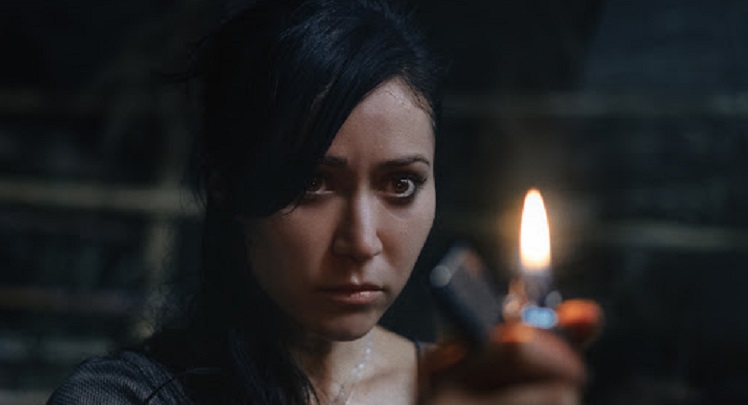
After taking an assignment in Veracruz, Mexico Cristina (Brigitte Kali Canales) finds herself hooded and imprisoned in small cell. Despite begging to see her cousin Miranda (Andrea Cortés) and general protestations: “I’m an American… and a reporter” there she remains, shackled to the beautifully rendered and chalked wall, forced to ingest goat’s milk and pee in a bucket.

Keeping her ‘prisoner’ is local witch Luz (Julia Vera) and son Javi (Sal Lopez). Both are convinced that Cristina has picked up a demon that has hitched a ride on her soul following an illicit trip to the ruins of La Boca. As the days turn to night, Cristina tries to find ways to escape, however, soon she starts to feel that maybe she does ‘have it’ or something which is holding her hostage.

Exorcism films as a sub-genre are ten-a-penny and usually contain some white child/young woman losing the battle to find the devil within. Or there’s a haunting with a vengeful spirit/lost soul possessing a house or member of a family. Sometimes there are rites, rituals, a cassocked Priest, or perhaps a Rabbi, prayers, chants and holy water. It is refreshing therefore when a film tries to do something that little bit different with the well-worn tropes – Christopher Alender’s – making the leap from shorts and TV to his first feature – The Old Ways does just that (albeit with some old faithful). 

This is exorcism as repatriation. Cristina’s soul was up for grabs because she wasn’t quite fulfilled, living with trauma in a country she never quite belonged to, even if she didn’t realise it until now, drug addled and empty. She needs to commune with her forgotten heritage – one she was ripped from as a child – in order to heal and rid herself of the demon ‘Postekhi’. Her childhood trauma is never far from her mind revisiting her in flashbacks and nightly visits of a small boy.

The beauty of this film is its subtlety, it takes its time and doesn’t outstay its welcome which make the last fifteen/twenty minutes all the more forgiveable. There’s still fun to be had but it loses the nuance it worked so hard to build on and it is those moments which feel somewhat unnecessary. Joy-of-joys, however, the practical effects are great with the odd stomach churning moment, hair regurgitation is never pretty, and special mention goes to Luz’s make-up (courtesy of Josh and Sierra Russell); the cracking white face paint, the blood-red cross across the eyes and cataract lens is striking.

The cast of four play off each other brilliantly but it is Canales’ Cristina who is the standout. She doesn’t play her as a victim but survivor, fighting tooth and nail against what is or isn’t missing inside of her. This is less about restoration of a possessed soul – the snakes and milk symbols of renewal and rebirth – but more about reclamation of a heritage as a way of life and forging ahead. Forget the passive female protagonist bed-bound and helpless to prevent what’s happening, this one schools herself with a red leather bound book of demons (Jung’s manifesto of the same hue also detailed the recovery of a soul). There’s even humour with some amusing play-acting, bribery attempts, and the cell may be dotted in candles but there’s still an electric fan to help with the heat and humidity.

All-in-all The Old Ways is a smart and surprisingly subtle horror film. A really attractive looking feature which deftly goes beyond the expelling of demons, speaks to the migrant experience and embraces cultural significance (the Mariachi-instrumental of “La Bamba” is a nice touch). If you can take one thing from it it’s to never forget who you are or where you come from… and always invest in practical effects.

The Old Ways screens at GFF FrightFest from 5-8 March

Categories
Article film review

Death Proof

The Tarantino debate has been doing the rounds again on social media with several of his films maligned (this one included) by ‘experts’ and divisive views reverberating around the echo chamber. Have you ever noticed that when Scorsese references other films it’s art but when Tarantino does it, he’s a rip-off artist? Anyhoo, it seems like as good a time as any to dust this off again…

Love him or loathe him, everybody seems to have an opinion about Quentin Tarantino and his body of work. Whether you admire, abhor, or are apathetic towards the Tennessee native most appear to have their favourites (Django Unchained and Reservoir Dogs), one that they just cannot stomach (Kill Bill Vol.2) or one that they unequivocally love. For me, that is Death Proof (2007). 

As appears to be the norm with Tarantino he channels all manner of homaging forces in his texts. For this one, exploitation meets Ozploitation, via a nudge of French new wave and an open-handed slap of the slasher to give a really enjoyable ride. Revenge is a dish best served hot rod (at 130 mph). 

Released alongside Robert Rodriguez’s Planet Terror as a Grindhouse double feature, the premise is a slasher road movie in which a group of women are stalked by an ex-stuntman, a lone wolf, who has little to do but force them off the road for shits and giggles. The first half of the film follows Jungle Julia (Sydney Poitier) and her friends Arlene a.k.a Butterfly (Vanessa Ferlito) and Shanna (Jordan Ladd) on a night out. They stop off at a bar – of which Warren (Tarantino) is the proprietor – and drink cocktails, down shots and generally bust the balls of the three men in their company – Eli Roth, Omar Doom and Michael Bacall (all three would later become Inglourious Basterds). 

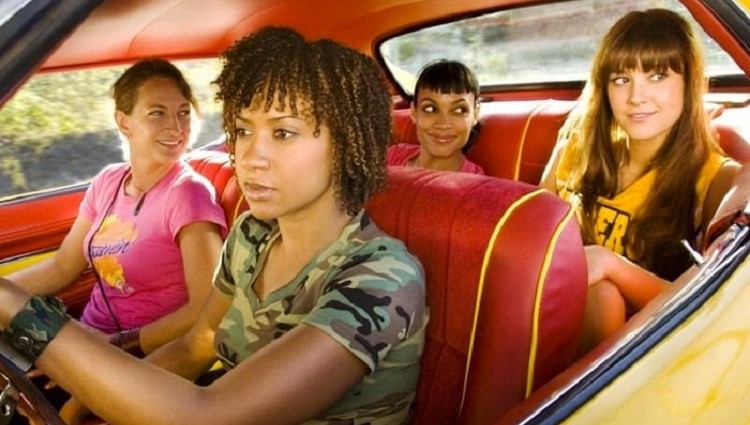
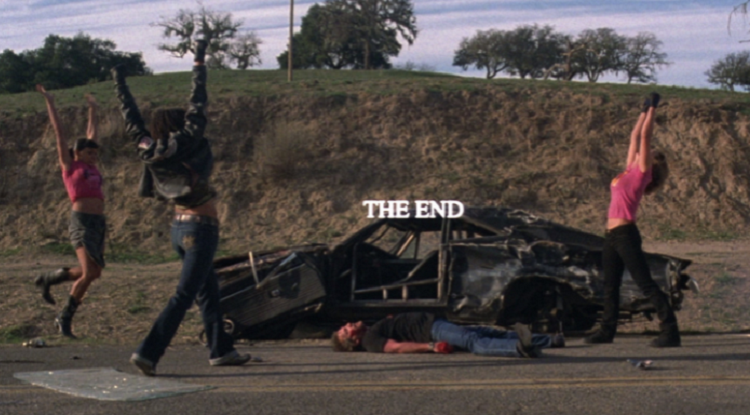
Stuntman Mike (Kurt Russell), it would appear, has been on their tail for some time, cut to a wonderful in-car-moment which does for Hold Tight – and the erroneously misnamed Dave Dee, Dozy, Beaky, Mitch (it’s Mick) and Tich – what Bohemian Rhapsody did for Wayne’s World. There is an interlude and a flash forward following a crossover sequence involving the PT hospital and Dr Dakota Block (Marley Shelton). This time, Abernathy (Rosario Dawson), Lee (Mary Elizabeth Winstead), Kim (Tracie Thoms) and Zoë (Zoë Bell) are in town taking a break from filming – they all work in the film industry – when Mike strikes again. Subsequent to the masochistic fender-bender of the first half, these ladies are ready for him. 

This film has all the markings of the 70s and early 80s; retro titles, an amazing soundtrack, jumbo cuts, fast zooms and scratches on the print adds authenticity and while these elements are in keeping with Rodriguez’s Terror it manages so much more even randomly switching to black and white. This is, I believe, Tarantino’s most feminist movie. These are sexually confident, voracious women who love men but also each other’s company (they even manage conversations where men are not even mentioned, although not quite as many as one would like) and best of all they kick arse. 

These savvy women are only as good as their aggressor and this is one of Kurt Russell’s best characters in years. As Stuntman Mike, he is fetishised with a facial scar, the first time we see him, fully, onscreen is in close-up shovelling greasy nachos into his mouth. He is Snake Plissken by way of John Wayne, his baby blues and dimples still visible beneath the aged, craggy demeanour – the fantastic facial hair would come much later in The Hateful Eight. Russell is beguiling and repugnant in equal measure with a beautiful maniacal laugh to boot. As Mike, he revels in inflicting pain and yet is not a fan of it himself and watching him writhe, scream and cry in agony is a very pleasurable experience, especially following the heinous, violent misogynistic code he appears to live by. 

There are, as expected, several nods to Tarantino’s earlier work including Reservoir DogsPulp FictionKill Bill, (as well as the subtle reference to DP in his 2019’s Once Upon in Hollywood), and even his collaboration with Rodriguez From Dusk Till Dawn. As well as several allusions to the films of the genre(s) he is paying homage to: Fair Game (1986), Dead End Drive-in (1986), Mad Max (1979), Road Games (1981), Vanishing Point (1971), and Faster, Pussycat! Kill! Kill! (1965) to name but a few. Tracie Thoms is the female equivalent to Samuel L. Jackson, delivering Tarantino’s lines with the same expletive motherfucking aplomb. The last action sequence is fantastic, reminiscent of the greatest set-pieces recorded onscreen, in the likes of Bullitt (1968), The French Connection (1971) and, hell, even The Bourne Supremacy (2004). 

New Zealand stuntwoman Zoë Bell plays a version of herself and the sight of her grappling on the bonnet of a white Dodge Challenger is exhilarating to watch and, lets face it, while Refn’s Drive (2011) may have had stylish neon cinematography, a funky score and the stoic masculinity of fanboy favourite Ryan Gosling, Death Proof is far more exciting and entertaining to watch – also, better soundtrack. The viewer needs to be part of a car chase and Tarantino keeps the camera on top and up close to the action, credit also has to go to the director’s editor, the late great Sally Menke who keeps up the frenetic pace. 

Yes, by no means is it perfect, it is a dialogue heavy screenplay and QT does flounder somewhat with the womanly repartee but it truly is an enlivened and gratifying female fantasy. So, <blows raspberry> to the naysayers.

Death Proof is currently showing on MUBI

Categories
Blu-ray film review

Monkey Shines (Dir. George A. Romero, 1988)

Following his death in July of 2017, George A. Romero’s back catalogue has been made more readily available and given the ‘label’ treatment. The Criterion Collection released Night of the Living Dead (1968), Arrow Video curated Before Night After Dawn – a boxset containing a trio of his more obscure titles – while Eureka Entertainment released a limited edition Dual Format disc of his 1988 film Monkey Shines as part of their Classics range.

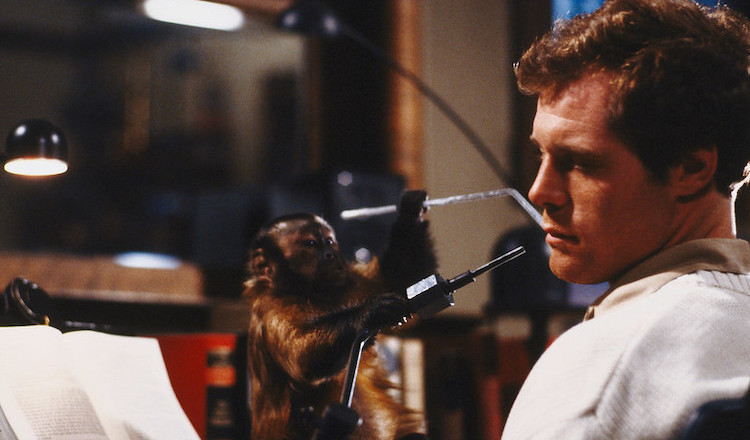
Law student and athlete Allan Mann (Jason Beghe) – A. Mann, get it? – is involved in a life-changing accident which leaves him paralysed from the neck down. Growing increasingly frustrated within his newly adapted home, overbearing mother and (Joyce Van Patten) and dwindling personal relationships, he attempts to take his own life. His despair and cry for help is heard by closest friend Geoffrey (John Pankow), a scientist (with an increasing addiction to speed) who has, not only, been injecting himself but primates with a serum containing human tissue. In an act of generosity, Geoff donates one of his Capuchins to service monkey trainer Melanie Parker (Kate McNeil) who trains Ella (Boo) to assist Allan, and hopefully lift his spirits by restoring some of his independence. Over time, Ella becomes a loyal and affectionate companion, however, their bond starts to take a sinister turn when Ella starts to act out.

Based upon Michael Stewart’s novel of the same name, Monkey Shines was Romero’s first – and subsequently last – foray into working with a studio. The fact that he returned to independent projects after this experience speaks volumes. As does the film itself, or at the very least the way it has been put together. There are multiple subplots over the course of the lengthy 113-minute duration which don’t always work but nearly always feel one too many. The pacing, however, is purposeful, allowing the audience time to empathise with Beghe’s Mann. The ‘horror’ is internalised, tension implied yet rarely seen with an overarching and prevalent theme of mental health.

The thing about Romero’s films is that while they are weighted in the horror genre, they tend to be far richer and allegorical in tone, beyond the odd scare, which make them all the more intelligent and effective. However interesting this film appears though, it never feels like a complete Romero, and certainly not that ending. When Ella’s ‘instinct’ kicks in and goes full throttle – combined with the inexplicable score – it becomes laughable. Riffing off Alien (1979) feels like a huge misstep. Thankfully, the alternate ending – George’s ending – is included in the disc extras. Spoiler: it works so much more convincingly (and satisfyingly) than the one the studio insisted on.

Studio interference aside, this is Romero at his most Hitchcockian, reminiscent of something his Creepshow collaborator Stephen King would write with shades of Rear Window and hues of Vertigo, and yet still feels somewhat original. There is plenty of merit outside of those last ludicrous moments, and fans of the Pittsburgh-native filmmaker will lap up this presentation, especially Tom Savini’s FX. Those monkey-point-of-view shots are inspired and Beghe’s simian teeth prosthesis so subtle few will spot them.

Though it may not be one of Romero’s more thoughtful pieces of work, somewhat neutered thanks to the studio, Monkey Shines is highly entertaining. A melodrama-horror about a man and the literal monkey on his back, played here by the remarkable capuchin Boo.

We still miss you, George.

Categories
Blu-ray film review

Under the Shadow (Dir. Babak Anvari, 2016)

In Two & Two (2011) – Babak Anvari’s BAFTA-nominated short allegorical film – a teacher (Bijan Daneshmand) attempts to re-educate his male pupils with some basic arithmetic, claiming that what they have always been taught is no longer true. The writer-director packs quite the punch with very little exposition and a whole lot of nuance when depicting the absurdity of an authoritarian regime/dictatorship. Which all bodes well when your next film – and first feature – is an effective little horror (and would become BAFTA award-winning in its own right). It is also a lovely touch to have that same actor play the University Dean who is responsible for shattering Shideh’s dreams of becoming a Doctor.

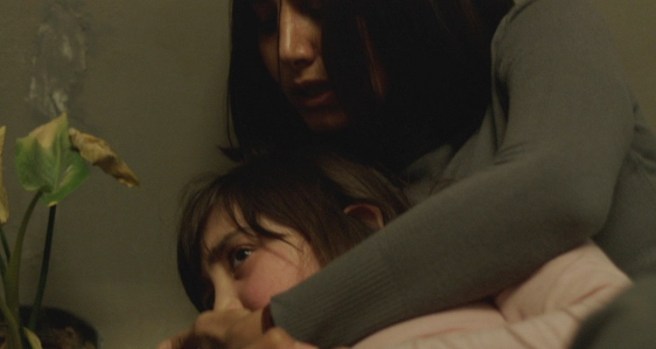
Under the Shadow is set in Tehran during the Iran-Iraq war of the 1980s and Shideh (Narges Rashidi) can no longer study medicine having been removed for her political beliefs. We are never party to what exactly her transgression is but suffice to say with the mention of ‘radical left groups’ she was – and probably still is – against the war that is currently waging in her country.

Once her chador is removed, we can ‘see’ some of her transgressions. Her hair cut (in a bob style), dress (westernised), and her autonomy around her home; the partnership with her husband, exercising to Jane Fonda. she’s also the only woman in the building who drives. This is a ‘modern’ woman, oppressed by external tradition and reduced to the confines of her four walls, and even those are not so secure with the shelling, daily explosions and air raids which can send residents into a panic at any given moment.

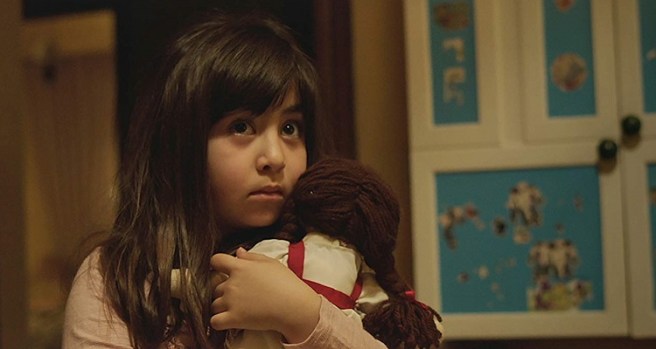
When her husband Iraj (Bobby Naderi) receives his draft notice, Shideh is left with her young daughter Dorsa (Avin Manshadi) as, one by one, all her neighbours pack up and move onto safety. The exacerbating factor a shell crashing through the roof of their building, killing the elderly resident within and leaving a gaping hole. The hole is covered with a sheet which appears to undulate in the wind like a bodily organ, flapping in and out like a heartbeat. A visual metaphor of a damaged culture, while the cracks in the ceiling – it can be argued – relate to Shideh’s psyche. Ever increasingly isolated, Shideh and Dorsa begin to experience things which may be the product of a child’s imagination or something altogether more supernatural.

Djinn is a malevolent spirit which has its history in Early Arabia and then later in Islamic mythology and theology. An entity that travels on the wind until it finds somebody to possess. Often dismissed as a superstitious belief, the spirit is reported to enjoy the souls of children (much like Krampus in European culture, or el Cuco in Latin America). It may explain Dorsa’s fever or not, after all Shideh was also once a child. Evil wants to hurt them alleges one neighbour while another, Mrs. Fakur (Soussan Farrokhnia), attempts to allay her friend’s fear: “people can convince themselves of anything if they want to”.

Tight framing adds to the oppressive atmosphere as mother and daughter’s fear and anxiety builds. Tension is slow-burning, and jump scares are few and far between yet effective when they do occur. There’s no score (music is only played during opening and closing credits) so is reliant upon diegetic noise and whistling winds. We’re never sure of the time of day given the constantly closed curtains and disturbed sleep patterns.

What appears to be mere moments gives the impression of hours. As people leave we can assume the passing of days and weeks yet the costumes of the leads mostly remain the same. Natural and artificial also play havoc with this, along with the production design: one location, open doors, hallways, and reflections in the television mean the constantly moving camera plays tricks with the eyes – was that something moving or not? Shideh’s lip is bruised from the constant biting, insecurity, anxiety, stress. Like all amazing genre films – nothing is ever quite how they appear and this film is all the better for it building beautifully the general sense of unease.

It seems apt that when she is preparing to fight, Shideh’s weapon of choice is a pair of scissors – as if tethered to a more domesticated past, her own mother’s apron strings or the chador in this instance. While the malevolent being appears to be set on persecution – even referring to the character as a ‘whore’ and ‘bad parent’ – it’s important to remember that Djinn is not inherently evil or good, and this entity could, at some point, be Shideh’s mother from beyond the grave.

A matriarch disappointed that her daughter will no longer practice medicine but needs to save her by forcing her to leave the building. Think back to the picture frame which houses Shideh’s mother’s portrait, the fractured glass obscuring the image within, it now laying down on the shelf hidden from view – but before that, the draped material serving as a backdrop in the photo is identical to the chador the entity embodies itself within. This reading further strengthens the mother-daughter links throughout, and the expectations a patriarchy levels at women, generally, but more so during the kind of regime in Tehran of the 80s.

As a first feature, Under the Shadow wears its influences well: Polanski’s apartment trilogy (Repulsion [1965], Rosemary’s Baby [1969], The Tenant [1976]) with a sprinkling of Hideo Nakata’s Dark Water via a domestic social realist drama in the ilk of Abbas Kiarostami and Asghar Farhadi. It’s a rich and visually arresting film which checks all of the above as well as featuring, at its heart, a really affecting horror fable. A 1980s Tehran-set horror film filmed entirely in Farsi – the first of its kind.

Finally, it has been given the kind of release it deserves courtesy of Second Sight that includes plenty of extra features, including five new interviews with the filmmaker, cast and crew, as well as a lively commentary between Director Anvari and film critic Jamie Graham, in which every aspect of the film’s genesis, production and release is covered.

Extras

Two & Two (8:48) – Babak Anvari’s BAFTA-nominated short film shown in its entirety. It’s the one extra which can be watched before the main feature.

Escaping the Shadow (23:53) – A long interview with Anvari who begins with his own childhood nightmares growing up in 80s Iran before his move to Britain. He talks at length about the filmmaking process, his cast, shooting in Jordan and expands upon things mentioned in the commentary. He’s a delightful interviewee, and while it is not the most imaginatively filmed featurette, Anvari’s charisma shines through.

Within the Shadow (12:52) – Star of Under the Shadow, Narges Rashidi discusses her own childhood in Iran and Germany and career now she is LA based. She describes the film as a ‘beautiful gift’, and again, static camera and a by-the-book interview reveals an excitable and rather lovely person.

Forming the Shadow (16:11) – Lucan Toh and Oliver Roskill talk all things ‘producer’, how they met Babak, the script, the film’s potential and their brief disappointment at not having to sell the film when it premiered at Sundance. A lot of their anecdotes are repeated in the commentary track.

Shaping the Shadow (13:29) – Anvari’s close collaborator and DoP Kit Fraser talks about his involvement from before the script was even written.

Limited Edition Contents – This set is limited to just 2000 copies, comes in a rigid slipcase featuring new artwork by Christopher Shy and with a soft cover book with new essays by Jon Tovison and Daniel Bird (unavailable at time of review). Plus behind-the-scenes photos, concept illustrations, and a poster with new artwork.