Categories
Film Festival film review

Petite Maman (Dir. Céline Sciamma, 2021)

“Shall we read?”

“No, I want to sleep to get to tomorrow.”

An elderly woman completes a crossword with a young girl – there is a brief assumption she’s her granddaughter but the child gets up to leave with an “au revoir”. The girl then goes into every room along the dimly lit corridor and bids farewell to the other female residents until she reaches her destination; the bright room at the end of the hallway. ”Mama, can I keep her stick?”

After the passing of her grandmother, Nelly (Joséphine Ganz) and her mother Marion (Gabrielle Sanz) drive to the latter’s childhood home to pack up belongings, keepsakes and transport furniture, as families are wan to do after a bereavement. Nelly feeds her mother from the backseat of the car, extends the juice carton to her lips and then reassuringly clamps her arms around her mother’s neck as they both follow Papa (Stéphane Varupenne) driving the white van in front. Nelly is every inch the little mother of the title despite the interchangeability of role throughout the taut 82-minute film.

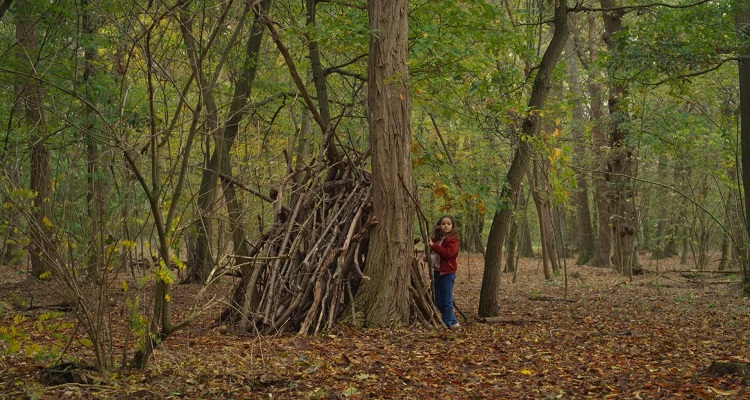
Nelly moves into her mother’s childhood bedroom and they both go through Marion’s note pads, school books and toys. The little girl chides her mother’s inability to spell but offers words of encouragement about a drawing of a fox. It’s an incredibly tender and loving relationship between the two. Despite being only eight years old, Nelly is wise beyond her years, empathy seeps from her every pore; she can sense her mother’s vulnerability and offers her narrow shoulders and small arms within which comfort can be sought. When Marion suddenly leaves, it is up to her daughter and partner to stay on and finish packing up. Nelly attempts to engage her father by bringing up the treehouse her mother built in the surrounding woods but the man merely shrugs and says he can’t recall anything about it. ” You don’t forget,” she scolds, “You just don’t listen.”

What happens next is so matter-of-fact that to go into detail would ruin the surprise (NB. Don’t watch the trailer if you wish to avoid spoilers) but it relies upon an open-minded audience and one which is willing to accept the ordinary and enchanted; the magic and imagination of a child. We all sought it once upon a time.

While Portrait of a Woman on Fire cemented Céline Sciamma as auteur, her earlier filmography has tended to forefront children and teenagers. Adults don’t really exist in the world she creates and she writes the world from their viewpoint whether they are eight-years-old, teenage girls, a tomboy, or a courgette. This film uses an autumnal colour palette full of lush browns and greens, and rich blues and burgundies; colours echoed between mother and daughter. Its costumes look to corduroy, woven jumpers and anoraks to weight the seasonal surroundings but also to give it a timeless quality. Transitions in time are slight but not insignificant – French language aside, this could be anywhere.

Childhood is a tricky thing to navigate while you’re experiencing it – although you tend not to realise just how much until you’re out the other side. Petite maman is extraordinary and enchanting, small and yet packs a punch. It is a thoroughly gorgeous film in which memories are tangible, maturation comes quickly, and a loving and assertive little woman seeks to renew her connection with her maman and say goodbye to her beloved grand-mère on her own terms.

Categories
Film Festival film review

Jumbo (Dir. Zoé Wittock, 2020)

Jeanne (Noémie Merlant) – age undetermined – lives with her maman Margarette (Emmanuelle Bercot). They are the mother and daughter equivalent of chalk and cheese but both still wounded slightly since their respective husband and father left. We are never given the details but indications suggest it was acrimonious and he did a number on both of them. Margarette seeks companionship with whichever bloke she takes a fancy to from work behind a bar and Jeanne happily tinkers with her creations/ machinations behind closed doors whenever she isn’t working nights at an amusement park.

The anti-social nature of her job – rubbish collecting in solitude – long after all paying customers have vacated the premises suits her down to the ground. She is painfully shy, a little anxious with her cute Amélie-style-bob and the pervading silence that accompanies her. She prefers to keep her head down, mouth shut and cloak herself in her own social awkwardness and quiet. Jeanne has absolutely no idea of her own attraction to men, swamping herself in baggy clothes, bright blue headphones blocking out the outside world. Ops Manager Marc (Bastien Bouillon) falls for her anyway. Her mother, on the other hand is overly loud, a little brash and brimming with confidence – a “bundle of joy”. Their relationship is fractious, with the absent partner/parent the push and pull, he’s the insult slung between them when they want to hurt the other or lash out. Then Jeanne meets Jumbo.

Image copyright: WILLIAMK

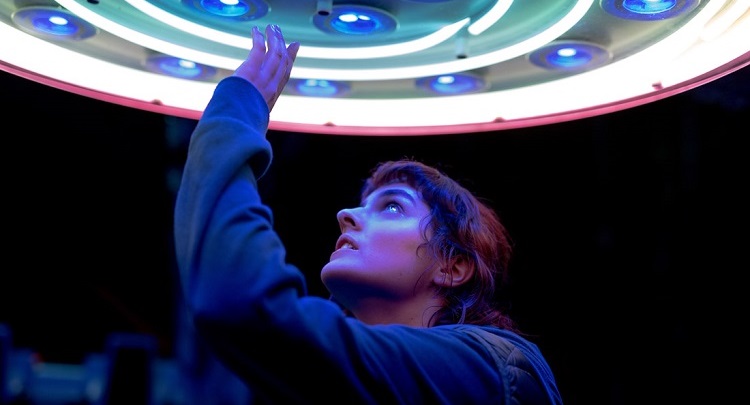
With its red and white stripe design, the fairground ride aptly resembles a piece of rock and Jeanne finds safety in its six huge mechanical arms, choosing to sit astride its dormant structure and spit-clean ‘his’ multitude of raised red bulbs with her hanky. To the more closed mind, the electrics could be shorting but to Jeanne, it/he appears to communicate with her – and she does most of her chatting while with him. For all intents and purposes, he understands her and she gives herself willingly, even falls in love, their sex scene reminiscent of the feeding scene in Under the Skin, only with the sea of blackness giving way to bright white purity as she is dripped in black viscous lubricant. It’s not too much of a stretch to conflate the exhilarating screams of pleasure and excitement experienced during a body-flinging Waltzer, or the dizzying heights of a ride on a Big One.

What follows is an astonishing performance from Merlant who completely sells the emotional, for want of a better word, rollercoaster that is all-consuming love; the joy, jubilation, soul-destroying confusing and rejection (culminating in some excellent ugly-crying over baked goods). The inevitable clash between mother and daughter over the new partner ensues, the kink-shaming starts because people can be cruel about that which transgresses the norm, and immediately condemn what they don’t understand. That the love is never in doubt in Jeanne’s eyes is what makes this such a convincing little film.

Wittock depicts the very real Objectum-sexuality (OS) empathetically. There have been women who have vowed to love, honour and cherish the Berlin Wall, Eiffel Tower, a San Diego train station, and Le Pont du Diable respectively. Tracey Emin even married a stone in 2015. Yet it is Floridian Linda Ducharme who married Bruce in 2013 after a thirty-year courtship (Bruce is a Ferris Wheel) which is the suggested inspiration here and the ‘true story’ checked in the opening credits.

Image copyright: WILLIAMK

While Jumbo may start out more than a little sci-fi thanks mainly to Thomas Buelen’s cinematography and the use of neon lights, and synthy-buzzes on Thomas Roussel’s soundtrack, it is successful in making the switch from the surreal to a charming offbeat love story (as much about Margarette and Jeanne as Jeanne and Jumbo). The ending which initially feels rather abrupt is lovely and joyous – how else could you end a film about love, intimacy and connection? Perhaps it lands differently mid-pandemic having been locked away from people we would normally be able to touch and adore freely but whatever your mind set, love is love no matter the form it takes.

Jumbo is in UK and Irish cinemas from 9th July

Categories
film review

Untouchable (Dir. Eric Toledano and Olivier Nakache, 2011)

In the same vein of adapted memoirs, The Sea Inside (Alejandro Amenábar, 2004) and The Diving Bell and the Butterfly (Julian Schnabel, 2007), Untouchable (AKA The Intouchables) too portrays a male protagonist living with a severe disability. While the aforementioned films attempted to encapsulate the struggle of locked-in syndrome, and a fight to end a life with dignity, this light comedy-drama provides the affecting story of two men trying to re-start their lives in light of personal circumstance. It is a surprising movie with a simplistic narrative and two great lead performances.

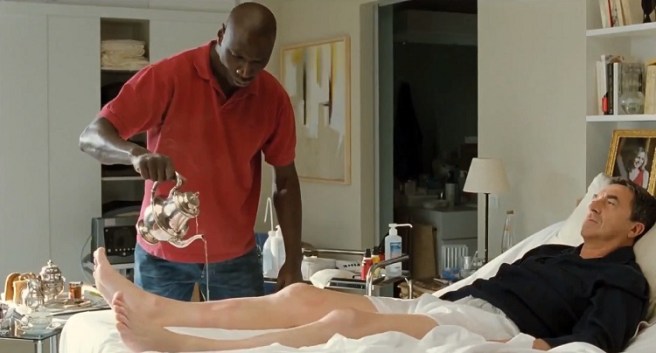
Widower, Philippe played by Dustin Hoffman-döppelganger François Cluzet (Little White Lies) lives an aristocratic lifestyle surrounded by staff on the outskirts of cosmopolitan Paris. Left quadriplegic after a paragliding accident he is without a male carer and has to interview for help several times a year, as no employee stays longer than a matter of weeks. Enter Senegalese-born ex-convict Driss (Omar Sy, Micmacs) from the projects; the only applicant in jeans, trainers and without experience or formal qualifications. The city’s Benefit Agency has organised a series of interviews as a formality; if Driss is refused three positions then, and only then, will they consider his claim and he can be supported by the state. He is large, loud and brash, in complete contrast to the staid Philippe, not least in class, race and musical taste.

When Driss returns to the rich man’s home the following day after their first meeting, he finds the necessary paperwork signed and the offer of a place to live and gainful employment; all he has to do is choose which and take the chance to make something of his rudimentary and, seemingly, directionless lifestyle. While Driss has to make these kind of decisions, in contrast, Philippe has not missed out on any aspect of his life. He has had no previous pecuniary restrictions but now his body and physical limitations have left him a prisoner, unable to do very little for himself. His most useful and powerful attribute is his mind and his articulation of language and expertise in the cultural arts has cemented a long-distance relationship with a woman in Brittany, albeit through the penmanship of another.

Driss, fabulously, dismisses aspects of Philippe’s disability which can be interpreted as both ignorance and innocence. He does not view the world as others do and often “forgets” his employer/friend is without the use of limbs and functions many take for granted. His pragmatism not only educates him but softens Philippe whose insistence on “no pity” is completely embraced by the younger man and it is this which charms most around him.

Chance is a recurring theme throughout this remarkable film, specifically, grabbing any and all that present themselves; this film depicts the opportunity to take a walk in a stranger’s shoes and touch their life, however briefly, is a rewarding endeavour. That said, this film never feels manipulative or overtly sentimental, it is a poignant reflection on living to the fullest, beyond mere existence and is portrayed through two extraordinary performances by the two leading actors, who manage to shatter any stereotype pertaining to class and race.

Cluzet is, as ever, outstanding as Philippe; the French veteran has, over the years, consistently proven his acting mettle. It is, however, relative newcomer Omar Sy (a 12-year-long career in comparison to his co-star’s 30 plus) who shines. His luminous grin lights up the screen and, along with his honesty, comedic timing, dreadful singing ability and love of 70s disco, is infectious. I defy anybody not to leave the cinema without a smile upon their face – in addition to damp cheeks – and a warm feeling in their heart; life affirmed, however briefly, from this inspiring, feel-good, crowd pleaser.

Categories
Blu-ray film review

Peppermint Soda (Dir. Diane Kurys, 1977)

Growing up is never easy and when you’re a girl on the cusp of womanhood, it can be worse (trust me). You fight the naïvety, loneliness and quiet rebellion of adolescence, face the ups and downs of school and try to balance a tumultuous home-life having never really gotten over your parents’ divorce – as is the premise of Peppermint Soda. Everyday battles include struggling to have a relationship with an overwrought mother who, not only, has a radically different one with your sister but seems to have little room for you outside of her new boyfriend and recent Psoriasis diagnosis.

It’s about a year (1963) of stolen kisses, summers on the beaches of Normandy and winter skiing trips, the loss of innocence, first love, as that awkward boy pays attention, and you finally get your first period. Music punctuates your daily life. Being curious and suspicious of sex is a given and rebelling in any small nylon way you can, desperately vying for the attention and affection of said older sister who must see how fragile you are; how angry and frustrated you are by everything, your altogether sullen nature when not bursting into tears but then, she has her own issues to deal with…

Peppermint Soda [Diabolo menthe] is arguably the first of its kind – a female-helmed and led film which deals explicitly with girls and growing pains, sisterhood, and its unbreakable bond. There have been many male-led dramas, not least The 400 Blows (1959), to which this film owes its final shot yet films such as this and À ma soeur [Fat Girl] (2001), Tomboy (2011), The Wonders (2015), Mustang (2015 and Divines (2016) are particularly important because they are framed and written by women and depict how girls see themselves, and not only validate their existence in a largely non-sexualised way but tend to encapsulate beautiful storytelling within a very small window of adolescence and puberty.

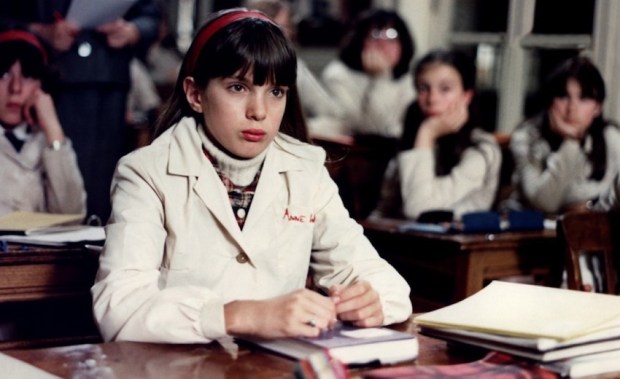
Based upon director Diane Kurys’ own youth, this delightful film largely takes place within the classrooms and corridors of the Lycée Jules-Ferry. The teachers at which are sarcastic, cruel, sadistic and mean-spirited or a laughing stock held together by frayed nerves. The whole place has a surreal edge to it, and its characters. Keep an eye out for Mme. Clou (Dora Doll) the gym teacher who dresses in an Adidas tracksuit, neck towel, full face of make-up, fur coat and hair turban.

For all of its lighter moments, there are heartbreaking ones – played out against elements of the political climate in 60s France – few of which are resolved. Peppermint Soda is light on plot and is edited together like several vignettes, and while Anne (Eléonore Klarwein) is very much the main character, there are moments which veer into Frédérique’s (Odile Michel) subjectivity and it’s seamless. Both sisters exhibit a maturity which can dissolve, more noticeably by the former, into a petulant childishness which strikes a chord, we’ve all been there, and it’s what makes this story so universal and timeless. The siblings are together and yet totally separate as they advance into adulthood and realise that it’s not all it’s cracked up to be. Friendships are forged, broken and lost in an instant.

Frank, funny and painfully realistic, Peppermint Soda is deftly directed, charmingly written, and a triumphant portrayal of the edge of adolescence, and who doesn’t love to be reminded of that time. Merde!

Categories
Blu-ray film review

Hiroshima, mon amour (Dir. Alain Resnais, 1959)

To my knowledge; I have never seen an Alain Resnais film – a filmmaker who has a weighty reputation within the French New Wave. I suppose I have to start somewhere, so beginning with his first feature, Hiroshima mon amour (1959), seems conducive.

The film opens with a close-up of entwined limbs, disembodied voices accompany the body parts which glisten with perspiration then are covered with atomic ash and glitter. It’s an evocative image which serves as a haunting reminder of the bomb. The score (composed by Georges Delerue and Giovanni Fusco) is affecting, particularly the inclusion of a flute but then the addition of a piano accompaniment adds a jauntiness which is at odds with the next slew of images: petrified rocks, specimens of skin, hair, footage recollecting the devastation; people writhing in pain and bloodied. It seems almost inexplicable to set a love story against this desolate and damaging backdrop, and yet when dealt with the passage of time and evocation of memory, it makes perfect sense. Like a Phoenix rising from flames, life and hope must continue and the ‘new’ Hiroshima is slowly being rebuilt and appears thriving as the Architect (Eiji Okada) and the Actress (Emmanuelle Riva) fall in love.

The passage of time and power of memory are strong themes throughout Marguerite Duras’ oblique script and the juxtaposition of her poetic dialogue alongside the images of horror is highly emotive. The non-linear narrative with its use of flashbacks, ellipses, and jump cuts must have been particularly original in ’59 and clearly influential as they continue to be used today. The repetition of history and the atrocity of genocide with the emphatic nuances of love in Riva’s performance are quite stunning; personal pain, public humiliation and the beautiful mesmeric shots of Sacha Vierny’s cinematography make for a quietly devastating film about the human condition and lost love. Having viewed it at a time when it would be appreciated, the melancholic beauty of Hiroshima mon amour leaves a lasting impression.

Note to self: must make the rest of the Resnais oeuvre a priority.