Categories
film review

Animals (Dir. Sophie Hyde, 2019)

Laura is 32 (Holliday Grainger) and has spent the last decade writing a novel, and still only achieved ten pages of content. It’s about a spider caught in its own web and the woman – one in love with the idea of being in love – who tries to rescue it. An analogy for the ages it has to be said. Laura lives with her best friend, Tyler (Alia Shawkat) who learns of her father’s death at the start of Animals (and just prior to her thirtieth birthday). While we never learn much more, it’s safe to assume there is no love lost there.

Taking its inspiration from the pages of Emma Jane Unsworth’s Manchester-based novel of the same name (she adapted her own work for the screen), the film plays out like a long extended night out complete with wraps of coke, gallons of Sauvignon and several brain-mushing hangovers. As for plot, there isn’t much of one per se as Laura and Tyler navigate their drunken, oft directionless way through life and the pressures that society places upon women (and ergo themselves) to conform to this ideal model of womanhood, i.e. successful, a wife, a mother, settled, and that darn necessity to ‘behave’.

Gladly, neither do, and what could have been a one-note comedy about women seeking love – Laura flirts with it briefly after meeting talented pianist Jim (Fra Fee) – children, marriage and ‘finding their way’ actually becomes that little bit darker. Do women have to settle for all of these things if they’re not deemed successful in a career? This film says nope, and acts instead as a celebration of women, their flaws – bad decisions and all – the complexities of female friendship and a glorious defiance against expectation.

While the novel’s location is replaced by the fair city of Dublin – Manchester is represented in the form of screenwriter Unsworth and Grainger – it loses nothing as the Irish capital is a wonderful alternative, fusing art, nightlife and creativity, and is just as inspirational as the themes it presents. It also acts as a perfect city buffer/juxtaposition to the suburbs; a place which has no sound; “they sell it as peace but really it’s death.” The recurring images of foxes and cats also fail to be seen in the suburbs – animals which nod not only to the film’s title but also act as visual representations of our leading ladies; on the prowl, sometimes feral, independent creatures surviving.

There’s a wonderful moment when Laura, Tyler and Marty the Poet (Dermot Murphy) are standing against a wall outside of a house and he asks the question: “What’s an animal’s primary need?” All three answer differently – food, sex and safety. That’s what the film is about, searching for your primary need outside of expectation, looking for shelter within yourself and longing to be exactly who you are without of all the exterior noise, whether that be ‘society’ or the unsolicited opinion of your best bud.
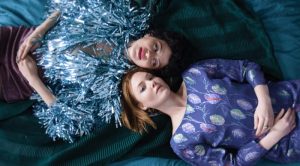
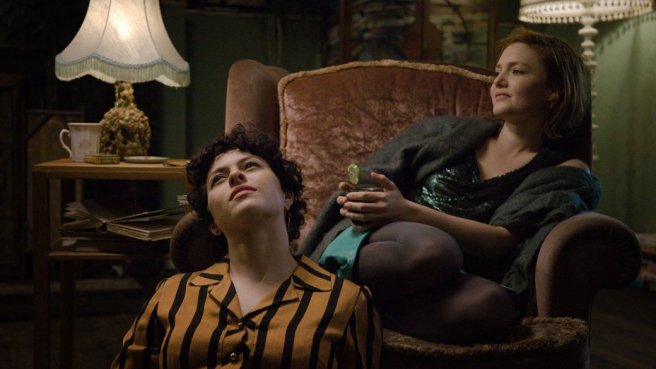
The film depicts loneliness and the pathos that goes with it in a compelling way; as a fight for independence and inspiration while embracing hedonism.. It’s funny and furious and led by a couple of splendid performances. Grainger proves she has more than (lovely) cheekbones and a pout to her repertoire and quite the emotional dexterity to inhabit a leading role and Shawkat, who is widely known for more comic roles brings a poignancy to Tyler’s acerbic wit. The character is a staunch feminist who refuses to acknowledge how lost she actually is, while ensuring her thoughts on everything are expressed and heard. There’s even an old Hollywood glamour to her character and her costumes (gorgeously designed by Renate Henschke), as if she is lost in time in this, a delightful depiction of modern femininity.

Animals is a breath of fresh air. It depicts fully rounded characters who are empathetic and credible in a current climate where women are having to defend their rights to choose how they live. It’s an insightful, fun and defiant celebration of female friendship and creativity (made by a largely female crew under Sophie ’52 Tuesdays’ Hyde’s direction), finding your place in the world and not settling. Emma Jane Unsworth’s next novel is called Adults. Although not a sequel, perhaps the animal phase comes after tween, coming-of-age with full maturation (allegedly) hitting at, say, 40.
Categories
film review

The Party’s Just Beginning (Dir. Karen Gillan, 2018)

As of 2017, Scotland held the highest suicide rate in the UK. Between 2011 and 2017 73% of those suicides were three times more likely to be men living in the most socio-economically deprived areas. Set in Inverness, The Party’s Just Beginning uses these statistics to shine a light on the issue and uses suicide to drive the overarching narrative. Not the most uplifting subject, however, first time director Karen Gillan puts her own surreal and oddly positive, comedic spin on dark proceedings.

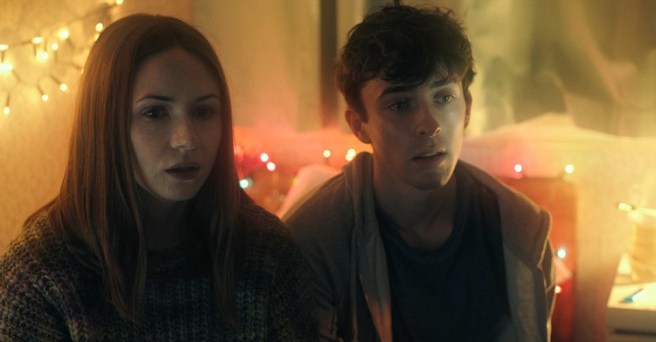
Twenty-four year old Liusaidh (Gillan) works on the cheese counter of a local supermarket. Her evenings tend to involve getting drunk, getting ‘lucky’, then shovelling in chips along the long walk home a little worse for wear… and rinse repeat. Her nightly routine (when not out drinking) consists of opening the net curtains and observing the neighbouring families opposite and see how they are with each other, while her own parents (Paul Higgins and Siobhan Redmond) leave their only daughter to her own devices. Liusaidh’s best friend Alistair (Matthew Beard), unable to cope with his own problems – including the loss of his drug-addled father – jumped off a bridge and onto an incoming train the year before.

Liusaidh is stuck in her crummy little town destined to relive a groundhog day of grief while remembering the fun, friendship (and pain) they experienced when he was alive. These memories are intercut throughout the film in a series of flashbacks. Liusaidh is reckless and overwhelmed with sorrow, loneliness and thoughts of suicide; Alistair’s, her own and other people’s, and she copes in the only way she knows how – silence and self-medication.

She’s fighting to heal and when she meets beautiful and mysterious stranger Dale (Lee Pace, complete with yet another convincing British accent), things briefly improve and perhaps, perhaps a little happiness starts to creep in. There’s also the old man who calls the house. One of a group of many who hit a wrong digit and rather than contacting the Helpline they’re after get through to a cracked (not yet completely broken) household. Liusaidh doesn’t hang up on this nuisance caller – who is grappling with his own regrets and losses – his disembodied voice becomes the ‘in’ to her own recovery.

Writer-director Gillan is best known for her work in front of the camera, first as Amy Pond in Doctor Who and now as blue-hued baldy Nebula in Guardians of the Galaxy, Infinity War and Endgame but has spent the last four years writing and directing short films. (One of which, Conventional, was screened at this year’s FrightFest). The Party’s Just Beginning is her first feature but you would never know it given its assured nature with visuals – shout-out to make-up artist Jacqui Mallett whose subtle brush strokes make Liusaidh’s stubble rash and growing black rings and eye bags wholly realistic – rapid kinetic cuts and the soundtrack. Composed by Kreng, it combines classical (including snippets of Grieg’s “Peer Gynt”), electro and original music. The leitmotif of The Communards’ ‘Don’t Leave Me This Way’ is a nice (Scottish) touch to an already dark and, at times, absurd film.

While Phoebe Waller-Bridge’s Fleabag cornered the market for middle-class woman in their thirties, Gillan’s Liusaidh has a lot to say for the millennial working-class woman in her twenties (even her name is Gaelic for ‘female’). Both created women struggling with their own identity and grief. Gillan uses the backdrop of the grey vista of Scotland to great effect. While the issues depicted are universal, the film is quintessentially Scottish and the scenes set in the Clootie Well (a Celtic place of pilgrimage where rags or pieces of clothing are tied to elicit healing) are beautiful with visuals and colours reminiscent of Xavier Dolan’s Laurence Anyways and more recently Rachel Tunnard’s 2016 gem Adult Life Skills.

Not content with the themes of suicide, depression and mental health, Gillan also adds rape and notions of consent, alcoholism, drug abuse, religion, homosexuality and transgender identity. She should be commended for tackling such issues and not least in her first feature film, however, it becomes one issue too many and this shoehorning leaves a feeling of contrivance which unravels the narrative somewhat and stretches the gamut of believability. Nit-picking aside, Gillan has brought together a talented crew and supporting cast including Pace and Beard. There are also lovely parts for instantly recognisable Higgins (Line of Duty, Utopia) and Redmond (Unforgotten, Taggart) as well as cameos by Daniela Nardini (Waterloo Road, This Life) and Julie Graham (Shetland, The Bletchley Circle).

There are moments in The Party’s Just Beginning that will hit you in the gut with at least one aspect of the storyline that most will identify with. As a feature debut, it is formidable in parts, flawed in others and yet, well worth 91 minutes of your time.

Categories
Blu-ray film review

Man of a Thousand Faces (Dir. Joseph Pevney, 1957)

Man of a Thousand Faces begins with the following cue: “On August 27 1930, the entire Motion Picture industry suspended work to pay tribute to the memory of one of its great actors. This is his story.” Except, well, it’s not. It’s the ‘Hollywood’ version steeped in melodrama and all a little dull.

At the Universal studio lot, the flag flies at half-mast as Irving Thalberg (played by the late Robert Evans, sans perma-tan) makes his own tribute to “The phantom of the opera.” In actuality, work was not suspended but a two minute silence was conducted in the wake of Lon Chaney’s death – nor were his most successful films made at Universal… This film starts as it means to go on, dramatising and conflating the life of an extremely private man who, if history books are to be believed, would have shunned even this mediocre production.

The biopic begins with the obligatory flashback which will serve the overarching narrative and then loop back around; aligning childhood, trauma and tragedy which is seemingly how it wants to establish Chaney (James Cagney). It traces his career from the Vaudeville stage to the cinema screen and admirably attempts to squeeze 30 years into 122 minutes, perhaps had the film been cast differently it may just have worked.

As talented as Cagney arguably was, there’s no way he can pull off aged 22 at 56 convincingly. Not to mention the physical limitations; a tall sinewy figure with a distinctive growl never really translates to a chipper Irish-American barely reaching 5’7”. Star personas were prevalent during the studio system and it’s fair to say, Cagney was horribly miscast nor did he have the lithe grace Chaney exhibited or the creepy melancholy.

If there’s one word used to describe the tone of the film, it is tragedy, as it prefers to add weight to the man’s alleged suffering than his film career. Hammering home his deaf-mute parents, hitting child abandonment and the dissolution of his marriage along the way, to having to place son Creighton in an orphanage and then, well, death. It’s all rather dreary; at odds with the sweeping epic soundtrack and the man whose early career began in Vaudeville and making people laugh. Why his parents’ deafness defines him or them, for that matter, appears to be a sign of the times – as for when that is the film does little to quantify. Creighton (he who would become Lon Chaney Jr.) is the only real evidentiary passage of time as the part is split between four actors (Dennis Rush, Rickie Sorensen, Robert Lydon and Roger Smith) each older than the next. None of which is helped by the occasional fifties-looking costuming.

Before his ‘big break’ as a lead, Chaney worked tirelessly and took every job he could, often making himself over and disguising his natural attributes depending on what was required on the call sheet. His ground-breaking make-ups led the way for the likes of Jack Pierce. Bud Westmore, Dick Smith, and, of course, Rick Baker among many, many others. It was then that casting agents began to take notice and he was cast in The Miracle Man thanks to his ability to twist and coil his body into unnatural positions. This would lead to arguably his greatest roles: The Phantom of the Opera and The Hunchback of Notre Dame in which he gravitated, yet again, to the tortured and afflicted depicting the tormented empathy of Quasimodo. Cagney tries but it’s hard not to see Cagney playing ‘Cagney’ imitating Chaney, or ‘Chagney’ if you will.

Obviously, given the decades between meant different make-up processes and evolution of the prosthetic. The make-up recreations in Man of a Thousand Faces are pretty awful given that Westmore et al would have used more modern supplies and they are still nowhere as convincing as Chaney and his ‘crude’ materials. Eagle-eyed viewers will also notice that camera-angles vary in relation to the original films, they’re not quite as polished.

It’s not all terrible, there are some high points. The father-son relationship shines and the performances from the actors who played the young(er) Creighton are lovely. These moments highlight Chaney’s love of mime and character, donning wigs and a false nose to “show” his son a bedtime story. The use of sign language is refreshingly brilliant for a film as old as this, when communicating it’s all about the face which for Lon Chaney it was. His.

He worked in cinema from 1914-1930 with 100 of his 157 films either lost or destroyed. It’s a missed opportunity that the 2000 documentary, The Man of a Thousand Faces narrated by Sir Kenneth Branagh isn’t included in the extras here. However, if Chaney holds an interest for you, seek it out, it’s really informative and one gets to see the original performer rather than a shallow impersonation. While the film never quite reaches the heights expected, the transfer is stunning. It is clear and crisp with very little residing grain which serve the make-up replicas and those stark chiaroscuro shadows which ‘Chagney’ often lurks within.

Lon Chaney died from a throat haemorrhage brought on my complications from the cancer that he was diagnosed with years earlier. An almost karmic fate for a versatile entertainer who sought silence both on stage and screen – his last film (a remake of Browning’s The Unholy Three) was his only speaking role – and has been revered ever since.

Disc Extras

Commentary by Tim Lucas – this is highly informative and provides great education for those unfamiliar with Chaney and his work and those that are interested in their broadening their knowledge. Lucas provides lots of information and titbits, paying particular attention to historical context – something the film sorely lacks.

The Man Behind a Thousand Faces: Kim Newman on Lon Chaney (20:52) Filmed in a cluttered room full of DVDs and books, Kim in his signature red waistcoat and cravat discusses the silent stars of Hollywood’s heyday including Chaplin, Garbo, Valentino and of course Chaney. Newman’s brief foray into the topic is not overly focussed and feels more conversational in tone which is a great contrast to the slightly more scripted and academic commentary. He maintains that Chaney lingers long in the cultured memory “and without Chaney’s make up Karloff and Lugosi would have contrived to play gangsters, and never Universal monsters (though, I’m sure Jack Pierce would have argued with that). He also thinks Cyrano de Bergerac was the role Chaney was made for but never got the chance to play. The chat is intercut with clips from the films and sadly, ends rather abruptly.

Theatrical Trailer (1:33) – It’s always worth watching the film’s theatrical trailer if only to see the original footage prior to the restoration process, and the extent of the transfer and clean up.

Image Galleries – These include 82 slides of production stills which show the costumes and make-ups in greater detail (not always a pro) and give more opportunity to see Bud Westmore’s clunky recreations albeit all in black and white. In addition to the slides, there are 18 posters and lobby cards in both monochrome and colour from all over the world including France, Spain, Germany and Russia.

Categories
Film Festival film review

Babyteeth (Dir. Shannon Murphy, 2019)

LFF 2019

Small-time drug dealer Moses (Toby Wallace) literally barges his way into Milla’s life while she is standing on the platform awaiting her train home from school. In the following moments, the jittery off-his-face-on-pharmacuticals nervous energy of the scruff-bag almost guarantees he won’t be going anywhere soon. He “saves her life” by stemming a sudden nosebleed with the shirt off his back. She offers to give him fifty bucks if he’ll do something for her, and as Moses hacks off her long hair with dog clippers, Milla (Eliza Scanlen) is smitten.

Meanwhile, across town (still in Sydney), therapist Henry Finlay (Ben Mendelsohn) is listening to Anna (Essie Davis) who is laying on an ottoman in the middle of the floor while he devours a sandwich. Only when they begin to awkwardly orchestrate sex on Henry’s desk do we realise that they are husband and wife and Milla is their daughter. Oh yes, and Milla has – although the word is never uttered once during the film’s 118-minute duration – a form of cancer.

Surrounding the Finlays – and Moses – are a cast of memorable and wonderful characters. There’s heavily pregnant Toby (Emily Barclay) who has recently moved into the house across the street, Latvian music teacher Gidon (Eugene Gilfedder) – he teaches Milla violin and was once Anna’s musical touring partner, Tin Wah (Edward Lau) – an accidental truant who’s a musical prodigy in the making, and Zachy (Zack Grech) Moses’ little brother. Each flesh out the story in their own memorable way but the film belongs to the four leads: Scanlen, Wallace, Davis and Mendelsohn.

To reveal more about the plot would spoil but suffice to say Shannon Murphy’s directorial debut feature is a little beauty. Based on Rita Kalnejais’ 2012 play – she adapts her own work for the screen – it thankfully has kept all the descriptors from the stage version. The film is chopped up into vignettes, each given a title which don’t always work, often only serving as a distraction, however, here are edited together flawlessly. They even help create a laugh before any action unfolds.

Murphy’s direction is subtle and natural – nothing feels forced. Light floods every frame even during night-time sequences, this is not a film about death despite its looming scythe but a celebration of life, first love and family achieved in such a beautiful way. Babyteeth is a bittersweet comedy and utterly unique. It’s not quite a coming-of-age story nor is it one of those heinous last-chance-at-love stories where the dying girl lies pale and clammy in her bed, or is accompanied by an oxygen tank in every scene. There is hope, joy and teen angst everywhere, and yes, the sobering fact that Milla may die is never far from the audience’s minds but her illness doesn’t define her.

Eliza Scanlen more than proved her acting mettle in Sharp Objects (a penchant for teeth too it seems) and creates a fully-rounded character in Milla. She’s not always likeable (what teenage girl is?) but we empathise with her, and can’t help but love her. Toby Wallace is brilliant as (almost) complete loser, Moses, who’s not beyond redemption, and nowhere near boyfriend material. Yet, there’s something so sweet and tragically melancholic about him. Which leaves the ‘olds’. If you’d like to see a masterclass in acting from two Australian legends of the large and small screen, look no further than Essie Davis and Ben Mendelsohn. They’re fabulous in most things individually but together something else entirely.

That’s one of things this film does so well, it’s not just about a diagnosis or how it effects the sick but those around them, and Davis and Mendelsohn convey so much with very little. It’s in the nuance of a sigh, a look, a nudge of affection, a kiss on the forehead, or getting exasperated at your wife’s ‘shower move’ just so she can get you naked. Let’s just say, Moses isn’t the only one self-medicating and dulling the pain, Anna hasn’t been able to play the piano at all since Milla’s news.

Music plays a huge part of this film, it’s what opens it – a string quartet hammer out a gorgeous version of “Golden Brown” while the remainder of the soundtrack – wonderfully put together by Amanda Brown – varies from electro, soul, cheesy pop to Mozart and Bach. Each piece conveys emotional heft and given that music means so much to the mother and daughter onscreen, it’s a really lovely way of exploring their relationship without unnecessary exposition.

Milla still has one of her baby teeth – hence the title – the perfect symbol for the childhood she wants to be free of and the adulthood she may never encounter. As a film, Babyteeth is a glorious joy from beginning to end; heart-aching and hilarious with an immensely talented cast who genuinely make this a special experience.

Quoted in the trailer! :)
Categories
Film Festival film review

Burning Cane (Dir. Phillip Youmans, 2019)

LFF 2019

Much will be made of Phillip Youmans’ age when the writer, director, DoP, and camera operator made, this, his first film. Just look at Xavier Dolan following his debut, the ‘wunderkind’ label was bandied round for at least five years of the last decade. However, that surliness and juvenile (albeit brilliant) edge to I Killed My Mother is largely missing from Youmans’ debut Burning Cane; a mature Southern Gothic drama which belies the (then) High Schooler’s age (he’s 19 now).

Set in rural Louisiana, our leading lady Helen (Karen Kaia Livers) sits on her stoop smoking, her voiceover discusses her dog Giorgio. It has the ‘mange’ and she is attempting to prolong its life anyway she can. Helen has been surrounded by ‘diseased mutts’ most of her life – her late husband succumbed to an AIDS-related illness while her Pastor Reverend Tillman (Wendell Pierce) and only son Daniel (Dominique McClellan) are fighting with alcoholism. Tillman continues to drink on the job following the death of his wife and won’t accept any help, least of all from his flock, choosing instead to drive home each night after sermons, inebriated, his car swerving all over the road.

Daniel, on the other hand, has to contend with keeping house while his partner (Emyri Crutchfield) goes to work and supports their family. He cooks, cleans, and fixes things around the place but it’s taking its toll. He’s questioning his masculinity and is steadily on self-destruct mode; he’s the man and should be the one providing, not staying at home looking after son Jeremiah (Braelyn Kelly).

‘Looking after’ may be somewhat of a stretch, the boy is mute – presumably a nod to the weeping prophet he is named for – unable (or choosing not) to talk and accepts his father’s love in the form of an occasional meal and glasses of milk laced with whatever liquor the older male is guzzling down. There’s a hint at something darker going on between father and son but the level of abuse remains at the booze-pushing and never leads anywhere else, beyond the steady decline of a man who would rather use his fists in a drunken stupor than work through any of his issues.

Youmans utilises a number of camera angles and shots which suit the oblique storytelling, however, at times poor lighting and a literal lack of focus feel unnecessary especially when considered alongside the already slow pace. Being unable to see much within the frame is problematic, however intentional but it does help build mood with the extreme dichotomy of light and dark. As the claustrophobia hits its peak, the humidity and sweat are palpable. It’s a pensive narrative, and while its foundations are embedded within the art film, it is largely raw, grass roots filmmaking.

This is Helen’s struggle to reconcile her faith alongside her relationship with her son. It’s a film about sin, despair, drink and poverty. One which examines a mother’s love for her child, deep-rooted toxic masculinity – the definition of what it means to be a man – and the role religion plays within the black community onscreen. Many pray to a Father for guidance, and yet few have fathers to guide them. There is condemnation of the Church and yet at no point does the institution feel demonised.

Colours are kept to a minimum too, greys, greens, browns with the occasional flash of orange (courtesy of the fruit trees Jeremiah finds solace in or the burning umber of a lit cigarette). Daylight is also a rarity – while we’re so used to the depiction of a light, bright sunny South on film, in Helen’s world, everything is tinged with a dismal grey while heavy clouds hang in the sky. The film’s title relates to the annual process of harvesting sugar cane; fields are set alight before the valuable part of the crop is harvested, an apt metaphor for the film’s narrative.

While as a whole, the film never feels completely cohesive and ends somewhat abruptly, it is a promising vérité style debut which feels reminiscent of early Burnett and Malick. Following its trifecta of wins at this year’s Tribeca Film Festival, It’s safe to say there will be plenty of interest in what Youmans creates next.