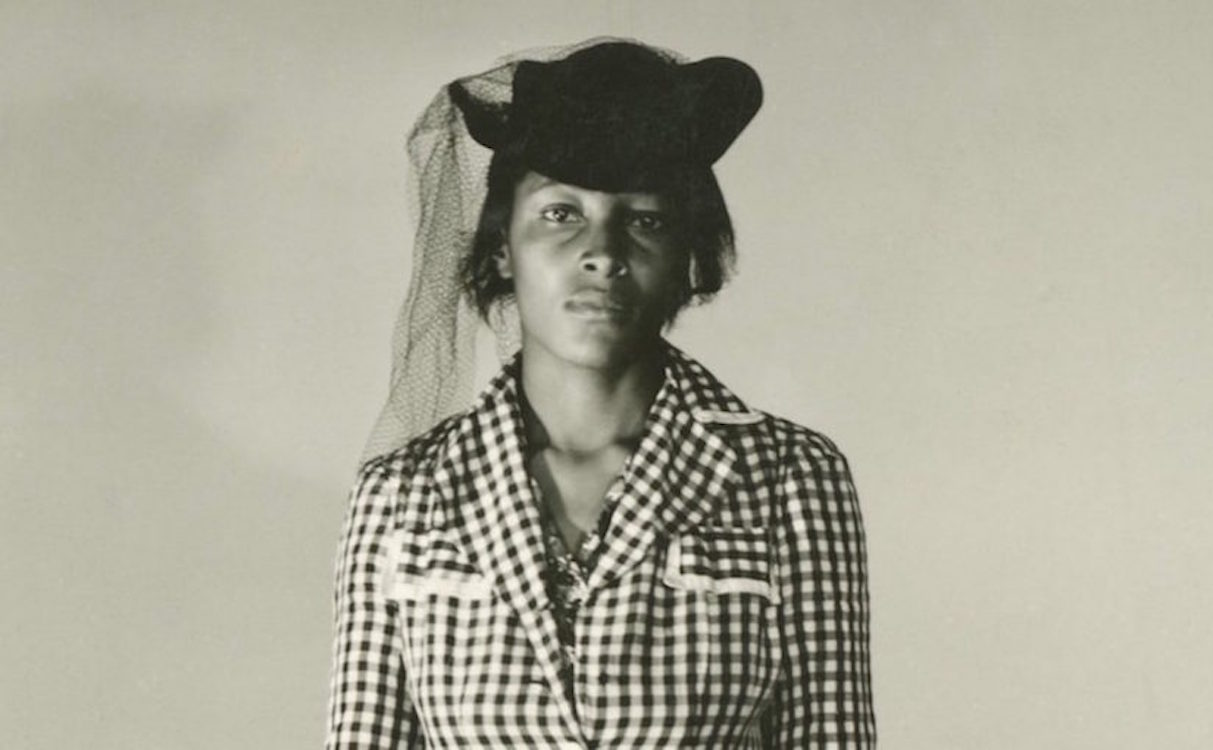
For many, the first time hearing the name Recy Taylor would have been in January 2018 when Oprah Winfrey paid tribute to the extraordinary woman in her Golden Globe speech, and yet Taylor’s sexual assault would prove to be an organisational spark in the Civil Rights Movement decades before the Women’s Movement and the #MeToo resurgence.
On September 3rd 1944, Recy Taylor neé Corbitt was kidnapped at gunpoint after leaving Church in Abbeville, Alabama by seven young white men. They drove her to a nearby wooded area where six of them – aged between 14-18 – took turns in raping and terrorising the 24-year-old sharecropper, wife and mother, before leaving her blindfolded and stranded at the side of the road. Despite three eye witnesses identifying the driver who would name all of his passengers (none of whom were questioned) an all white, all male jury dismissed the case. Enter the NAACP and their chief investigator, Ms. Rosa Parks who was to conduct a thorough investigation, help defend Taylor and seek punishment for her attackers – some eleven years before the Montgomery Bus Boycott – a dangerous business in Jim Crow-era South.
Writer-Director Nancy Buirski (The Loving Story) uses her film – which had premieres at the Venice Biennale and New York Film Festival – to expose the systematic racism that not only fostered the heinous crime but covered it up. She utilises footage from “race films” and their lack of white gaze to Recy Taylor’s story. These are intercut with gospel music and Church footage – shot by Zora Neale Hurston whose journalistic prose would prove important during another unconscionable and despicably unjust “rape” case in Scottsboro a decade earlier.
While the obvious tone of this documentary is solemnity, some may find its structure superfluous, however, these snippets of human life, art and joy in the face of such adversity are beautiful in an otherwise infuriating film where (yet again) white privilege not only dehumanised this woman but terrorised her family. The full impact of which is discussed in interviews with Taylor’s brother Robert and sister Alma. Hearing them describe how their father slept in a tree overlooking their home (after Recy and husband Willie’s house had been firebombed) with a shotgun as a means to protect his family is particularly hard to hear, made all the more galling when one considers the justification for lynching was the white man “protecting” his wife and daughters. Benny Corbitt was, of course, not afforded that power.
Recy Taylor was just one in a longer tradition of black women who spoke her truth and sought justice, and an aspect the documentary does particularly well is arguing passionately for their place in history – these women were always there. Harriet Tubman, Rosa Parks, Maya Angelou, Ruby Bridges, the afore-mentioned Winfrey – look at the audiences photographed during Martin Luther King’s numerous rallies, they were there, or look to the backbone of the Black Panther Party, or consider there wouldn’t even be a #MeToo without Tarana Burke.
The Rape of Recy Taylor is urgent and essential viewing. It speaks to the visibility of the African American woman, and the countless women whose voices have failed to be heard. A quietly devastating dedication – get tissues for the last ten minutes – to strength, resilience, resistance and a sustained fight for justice. The name Recy Taylor stands for them all.
The Rape of Recy Taylor is available to stream on Amazon Prime Video and MUBI
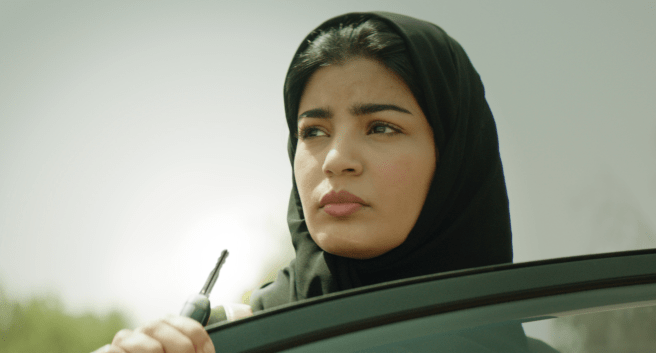
In 2017, the ban preventing Saudi women from driving was lifted and licenses were issued on the 24th June 2018. That same year Haifaa Al Mansour began production on her fourth film The Perfect Candidate (المرشح المثالي). It is no accident that Dr. Maryam Alsafan (Mila Al-Zahrani) drives, immediately placing the film in context and telling us something about the lead protagonist. Just as Wadjda’s (2012) coveted bike was bright green, Maryam’s car is a deep petrol blue in a sea of dirty white dusty vehicles.
The good doctor wears a niqab to drive and leaves it on when doing her rounds in the hospital. There, she has to contend with sick (male) patients shouting their dissent at being examined by a woman, making a difficult job ever harder. They would rather seek treatment from less qualified male nurses than have a woman lay her hands on them. One old man screams “Don’t look into her eyes!” a comment made even more ridiculous by the fact that her eyes are the only visible parts of her face to look at.
Maryam is what her music teacher father Abdulaziz (Khalid Abdulraheem) refers to as “a lion at home and a mouse in public” and serious. Seriously sincere about her patients and the road leading up to the hospital. A burst pipe has rendered it almost impossible for patients to reach their destination and the government refuses to fund the repair. However passionate she is, Maryam is determined not to stay at Al’hana hospital. Her ambitions lie in Riyadh, so when a networking conference taking place in Dubai presents itself, along with the promise of a job opportunity – for which she is the perfect candidate – she must attend.
A problem at the airport, however, prevents her from getting on the plane. Her paperwork has expired and she must seek a male’s signature in her father’s absence (he’s on tour with his band) before being able to travel. Maryam heads straight to her cousin, he has an office in the government and will surely help her. Upon leaving, Maryam instead finds herself heading home and running for local council.
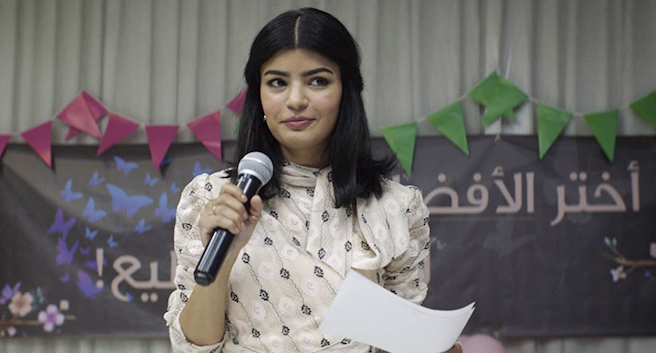
With encouragement from her sisters, Sara (Noura Al Awad) and Selma (Dhay) Maryam pulls together a campaign strategy – her main objective being the road repair, which is apparently not usually high-up on a woman’s list of priorities (we prefer flowers and children-based subjects). While fundraising activities welcome a large body of women, whether they will, or be ‘allowed’ to, vote for her remains to be seen. There’s an unexpected juxtaposing of Maryam and her father’s narrative strand – she’s finding her voice, her public lion, and he’s learning to embrace music again and sing following the death of his wife. While her father is adored for his voice and rewarded, the main goal of Maryam’s (mostly male) constituency is, unsurprisingly, shutting her up.
Maryam’s political career may end as abruptly as it begins but it’s her journey where the interest lies. Just like all the women in Al Mansour’s films – Violet (Nappily Ever After), Mary Shelley, and, of course, Wadjda – transgress societal norms in their own way, and Maryam is no different. Certainly, this film is the by-product when characters like that headstrong 12-year-old and Dr. Maryam – through their determination and intelligence – find their voice and value (beyond what they have been told) in a man’s world, navigating the choppy waters of deep-rooted misogyny and seeing land on the other side.
While a lot of The Perfect Candidate belongs to the political drama – gender politics are certainly at the heart of most films created within a place of female oppression like Saudi Arabia – this film feels more like an ode to the importance of cultural arts, perhaps even a tribute to the filmmaker’s own father, Abdul Rahman Mansour, who is a poet. Whether a conscious decision or due to her co-writer Brad Niemann’s input, the patriarch of this particular family is far gentler and more empathetic than we’re used to seeing onscreen – Maryam is never discouraged at any point by her Abi. As a result the male characters feel a lot more tangible within this narrative, with a variety of masculinities explored. It pulls from Maryam’s arc somewhat but as a result feels a little more balanced, ultimately the film begins and ends with the future. A woman. No longer hidden behind her niqab (if she so chooses).
The film’s colour palette is simple and muted save for the odd flash of tint and tone. Accompanying it, Volker Bertelmann’s string-heavy score is sweeping and rather lovely. The viola, cello and violin notes – and the oud within the diegesis – are beautifully optimistic. Even if the majority of the film doesn’t quite communicate this hope, those last scenes in the hospital certainly do. They signify a slow turning tide coming to Saudi Arabia – one petrol blue car in a sea of dirty white dusty vehicles – and with Haifaa Al Mansour at the wheel, the future of Saudi cinema is in more than capable hands.
In Two & Two (2011) – Babak Anvari’s BAFTA-nominated short allegorical film – a teacher (Bijan Daneshmand) attempts to re-educate his male pupils with some basic arithmetic, claiming that what they have always been taught is no longer true. The writer-director packs quite the punch with very little exposition and a whole lot of nuance when depicting the absurdity of an authoritarian regime/dictatorship. Which all bodes well when your next film – and first feature – is an effective little horror (and would become BAFTA award-winning in its own right). It is also a lovely touch to have that same actor play the University Dean who is responsible for shattering Shideh’s dreams of becoming a Doctor.
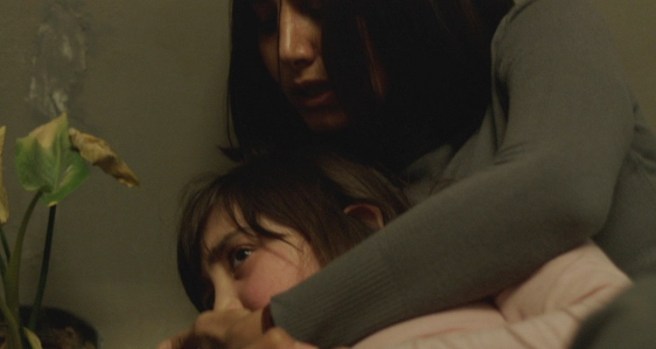
Under the Shadow is set in Tehran during the Iran-Iraq war of the 1980s and Shideh (Narges Rashidi) can no longer study medicine having been removed for her political beliefs. We are never party to what exactly her transgression is but suffice to say with the mention of ‘radical left groups’ she was – and probably still is – against the war that is currently waging in her country.
Once her chador is removed, we can ‘see’ some of her transgressions. Her hair cut (in a bob style), dress (westernised), and her autonomy around her home; the partnership with her husband, exercising to Jane Fonda. she’s also the only woman in the building who drives. This is a ‘modern’ woman, oppressed by external tradition and reduced to the confines of her four walls, and even those are not so secure with the shelling, daily explosions and air raids which can send residents into a panic at any given moment.
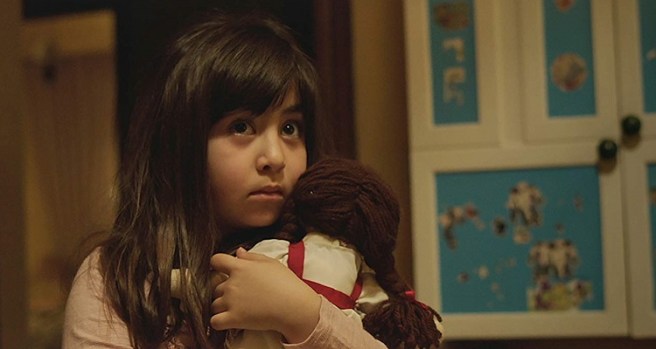
When her husband Iraj (Bobby Naderi) receives his draft notice, Shideh is left with her young daughter Dorsa (Avin Manshadi) as, one by one, all her neighbours pack up and move onto safety. The exacerbating factor a shell crashing through the roof of their building, killing the elderly resident within and leaving a gaping hole. The hole is covered with a sheet which appears to undulate in the wind like a bodily organ, flapping in and out like a heartbeat. A visual metaphor of a damaged culture, while the cracks in the ceiling – it can be argued – relate to Shideh’s psyche. Ever increasingly isolated, Shideh and Dorsa begin to experience things which may be the product of a child’s imagination or something altogether more supernatural.
Djinn is a malevolent spirit which has its history in Early Arabia and then later in Islamic mythology and theology. An entity that travels on the wind until it finds somebody to possess. Often dismissed as a superstitious belief, the spirit is reported to enjoy the souls of children (much like Krampus in European culture, or el Cuco in Latin America). It may explain Dorsa’s fever or not, after all Shideh was also once a child. Evil wants to hurt them alleges one neighbour while another, Mrs. Fakur (Soussan Farrokhnia), attempts to allay her friend’s fear: “people can convince themselves of anything if they want to”.
Tight framing adds to the oppressive atmosphere as mother and daughter’s fear and anxiety builds. Tension is slow-burning, and jump scares are few and far between yet effective when they do occur. There’s no score (music is only played during opening and closing credits) so is reliant upon diegetic noise and whistling winds. We’re never sure of the time of day given the constantly closed curtains and disturbed sleep patterns.
What appears to be mere moments gives the impression of hours. As people leave we can assume the passing of days and weeks yet the costumes of the leads mostly remain the same. Natural and artificial also play havoc with this, along with the production design: one location, open doors, hallways, and reflections in the television mean the constantly moving camera plays tricks with the eyes – was that something moving or not? Shideh’s lip is bruised from the constant biting, insecurity, anxiety, stress. Like all amazing genre films – nothing is ever quite how they appear and this film is all the better for it building beautifully the general sense of unease.
It seems apt that when she is preparing to fight, Shideh’s weapon of choice is a pair of scissors – as if tethered to a more domesticated past, her own mother’s apron strings or the chador in this instance. While the malevolent being appears to be set on persecution – even referring to the character as a ‘whore’ and ‘bad parent’ – it’s important to remember that Djinn is not inherently evil or good, and this entity could, at some point, be Shideh’s mother from beyond the grave.
A matriarch disappointed that her daughter will no longer practice medicine but needs to save her by forcing her to leave the building. Think back to the picture frame which houses Shideh’s mother’s portrait, the fractured glass obscuring the image within, it now laying down on the shelf hidden from view – but before that, the draped material serving as a backdrop in the photo is identical to the chador the entity embodies itself within. This reading further strengthens the mother-daughter links throughout, and the expectations a patriarchy levels at women, generally, but more so during the kind of regime in Tehran of the 80s.
As a first feature, Under the Shadow wears its influences well: Polanski’s apartment trilogy (Repulsion [1965], Rosemary’s Baby [1969], The Tenant [1976]) with a sprinkling of Hideo Nakata’s Dark Water via a domestic social realist drama in the ilk of Abbas Kiarostami and Asghar Farhadi. It’s a rich and visually arresting film which checks all of the above as well as featuring, at its heart, a really affecting horror fable. A 1980s Tehran-set horror film filmed entirely in Farsi – the first of its kind.
Finally, it has been given the kind of release it deserves courtesy of Second Sight that includes plenty of extra features, including five new interviews with the filmmaker, cast and crew, as well as a lively commentary between Director Anvari and film critic Jamie Graham, in which every aspect of the film’s genesis, production and release is covered.
Extras
Two & Two (8:48) – Babak Anvari’s BAFTA-nominated short film shown in its entirety. It’s the one extra which can be watched before the main feature.
Escaping the Shadow (23:53) – A long interview with Anvari who begins with his own childhood nightmares growing up in 80s Iran before his move to Britain. He talks at length about the filmmaking process, his cast, shooting in Jordan and expands upon things mentioned in the commentary. He’s a delightful interviewee, and while it is not the most imaginatively filmed featurette, Anvari’s charisma shines through.
Within the Shadow (12:52) – Star of Under the Shadow, Narges Rashidi discusses her own childhood in Iran and Germany and career now she is LA based. She describes the film as a ‘beautiful gift’, and again, static camera and a by-the-book interview reveals an excitable and rather lovely person.
Forming the Shadow (16:11) – Lucan Toh and Oliver Roskill talk all things ‘producer’, how they met Babak, the script, the film’s potential and their brief disappointment at not having to sell the film when it premiered at Sundance. A lot of their anecdotes are repeated in the commentary track.
Shaping the Shadow (13:29) – Anvari’s close collaborator and DoP Kit Fraser talks about his involvement from before the script was even written.
Limited Edition Contents – This set is limited to just 2000 copies, comes in a rigid slipcase featuring new artwork by Christopher Shy and with a soft cover book with new essays by Jon Tovison and Daniel Bird (unavailable at time of review). Plus behind-the-scenes photos, concept illustrations, and a poster with new artwork.
It is interesting to note that the titular character of Bernard Rose’s 1992 film Candyman was a painter, an artist determined to leave behind a legacy; never to be forgotten: “I am the writing on the wall, the whisper in the classroom. Without these things, I am nothing…” The myth – dating back to 1890 – surmises that Daniel Robitaille (although we wouldn’t learn his name until the first sequel) was educated and enslaved, on account of his father’s invention which assisted in the mass production of shoes after the Civil War.
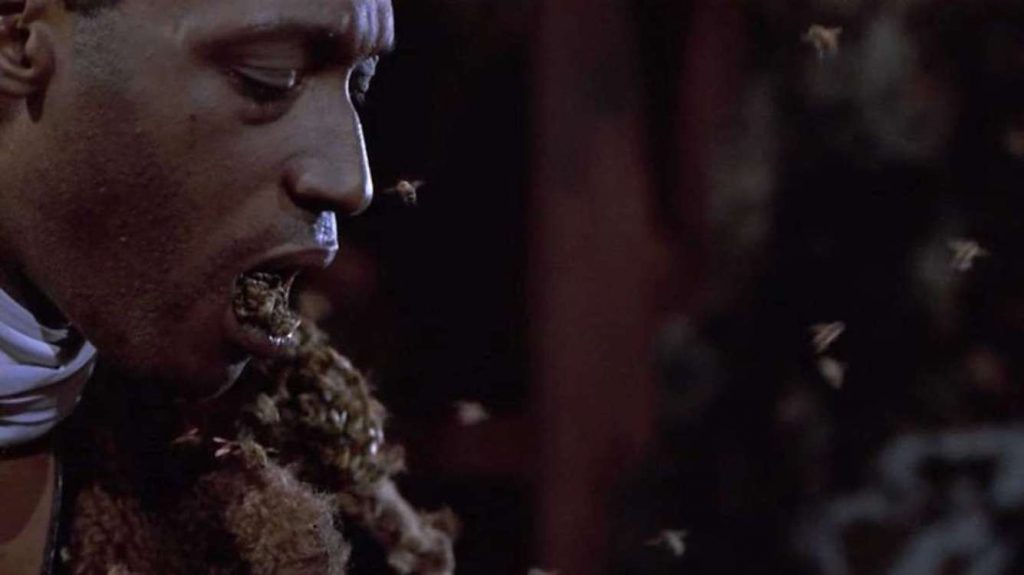
Robitaille was commissioned to paint the portrait of a wealthy landowner’s daughter. The two fell in love and when a child was conceived, fear of miscegenation led to a mob chasing the artist from town to the outskirts where his hand was sawn off, and his body smothered in honeycomb for bees to devour. 100 plus years later and, according to folklore, his soul and bloody hooked stump continues to haunt Cabrini Green, now home of the projects.
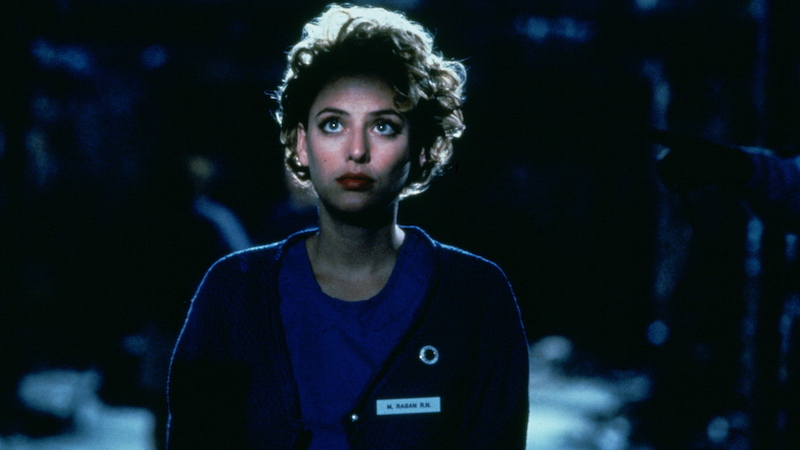
At least that’s what the legend suggests as it is told and retold, embellished by the storyteller, and those who believe in the Candyman (Tony Todd). For Helen Lyle (Virginia Madsen), the myth becomes a major part of her research. She and colleague Bernadette (Kasi Lemmons) are students at the University of Illinois researching urban legends as part of their thesis, within an academic department where being smug, white and male is a given. None more so than Helen’s own husband Trevor (an immensely slippery Xander Berkeley).
Helen discovers that there is a connection between her building and the apartments at Cabrini Green, after looking into the unexplained death of Ruthie Jean – a woman of colour who was mutilated in her bathtub by a killer who allegedly burst through her wall brandishing a hook. Helen interrogates the myth, and through her investigation we see just how limited her perspective is (in both literal and cultural terms), she is oblivious to anything outside of her area of interest until the myth has been appropriated. Only then does she (figuratively) wake up.
Rose – not unfamiliar with literary adaptations – has given audiences variations on numerous works of literature including his Tolstoy quintet of AnnaKarenina (1997), IvansXTC (2000), TheKreutzerSonata (2008), BoxingDay (2012), TwoJacks (2012), and more recently his take on Frankenstein (2015). Candyman was his first authored screenplay, based on Clive Barker’s short story TheForbidden (which can be found within volume five of his seminal anthology BooksofBlood). The Faustian-inspired story transposed Liverpool to Chicago, Helen’s surname became Lyle (from Buchanan), her thesis – which once centred around graffiti – now concentrated on urban legends, and class and race became intertwined in Rose’s vision. He kept the thematic material of the story but made it very much his own.
While the film is grounded in horror, part ghost story, part unconventional slasher by way of arthouse cinema. It plays with the tonal and generic shifts between the story and its retelling, building ambiguity before Candyman’s first full reveal to Helen (it’s well worth the wait), and their relationship as the film progresses.
Some have commented upon the fact that the film’s “villain” is a man of colour. True, however, he is not a typical “monster” (just like Helen is not a victim, despite his imploring her to be). Candyman is a tragic and romantic anti-hero, an eloquent and beautiful phantom who is seeking retribution from those who have wronged him. It’s an elegant performance by Todd who elicits as much empathy as scares, it’s hard to imagine anybody else embodying the handsome hook-man (although, what if the next is a white iteration or Yahya Abdul Mateen II*). He is led by an equally wonderful Virginia Madsen.
Her Helen is intelligent, determined and flawed, perhaps even unhinged. The line between the real world and the nightmare is completely blurred by the film’s midpoint. Is she responsible for the kidnapping of Anne-Marie McCoy’s (Vanessa Williams) baby boy? Is Candyman a figment of her imagination or is he the man who assaulted her? Has Helen lost her mind? There’s an old Hollywood glamour to Madsen/Helen, and yet she’s completely ordinary and easy to identify with. The choice of lighting her across the eyes is genius on the part of DoP Anthony B. Richmond (Don’tLookNow). It enhances those huge green windows especially when she appears in a trance, passively hypnotised by Todd’s velvet voice (in actuality, it was her director who was doing the mesmerising).
Richmond’s cinematography and Jane Ann Stewart’s production design have aged well. The graffiti and murals adorning the walls of Cabrini Green are still as effective – made all the more so by the careful 2K restoration from a new 4K scan of the original negative (supervised and approved by Rose and Richmond). Grain is kept to a minimum and the picture is perfect. Reds and petrol blues particularly bright and eye-catching along with that all important artwork on the walls leading to Candyman’s lair.
Bob Keen’s make-up FX is just as accomplished in a film that really was multi-layered and ahead of its time, (and still as timely today) even the bees are analogue with Todd pheromoned-up, standing in for the Queen. Apiculture has been practiced for a millennia, and given that bees are the creatives of the nature world, it’s a perfect extension of the art present. Philip Glass’ haunting, melancholic and melodic score brings the religious themes to the fore and is the aural icing on the cake.
By placing the film within a racial context, it polarises the worlds as they are depicted; white, middle-class academia and the poverty of the inner city African-American experience. Helen even spells it out: “A black woman is murdered and the police do nothing, a white woman gets attacked and they’re all over it.” However, as the film progresses it is evident that Helen and Daniel are linked rather than opposed. The racial and social commentary, however dated, opens up dialogue, not only holding up a mirror to an America of the past but what the future holds for people still living as a consequence of segregated housing. It will be fascinating to see how Nia DaCosta approaches the material in her version of the film.
Candyman continues to be an ambivalent and ambiguous arthouse horror film which depicts oppression and transgression, and manages to sustain the scares, even after 26 years. Bernard Rose and Tony Todd have created a legacy which will continue long after they depart.
Sadly, one of them now has… Rest peacefully Tony Todd (4/12/1954 – 6/11/2024)
Extras
Disc 1: US R-Rated Version
AudioCommentarywithBernardRoseandTonyTodd – The disc boasts not one but two audio commentaries. The first is provided by writer-director Rose and star Todd (his introduction is a particularly nice touch). The pair are obviously close, having reunited for Frankenstein, and cover a whole host of topics. Todd reviews InfinityWar, AQuietPlace, and Halloween. We hear Rose’s opinion on sequels, the new Halloween and his favourite horror films (he has excellent taste). The two men tend not to pay much attention to what’s onscreen, choosing instead to talk about the cinematic essence of the horror genre, offer occasional anecdotes re: filming, what constitutes as “American”, politics and social media, and the notion of fear. This is highly entertaining and well worth listening to.
AudioCommentarywithStephenJonesandKimNewman – The second places the film within critical context by writers/critics Jones and Newman. They discuss their friendship with Clive Barker and his stories which have been made into memorable films. They analyse the cast and their respective performances. Theirs is actual commentary accompanying the film as it unfolds and they offer several readings of the film and briefly consider the logic of nightmares (which allows for plot holes).
Bernard Rose’s Short Films – Three films – newly restored in HD – which cement Rose’s filmmaking prowess. Fans will see techniques, themes, and motifs which continued through his entire oeuvre to date.
A Bomb With No Name On It [1975] (3:34) – Terrorism is approached with horror elements and a classical score (he had to start somewhere). The action takes place in a busy London restaurant with the bomb maker, a white middle-class male. Perhaps an allusion to the IRA bombings of the seventies.
The Wreckers [1976] (5:54) – A film depicting ‘youth’ and more specifically a teenage boy and the party he throws when parents his head out for a dinner party amongst their peers. The generational divide is seen through the juxtaposing of the two soirées. Sparkling water is the adult’s drug of choice as the teens spark up their joints. It’s brilliantly created, mixing contemporary music with classical before the evening descends into coloured-filtered horrific chaos.
Looking At Alice [1977] (27:24) – This is Rose’s black and white avant garde film (every director has one). He plays with voyeurism as his protagonist watches and stalks the object of his affection through her love and conquests. Rose, once again, utilises classical music, jump cuts and repetitive dialogue. All three films are a welcome extra on the the film that many consider Rose’s masterpiece.
Theatrical Trailer (1:59)
Image Gallery – A slideshow continuing 40 images including film posters from across the world, VHS covers, film stills, publicity stills and lobby cards. It’s interesting to note the different studios that have historically owned the rights to Candyman.
Exclusive packaging featuring newly commissioned artwork by Gary Pullin (although, it appears that his hook in is the wrong hand).
6 lobby card reproductions
Reversible fold-out poster featuring two artworks
Fully illustrated collector’s booklet featuring new writing on the film by festival programmer Michael Blyth (unavailable for review).
Limited Edition bound booklet reproducing the original hand-painted storyboards by Bernard Rose
Yes, it’s a little odd that Philip Glass isn’t featured amongst the extras at all, a copy of the score would have rounded off the boxset nicely. The severe lack of women is also disappointing, specifically in a critical capacity or interviews with the other women in the cast.
That said, Arrow Films courtesy of their Video label have immortalised Candyman and his mythology in a stunning limited edition box set, packed with extra features that will make any film lovers cling to their rapture. Buy it, if you dare, just avoid mirrors.
In the same vein of adapted memoirs, The Sea Inside (Alejandro Amenábar, 2004) and The Diving Bell and the Butterfly (Julian Schnabel, 2007), Untouchable (AKA The Intouchables) too portrays a male protagonist living with a severe disability. While the aforementioned films attempted to encapsulate the struggle of locked-in syndrome, and a fight to end a life with dignity, this light comedy-drama provides the affecting story of two men trying to re-start their lives in light of personal circumstance. It is a surprising movie with a simplistic narrative and two great lead performances.
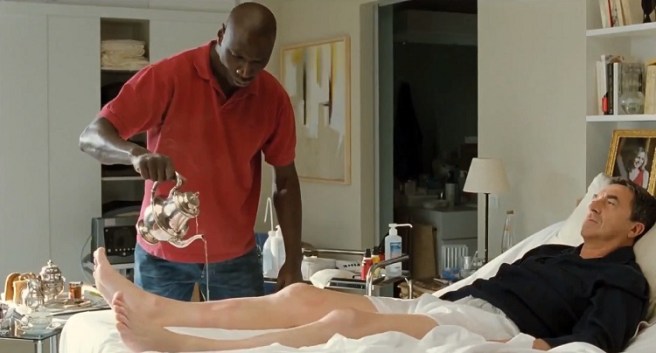
Widower, Philippe played by Dustin Hoffman-döppelganger François Cluzet (Little White Lies) lives an aristocratic lifestyle surrounded by staff on the outskirts of cosmopolitan Paris. Left quadriplegic after a paragliding accident he is without a male carer and has to interview for help several times a year, as no employee stays longer than a matter of weeks. Enter Senegalese-born ex-convict Driss (Omar Sy, Micmacs) from the projects; the only applicant in jeans, trainers and without experience or formal qualifications. The city’s Benefit Agency has organised a series of interviews as a formality; if Driss is refused three positions then, and only then, will they consider his claim and he can be supported by the state. He is large, loud and brash, in complete contrast to the staid Philippe, not least in class, race and musical taste.
When Driss returns to the rich man’s home the following day after their first meeting, he finds the necessary paperwork signed and the offer of a place to live and gainful employment; all he has to do is choose which and take the chance to make something of his rudimentary and, seemingly, directionless lifestyle. While Driss has to make these kind of decisions, in contrast, Philippe has not missed out on any aspect of his life. He has had no previous pecuniary restrictions but now his body and physical limitations have left him a prisoner, unable to do very little for himself. His most useful and powerful attribute is his mind and his articulation of language and expertise in the cultural arts has cemented a long-distance relationship with a woman in Brittany, albeit through the penmanship of another.
Driss, fabulously, dismisses aspects of Philippe’s disability which can be interpreted as both ignorance and innocence. He does not view the world as others do and often “forgets” his employer/friend is without the use of limbs and functions many take for granted. His pragmatism not only educates him but softens Philippe whose insistence on “no pity” is completely embraced by the younger man and it is this which charms most around him.
Chance is a recurring theme throughout this remarkable film, specifically, grabbing any and all that present themselves; this film depicts the opportunity to take a walk in a stranger’s shoes and touch their life, however briefly, is a rewarding endeavour. That said, this film never feels manipulative or overtly sentimental, it is a poignant reflection on living to the fullest, beyond mere existence and is portrayed through two extraordinary performances by the two leading actors, who manage to shatter any stereotype pertaining to class and race.
Cluzet is, as ever, outstanding as Philippe; the French veteran has, over the years, consistently proven his acting mettle. It is, however, relative newcomer Omar Sy (a 12-year-long career in comparison to his co-star’s 30 plus) who shines. His luminous grin lights up the screen and, along with his honesty, comedic timing, dreadful singing ability and love of 70s disco, is infectious. I defy anybody not to leave the cinema without a smile upon their face – in addition to damp cheeks – and a warm feeling in their heart; life affirmed, however briefly, from this inspiring, feel-good, crowd pleaser.





 While a lot of The Perfect Candidate belongs to the political drama – gender politics are certainly at the heart of most films created within a place of female oppression like Saudi Arabia – this film feels more like an ode to the importance of cultural arts, perhaps even a tribute to the filmmaker’s own father, Abdul Rahman Mansour, who is a poet. Whether a conscious decision or due to her co-writer Brad Niemann’s input, the patriarch of this particular family is far gentler and more empathetic than we’re used to seeing onscreen – Maryam is never discouraged at any point by her Abi. As a result the male characters feel a lot more tangible within this narrative, with a variety of masculinities explored. It pulls from Maryam’s arc somewhat but as a result feels a little more balanced, ultimately the film begins and ends with the future. A woman. No longer hidden behind her niqab (if she so chooses).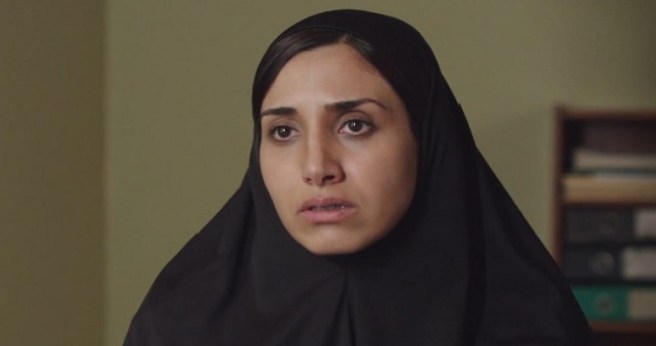







 The Framing Device