An elderly woman completes a crossword with a young girl – there is a brief assumption she’s her granddaughter but the child gets up to leave with an “au revoir”. The girl then goes into every room along the dimly lit corridor and bids farewell to the other female residents until she reaches her destination; the bright room at the end of the hallway. ”Mama, can I keep her stick?”
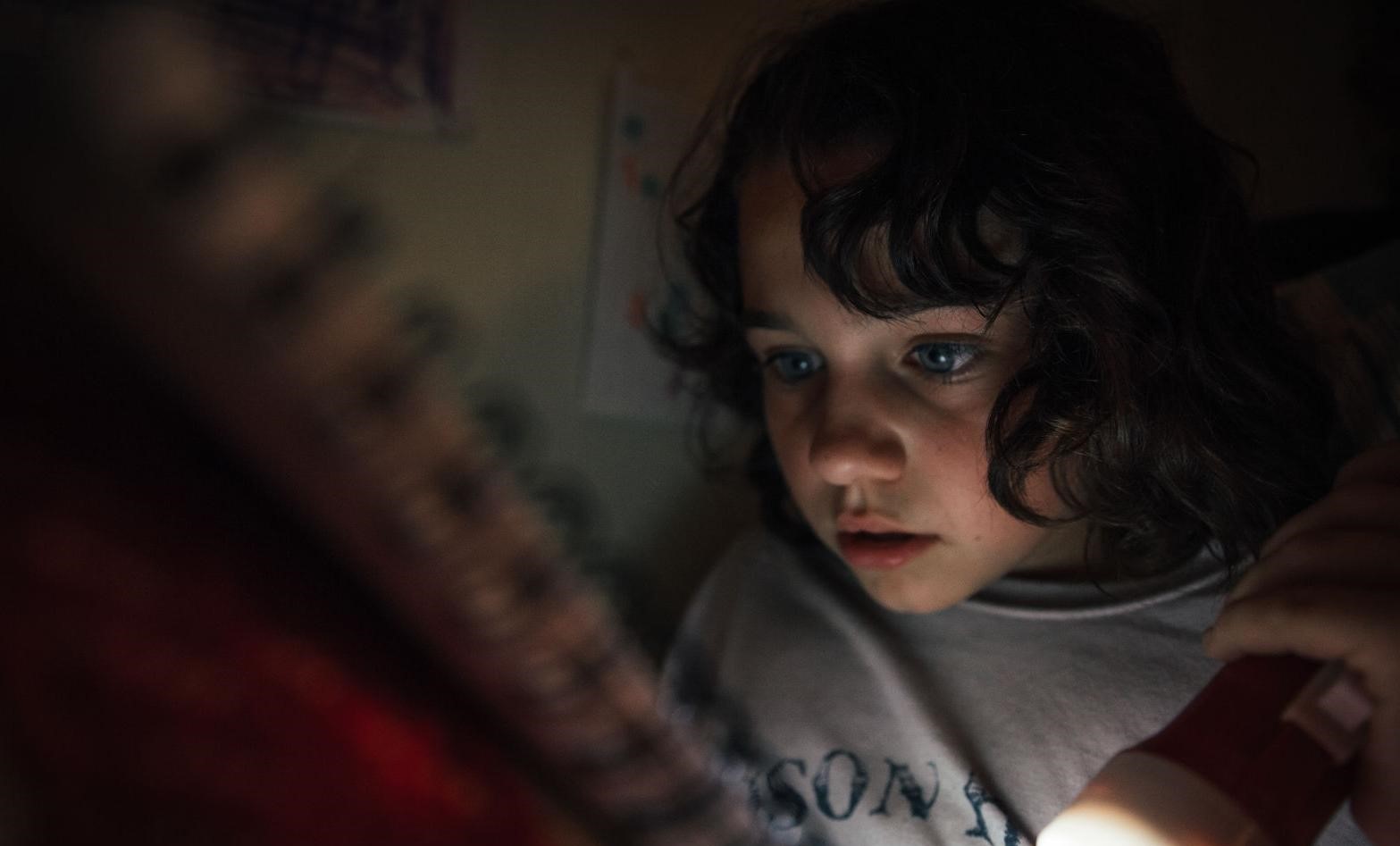
After the passing of her grandmother, Nelly (Joséphine Ganz) and her mother Marion (Gabrielle Sanz) drive to the latter’s childhood home to pack up belongings, keepsakes and transport furniture, as families are wan to do after a bereavement. Nelly feeds her mother from the backseat of the car, extends the juice carton to her lips and then reassuringly clamps her arms around her mother’s neck as they both follow Papa (Stéphane Varupenne) driving the white van in front. Nelly is every inch the little mother of the title despite the interchangeability of role throughout the taut 82-minute film.
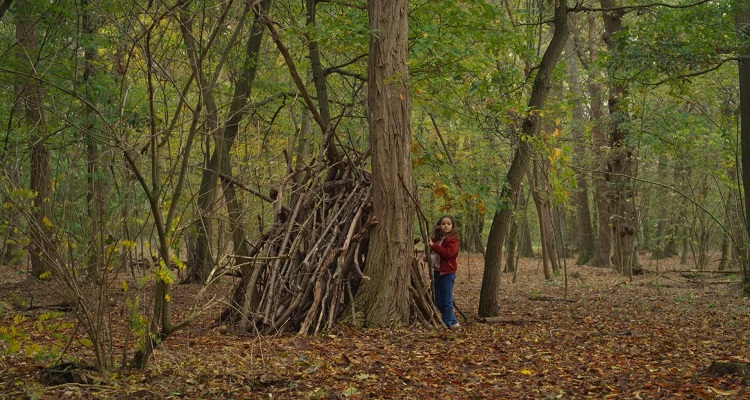
Nelly moves into her mother’s childhood bedroom and they both go through Marion’s note pads, school books and toys. The little girl chides her mother’s inability to spell but offers words of encouragement about a drawing of a fox. It’s an incredibly tender and loving relationship between the two. Despite being only eight years old, Nelly is wise beyond her years, empathy seeps from her every pore; she can sense her mother’s vulnerability and offers her narrow shoulders and small arms within which comfort can be sought. When Marion suddenly leaves, it is up to her daughter and partner to stay on and finish packing up. Nelly attempts to engage her father by bringing up the treehouse her mother built in the surrounding woods but the man merely shrugs and says he can’t recall anything about it. ” You don’t forget,” she scolds, “You just don’t listen.”
What happens next is so matter-of-fact that to go into detail would ruin the surprise (NB. Don’t watch the trailer if you wish to avoid spoilers) but it relies upon an open-minded audience and one which is willing to accept the ordinary and enchanted; the magic and imagination of a child. We all sought it once upon a time.
While Portrait of a Woman on Fire cemented Céline Sciamma as auteur, her earlier filmography has tended to forefront children and teenagers. Adults don’t really exist in the world she creates and she writes the world from their viewpoint whether they are eight-years-old, teenage girls, a tomboy, or a courgette. This film uses an autumnal colour palette full of lush browns and greens, and rich blues and burgundies; colours echoed between mother and daughter. Its costumes look to corduroy, woven jumpers and anoraks to weight the seasonal surroundings but also to give it a timeless quality. Transitions in time are slight but not insignificant – French language aside, this could be anywhere.
Childhood is a tricky thing to navigate while you’re experiencing it – although you tend not to realise just how much until you’re out the other side. Petite maman is extraordinary and enchanting, small and yet packs a punch. It is a thoroughly gorgeous film in which memories are tangible, maturation comes quickly, and a loving and assertive little woman seeks to renew her connection with her maman and say goodbye to her beloved grand-mère on her own terms.
M. Night Shyamalan isn’t the only filmmaker preoccupied with getting old as Benh Zeitlin’s long awaited sophomore feature Wendy is finally released in cinemas this week.
Once there was a… not a Hushpuppy this time around but a haunted train complete with “ghost” who steals away young Thomas (Krzysztof Meyn) from the whistle stop hash house Angie Darling (Shay Walker) serves at. The two-year-old toddler Wendy (Tommie Milazzo), stands on the counter top exposing her dimpled knees, through a halo of dark curls and full-lashed baby blues drinking it all in. Thomas is intent on becoming a pirate when he grows up and gets rather indignant when he’s informed he’ll be a “mop and broom man” like most grown men in the area. He flips out, flings off his trousers and climbs aboard the train at the behest of the cloaked figure up top.
The Darlings L-R: Wendy, James (Gage Naquin) and Douglas (Gavin Naquin)
As Wendy grows (now played by Devin France), Thomas’ ‘taking’ is what informs her bedtime stories as she imagines, narrates and illustrates his adventures while the reality of his missing child poster stares out from the wall of the café. Her brothers, twins, James (Gage Naquin) and Douglas (Gavin Naquin) prefer running wild, catching turtles and generally causing mayhem. It leads to a conversation with their mother in which it becomes clear that seeking adventures away from the confines of responsibilities gets increasingly harder as one gets older – dreams simply change.
Straight on ’til morning
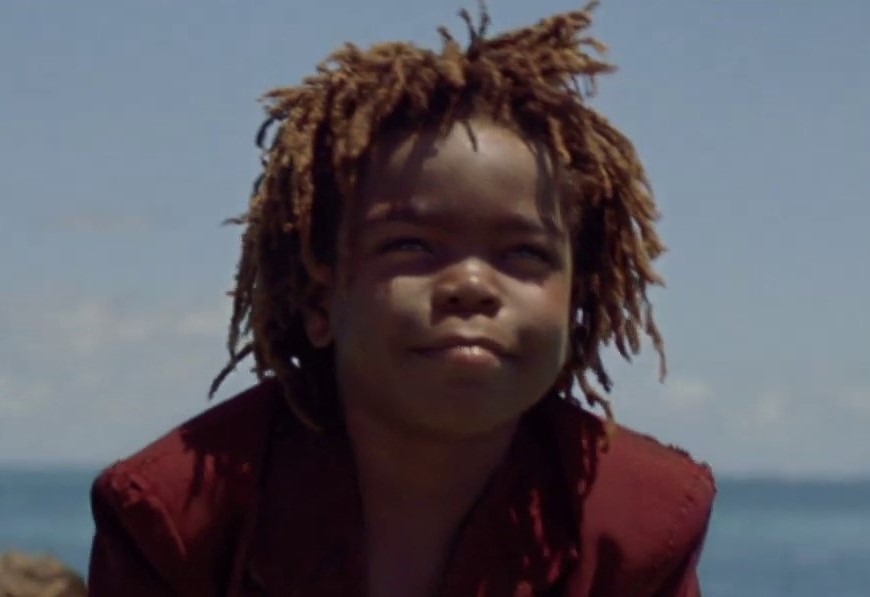
The next night Wendy, impulsively, decides to throw caution to the wind and climb aboard the chugging train with James and Douglas hot on her heels. She introduces herself to the phantom who, upon closer inspection, is an impish little boy wearing dreads and a tatty school blazer who goes by the name of Peter (Yashua Mack). He insists on taking 3/4 of the Darling family to his Never Land where the ocean is guarded by a large bioluminescent sea creature named Mother, Peter can control the volcano (Mother’s spirit) with his mind and, most importantly, nobody grows up. Well, almost… mostly.
Films don’t often take seven years to complete and this production which was reportedly in constant flux, has a cast of non-acting children who had to be taught how to swim, engage in sword-play and leap from great heights, and all while shooting in 16mm film. In the years that followed Beastsof the Southern Wild, he and Dan Romer picked up awards for their Brimstone & Glory score and he served as executive producer on Burning Cane, never let it be said that Zeitlin isn’t an ambitious and unconventional filmmaker. Here, he co-writes the screenplay with his sister, Eliza Zeitlin (who also serves as production designer) and once again provides the music with regular collaborator Romer. This score will, in much the same way as Beasts… bring a smile to your face and swell to the heart. Full of melancholy string-plucking, triumphant horns and waltzes on speciality instruments like the dulcimer, hurdy-gurdy, marimba and glass harmonica. The music, once again, serving as the emotional core of the film around it.
The Battle for Mañana
Its pacing does feel a little awkward at times and it’s hard to imagine small children having the attention span to sit through a film clocking in at 112 minutes but it’s not overly wordy and there’s plenty to keep older children enthralled. The Hook origin story is beautifully done and suitably grim and while some have complained it’s too dark, I would submit the source material… (only with a The City of Lost Children and Lord of the Flies edge shot through a modest and chaotic Emir Kusturica-esque lens). In Zeitlin’s Never Land – filmed on the islands of Montserrat and Antigua – childhood adventure is entangled with trauma, the inevitability of death, an active volcano and the ravages of climate change.
“To grow up is a great adventure…”
There’s an element of spontaneity to the whole affair which works well combined with the naturalistic performances from the kids who are a delight to watch. Especially Devin France who gets to experience her awfully big adventure with spirit, and more than proves that a whole film can rest on her capable shoulders. Yashua Mack is the first child of colour to portray Peter on film (just prior to Jordan A. Nash soon to be seen in the upcoming Come Away) and the first Rastafarian. Hailing from Antigua, Mack belongs to the Nyabinghi order of Rastafari who have a spiritual connection to the Earth, live at one with the earth and nature and share an ethos of remaining youthful at heart. His Peter is wonderful, full of bravado and charm – it’s easy to see why he was cast, at just five, to play Pan.
Yashua Mack as Peter
Since its inception as a stage play in 1904 and publication in 1911 as Peter and Wendy, it feels like we get a new Peter Pan adaptation every couple of years so Zeitlin’s revisionist take on Barrie’s beloved fable is refreshing and emotionally fulfilling. Some elements may not always work but there’s plenty to appreciate and be moved by. Whether in its use of magical realism which manages to convey a raw, beautiful and unique sense of wonder (and peril) led by its captivating cast or in the nostalgic yearning for a mother – a theme which becomes far more poignant given the film’s pre-credits dedication – and, of course, that gorgeous folksy-lullaby score.
It seems apt that the children of a pair of folklorists would make their own version of Peter Pan as adults. The film isn’t as socially resonant as Beasts… yet Wendy in spite of its collaborative nature feels like a map of, self-professed ‘Lost Boy’, Zeitlin’s mind (a little unstructured, ragtag and beautifully sound-tracked). It’s just like our eponymous Darling states: “All children grow up but some, the wild ones, the ones with the light in their eye, escape.” This film is for all of those that did.
Wendy is out in UK and Irish cinemas on 13th August
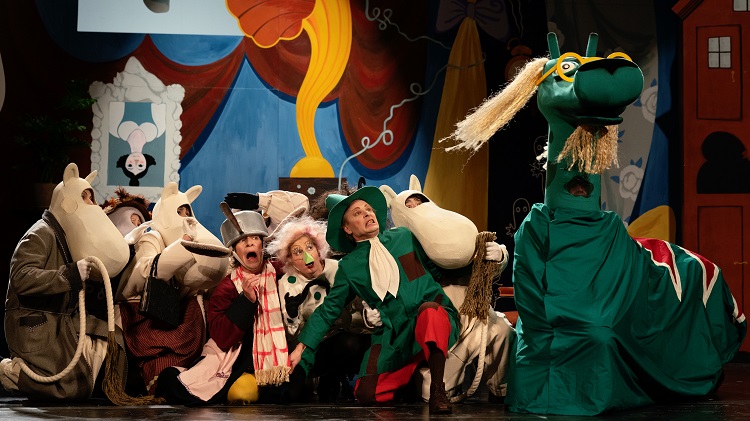
It is hard not to picture Tove Jansson (1914-2001), as a shyly smiling, jumper-clad woman pushing 70, windswept or chain-smoking on her island of Klovharun. Zaida Bergroth’s charming new film seeks to expand upon that image and expose more about the woman, artist, writer and Moomins creator. What’s in a name? Tove [Too-veh]. Such a diminutive old Norse word meaning ‘beautiful thunder’ and so obviously close to the English spelling of love, and boy did she ever. It appears to have been the driving force of her whole life’s wonderful adventure.
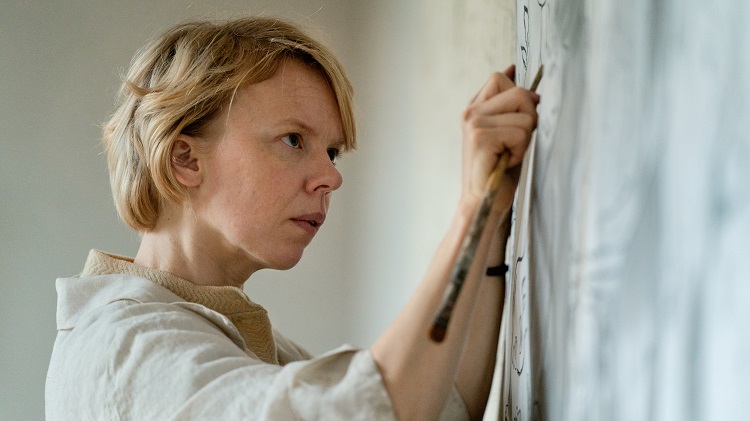
Tove focusses on three specific time periods 1944, ’47 and ’52 as Jansson navigates her artistic struggles, successes, love and loss. Beginning during war-time – after a brief and lively opening vignette – 30-year-old Tove (Alma Pöysti) sketches as bombs sound around her. It immediately establishes place, time and general mood as life, in Helsinki, begins again. There’s more disagreement with her famous sculptor-father Viktor (Robert Enckell) in which he once again attempts to dismiss her work and instil his artistic merit upon her. Apparently, her drawings do not constitute as ‘art’ – and she even describes herself as a “a bleak shadow of his genius” when eyebrows raise at the sound of her surname.
She leaves the family home and rents a dilapidated space ravaged by the war, missing windows, heat and electricity in order to gain her independence and create. Living, loving, working and sleeping in one large room. While Tove’s frustrations are evident, she continually strives to push herself without ever fully realising her artistic success and as the years advance, how beloved she will become. From her solo art exhibitions, tenure as a visual artist on GARM magazine to her publications of Moomins stories and weekly comic strips in the Evening News, all are given some attention here. As are her love stories, for there are many. Affection surrounds her via her graphic designer mother Signe (Kajsa Ernst), brother Lars (Wilhelm Enckell), fellow artists Sam Vanni (Jakob Öhrman) and Maya Vanni (played by the film’s screenwriter Eeva Putro) – but none more impactful during this time than her lovers, journalist-cum-MP Atos Wirtanen (Shanti Roney) and theatre director Vivica Bandler (Krista Kosonen). It is their relationships which allow for personal and professional growth, and which sets her on the path to meeting the love of her life.
While Tove’s lifestyle trangressed the conventional, the film seeks to normalise it in the same vein as Carol (2015) and Angela Robinson’s Professor Marston and the Wonder Women (2017). Depicting a time when society refused to accept the existence of the queer community. There was huge risk involved, Finland wasn’t always so advanced in relation to LGBTQIA+ rights. The decriminalisation of homosexuality did not occur until 1971 and then it, and lesbianism, (there was no word for pansexuality then either) was considered a diagnosed ‘illness’ for another decade after. Tove’s bravery to live authentically is the film’s main focus.
Whether you consider Jansson a pansexual radical or not remains to be seen – though when one thinks of the themes and amorphous gender identities embedded within the Moomin stories and the many satirical caricatures in print by her hand over the years, she was. Bona fide. Yet what we do get here is a fully-formed, credible version of her and that’s largely due to Alma Pöysti’s wonderful performance. No stranger to Jansson, she first portrayed her on stage in 2017.
Resemblance aside, her Tove is a joy: fierce, child-like, funny, wicked and supremely talented. People are drawn to her sunny disposition. Which is often literal as she is bathed in light, yellow and golds emitting a halo of warmth around her head and making her face glow. At times Tove is the burst of colour within a frame of muted dullness while at others, primary colours flood scenes, with the room décor matching Tove’s costumes -beautifully designed by Eugen Tamberg – the fabrics of which are often reminiscent of illustrations which are in and adorn the Moomin books.
This attention to detail and use of light and tone is gorgeous and make Catherine Nyquist Ehrnrooth’s production design and Linda Wassberg’s cinematography sing. All cherry-topped with Mattie Bye’s eclectic soundtrack which brings together the likes of Josephine Baker, Edith Piaf, Glenn Miller and the more contemporary Mambo noir trio amongst his own compositions. Dancing was incredibly important in Moominland and it seems only fitting that Tove has her own recurring motif when she goes to bust a move in the form of Benny Goodman’s Sing Sing Sing which bookends the film rapturously.
Little has changed in regards to the discourse surrounding art and the preoccupation with dictating who can create and what (but that’s a patriarchy for you). Declaring one form as somehow superior to the other was just as ludicrous as it is now; art is art just as love is love, and thankfully while it clearly gave her pause, it never stopped her. Jansson began providing illustrations for GARM at fifteen and continued until 1953, her work found its way into publications of The Hobbit and Alice’s Adventures in Wonderland. She authored five novels and seven short story collections which followed the seventeen works (including novels, short stories, picture books and comic strips) featuring her beloved Moomins.
It is heart-breaking in those moments when she considers herself a failed artist, and dismisses the stories and sketches as “just for children”. Especially when she worked so tirelessly on the drawings and placed herself and each and every person she loved within the pages, constantly using words and pictures to express her feelingswhether they were separated or not. Moomintroll became her alter-ego (“Love makes Moomintroll brave”), Atos became Snufkin, Vivica/Vifslan – Jansson was able to code their love in the symbiosis of Toflslan and Vifslan (known as Thingumy and Bob) – and her partner of 46 years Tuulikki Pietilä (Joanna Haartti) the inspiration for Too-Ticky. Staggeringly, on top of all of that, she still found the time to write some 92,000 letters (by hand) to her ‘darlings’. This connection between art and love is rendered beautifully in the film whether through the re-painting of a canvas in stifling white, the creation of a fresco mural, or new love triggering a portrait in oils.
Tove is a sumptuous celebration of an inspirational and adventurous life. It intimately re-creates just eight years in the life of an iconic artist and the genesis in the creation of a cultural legacy. A beautiful thunder clap that lived with courage, curiosity, and passion, and one who loved fiercely and honestly.
Tove is in cinemas 9 July from Blue Finch Film Releasing
Helen Keller lost her sight, hearing and ability to speak at 19 months old after contracting a mystery illness (although, Doctors now believe it was more than likely Scarlet Fever). Over 25 years, she learnt to communicate and learn. Her schooling took her from Alabama to Boston and New York before she graduated cum laude from Radcliffe College in 1904 aged 24 and so – following the publishing of her memoir The Story of My Life – began her career of social and political activism (women’s suffrage, birth control, pacifism, socialism), and as an lifelong advocate for the blind and deaf before co-founding the ACLU.
By Keller’s side, during this time and until her own death in 1936 was Anne Sullivan. Sullivan became Keller’s teacher at just 20 years-old when she left The Perkins School for the Blind in Massachusetts for rural Alabama and the cotton plantation that the Kellers lived on.
It is this time period – well, that first month to be exact – that is the basis for The Miracle Worker. Keller’s story would have its genesis in TV before heading for the Broadway stage. It was adapted for the screen by William Gibson (who originally wrote the stage play) with Arthur Penn directing his own Broadway hit in 1962. Both Anne Bancroft and Patty Duke reprised their roles from the stage to screen to critical acclaim including two gold and shiny Academy Awards which they both received, respectively, following the film’s release.
While it opens rather histrionically, with a scene between Kate Keller (Inga Swenson) and the Captain (Victor Jory), thankfully the film quickly finds it dramatic feet with those early moments giving weight to the immediacy Helen’s hearing, speech and sight were lost as a baby. The first seven years pass in the blink of an eye and the young Helen is now wild, unruly, almost feral because no one understands her (or even really tries to). Instead, they allow her to get away with erratic behaviour and even violence, a concept far easier on their lives.
Our introduction to Anne Sullivan (Anne Bancroft) is at the train station bidding her current students’ farewell as she leaves for Alabama. The slight Irish lilt is a little distracting given that the real Anne, although the daughter of Irish immigrants, was allegedly born in Boston, however, it serves as way of establishing the difference in background of the woman – whose own sight was damaged at aged five – and the Kellers who reside on the plantation property.
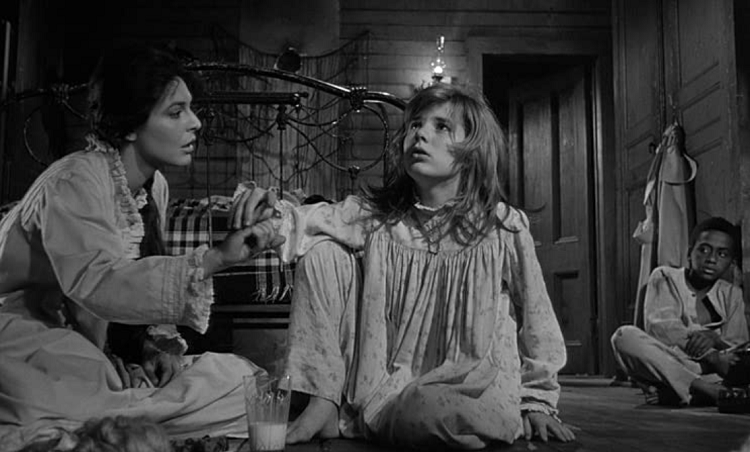
It is during this travelling montage that we see flashes of Anne’s memories and her humble beginnings. Images are out-of-focus and superimposed within the frame, almost like photographs that have not been properly developed. It’s an excellent touch and however fleeting immediately flag the aspects of life Anne is haunted by. Within moments of meeting each other, Helen learns the word ‘D-O-L-L’, however, with family members still around offering unnecessary commentary describing Helen as either a ‘monkey’ or ‘fencepost’, Anne’s job is never made any easier.
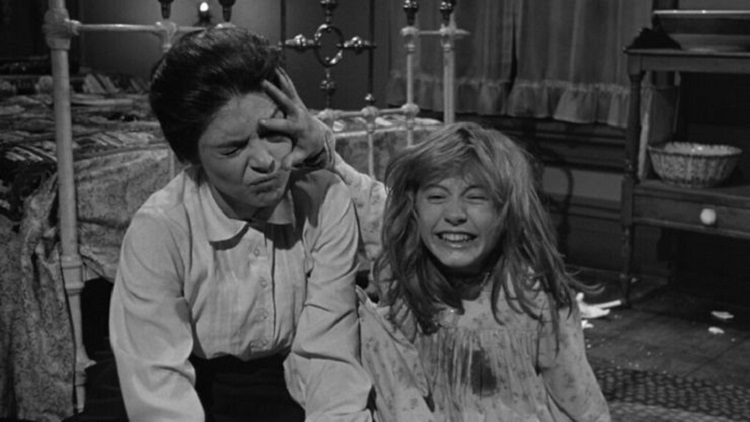
Bancroft’s Sullivan takes no prisoners. She is pushy, likes to challenge the rules with her quick temper, and as a result her relationship with the Captain comes across as a pre-cursor to that of George Banks and Mary Poppins. The two are continually at logger-heads not helped by his ‘Southern Gentleman’ ways, booming voice and dismissive, tyrannical nature. Anne attempting to teach Helen is a long, arduous task. Yet, at no point is the child pitied. Duke humanises her, makes Helen a fully formed character who happens to have a disability. One which her family seeks to define her by.
These scenes between are utterly compelling but hard to watch. They’re wrought, fraught with repetition and open-handed slaps and biting – not just on Helen’s part – it is at times amusing without necessarily meaning to be and can even be described as abusive but it is a means to an end. Anne is determined to teach the ‘problem child’, make her unlearn all those awful habits her family have ignored even encouraged, and submit to learning.
While there is the occasional diegetic sound – a pair of heavy boots smacking against the wooden floor as the girl thrashes about during a tantrum or the smashing of plates – scenes between the two leads are largely silent, only occasionally punctuated lovingly by Laurence Rosenthal’s melodic soundtrack and the instrumental leitmotif of the song ‘Mockingbird’. Aram Avakian’s editing is flawless and Ernesto Caparrós cinematography stunning under Penn’s directorial eye. Yes, it is staged and the camera tends to be static more often than not but it works.
Holding all of this together are two extraordinary performances, supported ably by Swenson, Jory and Andrew Prine (as Helen’s older half-brother James). Anne Bancroft and Patty Duke are superb together and it is more than easy to see why they both won the critic’s favour and countless awards for these roles – so ingrained in her career was The Miracle Worker that Duke would not only play the Sullivan role on TV in 1979 (opposite Melissa Gilbert) but would go onto direct a run of the play in Washington during 2011. You root for both teacher and pupil throughout and by the breath-taking and cathartic ending, you love them.
Fact has been blurred somewhat, and some truths left out altogether, however, it isn’t terribly important. There is the question of whether this film could be made in this day and age without severe backlash (one tends to think not in the wake of ‘woke’). Yet, even without knowing Helen and Anne’s real history; the grit, determination and sheer awe-inspiring narrative and gutsy performances on display here are more than enough for an audience to invest in.
Disc Extras
The film has now been restored in 1080p from a high definition digital transfer by Eureka Entertainment, as part of their Classics range and is released, available on Blu-ray for the first time, this week.
The disc restoration is evident especially when original footage is viewed via the theatrical trailer (2:21). The clean-up is very good, scratches are minimal, there is still some grain visible but extreme close-ups are crystal clear serving both women’s framing, Bancroft’s pores often visible and Duke’s child-like open face and vacant eyes transfixing (the resemblance between the 16-year-old actress and her eldest son Sean is striking).
Extras are kept to a minimum on this release when compared to some of Eureka’s other releases. However, in addition to the theatrical trailer there is an audio essay provided by critic and author Amy Simmons (11:14), who not only places the picture within historical context but also discusses the thematics of Arthur Penn’s oeuvre. It’s an interesting albeit short essay played over a slide show of stills (one can’t help but feel an extended version would have made an excellent commentary for the entire film). However, the film and its performances make up for any lack some may feel.
Accompanying the disc is a collector’s booklet featuring new essays by film critic and writer Alexandra Heller-Nicholas and film critic/author Richard Combs.
East and West Europe clash in Bettina Oberli’s sly satire My Wonderful Wanda which was included in Glasgow Film Festival’s stellar line-up, and given special mention in the Nora Ephron Award category at Tribeca.
Wanda (Agnieszka Grochowska) arrives by coach from Poland – and does so at the start of each chapter of the film’s structure – clutching as much of her life as she can pack into two pieces of luggage. The most important parts, her two sons, are left behind and cared for by her parents while she earns a wage. She is employed by the Wegmeister-Gloor family (yes, really – translate it) and cares for patriarch Josef (André Jung) who has been left debilitated by a stroke.
His wife Elsa (Marthe Heller) and adult children Sophie (Birgit Minichmayr) and Gregi (Jacob Matschenz) are unwilling to lift him, place him on the commode chair or shower him, their lives either too full or too empty to truly care one way or another. Wanda does it all. Even when Manuela goes back to Portugal, Wanda is asked to take on extra cooking and cleaning. The Wegmeister-Gloors are far from poor with their stunning lakeside home that it makes the fact that she must barter for her wages all the more galling to watch.
Josef starts paying Wanda for sex as another way to supplement her income. Their business transaction satisfying both as his needs are met and she is able to send more money home. Almost predictably, she is then accused of stealing the money and her passport threatened with confiscation. Make no mistake, these are not likeable people but you will have to wait until the final few moments as to whether any of them are redeemable.
When Wanda falls pregnant by the ‘infertile’ Josef that’s when the fun really starts as panic and horror sets in and the realisation of what this may cost the family, both in monetary terms and to their prided reputation. There’s an element of schadenfreude as one watches white privilege implode in a drunken haze and Nancy Sinatra, a protection of assets and a taxidermy funeral (an art installation in the snow), while Wanda remains the taciturn and rational one. Choices are made but not by her – the poor tend not to have those – and Gregi, the youngest Wegmeister-Gloor, finally takes his creepy bird noises with him and flies the nest.
Oberli’s film is nuanced and empathetically shot – the family as microcosm – with its greens and blues symbolising all that is in nature, the façade beneath the picturesque, as well as the cash and the bloodline. Its tone is perfectly measured as it deftly comments on class, the immigrant experience, motherhood, family dynamics (including the multitude of human neuroses that comes with it) and legacy, however, does it with a sense of self-awareness and humour. The inclusion of the cow is genius – both as cast member and visual metaphor – and provides ever more light relief.
My Wonderful Wanda’s strength lies in its direction, screenplay, biting satire, and ensemble cast, with standout performances from Grochowska and Heller. Perhaps, we are all just prisoners of circumstance whether rich or poor.









 The Framing Device