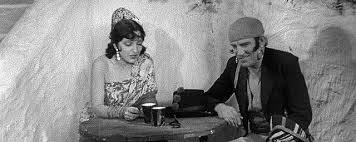
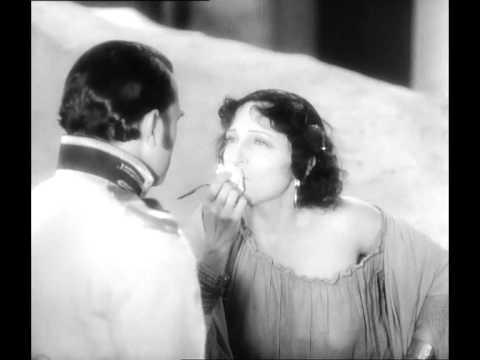
Pre-production code females were given carte blanche when it came to committing their ‘crimes’ against men/society, without veritable punishment, leaving the likes of Theda Bara, Pola Negri and Ida Lupino free to vamp it up, transgress, and use their feminine wiles as they chose, with little condemnation or repercussion. Post-code ladies like Marguerite Namara, for example, in 1931’s Gipsy Blood (aka Carmen), is not quite so lucky. Adapted from the novel Carmen by Prosper Mérimée and informed by the subsequent opera, Gipsy Blood tells the tale of a cigarette factory worker caught up in a love quadrangle. Directed by Cecil Lewis and music arranged and conducted by Malcolm Sargent, this Elstree Studios production is the first filmic rendering of Georges Bizet’s libretto.
Set in Seville, ‘betrayer of all men’, Carmen (American soprano Namara) is striking and clearly, the star, with her alabaster skin, black hair and saucer-like eyes framed with dark lashes. She’s the quintessential Spanish woman in her flamenco dress, hooped earrings and headscarf, standing with her hands on her hips, emitting an air of authority and accentuating her breasts and hip. She’s a seducer, capricious, even duplicitous and when stiff upper-lipped, innocent (and quick tempered) officer Don Josè (Thomas Burke), caddish, lecherous moustachioed corporal Zuniga (Lester Matthews) and charming Toreador Escamillo (Lance Fairfax) fall for her ample charms, it can’t end well. It’s the usual story: woman wrongly labelled ‘harlot’ because she exudes passion, sexuality and confidence leads to murderous jealousy all the while depicting the proletarian life amid immorality, and lawlessness (and xenophobic/sexist stereotyping).
Displaying stark cinematography, replete with chiaroscuro tones, Gipsy Blood is a delight albeit archaically put together. It won’t be for everyone, especially given the histrionic acting and, at times, stilted, awkwardly delivered dialogue. Sadly, the singing ability from the main mezzo-soprano, baritone and tenor does not quite match the acting style but in its deliciously camp and melodic story there is joy to be found. Granted, you probably have heard the arias sung far more proficiently in the 70 years since but Sargent’s arrangements still shine, no mean feat given the audio recording limitations of 30s cinema. A word of advice, never trust a dark, exotic temptress; they’ll break your heart!
Beyond the Hills is Cristian Mungiu’s follow up to 4 Months, 3 Weeks and 2 Days which won the coveted Palme d’Or in 2007 and once again, the director utilises the close friendship of two female protagonists to comment upon gender and politics influenced by Communism and its chokehold on Romanian society. While political and sexual repressions were depicted through the gamut of illegal abortion, here it is commented upon through an organised religious sect.
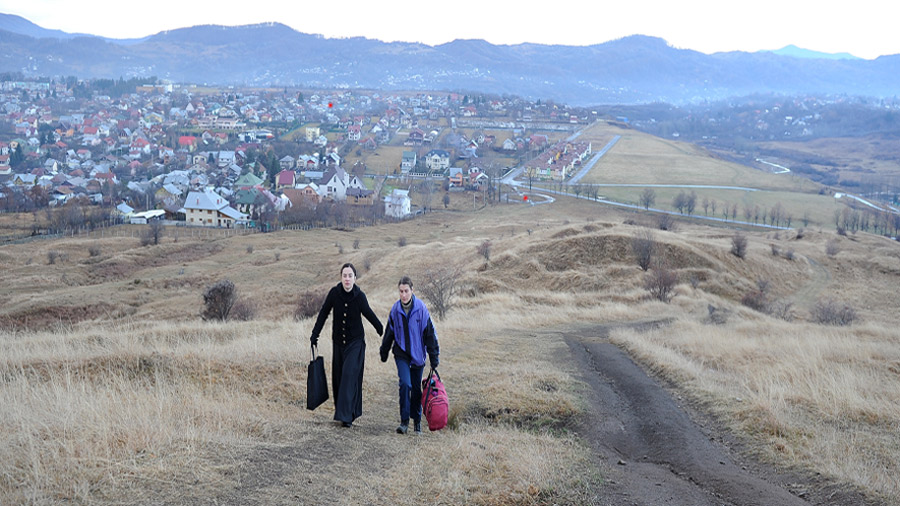
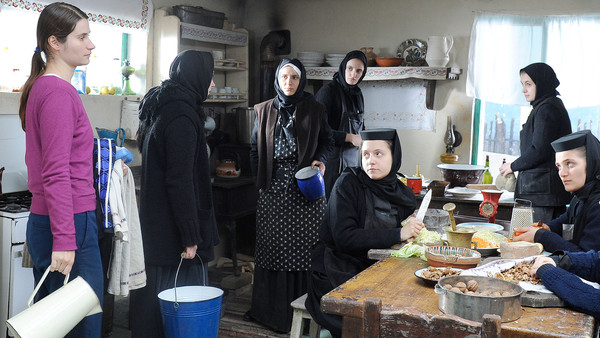
Volchita (Cosmina Stratan) and Alina (Cristina Flutur) are young women in their twenties, having grown up together in an orphanage. They have a familial bond tied by history and circumstance rather than blood; the true nature of their relationship is hinted at yet remains somewhat ambiguous throughout. Alina returns from Germany, where she now works, for a few days – a holiday – expectant that Volchita will return with her. Instead, she finds her friend living in a Monastery deep in the Romanian hills, literally hidden from civilisation embedded in an austere, archaic landscape. Volchita is confined to the bosom of Nuns who cohabit under the strict patriarchal, authoritarian rule of ‘Father’ (Valeriu Anchuta). The devout community stands alone next to an unconsecrated Church which houses a small congregation on a holy day. A sign on the front gate reads, “This is the house of God, forbidden to anybody of a different religion. Believe and don’t doubt”, the irony of which is not lost on the viewer especially once learning of the idolatrous and essentially, sacrilegious existence of this ‘House of God’. It is interesting and somewhat staggering to note that nearly 86% of the Romanian population practises the Orthodox faith, despite the fact that the country has no state religion but then, this film is not preoccupied with religious institution, at least not completely.
Mungiu’s third feature is a love story of sorts, faith at its very heart; belief in State, family and in a God which remains largely silent. It is a film about exorcism/possession, one situated outside of the confines of genre conventions and misogynistic dictatorship which is set on suppressing sinners who also happen to be women. The population outside is at a distance. You would be forgiven for thinking of it as a historical drama, the community is frozen in time, isolated, amid a lack of running water and electricity, save for Alina and her contemporary clothes. She is often the only splash of colour in an otherwise dark, dismal, and sombre mise-en-scène. She is a symbol of the outside world threatening to upset and challenge the religious conservatism and totalitarianism that appear to have engulfed Volchita.
The film is beautifully shot, blue and grey hued washes are abundant across the breathtaking landscape always captured in long shot, adding, not only, to its beauty but also educing the notion of freedom especially when juxtaposed with the interior medium shots. All employ, long takes, deep focus and are tightly framed which feeds the claustrophobic and repressive nature of the Monastery, exacerbating the tension between the religious and secular dichotomy and, in addition, the verisimilar style of storytelling Mungiu and his Romanian New Wave contemporaries adopt.
Beyond the Hills is deliberately paced to show the mundanity of life and natural flow of time. It is an enthralling and chilling commentary on traditionalism, irrationality of society and humanity at its most flawed. By its conclusion, which takes a jolting twist, all are accountable and yet there is no obvious villain. The final shot will resonate for a long time after the film has finished, once again, proving Mungiu as a director of merit, one who can coax astonishing performances from his leading actors and I know I, for one, will be awaiting his next contribution with bated breath.
The old adage, “you can never have too much of a good thing” would appear to be the mantra of Hollywood horror producers – excellence being sporadic and fleeting. Friday the 13th tops the list of saturated horror franchises with twelve movies, followed by Halloween with ten and then there are the seven Saws. The next dire instalment of mediocrity is probably not too far behind.
It has been thirty-nine years since Tobe Hooper’s seminal family horror, The Texas Chain Saw Massacre (1974) and over the years viewers have been party to sequels, new generations, prequels and remakes – “Chain Saw Massacre” became “Chainsaw Massacre” and then no “Massacre” at all – none of which have even come close to the first. Part of what made Hooper’s original so influential was its stark cinematography, verisimilitude and its “true story” marketing (based loosely on the exploits of real-life serial killer Ed Gein) with a documentary-style voiceover and photographic stills filmed on 16mm. Its narrative and plot were, of course, entirely fictional but the finished film serves as a subtle commentary on the political climate and symptomatic of the era; something of worth created within budgetary constraints. The US was still knee-deep in the Vietnam War and this affecting horror visualised an apocalyptic landscape, sparse and abandoned through industrial capitalism (Robin Wood). It depicted a non-traditional, perhaps arguably degenerate, familial homestead transgressing the boundaries of the norm and surviving via cannibalistic insanity. As a movie, it stays with you long after viewing and its esteemed standing in the horror genre a testament to director Hooper and writer Kim Henkel, who created an influential piece of frightening art in spite of a profound lack of blood, guts and gore.
A whole decade has passed since Marcus Nispel’s futile remake starring Jessica Biel and seven years since …The Beginning which tried to explain away all elements which made the original so groundbreaking and yet still the unnecessary franchise additions keep coming. The latest attempt, Texas Chainsaw is released on DVD from the 27 May 2013 through LionsGate. The film begins moments after the 1974 release and condenses its pioneer into a few short frames culminating in Sally Hardesty’s (Marilyn Burns) bloodied and hysterical escape. A Hatfield and McCoy type battle ensues between the Sawyers and Hartmans which leaves the old farmhouse burned to the ground, several members of each party dead and a small child ripped from the arms of her mother. Flashforward to present day and Heather Miller (Percy Jackson’s Alexandra Daddario) learns of her adoption and her biological grandmother Verna who has left her a significant inheritance. She jumps into a Volkswagen with her boyfriend Ryan (Tremaine ‘Trey Songz’ Neverson) and friends Nikki (Tania Raymonde) and Kenny (Keram Malicki-Sanchez) to learn her true identity. They pick up a drifter along the way in the form of Darryl (Shawn Sipos) and arrive in Texas to revel in her new-found wealth and meet her birth family, of which there is only one surviving member.
Regurgitating elements of horror films including Psycho (1960), Halloween (1978) The Funhouse (1981), I Know What You Did Last Summer (1997) (there’s even a cheesy nod to Saw), this film lacks any of the originality, atmosphere, zeal or purpose of those previously mentioned. Its director John Luessenhop has, by his own admission, never directed horror before and it shows. He has attempted to make a film comprising mainly of replicated shots, imitating but never matching the original source material. The mise-en-scène is coaxed to the point of contrivance, resulting in no scares and making for dull, and insulting, viewing especially for a fan of the genre. The decision to discount the franchise instalments which have been made since ’74 is certainly an interesting one from writers Debra Sullivan, Adam Marcus and Kristen Elms, especially in the introduction of the extended Sawyer clan (the Sawyer family name was not introduced until the 1986 sequel).
Unfortunately, this lack of research and attention to detail is evident throughout the 90 minutes and, for a film selling itself as a saga continuation, is problematic. There is an attempt to humanise the psychopath to almost Frankensteinian level asking the audience to illicit empathy for a character that back in the day was motiveless and incapable of remorse and one who should be close to retirement age by now. The recurring motif of meat has all but been removed, here “flesh” obviously connoted through its Abercrombie-&-Fitch-alike cast of characters, all of whom are underdeveloped, and a leading lady who blatantly and irritatingly defies the timeline the writers and director are attempting to evoke. Throw in a few derivative proverbs regaling family, highlight vigilantism and have at least three cameo appearances that only draw attention to the shortcomings and you have got yourself a wholly atrocious and (un)bloody waste of time.
Upon hearing the news regarding Steven Soderbergh’s ‘retirement’ I, like a lot of the movie-going public, flocked to see Side Effects (2013) and was left utterly disappointed. For me Haywire (2011), Magic Mike (2012) and the afore-mentioned have not been, well, particularly good. However, any reluctance I felt about Behind the Candelabra quickly dissipated upon reading reviews from Cannes and seeing the odd TV spot/trailer – also general curiosity is hard to ignore.
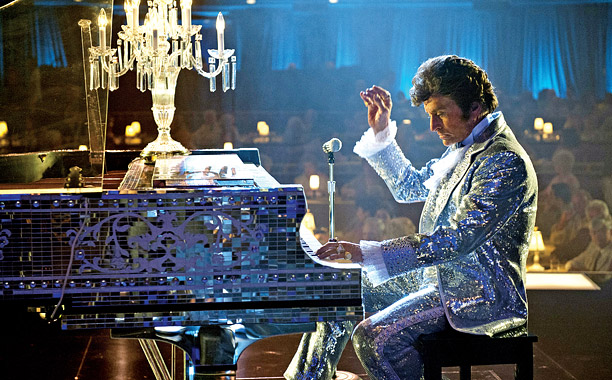
The film is based upon the memoir Behind the Candelabra: My Life with Liberace by Scott Thorson, which recounts the tempestuous six year relationship between the blonde, animal handler Thorson and the pianist extraordinaire and showman, Liberace. The candelabra referring to the sparklingly opulent piece of tableware Liberace always had placed upon his piano. The interesting thing about the candle tree is that, literally, you cannot actually hide behind it, but arguably be seen through it, part of your features hidden from view. Soderbergh attempts to show the viewer what is behind it, a glimpse of a man who insisted on hiding his sexuality from view. Unable to secure a major Hollywood studio to back the film, the director believed that studio rejection was down to it being ‘too gay’, thankfully, HBO stepped into the breach and produced this biopic. As a result, there will be no cinema release in the States and any accolades that Douglas could be nominated, or indeed deserve, for his portrayal of the flamboyant entertainer, are limited to Europe.
It is 1977 and the opening scene introduces the viewer to Thorson (Matt Damon) and his simple lifestyle working with animals and living with his Foster parents Rose and Joe Carracappa (Jane Morris and Garrett M. Brown) on a ranch in California. He is picked up in a bar by Bob Black (Scott Bakula) who, upon next meeting, flies the teenager to Vegas to meet ‘Lee’. Thorson quickly finds himself in a relationship with the much older, closeted, devout Catholic star. Spanning ten years, each year displayed upon an intertitle, Scott and Lee’s six-year relationship is very much a give-and-take kind of liaison; Liberace heaps wealth, in the form of gold and diamond jewellery, clothes, cars and a fixed abode in one of the most ostentatious surroundings, and Scott gives him what he needs in the bedroom. The pianist lived the life he chose, believing that ‘too much of a good thing is wonderful’. He, on countless occasions, denied his homosexuality and swiftly sued any tabloid/journalist who reported otherwise. The man purported on screen is one not completely removed from the lovable, warm, smiley entertainer the world seems to remember – perhaps a little darker. There is no denying the attraction to young men, however, the lonely star appeared to want a lover, friend, and son in Thorson and during one bizarre sequence ‘Lee’ and Scott meet with a lawyer to discuss the adoption process.
Their idyll becomes too comfortable with both surrendering to food during their extended ‘love-in’ and upon seeing himself on the Johnny Carson show, Liberace declares that he can no longer look so old. He enlists the surgical expertise of Dr Jack Startz (a ridiculous-looking Rob Lowe) and has a full face-lift, eye-lift…the whole shebang – the only side effect being that he cannot close his eyes, even when sleeping. Startz also sets out to recreate Scott too, into a young Liberace, complete with chin and cheek implants. The doctor then prescribes diet pills and Thorson’s spiralling unhappiness and claustrophobia from the reclusive living environment develops into an addiction with the ‘California Diet’ pills making way for cocaine. This then sees Scott sell off his possessions one by one, in order to support his increasing habit. Scott’s despondency, drug-induced mood swings and struggling with the concept of monogamy, Liberace begins to shut his lover out and they begin fighting amid jealous recriminations. It all comes to a head when Rose dies and Liberace insists on flying Scott home for his foster mother’s funeral. Upon return, Lee has already moved in Scott’s replacement and so begins a bitter battle when Scott attempts to sue for palimony – their life together, he insists, was a marriage.
In his first role since his cancer remission, Michael Douglas’ star has never shone quite so bright – not since Falling Down (1993, dir. Joel Schumacher) and Wonder Boys (2000, dir. Curtis Hanson) has he owned the screen in quite the same way – in fact, he is incandescent, sequins and glittering diamonds aside. It is hard to reconcile the virile, ladies man of the 80s and 90s, with this role; I would go as far as to say that this was the role he was born to play. Damon is, as ever, a strong presence as Thorson and the supporting cast including Debbie Reynolds as mother (Frances) Liberace, and Dan Aykroyd as Lee’s manager Seymour Heller is a joy, complete with a hairpiece to rival the showstopper himself. This feels like an HBO production and yet it still retains the richer, stylistic nuances which are associated with Soderbergh: lighting, colour washes, oblique camerawork and point-of-view. Whether his retirement or sabbatical from filmmaking is true, I am quite content for Behind the Candelabra (especially with that fabulously kitsch, blinging and camp dénouement) to be literally, albeit not technically, my last Soderbergh; at least for the time being.
It is a fair assessment that Lars von Trier courts controversy, to the extent that some viewers now expect to be shocked. Personally, for me, there is a level of indifference when approaching von Trier’s work, he is a sporadic captivator, and not always in a positive sense. His films demand engagement and provoke reactionary feelings which is said of any piece of subversive art, and that is to be celebrated. However, I never expected a film would provoke such a reaction as to make me turn it off. Antichrist did and yes, during *that* scene. I’m no prude but seeing such self-mutilation up close prompted me to cease watching. Months later, after the sheer joy of Melancholia, I decided to give it another chance. To be clear, von Trier does not need to justify why he makes the sensationalist, lurid fare he does but this, more so than his other texts, adds provocation to his chauvinism and disdain for the female sex, in addition to his fascination with Catholic ideology and iconography.
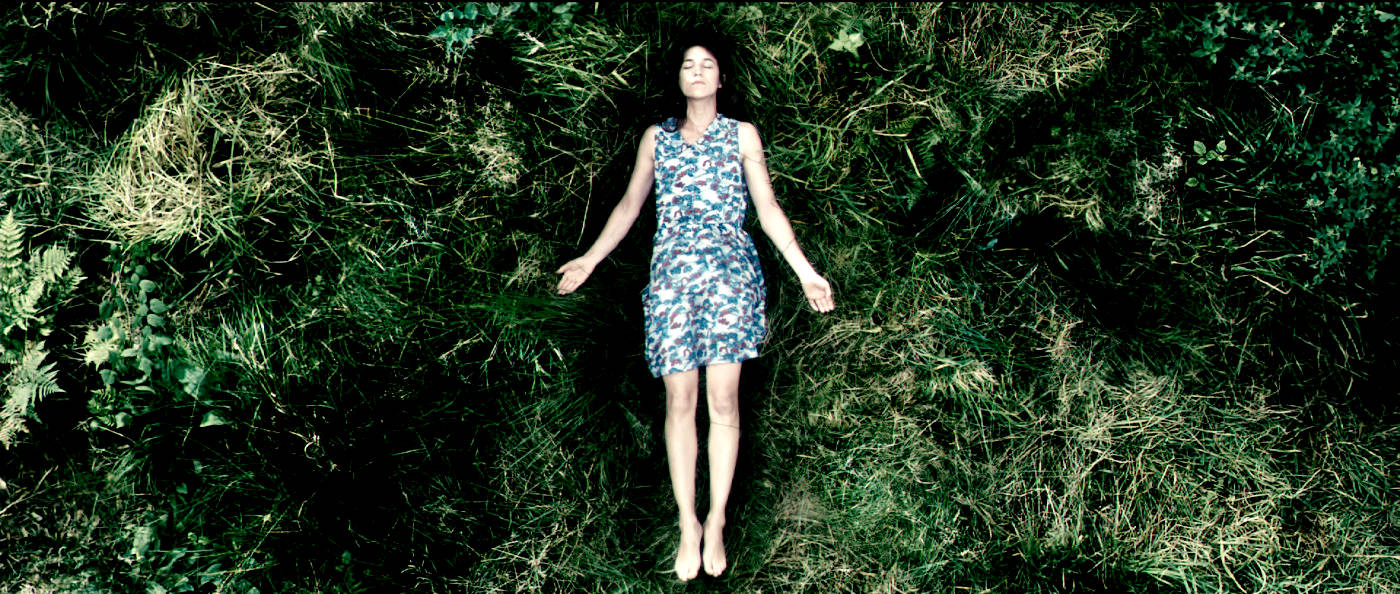
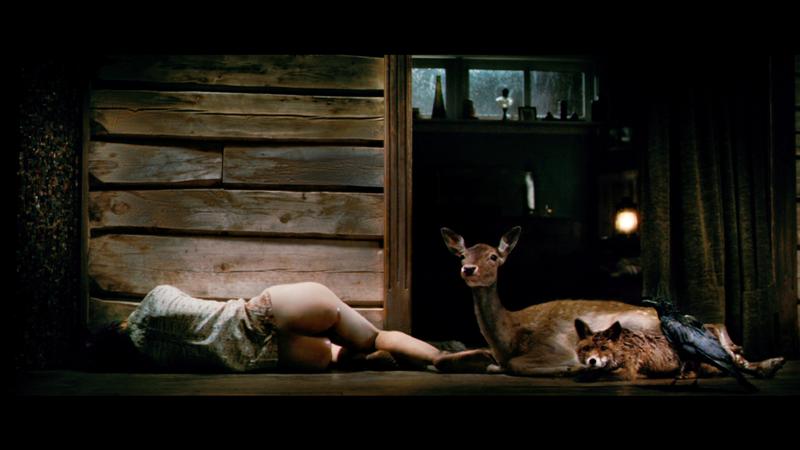
A couple ‘He’ (Willem Dafoe) and ‘She’ (Charlotte Gainsbourg) engage in energetic sex while their toddler son, supposed to be asleep, escapes his crib and displaying a final act of dare-devilry climbs upon a chair and tumbles out of an open window to his death. Devastated by the loss and rapidly losing faith in medicinal therapy, ‘He’, a psychiatrist, decides to treat his grieving wife himself using exposure therapy techniques. They retreat to their cabin in the woods, know as ‘Eden’ and both attempt to work their way through their grief, pain and despair; here depicted as three talisman in the opening prologue and then as an unholy trinity of animals, in the form of a roe deer, fox and raven.
Had this film been solely about the emotional turmoil of losing a child then perhaps it would have elicited heightened feelings of empathy and identification thereby making the experience a more enjoyable one. Instead, von Trier muddies the waters with allusions to Adam and Eve, Satan and concentrated evil personified in the figure of ‘woman’. Here, woman is aligned with nature…’She’ is a body of impulse, instinct and desire and is, apparently, beyond rational control. ‘He’ attempts to control her and when that fails, she must be punished – first mutilated at her own hand; then irrevocably at his.
The cinematography deviates from linear and transition shots, lens effects and from black and white stock to colour seemingly to create the idea of chaos while in reality it adds to the over-indulgence of the whole ‘horror’ text. There serves little purpose to ‘She’s Gynocide thesis plot-point other than to further elicit the Nietzchean ideal upon which the film is seemingly based. The director claims that this is his most personal film, however, I would suggest that the man has willfully set out to create a pretentious and rebarbative piece of art with the sole and deliberate intention of exasperating people to the point of irritability. Job done.




 The Framing Device