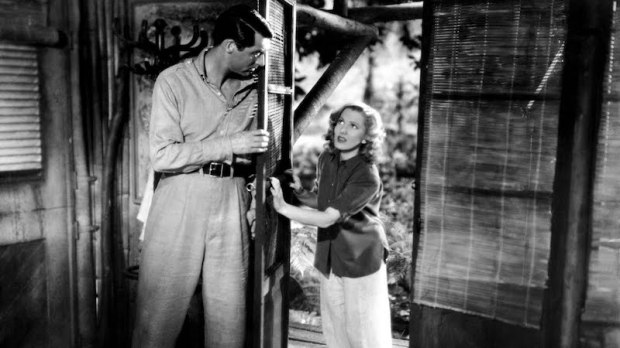
Bonnie Lee (Jean Arthur) disembarks the San Luis after it docks in the small South American port of Barranca. An unemployed showgirl and looking for company, she falls in with two fellow countrymen, Les Peteres (Allyn Joslyn) and Joe Souther (Noah Berry Jr) – American airmail fliers who frequent the, seemingly, only bar in town. Ran by ‘Dutchy’ (Sig Rumann), the bar/restaurant/general store/hotel/gathering place and headquarters of Barranca Airways is the place to be, where a toss-of-a-coin can get you a steak or the chance to be in the air.
Geoff Carter (Cary Grant), steely boss and general chauvinist makes his presence heard and seen; dressed flamboyantly in high waisted trousers, a gun belt and a large Panama hat worn on a jaunty angle, think saloon-dwelling Indiana Jones type. It is a quintessentially glamorous and sensitive Grant, however; there is an underlying darkness which is rare. A man, as the film’s original trailer declares, who has a “propeller blade for a heart and an eye for a pretty girl.” The pretty girls in question, although as per the Hawks way far are from just that, are Arthur and Rita Hayworth (looking far less Spanish than she had previously) and they are ably supported by Thomas Mitchell (Gone With the Wind, It’s a Wonderful Life) and Richard Barthelmess (Broken Blossoms, The Dawn Patrol).
If anybody can make an aviation adventure-dramedy with real levity and musical numbers blend in such a way it is Howard Hawks. The plot is slight but the dialogue; pacing and verbal wit, superb special FX and lighting (oh how Hawks could light a movie) flesh out the otherwise simple story, accompanied by a wonderful score by Dmitri Tiomkin. What carries it is the maverick machismo of these high flying men, their friendships, loneliness, camaraderie and even love. Love for each other and love for the air, there is little glory in what they do and certainly no flag flying but they are there day-in-day-out regardless of the peril. Not unlike all of those other men preparing to forge their own close barracked friendships following the Only Angels Have Wingsrelease in 1939.
The Criterion Collection launched in the UK on April 18th 2016 with a small, yet defined, assortment of filmic goodies on Blu-ray for the discerning cinephile – this film included – and has continued to grow. Only Angels Have Wings is the Hawks not often discussed; a hidden treasure made all the more valuable by the love and attention shown by Criterion’s beautiful restoration. The crisp sound and perfect transfer/picture quality will make an audience believe they are in that South American Port of Barranca.
To my knowledge; I have never seen an Alain Resnais film – a filmmaker who has a weighty reputation within the French New Wave. I suppose I have to start somewhere, so beginning with his first feature, Hiroshima mon amour (1959), seems conducive.
The film opens with a close-up of entwined limbs, disembodied voices accompany the body parts which glisten with perspiration then are covered with atomic ash and glitter. It’s an evocative image which serves as a haunting reminder of the bomb. The score (composed by Georges Delerue and Giovanni Fusco) is affecting, particularly the inclusion of a flute but then the addition of a piano accompaniment adds a jauntiness which is at odds with the next slew of images: petrified rocks, specimens of skin, hair, footage recollecting the devastation; people writhing in pain and bloodied. It seems almost inexplicable to set a love story against this desolate and damaging backdrop, and yet when dealt with the passage of time and evocation of memory, it makes perfect sense. Like a Phoenix rising from flames, life and hope must continue and the ‘new’ Hiroshima is slowly being rebuilt and appears thriving as the Architect (Eiji Okada) and the Actress (Emmanuelle Riva) fall in love.
The passage of time and power of memory are strong themes throughout Marguerite Duras’ oblique script and the juxtaposition of her poetic dialogue alongside the images of horror is highly emotive. The non-linear narrative with its use of flashbacks, ellipses, and jump cuts must have been particularly original in ’59 and clearly influential as they continue to be used today. The repetition of history and the atrocity of genocide with the emphatic nuances of love in Riva’s performance are quite stunning; personal pain, public humiliation and the beautiful mesmeric shots of Sacha Vierny’s cinematography make for a quietly devastating film about the human condition and lost love. Having viewed it at a time when it would be appreciated, the melancholic beauty of Hiroshima mon amour leaves a lasting impression.
Note to self: must make the rest of the Resnais oeuvre a priority.
Motherhood is supposed to be an exuberant time; one filled with expectation, apprehension and, above all, joy. Throw in the loneliness of London and the new neighbours who have moved into the downstairs flat and it will fast become something else entirely. Following his recent adaptation of The Night Manager, David Farr not only writes his own screenplay for The Ones Below but makes his directorial debut and no stranger to suspense, he makes a fairly entertaining job of it.
Kate (Cleménce Poésy) and Justin Pollard (Stephen Campbell Moore) met at University and – after (some) reluctance on Kate’s part – are expecting their first child. In fact, Billy is the first character we meet, at least in ultrasound form accompanied by Adem Ilhan’s haunting lullaby. Okay, so it may be a bit of a sledgehammer in terms of freeze-framed set-up and foreboding but Farr has our disconcerted attention.
The Pollards have a substantial income made apparent by their Saab™ and home in North London, everything is very drab and beige in their world, well, until the bright green AstroTurf lawn is laid in the garden below. Their new neighbours arrive; banker John Baker (David Morrissey) and his pretty pregnant Finnish wife Theresa (Laura Birn). Almost immediately, the petite blonde child-bearers bond and are fast becoming firm friends, quite an achievement for the quiet, introverted Kate. However, following an intimate and incredibly awkward dinner, tragedy strikes and relationships unravel.
Taking his visual cues from the likes of Polanski and Hitchcock – there’s even a Haneke starkness to the set design – first-time director Farr creates an interesting film, particularly assisted by the nifty camerawork courtesy of cinematographer, Ed Rutherford. It’s not a wholly original story, and we’re still delivered a female focussed narrative about a gender-specific biology via a male amid very privileged and homogenised surroundings but the differences between the couples and their environments are fascinating. It does try and make a quirk out of people who remove their shoes before walking into a house (hygiene, people!), there’s a brief fumbling over a spare key and why indeed would a wealthy banker move into a one-bedroomed flat? Yet, all-in-all, there is much to admire, not least the detachment and isolation a city scape can project.
The Ones Below covers a lot of hard-hitting themes and subjects, from maternal instinct and domesticity, to the very real issue of postnatal depression and the anxieties surrounding parenthood. Poésy does a particularly convincing job at giving Kate scope beyond the vanilla victim she could have become; her character and Birn’s Theresa are inextricably linked not only by hair colour and circumstance but entwined as if facets of the same person. Any similarity diminishes as the film progresses, culminating in a real distinction between the contrived and the verisimilar. For the most part, it works efficiently as a drama/psychological thriller, even a bloodless horror. That said, nothing quite prepares you for the devastating conclusion and creepy final scene. The grass is definitely not always greener and it appears to be, it’s a trick of lighting or all for show and probably rotten beneath the surface.
The New York City skyline is our establishing shot as The Apartment opens and a voice belonging to C.C. Baxter (Jack Lemmon) – “C. for Calvin, C. for Clifford, however most people call me Bud” recounts some statistics. Bud is a bit of a know-all when it comes to facts but only because he works for insurance company Consolidated Life, up on the nineteenth floor where he processes claims. Baxter has a charming apartment situated in a pleasant area – just right for a bachelor – however, he is rarely home and not always by choice. He stupidly lent his key, once, to a work colleague and word quickly spread. Now his apartment has become the venue of choice for a selection of insurance big-wigs to wine, dine and bed their mistresses without the knowledge of their wives. It’s not that Baxter is happy to encourage men to cheat but rather is a compromised loner who allows himself to be manipulated and is just too nice to argue.
His neighbours, Dr and Mrs Dreyfuss (Jack Kruschen and Naomi Stevens) – the benevolent parental figures, Jewish, unpretentious and in the case of the good Doctor, a mensch – believe him to be a “good-time Charlie” over-consuming liquor and indulging in far too many women. Baxter is the embodiment of the typical Wilderesque protagonist, and Lemmon plays him as an affable well-meaning fellow, not hyper-masculine but boyish and funny; a general outsider to society, an honest every man who is forced into a situation beyond his control.
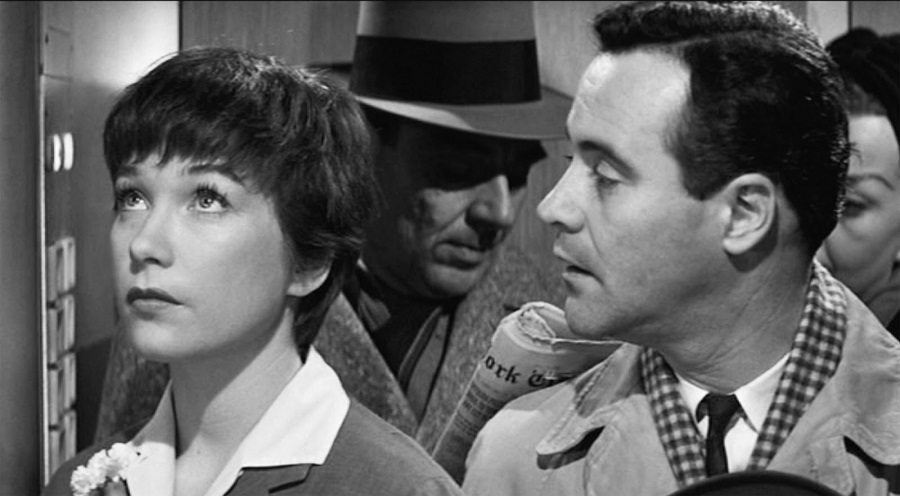
Although often alone, a highlight of Baxter’s day is the morning elevator ride up to the nineteenth floor when he gets to see and talk to lift attendant Miss Kubelik (Shirley MacLaine). His face lights up when he sees her and he is the only man in a sea of suits polite enough to remove his hat when in her company. Fran is sassy and sharp, not prone to suffer fools and certainly the men of Consolidated Life, regardless of stature or job title, get a tongue lashing if they act inappropriately. There is a sadness to Fran and like a lot of the characters in this movie, she is flawed. prone to heartbreak and circumstances unfold where, without giving too much away, both Baxter and Kubelik have to prove their mettle with and without the other’s help. Needless to say the man responsible for the running of the company, Mr Sheldrake (Fred MacMurray) finds out about the apartment situation and requests the key for himself. He, unlike his other Consolidated Life employees, is willing to foster capitalism (the others only make empty promises) and offers Baxter a promotion including a new office allowing him to climb the corporate ladder in record time. It is only when our hero has an epiphany near the film’s closingis the disenchanted and sardonic socialist worldview restored as per Wilder’s ideology.
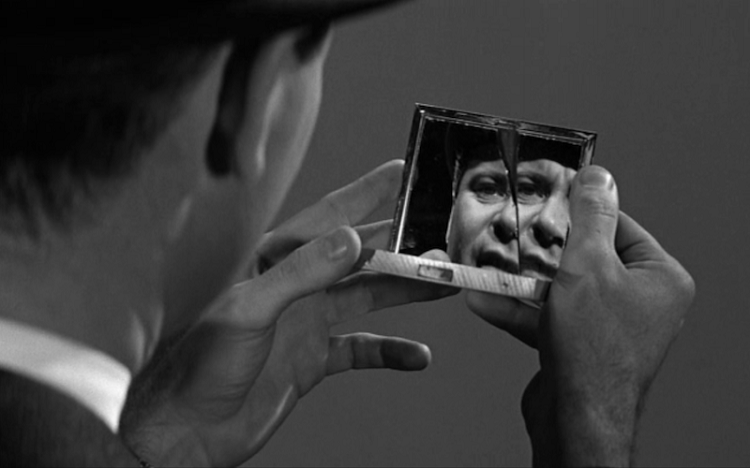
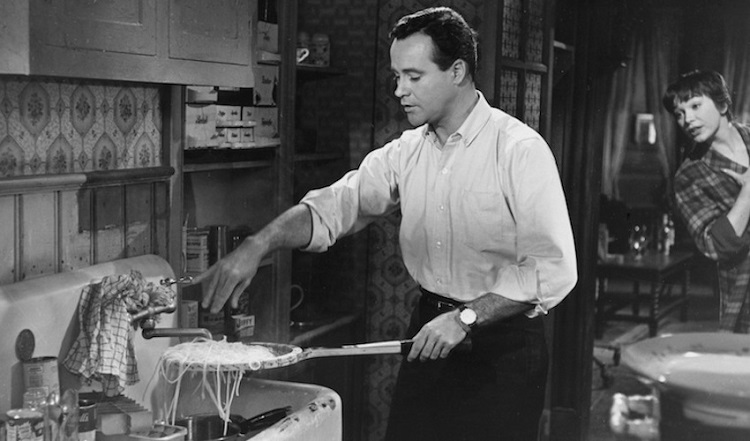
The émigré director always maintained that the best mise-en-scène was the one the viewer didn’t notice. However, his European sensibility is evident throughout his expressionistic cinematography and impossible point-of-view shots. In, practically, all of his oeuvre there are a series of habitual motifs specifically, the inclusion of Eastern European characters (an obvious reference to his and Iz Diamond’s respective homelands) the resident game of cards, and the use of the mirror – often utilised as the exposure scene where both the character and viewer make a discovery at the same time. Here, it’s Fran’s mirror compact which she won’t replace because the cracked glass shows her how she feels. Also included are telephone calls, surfing television channels (although that’s more of a dig at TV content) and making dinner as examples of the mundane (however, one would argue straining spaghetti through a tennis racket is anything but humdrum) in which the added realism enhances the wonderful story unfolding before the audience.
The Oscar-nominated and BAFTA award-winning performances given by Jack Lemmon and Shirley MacLaine in the lead roles have a lot to do with the film’s success. Their chemistry makes it a real joy to watch specifically as the viewer roots for both characters equally on their journey in life, it’s a road often tinged with the blackest comedy and world-weary cynicism. At one point Miss Kubelik declares “Oh God, I’m so fouled up” and fearlessly asks pondering questions like: “Why do people have to love people anyway?” without a hint of cliché, sentimentality or overt romanticism. There is no archetypal plot formation and it is not in the least bit predictable but contains subtle plot points and exposition which intelligently enforces the narrative where nothing is left up to chance. Wilder was a master of detail and restraint. Which makes the initial critical response all the more baffling: “[a] tasteless gimmick”, “dirty fairy tale”, “immoral”, “dishonest” and “without style or taste” are just some of the by-lines from 1960, which leads me to think that some critics just didn’t get it.
The Apartment is perfect, film-wise.
It is a true classic which celebrates disenchantment, love and the flaws of humanity through its acerbic dialogue, intelligence, wit and heart. There are more comedic elements to the screenplay than romantic, and however dark it gets there is real pathos. Arrow Academy has produced a beautiful celebration of it with a flawless 4K restoration, the process of which can be viewed in one of the many extras in this glorious box set which lavishly does one of Mr. Wilder’s masterpieces (he had a few) justice.
Special Features
Audio commentary provided by film historian Bruce Bloch. Bloch, just like Baxter in those opening moments is all about the facts, he discusses shot composition, cut sequences, and offers detailed analysis which often culminates in reading directly from Wilder and Diamond’s script. While a little dry in places, this thorough commentary will be a must-listen to fans of the film who will definitely benefit from Bloch’s insightful knowledge.
The Key to The Apartment (10 mins) – This is a new appreciation of the film delivered by film historian Philip Kemp, recorded exclusively for Arrow in 2017. Kemp keeps it brief, it’s a shame he reads from cue cards as his comments regarding The Apartment’s critical acclaim may have sounded less rehearsed.
Select Scene Commentary (8 mins) – Kemp is back in this short discussion which is delivered in voiceover accompanying two scenes from the films. He chooses the moment of (respective) despair for both protagonists; Baxter in the bar with Marge MacDougall and Kubelik at the apartment and the second scene in which Baxter is left standing outside The Music Man. It’s not quite long enough to make any real impact but interesting given the choice of scenes.
The Flawed Couple (20 mins) – A gorgeous video essay in which filmmaker David Cairns explores the many collaborations between Billy Wilder and, his every man, Jack Lemmon. Cairns looks at the simplicity and spontaneity of their working relationship which carried on into seven films over their respective careers: Some Like it Hot (1959), The Apartment (1960), Irma la Douce (1963), The Fortune Cookie (1966), Avanti! (1972), The Front Page (1974), and Buddy Buddy (1981). Wilder was responsible for putting Lemmon and Matthau onscreen together for the first time, which is especially poignant when you consider how many the duo went on to make and when all three passed away (Matthau, 2000; Lemmon, 2001 and Wilder, 2002). Cairns’ essay is accompanied by voiceover, archival clips and images.
A Letter to Castro (13 mins) – An exclusive interview with Hope Holiday recorded in 2017 for Arrow. In this lovely interview, 87-year-old Holiday details the exact moment she walked past the Brownstone off Central Park, carrying groceries, to see the crew measuring up for the would-be film-shoot, to her joining SAG and auditioning for her first speaking role of Marge MacDougall. She remembers Lemmon fondly and declares Wilder to be the best director she has ever worked with and recounts the “biggest thrill and happiest moment of my life – before marrying”. The lady is moved to tears as she talks about her experiences on set.
An Informal Conversation with Billy Wilder (23 mins) – Although originally made in 1995, this archival interview for the Writers Guild Foundations’ Oral Histories Series is a delight not least because it’s narrated by Lemmon: “Nobody’s perfect but Billy Wilder comes as close to it as any filmmaker in Hollywood.” It’s a mix of the filmmaker’s biographical info and filmography, detailing Wilder partnership with Charles Brackett through to the new(er) one with IAL Diamond before the interview with the man himself. Wilder is immaculately dressed and discusses his writing process, the structure and poetry of storytelling, casting, collaboration (which swinging, child-like, on his chair) all of which are intercut with images – such a fascinating, precise and humble man.
Restoration Showreel (2 mins) – This short feature details the process of how the 35mm camera negative was scanned at 4K resolution at Deluxe’s EFILM facility in Burbank, California but also shows some of the work completed during the digital restoration, the tools and techniques involved on the cleaning and repairing of damaged frames via before and after images. The work involved is also evident in the trailers and footage shown in numerous extras. It’s a welcome addition to the special features because it details a process few know or care little about.
Theatrical Trailer (2:19)
Archival Features: Inside The Apartment (29 mins) – This short documentary is originally from 2007 and features a whole host of subjects from critic Molly Haskell and Shirley MacLaine to Lemmon’s biographer, IAL Diamond’s son Paul to Chris Lemmon (Jack’s actor son). They discuss the film, in particular its black comedy and complexity and suggest why it stands the test of time.
Magic Time: The Art of Jack Lemmon (12 mins) – This featurette – again repurposed from the Fox/MGM’s new Collector’s Edition DVD which came out in 2007 – is a charming addition. Predominately narrated by Lemmon’s son Chris, he details his father’s childhood and progression to the stage right through to his film career and the meeting of Wilder and his “Pop”. It’s an affectionate look back at a wonderful actor or, in the words of his son a “marvellous, delicious leprechaun.”
Original screenplay by Billy Wilder and I.A.L. Diamond (BD-ROM content).
Special collector’s packaging featuring newly commissioned artwork by Ignatius Fitzpatrick.
Collector’s 150-page hardcover book (unavailable for review) featuring new writing by Neil Sinyard, Kat Ellinger, Travis Crawford and Heather Hyche, generously illustrated with rare stills and behind-the-scenes imagery.
The Apartment is a joy of a film, one of absolute perfection, and finally there is a box set which lavishly does one of Mr. Wilder’s masterpieces (he had a few) justice.
School is the worst place to hide in plain sight when you’re different and bullies are unforgiving and relentless, it’s one of the reasons why Stephen King’s first novel has stood the test of time and why Brian De Palma’s 1976 adaptation of Carrie still remains the best of its kind and resonates with an audience. Released just in time for Christmas (a Carrie White Christmas, no?) Arrow Video has pulled together a pretty decent limited edition boxset complete with a new 4K restoration from the original negative, replete with a whole host of new and archival extras, and new writing on the film.
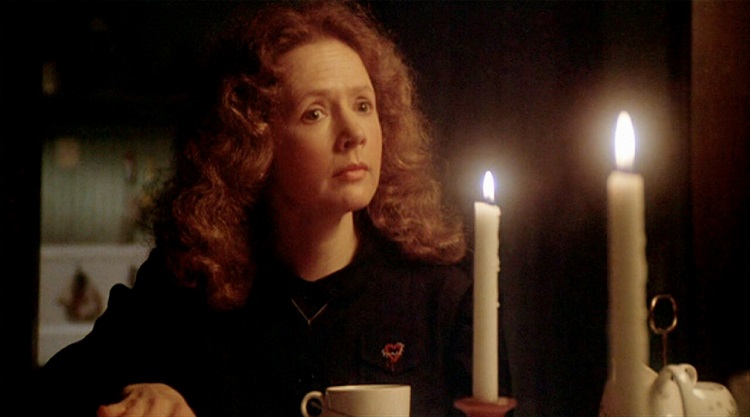
Carrie White (Sissy Spacek) is the only child of a religiously maniacal Gothic seamstress mother. Margaret (Piper Laurie) is a woman who insists on spreading the word of the Lord whether others like it or not. Her daughter wants nothing more than to fit in and be a regular teenager, however, the girls at school: Helen (Edie McClurg), Norma (P.J. Soles), and Sue (Amy Irving) led by Chris (Nancy Allen) have no intention of letting that happen. Even the teachers are mean. From that opening scene on the volley ball court in which our eponymous heroine is isolated and invited to “eat shit” after missing the ball to the following in the changing room. As Carrie’s pleasurable moment in the shower is interrupted by the violent and visceral experience of her first period. The original mean girls are at their most feral in their vicious hysteria as they launch sanitary pads and tampons at their vulnerable and terrified peer.
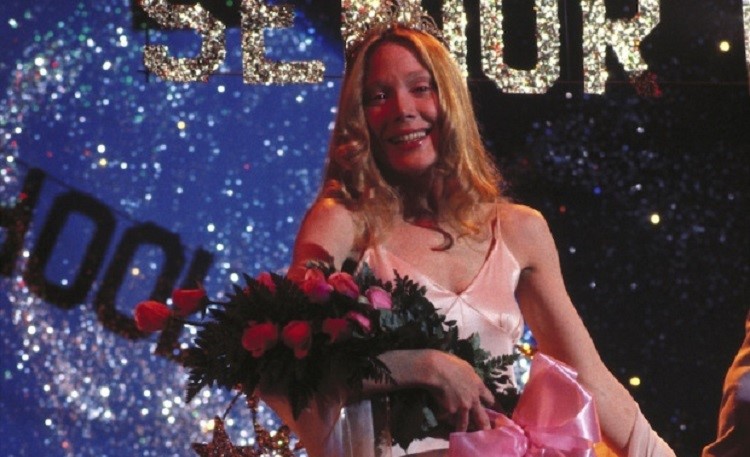
This girl is crying out for a mother and when she returns home it should be a place of comfort, somewhere she can feel safe, not a place where she has to repent in a closet for a biological function. However, with an abusive mother like Margaret – school is respite for her. A maternal figure comes in the unlikely form of gym teacher Miss Collins (Betty Buckley) and then the unexpected happens and Tommy Ross (William Katt) – who is supposed to be going with Sue Snell – asks her to Prom. Sue feels, that by asking Tommy to take Carrie to the biggest night of the school year, it will assuage her guilt for attacking the timid girl in the shower. Tommy, much like the majority of the males in this film (and there aren’t many) is a pawn; a conduit for the girl(s) to use to get their way. See also Billy (John Travolta) and Chris’ relationship and her pig of a plan for Carrie. The women are the ones in control – Carrie just has extra ability to play with.
De Palma’s adaptation bypasses the epistolary structure of the novel entirely and combines the weighty issues with satire. While there are brief moments which homage Psycho – some references are subtler than others – the score which should have been Bernard Herrmann’s instead went to Pino Donaggio who created a wonderfully atmospheric accompaniment and found the best way of repurposing the late Herrmann’s work (by isolating individual notes from the shower sequence and using the high-pitched shrill strings during the times when Carrie loses control). It is in those moments the film comes into its own – although, Arrow really missed a trick not including the soundtrack.
Carrie was not the first (or last) to conflate questions of femininity and the supernatural. If anything it paved the way for more male filmmakers to attempt to get their heads around the abject notion of menstruation. The text also subverted the idea of the American home as a safe space, instead its white picket fence and asymmetrical visage became a place of dread, fear and anxiety. Helped immensely by the religious iconography and paraphernalia invading the oppressive domestic space and aiding the sexual repression enforced my mother – there’s that Psycho link again.
The film created a bit of a feminist backlash too, particularly in relation to the shower scene and the alignment of pigs blood and women’s blood – women as pigs (?) and the monstrous female body as the site of transgression. Certainly, there are some interesting readings in relation to Carrie and it will, of course, depend on your perspective. Carrie is “othered” (like almost every other monster in horror) because, as Alexandra Heller-Nicholas states (citing Carol Clover) during her audio commentary: “horror is a female genre” – our protagonist is the literal outsider and yet we are invited to identify with her. Her fury at the world and those who punish her is fully justified, as frightening, irrational and uncontrollable that power is in its force; Carrie stands up to her bullies, and well, there’s something rather empowering in that.
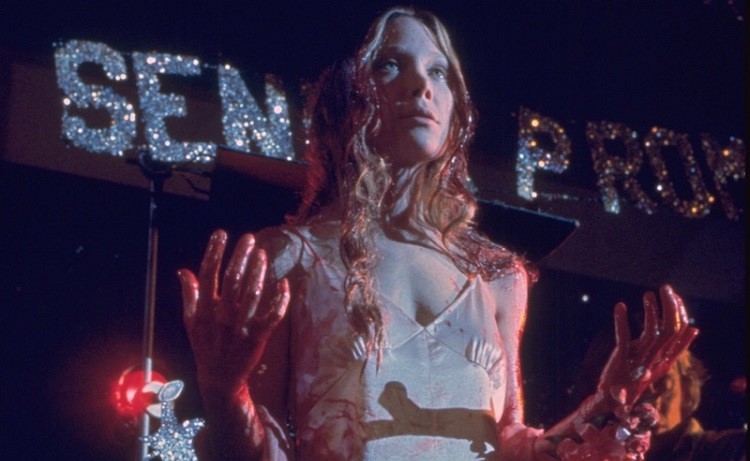
The Prom, its framing, use of space, split screens, Dutch angles, colour filters and the composition of each shot is superb (and a nice nod to Argento). Those blue and red filters and the scenes they colour are the greatest aspect to come from the restoration, they are visually amazing and, for me, the peerless part of the film. Even 40 years on, it holds up as one of the filmmaker’s best, if not the best (although, I’ll have to rewatch Sisters and get back to you on that). Carrie still resonates, we’re aligned with the “monster” of the piece and identify completely with this girl and her need/want of acceptance. Despite the fact that we know how the film ends, it’s easy to watch and still wish for a different outcome.
Special Features
Audio commentary provided by writers-critics-authors and all round good eggs, Alexandra Heller-Nicholas and Lee Gambin. These Aussies are authoritative (you can always trust these two when it comes to horror), knowledgeable and, better than anything, fun to listen to as they watch and examine Carrie; its themes, composition and their mutual love of it.
Acting Carrie (42 mins) – This 2001 featurette contains interviews with De Palma, art director Jack Fisk and the cast including: Sissy Spacek, Piper Laurie, Amy Irving, Priscilla Pointer, William Kat, P.J. Soles, Betty Buckley and Nancy Allen. They discuss the casting process which took place at the same time of Star Wars (Katt auditioned for Han Solo and Irving, Princess Leia). Spacek only auditioned following husband (and the film’s art director) Jack Fisk’s involvement and Laurie came out of retirement to play Margaret – it worked out well, they were both nominated for Academy Awards for their respective roles. Remember the last horror film to do that? Exactly. It’s an entertaining feature as we’re taken through the filmmaking process, story boarding details, and that shower scene. A building frenzy which Irving describes as “beautiful” and Allen, “disturbing. Ladies, it is indeed both.
More Acting Carrie (20 mins) updates on the previous extra by having a lot of the same cast members interviewed in 2016. There are new stills and images in this, however, a lot of anecdotes are repeated but it’s nice to see the cast in their advancing years. The addition of Edie McClurg is new (though the typo in the credits change her to ‘Eddie’) as we discover the real fire which broke out on the soundstage during filming and Soles’ perforated ear-drum following fire hose hi-jinks. Visualising Carrie: From Words to Images (41 mins) is a mini-feature which details Lawrence D. Cohen’s script brandishing in pre-production hell before securing a director. The Jack Fisk interview is the most interesting part as he details the process in making the White household which is known as “father, son and Holy Ghost” architecture due to its asymmetrical style, how he fashioned the Saint Sebastian statue in Carrie’s closet and the other religious icons he acquired for the set dressing. There’s a beautiful mention of the late Bill Paxton who put Fisk onto the pig farm.
Singing Carrie: Carrie the Musical (6 mins) – Although short lived, there was a 1988 musical production of Carrie which was written by Lawrence D. Cohen and starred Betty Buckley as Margaret White. Both she and Cohen discuss it and surmise why it failed on stage. In a 2016 interview Cohen is back in Writing Carrie (28 mins) as he discusses his process from receiving Stephen King’s manuscript, finishing it in one sitting and reviewing it for the paper he worked for. He believed even back then it would make a great film and upon seeing Obsession (1976) he knew De Palma was the man for the job. Cohen speaks warmly of his director and the success they both had with Carrie. He launches into discussing Carrie the musical, which seems a little redundant as the previous disc feature has already given us the lowdown.
A 2016 interview with cinematographer Mario Tosi follows in Shooting Carrie (14 mins), in which he describes the wonderful experience of working with “difficult communicator” De Palma. Tosi speaks in stilted English and uses cue-cards, not sure why he couldn’t have spoken in his mother tongue given the subtitled Donaggio interview later on. Cutting Carrie (24 mins) is a 2016 interview with editor Paul Hirsch in which he repeats a lot of information that has gone before. The monotonous tone of the man’s voice adds to the tedium of this extra as he describes the “painful” process of cutting the film. Not sure why he mentions Allen and Irving’s subsequent marriages either. This is worth skipping.
Although not drastically different from the very first feature, Casting Carrie is 15 minute long interview with casting director Harriet B. Helberg about her first screen credit which she loved every second of working on (from what she can remember). She’s a big fan of the remakes too. Bucket of Blood (24mins) – a 2016 interview with composer Pino Donaggio is one of the disc’s highlights as he recollects how De Palma changed his life and took him from the canals of Venice to Hollywood. It’s a charming interview and nowhere long enough as he takes us through his score; from the homage to Herrmann and his use of strings to create suspense to the more melodic music, like Carrie’s theme. For a musical genius, the man is so very humble and such a lovely interviewee. Horror’s Hallowed Ground is a 10 minute, low-budget episode of a TV series which began in 2006 (a lot are available on YouTube) where host Sean Clark visits locations from classic horror films. It crosscuts from Clark to the locations/scenes in the film. It’s harmless and well put together if amateurish.
The last of the big features is a brand new visual essay Comparing Carrie in which writer-editor Jonathan Bygraves compares the three screen versions of Carrie from 1976, 2002, and 2013. He examines time periods, production, structure, the characterisation of Carrie (Sissy Spacek, Angela Bettis, Chloe Grace Moretz), the different versions of Margaret White played by Piper Laurie, Patricia Clarkson and Julianne Moore respectively. There is one small mistake in which one image is labelled as 2002 when it belongs to 2013 and I can’t say I’m a fan of the font used. It’s all written in blood-red capital letters and would have been so much more readable in lowercase (and therefore referencing the 1976 credits). That said, the strains of Donaggio’s melodious score over the top of the essay is wonderful.
Alternate TV Opening – Details the main differences in the censored TV version.
Gallery – 45 slides showing posters, stills, publicity shots including some of the prologue that was shot but never used.
Trailer – Spoilery trailer which they’d never get away with today because… Film Twitter.
TV Spots (3 mins) – Five of them in total. All of which stating “If you have a taste for terror, you will have a date with Carrie” which is a “chilling blend of American Graffiti and Psycho.”
Radio Spots (1min 30sec) – Same voiceover used as in the TV spots.
Carrie Trailer Reel (6mins) – Combines trailers from 2002 TV movie Carrie (dir. David Carson), The Rage: Carrie II (1999, dir. Katt Shea) and 2013’s Carrie (dir. Kimberly Peirce).
Reversible Sleeve featuring original and new artwork by Laz Marquez (see featured image).
Limited Edition 60-page booklet (unavailable at the time of review) featuring new writing on the film by Neil Mitchell, author of Devil’s Advocates: Carrie, a reprint of The Final Girls’ 40th anniversary Carrie zine, and an archive interview with Brian De Palma.
I’m loathe to describe something as the “definitive” version of anything, however, if we’re talking about editions of Carrie, then this one is as near as damn it. It repurposes a lot of extra features which appear on the 2016 Shout Factory Collector’s Edition Blu-ray and archival bits and pieces from 2001’s MGM Special Edition DVD but my main gripe (and I’m really searching for one, honest), the thing that would have made it absolutely perfect – or “definitive” if I have to put a label on it – is the missing soundtrack.









 The Framing Device