Categories
film review

Tag (Dir. Sion Sono, 2017)

When watching any film by Japanese filmmaker Sion Sono, it is safe to say no two films are ever the same. He can turn his hand to all forms of genre cinema and yet doesn’t conform to any. From his last, gang rap musical in Tokyo Tribe to the gritty noirish neon of Guilty of Romance through his masterpiece, the epic romantic opera Love Exposure to the wonderfully weird hirsute horror Exte, one is always guaranteed an aural and visual experience of radical proportions and Tag, which would make an excellent companion piece to Sono’s 2001 feature Suicide Club, is no different.

Opening on the road with two coaches full of schoolgirls on a class trip all – except Mitsuko (Reina Trendl) who’s writing poetry in her journal – engage in a playful pillow fight as girls are prone to, apparently (it also sets up the recurring motif of falling feathers). A supernatural event then leaves her as the only survivor and she’s stranded with only her legs to carry her. This invisible perpetrator chases her to a lake, leaving more victims in its wake, where Mitsuko can wash off the majority of the blood spatter covering her stark white school uniform. She replaces the outfit with a second variant of a uniform and takes refuge in another all-girls school where everyone seems to know her despite never being there before. It isn’t long before death and chaos follows Mitsuko and she is, once again, on the run to the next reality and the next uniform, this time with a different face as she races to survive.

Tag offers up some interesting and philosophical musings about life, death and destiny as Mitsuko (in a couple of guises) spends the majority of the film running away yet, towards something. Participating in the human race has us all running from/towards death and experiencing the absurdity of life; a concept which is taken very literally here but then, thankfully, subtlety has never been Sono’s forte when combining his arthouse sensibilities with bloody action and horror. Yet, this film seems to take some cues from mainstream culture like Alice in Wonderland via seventies comedy horror classic, House.

Keeping the cast predominately women until the very end leads us through a womanhood of sorts: adolescence, love, laughter, and freedom to marriage when everything, or so it appears, ceases – the Groom with the animal head who resides in a black coffin certainly signifies as much – cue more carnage. This then culminates to a meta end and one which can also be read as a deliberate and timely response to the GamerGate controversy. However, as Mitsuko battles the new realities and does finally enter The Male World, it all goes way beyond a 2014 harassment campaign. It’s a largely silent and grim place where, surprisingly, women are decorative objects and all for the playing pleasure of a wizened old man (astutely cast Japanese heartthrob Takumi Saito under convincing prosthetics). He is the personification of patriarchy bending the world to his will, playing with his dolls and twisting reality to suit.

Tag, (inspired by Yusuke Yamada’s Riaru Onigokko) is a highly intelligent and exhilarating ride. The creativity and aesthetic of Sono is the driving force behind this provocative and surreal little tale. It is a bloody riot yet beautiful in its macabre weirdness, not least in those first five minutes – only in something so very artificial and unconventional can reality resonate even louder. It is a shame that there are no extras on the disc as a featurette or director commentary could shed more light on the inspiration for it, however, the not knowing is also what makes Tag such a pleasing experience. You, just like Mitsuko, get to choose and decide its fate.

Categories
Blu-ray film review

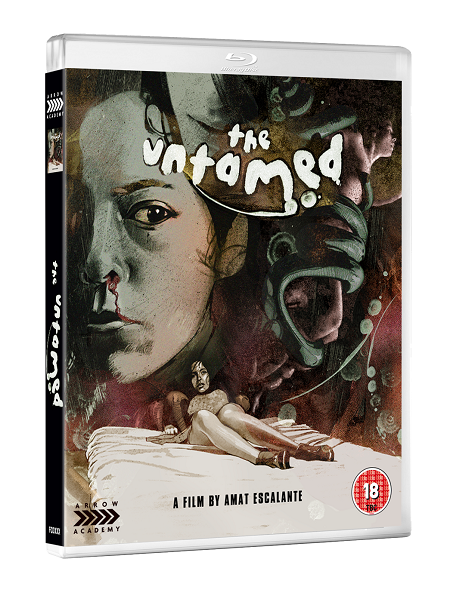
The Untamed (Dir. Amat Escalante, 2018)

Never one to shy away from the confrontational, Amat Escalante’s follow up to the unflinchingly brutal Heli (2012) is available now on DVD and Blu-ray courtesy of Arrow Films and its Arrow Academy label.

Straddling science fiction, horror and a Mexican kitchen sink drama, The Untamed, begins with a lingering shot of a meteor hovering in space. Its crash to Earth occurs off-camera but leaves a large crater in its wake and t brought something with it. That ‘something’ has tentacles, presumably a respiratory system of sorts, despite having no visible organs or features, and has taken up residency in the barn of an ageing couple (played by Oscar Escalante and Bernarda Trueba). It has a regular visitor in the form of Verónica (Simone Bucio) who, well it’s never made implicit what or how she serves the alien form despite strong indications; only that on this occasion, she is injured and forced to leave and find aid.

Shocked and bleeding, she seeks refuge in a local hospital where her wound is treated by Fabián (Edén Villavicencio) and one thing leads to another and the lonely and somewhat mysterious Verónica inserts herself into the gay nurse’s life and by extension his sister Ale (Ruth Ramos) and her less-than-blissful domestic set-up with cheating, bullish homophobe husband Ángel (Jesús Meza) and their two small boys. The stranger convinces them that the life form which resides in that barn is the answer to their problems just prior to and even after devastating, irreparable tragedy.

Apparently made as a direct response to chauvinism, mainstream homophobia and the moral perception of tragedy, this fantastical allegory builds atmosphere with a literal humming buzz in the diegesis and taps into our basest primitive state, and the relationship between pain and pleasure. This dichotomy is beautifully depicted through Ale and Angel’s youngest son and his love of chocolate, he knows he’s allergic but can’t resist. Those moments of gratification are worth it, even if it means an angry-looking itchy red rash and a prodding injection. Seemingly, for the adults, pain and pleasure mature through sex and violence, however, this is never fully connected within the film’s narrative, the strange alien life force or the human subjects.

The Untamed deals with hefty subject matters and is a human drama within a sci-fi-erotic-horror film. Several scenes are clearly influenced by Andrzej Žulawski (the late filmmaker is even acknowledged in the closing credits), there are moments which feel Cronenbergian, and even includes a scene which reminded of von Trier’s Antichrist (2009). The horror aspects never feel forced and are fascinating, specifically the creature, one is drawn to it much like the lost souls in the film yet it’s not given that much screen time. Sadly, it is in the human drama aspect that the film falls down. There was an intensity, rage and heft to Heli and even Žulawski’s Possession (1981) (if we’re to take that as the main text of inspiration) which feels missing here; yes it’s subversive, intelligent, and well put together but overall muted and a little disappointing.

DISC EXTRAS

The Making of The Untamed (84 mins) – this in-depth footage takes us behind the scenes with the cast and crew of the film, shot by one the film’s composers and the director’s brother, Martín Escalante. There are fascinating moments, warm interludes between filmmaker and his collaborators – who seem to compromise of some long-term friends and family members – and laborious retakes in shooting. Amat Escalante is a perfectionist, that much is clear.

Amarrados (Tied Up) (15 mins) –  Escalante’s first short which took first prize at the 2002 Voladero International Film Festival in Mexico and won him Best Short and Best Director at the Newport Beach International Film festival in 2003. Shot in black and white, the film centres around Niño (Abel Diaz), a young homeless boy who’s stuck in a vicious cycle of sexual abuse and glue-sniffing. There’s a beauty amid the misery in this short, in which class, race and religion are alluded to and Escalante’s follow-shot is included: a great edition to the disc.

First Pressing Only – Booklet featuring new writing on the film by critic and author Alexandra Heller-Nicholas, writing by critic Jonathan Romney, the director’s statement and extracts from the press book, illustrated with original stills (unavailable at the time of review).

Region: B/2|Rating 18|Language: Spanish|Subtitles: English/English SDH|Aspect Ratio: 1.66:1|Audio: Mono|Colour|Discs: 1

Categories
Blu-ray film review

Don’t Torture a Duckling (Dir. Lucio Fulci, 1972)

Of the three main maestros of Italian horror, it is Lucio Fulci who is regarded the most lurid, gory, even the trashiest of the trio, or at least he might have been once upon a time. Following many of the tropes associated with the genre, this Giallo also touches on prostitution, child murder, paedophilia, religion, truth, loss, and motherhood, Don’t Torture a Duckling is replete with symbolism and depth, the term ‘masterpiece’ has been somewhat cheapened over the years but this could well be Fulci’s.

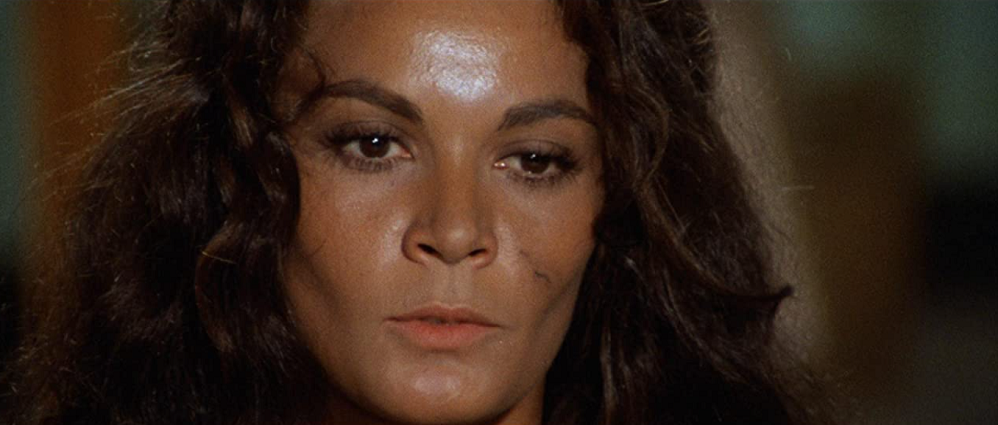
Opening in rural Southern Italy, the landscape is split by an ugly concrete motorway bringing with it a bit of modernity; prostitutes, and the ‘outsiders’ (following the first of the murders) in the form of rich ex-drug addict Patrizia (Barbara Bouchet) and city journalist Andrea (Tomas Milian). The idyll of the small village is rocked when the first of the boys, Bruno, goes missing. His brutal murder is quickly followed by the senseless deaths of his friends Michele, and Tonino. Suspicions soon lead to a local ‘witch’ Magiara (Florinda Bolkan), one-time student of eccentric black magic-practitioner Francesco (George Wilson), and of course because of her difference – even after she is exonerated – some local men take the law into their own torturous and contemptible hands, little do they know that the real culprit is much closer to home. It is down to Patrizia and Andrea to work together and expose the killer before he/she strikes again.

Mixing the thematic and stylistic tropes of the giallo with Gothic horror, Fulci makes women the interesting subjects in the narrative, especially Bolkan who is not only the most sympathetic character but whose performance is exceptional. In a film about the destruction of innocence and child murder, it isn’t actually their disturbing deaths that are the most shocking. Fulci builds the superstition and style, mood, tone and atmosphere with light and  bright wide exterior shots and juxtaposes them with claustrophobic dark interiors and yet subversively, just as the killer comes from within the community so, too, are these children killed outdoors.

Violence is, as one can expect, never shied away from and a truly gripping story intensifies to an emotional and visceral crescendo which is unforgettable thanks mainly to the editing and that slightly grating piece of pop music used to accompany the brutality. Yes, the effects are a little dated and the acting, a tad histrionic but it’s in keeping with the genre and boy, what a social commentary it provides. Traditional, old-fashioned values and small-town mentality are pulled apart and what goes hand-in-hand with that? Religion. Understandably, this film courted controversy in the eyes of the Catholic Church especially given the film’s ending, which is almost gleeful in its transgression (the director’s own Catholicism making it all the more delicious and rebellious) especially considering it’s length, audacity and those gratuitous close-ups.

While Lucio Fulci never seemed to have the sumptuous production value of Mario Bava or the operatic visual mania of Dario Argento, he’s integral to the period, Gialli, and Italian horror – Don’t Torture a Duckling more than proves that and now, thanks to Arrow Video you can view it in all its lurid high definition gory glory.

DISC EXTRAS

The Blood of Innocents (30 mins) – This video essay is delivered by Dr. Mikel J. Koven from the University of Worcester and author of La Dolce Morte: Vernacular Cinema and the Italian Giallo Film. He discusses the concept of ‘vernacular cinema’ (those films which tend to avoid the bourgeoise mainstream audience) with enthusiasm and makes this a fascinating lecture. While it is ultimately a bloke behind a desk, the essay is intercut with many clips of multiple film texts which fall under the Giallo umbrella including work from Sergio Martino, Dario Argento, Pupi Avati, and Antonio Bido.

Hell is Already in Us (20 mins) – Written and narrated by Kat Ellinger, this audio essay focusses on violence and gender with Ellinger defending the claim that Lucio Fulci was a misogynist filmmaker. She refers specifically to his 1982 New York Ripper and Don’t Torture a Duckling to state her case; that Fulci confronts the taboo and uses his art-form to comment upon civilisation and depicting oppressive patriarchal society in all its evil glory.

Audio Interview (Part 1: 20 mins/Part 2: 15 mins) – In August 1988, journalist Gaetano Mistretta sent a letter with a list of questions to the filmmaker and Fulci recorded an audio tape complete with all his answers and sent it back to Mistretta. It’s a great listen full of personal anecdotes about his process, his grandchildren even though we all know, he adds with a chuckle, that “children are monsters”, his favourite filmmakers (Argento, Cronenberg, Kubrick and Bava) and the correct length of a horror film (it’s 80 mins btw).

Interview with Florinda Bolkan (27 mins) – Filmed for Freak-O-Rama in 2016, one of Don’t Torture a Duckling‘s leading ladies chats about her experiences on set with Fulci (having completed A Lizard in a Woman’s Skin the previous year with him), whom she deemed a gentle man and genius. Discussion turns to that scene and despite never viewing it in its entirety, she agrees to watch it for the first time in 44 years, and is understandably horrified by it. Additional segments from this 2016 programme are also contained in the special edition content , all include those involved with Duckling including: The DP’s Eye (45 mins) – time spent with cinematographer Sergio D’Offizi, From the Cutting Table (25 mins) – assistant editor Bruno Micheli takes us through his process and in Endless Torture (15 mins) make-up artist Maurizio Trani talks his history with make-up, Fulci and the special effects used during the Bolkan scenes.

Audio Commentary provided by Troy Howarth, author of So Deadly, So Perverse: 50 Years of Italian Giallo Films.

Reverse sleeve featuring original and newly commissioned artwork by Timothy Pittides.

First pressing only: collector’s booklet with new writing on the film by Barry Forshaw and Howard Hughes (not available for review).

Region: AB 1/2|Rating 18|Language: Italian/English|Subtitles: English|Aspect Ratio: 2.35:1|Audio: Mono|Colour|Discs: 2

Categories
film review

Most Beautiful Island (Dir. Ana Asensio, 2018)

“Are you ready to receive the gift of salvation?” a street preacher asks lead character Luciana as she walks past him. It’s a running theme through the first half of Most Beautiful Island as Luciana discusses redemption with her mother. She has left her home country following an accident involving her daughter Sofia (we don’t know the specifics but there’s a shoebox containing baby clothes, sealed in plastic bags to preserve the newborn smell). In the US she must find the belief to survive and the faith that things will, have to, improve.

The film opens with a camera sweeping crowded streets, randomly honing in on unidentified women and briefly following them before moving onto the next, until it eventually finds Luciana (writer-director Ana Asensio). She is trying to see a doctor for the nausea, nightmares and nose bleeds which are becoming more and more prevalent, however she, like many undocumented individuals, has no health insurance nor the $75 spare to pay for the appointment. Her day made worse as she returns home to passive-aggressive notes from her roommate demanding rent and the Post-Its tacked to food items in the fridge reminding her that they are “Not Yours”.

What follows is a relentless pelting of lack of privilege and hardship, tightly framed and often in close-up to give a real sense of discomfort and entrapment as each situation becomes increasingly worse; living hand to mouth, the crappy jobs which include babysitting bratty children or dressing like a sexy chicken to advertise fast food (the latter something immigrant men are spared, presumably). While discussing the dismal prospects with friend Olga (Natasha Romanova) – another woman finding her way in the world – Luciana considers donating her eggs for the $8000 offered in a magazine ad, it’s either that or fully embrace the defeat she has been feeling. However, things look promising when Olga offers Luciana the opportunity to cover for her at a party, all she needs is a LBD and heels and in return she will earn $2000.

At some point, alarm bells must start ringing as Luciana is led to the bowels of a Chinese restaurant to pick up a handbag, a designer knock-off complete with a padlock and then onto the hastily scribbled address she carries on a scrap of paper. As a viewer, you’re internally screaming for her to turn back as her evening becomes more bizarre, she finds herself in a web of weirdness, and the significance of those women seen in the opening moments is made apparent. To say any more would be to spoil but suffice to say Jeffrey Alan Jones’ music comes into its own here, the jarring sounds adding to the tension as the voyeuristic handheld super 16mm camera bounces between close-ups and wide shots, most of the action taking place behind a closed door – we’re as much in the dark as Luciana.

Most Beautiful Island depicts the day and night, light and dark aspect of the American Dream, and the form the film takes is very much split in two as the day brings opportunity and the night brings the dastardly (and genre-favourite and the film’s producer Larry Fessenden in a very small role). Asensio’s deployment of those genre elements in the second half exaggerates an already increasingly hopeless situation and is particularly effective. The first-time director manages to communicate a great deal, harrowingly, in a taut 80 minutes and refreshingly doesn’t sugar-coat the human plight at the centre of her narrative.

Categories
film review

Deliver Us (Dir. Federica Di Giacomo, 2016)

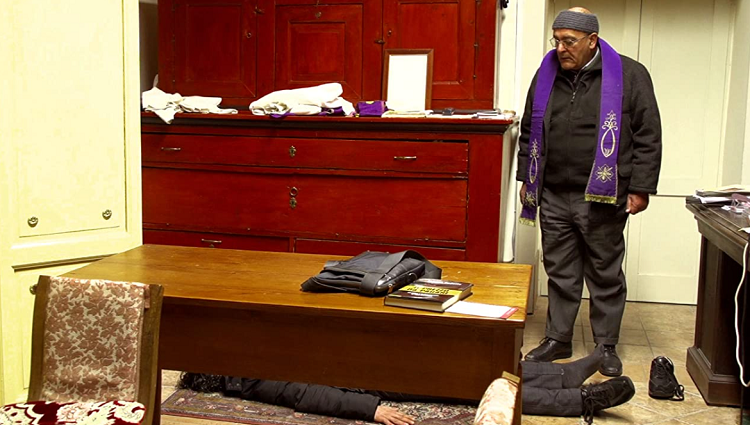
Cinematically, films featuring possession and the subsequent exorcism are ten-a-penny yet Federica Di Giacomo’s award-winning documentary Deliver Us [Liberami] deems to show how the ancient ritual is performed in a contemporary world. In the opening scene, which is chilling, a woman sits with her back to camera as a Priest anoints her with holy water. After he places his vestments on her head she wails and screams for the “bastard” to leave her alone and an almost secondary voice chuckles “she’s mine now.” Even if you stumbled across this documentary with little to no knowledge, it’s safe to say, this incapsulates the subject matter succinctly and effectively.

Father Cataldo Migliazzo is a sought-after Priest (and exorcist) in Palermo, people travel 150-200 km to attend his tiny Church and receive a blessing. Disturbingly, a lot seem to think they’re possessed – a child who refuses to go to school has parents who believe “a devil is inside of him”. A woman begins to cough and have, what appears to be, a panic attack and is taken into confession and, delivered from evil, and this is all before mass even begins. When it does, the “possessed” within the congregation hiss, spit and speak in tongues.

There is little doubt to these people’s beliefs, yet as they discuss what symptoms they present with, it becomes apparent that a lot can be explained away via human biology or medical tests. These vary from swearing, masturbation, seizures, drug addiction and depression to memories of child abuse. One even lists cervical pains, dizziness and exhaustion, another an unhappy marriage while one mentions schizophrenic episodes, and what could be epilepsy in a teenage girl. Yet, at no point are they directed to a medical professional – in shepherding their flock you would think that there is a duty of care. This is made all the more ridiculous (and hypocritical) when we see Cataldo’s medication spread across a table top for various ailments, right after he exorcises by telephone no less.

Unsurprisingly, almost all of those exhibiting signs of oppression are women. The patriarchal domination and control of women within the Catholic Church has almost become sacrosanct and this unspoken insinuation that women are weaker and the only ones susceptible to mental health issues leaves a bad taste in the mouth. Made all the more galling by a Father Carmine who tells a recently exorcised woman to laugh more, so to prevent another episode of oppression.

While Di Giacomo brings a neutrality to proceeding, there’s little judgement one way or the other and her film never strays into questioning faith or belief, there’s humour without ridicule and a melancholy as we follow these lost souls desperate to “cure” themselves. It is all too easy to condemn what is not understood, as ancient tradition and modern habits collide, which further plays on unnerving fear and delusion; the sacred and the profane, psychic and spiritual, disturbing and ludicrous.

However, it is in those last closing statistics which turns the fascinating (and somewhat infuriating) Liberami into a real-life horror – the increase of Priests who are now qualified to perform exorcisms within Dioceses across the world is staggering, and the indication that these numbers will continue to grow is absolutely terrifying. Federica Di Giacomo has produced a a stark work which fuses real-life with the absurd, proves that reality is more far more powerful than fiction, and leaves you with hope that all those lost souls are delivered from whatever ails them.