Categories
Blu-ray film review

Suntan (Dir. Argyris Papadimitropoulos, 2017)

In keeping with 2015’s Chevalier and The Lobster, Argyris Papadimitropoulos’ Suntan also places masculinity and middle-age under the microscope, it also happens to be Greek. Billed as a “coming of middle-age story”, it focusses upon Kostis (Maki Papadimitriou) who arrives on the island of Antiparos to take over as the new Doctor. As his new found friend Takis (Yannis Tsortekis) – think Chet Pussy (Cheech Marin) in From Dusk Till Dawn – explains only during the summer months does the island come to life and teems with tourists who inhabit the camping site just outside of the small city centre.

suntan_02

This summer brings with it, Anna (Elli Tringou), Jason (Dini Hart), Alin (Hara Kotsali), Mila (Milou Van Groesen) and Morten (Marcus Collen); an obnoxious bunch of youths who are determined to enjoy their holiday to the nth degree. They soon find themselves in Kostis’ examination room when Anna falls off her bike and upon treating her, the good doctor’s heart begins to flutter.

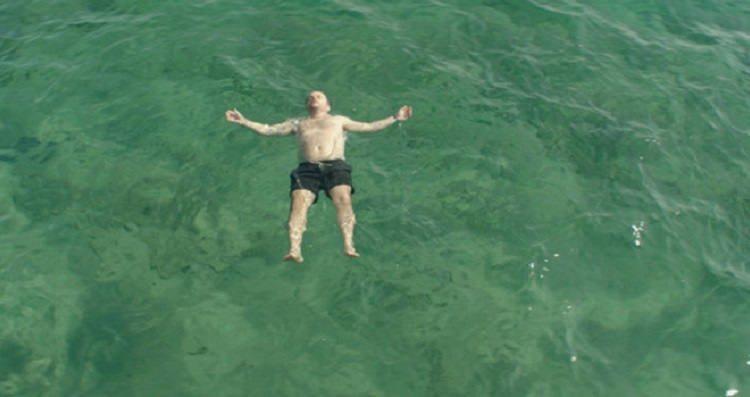
The sun, sea, and sand serves as a glorious backdrop, making sufficient use of lens flare as Kostis starts to “accidentally” run into the group who all seem intent on encouraging him and using him to amuse, abuse and buy them beer. They are sexually liberated spoilt brats whose nubile tanned taut flesh is often shot juxtaposing the Doc’s pale, hairy middle-aged paunch – the camera shames him and objectifies them, especially Anna.

His overeagerness is sweet yet cringeworthy and his lack of self-awareness overwhelming. We are initially invited, perhaps even encouraged to feel for him, he’s lonely, he missed the boat in some areas of life, he has regrets of youth, it’s easy enough but then, things take a turn.  His unlikely friendship with the woman half his age becomes an obsession, and his entitlement and aggressive behaviour gives way to darkness and a misogyny that is breathtaking.
4489_suntan

Papadimitriou embodies the sad-sack Kostis beautifully and while the ending comes as a bit of a shock, the lead up to the breakdown is heartbreaking and difficult to watch. Call it a cautionary tale or a painful parable yet Suntan is a solidly directed and acted Greek (New Wave) tragedy, however, where The Lobster and Chevalier relied upon biting satire within its drama, this falls short of humour and just plays out as dark, upsetting, and all a bit mean.

EXTRAS

Interview with director Argyris Papadimitropoulos (26 mins) –  Delivered in segments the director discusses the origins of the film, script, casting, and filming. Papadimitropoulos has a long standing history with the island of Antiparos, having began visiting at aged 16, he never wanted to recreate on film but depict it as it truly is. He talks about where the idea for the script came from (actually following his reading of Michel Houellebecq’s Whatever) which made him think of those who have access to pleasure and those who don’t. Thinking on the dichotomies in the film, it makes sense even down to the casting of the non-professional and inexperienced Elli Tringou opposite the “genius” of Makis Papadimitriou. This in depth sit-down with Suntan‘s filmmaker is really interesting and well worth watching after the main feature.

The Making of Suntan (15 mins) – A run-of-the-mill behind the scenes documentary-style featurette with a seriously good soundtrack, very Club La Luna, and in complete contrast to the previous extra.

Deleted Scenes – These include ‘Boogaloo’, ‘Downhill’, ‘Kalargyros’, ‘Milu Pees’ and ‘Camping’.

Theatrical Trailer

1080p Presentation on the Blu-ray|Progressive encode on the DVD|5.1 Surround and Stereo soundtrack options|Optional English subtitles (containing 1 or 2 errors)

Categories
Blu-ray film review

Witness For the Prosecution (Dir. Billy Wilder, 1957)

A year barely passes without an Agatha Christie adaptation hitting the BBC, while they all have their merits they are rarely as enjoyable as Billy Wilder’s version of Witness For the Prosecution. Made in ‘57 and released a year later, it was the first film adaptation based on Christie’s play adapted from her own short story which opened on stage in London during 1953.

The courtroom drama – set mostly in London’s Old Bailey – centres upon Sir Wilfrid Roberts Q.C. (Charles Laughton) who is recovering from a heart attack and vows to avoid (at his Doctor’s behest) criminal cases for the foreseeable. Enter Leonard Vole (Tyrone Power) who stands accused of murdering a Mrs. Emily French (Norma Varden), the older rich widow who had become rather attached to the affable and attractive Vole after their perfect meet-cute via the window of a milliners. She even made the eggbeater inventor (yes, really) the main beneficiary of her will. While everything points to Vole as the killer, Sir Wilfrid believes in the accused’s innocence and takes on his case. First on the agenda is speaking to the man’s alibi, his wife Christine (an impressively stoic Marlene Dietrich).

Wilder co-wrote the screenplay, this time with Harry Kurnitz. The director was on a break from a regular collaborator following his acrimonious split with Charles Brackett, and had written only the one screenplay – Love in the Afternoon – with I.A.L. Diamond. Witness For the Prosecution was the last before he and Iz would cement their writing relationship with Some Like it Hot (1959) and The Apartment (1960).

What strikes most about this Witness… is the humour. Unsurprising given the acerbic, wry wit which peppers every Wilder screenplay, however, it would all be nothing without the performances which make this film. Power – in his final film before his death – is solid as prime suspect Vole, prone to histrionics but what man potentially facing the death penalty isn’t? Dietrich gives fine Garboesque support as his secretive wife Christine. The star of this particular show, however, is Laughton.

The British veteran actor clearly had a ball with Sir Wilfrid, producing a playful performance; sympathetic and incredibly funny. Given his history of heavy drama and those darker roles, it really is a joy to see especially in his scenes with nurse Miss Plimsoll (Elsa Lanchester). There is no Plimsoll in the original Christie play\short story, she is the creation of the screenwriters. Although, a safe assumption is that the casting was all Wilder. Choosing Lanchester, given her and Laughton’s working and personal relationship was a genius move and provides more than one deliciously raucous moment between the husband and wife.

Granted, it has been 61 years and few will view this without prior knowledge of the plot and the ending(s) (of which there are several). Despite the imploring voiceover the end credits: “The management of this theatre suggests that for the greater entertainment of your friends who have not yet seen the picture, you will not divulge, to anyone the secret of the ending of Witness For the Prosecution.” It doesn’t hamper the viewing experience of Eureka! Entertainment’s – courtesy of their Masters of Cinema series – lovely package of the film, which is available on Blu-ray for the first time in the UK.

The 1080p presentation (with an uncompressed LPCM mono soundtrack) contains a number of extras which only enhance the main feature. This includes audio commentary provided by critic and Diabolique Editor-in-Chief Kat Ellinger.

Monocles and Cigars: Simon Callow on Charles Laughton (15:48) – Actor\writer Callow discusses WFTP in relation to Laughton, his performance in the film and his career as both an actor and director of stage and screen. He also briefly touches upon Laughton’s closeted love life and relationship with Elsa Lanchester which in itself was an unconventional and enduring love story. This feature is nowhere near long enough, Callow’s such an interesting interviewee and commanding presence who clearly adores his subject matter.

The Interview with Neil Sinyard (24:32) is slightly longer as the Professor of Film Studies discusses Billy Wilder’s career and collaborators. Sinyard focusses on the “lesser-known” films in the émigré writer-director’s oeuvre, like The Spirit of St. Louis (1957), Love in the Afternoon (1957), One, Two, Three (1961) and Hold Back the Dawn (1941), (all highly recommended by this reviewer). He talks specifics and comparisons between the stage play and film versions of WFTP, comedy and character. It’s a must-see for Wilder fans or even if you’re discovering the director for the first time.

Billy Wilder on Witness For the Prosecution (13:40) – This short interview is taken from the three-part 1992 programme, Billy: How Did You Do It? directed by Gisela Grischow and Volka Schlöndorff. It is Schlöndorff in conversation with the charismatic director who was 86 years young at the time of interview.

Within the first two minutes Wilder speaks German, French and English and is interrupted by the telephone in his office. He’s playful and charming, swinging on his chair and interrupting the interviewer (only to correct him, you understand). He only has fond things to say about Dietrich who he worked with twice on A Foreign Affair (1948) and this, praising her intellect, key lighting knowledge and of course “the face”. It’s another welcome extra to the disc but do try and source the original interview in its entirety – all parts are available on the Blu-ray edition of Eureka!’s The Lost Weekend (1945) – you will not regret it.

Also included is a collector’s booklet featuring her essays by film scholar Henry Miller and critic Phillip Kemp, a letter from Agatha Christie to Billy Wilder and rare archival imagery (unavailable for review), and of course, there is also the theatrical trailer and a reversible sleeve.

Witness For the Prosecution may well be regarded as a “lesser known” Wilder, however, it is well worth a punt not only for all the reasons mentioned above but its theatrical pacing, Wilder’s expressionistic mise-en-scène and it would be remiss not to mention that monocle trick. It was reportedly praised by Christie as the best adaptation of her work she had seen, and well, if it’s good enough for Agatha…