Categories
film review

Summer 1993 (Dir. Carla Simón, 2017)

Grief, sorrow and loss are overwhelming emotions in the wake of a family member’s death, as you struggle to make sense of their departure and the huge gaping hole they have left. It’s easy to dwell on the finality of death and the unfairness of it all, and that’s as an adult. Now imagine, you’re just six years old.

It is the summer of 1993 – a period when the AIDS virus is claiming lives – and the nighttime sky in Barcelona is lit by bursts of colour and light as fireworks go off with a multitude of bangs and whistles, and groups of children run around the neighbourhood, squealing with joy. There is little in the way of it for Frida (Laia Artigas) as she vacantly watches her belongings being packed into a van. She’s moving, leaving behind everything she has ever known following her mother’s death. She is going to live with her mother’s brother, uncle Esteve (David Verdaguer) and his wife Marta (Bruna Cusi) out in the Catalan county of La Garrotxa, surrounded by trees and fields of green. A complete departure from the urban city dwelling she has grown to call home.

This film – based on the childhood experiences of its writer-director Carla Simón – uses the urban setting and casts it against the neo-rural in a changing Spain. The surrounding leaves dappled with sunshine, and the revitalising greens and blues of the film’s palette create the perfect childhood idyll but this new and unfamiliar landscape is, seemingly, at odds with Frida’s perceptions of death, she is often preoccupied with both. At night, the child searches by torchlight for her ‘lost’ mother as if she has been stolen away by woodland creatures or leaves gifts, such as cigarettes, with the hidden statue of Our Lady guarding a cavernous hole in the wall.

Typically, there’s a split between the generations – history and tradition seen through a grandparent’s Catholicism and the gegants i capgrossos (the folkloric festival with its 15th century origins), as well as the obvious differing parenting styles of Esteve and his mother Àvia (Isabel Rocatti). Parental duties are divided between Verdaguer’s lovely uncle and Cusí’s patient Marga – although all family members are united in their love for their girl – who seemingly want to support, help repair the lost orphan and help her understand, accept her loss and acknowledge her grief all in her own time (though it is far from easy). To that end, this film never feels over-sentimental rather a beautifully tender and transformative experience as a small child grapples with rather overwhelming adult feelings. Brava to Simón who, in one sequence, normalises period cramps albeit while sensitively showing just how terrifying it appears to a child that has experienced a parent’s painful death.
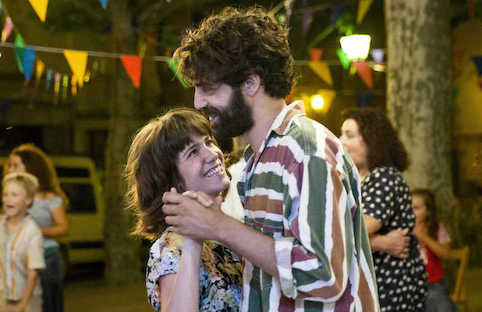
While Summer 1993 [Estiu 1993] is a relatively simple narrative edited together detailing such a small window of time, it is beautifully measured and made up of small moments which only deepens meaning and enhances the story. None of which, it has to be said, would be quite as transfixing if not for the two wonderful little girls. The casting is sublime, the physical differences between the two are evident, but their life experience(s) or lack thereof are displayed in their facial expressions, open innocence, and the way they both ‘act’. Laia Artigas and Paula Robles inhabit Frida and Anna so naturally the heightened realism shapes the overall tone; Santiago Racaj’s largely static camera is always observing, sometimes in tightly framed shots yet it never feels intrusive.

The camera is often at Frida’s eye level as she cradles her doll – one of a whole army, all with names and showered with kisses for they are a measure of just how much everyone loves her – the frame opening as her new surroundings envelop her and she starts to accept her new way of life. The little girl is quiet, withdrawn and while her level of understanding is never truly known, she observes everything (her cosplaying her mother proves that in spades). In complete contrast is Esteve and Marga’s daughter Anna (Paula Robles) who is always singing, climbing and generally following her cousin around. Frida, not only has to process her new habitat, family and grief but negotiate her new status as a big sister which leads to regression, cruelty and, understandably, petty jealousy.

Preceding this, Simón wrote and directed three shorts: Born Positive (2012), Lipstick (2013) and Las pequeñas cosas (2015) with the London Film School before completing Lacuna (2016) which was made using her late mother’s letters. She manages to inject her gorgeous feature film with a sweeping verisimilitude, concentrating on the complexities and minutiae of familial relationships which will warm your heart and swiftly break it (catharsis is such a powerful tool, especially during this dénouement). It goes a long way to communicate that a family may be reconstructed but it is still a family, and those who are no longer with us in body live on in memory.

Categories
film review

Animals (Dir. Sophie Hyde, 2019)

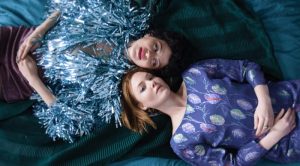
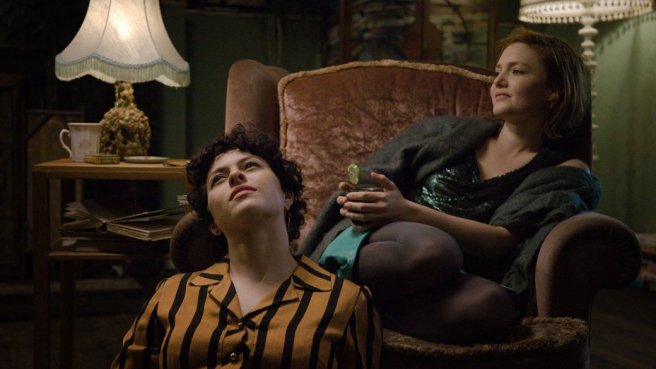
Laura is 32 (Holliday Grainger) and has spent the last decade writing a novel, and still only achieved ten pages of content. It’s about a spider caught in its own web and the woman – one in love with the idea of being in love – who tries to rescue it. An analogy for the ages it has to be said. Laura lives with her best friend, Tyler (Alia Shawkat) who learns of her father’s death at the start of Animals (and just prior to her thirtieth birthday). While we never learn much more, it’s safe to assume there is no love lost there.

Taking its inspiration from the pages of Emma Jane Unsworth’s Manchester-based novel of the same name (she adapted her own work for the screen), the film plays out like a long extended night out complete with wraps of coke, gallons of Sauvignon and several brain-mushing hangovers. As for plot, there isn’t much of one per se as Laura and Tyler navigate their drunken, oft directionless way through life and the pressures that society places upon women (and ergo themselves) to conform to this ideal model of womanhood, i.e. successful, a wife, a mother, settled, and that darn necessity to ‘behave’.

Gladly, neither do, and what could have been a one-note comedy about women seeking love – Laura flirts with it briefly after meeting talented pianist Jim (Fra Fee) – children, marriage and ‘finding their way’ actually becomes that little bit darker. Do women have to settle for all of these things if they’re not deemed successful in a career? This film says nope, and acts instead as a celebration of women, their flaws – bad decisions and all – the complexities of female friendship and a glorious defiance against expectation.

While the novel’s location is replaced by the fair city of Dublin – Manchester is represented in the form of screenwriter Unsworth and Grainger – it loses nothing as the Irish capital is a wonderful alternative, fusing art, nightlife and creativity, and is just as inspirational as the themes it presents. It also acts as a perfect city buffer/juxtaposition to the suburbs; a place which has no sound; “they sell it as peace but really it’s death.” The recurring images of foxes and cats also fail to be seen in the suburbs – animals which nod not only to the film’s title but also act as visual representations of our leading ladies; on the prowl, sometimes feral, independent creatures surviving.

There’s a wonderful moment when Laura, Tyler and Marty the Poet (Dermot Murphy) are standing against a wall outside of a house and he asks the question: “What’s an animal’s primary need?” All three answer differently – food, sex and safety. That’s what the film is about, searching for your primary need outside of expectation, looking for shelter within yourself and longing to be exactly who you are without of all the exterior noise, whether that be ‘society’ or the unsolicited opinion of your best bud.

The film depicts loneliness and the pathos that goes with it in a compelling way; as a fight for independence and inspiration while embracing hedonism.. It’s funny and furious and led by a couple of splendid performances. Grainger proves she has more than (lovely) cheekbones and a pout to her repertoire and quite the emotional dexterity to inhabit a leading role and Shawkat, who is widely known for more comic roles brings a poignancy to Tyler’s acerbic wit. The character is a staunch feminist who refuses to acknowledge how lost she actually is, while ensuring her thoughts on everything are expressed and heard. There’s even an old Hollywood glamour to her character and her costumes (gorgeously designed by Renate Henschke), as if she is lost in time in this, a delightful depiction of modern femininity.

Animals is a breath of fresh air. It depicts fully rounded characters who are empathetic and credible in a current climate where women are having to defend their rights to choose how they live. It’s an insightful, fun and defiant celebration of female friendship and creativity (made by a largely female crew under Sophie ’52 Tuesdays’ Hyde’s direction), finding your place in the world and not settling. Emma Jane Unsworth’s next novel is called Adults. Although not a sequel, perhaps the animal phase comes after tween, coming-of-age with full maturation (allegedly) hitting at, say, 40.

Categories
Blu-ray film review

The Bells of St. Mary’s (Dir. Leo McCarey, 1945)

It was the film listed on the marquee of the local cinema as George Bailey (James Stewart) ran through a snow-covered Bedford Falls, and back into the bosom of his family. It was also the picture that Michael Corleone (Al Pacino) took Kay Adams (Diane Keaton) to see at Radio City Music Hall on their first date. Aside from being dearly beloved by filmmakers named Francis, The Bells of St Mary’s does what very few films have been able to do, and that is out-charm its cinematic predecessor (despite Bosley Crowther’s 1946 claims in The New York Times).

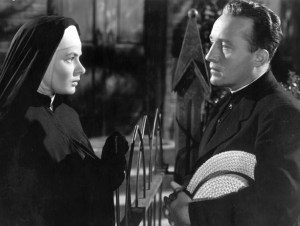
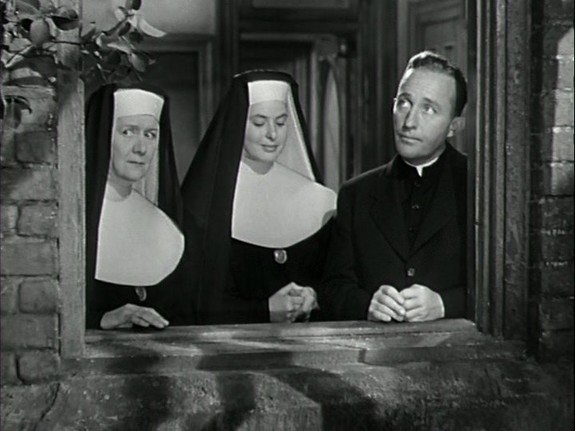
Father ‘Chuck’ O’Malley (Bing Crosby) was first seen in Leo McCarey’s 1944 hit Going My Way and is reintroduced here – wearing his straw boater on a jaunty angle – arriving at St. Mary’s in order to help Sister Superior Mary Benedict (Ingrid Bergman). She, who is fighting to keep the Parochial school open and out of local businessman Horace P. Bogardus’ hands. Bogardus (Henry Travers) has already purchased the adjacent building to St. Mary’s but is determined to secure the school grounds for his parking lot.

In the beginning, Father and Sister clash – albeit with a twinkle of the eye and a sly smile on the face, alongside quips like: “Did anyone ever tell you, you have a dishonest face? For a Priest, I mean.” Somewhat predictably, they – the American Priest and European Nun – realise they must come together to fight a common goal. Sound familiar? Okay, so it’s not fascism per se but the film was released in December of 1945 so it’s hardly a stretch to see its themes set against the war effort.

Director McCarey had a somewhat varied career, dabbling in slapstick (Duck Soup, 1933), melodrama (Make Way For Tomorrow, 1937), screwball comedy (The Awful Truth, 1937) and romance (An Affair to Remember, 1957). He would make four Priest-led films (Going My Way…St. Mary’sMy Son John in ’53 and The Devil Never Sleeps in ’62), which for a devout Catholic is hardly surprising, but in all and especially in this film he managed to humanise both Priests and Nuns, depicting them as flawed individuals and, crooner Crosby and the radiant Bergman take Dudley Nicholls’ script and run with it.

There are no villains of this piece – Travers best known for playing angel Clarence in Capra’s It’s a Wonderful Life is probably the most antagonistic, however, manages to convey sincerity and humour all the while attempting to chuck the Sisters and their young wards out of their school. While this is the overarching plot, there are minor, almost irrelevant arcs which provide the gentle comedy and at times offer the most laughs, which go to the heart of the film and viewer alike. Like, flunking student Patsy Gallagher (Joan Carroll) who leans on Father Chuck to help her pass the school year.

Patsy is left at St. Mary’s while her mother Mary (Martha Sleeper) weighs up giving caddish pianist Joe (William Gargan) – who left her pregnant and alone – another chance. Or, bullied Eddie Breen (Richard Tyler) who has been “turning the other cheek” as per Sister Superior’s advice until she decides to teach him, in one memorable and hilarious scene, to box. Even when Chuck and Mary Benedict do have a difference of opinion, it is all decidedly good natured.

It is these threads, and elements within the mise-en-scène, which show the passing of time as the seasons change and the school year progresses, culminating in the most adorable Nativity performance, in the history of Nativities. McCarey was all about improvisation and naturalism in his actors’ performances, and it is no more apparent than in the recreation of “Jesus’s birthday”. It was reportedly shot in just one take with the children encouraged to ignore the camera and crew, and approach their material as they saw fit.

This is an aspect of McCarey’s work ethic which admirer Yasujirō Ozu emulated in Tokyo Story – the 1953 retelling of Make Way For Tomorrow. It is a characteristic which make this film so utterly charming. There are of course – given Crosby’s presence – musical numbers, courtesy of composer Robert Emmett Dolan, such as the delightful “Aren’t You Glad You’re You?” and even Bergman stretches her vocal chords in her native Swedish for “Varvindar Friska” (Spring Breezes) and while musicals are not everybody’s cup of tea (I know, who doesn’t love a bit of Bing?) there are ample numbers to enhance the narrative yet few enough not to put people off completely.

Drill deeper and there are interesting depictions of the gendered approach to conflict which one may argue are outdated, however, some still ring true even today. Yes, it may offer an idealised, even sweet depiction of Catholic schooling but this assertion of patriarchal power is more than still relative especially in the institution of the Roman Catholic Church, and indeed, as discussed by Revd Steve Nolan’s analysis in the disc extras – the notion of paternalism. Made obvious in the way Dr. McKay (Rhys Williams) decides to withhold vital information of and from a (female) patient but discusses freely with ‘a man of the cloth’.

Although not necessarily a Christmas film, you can do a whole lot worse than including this film on your festive watchlist (if not before). It’s the perfect addition containing humour, charm and sincerity, and one which warms the cockles in much the same way as The Shop Around the Corner or Remember the Night. It may not be regarded as McCarey’s most cinematically satisfying film but its popularity is evident and understandable.

The performances are natural, subtle and nuanced especially Bergman who was rarely seen onscreen less than glamorous, and was loaned by David O. Selznick as part of a deal he struck with McCarey. Here she shines, quite literally, from the glow of her unmade-up face to the luminosity of her smile and the clever use of lighting which flawlessly renders her, hitting the eyes perfectly within her wimple. Made all the more noticeable here thanks Paramount’s restoration process which still contains some grain but which creates a beautiful monochromatic sheen to each frame, set within a 1:37:1 aspect ratio.

The Bells of St. Mary’s will charm your socks off – and it’s a well-known fact that this writer watches it every Christmas Eve without fail. It just ain’t Noël without that little boy, Bobby (Dolan Jr), knocking on a curtain introducing himself in one breath, “This is Mary and I’m Joseph, and we came to Bethlehem to find a place to stay.”

Special Features

It’s almost a given now that if it’s an Arrow Films release, the Academy label in this instance, there are always a few extras to enjoy after the credits have rolled… and only then.

Up to His Neck in Nuns (22 mins) – This visual essay by David Cairns is entertaining and informative as the writer dips into Leo McCarey’s filmmaking history, his early life, Catholicism and heavy drinking. It switches from film clips, stills, photos, archival interview quotes, and Cairns’ lovely Scottish lilt ensures it’s never boring.

Analysing O’Malley (19:48) – This appreciation by the Chaplain of Princess Alice Hospice, film academic, and author of Film, Lacan and the subject of Religions: A Psychoanalytic Approach to Religious Film Analysis, Revd Dr. Steve Nolan is a little dry in comparison to the previous essay. Nolan sits to the right of the frame and narrates; reading an essay from an autocue. It’s a fascinating analysis but one which would have worked just as well as a commentary (surprisingly lacking here).

You Change the World (32:07) – This short religious propaganda film was shot by Director McCarey in 1949 and features appearances by Bing Crosby, Bob Hope, Irene Dunne, William Holden, Loretta Young, and Jack Benny – all regarded at the time as ‘super Catholics’. It’s arguably some of the best acting any of them have ever done, and they’re playing themselves! It’s preachy, condescending, cringeworthy hypocrisy at its finest (and I say this as a Catholic). The purpose of the film was to persuade “good, decent, normal people” to join The Christophers. I stopped counting how often “The Declaration of Independence” is mentioned when I reached ten.

Two Screen Guild Theater Radio Adaptations: One from August 26th, 1946 (29:52) and the other recorded October 6th, 1947 (28:59). Both star Bing Crosby and Ingrid Bergman reprising their roles as Fr. Chuck O’Malley and Sister Superior Mary Benedict. The radio programmes are played over a slide show of film stills.

Musical Score Featurette produced by RKO Radio (22:28) – This was made to promote the film’s original release in December 1945, and is played over the same film stills as the radio adaptations.

Theatrical Trailer (1:51) – A perfect way to compare the film against this trailer and see the amount of work that has gone into the restoration process.

Image Gallery – This is slideshow of 35 images. There are gorgeous chiaroscuro snaps, candids, as well as magazine covers, set images and colour posters.

First pressing only: Fully illustrated booklet containing new writing on the film by Ronald Bergen.

Reversible sleeve featuring original and newly commissioned artwork by Jennifer Dionisio.

Categories
film review

A Man Called Ove (Dir. Hannes Holm, 2015)

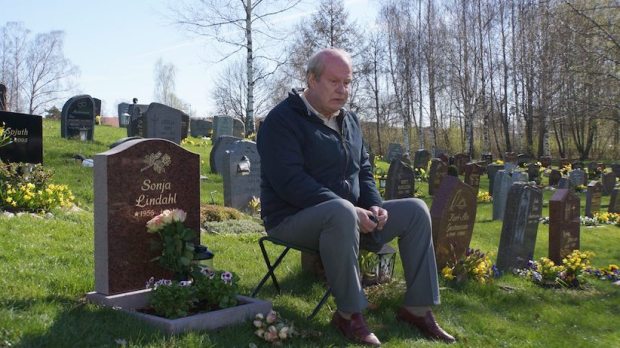
Time is a curious thing. Ove Lindahl (played respectively by Viktor Baagøe, Filip Berg and, of course, Rolf Lassgård) is a particularly cantankerous curmudgeon. Everybody is an idiot whose existences only serve to inconvenience him and his. He has worked the same job for 43 years, until two babyfaced executives take away his livelihood and present him with a gardening shovel as a token of service. Ove makes his rounds following his enforced retirement – he’s the worst (best) kind of neighbourhood watch in which he keeps his small Swedish community safe with his often impolite reinforcement of the block association rules. After his short walk, he puts on his best blue suit, empties the fridge, cancels his phone contract and attempts to hang himself in his living room, only to be interrupted by a crash outside his window. New neighbours: heavily-pregnant Parvaneh (Bahar Pars), Patrick (Tobias Almborg) and their girls, Sepideh (Nelly Jamarani) and Nasanin (Zozan Akgün) have moved in and they’re far from quiet. And so, Ove is coaxed back to giving life another go (until his next attempt) by the delightfully feisty Parvaneh, her family and his neighbours who – despite the grump’s failure to notice – actually like having him around.

Grief is a strange thing. Putting one foot in front of the other until your time is up and you can see your loved ones again (if you believe in that kind of thing). For Ove, living for those six months following his wife’s Sonja’s (Ida Engvøll) death is intolerable. It’s the one aspect which immediately warms the viewer to the largely unsympathetic moaning git. We can relate and as we get to know Ove through a series of flashbacks over the 120 plus minutes, there’s a very human reason for the doom, gloom, and defensive booming voice, and that’s testament to Rolf Lassgård’s performance. The one-time Wallander and veteran of Swedish film and TV brings a gentility and resolute grace to the character albeit in a slightly bad-tempered way. Despite being the same age as Ove at the time of filming, he underwent a bit of a physical transformation via prosthetics which age him greatly. This adds an additional layer of melancholy; this is a man who has had a hard life. Yet, he has such an old fashioned clarity of belief and a sense of morals, duty and unnerving conviction about how the world should be that one can’t help but admire him.

Love is a strange thing. It often takes you by surprise, and family comes in many forms and guises. A Man Called Ove is a heart-warming meditation on love, loss, family and life, and learning to follow and then disregard the rules. It reminds us the importance of community and the inclusion of the aged, experiencing joy alongside tragedy amid the blue, grey and beige phases of life. Oh, and that friendships can be forged and broken upon the type of car you drive. Hannes Holm’s adaptation of Fredrik’s Backman’s bestselling novel is warm, touching and moving. It treads a measured line between humour and sorrow and does so extremely well given how maudlin a film containing failed suicide attempts could’ve been. Instead, its regal music including triumphant strings does a really lovely job at elevating its purpose, and making a colourful, sweet and life-affirming film.

Categories
Blu-ray film review

My Life as a Dog (Dir. Lasse Hallström, 1985)

Lasse Hallström seems to have an affinity with pups, recently in cinemas with A Dog’s Purpose and before that, there was the utterly heartbreaking Hachi: A Dog’s Tale (2009). It all began, however, with his first feature 1985’s My Life as a Dog (Mitt liv som hund) which has now been transferred from original film to High Definition Blu-ray by Arrow Academy.

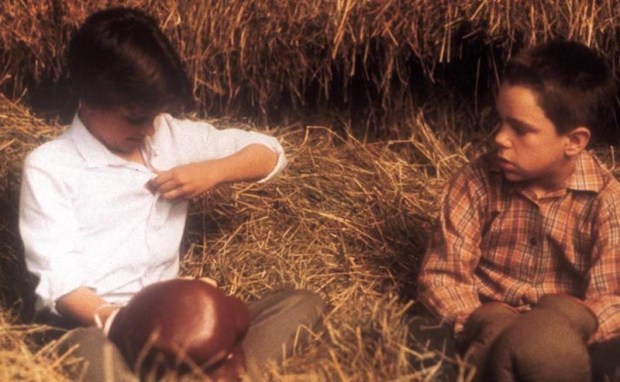
Based on Reidar Jönsson’s autobiographical novel, the film is set in late fifties Sweden and centres upon Ingemar (Anton Glanzelius); a gentle soul, if a little eccentric. He’s ‘married’ to a local girl (by cutting his thumb and having her suck the blood), gets his penis stuck in a bottle during a sex education class, and displays a slight tremor when drinking. Ingemar is twelve. He’s also attempting to live life as normally as possible while his terminally ill mother (Anki Lidén) screams bloody murder at her two sons, and fades slowly awaiting her final days.

Ingemar likens himself to Laika – the Soviet dog that was sent up into space, launched on a one-way trip aboard Sputnik 2, and ultimately left to die. Big feelings for a child who’s convinced things could be worse and one day he’ll be happy as he is packed off to spend the summer with Uncle Gunnar (Tomas von Brömssen) and Aunt Ulla (Kicki Rundgren), and the wonderfully unconventional cast of characters who inhabit Småland. There’s Manne (Jan-Philip Hollström), the boy with green hair, Saga (Melinda Kinnaman) the girl obsessed with boxing and football whose burgeoning breasts are tightly bound so she can stay on the team. Ailing Mr Arvidsson (Didrik Gustavsson) who lives in the basement of Gunnar’s house and likes to be read the lingerie catalogue, in order to silence the persistent roof-hammering of Fransson (Magnus Rask). He’s convinced the noisy neighbour wants to finish him off via the knock-knock-knocking of the metal head against wood. Even Uncle Gunnar with his cleavage obsession and his old vinyl copy of ‘I’ve Got a Lovely Bunch of Coconuts’ (which he plays on repeat) is a tad awkward and sweetly peculiar.

Regardless of their character traits there’s warmth and sincerity and real affection for our young protagonist despite being left at kennel after kennel, never completely wanted by anybody. It’s a remarkable performance by Anton Glanzelius) whose range, sensitivity and affecting depth belies his age and impish grin. While not as dark a piece as Cría Cuervos (1976), it does deal with a lot of the same issues and rests on the young shoulders of its lead(s), as the loss of innocence hits profoundly and they find themselves thrust somewhat prematurely into adulthood. Cinema Paradiso (1988) would follow – and would nicely round off this highly recommended triple-bill – even the US-produced October Sky (1999), clearly took some of its cues and hues from this Academy Award nominated Swedish film.

Hallström has made many pictures since 1985 and there has always been a gentility to his oeuvre, whether he’s dealing with ABBA, cider, chocolate, or Grapes and this bittersweet film extolling the virtues of rural communities and growing pains is no different. This is a warm, whimsical, funny and moving tale of a boy and his search for family; a place he can call home. Canines aside, My Life as a Dog is Lasse’s masterpiece.