Categories
film review

Tranny Fag (Dir. Kiko Goifman and Claudia Priscilla, 2018)

In the traditional Portuguese Tranny Fag translates as Bixa Travesty, a little less confrontational than the English but that’s just not the style of the documentary’s subject Linn da Quebrada – the self proclaimed “tranny fag”. Residing on the outskirts of São Paulo, she is marginalised economically before even considering the fact that she’s black and transgender, struggling to exist amid poverty and in a world that, for the most part, doesn’t comprehend her.

Rather than shy away from the public eye, Quebrada is taking the Brazilian funk scene by storm, alongside her partner-in-crime Jup do Bairro. Their songs – (performed throughout) providing a back story of sorts for the 27-year-old – contain abrasive coarse lyrics which pull no punches and berate society and the expectations it places on women, what it means to be a woman like her, and dismantling the patriarchy one bridge and chorus at a time. Her words are a weapon intent on holding the world accountable and paving a way of acceptance and understanding without inciting hatred.

As a subject, the singer-songwriter and spoken word artist is fascinating and inspiring. She’s pre-op and has yet to start hormones, consider breast implants or remove her facial hair because as far as she’s concerned she’d be pandering to society’s ideal of womanhood. Quebrada – who also co-wrote the script with directors Claudia Priscilla and Kiko Goifman – is a “black fag doll. Neither man or woman” embraces nudity, here and in her stage shows as an attempt to undermine, even recondition the collective mindset associating gender with genitalia and highlighting the façade of gender performance.
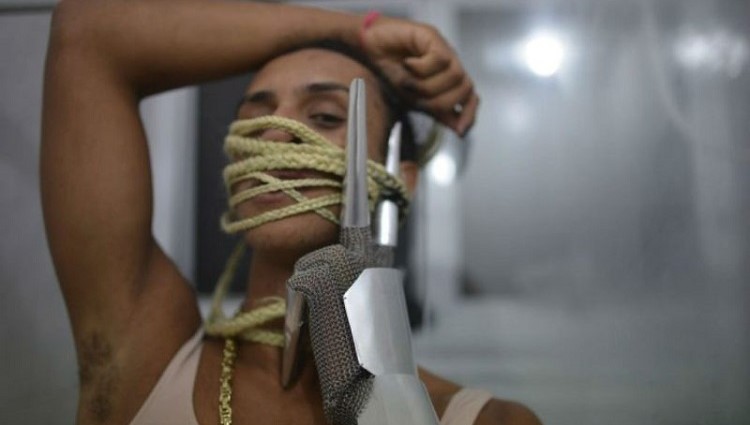
A real turning point in the documentary which jumps from talking head to music gig almost exclusively is the footage made during Quebrada’s treatment for testicular cancer, the physical effects and the profundity it had on the way she controlled her body. The scene which shows her literally pulling the lustrous locks of hair from her head, chemotherapy having ravaged her immune system is particularly powerful and in keeping with her persona, completely transgressive. This and the scenes with her mother offer a rare intimacy which is needed in an otherwise repetitive and prosaic documentary. The static camera and simplistic editing coupled with the pulsating combative stage performances start to feel isolating.

Tranny Fag is a LGBTQIA+ positive, important and transgressive, if slight, profile of a bold and beautiful artist who is unapologetically her confident self. She espouses her ideas and beliefs provocatively, is always interesting, and determined to not only stand out but belong in an accepting world.
Categories
film review

Whitney: Can I Be Me (Dir. Nick Broomfield, 2017)

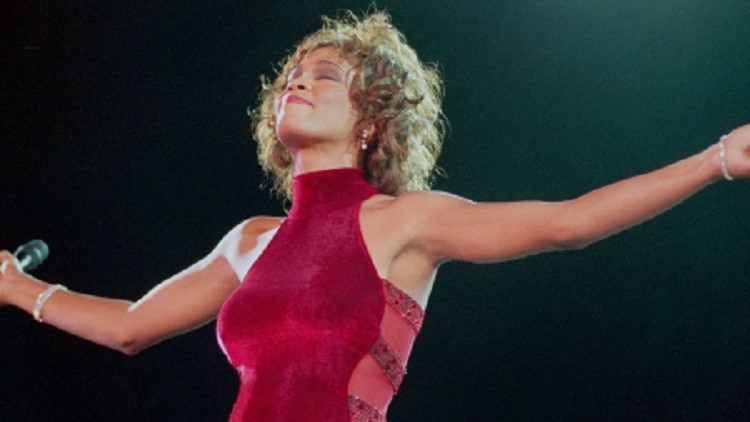
Can I Be Me‘s opening scenes take place on February 11th 2012 and we can hear the 911 dispatch call which was recorded on the night Whitney Houston, known as ‘Nippy’ to her family and friends, died alone aged 48. While there were dangerous levels of drugs found in her system, one of Whitney’s back-up singers tells us plainly, “She died of a broken heart.”

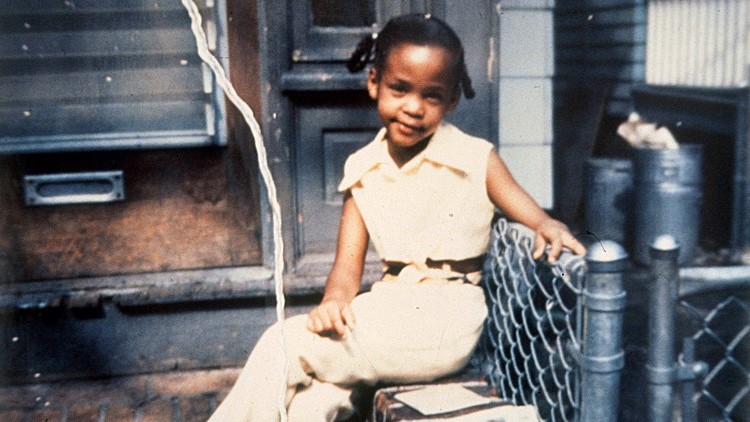
Whitney Elizabeth Houston was born in New Jersey on August 9th, 1963. Daughter of John and Cissy, and younger sister of Gary and Michael. Cissy would guide her, John would influence her and her brothers would provide the company when they did drugs together. Clive Davis would take her under his wing at 19 and create a pop icon – the best-selling black female vocalist since Aretha and Dionne (Warwick, who also happened to be a relative), and one who, according to Davis, would translate to a white audience.

Her debut album Whitney Houston sold 25 million copies. By 1988, the African American community felt she had sold out, her music had been ‘whitened’ and she was booed at the Soul Train Music Awards that same year (and the year after). Some say she never quite recovered from the rejection and she began seeing the “bad boy of R’n’B” Bobby Brown as, some have suggested, retaliation. They would later marry and the rest, as they say, is history. Well, not quite.

Footage takes us back to 1999 and the world tour Houston struggled to complete. The tour which would change the course of her career and, ultimately, her life. Combining home videos, archival footage and audio interviews,  Nick Broomfield and Rudi Dolezal’s documentary is revealing without disrespect or exploitative intent; a frank portrait of a beloved and troubled artist. Nor does it shy away from the drug consumption, from teenage recreation, through the accidental overdoses, to the day it claimed her. This in itself addresses the level of apportioned blame aimed at Brown by the media.

Their relationship was tumultuous to say the least, however, home videos depict a happy, loving couple with a similar goofy sense of humour while reality suggests there were three people in they marriage; Bobby, Whitney and Robyn Crawford. Crawford was Houston’s best friend and rumoured lover – Brown confirmed his wife’s bisexuality in his memoir – and from the footage depicted in this documentary, Brown and Crawford loathed each other. He appeared to be emasculated by her while she watched their competitive marriage hinge itself on drugs and alcohol; and yet both vied for Whitney’s love and attention. The real tragedy would be Bobby Kristina (March 4th 1993 – July 26th 2015), and this film is scathing in her parents’ neglect. Poor kid.

The situation reached breaking point when Houston’s bodyguard David Roberts compiled several reports on the singer’s habits and addictions, and his fears. He asked for help; an intervention but these pleas fell largely on deaf ears. How can you save somebody who doesn’t want to be saved? He maintains that all are responsible for Houston’s premature death. There are so many what-ifs offered up: if she had grown up in a less fiercely religious household… had she never touched drugs in the first place… had her father not claimed she owed him and sued her for $100 million. The biggest caveat of all is had she been able to live and love Robyn as she wanted, would she still be alive? Bobby Brown seems to think so but we are only offered this quote via an intertitle. He, Cissy, and Robyn are never interviewed by the filmmakers and thus it, along with Houston’s bisexuality, remains conjecture. 

Can I Be Me is a candid, fascinating and heart-breaking documentary detailing – albeit within a very small window of time – the true toxic tragedy of fame and the toll of addiction, as is often the case of the truly gifted. Perhaps all of those around Whitney were in some way complicit in her destructive downfall but she was an addict, trapped within a brilliant, beautiful and troubled singer who only ever wanted to be herself, and sing. ‘Nippy’ changed the music industry and while some may have made their disapproval known once upon a time, she paved the way for the Mariahs, Beyoncés, Rihannas, and Leonas of this world, and a whole host of artists besides.

Where do broken hearts go – can they find their way home? In the case of this one, let’s hope so.

Categories
Blu-ray film review

Grey Gardens (Dir. Albert and David Maysles, Ellen Hovde and Muffie Meyer, 1976)

The mother/daughter relationship is a profound one and not often placed under the microscope. In 1976, two filmmaker brothers Albert and David Maysles (co-directed by Ellen Hovde and Muffie Meyer) chose to do just that with their documentary, Grey Gardens, which the Criterion Collection restored a few years back, and released on Blu-ray for the first time in the UK.

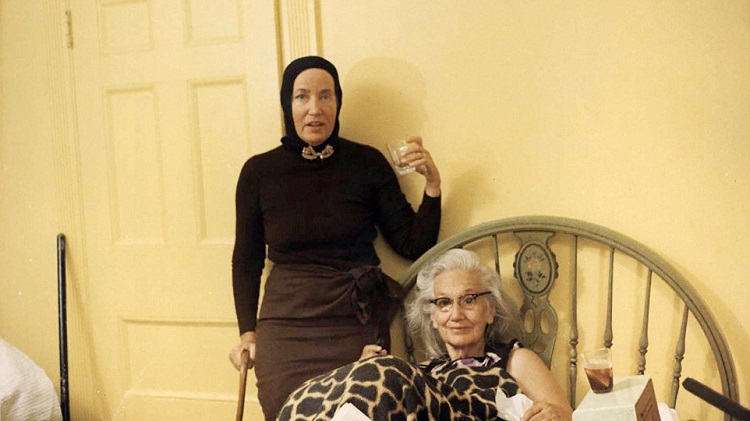
The Grey Gardens of the title is a 14-room house in the Georgica Pond neighbourhood of East Hampton, owned by Edith Ewing Bouvier Beale and her then-husband Phelan. Upon divorce, Phelan provided his wife, Big Edie and their daughter Little Edie with living costs. Once those funds had dried up, the house fell into disrepair and in ’72 the Suffolk County attempted to evict the two women and demolish the property. The press’ interest lay in whom the Beale’s were related to, one-time First Lady, Jacqueline Bouvier Kennedy.

Like with all documentaries, there is a level of manipulation, almost certainly, voyeurism and a vested interest in the subjects viewed. This is one of the few that appears to have no ulterior motive other than depicting Big Edie and Little Edie just as they are/were. It is a wonderfully weird piece of work; a character study of almost morbid fascination about privilege, crumbling Patriotism, and those two extraordinary women who thrived amongst reclusive squalor and the crumbling detritus of their lives.

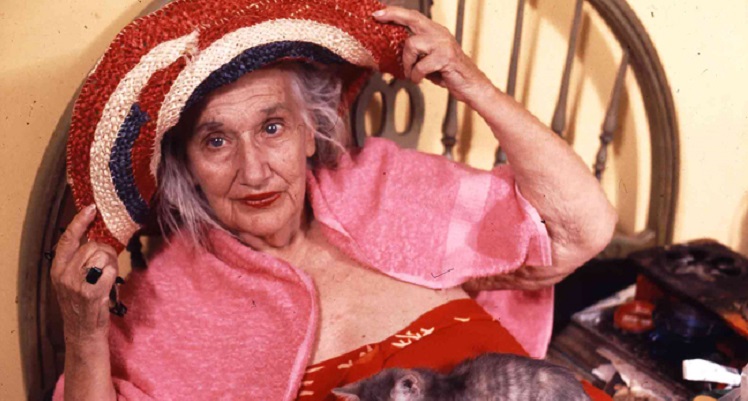
There is a home-video quality to Grey Gardens which although beautifully restored still contains a graininess which adds to its authenticity and intimacy. Often filmed outside, the natural lighting means that colours within the frame are stunning as Little Edie takes centre stage in her colourful ensembles and jewellery adorned headscarves. At times, it is hard to avert one’s eyes from what is onscreen, their eccentricities are, initially, hard to comprehend but both women have such warmth and veracity that the audience is soon taken in. One of the most beautiful aspects of the film is the lack of narrative time – the only indication is the dilapidated wall within the large expanse of foyer in the house and the noticeable hole in the wall gets bigger as the raccoon they share the house with (along with some 52 feral cats) makes itself a home.

Observing these two amazing women are the Maysles brothers who strike up such a seemingly genuine rapport with our main ‘characters’ that it is truly a joy to experience. In one of the disc extras, within the confines of the
scrapbook, it is stated that: “A few years ago, two brothers fell in love with a mother and her daughter.” Thanks to Criterion’s 4K restoration of the original negative we get to experience this visually beautiful love story first hand, sound quality is sublime and the mono track reproduces Little Edie and her mater’s dulcet singing voice to perfection.

Grey Gardens shows us a tender, loving and, at times argumentative, mother-daughter relationship; full of ups and downs and yet their commitment to each other and their way of life never faltered. Both are unapologetically wonderful and weird in equal measure. We should all embrace a Little Edie.

Categories
film review

Almost Heaven (Dir. Carol Salter, 2017)

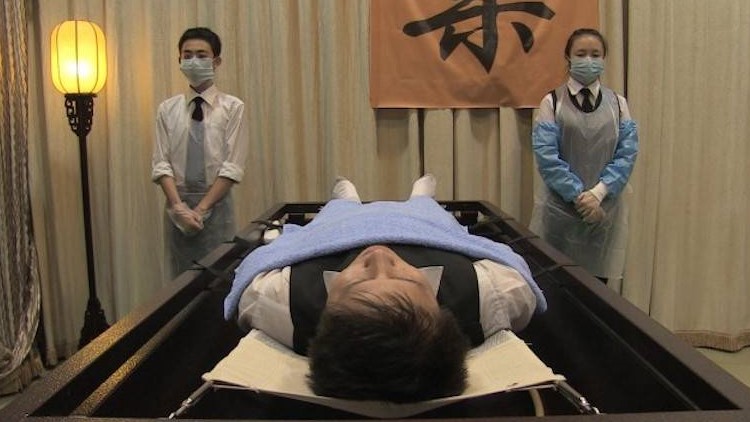
Nominated for Best Documentary at the 67th Berlin Film Festival, Carol Salter’s feature debut welcomes us with an intertitle. “In China, job opportunities are limited for teenagers.” This is then followed with multiple shots of vast, wide open corridors, silent doorways and car parks before being interrupted by an interaction between two extremely young co-workers discussing mosquito bites. It is then that we realise that these stiflingly quiet and desolate surroundings belong to a funeral home.

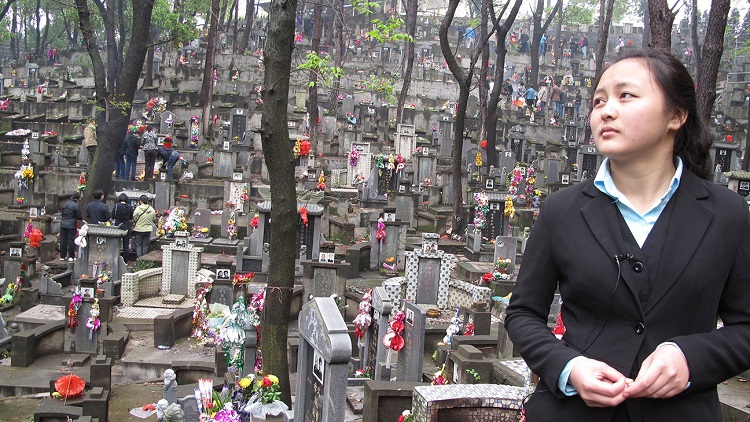
17-year-old Ying Ling works at the Ming Yang Mountain Funeral Home, far from home, at which cadavers arrive and depart via a hydraulic lift in the car park. In order to pass her exams and progress within the company, she must learn how to prep and cleanse a body before it can be viewed by a grieving family. One could argue a harrowing prospect for a such a sweet and young girl, one who is afraid of ghosts, made all the more understandable given the nature of the job and the eerie labyrinthine place of work.

Juxtaposing these expanses of space with tight close-ups of the frequently worried expression on her subject’s face, Salter elicits a shared social and psychological space. We watch as this kid – who observes everything, works 24-hour shifts, and whose cruel mother refuses to let her return home even for winter clothes – as she advances in her career whereby one day she is charged with keeping the plant life alive, before death becomes her one and only daily job. Refreshingly, these teenagers don’t see their future in the dead and yet by the documentary’s denouement, this is exactly where Ying Ling’s colleague Jin Hua finds his business.

Their friendship is an uplifting aspect of an otherwise uneasy watch, although humour does punctuate the documentary throughout. It needs to. Ying Ling and Jin Hua do everything together – live, eat, laugh, share days off, prepare the dead, and the affection between them is sweetly endearing; it rivals siblinghood yet teeters on something more. Jin Hia is Ying Ling’s beacon, her little piece of heaven amid the depressing, mosquito-pestered mortuary.

As for the funeral home itself, it’s ran as mostly highly efficient businesses are; preoccupied with making money, receiving cash and occasionally berating its staff. There’s a coldness to it, perpetuated by the long takes and the silence, and while respect is paid to the dearly departed, the same can’t be said for the living as money disputes rear their ugly heads during the most unfortunate moments.

What follows the second half is a number of harrowing scenes in which blood violently stains some sheets and shrouds and we, along with, Ying Ling, are confronted with the visceral horror of death and the wailing sorrow and melancholy of grief. While Salter’s camera stays on the periphery of those scenes, and can never be accused of being disrespectful, it nevertheless feels intrusive. Grief and mourning is such a private experience, having a camera record these moments feels almost voyeuristic in their candidness.

That said, it never strays into being overtly maudlin. Almost Heaven is an observational coming-of-age documentary where childhood is slowly diminished (in 75 short minutes) by approaching adulthood, and life and death is played out quite literally between takes. It is a gentile rumination on migratory workers, a reflection of life, death, and all the things in between.

Categories
film review

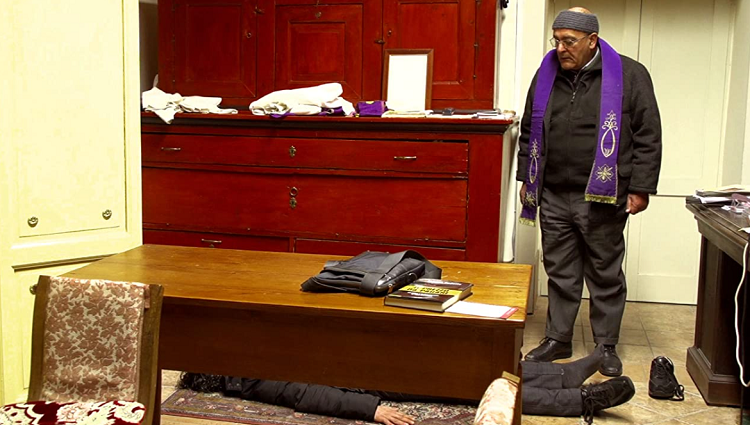
Deliver Us (Dir. Federica Di Giacomo, 2016)

Cinematically, films featuring possession and the subsequent exorcism are ten-a-penny yet Federica Di Giacomo’s award-winning documentary Deliver Us [Liberami] deems to show how the ancient ritual is performed in a contemporary world. In the opening scene, which is chilling, a woman sits with her back to camera as a Priest anoints her with holy water. After he places his vestments on her head she wails and screams for the “bastard” to leave her alone and an almost secondary voice chuckles “she’s mine now.” Even if you stumbled across this documentary with little to no knowledge, it’s safe to say, this incapsulates the subject matter succinctly and effectively.

Father Cataldo Migliazzo is a sought-after Priest (and exorcist) in Palermo, people travel 150-200 km to attend his tiny Church and receive a blessing. Disturbingly, a lot seem to think they’re possessed – a child who refuses to go to school has parents who believe “a devil is inside of him”. A woman begins to cough and have, what appears to be, a panic attack and is taken into confession and, delivered from evil, and this is all before mass even begins. When it does, the “possessed” within the congregation hiss, spit and speak in tongues.

There is little doubt to these people’s beliefs, yet as they discuss what symptoms they present with, it becomes apparent that a lot can be explained away via human biology or medical tests. These vary from swearing, masturbation, seizures, drug addiction and depression to memories of child abuse. One even lists cervical pains, dizziness and exhaustion, another an unhappy marriage while one mentions schizophrenic episodes, and what could be epilepsy in a teenage girl. Yet, at no point are they directed to a medical professional – in shepherding their flock you would think that there is a duty of care. This is made all the more ridiculous (and hypocritical) when we see Cataldo’s medication spread across a table top for various ailments, right after he exorcises by telephone no less.

Unsurprisingly, almost all of those exhibiting signs of oppression are women. The patriarchal domination and control of women within the Catholic Church has almost become sacrosanct and this unspoken insinuation that women are weaker and the only ones susceptible to mental health issues leaves a bad taste in the mouth. Made all the more galling by a Father Carmine who tells a recently exorcised woman to laugh more, so to prevent another episode of oppression.

While Di Giacomo brings a neutrality to proceeding, there’s little judgement one way or the other and her film never strays into questioning faith or belief, there’s humour without ridicule and a melancholy as we follow these lost souls desperate to “cure” themselves. It is all too easy to condemn what is not understood, as ancient tradition and modern habits collide, which further plays on unnerving fear and delusion; the sacred and the profane, psychic and spiritual, disturbing and ludicrous.

However, it is in those last closing statistics which turns the fascinating (and somewhat infuriating) Liberami into a real-life horror – the increase of Priests who are now qualified to perform exorcisms within Dioceses across the world is staggering, and the indication that these numbers will continue to grow is absolutely terrifying. Federica Di Giacomo has produced a a stark work which fuses real-life with the absurd, proves that reality is more far more powerful than fiction, and leaves you with hope that all those lost souls are delivered from whatever ails them.