Categories
Film Festival film review

Housewife of the Year (Dir. Ciarán Cassidy, 2024)

This documentary opens with a citation of article 41.12 of the Irish Constitution in which it states that no mothers will be “obliged by economic necessity to engage in labour to the neglect of their duties in the home.” The marriage bar would remain until 1973 three years after second-wave feminism hit Ireland. Preceding both, in 1968, was the launch of the annual contest Housewife of the Year.

Described as a “friendly competition”, women across Ireland would be judged on how effectively they budgeted and prepared meals. As well as their sense of humour, appearance, personality, sincerity, and civic mindedness – think Miss World sans swimwear segment. It would be televised from 1982 with beloved broadcaster Gay Byrne (1934-2019) as host with the winner getting £300 in cash along with £300 in white goods, usually a “beautiful cooker.”

Director Ciarán Cassidy uses the backdrop of this derisive, surreal and sexist competition to interrogate the role of women in Irish society over the years. There is mention of the Magdalene Laundries, the Catholic doctrine and rigidity surrounding contraception, poverty, the Ann Lovett tragedy of 1984, the Divorce Referendum of 1986 (which was eventually overturned in 1995). Yet, the real meat on the bones is the present day interviews with some of the contestants (and winners).

These extraordinary women – Margaret, Ena, Ann, Sally, Patricia, Miriam, Ellen, Bernie and Philomena – and their stories are fascinating and kind of shattering in equal measure. Their lack of choice and how they adhered to a life of wife and mother, their confinements lasting far beyond the forty weeks of pregnancy. Interned not only in the marriage itself but many quite literally pregnant for decades. Ann was married at 20 years old and by 31 had thirteen children (including four sets of twins). Patricia had to juggle her housework, child-rearing and fulfil her duties as a postal worker when her husband fell ill and unable to work. Miriam sacrificed her career as a Nurse in London just as soon as she uttered her vows, while Bernie was petrified that she’d be found out, her eldest child’s illegitimacy exposed, that her subsequent marriage and further five children would render her disqualified.

On the surface, Cassidy’s film questions the conformity perhaps just not quite as much as the women themselves. Many lament that the decisions made for them, this lack of choice was ridiculous but yet, somewhat paradoxically, credit the competition with giving them the confidence and self-esteem to speak up and question if there was more to life than what was expected of them. Or, in the case of Ellen, the impetus to survive when her husband walked out on her.

Housewife of the Year does not reinvent the wheel in terms of documentary style, combining a lot of talking head interviews with archival footage, however, it is beautifully edited by Cara Holmes and having the former contestants introduced via a spotlight on stage is a lovely touch. It leans heavily into nostalgia, is always sympathetic but never delves too deeply or rages quite hard enough, in the way that many an audience member will upon viewing. While it is pretty wonderful that these women are here to tell their tales, it is always at the forefront of your mind that many, many more are not. Women and girls abandoned by blatant misogyny and a deplorable system, which would have sooner seen them dead than accept a teenage pregnancy or fill a prescription for a diaphragm (without a court case). Not so far removed from where the USA is headed today.

During its run, the contest gave face to a generation of women who in spite of it all kept going and while the State endeavoured to make them second-class citizens, it was their resilience which ensured that, eventually, they would endeavour to make the State work for them. That they could achieve something, there was possibility in the future and change would come. Eventually.

Housewife of the Year plays this year’s Irish Film Festival, London which runs from 13-17 November.

Categories
Film Festival film review

Apples (Dir. Christos Nikou, 2020)

We are introduced to the nameless protagonist of Apples [Mila], played by Aris Servetalis, in his apartment, through a series of cuts (or polaroid snapshots) restlessly listening to the radio…staring impassively into space… banging his head against the doorframe before venturing out to buy the flowers himself much like the eponymous Mrs. Dalloway. Though there is no party in sight for Aris as he wanders aimlessly through the city and eventually falls fast asleep on a bus taking him from A to B. When the driver awakens him, Aris doesn’t recall where he should have alighted, his name or where he lives – his lack of identification only confirms it and he is packed off in an ambulance to the Disturbed Memory Department of the Neurological Hospital for evaluation.

From there, he is assigned a number (14842) and afforded a new life as an amnesiac. Sudden onset amnesia is not seen as unusual as the seemingly irreversible epidemic sweeps across a modern, yet strangely analogue Athens, with neither sight nor sound of a mobile device. All amnesiacs (at least those not claimed by family members) are given tape recorders and polaroid cameras. The cassette tapes containing prompts of how to manage their “new beginnings” and the cameras are to snap proof of how they spent their days; photos stored in albums for posterity.

Christos Nikou served as Yorgos Lanthimos’ AD on Dogtooth and it initially shows. His film – based on a screenplay he co-wrote with Stavros Raptis – does fit within the so-called Greek Weird Wave in which filmmakers and writers such as the likes of Panos H. Kontras, Lanthimos, Athina Rachel Angari, and Efthymis Filippou have given us some brilliantly strange pieces of work that have painted a unique, often ideological, versions of Greek society. Yet, while his predecessors liked the darker, mordant aspects of life, Nikou’s film is far more heartfelt and poignant.

Aris throughout plays it deadpan even when he meets fellow new beginner Anna (Sofia Georgovassili) and as he chomps his way through, roughly, an orchard. Servetalis is a combination of Daniel Day-Lewis and Buster Keaton, the line between bizarre and funny grows increasingly blurry as the film progresses, as to the linearity of the whole thing is anybody’s guess. The 4:3 aspect ratio harks back to the silent era and helps to further detach from reality – although the whole Athens-epidemic-as-narrative-device strikes close to home as we, like Aris, find a new weird normal – in our case remembering to smile with our eyes beneath the material which covers the rest of our face.

The film is a very quiet and wry allegory with several laugh-out-loud moments involving a Batman, and even a nod to an Outcast lyric. Its use of colour is gorgeous, the daylight palette tends to be muddy blues, greys and muted greens while the nights tend to be oranges and ochres much like the innards of a mouldy apple. The use of music is astute with all feeding into the theme of memory and remembrance: “Scarborough Fair”, “Seal It With A Kiss”, and “Let’s Twist Again” (although, this arguably has a dual meaning) – tenuous it may be but even “Ave Maria” mentions fruit!

Apples is a brilliant and absurdist rumination on loss, memory, identity and human connection. It ponders selective memory – the want to forget what’s in the memory bank, the fight to remember by heart and if there’s a difference, and what the hell did we do before the smart phone and documenting our days.

Apples will be available exclusively on Curzon Home Cinema from Friday 7th May.

Categories
film review

The Perfect Candidate (Dir. Haifaa Al Mansour, 2019)

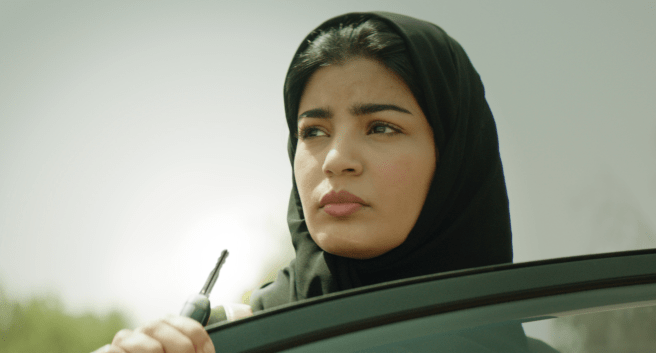
In 2017, the ban preventing Saudi women from driving was lifted and licenses were issued on the 24th June 2018. That same year Haifaa Al Mansour began production on her fourth film The Perfect Candidate (المرشح المثالي). It is no accident that Dr. Maryam Alsafan (Mila Al-Zahrani) drives, immediately placing the film in context and telling us something about the lead protagonist. Just as Wadjda’s (2012) coveted bike was bright green, Maryam’s car is a deep petrol blue in a sea of dirty white dusty vehicles.

The good doctor wears a niqab to drive and leaves it on when doing her rounds in the hospital. There, she has to contend with sick (male) patients shouting their dissent at being examined by a woman, making a difficult job ever harder. They would rather seek treatment from less qualified male nurses than have a woman lay her hands on them. One old man screams “Don’t look into her eyes!” a comment made even more ridiculous by the fact that her eyes are the only visible parts of her face to look at.

Maryam is what her music teacher father Abdulaziz (Khalid Abdulraheem) refers to as “a lion at home and a mouse in public” and serious. Seriously sincere about her patients and the road leading up to the hospital. A burst pipe has rendered it almost impossible for patients to reach their destination and the government refuses to fund the repair. However passionate she is, Maryam is determined not to stay at Al’hana hospital. Her ambitions lie in Riyadh, so when a networking conference taking place in Dubai presents itself, along with the promise of a job opportunity – for which she is the perfect candidate – she must attend.

A problem at the airport, however, prevents her from getting on the plane. Her paperwork has expired and she must seek a male’s signature in her father’s absence (he’s on tour with his band) before being able to travel. Maryam heads straight to her cousin, he has an office in the government and will surely help her. Upon leaving, Maryam instead finds herself heading home and running for local council.

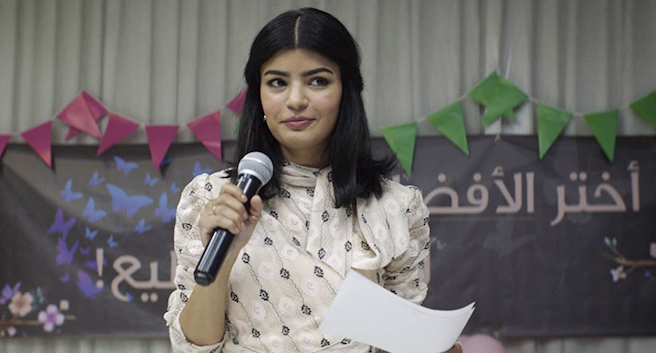
With encouragement from her sisters, Sara (Noura Al Awad) and Selma (Dhay) Maryam pulls together a campaign strategy – her main objective being the road repair, which is apparently not usually high-up on a woman’s list of priorities (we prefer flowers and children-based subjects). While fundraising activities welcome a large body of women, whether they will, or be ‘allowed’ to, vote for her remains to be seen. There’s an unexpected juxtaposing of Maryam and her father’s narrative strand – she’s finding her voice, her public lion, and he’s learning to embrace music again and sing following the death of his wife. While her father is adored for his voice and rewarded, the main goal of Maryam’s (mostly male) constituency is, unsurprisingly, shutting her up.

Maryam’s political career may end as abruptly as it begins but it’s her journey where the interest lies. Just like all the women in Al Mansour’s films – Violet (Nappily Ever After), Mary Shelley, and, of course, Wadjda – transgress societal norms in their own way, and Maryam is no different. Certainly, this film is the by-product when characters like that headstrong 12-year-old and Dr. Maryam – through their determination and intelligence – find their voice and value (beyond what they have been told) in a man’s world, navigating the choppy waters of deep-rooted misogyny and seeing land on the other side.

While a lot of The Perfect Candidate belongs to the political drama – gender politics are certainly at the heart of most films created within a place of female oppression like Saudi Arabia – this film feels more like an ode to the importance of cultural arts, perhaps even a tribute to the filmmaker’s own father, Abdul Rahman Mansour, who is a poet. Whether a conscious decision or due to her co-writer Brad Niemann’s input, the patriarch of this particular family is far gentler and more empathetic than we’re used to seeing onscreen – Maryam is never discouraged at any point by her Abi. As a result the male characters feel a lot more tangible within this narrative, with a variety of masculinities explored. It pulls from Maryam’s arc somewhat but as a result feels a little more balanced, ultimately the film begins and ends with the future. A woman. No longer hidden behind her niqab (if she so chooses).
The film’s colour palette is simple and muted save for the odd flash of tint and tone. Accompanying it, Volker Bertelmann’s string-heavy score is sweeping and rather lovely. The viola, cello and violin notes – and the oud within the diegesis – are beautifully optimistic. Even if the majority of the film doesn’t quite communicate this hope, those last scenes in the hospital certainly do. They signify a slow turning tide coming to Saudi Arabia – one petrol blue car in a sea of dirty white dusty vehicles – and with Haifaa Al Mansour at the wheel, the future of Saudi cinema is in more than capable hands.

Categories
film review

Rust and Bone (Dir. Jacques Audiard, 2012)

It is becoming increasingly difficult to approach a Jacques Audiard film without a high level of expectation, specifically, after the commercial success of his last cinematic effort, A Prophet (2009). One aspect which can be attributed to Audiard is that he knows men, or at least has the ability to write and cast them particularly well. His films have boasted memorable male protagonists played, with aplomb, by the likes of Mathieu Kassovitz (A Self Made Hero), Vincent Cassel (Read My Lips), Romain Duris (The Beat That My Heart Skipped) and of course A Prophet‘s Tahar Rahim. Rust and Bone, similarly, can also offer a critique in performative masculinity with stellar work by Matthias Schoenaerts (Bullhead). The difference here is that this film also glorifies the acting prowess of Marion Cotillard, thankfully back to La Vie en Rose (2007) and Little White Lies (2010) quality after a few, dubious, sub-standard English-speaking roles.

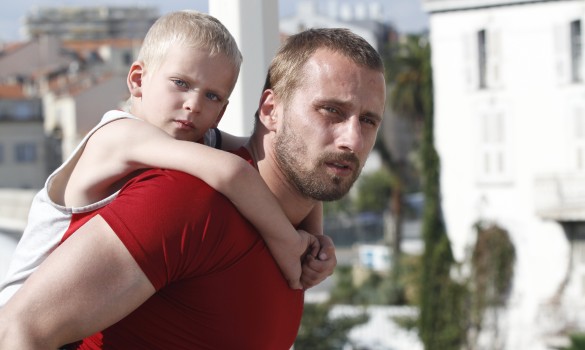
Ali (Schoenaerts) and his five-year old son Sam (Armand Verdure) drift from place to place, stealing to survive, until they leave Belgium and move to Antibes to live with his sister Anna (Corinne Masiero) and her husband Foued (Mourad Frarema). Ali begins work as a nightclub bouncer when he meets Stephanie (Cotillard) a discontent Orca trainer whose life leaves her cold. The circumstances of their chance meeting find her in the unlikely position of damsel-in-distress with Ali jeopardising his job in order to help her, however, devastating destiny reunites their respective damaged souls when Stephanie suffers a horrific accident and friendship flourishes.

This film falls into the melodramatic genre; a love story between two dislikeable, yet at times relatable, characters whose life adversity throws them together to forge remnants of a relationship. Audiard communicates, beautifully, the sheer messiness of love and delivers a dramatic narrative which remains (for the most part) unsentimental but completely empathetic. After the accident, Cotillard’s Stephanie faces life with emotional determination  and independent dignity wherever she can but it is Ali who reawakens her sexuality and desire for life. It is through these raw acts of passion that the viewer  sees Ali’s softer side.

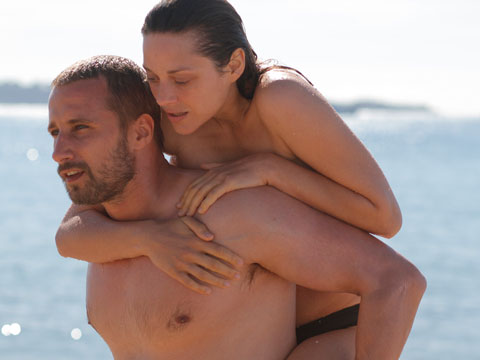
While Cotillard may be showered with acting plaudits following the film’s cinematic release, it is the male protagonist who is the most interesting to read. Ali is animalistic in his gait; father and lover are not roles that fit comfortably and when he loses his temper with Sam it is hard to empathise or identify. He is a fighter, and it is through the bare-knuckle boxing sequences that the viewer not only sees the man in his “natural” state but starts to gain an insight into Stephanie’s lust. There is, thankfully, more to him than violent outbursts, there has to be to warrant anybody loving him. It is his clumsiness, pragmatism and simplistic way of viewing the world which make him almost childlike and therefore more relatable; he is literally the tower of strength, when present, of the picture, carrying Sam and Stephanie on his shoulders.

There is a cool detachment to Rust and Bone which is, ultimately, why it is so successful as a piece of drama. Cotillard and Schoenaerts are outstanding in their respective roles and their magnetism both attracts and repels them as Stephanie and Ali. That said, there is one small criticism in relation to the end sequence, following the fade. It felt excessively sentimental, predictably unwarranted and resolutely manipulative. The emotional intensity which has the viewer captivated from the start ceases rather suddenly and, somewhat, spoils what had been leading up to be a truly accomplished piece of cinema.