Categories
Film Festival film review

Restless (Dir. Jed Hunt, 2024)

There is nothing worse than losing sleep and there is a special place in hell for anybody who comes for it and your peace of mind. This is something that Nicky (Lyndsey Marshal) quickly learns after new neighbour “Deano” (Aston McAuley) arrives in writer-director Jed Hunt’s feature debut Restless.

In an unnamed coastal town, empty-nester Nicky works practically all week in an understaffed and underfunded social care facility. Her days are, admittedly, a little banal but she – like the rest of us – relies on the small joys when she can claim them: listening to the classical music her late father insisted upon at breakfast, cooking dinner, baking to Beethoven, reading a good book and settling in on the sofa unwinding to the televised dulcet tones of Ken Doherty on the snooker (the heart wants what it wants). She lives vicariously through her teen son Liam (Declan Adamson via telephone) who is away at university. She grimaces during their latest chat when he tells her he’s off out to see an original cut of The Exorcist. Little does she know, she’ll perform her own exorcism over the next seven days.

It starts out harmless enough, just a small group unpacking a car. A blur of tracksuits and a fierce looking dog. Then the music starts, the antithesis of Rachmaninov, Vivaldi, Tchaikovsky et al, pound-pound-pounding through the walls. At first, Nicky drives to the waters edge with a pillow and gets some shut-eye before a new day dawns, bumps into Keith (Barry Ward) who invites her out for a drink later in the week (presenting her with a violin because of her love of classical music but that’s another story). He’s as sweet as he is cringeworthy. When deafening dance music keeps her awake a second and third night, she knocks next door and politely asks that Deano turn it down and is met with faux-niceties and “I got yer.” By day five, all out war has been declared as vengeance is vehemently pursued.

The performances – led so ably by Marshal – save Restless from being just another bleak kitchen-sink style British drama, it is actually something else entirely disguised as such and manages to surprise and swerve expectation. Lazy writing could have had these characters teeter and plummet into stereotype territory but a decent script by Hunt manages to always remain believable. The subject matter will be heavy for some – there is plenty of sly commentary on the state of the care and class system in Post-Brexit Britain where the sense of community (unity especially lacking) is null and void in places – and plenty triggering if you have ever lived next door to antisocial idiots who have little respect for others.

There are some memorable moments, Kate Robbins is a particular standout as Jackie who loves a fight – we all know someone like her – the cinematic flourish of the dream sequence is brilliant and the soundscape is fascinating even if the visuals can be a little on the nose at times. Nicky’s loss of reality and descent into mania is relatable (especially for those of us who have had to share a wall with hellish next-door neighbours), tense, uncomfortable and humorous – when she bakes the “special” brownies for Dean, the level of self-satisfaction even smug expression she wears is hilarious.

That’s what makes this debut work the most, the humour, which is why one can forgive the ending. Not sure, the felineicide is really sufficiently punished (#JusticeForReg) but some levity is absolutely needed given how near the knuckle the “reality” at times feels. This is testament to Hunt’s taut script and direction, David Bird’s almost vérité-style camerawork, Anna Meller’s editing, Ines Adriana’s integral and superlative sound design, and as, previously mentioned, lead actor Marshal.

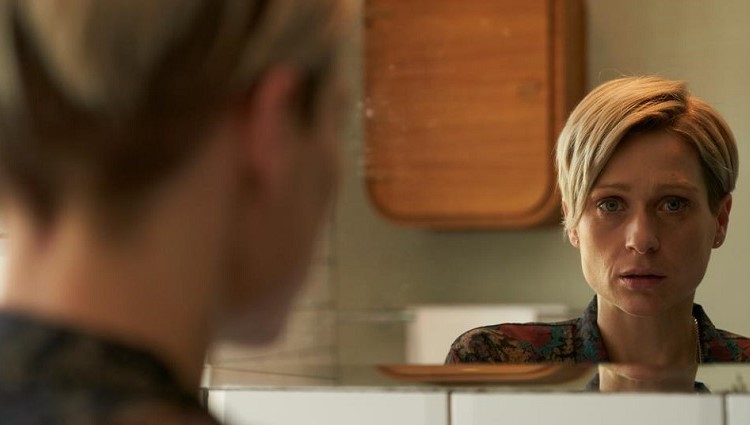
Her nuanced performance carries the film in its entirety and that isn’t to dismiss McAuley’s turn as Deano but often it’s waiting on Nicky’s reaction to him – or something inconsequential his late-night selfishness/shenanigans causes. They become two sides of the same stubbornly-headed coin and even start to dress in similar colours – which keeps the audience invested. Like when she leans against the kitchen sink hate-eating a crunchie™ or buying expensive headphones and trying meditation apps to lull herself to the land of nod. This brief look of resignation, fury or determination on her emotive face speaks volumes. The irony being that only through the enforced insomnia, is Nicky activated (so-to-speak) and finally fully awake.

Loathe thy neighbour indeed.
Categories
film review

Body of Water (Dir. Lucy Brydon, 2020)

Nothing quite brings a family together – or tears it apart – like a wedding. At least that’s the theory. For war photographer Stephanie (Sian Brooke), she must contend with organising a Hen party, writing a speech, attend dress fittings (complete with unhelpful comments like, “it’d probably look better on some curves”) and repair relationships with her teenage daughter Pearl (Fabienne Piolini-Castle) and mother/bride-to-be Susan (Amanda Burton). All of this while navigating getting well following several months of supervised showers, weigh-ins, eating plans and therapy in an inpatient treatment facility for an eating disorder.

Initially, interactions are overly polite and awkward – strained, fractious and as diminishing as Stephanie’s frame swamped in layers of clothing and over-sized hoodies. The tension palpable. Even more so at mealtimes when Stephanie is sat alone at the dinner table, a glass of water to hand to wash down the food or to fill her up so she doesn’t have to eat more. Long takes are utilised in these moments which only add to her struggle and isolation as she attempts bite after bite, hoping that an apple won’t defeat her. It is excruciating to watch.

The performances are all excellent, collectively working well together while creating three fully realised characters and a convincing family unit. Burton’s Susan is throwing herself into wedding preparation while trying to keep Stephanie, her illness and Pearl somewhat at arm’s length. She’s the authoritarian guardian of both her daughter and granddaughter having had to raise Pearl for much of her mother’s treatment – seven months at a time and on four separate occasions. Her impending nuptials are desperately important, not just for the significant commitment it celebrates but she’s hoping (or deluding herself) that it will be free from anorexia’s grasp.

Piolini-Castle perfectly encapsulates the teenage angst of Pearl – bouncing from apathy to anger, and aggression, flirting with rebellion as she sneaks out of the house using inappropriate sexual entanglements as a means of distraction. At its core, however, this is Brooke’s film. Her performance is powerful, subtle and complex. There’s a delicacy, a fragility which is at odds with the character’s tenacity and strength. She’s trying to be a good mother (and daughter) but illness has a grip on her, it won’t let her go and she’s tired of fighting it.

There are few men onscreen. There’s no mention of either Stephanie or Pearl’s father(s) – leaving us to draw our own conclusions and Stephanie’s Caseworker Shaun (Nick Blood) doesn’t paint a particularly positive picture of his sex or the social care system.

The term ‘eating disorder’ never quite communicates the severity of the mental illness that affects both men and women (3/4 tend to be the latter) and has the highest fatality rate, yet is the hardest to treat. It is not a subject matter new on film but writer-director Lucy Brydon’s BBC-backed drama seeks to reframe the narrative that is most prevalent (though still bearing a white protagonist). There is no pre-pubescent gymnast or ballet dancer whose goal-orientated weight loss is taken too far (and overcome through puberty) but an adult woman who is battling it and there is no trigger. We don’t know how, why or when it started for Stephanie, if it is psychological, sociological or genetic (or all of the above). It just is. Which makes the film all the more powerful for it.

Brydon makes the most of the 95 minute runtime, utilising space (or in Stephanie’s case limiting it) intuitively and Darran Bragg’s cinematography is captured through an almost continuously moving camera – sometimes slow and languid, other times a not-so-steady-cam, continuing the water theme – the colour palette adding to the muted tone with a mise-en-scène awash with blues, greens and greys. It’s a perfect metaphor for a lot of things but it encapsulates Stephanie’s struggle so perfectly, and in those moments when old habits creep in and threaten her recovery the sound design distorts so the audience is briefly under water with her, coupled with Rory Attwell’s atonal score.

Body of Water is an impressive debut, however, it is by no means an easy watch. Yet, it manages to convey some of the difficulties and psychological problems anorexia can present and how it can engulf sufferers and their families alike, all without judgement, stigma or fetishising the female body. This is a sensitively made and beautifully performed British drama that does well to depict the horrors of an illness, and questions whether true recovery actually exists for those who continue to shrink themselves to fit the world.