Robin Wright (the actress playing a version of herself) has made some lousy choices when it comes to her film career and men, or so she is forcefully told by her agent Al (Harvey Keitel) at the beginning of Ari Folman’s The Congress.
Her son Aaron (Kodi Smit-McPhee) has health problems, her daughter Sarah (Sami Gayle) thinks she should ‘do’ a Holocaust film as she can perfectly encapsulate ‘Nazi and victim’. These chalk-and-cheese children are just two of the reasons listed why character Wright ultimately chose life over the film offers and now Miramount Studio executive Jeff (Danny Huston) wants to offer her the chance to sign away the pressure. They wish to own “[the] thing called Robin Wright”; to create an image they manipulate and render in any filmic form as long as she retires from acting altogether. Any initial reluctance is given way to an affirmative and Wright is scanned; every emotion , every line, twinkle and wrinkle (a sequence that is particularly breath-taking, if completely isolating). The viewer is then transported twenty years into the future and the pension-age Wright is thrust into Abrahama City – the animated zone where she meets a 2D Disney-fied Jon Hamm.
The Congress, based upon a Stanislaw Lem story, is relevant, provocative, thematically rich – often to its detriment – and is almost impossible to categorise; part sci-fi, fantasy, family drama, there’s even some speculative dystopian fiction thrown in for good measure. However, what begins as a stinging critique and almost sly satire aimed primarily at the commodification of celebrity disappointingly loses its anger and gestates into something else entirely. The animated world is hallucinatory and disconcerting, a sinister Disney World™ where eagle-eyed viewers can spot Michael Jackson as a restaurant waiter, Grace Jones as a nurse or an exaggerated toothsome caricature of Tom Cruise. It is exhilarating, mesmerising and a little tiresome but perhaps this is the point in a post-avatar, digital-obsessed world? The questions of mortality our protagonist faces are replicated in our own manipulated interpretation; we should beware of the image. While its plethora of ideas and ambition feels relentless and even a little confusing, The Congress finally finds its humanity amid an existential denouement.
In any other actor’s hands, The Congress could have been a huge failure but the luminous Robin Wright delivers a stunning performance thanks, in part, to an excellent supporting cast of Keitel, Hamm, Huston and Paul Giamatti but mainly due to the fact that she is just that damn good. There is one scene in which the forty-plus Wright gazes at herself as Buttercup on a Princess Bride film poster, perhaps nostalgic for youth or the career she might have had, yet aside from the hair and the odd wisdom line, she appears exactly the same. If this film is one of her lousy choices, let’s hope she keeps on making them.
The name Marlon Brando is not necessarily one synonymous with the Western genre and yet he made three of them throughout his illustrious career, The Missouri Breaks (1976, Arthur Penn), The Appaloosa (1966, Sidney J. Furie) and the first, One-Eyed Jacks (1961), which also happens to be the only film he directed. A one-time vehicle for Stanley Kubrick, it was fraught with problems pre and post-production, the budget reportedly grew from $1.8 to $6 million when Brando took over and its eight week shooting time was extended to six months while the film’s finished edit had an original running time of five hours. This was before a Paramount executive made the decision to remove Brando’s creative authority and heavily cut the duration for release. It may have had its issues behind the scenes, but onscreen it remains one of the most memorable, and visually masterful Westerns ever produced.
This quirky revenge-Western, based upon Charles Neider’s The Authentic Death of Hendry Jones, tells the story of partners-in-crime; bank robbers Dad Longworth (Karl Malden) and The Rio Kid (Brando). It is 1880 and they are running from the law in Sonora, Mexico when Dad double-crosses Kid following their latest heist, and leaves him to be captured. Kid then spends five years in prison plotting his revenge before he can make his escape. When he does finally run into his old mentor, vengeance of the gun-toting variety is problematic, as Dad is now law-abiding, the local Sheriff, and married to Maria (Katy Jurado) with a step-daughter, Louisa (Pina Pellicer), towards whom Dad displays an obvious attraction. Rio, noticing the stolen, lustful glances, seeks retribution via seduction. Although never the intention, The Kid and Louisa fall in love and must, in Rio’s case, survive Dad’s wrath in doing so; a rage which involves a very public, painful flogging and brutal trigger-finger breaking.
Malden and Brando collaborated on three projects in a friendship that latest five decades, arguably some of their best work: Elia Kazan’s A Streetcar Named Desire (1951) and On the Waterfront (1954), and Brando’s baroque Western. Here, some may say cast against type (oh, and Baby Doll), Malden displays a repugnancy and cruelty in his performance as well-spoken Dad, a man dripping in piety and sanctimony. He exudes the seductive and paralysing power of the father figure within the diegetic space; the surrogate patriarch to The Kid – a young man putting a hard, obstinate face on his sensitivities in order to defeat the self-righteous and judgemental Longworth. This aspect of the script seemingly resonated with actor-director Brando, whose contentious and volatile relationship with his own father was reputed to be part of his motivation for making the film. Allowing the transposition of feelings or ‘emotional mechanics’ onscreen in keeping with his (and Malden’s) erudition as a student of the Constantin Stanislavski Method. Brando’s performance combines the manipulative, impulsive traits of a child while oozing his usual ambivalent sexuality. Rio is relatively non-violent as cowboys go, polished and clean shaven, one who would rather exert his virility by spending time with women than attend the saloon with his compadres. He is internally emotive and visibly tough; the explosive and volatile temper can dissolve as quickly into tears or laughter.
Visually, the film employs a lot of fluid camera movement and some of the tracking and panning shots are simply beautiful – courtesy of Brando’s eye and Charles Lang Jnr’s cinematography – in a film which relies upon John Ford-esque framing and takes evident inspiration from Sam Peckinpah. One-Eyed Jacks is replete with Brando’s over-indulgent and meticulous eye. Legend has it that the first-time director would delay filming until the right kind of waves hit the shore – it pays off too. It is one one of the most enthralling and visually captivating films of the Western genre committed to celluloid, and clearly a passion project. Steven Spielberg is a big fan. Martin Scorsese lauds it as one of the greatest Westerns ever made – in fact, they both were consultants on the restoration. Personally, it has always been at the very top of my favourite Westerns list and Brando performances but then, you’re more likely to listen to Marty.
Extras listed below are from the 4K restoration by Universal Pictures and The Film Foundation which was released by Arrow Academy in Dual-format DVD and Blu-ray.
Disc Extras Introduction by Martin Scorsese (2:51) In this brief introduction , Scorsese lauds One-Eyed Jacks as a masterpiece, not only as a fan but as a person interested in film history. He commends its representation as the “bridge between the emotional values of New Hollywood and the moviemaking sensibilities of Old Hollywood.” Quite the endorsement.
Marlon Brando: The Wild One (53:33) Written and directed by Paul Joyce, this programme was originally aired on TV on August 11th 1996. Joyce interviews numerous subjects about their dealings with Brando, including co-stars, friends, famous fans, and directors int he forms of: Dennis Hopper, Shelley Winters, Kevin McCarthy, Arthur Penn, Peter Bart, Martin Sheen, Francis Ford Coppola and Anthony Hopkins. All, except Bart, revered the actor and his enthralling screen magnetism. These interviews are intercut with clips and images from some of the Brando greats; Viva Zapata! (1952), On the Waterfront, Last Tango in Paris (1972), The Missouri Breaks, The Young Lions (1958),One-Eyed Jacks, The Chase (1966), Burn! (1969), The Godfather (1972) and Apocalypse Now (1979). While some of the anecdotes seem impersonal, some are touching, and many speak of Brando with genuine affection. Brando’s love of children, his weight problems, and his approach to fatherhood, which Martin Sheen claims had a huge influence of the way he raised his own children. This is a perfect, albeit very male-centric, introduction to the star, for those who know little about Brando. It is interesting to note that both Malden and Brando were still living at this point and either chose not to take part in this or were not asked.
Francis Ford Coppola on Brando (43:46) This rather tedious segment is the extended interview from the Paul Joyce documentary. Despite a 2017 edit, the interview is (as was the doc itself) twenty-plus years old. Yes, Coppola talks of Brando’s genius, and brandishes him the easiest actor to work with, and is awed by his intelligence, talent and physical beauty etcetera. It’s very repetitive as it regurgitates a lot of the footage and dialogue we’ve already seen and heard. As a super-fan of Brando – he was the subject of my Undergrad dissertation – none of the anecdotes or film trivia are new. It’s understandable why Coppola was asked to participate, he worked with Brando twice, but none of it has much to do with One-Eyed Jacks. Martin Scorsese discussing the film’s history, production, or restoration process would have made more sense and had have been welcome.
Arthur Penn on Marlon Brando (44:48) Again, the same as Coppola’s segment, this is the extended interview with Penn. Another male director that worked with Marlon on two occasions, at least one of the Penn/Brando collaborations was a Western! Similarly to the Coppola footage, it’s monotonous as a second man recounts similar anecdotes and experiences when he worked with the actor twenty years previous. Penn is more articulate than Coppola so parts of this are interesting although, he does offer history which is, not only, not specific to Brando but also little by way of One-Eyed Jacks. What is evident is Penn’s love for the man, the enigma, the “irreverent adolescent” whose devotion to his art made audiences believe in the film’s narrative and character before them. About OEJ, Penn states “If you want to [experience] the real artistry of the man, go see One-Eyed Jacks.”
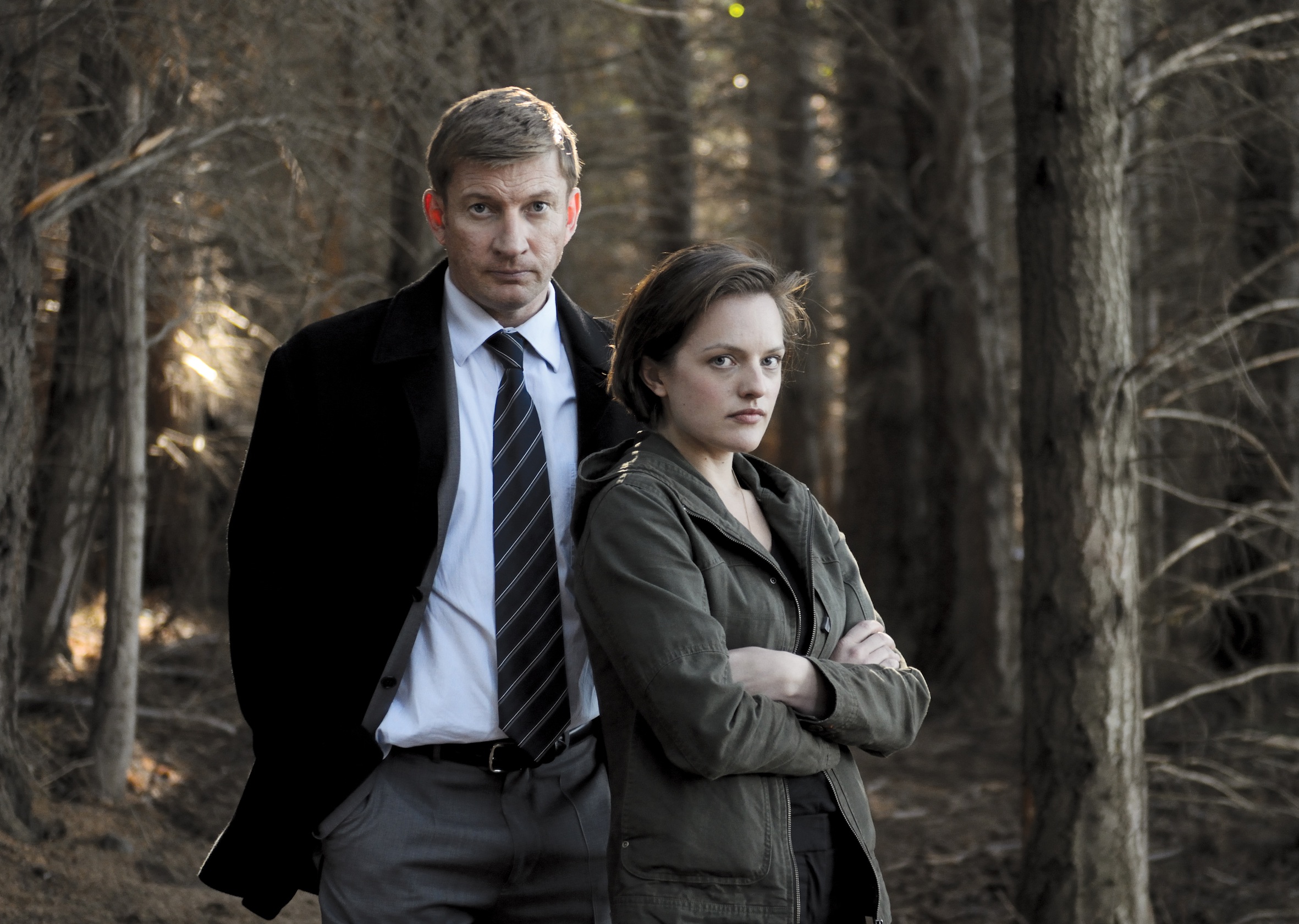
A determining factor, some may argue, at the heart of Campion’s oeuvre is the inclusion of a strong, emotive (and convincing) female protagonist seen in the likes of Sweetie (1981), An Angel At My Table (1990), The Piano (1993) and In the Cut (2003) to name but a few; these women are usually in search of themselves and while their strength and femininity are rarely questioned they tend to be deeply flawed characters. In Campion’s crime mini-series Top of the Lake – which sees her reunited with collaborator and long-time friend Gerard Lee – leading protagonist Robin Griffith (Elisabeth Moss) picks up the baton left by these memorable characters.
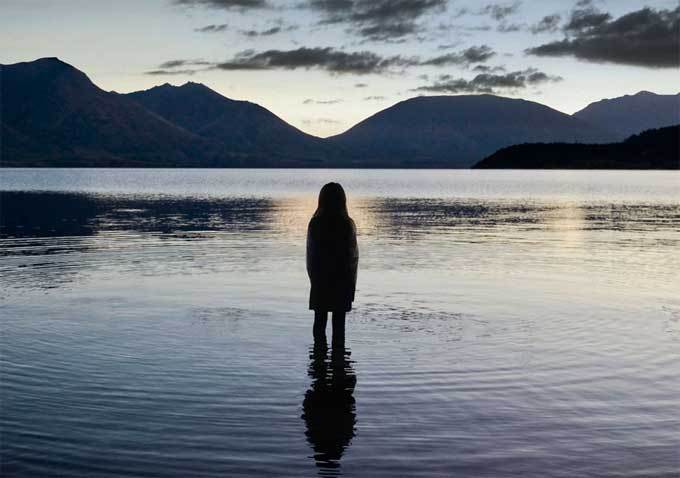
When 12-year-old Tui Mitchum (Jacqueline Joe) is rescued from Lake Top’s freezing stretch of water, her pregnancy is discovered and Detective Robin Griffith – having returned ‘home’ from Sydney – insists on taking the case. Over the course of the six-part drama, she contends with a lot more than just a statutory rape case; namely a dying mother, a long-term engagement she may or may not want, the boy she left behind, and her own demons that she has never fully faced. Throw into the mix, the all-female commune (attempting to take refuge from the debilitating aspects of their respective lives) that has set up home in a field they call Paradise, led by the enigmatic GJ (Holly Hunter). Feeling such a strong personal affiliation with young rape victim Tui, Robin is determined to assist the child; a prospect made all the more difficult when Tui disappears from a dysfunctional community full of secrets, lies, and deception, seemingly led by her father, Matt (Peter Mullan).
Boasting a cast which includes David Wenham (Oranges and Sunshine), Genevieve Lemon (The Piano) and Thomas M. Wright (soon to be seen in the US version of The Bridge) as well as the stellar prowess of Hunter and Mullan, all of whom are superb, this is really Moss’s show. Proving that she can do so much more than MadMen‘s Peggy Olson, she is, quite simply, brilliant as the psychologically paradoxical Robin. Filmed largely on New Zealand’s South Island (a character in itself), Top of the Lake, is a TV story which unfolds like a novel much like HBO’s Deadwood. Yet amid its style there is a stark hyper-realism and mimetic quality which emerges at its own pace – some may say a snail’s – but this deliberate pacing, silence and haunting cinematography has a purpose and builds upon the thrilling tension.
It is, oddly, reminiscent of Smillas’s Feeling for Snow (1997), yet ups the emotionally raw ante (and provides a much more relatable leading lady). Campion and Lee wrote a script in 2010, a lot of which is improvised around here, and manages to keep audience interest through many-a subject matter including murder, incest, police corruption and gender politics. Misandry and misogyny go hand-in-hand; the invisibility of the older woman is offset by the impotency of the ageing male, here in Lake Top everybody is damaged, vulnerable and/or breaking the law in some capacity. By the last episode, the conclusion of which is grimly satisfying, one realises that there is no actual resolution; there are still unanswered questions which is frustratingly refreshing and not usually expected in crime television of today’s standard, at least not of the English speaking variety anyway. Campion nails it yet again.
Beyond the Hills is Cristian Mungiu’s follow up to 4 Months, 3 Weeks and 2 Days which won the coveted Palme d’Or in 2007 and once again, the director utilises the close friendship of two female protagonists to comment upon gender and politics influenced by Communism and its chokehold on Romanian society. While political and sexual repressions were depicted through the gamut of illegal abortion, here it is commented upon through an organised religious sect.
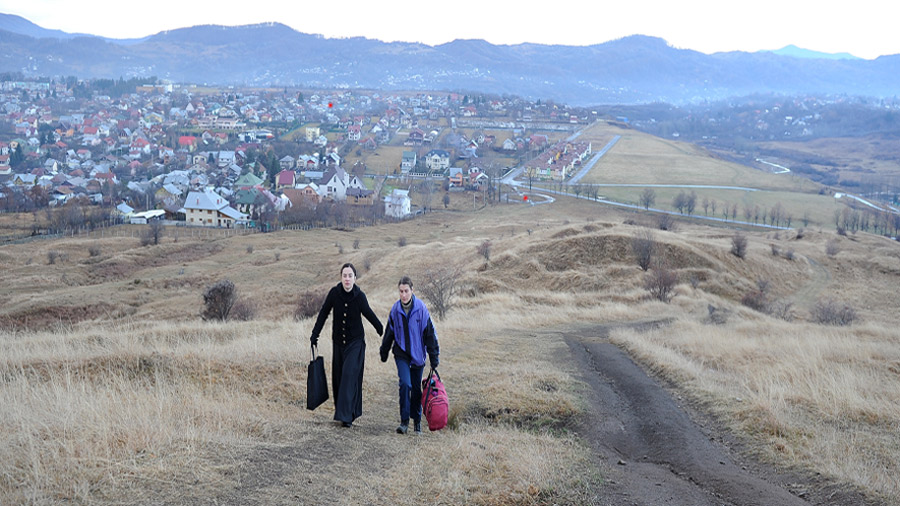
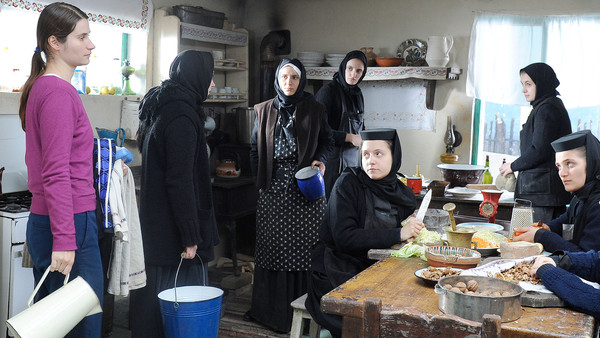
Volchita (Cosmina Stratan) and Alina (Cristina Flutur) are young women in their twenties, having grown up together in an orphanage. They have a familial bond tied by history and circumstance rather than blood; the true nature of their relationship is hinted at yet remains somewhat ambiguous throughout. Alina returns from Germany, where she now works, for a few days – a holiday – expectant that Volchita will return with her. Instead, she finds her friend living in a Monastery deep in the Romanian hills, literally hidden from civilisation embedded in an austere, archaic landscape. Volchita is confined to the bosom of Nuns who cohabit under the strict patriarchal, authoritarian rule of ‘Father’ (Valeriu Anchuta). The devout community stands alone next to an unconsecrated Church which houses a small congregation on a holy day. A sign on the front gate reads, “This is the house of God, forbidden to anybody of a different religion. Believe and don’t doubt”, the irony of which is not lost on the viewer especially once learning of the idolatrous and essentially, sacrilegious existence of this ‘House of God’. It is interesting and somewhat staggering to note that nearly 86% of the Romanian population practises the Orthodox faith, despite the fact that the country has no state religion but then, this film is not preoccupied with religious institution, at least not completely.
Mungiu’s third feature is a love story of sorts, faith at its very heart; belief in State, family and in a God which remains largely silent. It is a film about exorcism/possession, one situated outside of the confines of genre conventions and misogynistic dictatorship which is set on suppressing sinners who also happen to be women. The population outside is at a distance. You would be forgiven for thinking of it as a historical drama, the community is frozen in time, isolated, amid a lack of running water and electricity, save for Alina and her contemporary clothes. She is often the only splash of colour in an otherwise dark, dismal, and sombre mise-en-scène. She is a symbol of the outside world threatening to upset and challenge the religious conservatism and totalitarianism that appear to have engulfed Volchita.
The film is beautifully shot, blue and grey hued washes are abundant across the breathtaking landscape always captured in long shot, adding, not only, to its beauty but also educing the notion of freedom especially when juxtaposed with the interior medium shots. All employ, long takes, deep focus and are tightly framed which feeds the claustrophobic and repressive nature of the Monastery, exacerbating the tension between the religious and secular dichotomy and, in addition, the verisimilar style of storytelling Mungiu and his Romanian New Wave contemporaries adopt.
Beyond the Hills is deliberately paced to show the mundanity of life and natural flow of time. It is an enthralling and chilling commentary on traditionalism, irrationality of society and humanity at its most flawed. By its conclusion, which takes a jolting twist, all are accountable and yet there is no obvious villain. The final shot will resonate for a long time after the film has finished, once again, proving Mungiu as a director of merit, one who can coax astonishing performances from his leading actors and I know I, for one, will be awaiting his next contribution with bated breath.
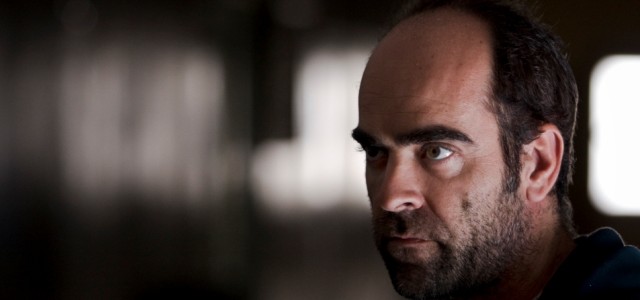
“There is always a way to be happy” declares a radio station caller during the opening of Sleep Tight [Mientras duermes], the intertitle cuts to a shot of César (Luis Tosar) standing on a roof-top seemingly ready to jump, clearly the exception to this declaration. His voiceover confesses that he has no motivation to rise out of bed in the morning, that he is never happy despite the fact that he “tries”. Cut again to him lying in bed next to a sleeping beauty, he awakens and begins a day-shift as an apartment building concierge. He visits his sick mother in hospital and on the surface appears to be an amiable everyman, invisible to some and less so to others.
Clara (Marta Etura) – the sleeping beauty – is the exact opposite to César in every way possible, not least in her sunny disposition. She is often shot in natural light and her bright, airy apartment and pale coloured summer wardrobe is juxtaposed with the male lead whose affiliation with the darkness becomes more and more apparent as the film progresses. Despite her ray-of-sunshine persona Clara’s life is far from idyllic, she is receiving poison-pen correspondence masquerading as love letters and disturbing text messages. The difference between the two characters? Clara always finds a way to smile, to be happy whether in her day-to-day routine or dancing around her living room. She is seemingly satisfied with her lot in life – little does she know just how unsafe she is in her own home.
Jaume Balagueró’s previous films [Rec] (2007) and [Rec]2 (2009) have been deeply rooted within the horror genre and this, ever-so, slight departure proves that his talent for building tension and unease really is innate. This psychological thriller gets under the skin and is executed perfectly with its canted and panning camerawork and especially with its playful soundtrack which lulls the audience into a false sense of security. Luis Tosar (Mr Nice, Cell 211) gives an outstanding performance, his César is sneering, ice cold and without empathy – a sociopath in every sense of the word.
This film is a testament to the lengths a person will go to, to destroy another’s spirit and its ending hammers home the true horror and hatred of humanity. There may be a cost to being happy – or perhaps there are more people who take absolute pleasure in inciting hatred and misery than we may think. It is tense, unnerving and delivers a well-plotted narrative which will stay with you long after the credits have rolled. Good luck sleeping tight after this one.








 The Framing Device