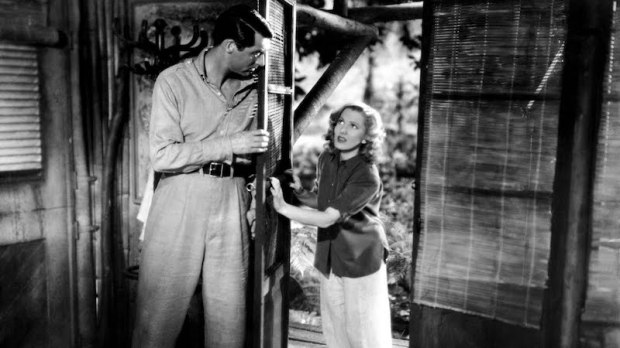
Bonnie Lee (Jean Arthur) disembarks the San Luis after it docks in the small South American port of Barranca. An unemployed showgirl and looking for company, she falls in with two fellow countrymen, Les Peteres (Allyn Joslyn) and Joe Souther (Noah Berry Jr) – American airmail fliers who frequent the, seemingly, only bar in town. Ran by ‘Dutchy’ (Sig Rumann), the bar/restaurant/general store/hotel/gathering place and headquarters of Barranca Airways is the place to be, where a toss-of-a-coin can get you a steak or the chance to be in the air.
Geoff Carter (Cary Grant), steely boss and general chauvinist makes his presence heard and seen; dressed flamboyantly in high waisted trousers, a gun belt and a large Panama hat worn on a jaunty angle, think saloon-dwelling Indiana Jones type. It is a quintessentially glamorous and sensitive Grant, however; there is an underlying darkness which is rare. A man, as the film’s original trailer declares, who has a “propeller blade for a heart and an eye for a pretty girl.” The pretty girls in question, although as per the Hawks way far are from just that, are Arthur and Rita Hayworth (looking far less Spanish than she had previously) and they are ably supported by Thomas Mitchell (Gone With the Wind, It’s a Wonderful Life) and Richard Barthelmess (Broken Blossoms, The Dawn Patrol).
If anybody can make an aviation adventure-dramedy with real levity and musical numbers blend in such a way it is Howard Hawks. The plot is slight but the dialogue; pacing and verbal wit, superb special FX and lighting (oh how Hawks could light a movie) flesh out the otherwise simple story, accompanied by a wonderful score by Dmitri Tiomkin. What carries it is the maverick machismo of these high flying men, their friendships, loneliness, camaraderie and even love. Love for each other and love for the air, there is little glory in what they do and certainly no flag flying but they are there day-in-day-out regardless of the peril. Not unlike all of those other men preparing to forge their own close barracked friendships following the Only Angels Have Wingsrelease in 1939.
The Criterion Collection launched in the UK on April 18th 2016 with a small, yet defined, assortment of filmic goodies on Blu-ray for the discerning cinephile – this film included – and has continued to grow. Only Angels Have Wings is the Hawks not often discussed; a hidden treasure made all the more valuable by the love and attention shown by Criterion’s beautiful restoration. The crisp sound and perfect transfer/picture quality will make an audience believe they are in that South American Port of Barranca.
The New York City skyline is our establishing shot as The Apartment opens and a voice belonging to C.C. Baxter (Jack Lemmon) – “C. for Calvin, C. for Clifford, however most people call me Bud” recounts some statistics. Bud is a bit of a know-all when it comes to facts but only because he works for insurance company Consolidated Life, up on the nineteenth floor where he processes claims. Baxter has a charming apartment situated in a pleasant area – just right for a bachelor – however, he is rarely home and not always by choice. He stupidly lent his key, once, to a work colleague and word quickly spread. Now his apartment has become the venue of choice for a selection of insurance big-wigs to wine, dine and bed their mistresses without the knowledge of their wives. It’s not that Baxter is happy to encourage men to cheat but rather is a compromised loner who allows himself to be manipulated and is just too nice to argue.
His neighbours, Dr and Mrs Dreyfuss (Jack Kruschen and Naomi Stevens) – the benevolent parental figures, Jewish, unpretentious and in the case of the good Doctor, a mensch – believe him to be a “good-time Charlie” over-consuming liquor and indulging in far too many women. Baxter is the embodiment of the typical Wilderesque protagonist, and Lemmon plays him as an affable well-meaning fellow, not hyper-masculine but boyish and funny; a general outsider to society, an honest every man who is forced into a situation beyond his control.
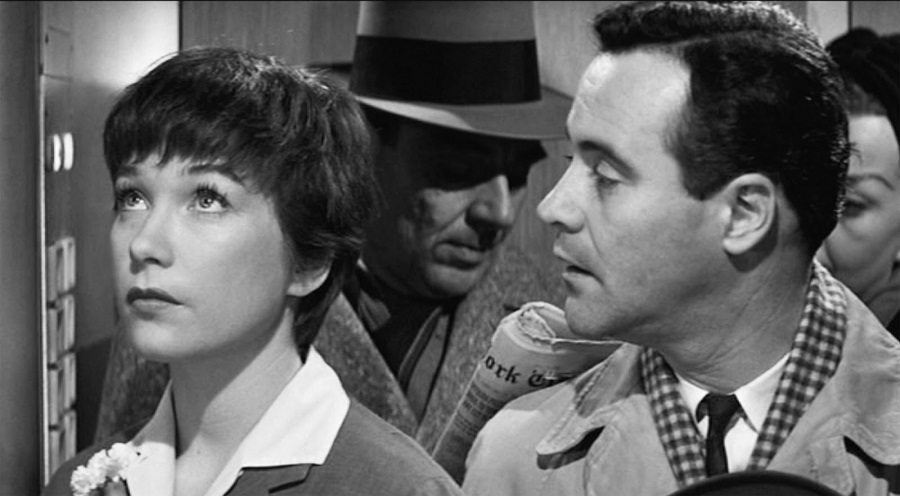
Although often alone, a highlight of Baxter’s day is the morning elevator ride up to the nineteenth floor when he gets to see and talk to lift attendant Miss Kubelik (Shirley MacLaine). His face lights up when he sees her and he is the only man in a sea of suits polite enough to remove his hat when in her company. Fran is sassy and sharp, not prone to suffer fools and certainly the men of Consolidated Life, regardless of stature or job title, get a tongue lashing if they act inappropriately. There is a sadness to Fran and like a lot of the characters in this movie, she is flawed. prone to heartbreak and circumstances unfold where, without giving too much away, both Baxter and Kubelik have to prove their mettle with and without the other’s help. Needless to say the man responsible for the running of the company, Mr Sheldrake (Fred MacMurray) finds out about the apartment situation and requests the key for himself. He, unlike his other Consolidated Life employees, is willing to foster capitalism (the others only make empty promises) and offers Baxter a promotion including a new office allowing him to climb the corporate ladder in record time. It is only when our hero has an epiphany near the film’s closingis the disenchanted and sardonic socialist worldview restored as per Wilder’s ideology.
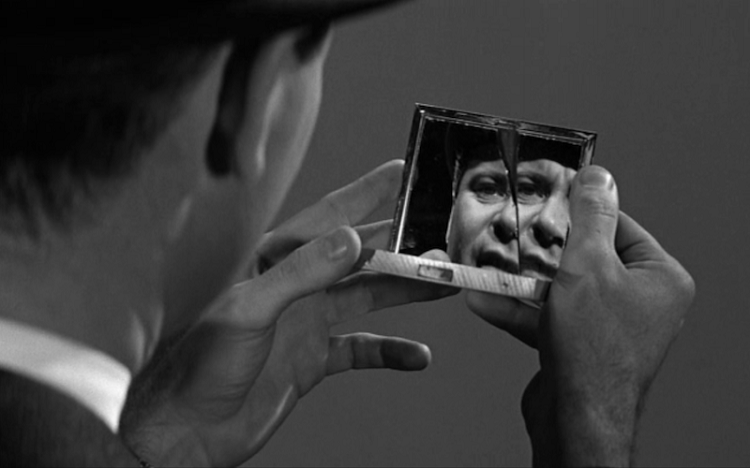
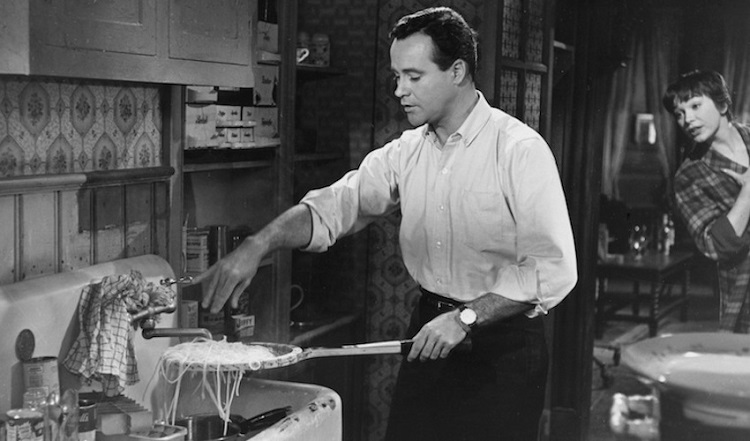
The émigré director always maintained that the best mise-en-scène was the one the viewer didn’t notice. However, his European sensibility is evident throughout his expressionistic cinematography and impossible point-of-view shots. In, practically, all of his oeuvre there are a series of habitual motifs specifically, the inclusion of Eastern European characters (an obvious reference to his and Iz Diamond’s respective homelands) the resident game of cards, and the use of the mirror – often utilised as the exposure scene where both the character and viewer make a discovery at the same time. Here, it’s Fran’s mirror compact which she won’t replace because the cracked glass shows her how she feels. Also included are telephone calls, surfing television channels (although that’s more of a dig at TV content) and making dinner as examples of the mundane (however, one would argue straining spaghetti through a tennis racket is anything but humdrum) in which the added realism enhances the wonderful story unfolding before the audience.
The Oscar-nominated and BAFTA award-winning performances given by Jack Lemmon and Shirley MacLaine in the lead roles have a lot to do with the film’s success. Their chemistry makes it a real joy to watch specifically as the viewer roots for both characters equally on their journey in life, it’s a road often tinged with the blackest comedy and world-weary cynicism. At one point Miss Kubelik declares “Oh God, I’m so fouled up” and fearlessly asks pondering questions like: “Why do people have to love people anyway?” without a hint of cliché, sentimentality or overt romanticism. There is no archetypal plot formation and it is not in the least bit predictable but contains subtle plot points and exposition which intelligently enforces the narrative where nothing is left up to chance. Wilder was a master of detail and restraint. Which makes the initial critical response all the more baffling: “[a] tasteless gimmick”, “dirty fairy tale”, “immoral”, “dishonest” and “without style or taste” are just some of the by-lines from 1960, which leads me to think that some critics just didn’t get it.
The Apartment is perfect, film-wise.
It is a true classic which celebrates disenchantment, love and the flaws of humanity through its acerbic dialogue, intelligence, wit and heart. There are more comedic elements to the screenplay than romantic, and however dark it gets there is real pathos. Arrow Academy has produced a beautiful celebration of it with a flawless 4K restoration, the process of which can be viewed in one of the many extras in this glorious box set which lavishly does one of Mr. Wilder’s masterpieces (he had a few) justice.
Special Features
Audio commentary provided by film historian Bruce Bloch. Bloch, just like Baxter in those opening moments is all about the facts, he discusses shot composition, cut sequences, and offers detailed analysis which often culminates in reading directly from Wilder and Diamond’s script. While a little dry in places, this thorough commentary will be a must-listen to fans of the film who will definitely benefit from Bloch’s insightful knowledge.
The Key to The Apartment (10 mins) – This is a new appreciation of the film delivered by film historian Philip Kemp, recorded exclusively for Arrow in 2017. Kemp keeps it brief, it’s a shame he reads from cue cards as his comments regarding The Apartment’s critical acclaim may have sounded less rehearsed.
Select Scene Commentary (8 mins) – Kemp is back in this short discussion which is delivered in voiceover accompanying two scenes from the films. He chooses the moment of (respective) despair for both protagonists; Baxter in the bar with Marge MacDougall and Kubelik at the apartment and the second scene in which Baxter is left standing outside The Music Man. It’s not quite long enough to make any real impact but interesting given the choice of scenes.
The Flawed Couple (20 mins) – A gorgeous video essay in which filmmaker David Cairns explores the many collaborations between Billy Wilder and, his every man, Jack Lemmon. Cairns looks at the simplicity and spontaneity of their working relationship which carried on into seven films over their respective careers: Some Like it Hot (1959), The Apartment (1960), Irma la Douce (1963), The Fortune Cookie (1966), Avanti! (1972), The Front Page (1974), and Buddy Buddy (1981). Wilder was responsible for putting Lemmon and Matthau onscreen together for the first time, which is especially poignant when you consider how many the duo went on to make and when all three passed away (Matthau, 2000; Lemmon, 2001 and Wilder, 2002). Cairns’ essay is accompanied by voiceover, archival clips and images.
A Letter to Castro (13 mins) – An exclusive interview with Hope Holiday recorded in 2017 for Arrow. In this lovely interview, 87-year-old Holiday details the exact moment she walked past the Brownstone off Central Park, carrying groceries, to see the crew measuring up for the would-be film-shoot, to her joining SAG and auditioning for her first speaking role of Marge MacDougall. She remembers Lemmon fondly and declares Wilder to be the best director she has ever worked with and recounts the “biggest thrill and happiest moment of my life – before marrying”. The lady is moved to tears as she talks about her experiences on set.
An Informal Conversation with Billy Wilder (23 mins) – Although originally made in 1995, this archival interview for the Writers Guild Foundations’ Oral Histories Series is a delight not least because it’s narrated by Lemmon: “Nobody’s perfect but Billy Wilder comes as close to it as any filmmaker in Hollywood.” It’s a mix of the filmmaker’s biographical info and filmography, detailing Wilder partnership with Charles Brackett through to the new(er) one with IAL Diamond before the interview with the man himself. Wilder is immaculately dressed and discusses his writing process, the structure and poetry of storytelling, casting, collaboration (which swinging, child-like, on his chair) all of which are intercut with images – such a fascinating, precise and humble man.
Restoration Showreel (2 mins) – This short feature details the process of how the 35mm camera negative was scanned at 4K resolution at Deluxe’s EFILM facility in Burbank, California but also shows some of the work completed during the digital restoration, the tools and techniques involved on the cleaning and repairing of damaged frames via before and after images. The work involved is also evident in the trailers and footage shown in numerous extras. It’s a welcome addition to the special features because it details a process few know or care little about.
Theatrical Trailer (2:19)
Archival Features: Inside The Apartment (29 mins) – This short documentary is originally from 2007 and features a whole host of subjects from critic Molly Haskell and Shirley MacLaine to Lemmon’s biographer, IAL Diamond’s son Paul to Chris Lemmon (Jack’s actor son). They discuss the film, in particular its black comedy and complexity and suggest why it stands the test of time.
Magic Time: The Art of Jack Lemmon (12 mins) – This featurette – again repurposed from the Fox/MGM’s new Collector’s Edition DVD which came out in 2007 – is a charming addition. Predominately narrated by Lemmon’s son Chris, he details his father’s childhood and progression to the stage right through to his film career and the meeting of Wilder and his “Pop”. It’s an affectionate look back at a wonderful actor or, in the words of his son a “marvellous, delicious leprechaun.”
Original screenplay by Billy Wilder and I.A.L. Diamond (BD-ROM content).
Special collector’s packaging featuring newly commissioned artwork by Ignatius Fitzpatrick.
Collector’s 150-page hardcover book (unavailable for review) featuring new writing by Neil Sinyard, Kat Ellinger, Travis Crawford and Heather Hyche, generously illustrated with rare stills and behind-the-scenes imagery.
The Apartment is a joy of a film, one of absolute perfection, and finally there is a box set which lavishly does one of Mr. Wilder’s masterpieces (he had a few) justice.
Arrow Films’ release of Eaten Alive is introduced (as part of the extras package) by helmer and Texas Chain Saw Massacre maestro Tobe Hooper, as a parting shout he exclaims “Hope you like the colours!”
Hmm, it starts very shakily and in the space of 11 minutes a woman escapes from a brothel and winds up at a fleapit motel (all clearly set on a studio lot). Two men try to rape her (including a young Robert Englund), she is forked to death (no pun intended) and thrown to a swamp-dwelling creature which could be a crocodile or alligator; locals are unsure. I wish I could tell you it gets better… even though it was adapted by Kim Henkel, Texas Chain Saw Massacre this is not.
All characters stumble upon Judd’s grotty Starlight Hotel with its dirty damp patches and soiled walls – believe when I tell you, you’d rather sleep in your car. Judd (Neville Brand)is a loner Patriot, guns (and American flag) adorn most walls, there’s even a swastika flag draped on a chair. Judd isn’t the type of man to leave you alone, he has a pet alligator and leers suggestively at any and all females that pass through. He’s a misogynist who even takes delight at terrorising a small calliper-wearing (female) child. That said every character is practically irredeemable; child and ‘gator aside. From an unrecognisable Carolyn Jones as brothel owner Hattie, via rugged ‘cowboy’ Sheriff (Stuart Whitman), to arguably the greatest Final Girl Marilyn Burns as Faye who sadly spends most of the film with her mouth taped shut. The filters used create an artificiality, which given the setting makes perfect sense and does add to the whole surreal B-movie effect. Garish reds and blues distort images and there’s a lot of eerie, atmospheric mist over the swamp; in keeping with the red, white, and blue of the flag.
Okay, so dig a little deeper and there are indications of an ideology, the film is playing to affirm and just like Hooper’s earlier work, the family is at the centre but the problem is Eaten Alive – or as it is otherwise known Death Trap – isn’t very good; it’s disjointed and a little exploitative particularly in its scopophilia. There is some inexplicable make-up work and a foray of (dodgy) women’s wigs which further aid the ridiculous.
So yes Tobe, can’t say I enjoyed the film greatly but I liked the colours.
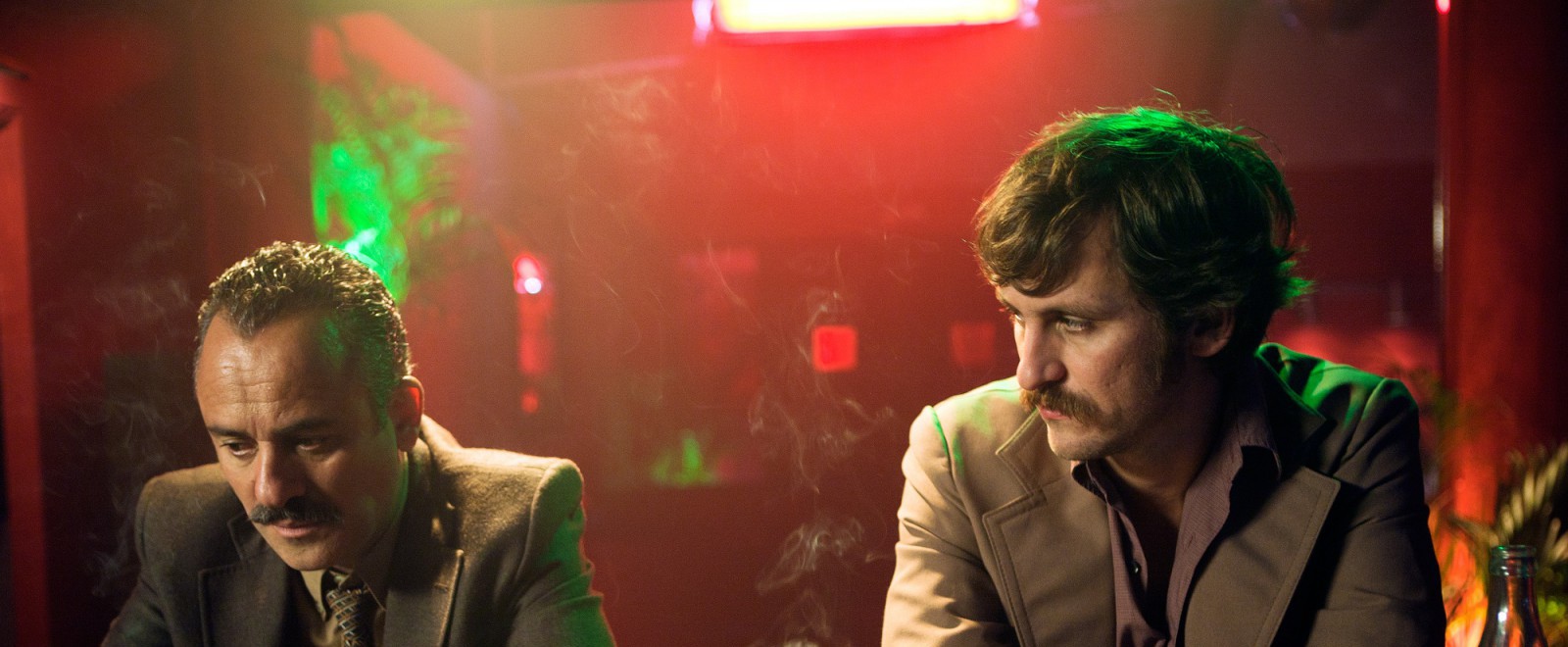
Alberto Rodríguez’s Marshland [La isla minima] opens in 1980 Andalucía. Times are a-changing as the fascist regime has come to an end and a democratic genesis is taking baby-steps in moving the country out of political turmoil. Detectives Juan (Javier Gutiérrez) and Pedro (Raúl Arévalo) are called in from Madrid to investigate the disappearance of sisters Estrella and Carmen. Both men are out of their comfort zone in Guadalquivir marshland and aside from their employment and respective facial hair, they appear to have little in common and each personifies the changes of the political climate (and not always in the ways one would think). This personality clash adds to the tension, especially when the girls are eventually found, sexually assaulted, tortured; their mutilated bodies left in a ditch, and so begins the ambiguous crossing of lines between cop and hunted. Both determined to catch a murderer and prevent more killings by any means necessary.
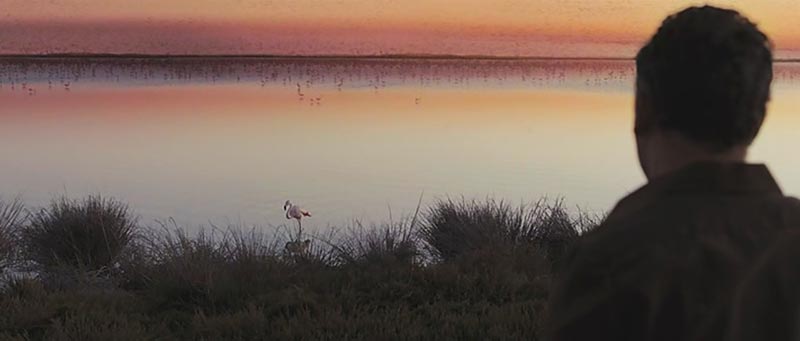
Visually, this Southern Spanish Gothic-cum-neo-noir is stunning, beautifully shot with some breath-taking views courtesy of Alex Catalan’s cinematography. The drone-captured aerial shots, while not a particularly new technique of late, are fantastic; the opening montage resembling both brain and ocular cavity, as if the land itself is an additional character. The use of colour is wonderful, the flamingo scene stunning. Rural Andalucía brings to mind South Korea’s Memories of Murder, Argentina’s Everybody Has a Plan, and even the US’ The Texas Killing Fields and certainly the tone and colour – as well as subject matter – does lend itself to these films and builds an atmosphere which becomes specifically gripping during the final sequence. There is even a supernatural element which aids the noirish and gothic feel to the whole insular, albeit, conventional plot. Misogyny and machismo are at odds just as democracy and the Franco era which still lurks in the background.
The male leads are outstanding, even Goya-winning in the case of Gutiérrez, they are not necessarily complex but at least they have activity to see them through the plot, which sadly, cannot be said for most of the females in the diegesis. There is a severe lack of characters beyond victims, not all are named and almost all either cry or die. Yes, this is an eighties set film and, as previously stated, there is an authenticity to it but a little character development would not have gone amiss, although given the parallels of the 80s and the world today (economic crisis, social tension, inherent sexism), perhaps, it is purposefully done. The slightest of niggles aside; it really is an enthralling watch which unfolds amid beautiful aesthetics.
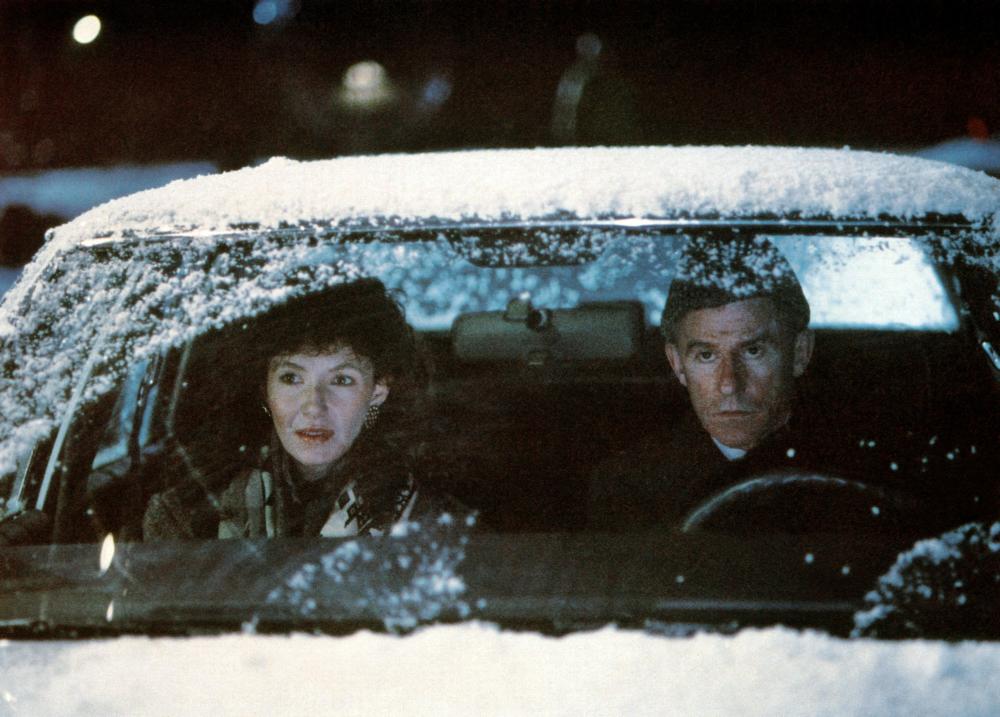
On a snowy, freezing cold night, a woman walks into St. Clair Avenue station and heads towards the line of lockers on the far wall. She walks past twin girls in blue, opens up locker 214 and a grabs a brown leather bag full of money. The audience never sees the woman’s face but her clothing – wide-brimmed hat, mackintosh – all with a splash of red hint at noir while the score screams giallo. Dead of Winter is one of those films that is hard to categorise; part drama, part slasher with a pinch of psychological thriller thrown. Wherever it lies one can, at the very least, argue that it is Arthur Penn’s (yes, that one) attempt at gothic horror.
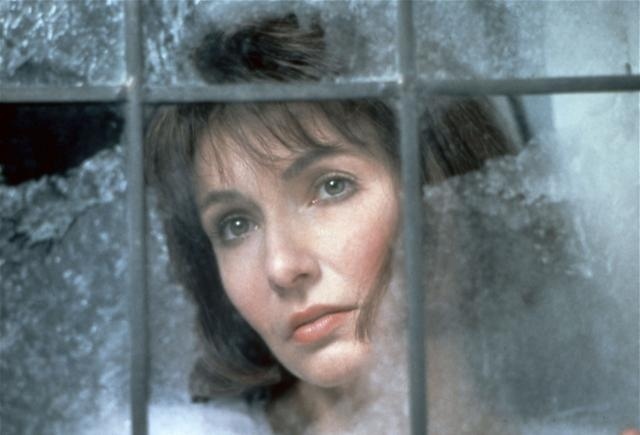
Loosely based on the Joseph H. Lewis’ noir My Name is Julia Ross (1943), even using the director’s name for Jan Rubes’ character. It is a Freudian’s dream given the numerous nods; from the uncanny, doppelgänger, castrated man, psychologist – everything is to be read and is all, well, very obvious. Rubes’ performance is fairly monotonous, McDowell is a little over-the-top and mediocre; only Steenburgen has work to do and is fairly convincing as three different characters. She conveys a real fragility as Kate McGovern, the actress holed up in a mansion with the two men for a screen test.
There is some suspense to the film, however – while it is well-made – it is a largely televisual affair (even some curse-word dubbing still prevalent in this cut) with some real inexplicable moments which definitely throws up questions. An audience will never guess the outcome in a month of Sundays but by the time it wraps up it has bordered on the absurd and the payoff is not actually worth it.
The music, sound, and red motif are nice touches and certainly enhances Penn’s mise-en-scène, and the wintery backdrop serves the film well but it has a misjudged feel about the whole thing, like Penn has thrown everything cliché, motif and dodgy middling histrionic at it.








 The Framing Device