Categories
Film Festival film review

Peacock (Dir. Bernhard Wenger, 2024)

©NGFGeyhalterfilm-CALAfilm-AlbinWidner

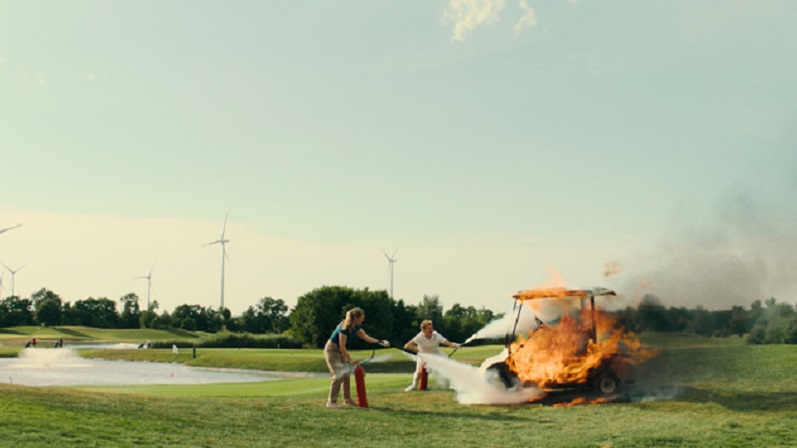
Bernhard Wenger’s feature debut begins completely out of context as a golf cart is engulfed in flames. Two people run into frame unleashing fire extinguishers until the blaze is out and golfers slowly walk over commending the duo on a heroic job well done.

We will soon learn the man is Matthias (Albrecht Schuch, All Quiet on the Western Front, System Crasher) and he works for a company called My Companion, not your regular ‘friend for hire’ agency headed by his boss and friend David (Anton Noori). Matthias fulfils the needs, wants and desires of complete strangers, whether putting out inexplicable golf fires, attending outdoor concerts with older women or posing as the pilot father of a small child, moustachioed Matthias is the star of the company, his success evident in the glowing reviews he receives for his “work” and obvious wealth symbolised by the immaculate house he shares with girlfriend Sophia (Julia Franz Richter).

The problem is Matthias is so good at his job that he ceases to exist beyond a surface level in everyday life, he needs cueing up for everything, when to speak, when to appear sympathetic and when to act. Everything is a construct and performative and Sophia has had enough – “You don’t seem real anymore” – and leaves him. What follows is an existential calamity onscreen. The male in crisis here is handsome, polite, patient, considerate, professionally adept and yet socially inept it is laugh-out-loud hilarious and so cringeworthy, the whole body flinches, also a little heart breaking. Matthias is played to perfection by Schuch whose comic timing is sublime made all the more inviting by Albin Widner’s pristine cinematography, visual humour coolly framed and aesthetically pleasing.

©NGFGeyhalterfilm-CALAfilm-AlbinWidner

Wenger’s assured and absurdist satire takes a swipe at corporation and capitalism. The unpredictability of technology beautifully depicted during the scene when Alexa fails to understand his request for a specific song and declares it will chose a song for him and decides upon ‘Clap Your Hands’ which, of course, interferes with the electricity and clap-activated overhead lights.

Here, the world is a microcosm and life is just one long performance while posing “serious” questions about what constitutes as art – if that happens to be a naked man dousing himself in paint and throwing himself head first into a blank canvas on stage, then fill your boots. To watch the almost-perfect albeit passive man – which in itself is a breath of fresh air from, what feels like, the multitude(s) of male toxicity onscreen – regress and slowly unravel is heart-stinging and, though it’s kind of mean, a laugh-out-loud joy in a film that is tonally perfect from that opening sequence on the green. The dénouement of which is *chef’s kiss*.

Peacock, visually, is reminiscent of Joachim Trier’s work – complete with a Norwegian love interest – shot through with the dead-pan sensibility associated with other Scandi cinema specifically early Östlund or even Lanthimos (when there was a Greek ‘weird’ Wave stirring). Though, by the end, it feels as excruciating (and amusing) as something like Toni Erdmann (2016), whereby the lead is resigned to a specific way of life but then experiences a rebirth, of sorts, which presents a whole new approach to navigating the world.

Matthias can be a your hero, companion, a son, everything for you… but just not as himself.

Categories
film review

A Man Called Ove (Dir. Hannes Holm, 2015)

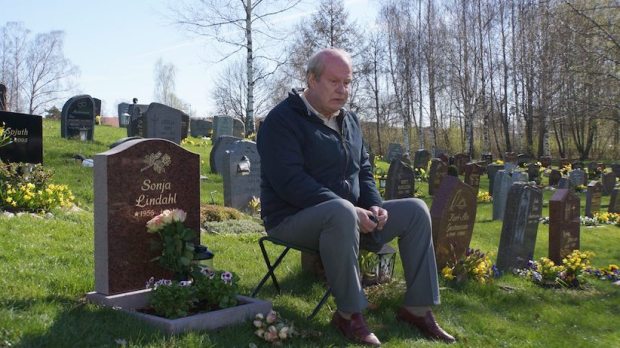
Time is a curious thing. Ove Lindahl (played respectively by Viktor Baagøe, Filip Berg and, of course, Rolf LassgÃ¥rd) is a particularly cantankerous curmudgeon. Everybody is an idiot whose existences only serve to inconvenience him and his. He has worked the same job for 43 years, until two babyfaced executives take away his livelihood and present him with a gardening shovel as a token of service. Ove makes his rounds following his enforced retirement – he’s the worst (best) kind of neighbourhood watch in which he keeps his small Swedish community safe with his often impolite reinforcement of the block association rules. After his short walk, he puts on his best blue suit, empties the fridge, cancels his phone contract and attempts to hang himself in his living room, only to be interrupted by a crash outside his window. New neighbours: heavily-pregnant Parvaneh (Bahar Pars), Patrick (Tobias Almborg) and their girls, Sepideh (Nelly Jamarani) and Nasanin (Zozan Akgün) have moved in and they’re far from quiet. And so, Ove is coaxed back to giving life another go (until his next attempt) by the delightfully feisty Parvaneh, her family and his neighbours who – despite the grump’s failure to notice – actually like having him around.

Grief is a strange thing. Putting one foot in front of the other until your time is up and you can see your loved ones again (if you believe in that kind of thing). For Ove, living for those six months following his wife’s Sonja’s (Ida Engvøll) death is intolerable. It’s the one aspect which immediately warms the viewer to the largely unsympathetic moaning git. We can relate and as we get to know Ove through a series of flashbacks over the 120 plus minutes, there’s a very human reason for the doom, gloom, and defensive booming voice, and that’s testament to Rolf LassgÃ¥rd’s performance. The one-time Wallander and veteran of Swedish film and TV brings a gentility and resolute grace to the character albeit in a slightly bad-tempered way. Despite being the same age as Ove at the time of filming, he underwent a bit of a physical transformation via prosthetics which age him greatly. This adds an additional layer of melancholy; this is a man who has had a hard life. Yet, he has such an old fashioned clarity of belief and a sense of morals, duty and unnerving conviction about how the world should be that one can’t help but admire him.

Love is a strange thing. It often takes you by surprise, and family comes in many forms and guises. A Man Called Ove is a heart-warming meditation on love, loss, family and life, and learning to follow and then disregard the rules. It reminds us the importance of community and the inclusion of the aged, experiencing joy alongside tragedy amid the blue, grey and beige phases of life. Oh, and that friendships can be forged and broken upon the type of car you drive. Hannes Holm’s adaptation of Fredrik’s Backman’s bestselling novel is warm, touching and moving. It treads a measured line between humour and sorrow and does so extremely well given how maudlin a film containing failed suicide attempts could’ve been. Instead, its regal music including triumphant strings does a really lovely job at elevating its purpose, and making a colourful, sweet and life-affirming film.