Categories
Blu-ray film review

Candyman (Dir. Bernard Rose, 1992)

It is interesting to note that the titular character of Bernard Rose’s 1992 film Candyman was a painter, an artist determined to leave behind a legacy; never to be forgotten: “I am the writing on the wall, the whisper in the classroom. Without these things, I am nothing…” The myth – dating back to 1890 – surmises that Daniel Robitaille (although we wouldn’t learn his name until the first sequel) was educated and enslaved, on account of his father’s invention which assisted in the mass production of shoes after the Civil War.

Robitaille was commissioned to paint the portrait of a wealthy landowner’s daughter. The two fell in love and when a child was conceived, fear of miscegenation led to a mob chasing the artist from town to the outskirts where his hand was sawn off, and his body smothered in honeycomb for bees to devour. 100 plus years later and, according to folklore, his soul and bloody hooked stump continues to haunt Cabrini Green, now home of the projects.

At least that’s what the legend suggests as it is told and retold, embellished by the storyteller, and those who believe in the Candyman (Tony Todd). For Helen Lyle (Virginia Madsen), the myth becomes a major part of her research. She and colleague Bernadette (Kasi Lemmons) are students at the University of Illinois researching urban legends as part of their thesis, within an academic department where being smug, white and male is a given. None more so than Helen’s own husband Trevor (an immensely slippery Xander Berkeley).

Helen discovers that there is a connection between her building and the apartments at Cabrini Green, after looking into the unexplained death of Ruthie Jean – a woman of colour who was mutilated in her bathtub by a killer who allegedly burst through her wall brandishing a hook. Helen interrogates the myth, and through her investigation we see just how limited her perspective is (in both literal and cultural terms), she is oblivious to anything outside of her area of interest until the myth has been appropriated. Only then does she (figuratively) wake up.

Rose – not unfamiliar with literary adaptations – has given audiences variations on numerous works of literature including his Tolstoy quintet of Anna Karenina (1997), Ivans XTC (2000), The Kreutzer Sonata (2008), Boxing Day (2012), Two Jacks (2012), and more recently his take on Frankenstein (2015). Candyman was his first authored screenplay, based on Clive Barker’s short story The Forbidden (which can be found within volume five of his seminal anthology Books of Blood). The Faustian-inspired story transposed Liverpool to Chicago, Helen’s surname became Lyle (from Buchanan), her thesis – which once centred around graffiti – now concentrated on urban legends, and class and race became intertwined in Rose’s vision. He kept the thematic material of the story but made it very much his own.

While the film is grounded in horror, part ghost story, part unconventional slasher by way of arthouse cinema. It plays with the tonal and generic shifts between the story and its retelling, building ambiguity before Candyman’s first full reveal to Helen (it’s well worth the wait), and their relationship as the film progresses.

Some have commented upon the fact that the film’s “villain” is a man of colour. True, however, he is not a typical “monster” (just like Helen is not a victim, despite his imploring her to be). Candyman is a tragic and romantic anti-hero, an eloquent and beautiful phantom who is seeking retribution from those who have wronged him. It’s an elegant performance by Todd who elicits as much empathy as scares, it’s hard to imagine anybody else embodying the handsome hook-man (although, what if the next is a white iteration or Yahya Abdul Mateen II*). He is led by an equally wonderful Virginia Madsen.

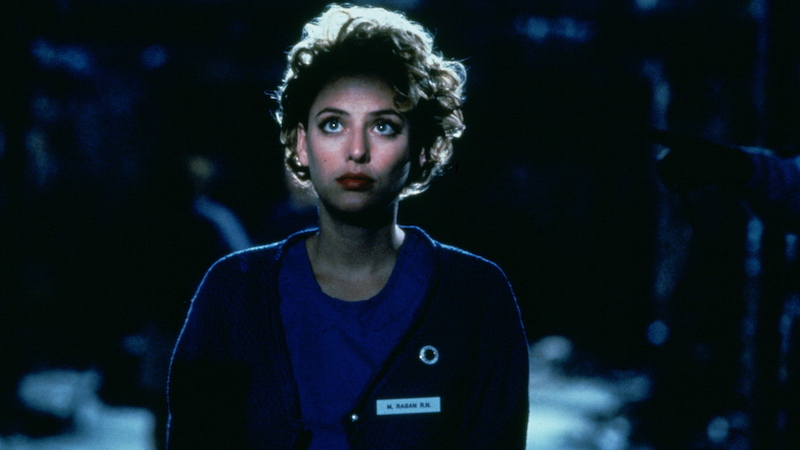
Her Helen is intelligent, determined and flawed, perhaps even unhinged. The line between the real world and the nightmare is completely blurred by the film’s midpoint. Is she responsible for the kidnapping of Anne-Marie McCoy’s (Vanessa Williams) baby boy? Is Candyman a figment of her imagination or is he the man who assaulted her? Has Helen lost her mind? There’s an old Hollywood glamour to Madsen/Helen, and yet she’s completely ordinary and easy to identify with. The choice of lighting her across the eyes is genius on the part of DoP Anthony B. Richmond (Don’t Look Now). It enhances those huge green windows especially when she appears in a trance, passively hypnotised by Todd’s velvet voice (in actuality, it was her director who was doing the mesmerising).
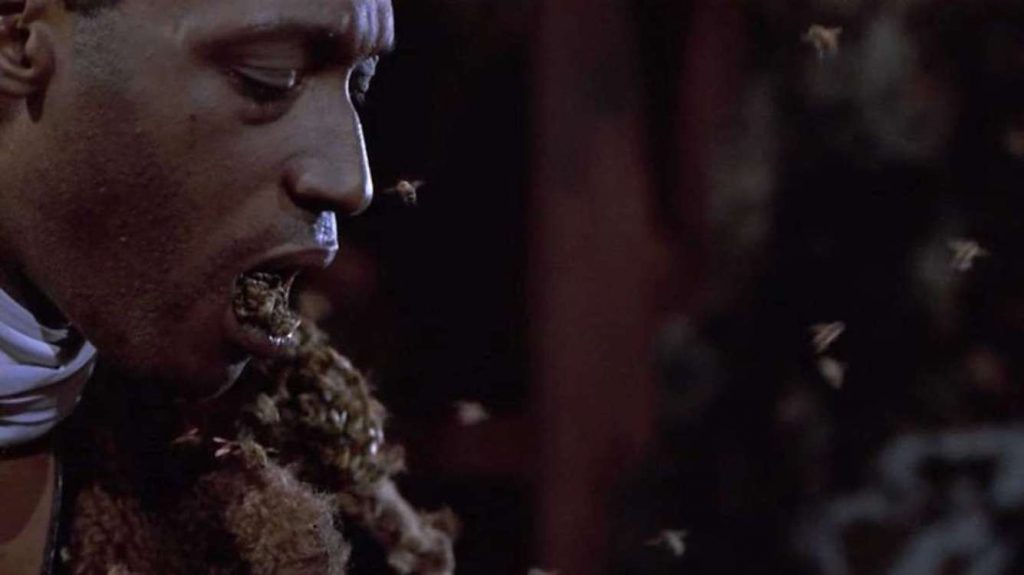
Richmond’s cinematography and Jane Ann Stewart’s production design have aged well. The graffiti and murals adorning the walls of Cabrini Green are still as effective – made all the more so by the careful 2K restoration from a new 4K scan of the original negative (supervised and approved by Rose and Richmond). Grain is kept to a minimum and the picture is perfect. Reds and petrol blues particularly bright and eye-catching along with that all important artwork on the walls leading to Candyman’s lair.

Bob Keen’s make-up FX is just as accomplished in a film that really was multi-layered and ahead of its time, (and still as timely today) even the bees are analogue with Todd pheromoned-up, standing in for the Queen. Apiculture has been practiced for a millennia, and given that bees are the creatives of the nature world, it’s a perfect extension of the art present. Philip Glass’ haunting, melancholic and melodic score brings the religious themes to the fore and is the aural icing on the cake.

By placing the film within a racial context, it polarises the worlds as they are depicted; white, middle-class academia and the poverty of the inner city African-American experience. Helen even spells it out: “A black woman is murdered and the police do nothing, a white woman gets attacked and they’re all over it.” However, as the film progresses it is evident that Helen and Daniel are linked rather than opposed. The racial and social commentary, however dated, opens up dialogue, not only holding up a mirror to an America of the past but what the future holds for people still living as a consequence of segregated housing. It will be fascinating to see how Nia DaCosta approaches the material in her version of the film.

Candyman continues to be an ambivalent and ambiguous arthouse horror film which depicts oppression and transgression, and manages to sustain the scares, even after 26 years. Bernard Rose and Tony Todd have created a legacy which will continue long after they depart.

Sadly, one of them now has… Rest peacefully Tony Todd (4/12/1954 – 6/11/2024)

Extras

Disc 1: US R-Rated Version

Audio Commentary with Bernard Rose and Tony Todd – The disc boasts not one but two audio commentaries. The first is provided by writer-director Rose and star Todd (his introduction is a particularly nice touch). The pair are obviously close, having reunited for Frankenstein, and cover a whole host of topics. Todd reviews Infinity War, A Quiet Place, and Halloween. We hear Rose’s opinion on sequels, the new Halloween and his favourite horror films (he has excellent taste). The two men tend not to pay much attention to what’s onscreen, choosing instead to talk about the cinematic essence of the horror genre, offer occasional anecdotes re: filming, what constitutes as “American”, politics and social media, and the notion of fear. This is highly entertaining and well worth listening to.

Audio Commentary with Stephen Jones and Kim Newman – The second places the film within critical context by writers/critics Jones and Newman. They discuss their friendship with Clive Barker and his stories which have been made into memorable films. They analyse the cast and their respective performances. Theirs is actual commentary accompanying the film as it unfolds and they offer several readings of the film and briefly consider the logic of nightmares (which allows for plot holes).

Be My Victim: Interview with Tony Todd ©2018 (9:38) – Todd discusses how he got the role, the romantic gothic horror elements of the film, and his approach to the role which included ballroom dancing. He likens Candyman to the Phantom of the Opera and speaks positively, not only, of the experience but of Rose who he describes as a “highly intelligent” filmmaker. He touches upon his costume, location shooting including the active gang members who agreed to be on film, and facing his fear of bees. It is evident that he has a great deal of affection for both Rose and the character. The racial aspects of the film are still open for discussion and Todd welcomes the conversation.

It Was Always You, Helen: Interview with Virginia Madsen ©2018 (13:00) – Madsen talks about her first action(s) following getting the role; going for tests as she was allergic to bee stings and eating a lot of pizza as Bernard wanted her a little rounder as Helen. It’s a lively and informal discussion, much like Todd, Madsen is clearly comfortable talking about the film, the experience and having a close working relationship with he cast/crew. She’s incredibly proud of the film, it remains one of the best experiences she has ever had, particularly enjoying waltzing with the “beautiful and gentle” Todd.

The Writing on the Wall: Interview with Jane Ann Stewart ©2018 (6:10) – Stewart worked as Production Designer on the film, and here discusses scouting for locations, basing her designs on truth and just how much fun she had working on Candyman, especially as a student of Art History.

Forbidden Flesh: The Make-up FX of Candyman ©2018 (7:49) – This featurette interviews (albeit separately) Bob Keen, Gary J. Tunnicliffe and Mark Coulier the three British make-up artists who were responsible for the FX of Candyman.  This is interesting especially as they describe “making” excrement for the walls of the public bathroom from a selection of biscuits, and the forging of the hook. “Proud” is definitely the verb of choice from everyone interviewed about this film.

A Story to Tell: Clive Barker’s The Forbidden ©2018 (18:28) – Critic/writer Douglas E. Winter critiques Barker’s seminal Books of Blood and original source story The Forbidden. Winter is an adorer of Barker whom he describes as the “finest horror writer of the [80s]”. He also discusses Rose as author and artist and briefly touches on the feminist aspects of the Candyman sequels: Farewell to the Flesh (1995) and Day of the Dead (1999).

Urban Legend: Unwrapping Candyman ©2018 (20:21) – This critical analysis of the film by UCLA Lecturer/writer Tananarive Due and author/screenwriter Steven Barnes is the highlight on the disc. They consider the film from a Black historical context and gaze. Their analysis is invaluable, intelligent and allows for the viewer to reconsider a film text they think they know. Subjectivity is a fascinating tool and representation matters, as well as diversity behind the camera. This is essential viewing, not least because, Madsen aside, Due is the only woman involved in this boxset as a whole.

Bernard Rose’s Short Films – Three films – newly restored in HD – which cement Rose’s filmmaking prowess. Fans will see techniques, themes, and motifs which continued through his entire oeuvre to date.

  • A Bomb With No Name On It [1975] (3:34) – Terrorism is approached with horror elements and a classical score (he had to start somewhere). The action takes place in a busy London restaurant with the bomb maker, a white middle-class male. Perhaps an allusion to the IRA bombings of the seventies.
  • The Wreckers [1976] (5:54) – A film depicting ‘youth’ and more specifically a teenage boy and the party he throws when parents his head out for a dinner party amongst their peers. The generational divide is seen through the juxtaposing of the two soirées. Sparkling water is the adult’s drug of choice as the teens spark up their joints. It’s brilliantly created, mixing contemporary music with classical before the evening descends into coloured-filtered horrific chaos.
  • Looking At Alice [1977] (27:24) – This is Rose’s black and white avant garde film (every director has one). He plays with voyeurism as his protagonist watches and stalks the object of his affection through her love and conquests. Rose, once again, utilises classical music, jump cuts and repetitive dialogue. All three films are a welcome extra on the the film that many consider Rose’s masterpiece.

Theatrical Trailer (1:59)

Image Gallery – A slideshow continuing 40 images including film posters from across the world, VHS covers, film stills, publicity stills and lobby cards. It’s interesting to note the different studios that have historically owned the rights to Candyman.
Disc 1: Original UK Theatrical Version

The Cinema of Clive Barker: The Divine Explicit ©2018 (28:00) – This in depth interview with author/director/visual artist Barker, who discusses his literary work and the subsequent film adaptations, including Rawhead Rex, Hellraiser (with his old school chum Doug Bradley), the connoted homosexuality of Nightbreed and, of course, Candyman. He talks about horror and what it does to us as a film audience, finding beauty in the darkest of things, celebrating difference, and his childhood. It’s a fascinating interview. Barker looks gaunt, ageing following operations to remove polyps from his throat. As Americanised as his accent is now, the Liverpudlian is still evident to the trained ear. On a personal note, it’s heartwarming to see and hear someone with a huge talent be a success in a field you love who also happened to go to your old school and sound a bit like you.

As if that wasn’t enough, there’s also:

  • Exclusive packaging featuring newly commissioned artwork by Gary Pullin (although, it appears that his hook in is the wrong hand).
  • 6 lobby card reproductions
  • Reversible fold-out poster featuring two artworks
  • Fully illustrated collector’s booklet featuring new writing on the film by festival programmer Michael Blyth (unavailable for review).
  • Limited Edition bound booklet reproducing the original hand-painted storyboards by Bernard Rose

Yes, it’s a little odd that Philip Glass isn’t featured amongst the extras at all, a copy of the score would have rounded off the boxset nicely. The severe lack of women is also disappointing, specifically in a critical capacity or interviews with the other women in the cast.

That said, Arrow Films courtesy of their Video label have immortalised Candyman and his mythology in a stunning limited edition box set, packed with extra features that will make any film lovers cling to their rapture. Buy it, if you dare, just avoid mirrors.

Categories
Blu-ray film review

Man of a Thousand Faces (Dir. Joseph Pevney, 1957)

Man of a Thousand Faces begins with the following cue: “On August 27 1930, the entire Motion Picture industry suspended work to pay tribute to the memory of one of its great actors. This is his story.” Except, well, it’s not. It’s the ‘Hollywood’ version steeped in melodrama and all a little dull.

At the Universal studio lot, the flag flies at half-mast as Irving Thalberg (played by the late Robert Evans, sans perma-tan) makes his own tribute to “The phantom of the opera.” In actuality, work was not suspended but a two minute silence was conducted in the wake of Lon Chaney’s death – nor were his most successful films made at Universal… This film starts as it means to go on, dramatising and conflating the life of an extremely private man who, if history books are to be believed, would have shunned even this mediocre production.

The biopic begins with the obligatory flashback which will serve the overarching narrative and then loop back around; aligning childhood, trauma and tragedy which is seemingly how it wants to establish Chaney (James Cagney). It traces his career from the Vaudeville stage to the cinema screen and admirably attempts to squeeze 30 years into 122 minutes, perhaps had the film been cast differently it may just have worked.

As talented as Cagney arguably was, there’s no way he can pull off aged 22 at 56 convincingly. Not to mention the physical limitations; a tall sinewy figure with a distinctive growl never really translates to a chipper Irish-American barely reaching 5’7”. Star personas were prevalent during the studio system and it’s fair to say, Cagney was horribly miscast nor did he have the lithe grace Chaney exhibited or the creepy melancholy.

If there’s one word used to describe the tone of the film, it is tragedy, as it prefers to add weight to the man’s alleged suffering than his film career. Hammering home his deaf-mute parents, hitting child abandonment and the dissolution of his marriage along the way, to having to place son Creighton in an orphanage and then, well, death. It’s all rather dreary; at odds with the sweeping epic soundtrack and the man whose early career began in Vaudeville and making people laugh. Why his parents’ deafness defines him or them, for that matter, appears to be a sign of the times – as for when that is the film does little to quantify. Creighton (he who would become Lon Chaney Jr.) is the only real evidentiary passage of time as the part is split between four actors (Dennis Rush, Rickie Sorensen, Robert Lydon and Roger Smith) each older than the next. None of which is helped by the occasional fifties-looking costuming.

Before his ‘big break’ as a lead, Chaney worked tirelessly and took every job he could, often making himself over and disguising his natural attributes depending on what was required on the call sheet. His ground-breaking make-ups led the way for the likes of Jack Pierce. Bud Westmore, Dick Smith, and, of course, Rick Baker among many, many others. It was then that casting agents began to take notice and he was cast in The Miracle Man thanks to his ability to twist and coil his body into unnatural positions. This would lead to arguably his greatest roles: The Phantom of the Opera and The Hunchback of Notre Dame in which he gravitated, yet again, to the tortured and afflicted depicting the tormented empathy of Quasimodo. Cagney tries but it’s hard not to see Cagney playing ‘Cagney’ imitating Chaney, or ‘Chagney’ if you will.

Obviously, given the decades between meant different make-up processes and evolution of the prosthetic. The make-up recreations in Man of a Thousand Faces are pretty awful given that Westmore et al would have used more modern supplies and they are still nowhere as convincing as Chaney and his ‘crude’ materials. Eagle-eyed viewers will also notice that camera-angles vary in relation to the original films, they’re not quite as polished.

It’s not all terrible, there are some high points. The father-son relationship shines and the performances from the actors who played the young(er) Creighton are lovely. These moments highlight Chaney’s love of mime and character, donning wigs and a false nose to “show” his son a bedtime story. The use of sign language is refreshingly brilliant for a film as old as this, when communicating it’s all about the face which for Lon Chaney it was. His.

He worked in cinema from 1914-1930 with 100 of his 157 films either lost or destroyed. It’s a missed opportunity that the 2000 documentary, The Man of a Thousand Faces narrated by Sir Kenneth Branagh isn’t included in the extras here. However, if Chaney holds an interest for you, seek it out, it’s really informative and one gets to see the original performer rather than a shallow impersonation. While the film never quite reaches the heights expected, the transfer is stunning. It is clear and crisp with very little residing grain which serve the make-up replicas and those stark chiaroscuro shadows which ‘Chagney’ often lurks within.

Lon Chaney died from a throat haemorrhage brought on my complications from the cancer that he was diagnosed with years earlier. An almost karmic fate for a versatile entertainer who sought silence both on stage and screen – his last film (a remake of Browning’s The Unholy Three) was his only speaking role – and has been revered ever since.

Disc Extras

Commentary by Tim Lucas – this is highly informative and provides great education for those unfamiliar with Chaney and his work and those that are interested in their broadening their knowledge. Lucas provides lots of information and titbits, paying particular attention to historical context – something the film sorely lacks.

The Man Behind a Thousand Faces: Kim Newman on Lon Chaney (20:52) Filmed in a cluttered room full of DVDs and books, Kim in his signature red waistcoat and cravat discusses the silent stars of Hollywood’s heyday including Chaplin, Garbo, Valentino and of course Chaney. Newman’s brief foray into the topic is not overly focussed and feels more conversational in tone which is a great contrast to the slightly more scripted and academic commentary. He maintains that Chaney lingers long in the cultured memory “and without Chaney’s make up Karloff and Lugosi would have contrived to play gangsters, and never Universal monsters (though, I’m sure Jack Pierce would have argued with that). He also thinks Cyrano de Bergerac was the role Chaney was made for but never got the chance to play. The chat is intercut with clips from the films and sadly, ends rather abruptly.

Theatrical Trailer (1:33) – It’s always worth watching the film’s theatrical trailer if only to see the original footage prior to the restoration process, and the extent of the transfer and clean up.

Image Galleries – These include 82 slides of production stills which show the costumes and make-ups in greater detail (not always a pro) and give more opportunity to see Bud Westmore’s clunky recreations albeit all in black and white. In addition to the slides, there are 18 posters and lobby cards in both monochrome and colour from all over the world including France, Spain, Germany and Russia.

Categories
Blu-ray film review

The Cat O’Nine Tails (Dir. Dario Argento, 1972)

The Cat O’Nine Tails [il gatto a nove code] is largely regarded (tenuously so) as the second instalment of Dario Argento’s Animal Trilogy, sandwiched between The Bird With the Crystal Plumage (1971) and Four Flies on Grey Velvet (1974). While it does lack some of the panache of those two films, the Karl Malden vehicle is still a largely enjoyable fare, seemingly influenced by The Spiral Suitcase and Hitchcock’s Suspicion, and containing some visuals that would be seen again in Deep Red (1975).

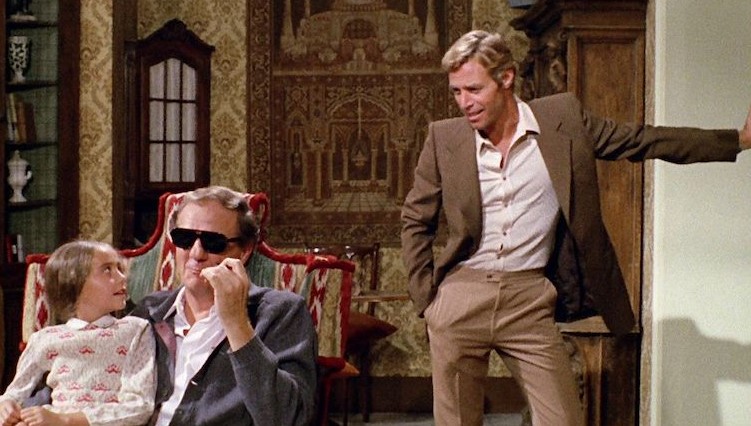
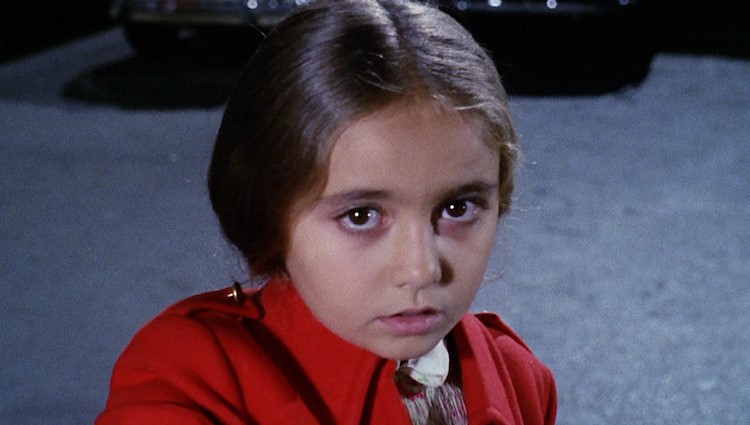
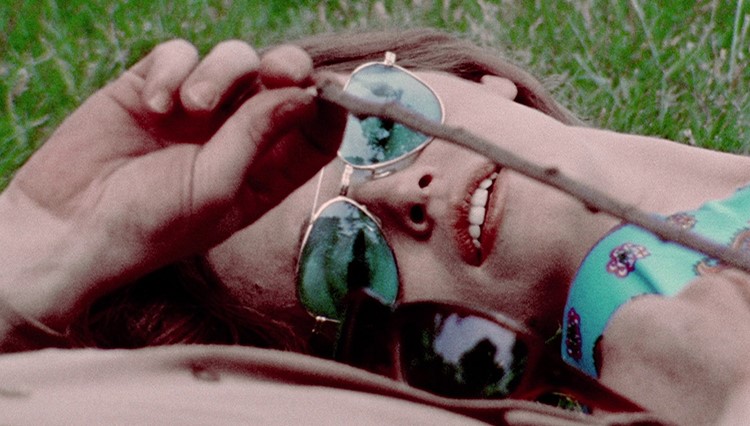
Upon walking home one evening with his niece Lori (Cinzia De Carolis) – who affectionately refers to him as “Cookie” (or Biscottino depending on whether you’re watching the English or Italian dub) – Franco Arnò (Malden), a blind crossword writer overhears a conversation which sounds suspiciously like blackmail in a car near his apartment. He thinks nothing more until a break-in at The Terzi Institute, a genetics lab, triggers a number of deaths. Ex-newspaper man Arnò joins forces with the handsome and charismatic investigative journalist Carlo Giordani (James Franciscus) and together, they do a little digging and attempt to solve the mystery, which in true Gialli style, picks off anybody who edges closer to the truth, via some nifty subjective camerawork before revealing the killer.

The Cat O’Nine Tails is an unique entry into the Argento oeuvre because it is the only film to remain uncensored in any parts of the world, and yet, by his own admission, it is one of the filmmaker’s least favourite. He believes it to be “too American”. Perhaps, it is the sprawling narrative which fixates on genetics and the XXY chromosome which can distinguish criminality – the murder gene – and the nine leads which make it increasingly convoluted and by the time the end arrives, and on a rooftop no less, the killer’s reveal feels rather arbitrary.

Less than twenty minutes in, there’s a tremendous set-piece involving a train and corpse; in addition to murder, intrigue, jump-cuts, extreme close-ups, recurring visual motifs – the filmmaker’s use of colour really is second only to Bava – glorious costumes courtesy of Luca Sabatelli and charming performances from Malden and child actor De Carolis, all backed extraordinarily by a subtle yet jarring score by that little-known composer, Ennio Morricone. While it is regarded as a lesser Argento – although not to the degree of Dracula 3DThe Cat O’Nine Tails is a stylish little number, perhaps not narratively speaking but as per Argento, a visual treat.

Arrow Video once again fleshes out their restoration with extras, although this time not quite as many or as varied as expected, the greatest achievement is that 4K restoration, the 1080p presentation, and the newly translated English subtitles for the soundtrack. The audio commentary is provided by Argento author and father of FrightFest Alan Jones, who is joined by critic/author Kim Newman. The commentary does contain spoilers so it is advisable to watch the film beforehand but it’s interesting, personally, I could listen to Alan Jones read a shopping list, but both men have fun and their vast knowledge is more than put to good use.

Special Features

Nine Lives (15:22) – An exclusive interview with co-writer/director Dario Argento recorded for Arrow Video in 2017 written, edited and directed by Federico Caddeo. In it, the filmmaker discusses the story and how he regards it as a sequel to The Bird With the Crystal Plumage and how he found shooting in Turin.

The Writer O’Many Tales (34:46) – Dardano Sacchetti wrote CONT with Argento and in this extended interview, the Italian writer discusses his career in detail, from his filmic first memory to how he met Dario Argento, and how he spent his pay check. It’s a little drawn out, and far more about the man than the film, and also twice as long as the Argento segment, in which he’s incredibly respectful to his ex-collaborator but make no mistake, there’s no love lost between the two men.

Child Star – Another new interview, this time with actress Cinzia De Carolis. This was unavailable at the time of review due to a disc error.

Giallo in Turin (15:09) – A chat with production manager Angelo Iacono, in it he discusses his 16-year relationship (seven films) with Dario Argento whom he describes as “adorable”.

Original Ending (3:07) – As originally written, The Cat O’Nine Tails didn’t end with the death of [redacted]. Footage was shot of Lori being rescued and an epilogue featuring Giordani and Terzi. While the original footage is now lost, the script pages survive and are presented here in English for the first time, containing lobby card images from the ending.

Trailers: Italian Theatrical (1:46), International Theatrical (1:52), US Domestic Theatrical Trailer (1:37)

Also included as part of the boxset is reversible sleeve featuring original and newly commissioned artwork by Candice Tripp, a double-sided fold-out poster, four lobby card reproductions and (unavailable for review) a limited edition booklet illustrated by Matt Griffin, featuring an essay on the film by Dario Argento, and new writing by Barry Forshaw, Troy Howarth and Howard Hughes.


Categories
Blu-ray film review

George A. Romero: Between Night and Dawn

When George Romero sadly passed away in July of 2017, it is fair to say the news left film fans in mourning and specifically horror fiends. Famous for his flesh-eating and satirical Dead trilogy – which would eventually become a six-film anthology by 2009, he was a filmmaker who refused to be pigeon-holed (as the films in this set will attest). Before Dawn of the Dead (1978) and Martin (1978) he completed three other features. It is these  – There’s Always Vanilla (1971), Season of the Witch (1972) and The Crazies (1973) which were lovingly restored and presented in a box set by the wonderful folks at Arrow Films and their Video label.

There’s Always Vanilla AKA The Affair was the first film made by the team behind Night of the Living Dead (1968) and was fraught with problems from the start of its troubled production. It is not so much a film directed by Romero – his style is barely recognisable – than superbly edited making the most of a flimsy plot. The film centres around a love story during the 70s in which sexuality was liberated and countercultural, clearly inspired by Mike Nichol’s The Graduate (1968) and Larry Peerce’s Goodbye, Columbus (1969) which had been released a few years before. Chris (Raymond Laine) loves Lynn (Judith Ridley) and she loves him until… they don’t, she’s a commercial actress and he’s struggling to find a niche following time served in the army.

The film was carved from a short showreel meant for Laine (a dead-ringer for a young Russell Crowe) and while the crosscutting and juxtapositions are rather heavy-handed, – and the first half feels somewhat aimless and laboured – Vanilla‘s an interesting look at the experimental cinematic mood – it captures an essence of the era. Granted, with some horrendously dated gender labels and stereotypes. There is a hint of the director during the sinister and sleazy abortion scenes in which canted camera angles and filters are employed and an ominous soundtrack plays.

There’s Always Vanilla, so named for the lead character’s father’s analogy for life – the more exotic flavours tend to be discontinued or hard to locate, you see but there’s always… well, you get the drift. The pretty metaphor within the ending which we also see at the film’s opening brings it full circle and attempts to convey the alleged freedom and liberty of the decade, or perhaps it’s also a state of mind; you’re only free if you believe you are – deeply philosophical questions for a film that started life as a showreel. While the film is dated and technically flawed, it really captures a mood and authenticity of a period and the beginnings of a filmmaker and his team at the genesis of their craft.

Season of the Witch AKA Hungry Wives (awful) or Jack’s Wife (working title) fares better. Made in 1972 and revolving around housewife Joan Mitchell (Jan White) and her eventual dabbling in the occult, courtesy of a few tarot card readings, before accepting her place in a coven. What strikes most with this film is the level of sophistication in comparison to …Vanilla. Still prevalent are some technical flaws however, from the Buñuelian and atmospheric opening to the depiction of female disillusionment within the narrative, this film is fascinating.

It isn’t necessarily about magic but rather how a woman – who wants more beyond marriage and motherhood – wishes to embrace her independence and sexual prime, and take back some power through witchcraft (almost depicted here as a completion of womanhood). One can see its distinct influence on Anna Biller’s fabulously feminist The Love Witch (2016). Using themes of oppression and transgression, it is no accident that this film’s existence stems from the period of women’s lib – patriarchy manifested as a demon-masked man on the prowl, personifying Joan’s fears, albeit within a recurring dream sequence – while fragile and toxic masculinity personified through the characters of Jack Mitchell (Bill Thunhurst) and Greg (Raymond Laine).

Season of the Witch is a gem of a film, from its avant-garde opening to the interesting depiction of gender roles coupled with the enigmatic and nuanced performance of Jan White. It feels like a primer for Martin with its political progression, religious motifs and the use of the colour red (although to differing effects).

This use of chromatic is also prominently used in The Crazies, a science-fiction-horror-thriller in which a small American town is quarantined following the accidental release of a biological weapon. The Army have “everything under control”, at least they certainly want everyone to believe they do – reinforced by a non-diegetic military drumroll punctuated sporadically throughout. We, along with the townspeople are on a need-to-know basis as all hell breaks loose and national security becomes a real concern.

We’re subjected to horrifying images as people are dragged from their sanctuary of Church or a small group of individuals are backed into a stand-off, threatened by gunfire. Then, there’s the scientist who makes a breakthrough with an antidote (the soldiers have all been inoculated first with what little antibiotics they have) only to be murdered, his vials of life-saving serum (red again) smashed around him. David (W.G. McMillan) and Judy’s (Lane Carroll) arc pulls at the heartstrings and, a few pacing issues aside, it is them we root for.

Watching the films in this boxset in chronological order shows a distinct progression in the New York native/Carnegie Mellon alum’s filmmaking. The man who made films (whether writing, directing or editing or a combination of all three) instinctively, was politically progressive, possessed a sense of humour and rarely wrote characters that weren’t multi-faceted. He depicted a rare equality within male and female characterisations and did not exploit or resort to sex.

Mr. Romero, George, you are sorely missed.

This box set of his early works between Night of the Living Dead and Dawn of the Dead – see what they did there? is replete with extras and special features and is a must-buy for any fan. He was still developing his style and craft and the films may not strike as much of a chord as the ones that followed*, however, there’s still much to enjoy and appreciate. Season of the Witch, and the Guillermo del Toro interview with George – which is a wonderful and joyous watch – are worth the purchase alone. Alternatively, all three are now available individually via Arrow.

*”My stuff is my stuff. Sometimes, it’s not as successful as my other stuff but it’s my stuff.” (G.A.R, 2011)

 
Categories
Blu-ray film review

Don’t Torture a Duckling (Dir. Lucio Fulci, 1972)

Of the three main maestros of Italian horror, it is Lucio Fulci who is regarded the most lurid, gory, even the trashiest of the trio, or at least he might have been once upon a time. Following many of the tropes associated with the genre, this Giallo also touches on prostitution, child murder, paedophilia, religion, truth, loss, and motherhood, Don’t Torture a Duckling is replete with symbolism and depth, the term ‘masterpiece’ has been somewhat cheapened over the years but this could well be Fulci’s.

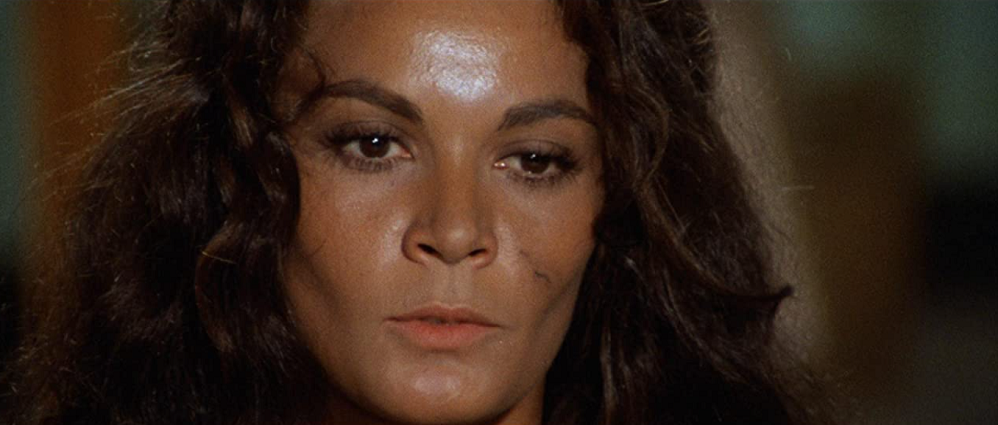
Opening in rural Southern Italy, the landscape is split by an ugly concrete motorway bringing with it a bit of modernity; prostitutes, and the ‘outsiders’ (following the first of the murders) in the form of rich ex-drug addict Patrizia (Barbara Bouchet) and city journalist Andrea (Tomas Milian). The idyll of the small village is rocked when the first of the boys, Bruno, goes missing. His brutal murder is quickly followed by the senseless deaths of his friends Michele, and Tonino. Suspicions soon lead to a local ‘witch’ Magiara (Florinda Bolkan), one-time student of eccentric black magic-practitioner Francesco (George Wilson), and of course because of her difference – even after she is exonerated – some local men take the law into their own torturous and contemptible hands, little do they know that the real culprit is much closer to home. It is down to Patrizia and Andrea to work together and expose the killer before he/she strikes again.

Mixing the thematic and stylistic tropes of the giallo with Gothic horror, Fulci makes women the interesting subjects in the narrative, especially Bolkan who is not only the most sympathetic character but whose performance is exceptional. In a film about the destruction of innocence and child murder, it isn’t actually their disturbing deaths that are the most shocking. Fulci builds the superstition and style, mood, tone and atmosphere with light and  bright wide exterior shots and juxtaposes them with claustrophobic dark interiors and yet subversively, just as the killer comes from within the community so, too, are these children killed outdoors.

Violence is, as one can expect, never shied away from and a truly gripping story intensifies to an emotional and visceral crescendo which is unforgettable thanks mainly to the editing and that slightly grating piece of pop music used to accompany the brutality. Yes, the effects are a little dated and the acting, a tad histrionic but it’s in keeping with the genre and boy, what a social commentary it provides. Traditional, old-fashioned values and small-town mentality are pulled apart and what goes hand-in-hand with that? Religion. Understandably, this film courted controversy in the eyes of the Catholic Church especially given the film’s ending, which is almost gleeful in its transgression (the director’s own Catholicism making it all the more delicious and rebellious) especially considering it’s length, audacity and those gratuitous close-ups.

While Lucio Fulci never seemed to have the sumptuous production value of Mario Bava or the operatic visual mania of Dario Argento, he’s integral to the period, Gialli, and Italian horror – Don’t Torture a Duckling more than proves that and now, thanks to Arrow Video you can view it in all its lurid high definition gory glory.

DISC EXTRAS

The Blood of Innocents (30 mins) – This video essay is delivered by Dr. Mikel J. Koven from the University of Worcester and author of La Dolce Morte: Vernacular Cinema and the Italian Giallo Film. He discusses the concept of ‘vernacular cinema’ (those films which tend to avoid the bourgeoise mainstream audience) with enthusiasm and makes this a fascinating lecture. While it is ultimately a bloke behind a desk, the essay is intercut with many clips of multiple film texts which fall under the Giallo umbrella including work from Sergio Martino, Dario Argento, Pupi Avati, and Antonio Bido.

Hell is Already in Us (20 mins) – Written and narrated by Kat Ellinger, this audio essay focusses on violence and gender with Ellinger defending the claim that Lucio Fulci was a misogynist filmmaker. She refers specifically to his 1982 New York Ripper and Don’t Torture a Duckling to state her case; that Fulci confronts the taboo and uses his art-form to comment upon civilisation and depicting oppressive patriarchal society in all its evil glory.

Audio Interview (Part 1: 20 mins/Part 2: 15 mins) – In August 1988, journalist Gaetano Mistretta sent a letter with a list of questions to the filmmaker and Fulci recorded an audio tape complete with all his answers and sent it back to Mistretta. It’s a great listen full of personal anecdotes about his process, his grandchildren even though we all know, he adds with a chuckle, that “children are monsters”, his favourite filmmakers (Argento, Cronenberg, Kubrick and Bava) and the correct length of a horror film (it’s 80 mins btw).

Interview with Florinda Bolkan (27 mins) – Filmed for Freak-O-Rama in 2016, one of Don’t Torture a Duckling‘s leading ladies chats about her experiences on set with Fulci (having completed A Lizard in a Woman’s Skin the previous year with him), whom she deemed a gentle man and genius. Discussion turns to that scene and despite never viewing it in its entirety, she agrees to watch it for the first time in 44 years, and is understandably horrified by it. Additional segments from this 2016 programme are also contained in the special edition content , all include those involved with Duckling including: The DP’s Eye (45 mins) – time spent with cinematographer Sergio D’Offizi, From the Cutting Table (25 mins) – assistant editor Bruno Micheli takes us through his process and in Endless Torture (15 mins) make-up artist Maurizio Trani talks his history with make-up, Fulci and the special effects used during the Bolkan scenes.

Audio Commentary provided by Troy Howarth, author of So Deadly, So Perverse: 50 Years of Italian Giallo Films.

Reverse sleeve featuring original and newly commissioned artwork by Timothy Pittides.

First pressing only: collector’s booklet with new writing on the film by Barry Forshaw and Howard Hughes (not available for review).

Region: AB 1/2|Rating 18|Language: Italian/English|Subtitles: English|Aspect Ratio: 2.35:1|Audio: Mono|Colour|Discs: 2