Categories
film review

Fingernails (Dir. Christos Nikou, 2023)

Anna (Jessie Buckley) drives along just as the dulcet tones of Bonnie Tyler’s Total Eclipse of the Heart fades out on the radio. The DJ thanks the caller for their request and commiserates on their negative test “it happens to us all”. Anna is a teacher currently between jobs and even the woman on the other side of the desk asking her job-related questions is lamenting negative results. While all will become clear whatever is happening is effecting plenty of people. Plus, if you have seen Christos Nikou’s debut film Apples, you’ll know that this almost-dystopia isn’t so far removed from the world we currently inhabit.

Later that evening, Anna receives a phone-call from The Love Institute offering her a job – overcome with curiosity she accepts on the spot but keeps it to herself. At dinner with her partner, Ryan (Jeremy Allen White) and coupled friends the ‘tests’ are explained, sort of. Couples visit The Institute, take the test, and based on its outcome it will be determined if those in the relationship(s) are actually in love. Anna and Ryan took it years previously, they are what Helen Fielding would call ‘smug marrieds’ (albeit just co-habiting and not actually married). Did you know that only those who sleep soundly and sing aloud to songs are actually in love?
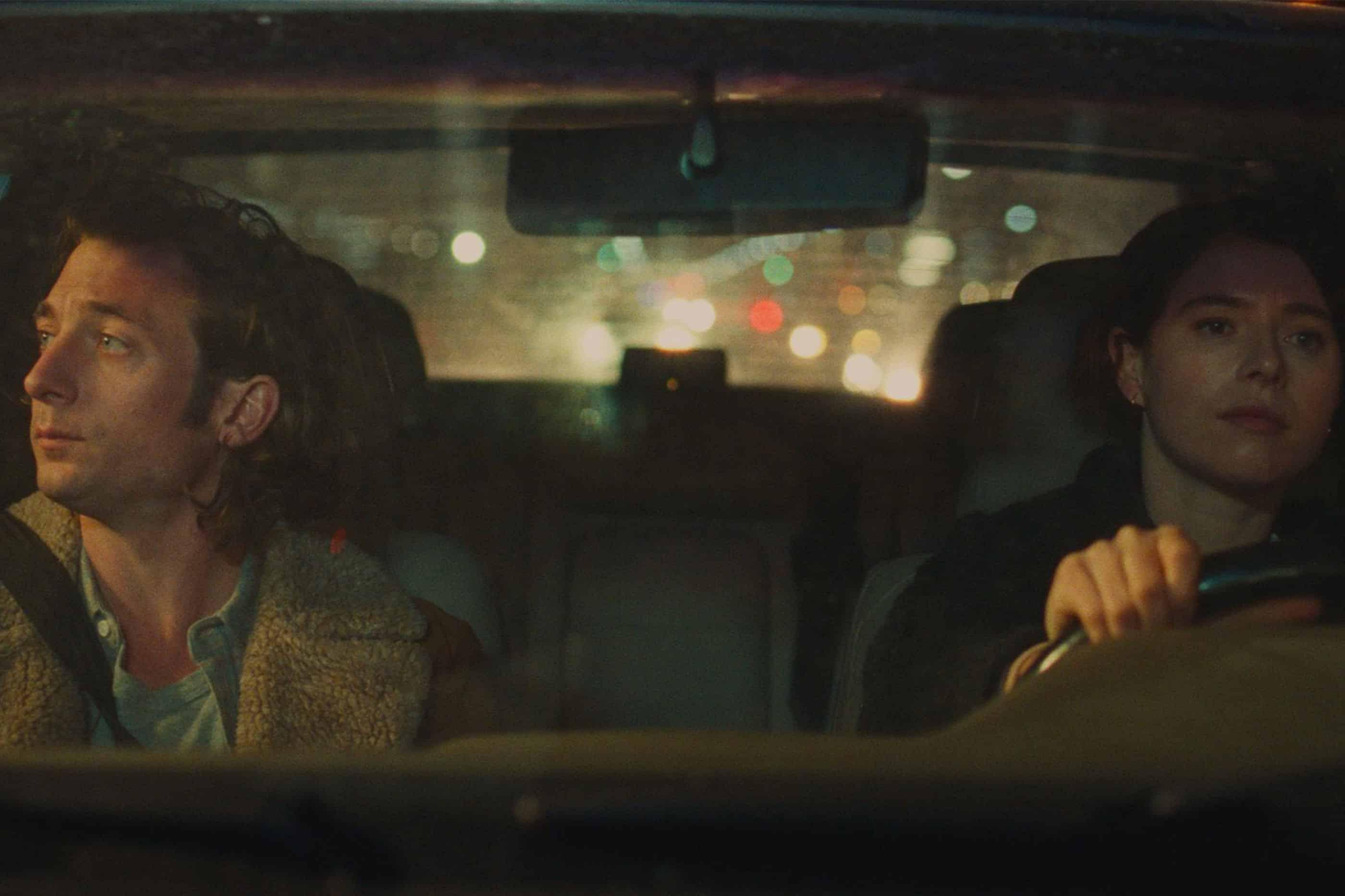
When she starts at her new place of work under the management of divorcé Duncan (Luke Wilson). He who delivers her induction which includes Playmobil figures and a multitude of toy-realised scenarios (meet-cuticles, shall we say… I’ll get my coat). Anna is then assigned to shadow Amir (Riz Ahmed) as she learns the ropes. It’s a quirky set-up in which couples arrive (in a multitude of races but always heteronormative duos. NB. the gay couple who ‘break’ the machine later in the film) and are put through their paces, their connection prodded and poked at, their bond put to a slew of tests. Like, can they identify their partner while blindfolded just from body odour or do they trust each other enough to be flung out of a plane from a great height while sharing a parachute? All the while listening to the sound of pee-inducing rain through the sound system or only singing French lyrics during karaokec’est romantique et la lange d’amour!

Just like in Apples, the analog and digital dichotomy is blindingly obvious and yet again, somebody is assigning tasks/tests to ascertain some kind of proof of diagnosis as it were i.e. loss of memory or, here, romantic compatibility. Until the final test and they have a fingernail (of their choosing) ripped out with pliers which is then placed in a petri dish and shoved in a microwave-esque piece of machinery before the result is determined.

Anna throws herself into her job and makes many test suggestions along the way, some of these even find their way home. Perhaps she and Ryan can shower each other after drawing their portraits or pull a Sam/Molly Swayze/Moore at the pottery wheel. It becomes apparent that Anna is delighted by love and the prospect of it and yet still won’t disclose to her one-and-only where she goes everyday. Why is she so bothered by his opinion (he loathes the Institute though we never find out why)?

Like its predecessor, Fingernails is a quiet, wry look at love and human connection, an allegory on the belief of love. Its premise isn’t so far-fetched when one considers how the majority of us look for it in this day and age courtesy of social media, dating apps and the reliance of technology. Matches made based on a percentage score following a few asinine and inconsequential questions, algorithm and the swiping of a finger. There’s a timeless quality before technology is onmipresent – shot on 35mm - to the film, a space without mobile phones before technology is omnipresent. Visuals suggest it could be the nineties but music gives an eighties flavour. The soundtrack is, just like Apples, perfectly curated for the subject matter at hand: Bonnie Tyler’s Total Eclipse of the Heart, Only You and Don’t Go by Yazoo, and Frankie Valli’s The Night providing emotional heft and accompaniment when needed.

There’s an Eternal Sunshine of the Spotless Mind melancholy and Truman Show tragi-comedy to Nikou’s sophomore feature which is less dark (figuratively and literally speaking), the colour palette is still muted and muddy in tone with the occasional flash of red. The filmmaker refutes the whole ‘Greek Weird Wave’ label and cites American cinema as his main influence - hammered home by the North American setting and English speaking cast. Stylistically speaking it is not quite dystopian but something is definitely off in this absurdist allegory and the search for human connection and true love. Love is instinctual, it needs to be felt, and according to a working class hero is all you need. The course of which never did run smooth, unlike the healthy nailbed.

Fingernails is available to watch on Apple TV+

Categories
Film Festival film review

Apples (Dir. Christos Nikou, 2020)

We are introduced to the nameless protagonist of Apples [Mila], played by Aris Servetalis, in his apartment, through a series of cuts (or polaroid snapshots) restlessly listening to the radio…staring impassively into space… banging his head against the doorframe before venturing out to buy the flowers himself much like the eponymous Mrs. Dalloway. Though there is no party in sight for Aris as he wanders aimlessly through the city and eventually falls fast asleep on a bus taking him from A to B. When the driver awakens him, Aris doesn’t recall where he should have alighted, his name or where he lives – his lack of identification only confirms it and he is packed off in an ambulance to the Disturbed Memory Department of the Neurological Hospital for evaluation.

From there, he is assigned a number (14842) and afforded a new life as an amnesiac. Sudden onset amnesia is not seen as unusual as the seemingly irreversible epidemic sweeps across a modern, yet strangely analogue Athens, with neither sight nor sound of a mobile device. All amnesiacs (at least those not claimed by family members) are given tape recorders and polaroid cameras. The cassette tapes containing prompts of how to manage their “new beginnings” and the cameras are to snap proof of how they spent their days; photos stored in albums for posterity.

Christos Nikou served as Yorgos Lanthimos’ AD on Dogtooth and it initially shows. His film – based on a screenplay he co-wrote with Stavros Raptis – does fit within the so-called Greek Weird Wave in which filmmakers and writers such as the likes of Panos H. Kontras, Lanthimos, Athina Rachel Angari, and Efthymis Filippou have given us some brilliantly strange pieces of work that have painted a unique, often ideological, versions of Greek society. Yet, while his predecessors liked the darker, mordant aspects of life, Nikou’s film is far more heartfelt and poignant.

Aris throughout plays it deadpan even when he meets fellow new beginner Anna (Sofia Georgovassili) and as he chomps his way through, roughly, an orchard. Servetalis is a combination of Daniel Day-Lewis and Buster Keaton, the line between bizarre and funny grows increasingly blurry as the film progresses, as to the linearity of the whole thing is anybody’s guess. The 4:3 aspect ratio harks back to the silent era and helps to further detach from reality – although the whole Athens-epidemic-as-narrative-device strikes close to home as we, like Aris, find a new weird normal – in our case remembering to smile with our eyes beneath the material which covers the rest of our face.

The film is a very quiet and wry allegory with several laugh-out-loud moments involving a Batman, and even a nod to an Outcast lyric. Its use of colour is gorgeous, the daylight palette tends to be muddy blues, greys and muted greens while the nights tend to be oranges and ochres much like the innards of a mouldy apple. The use of music is astute with all feeding into the theme of memory and remembrance: “Scarborough Fair”, “Seal It With A Kiss”, and “Let’s Twist Again” (although, this arguably has a dual meaning) – tenuous it may be but even “Ave Maria” mentions fruit!

Apples is a brilliant and absurdist rumination on loss, memory, identity and human connection. It ponders selective memory – the want to forget what’s in the memory bank, the fight to remember by heart and if there’s a difference, and what the hell did we do before the smart phone and documenting our days.

Apples will be available exclusively on Curzon Home Cinema from Friday 7th May.

Categories
Blu-ray film review

Under the Shadow (Dir. Babak Anvari, 2016)

In Two & Two (2011) – Babak Anvari’s BAFTA-nominated short allegorical film – a teacher (Bijan Daneshmand) attempts to re-educate his male pupils with some basic arithmetic, claiming that what they have always been taught is no longer true. The writer-director packs quite the punch with very little exposition and a whole lot of nuance when depicting the absurdity of an authoritarian regime/dictatorship. Which all bodes well when your next film – and first feature – is an effective little horror (and would become BAFTA award-winning in its own right). It is also a lovely touch to have that same actor play the University Dean who is responsible for shattering Shideh’s dreams of becoming a Doctor.

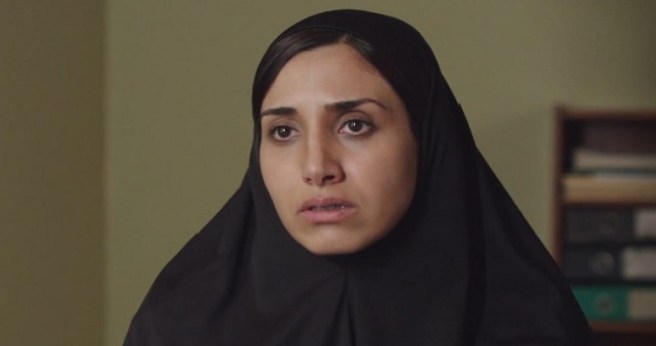
Under the Shadow is set in Tehran during the Iran-Iraq war of the 1980s and Shideh (Narges Rashidi) can no longer study medicine having been removed for her political beliefs. We are never party to what exactly her transgression is but suffice to say with the mention of ‘radical left groups’ she was – and probably still is – against the war that is currently waging in her country.

Once her chador is removed, we can ‘see’ some of her transgressions. Her hair cut (in a bob style), dress (westernised), and her autonomy around her home; the partnership with her husband, exercising to Jane Fonda. she’s also the only woman in the building who drives. This is a ‘modern’ woman, oppressed by external tradition and reduced to the confines of her four walls, and even those are not so secure with the shelling, daily explosions and air raids which can send residents into a panic at any given moment.

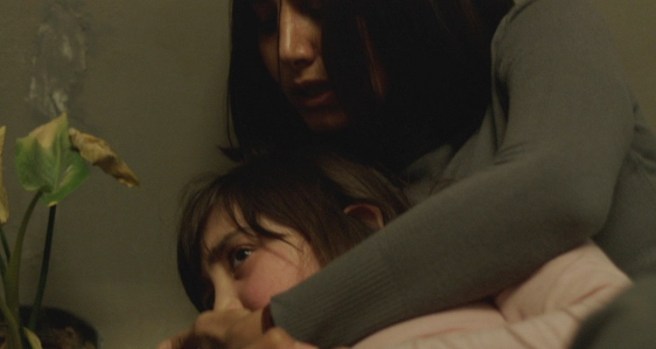
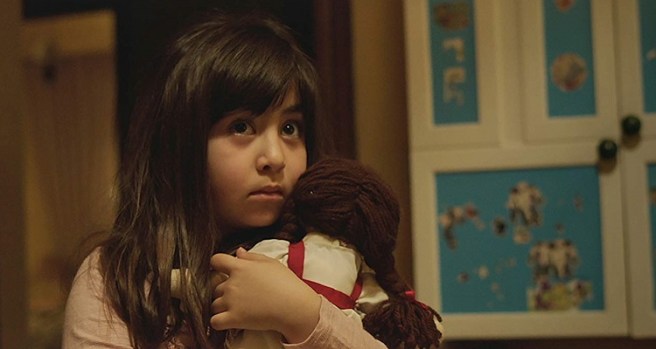
When her husband Iraj (Bobby Naderi) receives his draft notice, Shideh is left with her young daughter Dorsa (Avin Manshadi) as, one by one, all her neighbours pack up and move onto safety. The exacerbating factor a shell crashing through the roof of their building, killing the elderly resident within and leaving a gaping hole. The hole is covered with a sheet which appears to undulate in the wind like a bodily organ, flapping in and out like a heartbeat. A visual metaphor of a damaged culture, while the cracks in the ceiling – it can be argued – relate to Shideh’s psyche. Ever increasingly isolated, Shideh and Dorsa begin to experience things which may be the product of a child’s imagination or something altogether more supernatural.

Djinn is a malevolent spirit which has its history in Early Arabia and then later in Islamic mythology and theology. An entity that travels on the wind until it finds somebody to possess. Often dismissed as a superstitious belief, the spirit is reported to enjoy the souls of children (much like Krampus in European culture, or el Cuco in Latin America). It may explain Dorsa’s fever or not, after all Shideh was also once a child. Evil wants to hurt them alleges one neighbour while another, Mrs. Fakur (Soussan Farrokhnia), attempts to allay her friend’s fear: “people can convince themselves of anything if they want to”.

Tight framing adds to the oppressive atmosphere as mother and daughter’s fear and anxiety builds. Tension is slow-burning, and jump scares are few and far between yet effective when they do occur. There’s no score (music is only played during opening and closing credits) so is reliant upon diegetic noise and whistling winds. We’re never sure of the time of day given the constantly closed curtains and disturbed sleep patterns.

What appears to be mere moments gives the impression of hours. As people leave we can assume the passing of days and weeks yet the costumes of the leads mostly remain the same. Natural and artificial also play havoc with this, along with the production design: one location, open doors, hallways, and reflections in the television mean the constantly moving camera plays tricks with the eyes – was that something moving or not? Shideh’s lip is bruised from the constant biting, insecurity, anxiety, stress. Like all amazing genre films – nothing is ever quite how they appear and this film is all the better for it building beautifully the general sense of unease.

It seems apt that when she is preparing to fight, Shideh’s weapon of choice is a pair of scissors – as if tethered to a more domesticated past, her own mother’s apron strings or the chador in this instance. While the malevolent being appears to be set on persecution – even referring to the character as a ‘whore’ and ‘bad parent’ – it’s important to remember that Djinn is not inherently evil or good, and this entity could, at some point, be Shideh’s mother from beyond the grave.

A matriarch disappointed that her daughter will no longer practice medicine but needs to save her by forcing her to leave the building. Think back to the picture frame which houses Shideh’s mother’s portrait, the fractured glass obscuring the image within, it now laying down on the shelf hidden from view – but before that, the draped material serving as a backdrop in the photo is identical to the chador the entity embodies itself within. This reading further strengthens the mother-daughter links throughout, and the expectations a patriarchy levels at women, generally, but more so during the kind of regime in Tehran of the 80s.

As a first feature, Under the Shadow wears its influences well: Polanski’s apartment trilogy (Repulsion [1965], Rosemary’s Baby [1969], The Tenant [1976]) with a sprinkling of Hideo Nakata’s Dark Water via a domestic social realist drama in the ilk of Abbas Kiarostami and Asghar Farhadi. It’s a rich and visually arresting film which checks all of the above as well as featuring, at its heart, a really affecting horror fable. A 1980s Tehran-set horror film filmed entirely in Farsi – the first of its kind.

Finally, it has been given the kind of release it deserves courtesy of Second Sight that includes plenty of extra features, including five new interviews with the filmmaker, cast and crew, as well as a lively commentary between Director Anvari and film critic Jamie Graham, in which every aspect of the film’s genesis, production and release is covered.

Extras

Two & Two (8:48) – Babak Anvari’s BAFTA-nominated short film shown in its entirety. It’s the one extra which can be watched before the main feature.

Escaping the Shadow (23:53) – A long interview with Anvari who begins with his own childhood nightmares growing up in 80s Iran before his move to Britain. He talks at length about the filmmaking process, his cast, shooting in Jordan and expands upon things mentioned in the commentary. He’s a delightful interviewee, and while it is not the most imaginatively filmed featurette, Anvari’s charisma shines through.

Within the Shadow (12:52) – Star of Under the Shadow, Narges Rashidi discusses her own childhood in Iran and Germany and career now she is LA based. She describes the film as a ‘beautiful gift’, and again, static camera and a by-the-book interview reveals an excitable and rather lovely person.

Forming the Shadow (16:11) – Lucan Toh and Oliver Roskill talk all things ‘producer’, how they met Babak, the script, the film’s potential and their brief disappointment at not having to sell the film when it premiered at Sundance. A lot of their anecdotes are repeated in the commentary track.

Shaping the Shadow (13:29) – Anvari’s close collaborator and DoP Kit Fraser talks about his involvement from before the script was even written.

Limited Edition Contents – This set is limited to just 2000 copies, comes in a rigid slipcase featuring new artwork by Christopher Shy and with a soft cover book with new essays by Jon Tovison and Daniel Bird (unavailable at time of review). Plus behind-the-scenes photos, concept illustrations, and a poster with new artwork.

Categories
film review

Thelma (Dir. Joachim Trier, 2016)

Thelma opens with a picturesque long shot as a young girl and, presumably, her father walk across an ice-covered lake to the deep blanket of – audibly underfoot crunching – snow where father and daughter head into the woods to go hunting. The man stops and lifts his rifle, taking aim at an approaching deer only to turn it onto the back of the head of the small child dressed in red. It immediately calls to mind Snow White and her trip with the Huntsman and even a little Red Riding Hood.

Fade to black – signifying a time lapse – and an aerial shot slowly zooms in and follows a young woman (also wearing a red tone) as she walks across campus and into a biology lecture. So sets the scene of Joachim Trier’s fourth feature. Once again he partners with screenwriter Eskil Vogt to bring something a little different yet equally as beautiful and resonant as Reprise, and Oslo, August 31st, if far more supernatural and allegorical in tone.

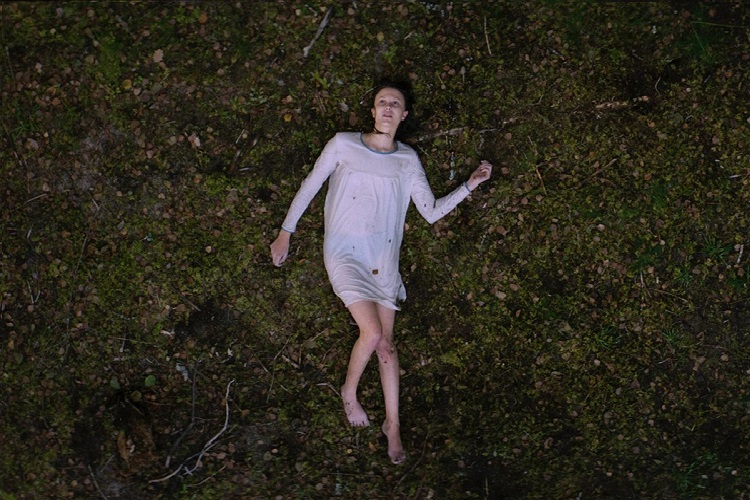
Thelma (Eili Harboe) is a shy loner, has stiflingly over-protective and controlling parents (Blind’s Ellen Dorrit Peterson and Henrik Rafaelsen) and begins to experience seizures, seemingly triggered by her meeting Anya (Kaya Wilkins). Slowly, she begins to integrate herself into a social circle, her Christian upbringing a source of fascination for some of her new friends. Torn between fulfilling her parents’ expectations, self-acceptance and suppressing everything else – including her attraction to Any – Thelma’s psychogenic seizures begin to debilitate until she seeks medical help and the truth about her condition is revealed.

While a coming-of-age with supernatural elements is nothing new, Trier’s evocative, moody and visually arresting love story manages to sustain its mystery for the 116-minute runtime. Some may be reminded of Carrie but this has more in common with Let the Right One in (2009) and When Animals Dream (2014) riffing on the Female Gothic, Nordic-style, via horror tropes/themes offering a melancholic and deliberately paced affecting drama. True to Trier form, there is the signature neutral colour palette of greys, blues and muted tones punctuated with the occasional burst of colour, the slightly voyeuristic camera courtesy of Jakob Ihre’s cinematography, along with the jarring soundtrack (that occasionally diminishes into deafening silence) by composer Ola Fløttum.

Okay, so the Freudian/religious imagery is a little on the nose but for a modern day gothic fairy tale-come-teen-drama, Thelma deals beautifully with the ambiguity of growing-up, trauma, and the end of oppressive patriarchal control, as well as the need for autonomy, self-love and acceptance.

Categories
Blu-ray film review

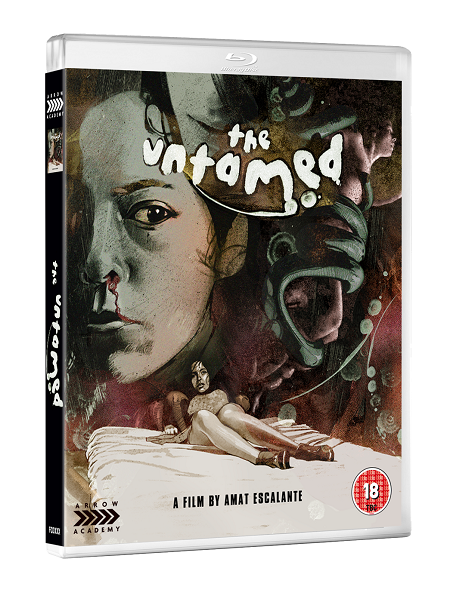
The Untamed (Dir. Amat Escalante, 2018)

Never one to shy away from the confrontational, Amat Escalante’s follow up to the unflinchingly brutal Heli (2012) is available now on DVD and Blu-ray courtesy of Arrow Films and its Arrow Academy label.

Straddling science fiction, horror and a Mexican kitchen sink drama, The Untamed, begins with a lingering shot of a meteor hovering in space. Its crash to Earth occurs off-camera but leaves a large crater in its wake and t brought something with it. That ‘something’ has tentacles, presumably a respiratory system of sorts, despite having no visible organs or features, and has taken up residency in the barn of an ageing couple (played by Oscar Escalante and Bernarda Trueba). It has a regular visitor in the form of Verónica (Simone Bucio) who, well it’s never made implicit what or how she serves the alien form despite strong indications; only that on this occasion, she is injured and forced to leave and find aid.

Shocked and bleeding, she seeks refuge in a local hospital where her wound is treated by Fabián (Edén Villavicencio) and one thing leads to another and the lonely and somewhat mysterious Verónica inserts herself into the gay nurse’s life and by extension his sister Ale (Ruth Ramos) and her less-than-blissful domestic set-up with cheating, bullish homophobe husband Ángel (Jesús Meza) and their two small boys. The stranger convinces them that the life form which resides in that barn is the answer to their problems just prior to and even after devastating, irreparable tragedy.

Apparently made as a direct response to chauvinism, mainstream homophobia and the moral perception of tragedy, this fantastical allegory builds atmosphere with a literal humming buzz in the diegesis and taps into our basest primitive state, and the relationship between pain and pleasure. This dichotomy is beautifully depicted through Ale and Angel’s youngest son and his love of chocolate, he knows he’s allergic but can’t resist. Those moments of gratification are worth it, even if it means an angry-looking itchy red rash and a prodding injection. Seemingly, for the adults, pain and pleasure mature through sex and violence, however, this is never fully connected within the film’s narrative, the strange alien life force or the human subjects.

The Untamed deals with hefty subject matters and is a human drama within a sci-fi-erotic-horror film. Several scenes are clearly influenced by Andrzej Žulawski (the late filmmaker is even acknowledged in the closing credits), there are moments which feel Cronenbergian, and even includes a scene which reminded of von Trier’s Antichrist (2009). The horror aspects never feel forced and are fascinating, specifically the creature, one is drawn to it much like the lost souls in the film yet it’s not given that much screen time. Sadly, it is in the human drama aspect that the film falls down. There was an intensity, rage and heft to Heli and even Žulawski’s Possession (1981) (if we’re to take that as the main text of inspiration) which feels missing here; yes it’s subversive, intelligent, and well put together but overall muted and a little disappointing.

DISC EXTRAS

The Making of The Untamed (84 mins) – this in-depth footage takes us behind the scenes with the cast and crew of the film, shot by one the film’s composers and the director’s brother, Martín Escalante. There are fascinating moments, warm interludes between filmmaker and his collaborators – who seem to compromise of some long-term friends and family members – and laborious retakes in shooting. Amat Escalante is a perfectionist, that much is clear.

Amarrados (Tied Up) (15 mins) –  Escalante’s first short which took first prize at the 2002 Voladero International Film Festival in Mexico and won him Best Short and Best Director at the Newport Beach International Film festival in 2003. Shot in black and white, the film centres around Niño (Abel Diaz), a young homeless boy who’s stuck in a vicious cycle of sexual abuse and glue-sniffing. There’s a beauty amid the misery in this short, in which class, race and religion are alluded to and Escalante’s follow-shot is included: a great edition to the disc.

First Pressing Only – Booklet featuring new writing on the film by critic and author Alexandra Heller-Nicholas, writing by critic Jonathan Romney, the director’s statement and extracts from the press book, illustrated with original stills (unavailable at the time of review).

Region: B/2|Rating 18|Language: Spanish|Subtitles: English/English SDH|Aspect Ratio: 1.66:1|Audio: Mono|Colour|Discs: 1