
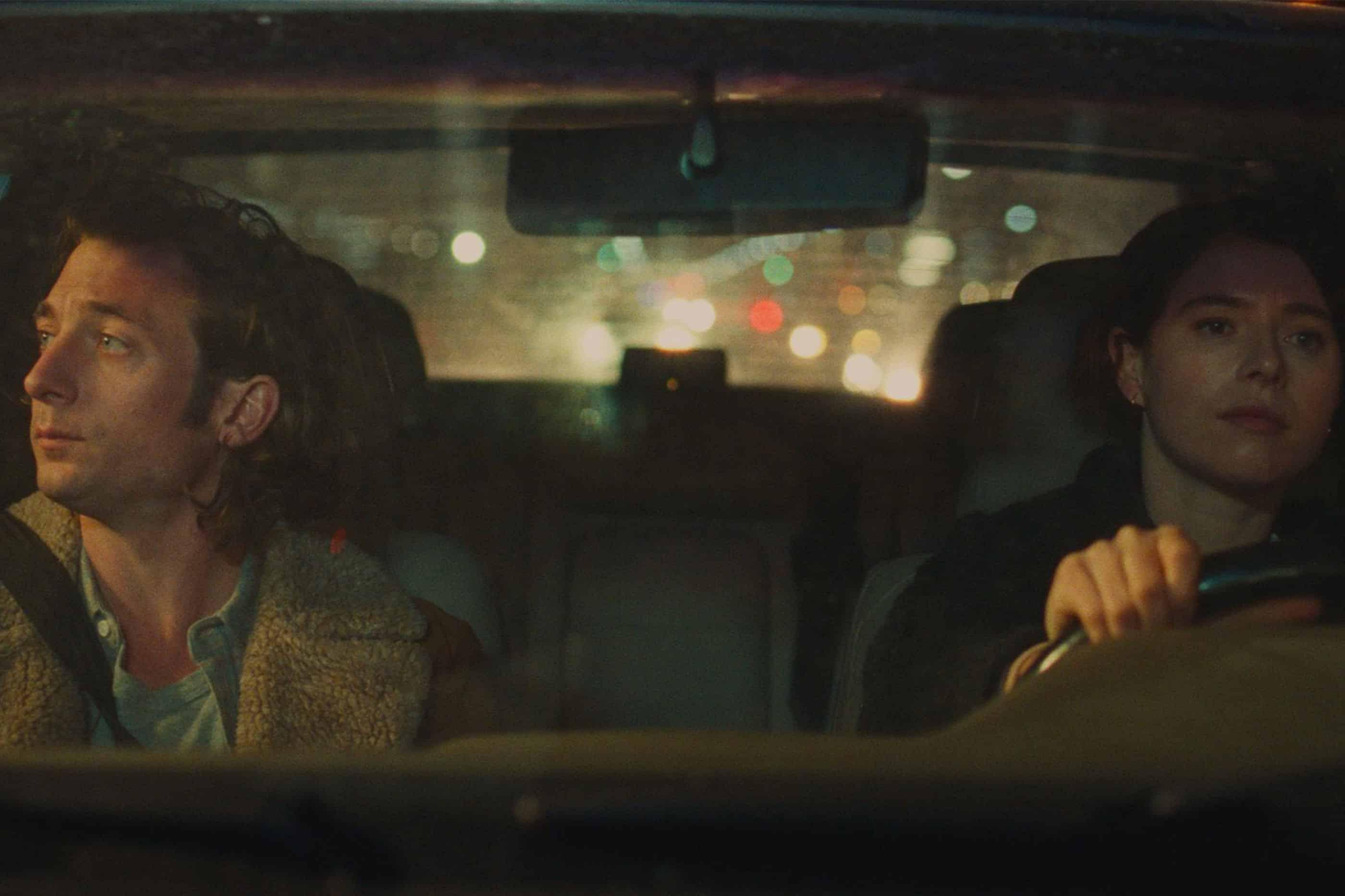
Anna (Jessie Buckley) drives along just as the dulcet tones of Bonnie Tyler’s Total Eclipse of the Heart fades out on the radio. The DJ thanks the caller for their request and commiserates on their negative test “it happens to us all”. Anna is a teacher currently between jobs and even the woman on the other side of the desk asking her job-related questions is lamenting negative results. While all will become clear whatever is happening is effecting plenty of people. Plus, if you have seen Christos Nikou’s debut film Apples, you’ll know that this almost-dystopia isn’t so far removed from the world we currently inhabit.
Later that evening, Anna receives a phone-call from The Love Institute offering her a job – overcome with curiosity she accepts on the spot but keeps it to herself. At dinner with her partner, Ryan (Jeremy Allen White) and coupled friends the ‘tests’ are explained, sort of. Couples visit The Institute, take the test, and based on its outcome it will be determined if those in the relationship(s) are actually in love. Anna and Ryan took it years previously, they are what Helen Fielding would call ‘smug marrieds’ (albeit just co-habiting and not actually married). Did you know that only those who sleep soundly and sing aloud to songs are actually in love?
When she starts at her new place of work under the management of divorcé Duncan (Luke Wilson). He who delivers her induction which includes Playmobil figures and a multitude of toy-realised scenarios (meet-cuticles, shall we say… I’ll get my coat). Anna is then assigned to shadow Amir (Riz Ahmed) as she learns the ropes. It’s a quirky set-up in which couples arrive (in a multitude of races but always heteronormative duos. NB. the gay couple who ‘break’ the machine later in the film) and are put through their paces, their connection prodded and poked at, their bond put to a slew of tests. Like, can they identify their partner while blindfolded just from body odour or do they trust each other enough to be flung out of a plane from a great height while sharing a parachute? All the while listening to the sound of pee-inducing rain through the sound system or only singing French lyrics during karaoke – c’est romantique et la lange d’amour!
Just like in Apples, the analog and digital dichotomy is blindingly obvious and yet again, somebody is assigning tasks/tests to ascertain some kind of proof of diagnosis as it were i.e. loss of memory or, here, romantic compatibility. Until the final test and they have a fingernail (of their choosing) ripped out with pliers which is then placed in a petri dish and shoved in a microwave-esque piece of machinery before the result is determined.
Anna throws herself into her job and makes many test suggestions along the way, some of these even find their way home. Perhaps she and Ryan can shower each other after drawing their portraits or pull a Sam/Molly Swayze/Moore at the pottery wheel. It becomes apparent that Anna is delighted by love and the prospect of it and yet still won’t disclose to her one-and-only where she goes everyday. Why is she so bothered by his opinion (he loathes the Institute though we never find out why)?

Like its predecessor, Fingernails is a quiet, wry look at love and human connection, an allegory on the belief of love. Its premise isn’t so far-fetched when one considers how the majority of us look for it in this day and age courtesy of social media, dating apps and the reliance of technology. Matches made based on a percentage score following a few asinine and inconsequential questions, algorithm and the swiping of a finger. There’s a timeless quality before technology is onmipresent – shot on 35mm - to the film, a space without mobile phones before technology is omnipresent. Visuals suggest it could be the nineties but music gives an eighties flavour. The soundtrack is, just like Apples, perfectly curated for the subject matter at hand: Bonnie Tyler’s Total Eclipse of the Heart, Only You and Don’t Go by Yazoo, and Frankie Valli’s The Night providing emotional heft and accompaniment when needed.
There’s an Eternal Sunshine of the Spotless Mind melancholy and Truman Show tragi-comedy to Nikou’s sophomore feature which is less dark (figuratively and literally speaking), the colour palette is still muted and muddy in tone with the occasional flash of red. The filmmaker refutes the whole ‘Greek Weird Wave’ label and cites American cinema as his main influence - hammered home by the North American setting and English speaking cast. Stylistically speaking it is not quite dystopian but something is definitely off in this absurdist allegory and the search for human connection and true love. Love is instinctual, it needs to be felt, and according to a working class hero is all you need. The course of which never did run smooth, unlike the healthy nailbed.
Fingernails is available to watch on Apple TV+

 The Framing Device