Word of mouth can make or break a film and (some) reviews have been less than kind about Ava DuVernay’s A Wrinkle in Time. Her earlier work has consisted of documentaries This is the Life (2008), and 13th (2016), indie drama I Will Follow (2010) and romance Middle of Nowhere (2012) before using the historical biopic to really make her mainstream mark with Selma (2014). Her current Netflix smash is the absolutely stunning mini-series When They See Us (2019). Aside from the occasional repeat casting (namely David Oyelowo who voices The It here) the commonality of these films is their setting deep within the African American experience – and this is only set to continue as Hollywood has the overhaul it so desperately needs, and the world gets to embrace the work of Barry Jenkins, Ryan Coogler, Jordan Peele and DuVernay.
Tackling Madeleine L’Engles much loved children’s novel of the same name and deemed unfilmable (though attempted for TV in 2003), DuVernay brings it to the big screen – with a reported $100 million budget – amid fantastical imagery and visual effects (and some occasionally weak CGI), however, the themes it tackles feel particularly relatable and relevant regardless of the fifty-six year old story.
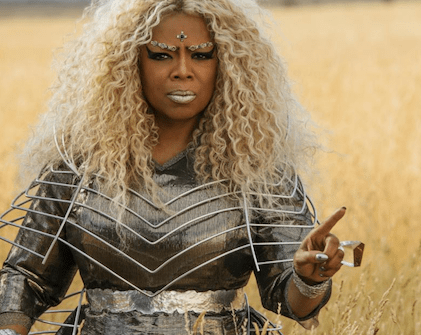
Meg (Storm Reid) is a social outcast at school, made all the weirder by her father’s disappearance four years previously. Dr. Alex Murry (Chris Pine) in his search of travel via a Tessaract vanished without a trace leaving fellow physicist (and wife) Dr. Kate Murry (Gugu Mbatha-Raw) to raise their children – Meg and her brother Charles Wallace (Deric McCabe) – alone. However, upon a visit from Mrs. Whatsit (Reese Witherspoon), encouragement from Mrs. Which (Mindy Kaling) albeit through inspirational guidance from Mrs. Which (Oprah Winfrey), Meg decides to take Charles Wallace and school pal Calvin (Levi Miller) and go look for her Dad and bring him back home if she can. She only needs to journey across time, space and several dimensions, and most importantly believe in herself.
Okay, so there’s little here that you haven’t seen in some form before – not least that television adaptation from 2003. There are some nice touches, Paco Delgados’ costumes for one and it certainly looks pretty, reminiscent of The Wizard of Oz/The Wiz. Definitely a personal preference but André Holland as Principal James Jenkins (a possible reference to activist/writer Baldwin and filmmaker Barry) isn’t in it nearly enough, nor Michael Peña (sporting splendiferous facial hair as Red). For all the lack of subtlety, it wears its heart on its sleeve – a very simple, powerful message at its core.
It seems a shame that Jennifer Lee and Jeff Stockwell’s screenplay includes such heavy handed bombastic dialogue (along with some meandering camera work which can prove distracting), I’m sure its genus has likely come from the pages of the book but one wonders if small children would grasp some of the more complicated terminology. There’s little doubt that its scientifically viable, there was even a scientific advisor – Dr. Stephon Alexander – on set, but the film is so thematically broad that it ambles to a conclusion which feels more like the end of a series of visually impressive vignettes rather than one completed feature.
Much like that other big budget Disney production Black Panther, it takes its cues from the Afro-futurism genre, vibrant in colours and thematic similarities like the absentee father and embracing the warrior within. It is after all a Disney film so there are certain expectations. While it may not be to the taste of the adults, there’s plenty for children to enjoy not least the “greatest mind of our time” belonging to the squeaky voiced six-year-old Charles Wallace. Deep and meaningful monologues seek to empower the tween generation and why not? Love triumphs over evil, facing darkness can bring the light, a young person embraces their inner strength to rescue their missing parent… certainly plenty of films check this list, however, few of these young protagonists look like Storm Reid and Deric McCabe.
A Wrinkle in Time is nowhere near as dire as you may have been made to believe – despite its budget and subsequent box-office loss – the second half improves on the first, just suspend your disbelief a smidge more. A young girl who realises her strength, intellect, courage and beauty, ignores the bullies and believes in herself is to be celebrated.
The tale of Snow White was published by Grimm brothers Jacob and Wilhelm in their Hausmärchen collection and has seen many a filmmaker make attempts to adapt the classic fairy tale to the big screen including Walt Disney, Michael Cohn and most recently Tarsem Singh and Rupert Sanders. Both directors released, respectively, very different versions, however, since literary publication in 1812 it has taken some 200 years for a truly original retelling to be produced and Blancanieves (2012, dir. Pablo Berger) not only pays tribute to silent cinema but also serves as a love letter to Hispanic culture and historiography.
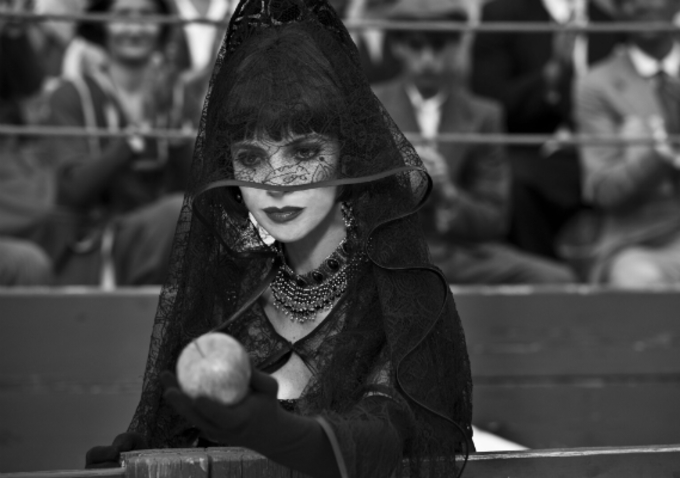
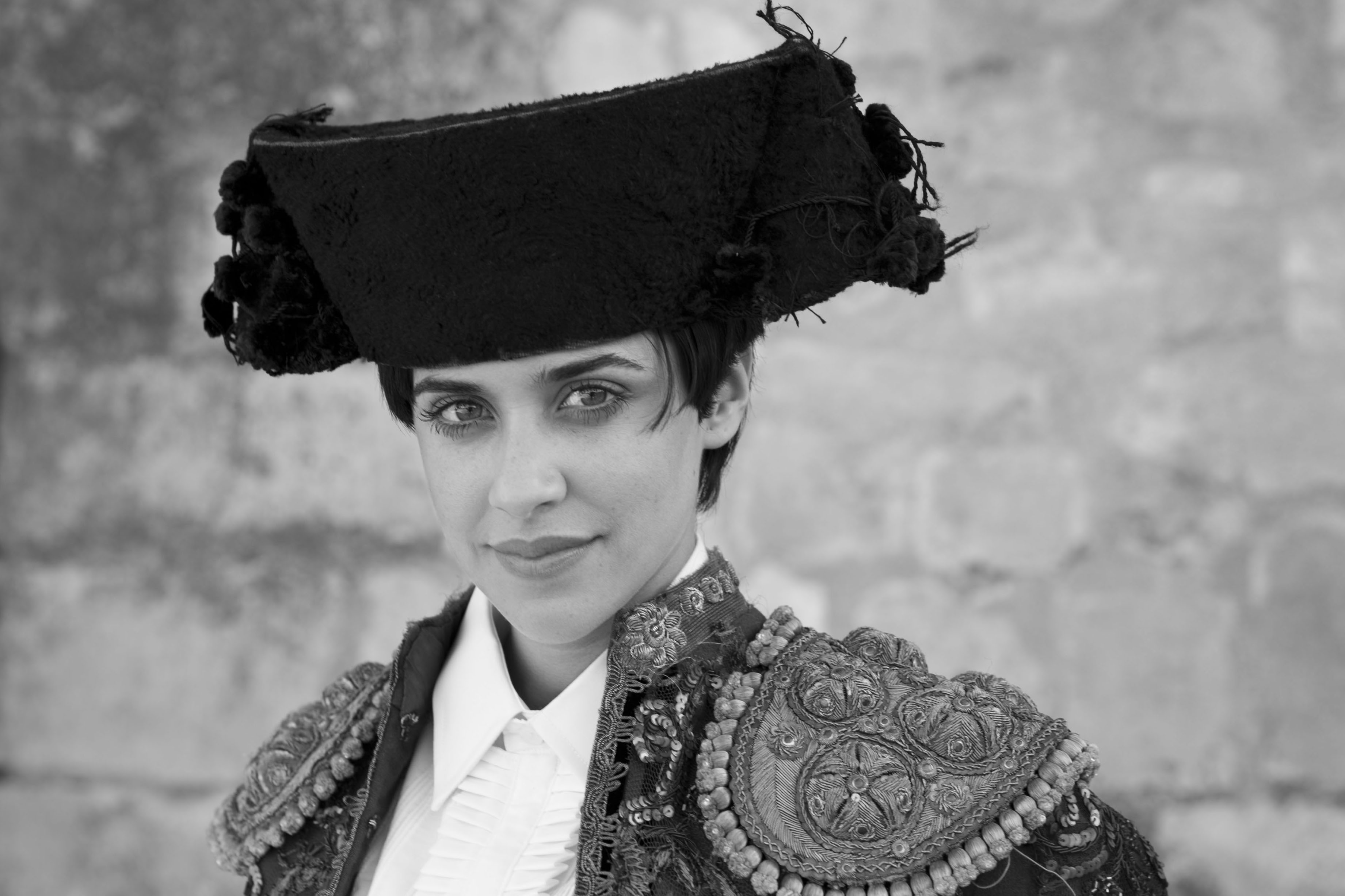
In 1910 Andalucia, Antonio Villata (Daniel Giménez Cacho) is at the height of his profession as a matador. His beautiful wife, and one time recording artist/flamenco dancer, Carmen (Inma Cuesta) watches from the crowd cradling their unborn child in her bulging belly. Tragedy strikes during the estocada and Antonio is gored by his opponent; the shock of which induces labour and baby Carmencita is born into the world motherless with a disinterested and bereaved father who, unable to fend for himself, soon remarries Nurse Encarna (Maribel Verdú). The woman’s disdain of the infant is apparent and her intentions clear from the moment she flutters her heavy kohled lashes at the fallen toreros and thus Carmencita (played in childhood by Sofia Oria) is raised by her grandmother Dõna Concha (Ángela Molina). When her grandmother passes away on the child’s Holy Communion day Carmencita is returned to her father and they can, albeit in secret, renew their relationship. A decade passes and Encarna’s villainy drives the adult Carmen (Macarena Garcia) out of the family home world and into the collective bosom of six bull-fighting dwarves, one of whom doubles, wonderfully, as Prince Charming.
This production was reportedly in development for several years before director-screenwriter Pablo Berger started shooting and nothing is left to chance. Verdú (Y tu Mamá También; Pan’s Labyrinth) who was Berger’s first choice to play Encarna clearly revels in the role; an evil stepmother she was born to play even sans magic mirror (here an artist’s interpretation of the wicked woman on canvas, in a multitude of costume changes, replaces the reflection motif). While this film takes the majority of its cues and sway from the Snow White tale – Blancanieves’ literal translation is SnoWhite – there are also intertextual signifiers to other Grimm tales along the way including Little Red Cap, Cinderella and The Sleeping Beauty via Tod Browning’s Freaks (1932). The mise-en-scène, as a whole, is an eclectic homage to the silent era of European cinema and the drama of the bullfight which includes the over-elaborate traje de luces (suit of lights) and black montera (hat), however, it is Alfonso De Vilallonga’s lush score, heavy on the flamenco beats, which is the real joy and builds emotion, tension and crescendo with each hand-clap of the non-diegetic sound.
In spite of the evidentiary early-20s influence Berger delivers a fresh spin on a female protagonist – often celebrated for her passivity and reliance upon a prince – which gives Carmen/Snow the edge needed for a 21st century heroine and reinforces this masterpiece’s declaration: that Blancanieves is, in fact, the fairest of them all.
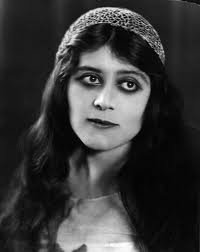
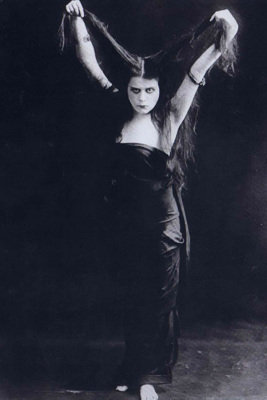
Theodosia Goodman was the eldest of three children born to a Polish father and Swiss mother in Cincinnati. The Goodmans lived in the leafy suburb of Avondale until 1905 when their daughter left for New York to become Theda Bara. The name an anagram of “Arab Death”[1], made Bara the epitome of exotic temptress known as the Vamp. She, at the time, allegedly used her sex appeal to manipulate and embodied voluptuous transgression – the exact attributes that Post-Code Hollywood attempted to make commodity and control. In total, Theda Bara made over forty films between 1914-1919 including Carmen[2], Cleopatra[3] and Salome[4], yet it was her first leading role which cemented her as The Vampire. I propose that it was this dichotomous ambivalence and marginalisation in both characters portrayed and persona[5] which started a promising film career but essentially the ideology could not last and ended it too soon. Taking inspiration from a Philip Burne-Jones painting and Rudyard Kipling poem in 1897, A Fool There Was[6] intercuts verses of Kipling’s poem with scenes which are, it would seem, an introduction to the lead characters. An iris reveals a male, who is later revealed to be Mr John Schuyler (Edward José), shot, sat behind a desk gazing at long stem roses, he looks directly into the camera before picking up the flowers and smelling them. After the second verse of the poem, The Vampire (Bara) stands haughtily next to a vase holding similar flowers and picks one out, smells it and then pulls the bud from its stem crushing the delicate petals between her palm. She is dressed in heavy, dark materials and fur, jewellery adorns every other finger perhaps symbolising living beyond her means, or as Molly Haskell describes them “emblems of her wickedness”.[7] The silent film is set within the melodramatic mode consisting of two dominant styles, as identified, by Roberta Pearson, “the histrionic and the verisimilar”[8]
John Schuyler and his family are white, in not only skin tone but within the mise-en-scène. His wife, Kate (Mabel Fremyear), daughter (Runa Hodges) and sister-in-law (May Allison) are nearly always shot outdoors in natural light and dressed head-to-toe in white costumes. The Schuyler’s daughter, who later is referred to as ‘innocence’, is fair-haired, her blonde ringlets bouncing as she runs. She is, physically, a Mary Pickford/Lillian Gish in miniature, perhaps an indicator of the next generation which will resemble America’s Sweethearts[9] and not the dark, mysterious threat of the Vamp. A dialogue intertitle introduces The Vampire (Bara) so called because she has the sexual prowess and potential occult ability to drain their life source and wealth. The uncanny is aligned with this predator to enhance her otherness in relation to the ‘norm’ – the white, faithful wife and as Sumiko Higashi writes, “implied that her powers were supernatural or that she was, at the very least, inhuman”[10] She is dressed almost exclusively in black, hypnotically so, with an occasional white accessory, as if she were trying to assimilate into “decent” society. The Vampire reads of Schuyler’s trip and Statesman honour while resting at home. She has a black housemaid and an Asian male in attendance and this simultaneously whitens her against their ethnic variations but in the same token reminds the audience that she herself is ‘othered’ when considered alongside the Schuyler family.
As she boards the ship two previous victims (as they are described in the intertitle text) attempt to get her attention; one is a tramp who gets lead away by a police officer, the other, Mr Benoit, pulls out a gun and threatens to shoot her. The Vampire merely laughs and knocks it away with a flower and coaxes Benoit to commit suicide offering him one last kiss; “kiss me, my fool” before he pulls the trigger at his temple. His death fails to move her and she is reported, by the ship’s porter, to have stood over his body “laughing like a she-devil”. When Schuyler first sees this woman she is framed by a porthole powdering her nose which suggests a subtle hint at female consumerism. She has one eye on her own reflection and the other on her “prey”.
Visible through this porthole and clearly comfortable on deck, The Vampire can be read as a symbol of xenophobic (American) fears of immigration. Numbers of immigrants increased dramatically during the years 1899-1910 and while there is an attempt to Americanise The Vampire. Full assimilation fails as her ethnic femininity and,
[the] vamp persona [situates] her at the intersection of two established representative tropes: the predatory female vampire and the immigrant whose assimilation skills and potential for economic and cultural contribution were uncertain[11]
As an ethnic ambivalent, The Vampire may well have been the all-desiring temptress, however, to describe her as the representation of “the [unleashed] male sexual instinct”[12] as Higashi does seem a little extreme. She and, in this instance, his wife personify the polar opposites constructed through Patriarchy with the wife and child further representing social and moral order, and The Vampire revelling in the destruction and exploitative chaos her ability to emasculate exacerbates. In a Post-Code Hollywood future, as the femme fatale[13], she would be contained, however, Pre-Code, in these early films she was a player in the “fallen man genre”[14]
Even when society turns its back on Schuyler, his mistress brazens it out and walks with her head held high. She, much like the name she is given, sucks the wealth and life from her victim gaining more audacity and strength from his, increasingly, alcohol-induced catatonic state. Schuyler’s gait, once upright begins to stoop and his hair whitens: “The Fool was stripped to his foolish hide”. While this representation of woman displays a level of sexual freedom and independence, it can be limiting to female actors merely providing another stereotype to play in a male world. Theda Bara’s enigma was open to many an interpretation was described by James Card in the following way:
Endless lure of pomegranate lips…red enemy of man…the sombre brooding beauty of a thousand Egyptian nights…black-browed and starry-eyed…infinite mystery in their smouldering depths, never to be revealed…Mona Lisa…Cleopatra…child of the Russian countryside…daughter of the new world…peasant…goddess…eternal woman[15]
Her persona was created and cinematically, as The Vamp, was seen to promote a cultural threat; that of female immigrant sexuality and as Diane Negra writes “was an ideal figure to manage cultural anxiety” and reflected a real need to regulate female sexuality (and the growing birth rate).[16] Bara seemed to be at odds with the direction her film career was taking and tried, somewhat unsuccessfully, to diversify the roles she signed up to, including Romeo and Juliet[17]. The virginal Juliet was an unlikely role for The Vamp archetype and some reviews were critical of her acting style. Like most of her contemporaries, Bara was a student of the Delsarte method. François Delsarte (1811-1871) was the founder of an applied aesthetics system which included rhythmic movement, kinesics and semiology.[18] This system would have given film audiences pause for thought as every emotion was rendered through an eye or bodily movement.
The real reasons why Theda Bara’s career failed at longevity are unanswerable. The Vamp and émigré artist still continued to make pictures, names like Naldi, Negri, Valentino, and eventually Garbo and Dietrich cemented their places as household names. Bara appeared to grow tired of the limitations that The Vamp construction placed on the film roles she was offered and often this would be evident in some of the newspaper and magazine interviews that she gave. She made a last short, comedic film in 1926 called Madame Mystery which was co-directed by Richard Wallace and Stan Laurel but then seemingly retired after marrying. Bara died on 7 April 1955, aged sixty-nine from abdominal cancer leaving behind a lasting cinematic legacy as the original screen Vamp.
Watch one the few surviving Bara films: A Fool There Was (1915, dir: Frank Powell)
[1] This anagram was alleged to have been the actresses’ own invention and the studio embraced it wholeheartedly creating a birth in the shadows of the Sphinx, a childhood in Egypt and exotic Parisian-Italian parentage. Tactics which enhanced the allure of the Cincinnati-born girl who wanted Hollywood to sit up and take notice.
[2]Carmen (1915, dir. Raoul, A. Walsh) Fox Film Corporation.
[3]Cleopatra (1917, dir. J. Gordon Edwards) Fox Film Corporation.
[4]Salome (1918, dir. J Gordon Edwards) Fox Film Corporation.
[5] Theda Bara functioned as a star persona serving as a ideological construct as detailed in Richard Dyer, Stars, (London:British Film Institute, 1998).
[6]A Fool There Was (1915, dir. Frank Powell) William Fox Vaudeville Company.
[7] Molly Haskell, From Reverence to Rape: The Treatment of Women in the Movies, (Chicago & London: The University of Chicago Press, [1974] 1987) p103.
[8] Roberta Pearson, “O’er Step Not the Modesty of Nature: A Semiotic Approach to Acting in the Griffith Biographs, in: Zucker, C (ed) Making Visible the Invisible: An Anthology of Original Essays on Film Acting (Metuchen: New Jersey, 1990) pp1-27.
[9] Richard Dyer, White, (London & New York: Routledge, 1997 ) p
[10] Sumiko Higashi, Virgins, Vamps, and Flappers: The American Silent Movie Heroine (Canada: Eden Press, 1978) p58.
[11] Diane Negra “The Fictionalized Ethnic Biography: Nita Naldi and the Crisis of Assimilation” in: Gregg Bachman and Thomas J. Slater (eds) American Silent Film: Discovering Marginalized Voices, (USA: Southern Illinois University Press, 1997) pp 176-200 (179).
[13] Mary Ann Doane, Femmes Fatales: Feminism, Film Theory, Psychoanalysis (London: Routledge, 1991) I.
[14] Janet Staiger, Bad Women: Regulating Sexuality in Early American (Minneapolis: University of Minnesota Press, 1995) p148.
[15] James Card, Seductive Cinema: The Art of the Silent Film (Minneapolis: University of Minnesota) p189.
[16] Diane Negra, “Immigrant Stardom in Imperial Stardom” in: Gregg Bachman and Thomas J. Slater (eds) American Silent Film: Discovering Marginalized Voices, (USA: Southern Illinois University Press, 1997)
[17]Romeo and Juliet (Dir: J. Gordon Edwards, 1916) Fox Film Corporation.
[18] E.T. Kirby, “The Delsarte Method: 3 Frontiers of Actor Training” in The Drama Review: TDR, Vol.16, No1, March 1972 pp55.69. http://www.jstor.org/stable/1144731?seq=1 [accessed 25 May 2012].
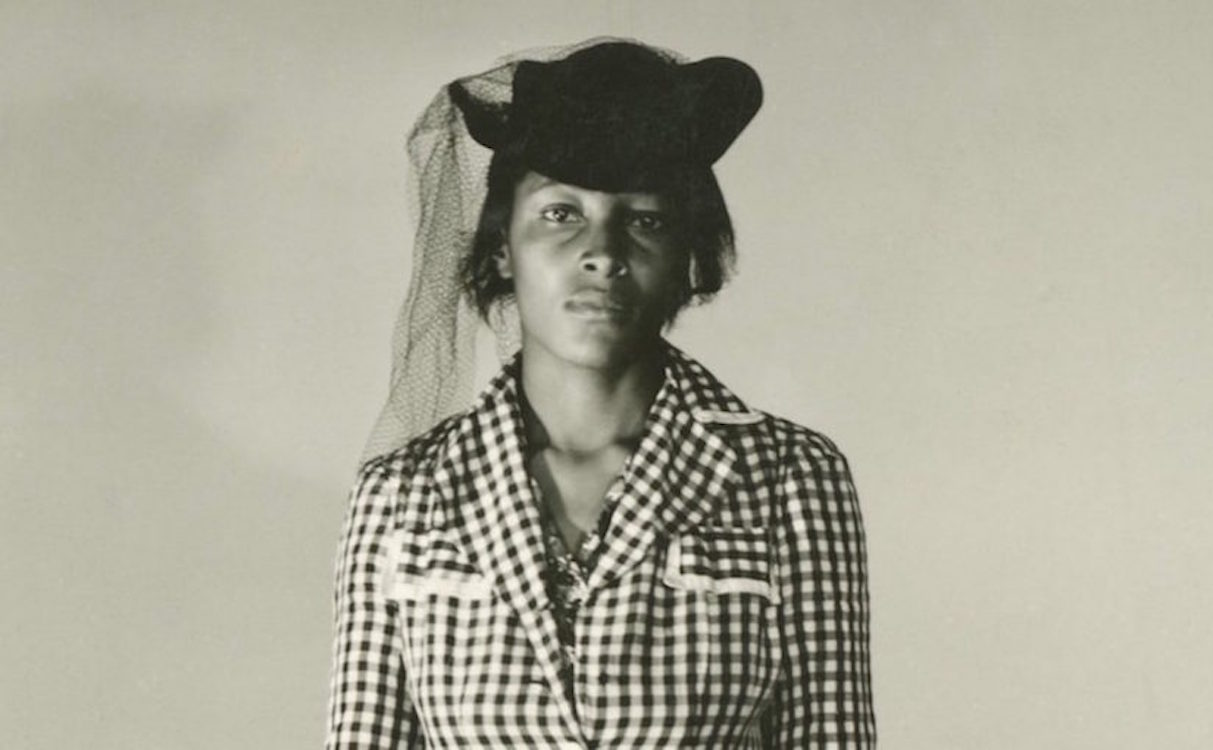
For many, the first time hearing the name Recy Taylor would have been in January 2018 when Oprah Winfrey paid tribute to the extraordinary woman in her Golden Globe speech, and yet Taylor’s sexual assault would prove to be an organisational spark in the Civil Rights Movement decades before the Women’s Movement and the #MeToo resurgence.
On September 3rd 1944, Recy Taylor neé Corbitt was kidnapped at gunpoint after leaving Church in Abbeville, Alabama by seven young white men. They drove her to a nearby wooded area where six of them – aged between 14-18 – took turns in raping and terrorising the 24-year-old sharecropper, wife and mother, before leaving her blindfolded and stranded at the side of the road. Despite three eye witnesses identifying the driver who would name all of his passengers (none of whom were questioned) an all white, all male jury dismissed the case. Enter the NAACP and their chief investigator, Ms. Rosa Parks who was to conduct a thorough investigation, help defend Taylor and seek punishment for her attackers – some eleven years before the Montgomery Bus Boycott – a dangerous business in Jim Crow-era South.
Writer-Director Nancy Buirski (The Loving Story) uses her film – which had premieres at the Venice Biennale and New York Film Festival – to expose the systematic racism that not only fostered the heinous crime but covered it up. She utilises footage from “race films” and their lack of white gaze to Recy Taylor’s story. These are intercut with gospel music and Church footage – shot by Zora Neale Hurston whose journalistic prose would prove important during another unconscionable and despicably unjust “rape” case in Scottsboro a decade earlier.
While the obvious tone of this documentary is solemnity, some may find its structure superfluous, however, these snippets of human life, art and joy in the face of such adversity are beautiful in an otherwise infuriating film where (yet again) white privilege not only dehumanised this woman but terrorised her family. The full impact of which is discussed in interviews with Taylor’s brother Robert and sister Alma. Hearing them describe how their father slept in a tree overlooking their home (after Recy and husband Willie’s house had been firebombed) with a shotgun as a means to protect his family is particularly hard to hear, made all the more galling when one considers the justification for lynching was the white man “protecting” his wife and daughters. Benny Corbitt was, of course, not afforded that power.
Recy Taylor was just one in a longer tradition of black women who spoke her truth and sought justice, and an aspect the documentary does particularly well is arguing passionately for their place in history – these women were always there. Harriet Tubman, Rosa Parks, Maya Angelou, Ruby Bridges, the afore-mentioned Winfrey – look at the audiences photographed during Martin Luther King’s numerous rallies, they were there, or look to the backbone of the Black Panther Party, or consider there wouldn’t even be a #MeToo without Tarana Burke.
The Rape of Recy Taylor is urgent and essential viewing. It speaks to the visibility of the African American woman, and the countless women whose voices have failed to be heard. A quietly devastating dedication – get tissues for the last ten minutes – to strength, resilience, resistance and a sustained fight for justice. The name Recy Taylor stands for them all.
The Rape of Recy Taylor is available to stream on Amazon Prime Video and MUBI
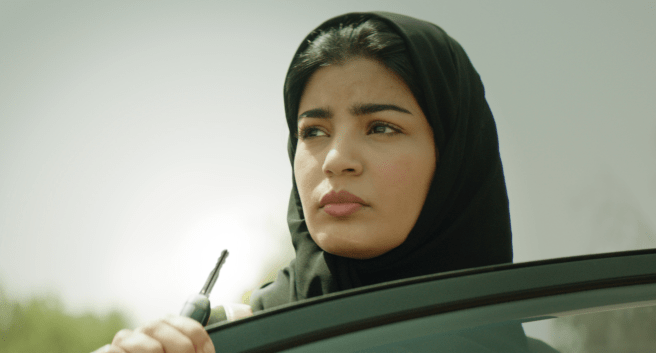
In 2017, the ban preventing Saudi women from driving was lifted and licenses were issued on the 24th June 2018. That same year Haifaa Al Mansour began production on her fourth film The Perfect Candidate (المرشح المثالي). It is no accident that Dr. Maryam Alsafan (Mila Al-Zahrani) drives, immediately placing the film in context and telling us something about the lead protagonist. Just as Wadjda’s (2012) coveted bike was bright green, Maryam’s car is a deep petrol blue in a sea of dirty white dusty vehicles.
The good doctor wears a niqab to drive and leaves it on when doing her rounds in the hospital. There, she has to contend with sick (male) patients shouting their dissent at being examined by a woman, making a difficult job ever harder. They would rather seek treatment from less qualified male nurses than have a woman lay her hands on them. One old man screams “Don’t look into her eyes!” a comment made even more ridiculous by the fact that her eyes are the only visible parts of her face to look at.
Maryam is what her music teacher father Abdulaziz (Khalid Abdulraheem) refers to as “a lion at home and a mouse in public” and serious. Seriously sincere about her patients and the road leading up to the hospital. A burst pipe has rendered it almost impossible for patients to reach their destination and the government refuses to fund the repair. However passionate she is, Maryam is determined not to stay at Al’hana hospital. Her ambitions lie in Riyadh, so when a networking conference taking place in Dubai presents itself, along with the promise of a job opportunity – for which she is the perfect candidate – she must attend.
A problem at the airport, however, prevents her from getting on the plane. Her paperwork has expired and she must seek a male’s signature in her father’s absence (he’s on tour with his band) before being able to travel. Maryam heads straight to her cousin, he has an office in the government and will surely help her. Upon leaving, Maryam instead finds herself heading home and running for local council.
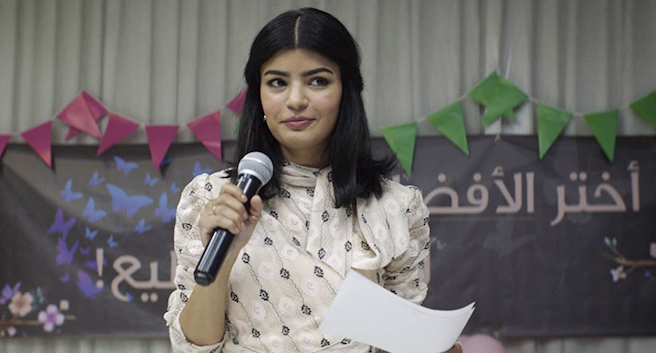
With encouragement from her sisters, Sara (Noura Al Awad) and Selma (Dhay) Maryam pulls together a campaign strategy – her main objective being the road repair, which is apparently not usually high-up on a woman’s list of priorities (we prefer flowers and children-based subjects). While fundraising activities welcome a large body of women, whether they will, or be ‘allowed’ to, vote for her remains to be seen. There’s an unexpected juxtaposing of Maryam and her father’s narrative strand – she’s finding her voice, her public lion, and he’s learning to embrace music again and sing following the death of his wife. While her father is adored for his voice and rewarded, the main goal of Maryam’s (mostly male) constituency is, unsurprisingly, shutting her up.
Maryam’s political career may end as abruptly as it begins but it’s her journey where the interest lies. Just like all the women in Al Mansour’s films – Violet (Nappily Ever After), Mary Shelley, and, of course, Wadjda – transgress societal norms in their own way, and Maryam is no different. Certainly, this film is the by-product when characters like that headstrong 12-year-old and Dr. Maryam – through their determination and intelligence – find their voice and value (beyond what they have been told) in a man’s world, navigating the choppy waters of deep-rooted misogyny and seeing land on the other side.
While a lot of The Perfect Candidate belongs to the political drama – gender politics are certainly at the heart of most films created within a place of female oppression like Saudi Arabia – this film feels more like an ode to the importance of cultural arts, perhaps even a tribute to the filmmaker’s own father, Abdul Rahman Mansour, who is a poet. Whether a conscious decision or due to her co-writer Brad Niemann’s input, the patriarch of this particular family is far gentler and more empathetic than we’re used to seeing onscreen – Maryam is never discouraged at any point by her Abi. As a result the male characters feel a lot more tangible within this narrative, with a variety of masculinities explored. It pulls from Maryam’s arc somewhat but as a result feels a little more balanced, ultimately the film begins and ends with the future. A woman. No longer hidden behind her niqab (if she so chooses).
The film’s colour palette is simple and muted save for the odd flash of tint and tone. Accompanying it, Volker Bertelmann’s string-heavy score is sweeping and rather lovely. The viola, cello and violin notes – and the oud within the diegesis – are beautifully optimistic. Even if the majority of the film doesn’t quite communicate this hope, those last scenes in the hospital certainly do. They signify a slow turning tide coming to Saudi Arabia – one petrol blue car in a sea of dirty white dusty vehicles – and with Haifaa Al Mansour at the wheel, the future of Saudi cinema is in more than capable hands.










 While a lot of The Perfect Candidate belongs to the political drama – gender politics are certainly at the heart of most films created within a place of female oppression like Saudi Arabia – this film feels more like an ode to the importance of cultural arts, perhaps even a tribute to the filmmaker’s own father, Abdul Rahman Mansour, who is a poet. Whether a conscious decision or due to her co-writer Brad Niemann’s input, the patriarch of this particular family is far gentler and more empathetic than we’re used to seeing onscreen – Maryam is never discouraged at any point by her Abi. As a result the male characters feel a lot more tangible within this narrative, with a variety of masculinities explored. It pulls from Maryam’s arc somewhat but as a result feels a little more balanced, ultimately the film begins and ends with the future. A woman. No longer hidden behind her niqab (if she so chooses).
 The Framing Device