Categories
film review

Tale of Tales (Dir. Matteo Garrone, 2015)

T0T1

Long, long ago there lived a Queen (Salma Hayek); a desperate, seemingly infertile Queen who wished for a child more than anything. Her husband, the King (John C. Reilly) would (and does) do anything to make his love happy and provide her with the child she so yearns, and so begins Matteo Garrone’s (Reality, Gomorrah) first English language feature Tale of Tales. The tone of which is set from the very beginning as the King of Longtrellis wades into water to slay the sea monster and pluck out its heart thus providing his beloved with the bloody, and delicious, means to conception and the shortest gestation period ever. His untimely demise brings the neighbouring Kings; sex-crazed libertine Strongcliff (Vincent Cassel) and sweet melancholic Highhills (Toby Jones) to the funeral procession, and all three kingdoms merge, intersect and ultimately influence the other as the triptych of tales unfurl, some sixteen years later.

Queenie is now mother to a teenage albino Elias (Christian Lees) – taking on the colouring of the sea beast – and who is spending a lot more time with his identical twin brother from another mother, Jonah (Jonah Lees). The Royal mother is overcome with envy as the two boys; one princely, one a pauper make adventures of their own.

ToT7

Strongcliff is a skin-crawling, somewhat beastly Don Juan-type whom women seem to grow tired of very quickly. Looking for another distraction, he hears a beautiful singing voice and follows it, mistaking an old crone (played respectively by Hayley Carmichael and Stacy Martin) for a beautiful Princess and so begins an obsessive courtship, of sorts, (through a door) chaperoned by her equally wrinkled sister Imma (Shirley Henderson).

ToT4

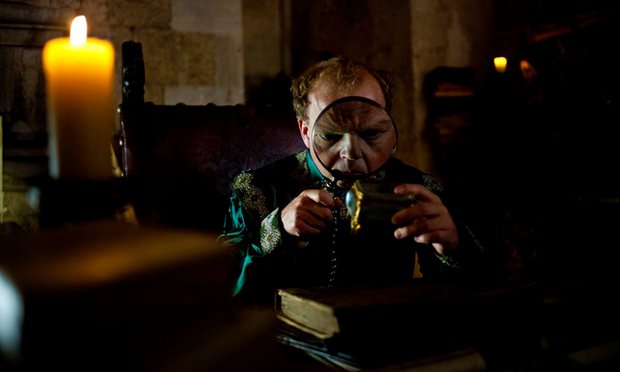
Highhills is a widower who as his only daughter Violet (Bebe Cave) matures becomes more attached to a flea than the fruit of his loins, and when said pet passes on (respiratory issues) provides a fun guessing game, the prize of which is the hand of Violet. Step forward the Ogre (Guillaume Delaunay) and the poor Princess is whisked away, under duress, to what essentially is a hole in a mountain.

While the majority of audiences – whether filmic and/or literary – will recognise the conventions, motifs, metaphors, plots and characters of the traditional fairy tale, they may even attribute to the Brothers Grimm. However, without putting too finer point on it; the Italians came first. Straparola inspired Giambattista Basile, upon whose tales –The Enchanted Doe, The Flea, and The Old Woman Who Was Skinned– this film is loosely based. In his work, Basile, deployed the loquacious gifts of female storytellers while Garrone adapts to forefront the role of women in his carnivalesque cinematic tale for they all can be read as rebellious females manipulating their surroundings and fashioning their own fates.

ToT3

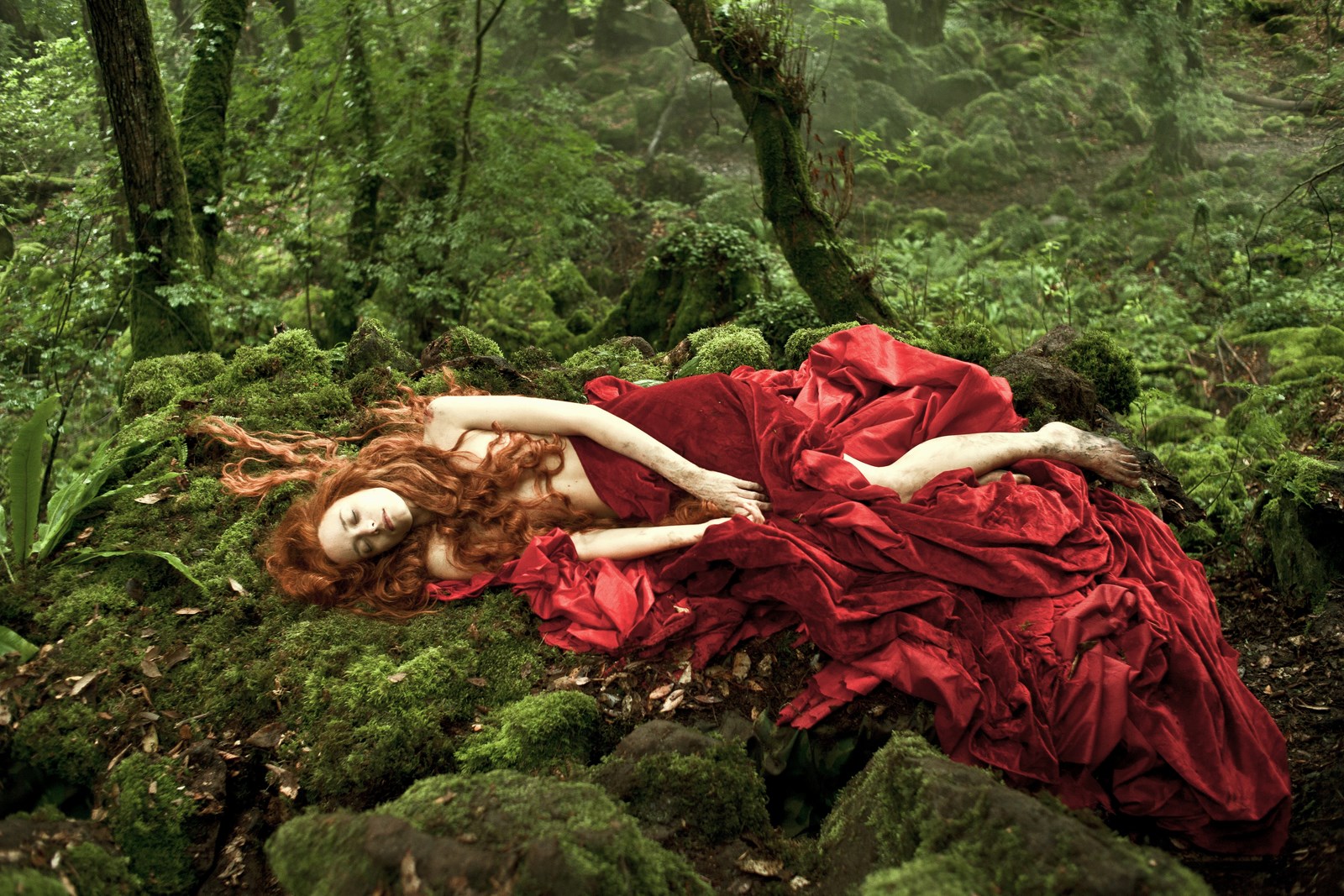
The film is a real feast for the eyes combining the Italian setting with baroque beauty, brimming with flamboyant metaphors which render Tale of Tales as sitting somewhere between repulsive and hilarious. Garrone clearly appreciates the richness, diversity and complexity of the fairy tale, especially those from his motherland. It intrigues, has much to say on the power of civility and transformation and is completely wicked and highly pleasurable. Not least due to its direction but the special visual effects (practical, digital art, props) and ageing prosthetics, provided by mAKINARIUm are outstanding, as is Massimo Cantini Parrini’s gorgeous and sumptuous costuming; fit for any Royal. Alexandre Desplat delivers a dreamy score, expressive in tone and timbre which really lifts and enhances those darker moments.

ToT5

Tale of Tales is a charming curio – dark, gruesome and mirthful; a transgressive grotesquery, thematically rich, irreverent and unctuous. Those fiabe that we hold dear as children are just as important to us as adults, and when they are as wonderfully made as this, even better.

And they all lived happily ever after…yeah right.

Categories
film review

Batman v Superman: Dawn of Justice (Dir. Zack Snyder, 2016)

BVS

I was always going to see it (twice, in fact) and while I wasn’t a fan of Man of Steel, I enjoyed Batman v Superman; I know, such a contrary Mary! Chin Dimple needed a little more to do, Batfleck was pretty good, and Wonder Woman didn’t disappoint. Don’t get me wrong, it was ludicrous in parts but…oh it’s probably best you just have a read:

Batman v Superman: Dawn of Justice opens with the same devastation that ended 2013’s Man of Steel, as Supes (Henry Cavill) and General Zod (Michael Shannon) threw down and battled, wreaking destruction upon Metropolis’ skyline. Only this time, it is seen from the vantage point of Bruce Wayne (Ben Affleck), choppered in from neighbouring Gotham City to watch helplessly as his employees are trapped and ultimately killed in the fallout.

It goes to explain away some of his contempt for the Kryptonian but only ever-so slightly. Yet again, we are treated to the now inevitable flashback to Bruce’s parents and their murder, except now they’re played by Jeffrey Dean Morgan and Lauren Cohan, and it’s 1981. There’s another bat sequence too. Necessary? Not remotely but it serves as a heavy-handed reminder that the two main things still driving Bruce are vengeance and fear. Clark is still working at the Daily Planet, loving/saving Lois (Amy Adams) and generally wondering whether Superman can actually exist in a world that doesn’t really know if it wants him or outside of Lois, he really wants it. He also finds himself judging the Bat’s from of vigilante justice. Eventually both are brought together by scheming sycophant Lex Luthor (Jesse Eisenberg) at the opening of a library, no less. Also in attendance is a mystery lady – could she be Wonder Woman? Of course she is, we’ve all seen the trailer.

The action flits between Gotham, Metropolis, the Indian Ocean, Africa and Bruce’s subconscious, all within the first hour or so. Sadly, this lack of focus remains as more subplots give way to some convolution and a few bloated set-pieces, in addition to some rather inexplicable moments which do not serve the overarching plot and feel wholly out of place. For example, Lois having a bath, or a sweaty Bruce hitting a large tyre with a sledge hammer and even the deceased Jonathan Kent atop a snowy mountain are head-scratchers and deserved to have seen the cutting room floor.

Usually, a superhero’s popularity depends upon the context of time and perhaps, due to the darkness of the world as it is, gives way to audiences wanting to see the character as he was – namely the Reeve guise; bumbling geek Clark and the heroic, always got a smile for everyone, Kal-El – or as he is on the page. Snyder has instead used 9/11, terrorism and illegal aliens and has the film(s) reflect this dark, angry, miserable and political world we inhabit. Apparently, in an attempt to ground Superman in some sort of reality; an alien from an extinct planet, who can fly, is indestructible save for interaction with a glowing green rock, and shoots lasers from his eyes… Can he ever really be that realistic? An audience doesn’t need to delve too far to see the potential allegorical readings, they are all fairly obvious.

On the one hand, I miss the red pants, and the confident, almost care-free caped chappy who didn’t really seem to have a temper and was a friend to everyone. Yet on the other, a change is as good as a rest, it worked (mostly) for Batman. The Superman of my childhood is still accessible, and this is the franchise which will see WW onscreen for the very first time so why wouldn’t I give it the benefit of the doubt? Cavill’s Superman is at odds with his alien heritage and human one – as his mother states “you don’t owe the world a thing” but then, when it comes down to it, it is his human side which is the most affected when Luthor finally reveals his play and ultimately his alien self/limitations which helps destroy him. Reeve, interviewed in 1987, told future inheritors of the cape to never lose the humanity of him; “to forget he can fly; [his] super strength. He’s a gentleman.” Cavill’s is a gentlemen but it has to be on his terms and the humanity is there but it has taken a film and a half to uncover it, little to no smiles, and a human Bat to help.

This Bruce is older, greying at the temples, grizzled, tired and so, very angry. There is a ruthlessness to the incarnation; Affleck is actually very good and the irony is, murderous intent aside, this Bruce needs Superman to give his life some (re)purpose. Alfred (Jeremy Irons) is a younger, more sardonic Pennyworth who seems to have less faith in his billionaire brat and wearily (often sarkily) mutters under his breath a lot of the time. The hallucinations/dream sequences (one too many if you ask me) can be read as an alcoholic’s delusions but then a fleeting face from the future may prove integral to the next film but, yes you’ve guessed it, slightly unclear. I like this Bruce. Yes, he’s different, just like all the other actors who have portrayed him, there’s a fury to this one that it great to watch if a little at times growling, ragey and largely unexplained.

As is Luthor’s motive in proceedings – he want Kryptonite for assassination purposes and access to the crash site and Zod’s remains. Why does he need Batman for that? Eisenberg seems to channel Edward Nygma via Mark Zuckerberg – if you’re going to give us Lex then do so, not some weird, obnoxious Riddler-hybrid. He’s a sociopathic teenager hell bent on destroying the one man getting more attention than him. Yes, he’s a villain but he’s irritating rather than intimidating; he is more memorable than Spacey’s turn but not sure how high a bar that is to set, and the hair – why? It’s more distracting than the weird noises he makes.

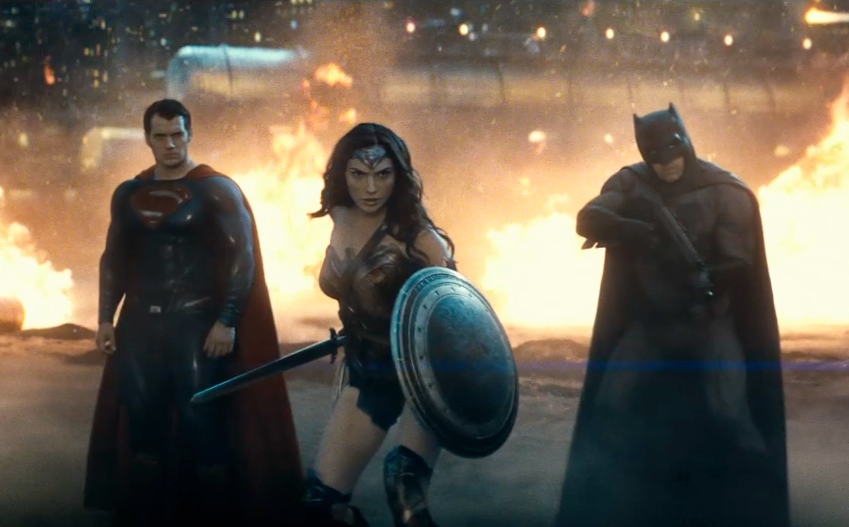
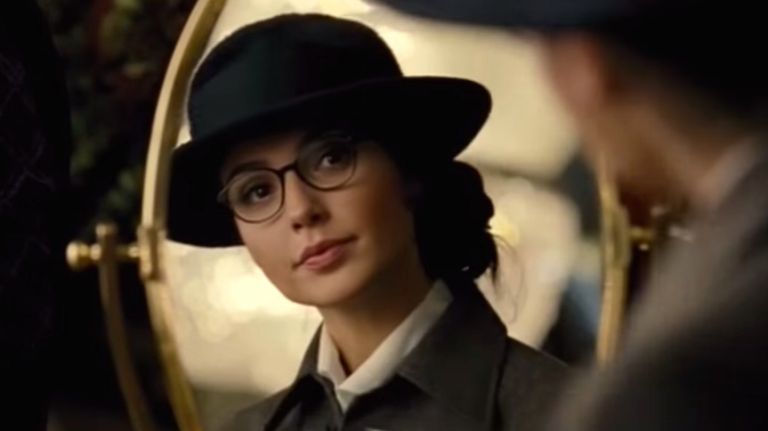
Which brings me to Wonder Woman, a character I adore, and finally, she’s here. She’s not given nearly enough screen-time, nor given enough dialogue and my expectations were not particularly high following Gadot’s casting but her presence gave me a buzz, people even clapped in my screening for her. I haven’t been lucky enough to see an evolution of character or multiple versions of WW and so, I was happy with the little I saw. She kicks Doomsday’s derriere and seems to thoroughly enjoy doing it and as for the Turkish Airlines bit, SHE GOT OFF THE PLANE (phew) presumably to fly her own invisible one…. But not before she sums up the entire film (and perhaps fanboy-dom in general) in one snarky sentence – about little boys and their lack of inclination to share.

The supporting cast are fine, no real standouts. Callan Mulvey is now Russian arms dealer Anatoli Knyazev, last seen as Jack Rollins in The Winter Soldier (and you thought there could be no DC and Marvel crossovers). Fishburne is back as Perry White and far more flamboyant than the MoS version, Holly Hunter is great as Senator June Finch, who stands in the way of Luthor Jr but whose senate spiel is pointless. “We know what Superman can do” Do we, really? “We haven’t considered what he should do.” What does that even mean? Run every potential saving by the US government? Say, “okay I’ll help those people over there but not those here”? Wait for a phone-call on a flashing red telephone…oh wait. The word unilateral is thrown about several times which is exasperating; as if Superman saving folk is somehow a selfish act. Diane Lane and Amy Adams are, for the most part, bait, or perhaps I’m being unfair. Adams is definitely stronger in her performance here but I am yet to be convinced by her Lois and then there’s all that running about amid rubble and destruction and swimming… all in heels.

Snyder has always been commended for his visuals and there is a depletion of colour (not always as depressing at it sounds) with red, white and blue colour motifs dotted throughout and Affleck’s batsuit appears to riff off of Adam West’s outfit with the black on grey. There are nostalgic nods but let’s face it, these aren’t the characters we grew up with, and as the last week or so have shown, few seem willing to welcome change. I really liked the intertextual links and the Justice LeagueEaster eggs (although, shoehorned isn’t the word) and, obscurely, The Wizard of Oz. It is referenced multiple times and I’m still contemplating why. Perhaps, it is tenuous commentary on American commerce or Lex requires courage, Bruce a brain and Clark a heart and then there’s Dorothy, the infamous orphan as all of our boys here. Plus, 1939, the year of the film’s release and the year Batman was created and joined him in the DC universe and there’s even a witch, sort of but I digress.

By the time the big face off presents itself, it’s not quite worth the wait, actually a little dull and oh so futile but Luthor is the puppet master. When both titular characters realise they should be working together, it should be joyous and not just that they realise they both have mothers named Martha. The score is a little hit-and-miss, Zimmer is renowned for big anthems and when the two titans do finally square up, I was expecting fireworks, not just a damn squib. Lex’s theme (The Red Capes Are Coming) is a standout as is Wonder Woman’s (Is She With You?), that electric cello is really quite something.

All in all, Dawn of Justice plays with some heavy themes; democracy, xenophobia, terrorism – not so terribly far removed from the world we live in, Snyder is determined to make the world as realistic as possible yet removes most of the fun. Truth, Justice and the American way – this *is* the America of today but it all feels too horribly realistic and befuddling – I would have liked Kal to be the beacon of hope his birth parents intended him to be, not least to give Henry Cavill a bit more to do. The religious imagery is still there, Superman is the Messiah (and a very miserable boy) just as in MoS: God v Man, etcetera. There are a multitude of questions and it is left up to the audience to decipher the mess (small children may have difficulty) yet there is levity, nowhere near enough but present.

I’ve accepted the lack of comic-book iconography in Synder’s interpretation and it’s only a little thing but would it hurt Supes to smile? I enjoyed more than I loathed, however, there is just one death that was a little too calculated even for me… Zack, you meanie.

Categories
film review

Frankenstein (Dir. Bernard Rose, 2015)

After adaptations dating back to 1910, you would be forgiven for dismissing yet another screen outing of Mary Shelley’s Frankenstein, and the men who have played both the infamous titular Doctor and their human, not monstrous, creation. There have been many, and several more via television and stage; even an ex-member of Bros was birthed as the wretch. Yet none is more renowned than James Whale’s 1931 version. Even if unseen, all are familiar with its star, Karloff in that Jack Pierce make-up and it is often this and its sequel The Bride of Frankenstein, which are heralded as the yardstick by which all filmic adaptations have been measured. Not unfairly so but it was never as true to the original novel as once thought and most versions, if not all, fall down on their fidelity to Shelley’s 1818 novel. In 2015, there were two new attempts: one which received a cinema release and Bernard Rose’s.

Rose, not unfamiliar with literary adaptations, has given audiences some wonderful variations on numerous works of literature: from Paperhouse (1988), Candyman (1992) to his Tolstoy quintet: Anna Karenina (1997), Ivans XTC (2000), The Kreutzer Sonata (2008), Boxing Day (2012) and Two Jacks (2012). He even claimed at FrightFest 2015 that it is comforting to have a source material to hide behind. He needn’t worry, his attention to detail and dramatic creativity really serve this story above all else.

Despite the novel’s weight within the Gothic and Romantic, Rose’s 21st century Frankenstein straddles Gothic horror, the supernatural, and drama, and updates to a modern context and downtown LA. It also remains largely faithful to the original text and uses the chapters from “The Monster’s” point-of-view as the basis for his voiceover narrative and the inner monologue of Monster/Adam (Xavier Samuel). The film may be called Frankenstein but for all intents and purposes, he is one; the (brain)child of researchers Elizabeth (Carrie-Anne Moss) and Victor Frankenstein (Rose regular, Danny Huston). Adam is the result of a 3D printer which has created and shaped the human form and is the first real success in what is seemingly a long line of failures. While he resembles the form of a grown man, Adam is a baby. He is unable to support his own body weight, has difficulty focusing, eats and sleeps much like a newborn.

It is an astonishing performance by Xavier Samuel who brings such soul to a role which has him largely mute for the majority of the film. Samuel has produced a fascinating and varied filmography since making (personal favourite) The Loved Ones(2009) in his native Australia and has an incredible face even under heavy prosthetics; his ability to emote in such a way is impressive. When he opens his eyes, Victor actually yells – in an obvious homage/parody however you wish to look at it of Clive’s character in Whale’s film – “He’s alive!” Once he is, so is the film. Samuel’s Adam is a creation of life not a reanimated corpse, he symbolises the advancement and the potential dangers of technology and yet is more than a metaphor. For all his physical detriments, he feels, thinks and is perfectly human; a modern John Merrick.

Thankfully, Elizabeth is a partner in the research facility in Rose’s version. It is interesting that in spite of Shelley’s famous feminist parentage, it is a London-born male film director who actually gives the character, Elizabeth a more prominent role. By supplanting Victor in this way, it gives more depth to the film. She is also the maternal that Adam wants to return to after his escape, and in this aligning there is a more primal notion to the story, perhaps even Oedipal reading. She is the first person he sees when he awakens and like most animals, he imprints and any notion of the ridiculous when a grown man is seen suckling from the teat of a bottle dissipates as a standing testament to Samuel’s performance. Instinctively, his first few words are ‘mama’ and dada’ which seems to touch Elizabeth more, albeit briefly, than Victor.  Sadly, the new family is short-lived as necrosis attacks Adam’s tissue, the flesh-eating bacteria and breakdown of cells render him monstrous and thus he begins to associate with this and even adopts the name “Monster” for a time. Far from the perfect specimen they thought they had created, Victor and Elizabeth make the decision to essentially euthanise their infant son. From then on, Adam is alone and flees to shed his innocence and experience the world, such as it is.

Noise, aggression, pollution, often violent confrontation as society greets him; when they don’t he is able to appreciate nature in all its beautiful, calming glory. It’s a motif which is dotted amongst the pages of the novel and its obvious Romanticism links are weighted in Adam’s relationship with the natural world and surroundings. This is a film, for all its brief horrific moments (amongst others, there is an appalling moment with a surgical saw… God bless Randy Westgate’s incredibly realistic looking effects make-up) about societal privilege, man’s consciousness, his commune with nature and, above all, love.  Some shots are reminiscent of Botticelli/Michelangelo; religious iconography shapes the Oedipal readings while the police state which inhabits LA and preys on the homeless community keeps a tight and suffocating grasp. It’s a fascinating take on one of the themes in the original novel and one which is so palpable, resonating on a profound topical level. How many individuals are shot, assaulted and/or murdered based on the way they look? How many police officers believe they are above the law?

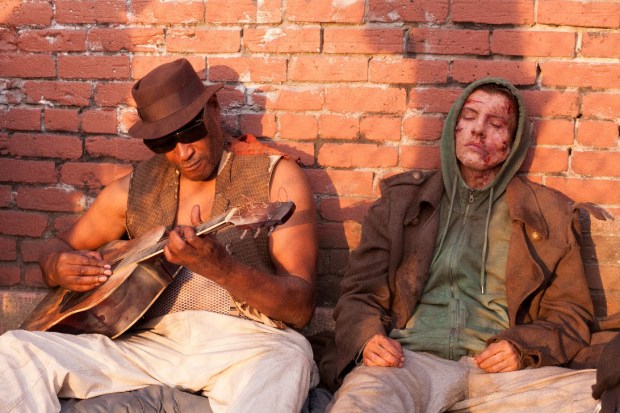
Most will know the outcome of Frankenstein whether via the novel or the previously released films or stage productions, as well as specific plot points, most of which are restored and depicted here. The blind man is played by an outstanding Tony Todd, reuniting with Rose for the first time in 22 years. Here he is transposed as a homeless blues singer who ‘takes in’ Monster and teaches him to speak (and sing), act in company and generally fend for himself on the street and, above all, gives him hope. That is until it is cruelly taken away.

It has taken approximately 85 years to produce a film on par with Whale’s and a couple of hundred to finally see one which does the novel justice and serve Shelley’s narrative. That said, Rose’s Frankenstein is as beguiling as it is beautiful, as dark as it is primal and disturbing. It’s quite the feat to breathe new life into something which has saturated modern culture and present something as visceral and emotional as this. See it, it’s stunning. By using the voiceover narrative which frames the story it affords the audience a stronger connection with the lead. Perhaps, that’s why it is so moving, cathartic and tear-inducing; he is Adam, not a monster.

Categories
film review

Spotlight (Dir. Tom McCarthy, 2015)

spotlight

There have been a number of films which have dealt with the subject of abuse within the Roman Catholic Church. Most memorable is Alex Gibney’s damning documentary Mea Maxima Culpa (2012) and Pablo Larrain’s The Club (2015). While the latter is a dark work of fiction based upon an overwhelming truth, Tom McCarthy and Josh Singer chose the Pulitzer Prize-winning investigation by The Boston Globe as the basis for their screenplay, Spotlight.

In 2001, Marty Baron (Liev Schreiber) took over as Editor of the Globe and immediately suggested that a group of journalists: Mike Rezendes (Mark Ruffalo), Sacha Pfeiffer (Rachel McAdams) and Matt Carroll (Brian D’arcy James), led by Walter ‘Robby’ Robinson (Michael Keaton) look into the case of Father John Geoghan and the accusations of child abuse that were levelled at him. Although the events of 9/11 delayed their investigation until 2002, the Spotlight journalists joined forces with lawyer Mitchell Garabedian (Stanley Tucci) to expose the lengthy cover-up by the Church and how this Priest and the 86 others, within the State of Boston, were deemed above the law.

globe staff

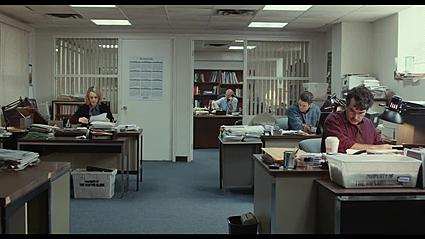
Hollywood has a way of sanitising; it is why, I would argue, European cinema hits harder. Spotlight is the exception to the rule. It recounts those tireless, investigative months with dignity, anger and drama and only for the intertitles and events detailing 9/11, it is timeless, and reminiscent of that last great newsroom -based drama, All the President’s Men (1976) by way of something as emotionally-charged as Philomena (2013).

We know the characters names and there are obvious hints to their marital statuses and even the faith within which they were raised but no unnecessary character development deviates from the point of this low-key yet impacting film. The Globe’s involvement is two-fold; selling newspapers but also making amends by detailing a story they had access to five years previously. This is about facts and exposing the truth, while making an audience engage with what they are seeing.

spotlightroom

It also throws up some infuriating questions – for the audience, and the characters onscreen – does the ‘good’ work of the Catholic Church cancel out the heinous and systematic abuse? (This is rhetorical.) Upsetting the cart for a few bad apples is an analogy best suited for this horror. When all is said and done, it wasn’t/isn’t all Priests but some 6% of any one discretion, according to former-Father and psychiatrist Robert Sipe. The incredulity of the reporters, when they think they are dealing with only one Priest, triples as realisation hits (remember what that felt like); just how many “fool around” with children? These predators targeted a specific type of child – poor, working class; those who would take whatever pay-off they were offered and keep their “shame” to themselves. The Church has money and they turned child abuse into a cottage industry while putting more children in danger by not dealing with the problem but merely reassigning Priests to other parishes for the cycle to begin all over again.

Oh, and I’m not just “another lapsed Catholic pissed off at the Church”, as John Slattery in his guise as Ben Bradlee Jr flippantly states. I’m a furious, lapsed Roman Catholic who cannot comprehend the immoral and criminal way in which men (and women) of my faith behave(d). Anybody, regardless of creed, who harms a child is evil and the rationalisations which, seemingly, members of the Church place upon that level of abuse are horrifying. Apparently, there is a distinction between abuse, rape and sexual gratification and a pederast can walk out of a police station without charge as long as he is wearing clerical dress. Guilt, according to Spotlight, also lies outside of the abuser. How many people, including men of power, knew and did nothing? Mitch Garabedian/Stanley Tucci says it best, “If it takes a village to raise a child, it takes a village to abuse one.”

words

Spotlight is a tremendous piece of work. It makes for a riveting watch and is incredibly moving and thrilling. Everything within the mise-en-scène is very subtle, even downplayed including McCarthy’s direction; Howard Shore’s score is sombre, restrained and emotive without ever feeling manipulative, and the cast? Every single one of them is outstanding and it is the best ensemble piece seen in a long while; from a very passionate Rezendes/Ruffalo to the staid and calming force of Baron/Schreiber. This is one of those flawless films you don’t want to miss and more importantly, shouldn’t.

Categories
Article

75 Years is a Really Long Time…

galgadotwonderwoman

Footage has been released! http://www.youtube.com/watch?v=i9Ur4De7yT8

No, I’m not talking about the dreary looking Batman Vs. Superman, within which there is some nonsense about whether Supes bleeds, some fighting presumably instigated by a small bewigged Luthor, people getting angsty, etc. until they make nice and play with that woman with the shield, who, by the way isn’t “with” either of them. I am, of course, talking about said (wonder) woman and no, I’m not going to analyse the footage. At least not exhaustively because let’s face it, somebody will have done so already and either offered some salient points,  snark and anger or deluded optimism.

Wonder-Woman-First-Look-3-2

For the record, I sit somewhere in the middle. I think I’ve made my feelings on the character, casting, and the 75 year hiatus between comic inception to big screen heard. Following the release of footage, which is seconds long (by the way) and yet again released on the coat-tails or rather, I should say, flowing capes of the men in the DC universe. DC comic writer Geoff Johns, Gal Gadot, Chris Pine and Patty Jenkins all offer up some spiel over the snippets. Good, bully for them but at the end of the day it is those few shots that I am most interested in. Yes, they’re dark and swift but I was (briefly) giddy and determined to show anybody who showed the remotest interest. Johns describes WW as an Amazon Warrior charged with protecting “man’s” world, a corner of the internet seethed – he shouldn’t have said man he should have said humanity. In the original comics, it was man’s world. Themyscira is an island housed solely by women (why do you think WW was made of clay? No sperm producers). Also, he then describes it as ‘our’ world.

WWGal-Gadot-i

All of the other titbits of information…feminist cultural icon (check)…stands for equality (check)… are followed by Patty who declares Wonder Woman to be “good and kind and loving, yet none of it negates her power”. Yeah, Ms. Jenkins gets it – another corner of the internet eye-rolled, female superheroes don’t have to be loving, good and kind. No, they don’t but Wonder Woman IS. That’s kind of the point; she was Marston’s utopian vision of a strong, good woman who is all for equality and love, ooh and also not a misandrist just because she can kick your arse.

Ah, her arse. That came up too apparently, she’s sexualised in those few short seconds, the camera held at butt-level. Having rewatched a good half a dozen times, I don’t see it. The camera angle is low, sure (I would suggest that is because she’s a Goddess, we’re mere mortals looking upon her/up at her) but her entire body is in frame and she’s active, ferociously so and I just don’t register a scopophilic gaze but then, my gaze tends to be female and I’m not objectifying her.

I love the fact that a few seconds of film can produce such disparagement but I’ll be damned if I let it ruin the experience for me.