Categories
Blu-ray film review

Moana (Dir. Ron Clements and Ron Musker, 2016)

In the beginning there was only ocean…

For the inhabitants of Motunui, that ocean is vast, and while once conquerable, it now serves to separate rather than unite, and to provide food. For Moana (Auli’i Cravalho), daughter of Chief Tui (Temuera Morrison), it calls to her. From infancy, she has a special relationship with it, hell, it’s even the translation of her name. Her beloved Gramma Tala (Rachel House) regales her with tales of myths and legends; amongst them, that of Te Fiti, Te Kā, and Maui.

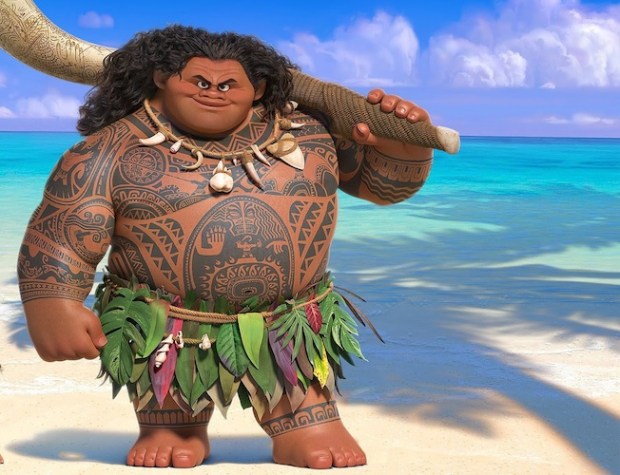
Moana is fearless and yet torn – as she matures – between her birthright, of becoming Chief or giving in to the niggling voice within and setting sail beyond the reef. She’s at odds with who she is and who her people need her to be. When circumstances change and her village starts to suffer, she summons her courage and determination, along with hapless stowaway Hei Hei (Alan Tudyk), and restore the heart of Te Fiti. Her heart previously stolen by Maui (Dwayne Johnson) – chump, braggart, all hubris and hair (and moko). Moana must persuade the demigod to help her reverse the damage he has caused.

Disney’s last dabble with Polynesian culture was in 2002 with the Hawaii-set Lilo and StitchMoana – although the period of time is never established – is most definitely the pre-cursor to Lilo… – the island of Hawaii still to be discovered by the voyaging canoes of the master navigators using star constellations to guide them to lands old and new.

A non-white cast certainly makes a refreshing change. In fact, only the gormless chicken is voiced by a non-Polynesian with the remainder of the cast made up of Hawaiian, Samoan, Māori, and Tahitian natives, this authenticity makes all the difference. Yes, it’s a Disney-fied version of history but oh what a beautiful one with the music making it. Moana’s songs are written and composed by the trifecta that is Opetaia Foa’i, Lin-Manuel Miranda, and Mark Mancina. They are heartfelt, incredibly catchy and above all memorable with highlights including ‘Where You Are’, ‘How Far I’ll Go’, ‘We Know the Way’, ‘You’re Welcome’ and the Bowie-inspired, Jemaine Clement solo, ‘Shiny’. This soundtrack is up there with Beauty and the Beast (1991) and The Lion King (1994) for standard, originality, and (eventual) longevity.
In keeping with the recent trend, there isn’t a romantic slant to the narrative. Just like Merida in Brave and Elsa in Frozen, the love story element is reframed within a pre-existing relationship, i.e. Merida and her mother, Elsa and her sister, and their respective narrative drives stem from finding their place in the world. By comparison, Moana is about a girl and her grandmother and celebrating tradition, embracing heritage, and restoring balance. Like an animated, musical, slant on Niki Caro’s Whale Rider (2002).

Directors John Musker and Ron Clements having previously helmed The Little Mermaid (1989), Aladdin (1992), and The Princess and the Frog (2009) have, with Moana, created an incredibly respectful window into a previously untouched culture, certainly by Disney standards. This not only gives young vahines a voice but recognisable onscreen figures to identify with. Moana embraces her independence to venture and veer from her expected path, assert herself and listen to that voice within. What’s not to love about that?
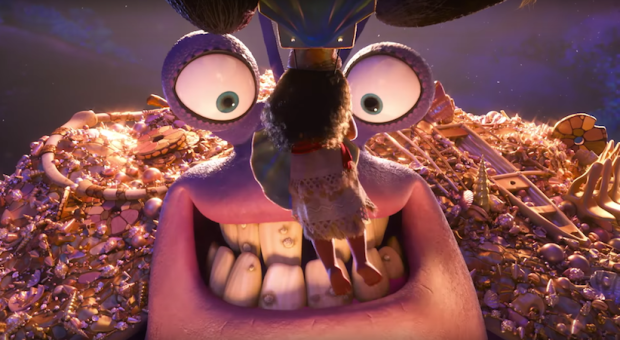
The film is a sheer joy from beginning to end; 113 glorious minutes in which to be engulfed, immersed, and swallowed by an entire oceanic culture.

Bonus Features

The disc doesn’t scrimp on extras either and these are well worth exploring. Gone Fishing (2 mins) is a short film in which, once again, Moana and, her namesake, the ocean get the better of demigod Maui. The real gem of all the extras is the documentary Voice of the Islands (31 mins) which follows the two Midwestern directors in their research for Moana and documents their visits to the Pacific islands, which included Fiji, Samoa, Tahiti, Mo’orea; ending their journey in New Zealand. It’s an incredibly fascinating short doc, and depicts this latest animated outing as a real labour of love on all counts. Working alongside the Oceanic Story Trust, Moana was a wholly inclusive project in which Pacific choreographers, linguists, anthropologists, fishermen, tattoo artists are interviewed and encouraged, at every turn, to contribute. It is an emotional, informative and highly interesting watch. This is followed by Things You Didn’t Know About… (5 mins) delivered in one minute segments in which the directors, Dwayne Johnson, Auli’i Cravalho, Lin-Manuel Miranda, Mark Mancina and Opetaia Foa’i are asked to answer fun, quick fire questions.


Island Fashion (5 mins) is an informative, if slight, addition to the extras menu in which costume design is examined, complete with storyboards and accessories. The Elements of… (13 mins) looks, in minute detail, (despite its short run time) at the more technical elements of Moana including Mini-Maui – a 2D integration within a 3D animation, drawn by Eric Goldberg. Further segments include water, lava, and hair, all explained by the visual effects supervisors and provide real insight into the extent and painstaking processes required to produce, say, responsive waves, smoke, fire and realistic hair.

They Know the Way: The Making of the Music Moana (12 mins). Again, Disney sure know how to pack a lot of information into a short duration. This covers the process by all three writers/composers/singers Mancina, Miranda, Foa’i and despite the fact that they are from the east coast, west coast and south pacific respectively, their cultural and musical difference worked so well as a collaboration. The Igelese Ete & Pasifika Voices choral clips are beautiful. Although, included on the soundtrack, another bonus feature is outtake ‘Warrior Face’ was deleted from the final film. It was inspired by the haka and is played in a three minute video against storyboards of the scene it would have accompanied. Fishing For Easter Eggs (3 mins) reveals hidden treasures from FrozenAladdinZootopiaLittle MermaidTangled and other Disney iconography which is dotted throughout Moana which even eagle-eyed viewers may have missed the first time.

Both directors introduce the Deleted Scenes (25 mins). These are in storyboard form and depict Moana as an eight year old, with her sibling, and definitely expand on a backstory which failed to make the final film. One feature, perhaps, for older children interested in the process but it’s very repetitive and younger audience members may lose interest. The disc extras are rounded off with the video for the Alessia Cara version of ‘How Far I’ll Go’ followed by the whole song translated into twenty-four languages.

Moana in home release is a worthy addition to the Disney family; full of magic and mana.

Categories
film review

A Man Called Ove (Dir. Hannes Holm, 2015)

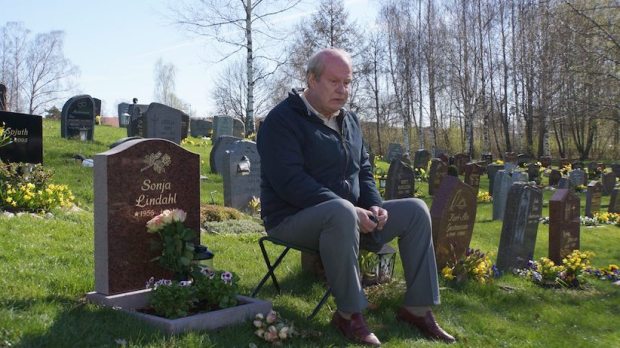
Time is a curious thing. Ove Lindahl (played respectively by Viktor Baagøe, Filip Berg and, of course, Rolf Lassgård) is a particularly cantankerous curmudgeon. Everybody is an idiot whose existences only serve to inconvenience him and his. He has worked the same job for 43 years, until two babyfaced executives take away his livelihood and present him with a gardening shovel as a token of service. Ove makes his rounds following his enforced retirement – he’s the worst (best) kind of neighbourhood watch in which he keeps his small Swedish community safe with his often impolite reinforcement of the block association rules. After his short walk, he puts on his best blue suit, empties the fridge, cancels his phone contract and attempts to hang himself in his living room, only to be interrupted by a crash outside his window. New neighbours: heavily-pregnant Parvaneh (Bahar Pars), Patrick (Tobias Almborg) and their girls, Sepideh (Nelly Jamarani) and Nasanin (Zozan Akgün) have moved in and they’re far from quiet. And so, Ove is coaxed back to giving life another go (until his next attempt) by the delightfully feisty Parvaneh, her family and his neighbours who – despite the grump’s failure to notice – actually like having him around.

Grief is a strange thing. Putting one foot in front of the other until your time is up and you can see your loved ones again (if you believe in that kind of thing). For Ove, living for those six months following his wife’s Sonja’s (Ida Engvøll) death is intolerable. It’s the one aspect which immediately warms the viewer to the largely unsympathetic moaning git. We can relate and as we get to know Ove through a series of flashbacks over the 120 plus minutes, there’s a very human reason for the doom, gloom, and defensive booming voice, and that’s testament to Rolf Lassgård’s performance. The one-time Wallander and veteran of Swedish film and TV brings a gentility and resolute grace to the character albeit in a slightly bad-tempered way. Despite being the same age as Ove at the time of filming, he underwent a bit of a physical transformation via prosthetics which age him greatly. This adds an additional layer of melancholy; this is a man who has had a hard life. Yet, he has such an old fashioned clarity of belief and a sense of morals, duty and unnerving conviction about how the world should be that one can’t help but admire him.

Love is a strange thing. It often takes you by surprise, and family comes in many forms and guises. A Man Called Ove is a heart-warming meditation on love, loss, family and life, and learning to follow and then disregard the rules. It reminds us the importance of community and the inclusion of the aged, experiencing joy alongside tragedy amid the blue, grey and beige phases of life. Oh, and that friendships can be forged and broken upon the type of car you drive. Hannes Holm’s adaptation of Fredrik’s Backman’s bestselling novel is warm, touching and moving. It treads a measured line between humour and sorrow and does so extremely well given how maudlin a film containing failed suicide attempts could’ve been. Instead, its regal music including triumphant strings does a really lovely job at elevating its purpose, and making a colourful, sweet and life-affirming film.

Categories
Blu-ray film review

My Life as a Dog (Dir. Lasse Hallström, 1985)

Lasse Hallström seems to have an affinity with pups, recently in cinemas with A Dog’s Purpose and before that, there was the utterly heartbreaking Hachi: A Dog’s Tale (2009). It all began, however, with his first feature 1985’s My Life as a Dog (Mitt liv som hund) which has now been transferred from original film to High Definition Blu-ray by Arrow Academy.

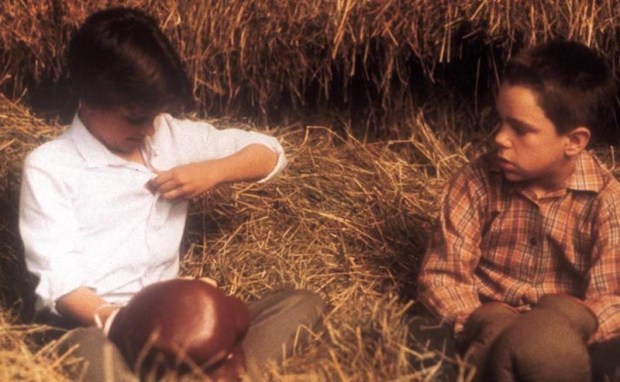
Based on Reidar Jönsson’s autobiographical novel, the film is set in late fifties Sweden and centres upon Ingemar (Anton Glanzelius); a gentle soul, if a little eccentric. He’s ‘married’ to a local girl (by cutting his thumb and having her suck the blood), gets his penis stuck in a bottle during a sex education class, and displays a slight tremor when drinking. Ingemar is twelve. He’s also attempting to live life as normally as possible while his terminally ill mother (Anki Lidén) screams bloody murder at her two sons, and fades slowly awaiting her final days.

Ingemar likens himself to Laika – the Soviet dog that was sent up into space, launched on a one-way trip aboard Sputnik 2, and ultimately left to die. Big feelings for a child who’s convinced things could be worse and one day he’ll be happy as he is packed off to spend the summer with Uncle Gunnar (Tomas von Brömssen) and Aunt Ulla (Kicki Rundgren), and the wonderfully unconventional cast of characters who inhabit Småland. There’s Manne (Jan-Philip Hollström), the boy with green hair, Saga (Melinda Kinnaman) the girl obsessed with boxing and football whose burgeoning breasts are tightly bound so she can stay on the team. Ailing Mr Arvidsson (Didrik Gustavsson) who lives in the basement of Gunnar’s house and likes to be read the lingerie catalogue, in order to silence the persistent roof-hammering of Fransson (Magnus Rask). He’s convinced the noisy neighbour wants to finish him off via the knock-knock-knocking of the metal head against wood. Even Uncle Gunnar with his cleavage obsession and his old vinyl copy of ‘I’ve Got a Lovely Bunch of Coconuts’ (which he plays on repeat) is a tad awkward and sweetly peculiar.

Regardless of their character traits there’s warmth and sincerity and real affection for our young protagonist despite being left at kennel after kennel, never completely wanted by anybody. It’s a remarkable performance by Anton Glanzelius) whose range, sensitivity and affecting depth belies his age and impish grin. While not as dark a piece as Cría Cuervos (1976), it does deal with a lot of the same issues and rests on the young shoulders of its lead(s), as the loss of innocence hits profoundly and they find themselves thrust somewhat prematurely into adulthood. Cinema Paradiso (1988) would follow – and would nicely round off this highly recommended triple-bill – even the US-produced October Sky (1999), clearly took some of its cues and hues from this Academy Award nominated Swedish film.

Hallström has made many pictures since 1985 and there has always been a gentility to his oeuvre, whether he’s dealing with ABBA, cider, chocolate, or Grapes and this bittersweet film extolling the virtues of rural communities and growing pains is no different. This is a warm, whimsical, funny and moving tale of a boy and his search for family; a place he can call home. Canines aside, My Life as a Dog is Lasse’s masterpiece.

Categories
Blu-ray film review

Only Angels Have Wings (Dir. Howard Hawks, 1939)

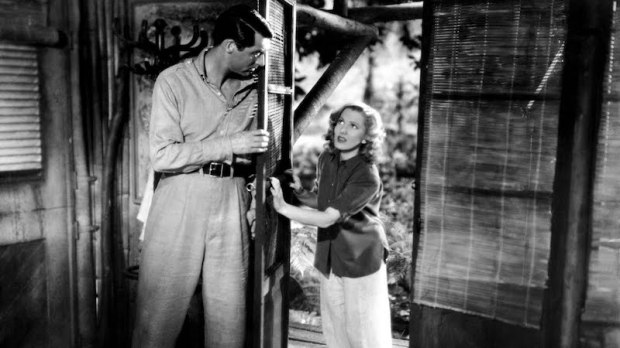
Bonnie Lee (Jean Arthur) disembarks the San Luis after it docks in the small South American port of Barranca. An unemployed showgirl and looking for company, she falls in with two fellow countrymen, Les Peteres (Allyn Joslyn) and Joe Souther (Noah Berry Jr) – American airmail fliers who frequent the, seemingly, only bar in town. Ran by ‘Dutchy’ (Sig Rumann), the bar/restaurant/general store/hotel/gathering place and headquarters of Barranca Airways is the place to be, where a toss-of-a-coin can get you a steak or the chance to be in the air.

Geoff Carter (Cary Grant), steely boss and general chauvinist makes his presence heard and seen; dressed flamboyantly in high waisted trousers, a gun belt and a large Panama hat worn on a jaunty angle, think saloon-dwelling Indiana Jones type. It is a quintessentially glamorous and sensitive Grant, however; there is an underlying darkness which is rare. A man, as the film’s original trailer declares, who has a “propeller blade for a heart and an eye for a pretty girl.” The pretty girls in question, although as per the Hawks way far are from just that, are Arthur and Rita Hayworth (looking far less Spanish than she had previously) and they are ably supported by Thomas Mitchell (Gone With the Wind, It’s a Wonderful Life) and Richard Barthelmess (Broken Blossoms, The Dawn Patrol).

If anybody can make an aviation adventure-dramedy with real levity and musical numbers blend in such a way it is Howard Hawks. The plot is slight but the dialogue; pacing and verbal wit, superb special FX and lighting (oh how Hawks could light a movie) flesh out the otherwise simple story, accompanied by a wonderful score by Dmitri Tiomkin. What carries it is the maverick machismo of these high flying men, their friendships, loneliness, camaraderie and even love. Love for each other and love for the air, there is little glory in what they do and certainly no flag flying but they are there day-in-day-out regardless of the peril. Not unlike all of those other men preparing to forge their own close barracked friendships following the Only Angels Have Wings release in 1939. 

The Criterion Collection launched in the UK on April 18th 2016 with a small, yet defined, assortment of filmic goodies on Blu-ray for the discerning cinephile – this film included – and has continued to grow. Only Angels Have Wings is the Hawks not often discussed; a hidden treasure made all the more valuable by the love and attention shown by Criterion’s beautiful restoration. The crisp sound and perfect transfer/picture quality will make an audience believe they are in that South American Port of Barranca.

Categories
Blu-ray film review

Hiroshima, mon amour (Dir. Alain Resnais, 1959)

To my knowledge; I have never seen an Alain Resnais film – a filmmaker who has a weighty reputation within the French New Wave. I suppose I have to start somewhere, so beginning with his first feature, Hiroshima mon amour (1959), seems conducive.

The film opens with a close-up of entwined limbs, disembodied voices accompany the body parts which glisten with perspiration then are covered with atomic ash and glitter. It’s an evocative image which serves as a haunting reminder of the bomb. The score (composed by Georges Delerue and Giovanni Fusco) is affecting, particularly the inclusion of a flute but then the addition of a piano accompaniment adds a jauntiness which is at odds with the next slew of images: petrified rocks, specimens of skin, hair, footage recollecting the devastation; people writhing in pain and bloodied. It seems almost inexplicable to set a love story against this desolate and damaging backdrop, and yet when dealt with the passage of time and evocation of memory, it makes perfect sense. Like a Phoenix rising from flames, life and hope must continue and the ‘new’ Hiroshima is slowly being rebuilt and appears thriving as the Architect (Eiji Okada) and the Actress (Emmanuelle Riva) fall in love.

The passage of time and power of memory are strong themes throughout Marguerite Duras’ oblique script and the juxtaposition of her poetic dialogue alongside the images of horror is highly emotive. The non-linear narrative with its use of flashbacks, ellipses, and jump cuts must have been particularly original in ’59 and clearly influential as they continue to be used today. The repetition of history and the atrocity of genocide with the emphatic nuances of love in Riva’s performance are quite stunning; personal pain, public humiliation and the beautiful mesmeric shots of Sacha Vierny’s cinematography make for a quietly devastating film about the human condition and lost love. Having viewed it at a time when it would be appreciated, the melancholic beauty of Hiroshima mon amour leaves a lasting impression.

Note to self: must make the rest of the Resnais oeuvre a priority.