Categories
Film Festival film review

Make Me Up (Dir. Rachel Maclean, 2018)

LFF 2018

For those unfamiliar with Rachel Maclean’s work, the Edinburgh-born multimedia artist created one of the 50-feet portraits of Billy Connolly which adorned the streets of Glasgow for The Big Yin’s 75th birthday. She also submitted a short: Spite Your Face to last year’s London and Venice film festivals. This piece focussed on a Pinocchio-type character – played by Maclean – who chases the lure of wealth within an abusive patriarchal power. It was made as a response to Britain’s decision to leave the EU and Trump’s presidential campaign. Within the mise-en-scéne its colours of choice were (Tory) blue and (Trump) gold.

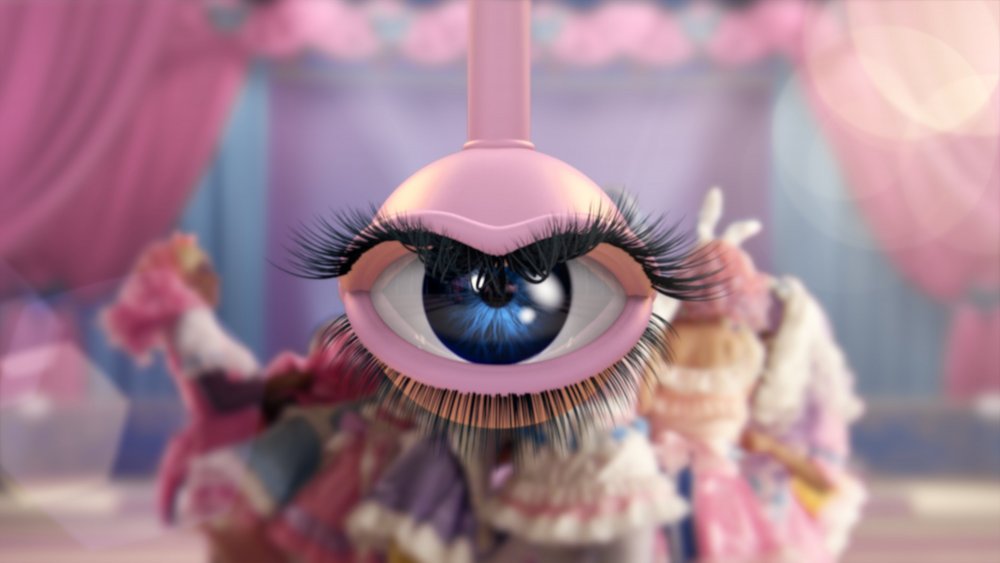
The artist’s first full-length feature – included in the BFI’s 2018 festival programme – uses bubble gum pinks, violets and blues in every frame, and like its predecessor zones in on the post-Brexit zeitgeist in a similarly confrontational and acerbic manner. Make Me Up begins with the familiar aural tone and visual most Apple users attribute to the Siri application, when a disembodied male voice asks, “Siri, when is the world going to end?” before a woman screams “I don’t know!” and her cries resonate over the black screen.

Siri (Christina Gordon) in this case is a woman, pink of hair, born of a gelatinous lump of flesh. Unsure of how she ended up in such an inexplicable place, she becomes allies with Alexa (Colette Dalal Tchantcho) and is forced to compete against several other women (there’s even a Cortana too) in a hyper-real game show of sorts. All under watchful Orwellian eye(s) which fall from the ceilings and monitor everything and everyone via facial expressions and status updates.

In charge is the Figurehead (Rachel Maclean). An equally magenta-haired woman who schools her audience on the role of women within civilisation and through the history of art. Like her ‘pupils’ she has no voice of her own but is a conduit for the dulcet tones of historian Kenneth Clark, and specifically his 1969 BBC TV series Civilisation. She has other voices in her arsenal, namely those belonging to Andrew Graham Nixon and critics E.H. Gombrich and Robert Hughes, all stored within a device embedded in her arm. Her mannerisms scream Thatcher as her lips sync to the pomposity of the white, male patriarch. The girls before her know to mind their Ps and Qs and if they don’t? Well, naughty girls are punished, pitted against one another before elimination. The winner gets to eat.

Every inch of the film is aesthetically pleasing – although some may find it on the kitsch-side (when is that ever a bad thing?) – from Maclean’s production and costume design (she is also editor and responsible for the compositing and 2D effects) to Grant Mason’s prosthetics and Scott Twynholm’s score; it is all substance and style. Maclean asks us to consider the toxicity of social media, the depiction of women in politics, art iconography and beauty culture. The use of The Woman of Willendorf and the Venus de Milo is particularly powerful to illustrate the evolution of the female image, with nods to the works of Michelangelo, Botticelli, and Munch later on.

Make Me Up is a biting and thought-provoking satire which could not be more timely, not least in its celebration of the Suffragist Movement. It presents the violent and submissive fears, desires, control and pressures surrounding women. It asks questions of the role of women in contemporary feminism and art, as well as realigning the male gaze albeit sardonically amid Freudian visuals (the breast-shaped door handles and phallic dinner meat are particularly delightful). It has aspects of Alice in Wonderland by way of Sucker Punch via Hartbeat.
There is, however, no all-encompassing decorative pink bow of a conclusion – as Siri plots her escape thanks to the support of the sisterhood, you will recognise a few – and some may even find the final shot dispiriting but thankfully women persist. Director/Writer/Artist and all-round multitasker Rachel Maclean has put together something highly intelligent and imaginative. It deconstructs the beauty myth (perfection paint, anyone?) and reconsiders art history, criticism and all with a grin on its face and a knowing wink. More please.

Categories
film review

Papillon (Dir. Michael Noer, 2018)

Much has been made of Henri Charrière’s time in prison not least in his 1969 autobiography Papillon, its sequel Banco – published in ’72 – and the ’73 Franklin J. Schaffner film starring Steve McQueen and Dustin Hoffman. Even 45 years later, the film was hardly primed for a remake but yet here we are.

Beginning in 1931 Paris, safecracker Henri “Papillon” Charrière (Charlie Hunnam) – so named for the butterfly tattoo on his chest – steals some diamonds for mob boss Jean Castili (Christopher Fairbank). Though, why they all sound like extras from Boardwalk Empire is never explained. Only, Papi’s light fingers also grab a necklace and a few of the precious stones so he and lady love Nennete (Eve Hewson) can eventually do a flit and start a life free from crime. The next morning, he finds himself accused of murder, banged up and set for hard labour in the penal settlement of Bagne de Cayenne (AKA Devil’s Island), French Guiana.

Aboard the transit vessel, an early disembowelling cements Papillon as Louis Degas’ (Rami Malek) protector as he vows to keep the bespectacled con-man alive for the duration of the trip. Degas becomes his bodyguard’s benefactor for any future escape, promising to share the stash of cash he keeps in an intimate place (let’s just say this was long before cavity searches). No one thinks to question the authenticity of the roll of banknotes despite Degas’ counterfeiting crimes, however, an unlikely friendship forms between the two as they reluctantly embrace their jailtime.

Papillon’s first escape attempt doesn’t quite go to plan and it lands him in solitary confinement for two years under the watchful eye of Warden Barrot (Yorick van Wageningen), a large man with a gentle voice who’s genuinely curious about the prisoner that can withstand and survive solitary. Any other time he stands, holding court to his kneeling prisoners, in front of a guillotine wearing a cream linen suit – a bit like a sadistic Man From Del Monte.

Even if you haven’t seen the first film, this is a story which will instantly seem familiar. Michael Noer’s rendition may be bookended by an epilogue and prologue – presumably to incorporate more of the source material – however, that’s where the differences begin and end as the plot in between is practically identical to Schnaffer’s. Director Noer and his production designer Tom Moyer, cinematographer Hagen Bogdanski, and composer David Buckley work incredibly hard to deliver a pacy epic (based on Aaron ‘Prisoners‘ Guzikowski’s script). It often looks (and sounds) amazing, however, it remains unconvincing in its central performances.

Hunnam doesn’t have the hubris and gravitas of McQueen who inhabited the role of Papi effortlessly (although Hunnam’s is certainly the gentler of the two) and Malek – fresh from his outstanding turn as Freddie Mercury – seems to sleepwalk through his version of the bookish Degas, perhaps those shoes were just too large to fill. Neither character looks particularly lived-in, save for their last scenes together despite the (eventual) 14-year sentence, and overall it lacks the dingy grime and dirt of the original which may have been melodramatic in comparison but at least carried some tension with it. Even the fight scene in the prison shower (of course, there’s always one) comes off as risible as it’s choreographed within an inch of its life, clearly to prevent any display of full-frontal male nudity.

Yes, an argument can be made that this Papillon is purposefully hopeless and, at times, more brutal than its predecessor acting as a commentary of today’s prison system and its privatisation but you’ll find more anger and urgency in the likes of Brawl in Cell Block 99 or even Oz, and Orange is the New Black. While it pushes the ‘true story’ angle despite the questionable ‘facts’ (according to prison records, Charrière was never on Devil’s Island), one wonders if there could have been more care taken with casting or if utilising other aspects of the man’s life after prison might have elevated the already excellent story and produced something, well, more.

Papillon is by no means a mitigated disaster, nor is it as compelling as the original source material however embellished and/or fictitious elements of it were. It’s a decent prison-drama for those unfamiliar with the exploits of real-life Charrière, and McQueen’s screen incarnation. For the rest of us, most will argue that the best cinematic version of that story has already been told.

Categories
film review

It (Dir. Andy Muschietti, 2018)

It feels idiotic to assume yet I expect most of the world is well-versed in the Stephen King novel and if not the book then the TV serial which surfaced in 1990. It’s back and, just like before children are disappearing and the adults are oblivious. Amidst a downpour in 1988, a little figure clad in a yellow slicker and green galoshes runs alongside the paper boat that his big brother and ‘bestest pal’ made for him. SS Georgie battles the raging seas i.e. gushing rainwater on the streets of Derry, Maine, until it slips from tiny grasp into the storm drain.

Twelve months later and still reeling from the loss of his little brother George (Jackson Robert Scott), Bill Denbrough (Jaeden Lieberher) and his group of friends: Richie Tozier (Finn Wolfhard), Eddie Kaspbrak (Jack Dylan Grazer), Ben Hanscomb (Jeremy Ray Taylor), Beverly Marsh (Sophia Lillis), Mike Hanlon (Chosen Jacobs) and Stanley Uris (Wyatt Oleff) known affectionately, as The Losers Club join forces to defeat school bullies and the evil thing that is devouring the town’s children.

Adapting any major work must be hard, not least when the original text is a magnum opus. Liberties were certainly taken in 1990 condensing nearly 1400 pages into a three-hour TV series but then I was a child, had yet to read a King novel, and was utterly horrified at the prospect of Pennywise the Dancing Clown and his shifting shape(s) of fear. This time round, and now well-read, it feels slightly more faithful in some ways and yet there are those damn liberties again. Despite early production problems, and the acrimonious departure which took with him, his Will Poulter-shaped Pennywise and director’s chair, Cary Fukunaga retains a writer credit alongside his writing partner Chase Palmer but it’s Gary Dauberman who takes the lead while Andrés (Andy) Muschietti (Mama) steers the ship.

The novel’s structure has changed and 50s Derry is transposed to the 80s – just as Regan handed over the keys of 1600 Pennsylvania Avenue to Bush – but that just gives the 15-rated film a Stand By Me meets The Goonies (and John Wayne Gacy) retro quality that actually really works. Splitting the film into two chapters and avoiding those flashbacks and forwards, means these kids are able to hook us entirely, we’re completely invested in their plight, their friendships and fears, and that emotional connection is made. This is their time and each of the main cast is a delight.

Richie’s still a motormouth and has the best lines, Bev – she of Winter fire hair – is great; kind and tough, hypochondriac Eddie is more verbose than I remember, Bill’s still a little bland, and Ben’s a sweetheart (with excellent taste in boybands). Stanley’s character is fleshed out a little more while, disappointingly, Mike’s is somewhat diluted. His interest in Derry history is sidelined and given to Ben for reasons unknown, and not, one hopes, just a way for the filmmakers’ to avoid the racial elements of the story. He is clearly painted as the outsider. Fingers crossed that come Chapter Two some of these issues will be addressed, and he receives the narrative pull that was expected. My point is, gripes aside, it’s like revisiting old friends.

Had I watched this version at 11 years old, I’d have been traumatised, It comes back every 27 years (in actuality, 25 for me) and now I’m the adult no longer afraid (well, ish). To be fair, Bill Skarsgård in the clown get-up is the stuff of nightmares. He’s less abrasive and wisecracking than Tim Curry, and there is an underlying innocence to his Pennywise which adds to the vile and creepy. His body movements are manic and frenetic, even a little awkward, like a child who has experienced a growth spurt overnight and boy, is he hungry (the saliva drenched lips and string of drool, a dead giveaway). He is terrifying and yet, for me, the scares throughout the film are somewhat lacking despite the gripping sense of unease felt from the start with poor Georgie. 

Visually, the film is stunning thanks largely to Chung Chung-hoon’s cinematography, Janie Bryant’s costumes, and the VFX and make-up provided, in part, by Stan Winston alums Tom Woodruff Jr and Alec Gillis. The sets are elaborate and striking and for horror fans it has a real kid-in-a-sweet-shop feel, especially the house on Neibolt Street. The set-pieces are thrilling and rich in detail, and littered with plenty of horror-themed easter eggs, the jump scares are fairly frequent and perhaps a little obvious but there was one that the two guys sat next to me didn’t see coming.

All-in-all, this is a thoroughly enjoyable adaptation, horrific, heartfelt, and not in the least bit hokey; a perfect trip down memory lane via childhood street and nostalgia way. By the time the credits roll, you’ll float too.

Categories
film review

Tag (Dir. Sion Sono, 2017)

When watching any film by Japanese filmmaker Sion Sono, it is safe to say no two films are ever the same. He can turn his hand to all forms of genre cinema and yet doesn’t conform to any. From his last, gang rap musical in Tokyo Tribe to the gritty noirish neon of Guilty of Romance through his masterpiece, the epic romantic opera Love Exposure to the wonderfully weird hirsute horror Exte, one is always guaranteed an aural and visual experience of radical proportions and Tag, which would make an excellent companion piece to Sono’s 2001 feature Suicide Club, is no different.

Opening on the road with two coaches full of schoolgirls on a class trip all – except Mitsuko (Reina Trendl) who’s writing poetry in her journal – engage in a playful pillow fight as girls are prone to, apparently (it also sets up the recurring motif of falling feathers). A supernatural event then leaves her as the only survivor and she’s stranded with only her legs to carry her. This invisible perpetrator chases her to a lake, leaving more victims in its wake, where Mitsuko can wash off the majority of the blood spatter covering her stark white school uniform. She replaces the outfit with a second variant of a uniform and takes refuge in another all-girls school where everyone seems to know her despite never being there before. It isn’t long before death and chaos follows Mitsuko and she is, once again, on the run to the next reality and the next uniform, this time with a different face as she races to survive.

Tag offers up some interesting and philosophical musings about life, death and destiny as Mitsuko (in a couple of guises) spends the majority of the film running away yet, towards something. Participating in the human race has us all running from/towards death and experiencing the absurdity of life; a concept which is taken very literally here but then, thankfully, subtlety has never been Sono’s forte when combining his arthouse sensibilities with bloody action and horror. Yet, this film seems to take some cues from mainstream culture like Alice in Wonderland via seventies comedy horror classic, House.

Keeping the cast predominately women until the very end leads us through a womanhood of sorts: adolescence, love, laughter, and freedom to marriage when everything, or so it appears, ceases – the Groom with the animal head who resides in a black coffin certainly signifies as much – cue more carnage. This then culminates to a meta end and one which can also be read as a deliberate and timely response to the GamerGate controversy. However, as Mitsuko battles the new realities and does finally enter The Male World, it all goes way beyond a 2014 harassment campaign. It’s a largely silent and grim place where, surprisingly, women are decorative objects and all for the playing pleasure of a wizened old man (astutely cast Japanese heartthrob Takumi Saito under convincing prosthetics). He is the personification of patriarchy bending the world to his will, playing with his dolls and twisting reality to suit.

Tag, (inspired by Yusuke Yamada’s Riaru Onigokko) is a highly intelligent and exhilarating ride. The creativity and aesthetic of Sono is the driving force behind this provocative and surreal little tale. It is a bloody riot yet beautiful in its macabre weirdness, not least in those first five minutes – only in something so very artificial and unconventional can reality resonate even louder. It is a shame that there are no extras on the disc as a featurette or director commentary could shed more light on the inspiration for it, however, the not knowing is also what makes Tag such a pleasing experience. You, just like Mitsuko, get to choose and decide its fate.

Categories
Blu-ray film review

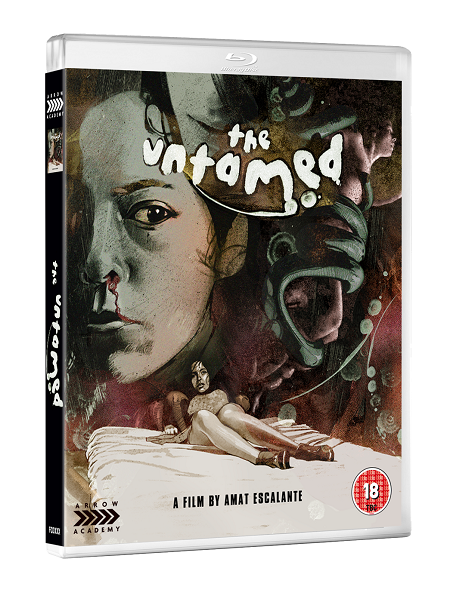
The Untamed (Dir. Amat Escalante, 2018)

Never one to shy away from the confrontational, Amat Escalante’s follow up to the unflinchingly brutal Heli (2012) is available now on DVD and Blu-ray courtesy of Arrow Films and its Arrow Academy label.

Straddling science fiction, horror and a Mexican kitchen sink drama, The Untamed, begins with a lingering shot of a meteor hovering in space. Its crash to Earth occurs off-camera but leaves a large crater in its wake and t brought something with it. That ‘something’ has tentacles, presumably a respiratory system of sorts, despite having no visible organs or features, and has taken up residency in the barn of an ageing couple (played by Oscar Escalante and Bernarda Trueba). It has a regular visitor in the form of Verónica (Simone Bucio) who, well it’s never made implicit what or how she serves the alien form despite strong indications; only that on this occasion, she is injured and forced to leave and find aid.

Shocked and bleeding, she seeks refuge in a local hospital where her wound is treated by Fabián (Edén Villavicencio) and one thing leads to another and the lonely and somewhat mysterious Verónica inserts herself into the gay nurse’s life and by extension his sister Ale (Ruth Ramos) and her less-than-blissful domestic set-up with cheating, bullish homophobe husband Ángel (Jesús Meza) and their two small boys. The stranger convinces them that the life form which resides in that barn is the answer to their problems just prior to and even after devastating, irreparable tragedy.

Apparently made as a direct response to chauvinism, mainstream homophobia and the moral perception of tragedy, this fantastical allegory builds atmosphere with a literal humming buzz in the diegesis and taps into our basest primitive state, and the relationship between pain and pleasure. This dichotomy is beautifully depicted through Ale and Angel’s youngest son and his love of chocolate, he knows he’s allergic but can’t resist. Those moments of gratification are worth it, even if it means an angry-looking itchy red rash and a prodding injection. Seemingly, for the adults, pain and pleasure mature through sex and violence, however, this is never fully connected within the film’s narrative, the strange alien life force or the human subjects.

The Untamed deals with hefty subject matters and is a human drama within a sci-fi-erotic-horror film. Several scenes are clearly influenced by Andrzej Žulawski (the late filmmaker is even acknowledged in the closing credits), there are moments which feel Cronenbergian, and even includes a scene which reminded of von Trier’s Antichrist (2009). The horror aspects never feel forced and are fascinating, specifically the creature, one is drawn to it much like the lost souls in the film yet it’s not given that much screen time. Sadly, it is in the human drama aspect that the film falls down. There was an intensity, rage and heft to Heli and even Žulawski’s Possession (1981) (if we’re to take that as the main text of inspiration) which feels missing here; yes it’s subversive, intelligent, and well put together but overall muted and a little disappointing.

DISC EXTRAS

The Making of The Untamed (84 mins) – this in-depth footage takes us behind the scenes with the cast and crew of the film, shot by one the film’s composers and the director’s brother, Martín Escalante. There are fascinating moments, warm interludes between filmmaker and his collaborators – who seem to compromise of some long-term friends and family members – and laborious retakes in shooting. Amat Escalante is a perfectionist, that much is clear.

Amarrados (Tied Up) (15 mins) –  Escalante’s first short which took first prize at the 2002 Voladero International Film Festival in Mexico and won him Best Short and Best Director at the Newport Beach International Film festival in 2003. Shot in black and white, the film centres around Niño (Abel Diaz), a young homeless boy who’s stuck in a vicious cycle of sexual abuse and glue-sniffing. There’s a beauty amid the misery in this short, in which class, race and religion are alluded to and Escalante’s follow-shot is included: a great edition to the disc.

First Pressing Only – Booklet featuring new writing on the film by critic and author Alexandra Heller-Nicholas, writing by critic Jonathan Romney, the director’s statement and extracts from the press book, illustrated with original stills (unavailable at the time of review).

Region: B/2|Rating 18|Language: Spanish|Subtitles: English/English SDH|Aspect Ratio: 1.66:1|Audio: Mono|Colour|Discs: 1