Much will be made of Phillip Youmans’ age when the writer, director, DoP, and camera operator made, this, his first film. Just look at Xavier Dolan following his debut, the ‘wunderkind’ label was bandied round for at least five years of the last decade. However, that surliness and juvenile (albeit brilliant) edge to I Killed My Mother is largely missing from Youmans’ debut Burning Cane; a mature Southern Gothic drama which belies the (then) High Schooler’s age (he’s 19 now).
Set in rural Louisiana, our leading lady Helen (Karen Kaia Livers) sits on her stoop smoking, her voiceover discusses her dog Giorgio. It has the ‘mange’ and she is attempting to prolong its life anyway she can. Helen has been surrounded by ‘diseased mutts’ most of her life – her late husband succumbed to an AIDS-related illness while her Pastor Reverend Tillman (Wendell Pierce) and only son Daniel (Dominique McClellan) are fighting with alcoholism. Tillman continues to drink on the job following the death of his wife and won’t accept any help, least of all from his flock, choosing instead to drive home each night after sermons, inebriated, his car swerving all over the road.
Daniel, on the other hand, has to contend with keeping house while his partner (Emyri Crutchfield) goes to work and supports their family. He cooks, cleans, and fixes things around the place but it’s taking its toll. He’s questioning his masculinity and is steadily on self-destruct mode; he’s the man and should be the one providing, not staying at home looking after son Jeremiah (Braelyn Kelly).
‘Looking after’ may be somewhat of a stretch, the boy is mute – presumably a nod to the weeping prophet he is named for – unable (or choosing not) to talk and accepts his father’s love in the form of an occasional meal and glasses of milk laced with whatever liquor the older male is guzzling down. There’s a hint at something darker going on between father and son but the level of abuse remains at the booze-pushing and never leads anywhere else, beyond the steady decline of a man who would rather use his fists in a drunken stupor than work through any of his issues.
Youmans utilises a number of camera angles and shots which suit the oblique storytelling, however, at times poor lighting and a literal lack of focus feel unnecessary especially when considered alongside the already slow pace. Being unable to see much within the frame is problematic, however intentional but it does help build mood with the extreme dichotomy of light and dark. As the claustrophobia hits its peak, the humidity and sweat are palpable. It’s a pensive narrative, and while its foundations are embedded within the art film, it is largely raw, grass roots filmmaking.
This is Helen’s struggle to reconcile her faith alongside her relationship with her son. It’s a film about sin, despair, drink and poverty. One which examines a mother’s love for her child, deep-rooted toxic masculinity – the definition of what it means to be a man – and the role religion plays within the black community onscreen. Many pray to a Father for guidance, and yet few have fathers to guide them. There is condemnation of the Church and yet at no point does the institution feel demonised.
Colours are kept to a minimum too, greys, greens, browns with the occasional flash of orange (courtesy of the fruit trees Jeremiah finds solace in or the burning umber of a lit cigarette). Daylight is also a rarity – while we’re so used to the depiction of a light, bright sunny South on film, in Helen’s world, everything is tinged with a dismal grey while heavy clouds hang in the sky. The film’s title relates to the annual process of harvesting sugar cane; fields are set alight before the valuable part of the crop is harvested, an apt metaphor for the film’s narrative.
While as a whole, the film never feels completely cohesive and ends somewhat abruptly, it is a promising vérité style debut which feels reminiscent of early Burnett and Malick. Following its trifecta of wins at this year’s Tribeca Film Festival, It’s safe to say there will be plenty of interest in what Youmans creates next.
Despite origins in 16th century Italy and containing a character named Pulcinella, the concept of the traditional puppet show Punch & Judy would eventually make its home in Britain during the 17th century – historians say 1662, thanks to a diary entry by the Bridget Jones of his day, Samuel Pepys.
Within a hundred years ‘Pulcinella’ was anglicised to the much snappier and succinct ‘Mr. Punch’ and Joan, his wife also had a name change and took on the moniker ‘Judy’. Puppets on strings would pull a Pinocchio, only rather than becoming ‘real’ they would adorn the hands of the hidden human and entertain adults and children alike for more than 350 years – regardless of form or plot-line – usually at the seaside. Perhaps it was the sea air which rendered audiences immune to the repugnancy of the insidious Mr. Punch.
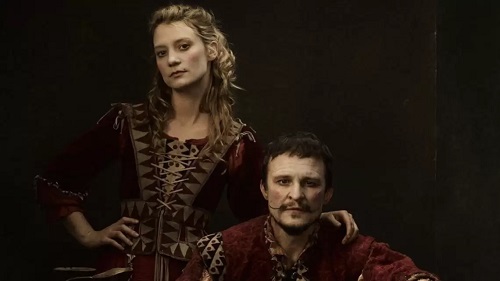
‘Seaside’ is the locale of Mirrah Foulkes’ debut feature, ‘somewhere in England’ and ‘nowhere near the sea’. A small cloaked figure steals into town to sneak into the evening’s show. Bottler Judy (Mia Wasikowska) shakes a tankard for coinage and entertains the crowd before announcing the main event: Professor Punch (Damon Herriman) and his puppets. He appears through crimson velvet drapery with a bang and cloud of smoke; caked in face-paint, jester-like in his stage costume complete with twirled moustache. Make no mistake, this – debatable when we see Judy’s puppeteering skills – is the star of the show. By the end of the elaborate opening credits we, just like the rowdy audience onscreen, are hooked.
Punch and Judy live in a beautiful home with their daughter, Baby (the cheek pinchingly adorable Scarlett and Summer Dixon), maid Maud (Brenda Palmer) and her husband Scaramouche (Tony Norris). They await the day that scouts arrive in Seaside to discover the magic of their talent and transplant it to The Big Smoke. He wants more fame and fortune – swanning around Seaside as a minor celeb is not quite enough for his ego – while she seems fairly content with their lot. Although, she does seek to tone down the ‘punchy and smashy’ aspect of the show, while imploring him to stop frequenting local watering hole McDrinkie’s, and ideally would like the community around her to be a little less… judgemental.
Townspeople are banished as heretics to the Black Forest, others are publicly hanged, and women are stoned daily for reasons that are utterly ridiculous but are, of course, to the folk of Seaside signs of witchcraft and (obviously) the work of The Devil. Leading the charge is the simpering and sneering Mr. Frankly (Tom Budge) who rewards the important men of town with casting the first stone and brings actual fanfare to the Gallows. New Constable Derrick (Benedict Hardie) has his work cut out; crimes and grievances bypass his office and result in quick confessions and executions. Then there’s his crush on Judy… while local prostitute Polly (Lucy Velik) only has eyes for Punch. Maud’s job is becoming harder as hubby Scaramouche’s memory worsens but as long as her master gets his sausages before Toby the dog gets his paws on them, all should be well.
Plot-wise, if you’re at all familiar with the show, then you can rest assured it’s all here. Foulkes gives us a bit of an origin story – albeit a subverted one – which looks at the historical context and celebration of (gendered) violence, as well as the notion of oral histories and storytelling in its earliest form, idiom and allegory. The film is darkly comic from the very beginning with a never-faltering tone which is perfectly pitched and often black. It’s hard to find the humour in heavy hitting themes such as domestic violence, alcoholism, adultery, murder, early onset dementia, and misogyny but writer-director Foulkes finds that twisted balance perfectly. Assisting her in some lovely cinematography is seasoned DoP Stefan Duscio, gorgeous period costumes designed by Edie Kurzer and a gloriously bizarre soundtrack courtesy of composer François Tetaz – there’s a theatricality to his music which simultaneously feels dated and contemporary when accompanied with the action onscreen.
Performances are solid from Hardie’s drippy Derrick to Gillian Jones’ dark, mysterious – and possibly necromantic – Dr. Goodtime. Terry Norris’ bumbling Scaramouche is a delight, Wasikowska is always worth the price of admission, and the currently ubiquitous Herriman is suitably deranged as maniacal Punch. It’s a charming collective of Australian actors – including Foulkes behind the camera (she can be seen in front of it in The Gift, The Turning, and Animal Kingdom) albeit with a multitude of British and Irish accents. Not every single one is convincing but it often adds to the hilarity – Herriman’s is of course flawless.
Astonishingly, the entire film was filmed on location in Australia and yet is so authentically ‘English-looking’. It all works brilliantly. As an origin story, comedy, and dark drama Judy & Punch is an assured, astute and compelling film. It’s one which offers up a lot and delivers on everything – History becomes Herstory and brava to that.
It was the film listed on the marquee of the local cinema as George Bailey (James Stewart) ran through a snow-covered Bedford Falls, and back into the bosom of his family. It was also the picture that Michael Corleone (Al Pacino) took Kay Adams (Diane Keaton) to see at Radio City Music Hall on their first date. Aside from being dearly beloved by filmmakers named Francis, The Bells of St Mary’s does what very few films have been able to do, and that is out-charm its cinematic predecessor (despite Bosley Crowther’s 1946 claims in The New York Times).
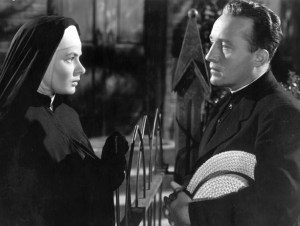
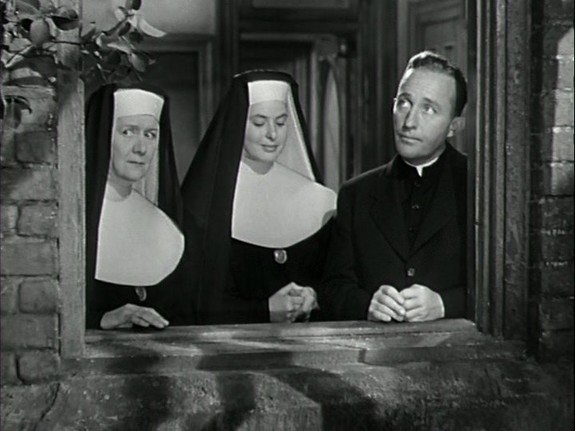
Father ‘Chuck’ O’Malley (Bing Crosby) was first seen in Leo McCarey’s 1944 hit Going My Way and is reintroduced here – wearing his straw boater on a jaunty angle – arriving at St. Mary’s in order to help Sister Superior Mary Benedict (Ingrid Bergman). She, who is fighting to keep the Parochial school open and out of local businessman Horace P. Bogardus’ hands. Bogardus (Henry Travers) has already purchased the adjacent building to St. Mary’s but is determined to secure the school grounds for his parking lot.
In the beginning, Father and Sister clash – albeit with a twinkle of the eye and a sly smile on the face, alongside quips like: “Did anyone ever tell you, you have a dishonest face? For a Priest, I mean.” Somewhat predictably, they – the American Priest and European Nun – realise they must come together to fight a common goal. Sound familiar? Okay, so it’s not fascism per se but the film was released in December of 1945 so it’s hardly a stretch to see its themes set against the war effort.
Director McCarey had a somewhat varied career, dabbling in slapstick (Duck Soup, 1933), melodrama (Make Way For Tomorrow, 1937), screwball comedy (The Awful Truth, 1937) and romance (An Affair to Remember, 1957). He would make four Priest-led films (Going My Way, …St. Mary’s, My Son John in ’53 and The Devil Never Sleeps in ’62), which for a devout Catholic is hardly surprising, but in all and especially in this film he managed to humanise both Priests and Nuns, depicting them as flawed individuals and, crooner Crosby and the radiant Bergman take Dudley Nicholls’ script and run with it.
There are no villains of this piece – Travers best known for playing angel Clarence in Capra’s It’s a Wonderful Life is probably the most antagonistic, however, manages to convey sincerity and humour all the while attempting to chuck the Sisters and their young wards out of their school. While this is the overarching plot, there are minor, almost irrelevant arcs which provide the gentle comedy and at times offer the most laughs, which go to the heart of the film and viewer alike. Like, flunking student Patsy Gallagher (Joan Carroll) who leans on Father Chuck to help her pass the school year.
Patsy is left at St. Mary’s while her mother Mary (Martha Sleeper) weighs up giving caddish pianist Joe (William Gargan) – who left her pregnant and alone – another chance. Or, bullied Eddie Breen (Richard Tyler) who has been “turning the other cheek” as per Sister Superior’s advice until she decides to teach him, in one memorable and hilarious scene, to box. Even when Chuck and Mary Benedict do have a difference of opinion, it is all decidedly good natured.
It is these threads, and elements within the mise-en-scène, which show the passing of time as the seasons change and the school year progresses, culminating in the most adorable Nativity performance, in the history of Nativities. McCarey was all about improvisation and naturalism in his actors’ performances, and it is no more apparent than in the recreation of “Jesus’s birthday”. It was reportedly shot in just one take with the children encouraged to ignore the camera and crew, and approach their material as they saw fit.
This is an aspect of McCarey’s work ethic which admirer Yasujirō Ozu emulated in Tokyo Story – the 1953 retelling of Make Way For Tomorrow. It is a characteristic which make this film so utterly charming. There are of course – given Crosby’s presence – musical numbers, courtesy of composer Robert Emmett Dolan, such as the delightful “Aren’t You Glad You’re You?” and even Bergman stretches her vocal chords in her native Swedish for “Varvindar Friska” (Spring Breezes) and while musicals are not everybody’s cup of tea (I know, who doesn’t love a bit of Bing?) there are ample numbers to enhance the narrative yet few enough not to put people off completely.
Drill deeper and there are interesting depictions of the gendered approach to conflict which one may argue are outdated, however, some still ring true even today. Yes, it may offer an idealised, even sweet depiction of Catholic schooling but this assertion of patriarchal power is more than still relative especially in the institution of the Roman Catholic Church, and indeed, as discussed by Revd Steve Nolan’s analysis in the disc extras – the notion of paternalism. Made obvious in the way Dr. McKay (Rhys Williams) decides to withhold vital information of and from a (female) patient but discusses freely with ‘a man of the cloth’.
Although not necessarily a Christmas film, you can do a whole lot worse than including this film on your festive watchlist (if not before). It’s the perfect addition containing humour, charm and sincerity, and one which warms the cockles in much the same way as The Shop Around the Corner or Remember the Night. It may not be regarded as McCarey’s most cinematically satisfying film but its popularity is evident and understandable.
The performances are natural, subtle and nuanced especially Bergman who was rarely seen onscreen less than glamorous, and was loaned by David O. Selznick as part of a deal he struck with McCarey. Here she shines, quite literally, from the glow of her unmade-up face to the luminosity of her smile and the clever use of lighting which flawlessly renders her, hitting the eyes perfectly within her wimple. Made all the more noticeable here thanks Paramount’s restoration process which still contains some grain but which creates a beautiful monochromatic sheen to each frame, set within a 1:37:1 aspect ratio.
The Bells of St. Mary’s will charm your socks off – and it’s a well-known fact that this writer watches it every Christmas Eve without fail. It just ain’t Noël without that little boy, Bobby (Dolan Jr), knocking on a curtain introducing himself in one breath, “This is Mary and I’m Joseph, and we came to Bethlehem to find a place to stay.”
Special Features
It’s almost a given now that if it’s an Arrow Films release, the Academy label in this instance, there are always a few extras to enjoy after the credits have rolled… and only then.
Up to His Neck in Nuns (22 mins) – This visual essay by David Cairns is entertaining and informative as the writer dips into Leo McCarey’s filmmaking history, his early life, Catholicism and heavy drinking. It switches from film clips, stills, photos, archival interview quotes, and Cairns’ lovely Scottish lilt ensures it’s never boring.
Analysing O’Malley (19:48) – This appreciation by the Chaplain of Princess Alice Hospice, film academic, and author of Film, Lacan and the subject of Religions: A Psychoanalytic Approach to Religious Film Analysis, Revd Dr. Steve Nolan is a little dry in comparison to the previous essay. Nolan sits to the right of the frame and narrates; reading an essay from an autocue. It’s a fascinating analysis but one which would have worked just as well as a commentary (surprisingly lacking here).
You Change the World (32:07) – This short religious propaganda film was shot by Director McCarey in 1949 and features appearances by Bing Crosby, Bob Hope, Irene Dunne, William Holden, Loretta Young, and Jack Benny – all regarded at the time as ‘super Catholics’. It’s arguably some of the best acting any of them have ever done, and they’re playing themselves! It’s preachy, condescending, cringeworthy hypocrisy at its finest (and I say this as a Catholic). The purpose of the film was to persuade “good, decent, normal people” to join The Christophers. I stopped counting how often “The Declaration of Independence” is mentioned when I reached ten.
Two Screen Guild Theater Radio Adaptations: One from August 26th, 1946 (29:52) and the other recorded October 6th, 1947 (28:59). Both star Bing Crosby and Ingrid Bergman reprising their roles as Fr. Chuck O’Malley and Sister Superior Mary Benedict. The radio programmes are played over a slide show of film stills.
Musical Score Featurette produced by RKO Radio (22:28) – This was made to promote the film’s original release in December 1945, and is played over the same film stills as the radio adaptations.
Theatrical Trailer (1:51) – A perfect way to compare the film against this trailer and see the amount of work that has gone into the restoration process.
Image Gallery – This is slideshow of 35 images. There are gorgeous chiaroscuro snaps, candids, as well as magazine covers, set images and colour posters.
First pressing only: Fully illustrated booklet containing new writing on the film by Ronald Bergen.
Reversible sleeve featuring original and newly commissioned artwork by Jennifer Dionisio.
There are two versions of The Colour of Pomegranates to choose from on disc one of the Second Sight limited edition box set. The Armenian version (“Parajanov’s cut) was restored – explained in the introductory intertitles – from the original camera negative provided by Gosfilmofond in Russia, in addition to the 35mm dupe negative held by the National Cinema Centre of Armenia. The Russian version (“Yutkevich’s cut) is presented “for posterity” using the original camera negative. For the purposes of this review, the Armenian version will be the one referred to, it is after all Sergei Parajanov’s vision which deserves to be seen uncut.
Armenian troubadour Sayat Nova, born Harutyun Sayatyan, (1712-1795) is the subject of The Colour of Pomegranates and although not a typical biopic, it does approach Sayatyan’s life in linear order from his birth into a wool-dyeing family, his education in literature by the Armenian Church; to his marriage, subsequent widowerhood and his monastic life in Haghpat before his death through a series of non-narrative visually poetic frames. The most significant aspects of the poet’s life are depicted through detailed tableaux, combining colour, costume and music within an extraordinary mise-en-scéne. Parajanov used a static camera so every scene resembles a painting with a theatricality to the performances – which renders the 4K scan and colour grading beautifully naturalistic despite the overt artifice within each frame. One could argue against the film’s accessibility but it is easy to follow, rich in metaphor, symbolism and allegory that its historical and biographical basis within Armenian culture means it is deeply resonant on a universal level.
“In this healthy and beautiful life only I have been made to suffer. Why is that so?”
Only when looking into Sergei Parajanov’s life does it also becomes apparent – and the disc extras help hugely in this – that TCOP isn’t just about Sayat Nova. The Georgian-born Armenian Parajanov was considered a controversial director of the Soviet era and yet is now regarded as one of the greatest masters of cinema. After seeing Andrei Tarkovsky’s Ivan’s Childhood (1962), the inspired filmmaker changed his artistic method and, in 1964, made Shadow of Forgotten Ancestors in this new style to international acclaim, while at home its aesthetic and ideology was attacked and promptly banned. Even when Parajanov moved back to Armenia from Russia, it made little difference. Russian censors deemed …Pomegranates inappropriate, claiming it did not reflect Sayat Nova’s (who had been dead some 174 years at that point) life, renamed it and instigated a trial and imprisonment. Parajanov was jailed for five years with a whole host of vague charges levelled at him including suspected homosexuality, illegal antiques trading, incitement of suicide… he was forbidden from making films for the next 15 years.
The Colour of Pomegranates is a unique and fascinating achievement and it’s easy to see its inspiration in the likes of Alejandro Jodorowsky and Tarsem Singh’s work. Some may call it obtuse but even with its limited use of language, it is glorious in content, colour and cinematography – one of those films you should see before you die. This luxurious box set is, aptly, as rich in content as the film itself. Second Sight have packed the limited edition with extras which enhances (and informs) the experience.
Extras
Parajanov’s Cut: The Armenian version of the film (80 mins) – complete with an annotated commentary by James Steffen, author of The Cinema of Sergei Parajanov, and advisor of the new restoration.
Yutkevich’s Cut: The Russian version of the film (70 mins). This has an annotated commentary by Levon Abrahamyan.
Disc 2
Kyiv Frescoes (14:36) – new 2K restoration, accompanied by an annotated commentary by Daniel Bird. During 1965, Parajanov worked on these screen tests, when the film was cancelled and production halted indefinitely the filmmaker took his screen tests and made them into a short film which is a celebration of the great patriotic war.
Pomegranates Rediscovered (8:38) – a short film describing the restoration process, the presentation of negatives, colour grading and the 4K scan. Presented by Cecilia Cenciarelli of Cineteca Di Bologna, this is really interesting, particularly with the split screen comparison showing the amount of work it took to reproduce this gorgeous film.
Free Parajanov! (11:39) – An audio interview with Tony Rayns which plays over stills from the film. In it the critic discusses how he discovered Parajanov and the first screening he attended of The Colour of Pomegranates.
The World is a Window: The Making of The Colour of Pomegranates (75:58) – This in depth documentary is enlightening, if a little dry in places as four contributors; scholars James Steffen and Karla Oeler, photographer Yuri Mechitov and cultural anthropologist Levon Abrahamyan discuss the making of the film amid the political climate.
Memories of Sayat Nova (31:38) – Short subtitled film by Levon Grigoryan from 2006. The most interesting aspect is that the film states that it is “impossible to restore Sayat Nova” and contains grainy footage from the then finished film (which would then end up as a purple-hued negative as seen in a previous extra). That version was shorter, the full cut never destined to be restored.
Parajanov: A Requiem (59:06) – A short documentary from 1994 featuring the filmmaker – an extremely happy delight of a man – who recounts the casting process of the film, his thoughts on being a director (they can never be trained, “it is a gift from the womb”). He discusses his time in prison and presents footage from his earlier films, shows the exhibits which would become part of the Parajanov Museum. The last third holds footage from the Venice Film Festival (1988) and Istanbul Film Festival (1989) where the filmmaker introduces his film. At the latter, he rather poignantly declares he “would like to die after this.” He passed the following year.
120-page limited edition book – this features an introduction by Martin Scorsese, archive material, new writing, costume designs, storyboards and original literary script (unavailable for review).
Fermented grape juice is a special kind of elixir, even Shakespeare was a fan of crushing a cup and some, one could argue, might go to extreme lengths for a glass of vino, maybe even a bottle… or million. Stanley Kramer’s The Secret of Santa Vittoria opens with Fabio (Giancarlo Giannini) rushing home to deliver good news, il Duce has been ousted from the NFP. Sadly, the young man’s enthusiasm isn’t met in quite the way he was hoping as most of Santa Vittoria does not understand what the end of Fascism means for them but Mussolini has gone and the Germans are on their way, led by Captain von Prum (Hardy Krüger) and will take whatever they like.
The film is set in a generic wine-producing region of Italy (in approximately 1943 although made some 25 years later) where the men drink and their wives are seen but generally not heard, a real “Boys Club”. Bombolini (Anthony Quinn) is one man whose wife, Rosa (Anna Magnani) insists on being heard. She runs the inn with her husband and is at the end of her rope; she loved him once but cannot remember exactly when. He’s well liked amongst the other hard-drinkers and they encourage him to put “a fist in her mouth” mainly because “it’s a sad house when the cock is silent and the hen does all the crowing.” Ah, domestic violence is hilarious, isn’t it? Especially when a film normalises women hitting men but the threat against women is somehow more shocking. To be fair, in this film, neither gender comes off particularly well. Fragile masculinity is personified in Quinn’s Bombolini, he is – not to put too finer point on it – an idiot and the townspeople make him Mayor *because* he’s a fool which bodes well. Predictably, the title and gold medallion leads the clown to think he’s arrived, and Rosa will suddenly become obedient. Almost immediately, we realise this is not the case but he does cease drinking and successfully hides the bulk of the fruits of their labour/vinification.
There are a couple of subplots which largely deal with the love lives of three female characters: Signora Rosa, Caterina (Virna Lisa) – who returns to the village after the death of her Fascist husband but then falls in love with injured soldier Tufa (Sergio Franchi) who she nurses back to health, and who also happens to be a Fascist. However, as he’s a peasant from Santa Vittoria she’s willing to turn a blind-eye. Rounding off the trio is Rosa and Italo’s daughter, Angela (Patrizia Valturri). She’s in love with Fabio but is only interested in sex, not marriage.
One of the major niggles with The Secret of Santa Vittoria is it hasn’t aged well. Its politics are muddled and archaic, it never leads with a message or knows exactly what it wants to say, it does pick up pace – how the townspeople shift the million bottles of wine is quite something albeit disbelief suspending – and the jaunty and affable score is enjoyable but none of it is affecting, surprising or particularly spontaneous. It functions as a huge Hollywood production, structured to within an inch of its life. It isn’t a musical but would have worked very well as one.
The saving grace is Anna Magnani, in her last English-speaking role. Her powerful demeanour and beautiful imperious face never falters; it’s worth watching all the way through just to see that world-class grimace break into a grin. She was a stunning actress and here makes the most of the material given – by no means a stretch – she’s wonderful as the tough and feisty Rosa, the only downside is she’s not given nearly enough screen-time.
The Secret of Santa Vittoria is a pleasant, mostly entertaining fare; perfect Sunday afternoon viewing, with, of course, a quaffable glass of red.