Categories
Essay film review

Storytelling and Reality in The Fall and The City of Lost Children

The power of fairy tales and stories in childhood can impact a lifetime not least due to the bedtime story whereby the adult attempts to lull the child to sleep with tales of wonder, and aid in the creation of dreams. Dreams, according to Freud, unconsciously assist with the resolution of a conflict and will be considered later, in greater detail, through an analysis of The City of Lost Children (1995). However, it is the action itself of storytelling which is intriguing, specifically between the adult, the child and the space they commune or what Maria Tatar refers to as a “contact zone”[1], a place of mutual meeting and experience as depicted in a film like The Fall (2006).

By distinguishing between the adult and child Tatar creates ambivalence, how can these two individuals share a mutual experience when she herself sets them apart from each other? Not to mention their individual reader identification and expectation[2]. The contact zone can be said to exist but it is not more likely a mutual meeting of contradictory experience (or even be described as repellent)? A story’s narrative sets both adult and child onto different paths. Adam Gopnik suggests that “the grown up wants a comforting image of childhood”[3] and is driven by nostalgia while the child uses the tales to move beyond childish things, a way of bypassing childhood and venturing out, albeit figuratively, into the world. There is even a suggestion that this contact zone/story space may extend to the dream-world specifically when considering Jeunet & Caro’s The City of Lost Children.

Fairy tales have, over the years, been the cause of much debate. Psychoanalyst Bruno Bettelheim stated that the tales speak directly to children[4] while Danish Folklorist Bengt Holbek maintained that fairy tales were written for an adult audience with children occasionally listening to narratives not meant for their ears[5]. What if they were written with both in mind? After all children are small(er) adults and adults are grown up children. Why should the listener or audience miss out on revisiting an aspect of childhood by vacating the realm of youth? It is the intention of this article to examine two original screen fairy tales in relation to the dual protagonists depicted, the notion of storytelling and the distinction of the ambivalent “contact zone”. The use of this concept, has been renamed the “story space” and may be a basis for the adult/child casting, however, this doubling or duality of character representation offers other possibilities, some of which will be explored.

In Tarsem Singh’s The Fall the protagonists consist of an adult and a child, strangers brought together by accidental circumstances. The film opens with an intertitle: “Los Angeles, long long ago” and scenes from the opening sequence quickly establish the setting in circa. 1915 California. Stuntman Roy Walker (Lee Pace) is languishing on the male ward of a picturesque hospital, confined to his bed after a stunt fall ends badly. Walker is a broken man in more ways than one, he has, not only, lost the use of his legs but the love of his life to the film’s leading man. Romanian immigrant Alexandria (Catinca Untaru) is on the other side of the compound in the children’s ward, her left arm in plaster following her fall from the top of a fruit picking ladder. Neither is necessarily destined to meet but both are isolated with few visitors. One day the wind blows Alexandria’s note to Sister Evelyn (Justine Waddell) out of her hands, into an open window and onto Roy’s lap.

So begins two exposition stories, one weighted in reality the other in an alternative world where the outcome is dependent upon how the real infiltrates the imaginary. Roy’s epic tale is a story of six unlikely companions; buccaneer and explosives expert Luigi (Robin Smith), ex-slave Otta Benga (Marcus Wesley), Charles Darwin (Leo Bill), The Indian (Jeetu Verma), a Mystic (Julian Bleach) and The Blue Bandit (Emil Hostina) and follows their quest to defeat the evil Governor Odious (Daniel Caltagirone).

From the start there is an indication that the visuals are formed through Alexandria’s imagination, elements within the fantastical realm are linked to the sights she sees around the hospital. She is providing the pictures while Roy creates the words. For example, much like The Wizard of Oz (1939), characters are drawn from the real world and find their way into the imaginary, Otta Benga is played by the man who delivers ice to the hospital and Odious’ henchman are costumed to closely resemble the Radiographer Alexandria is afraid of. Often the images and description do not correspond with each other, and the Indian of Alexandria’s mind is a man from India who wears a turban and who is mourning the death of his wife while Roy’s, unreliable, narration describes the man living in a wigwam and marrying a squaw[6].

The inclusion of the villainous Odious in the form of Sinclair (Caltagirone) the actor who has stolen the heart of Roy’s actress girlfriend once again confuses the narrative and thus the cinematic narrator[7] has to take over. It is also following this first segment of story that the audience is aware of the real reason behind Roy’s affection of Alexandria’s company. He is using the story space to manipulate the small girl and will only continue the tale after she has located a bottle of morphine for him so he can finally “sleep”.
1.1
1.2

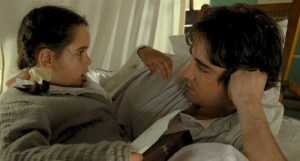
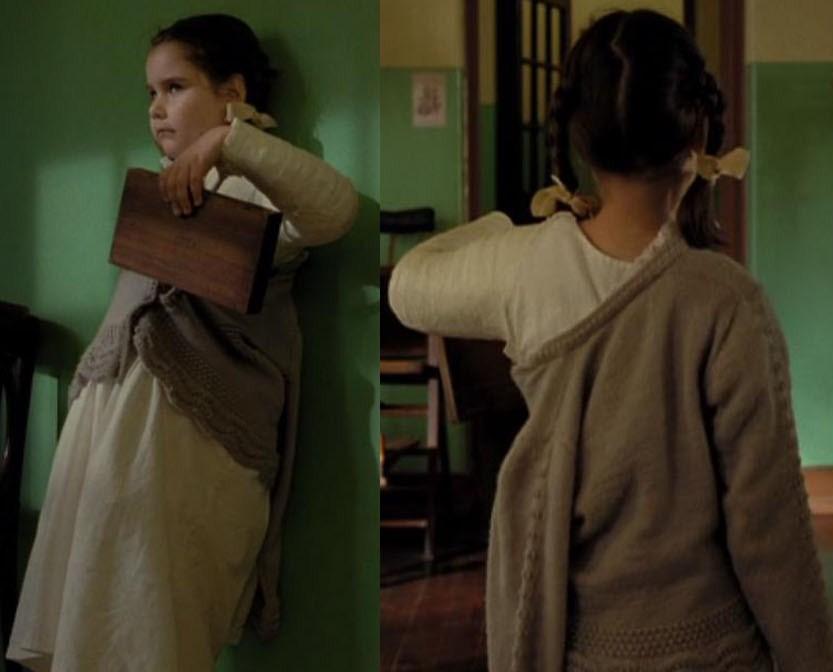
Alexandria is dark-haired and adorably plump and when she is first shot, she is framed within a doorframe, a crucifix mounted on the wall above her thus suggesting that she is inextricably linked with the divine. She has a special relationship with the hospital’s priest and even steals the Eucharist from the chapel and shares it with Roy who asks her if she is trying to save his soul. Her green eyes, missing teeth[8] and stilted English make for an engaging and naturalised performance not least because the audience can occasionally miss snatches of dialogue. Her left arm is perpetually outstretched away from her body for the majority of the film’s runtime and she is almost always dressed in a white nightgown and taupe cardigan which she cannot wear properly due to the frame of the plaster cast. The wooden box she carries, which looks like a book, contains items she “likes”, photographs of her family, a spoon, small toys; a nostalgia box of memories.

Roy is also a brunette and despite their gender difference they are often clothed the same and often mimic each other’s body language (see images below). This may be an attempt by the adult to place the child at ease or perhaps is the visual depiction of the contact zone / story space previously discussed. Roy and Alexandria’s mutual experience of a fall, hospitalisation and subsequent isolation is the meeting place for them both. The story they both appear to enjoy, whether Roy wishes to return to his childhood or Alexandria wants to surpass hers, as Gopnik ascertains, remains to be seen.
1.5

On the surface, it can be argued that the girl represents the child Roy may never have. He has lost the love of life and the severity of his injury is never fully explored. For Alexandria, he may be a replacement father-figure having lost her father in a house fire. These are easy summations to make, however, another reading may suggest that Alexandria is Roy’s repressed inner child, or as described in Jungian theory, the Divine Child[9] who has manifested through his suicidal despair. This archetype, according to Jung, is weak by design, under developed but one which can bring happiness and instil hope when it has been lost.

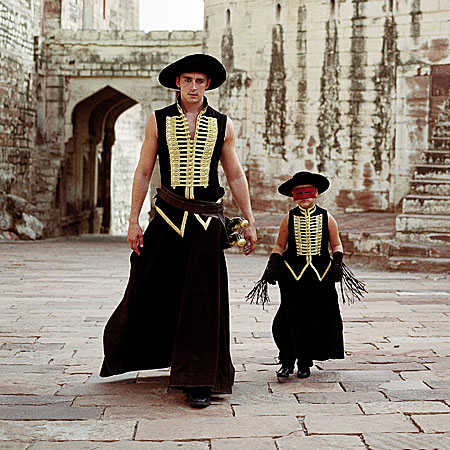
While this, in part, is true, Alexandria is stronger and more mature, even at six, than the infant images which are associated with the Divine Child. She is just as manipulative as Roy and changes the narrative at will, even inserting herself into the story when it looks like the original narrator is close to death. Rather than embodying the child archetype she can be read as Roy’s shadow, quite literally becoming his double once she is a part of the narrative and injects herself into the imaginary world, referring to herself as the Bandit’s daughter, stronger than ever, with two perfectly formed front teeth.
3.1

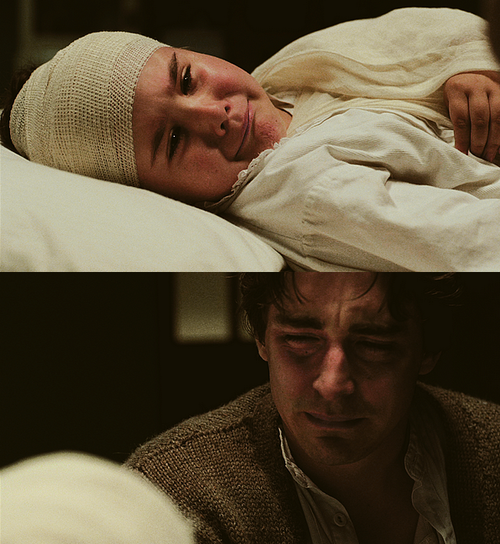
In reality, the roles have reversed in the sense that it is Roy who is now visiting a prostrate Alexandria. She has made a second attempt at getting the bottle of morphine pills, broken into the dispensary and fallen again which has resulted in a serious head injury and Roy is visibly distraught at what he has caused. It is worth noting that after her fall, Alexandria’s recovery is seen through a series of cinematic stills whereby her back-story is shown through live action images and animatronics. Her life literally flashes before her and this sequence is much darker than Roy’s beautifully invented panorama suggesting a real ambivalence between experience and innocence.

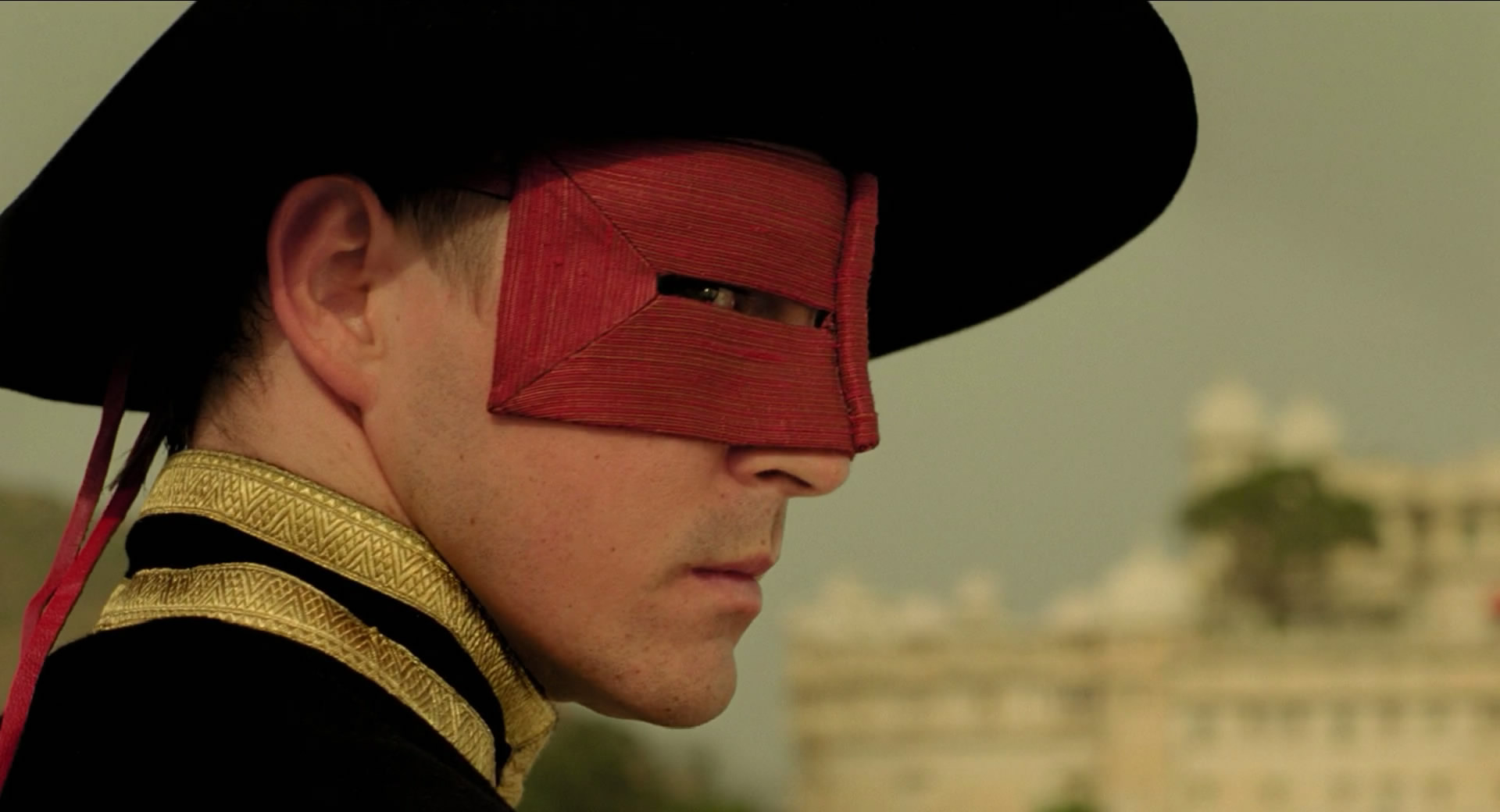
Roy admits that the story was a subterfuge to push the girl into assisting his suicide but Alexandria stubbornly refuses to believe this, even after Roy begins murdering the tale’s protagonists one by one. She begs him to stop and he tells her that it is his story, to which she answers “mine too”. Roy, who was also inserted into the fantasy after the death of the Blue Bandit and is now personifying the vengeful Black Bandit, allows Odious to drown him while his double-in-miniature looks on. Back in the hospital, both Alexandria and Roy are in tears and she begs him “Please. Don’t kill him I don’t want him to die. She loves him”.

Alexandria then makes an admission, she has known all along what Roy intended to do with the morphine pills “I don’t want you to die”. In preventing Alexandria’s despair, Roy has to save himself and in the fairy tale world he bursts through the water, re-born, and saved by his blessing in disguise[16]. This confirmation of mortality, as experienced through Alexandria, is further explained by Bettelheim “[the] psychosocial crises of growing up are imaginatively embroidered and symbolically represented in fairy tales […] but the essential humanity of the hero, despite his strange experiences, is affirmed by the reminder that he will have to die like the rest of us”[10].
lp
The-Fall-0661

In The City of Lost Children, one character who is in denial about death is Krank (Daniel Emilfork). He is ageing at a progressive rate because he cannot dream; a lack of imagination is slowly killing him and so, he kidnaps children against the backdrop of a timeless, surrealist, Paris in order to extract their dreams and manipulate them as his own. He does this without realising that in his company they too cannot dream only produce nightmares which terrorise the thief in slumber.

Visually this text is very different from The Fall, where there was a palette abundant in colours and light, here there is limited light and the dominant colours are (as in Jeunet’s later film Amélie [2001]) red and green. This lack of light is metaphorical of the disorientating struggle displayed in the mise-en-scéne; this is a place where babies are left out in rubbish bins and not missed. Krank’s “uncle” Irvin is a disembodied brain which survives in a tank and in the opening twenty minutes serves as the intradiegetic narrator and sets the scene:

brain

“Once upon a time, there lived an inventor with a gift for giving life. […] Having neither wife nor child, he decided to make them himself. His wife’s gift was to be the most beautiful princess in the world. Alas a bad fairy gene cast a spell on the inventor so that when the princess was born, she was only three inches tall. He cloned six children in his own image, so similar you could hardly tell them apart but the bad spell meant that they all had the sleeping sickness. He needed a confidant, so, inside a fish tank, he grew a brain that had many migraines. Finally, he created his masterpiece, a man more intelligent than the most intelligent men. Alas, the inventor also gave him a flaw. He couldn’t dream […] it made him so unhappy that he grew old unimaginably fast [and then] died in dreadful agony, having never had a single dream.”

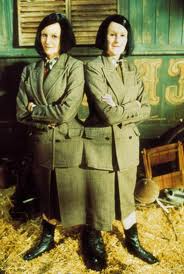
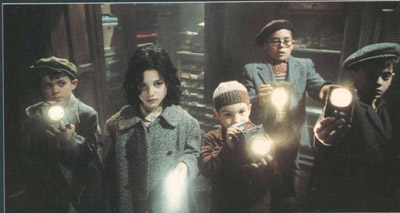
This is hardly the ideological filmic representation of hopes, wishes and desires that Jack Zipes describes when he is discussing the screen fairy tale[11] but a social commentary on the complex use of technology versus religious fundamentalism. The inventor creates his family through technology and essentially ‘plays God’ only to be worshipped by a cult of Cyclops who, in return for their sight, kidnap the children Krank requires for his dream-catching. The messianic figure of One (Ron Perlman) whose back story is linked with other fairy tales (Jonah and the Whale and Pinocchio[12]) enlists the help of an alluded-to Wendy[13], Miette (Judith Vittet) and her gang of Lost Boys/ urchins to rescue One’s little brother Denrée (Joseph Lucien). Miette and her fellow orphans work for The Octopus (Geneviève Brunet and Odile Mallet) identical twin sisters who dress, function, speak and work as one entity, conjoined at the leg.

4.2
4.3

While these dual characters are literally mirrored in their representation there are other characters which are connected subconsciously. Krank is beyond childhood without having actually experienced one and yet acts like a child, prone to tantrums and crying fits. Miette, on the other hand, is still physically in childhood but has the demeanour of an adult. Her orphaned abandonment has enabled her to mature quickly and her instinct for survival has her resorting to any means necessary to live, she is wise and tough far beyond her years. Miette and Krank are, in essence, two facets of the same person.

As described by Gopnik in his 1996 New Yorker article, Krank wants a way back into childhood while Miette wishes to embrace adulthood, even envisioning a relationship with the man-child strongman, One. When Miette and Krank come together in their contact zone/story space it is not through traditional storytelling but a dream in which they get to embrace their shadow selves and share a mutual experience.

dream-device

Jung articulated this exchange in this way, “beneath the social mask we wear every day we have a hidden shadow side, an impulsive, wounded, sad or isolated part that we generally try to ignore. The Shadow can be a source of emotional richness and vitality, and acknowledging it can be a pathway to healing and an authentic life. We meet our dark side, accept it for what it is and we learn to use its powerful energies in productive ways […] By acknowledging and embracing The Shadow as deeper level of consciousness and imagination can be experienced.” [14]

Krank is dispossessed of a soul, an imagination and empathy and upon sharing consciousness with Miette – the girl who does not dream – can finally experience what he has been missing. In the same token, Miette can embrace her youth and rescue the man she loves. The child in the crib is dressed in pyjamas which are the same colour and style and the boy’s hair has been reddened, he resembles a young One, this is evidently how she reconciles the contact zone.
4.1

Interestingly, only when the child starts to morph into Krank does the ageing process begin, the Shadow selves meet. Unlike The Fall, where assumptions are made regarding Alexandria and Roy’s future selves, here Krank accepts his Shadow and so begins his regression. In opposition, Miette begins to wither and age until the demented dream-catcher is a baby. Miette must embrace her biggest fear so she can move forward and that is imagining One dead. This interchange of dreams kills Krank in reality thus substantiating the importance of imagination, use of enchantment and originality.

Fairy tales give the adult reader a re-presented imagination. Understandably, the physical child may have evolved but these screen tales enable the repressed child to re-emerge through viewer identification. Perhaps, just like the children in these texts they enforce a sense of hope, strength and resilience which has long been forgotten.

The inclusion of a child within an adult diegesis serves more than just viewer manipulation[15]. This division of realities and mirroring of locations, narratives and characterisations is an integral part of the postmodern film and more specifically this dual nature is present in screen fairy tales. While the texts that have been considered here have a very distinct separation between the real and imaginary, it would be worth considering the screen fairy tale which is based in reality and consider what purpose they may serve for an adult audience.

Sources

[1] Maria Tatar, Enchanted Hunters: The Power of Stories in Childhood (New York/London: W. W. Norton & Company, 2009). A term borrowed from Mary Louise Pratt. Tatar changes the context of the original contact zone and sets about making her own.

[2] Ibid. p242. “The power of reading together derives in part from the fact that it involves a transaction between more than a single reader and a text. The dialogue that takes place between the [storytelling] partners fuels the transformative power of the story, leaving both the child and adult altered in ways they might never have imagined. [Mary Louise] Pratt found in contact zones a process of transculturation, with colonizer and colonized entering into lively, two-way cultural exchanges”.

[3] Adam Gopnik, “Grim Fairy Tales”, The New Yorker (November 18, 1996) p96. http://www.newyorker.com/archive/1996/11/18/1996_11_18_096_TNY_CARDS_000376397 [accessed 10 January 2012].

[4] Bruno Bettelheim, The Uses of Enchantment: The Meaning and Importance of Fairy Tales, (UK: Penguin, 1991).

[5] Bengt Holbek, Interpretation of Fairy Tales: Danish Folklore – A European Perspective, (Denmark: Suomalainen tiedeakatemia, 1987).

[6] These differences can also be examples of Pratt’s ‘contact zone’ specifically with the cross-cultural experience between American Roy and Romanian Alexandria.

[7] Seymour Chatman, Story and Discourse: Narrative Structure in Fiction and Film, (USA: Cornell University Press, 1980).

[8] Missing teeth as a motif are used throughout the picture. Roy tells Alexandria that power is symbolically associated with teeth and that she is currently “missing some strength”. Upon further investigation, however, teeth can be associated with illness and death and even a lack of faith (Greek) and in Chinese culture missing teeth symbolise telling lies. Some cultures believe that losing teeth can be sign that an individual has placed more faith in the word of man and has lost trust in God.

[9] Carl G. Jung, Essays on a Science of Mythology: The Myth of the Divine Child and the Mysteries of Eleusis, (USA: Princeton University Press, 1969).

[10] The movie’s tagline is quite apt here. Only at Roy’s lowest ebb did she manifest.

[11] Bettelheim, 1978 pp39-40.

[12] Jack Zipes, Happily Ever After: Children and the Culture Industry, (New York/London: Routledge, 1997) p9.

[13] One is an ex-whaler and following the loss of this job is hired by a travelling circus, of sorts, as a strongman. Aside from size he is for all intents and purposes a boy.

[14] J M Barrie, Peter Pan, (UK: Puffin [Re-issue], 2014).

[15] Jung, cited in Connie Zweig and Steve Wolf, Romancing the Shadow: A Guide to Soul Work for a Vital Life, (UK/USA: Random House Publishing 1999) p21.

[16] Karen Lury, The Child in Film: Tears, Fears and Fairy Tales (UK: I B Tauris & Co Ltd, 2010). Lury likens the child to a pet and even refers to both as ‘it’, she ascertains that the inclusion of children within a narrative is merely to serve an emotional purpose for the viewer.
Categories
Blu-ray film review

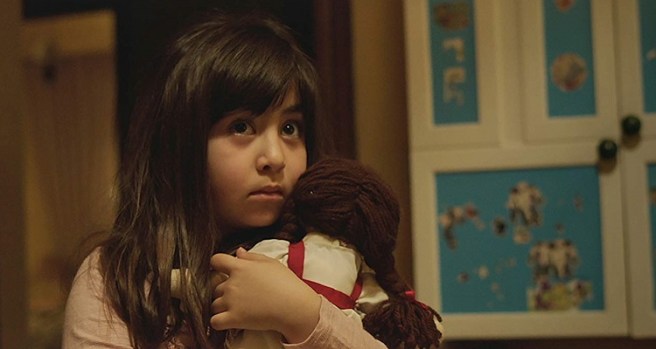
Under the Shadow (Dir. Babak Anvari, 2016)

In Two & Two (2011) – Babak Anvari’s BAFTA-nominated short allegorical film – a teacher (Bijan Daneshmand) attempts to re-educate his male pupils with some basic arithmetic, claiming that what they have always been taught is no longer true. The writer-director packs quite the punch with very little exposition and a whole lot of nuance when depicting the absurdity of an authoritarian regime/dictatorship. Which all bodes well when your next film – and first feature – is an effective little horror (and would become BAFTA award-winning in its own right). It is also a lovely touch to have that same actor play the University Dean who is responsible for shattering Shideh’s dreams of becoming a Doctor.

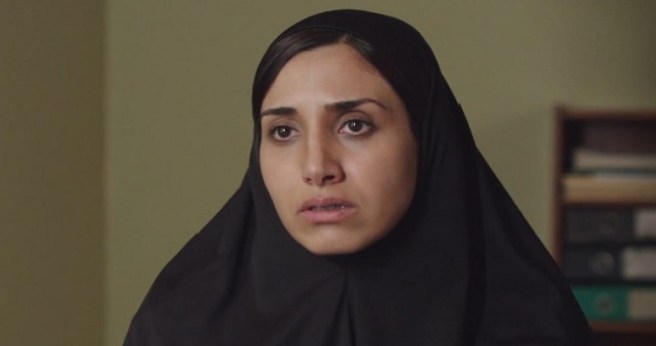
Under the Shadow is set in Tehran during the Iran-Iraq war of the 1980s and Shideh (Narges Rashidi) can no longer study medicine having been removed for her political beliefs. We are never party to what exactly her transgression is but suffice to say with the mention of ‘radical left groups’ she was – and probably still is – against the war that is currently waging in her country.

Once her chador is removed, we can ‘see’ some of her transgressions. Her hair cut (in a bob style), dress (westernised), and her autonomy around her home; the partnership with her husband, exercising to Jane Fonda. she’s also the only woman in the building who drives. This is a ‘modern’ woman, oppressed by external tradition and reduced to the confines of her four walls, and even those are not so secure with the shelling, daily explosions and air raids which can send residents into a panic at any given moment.

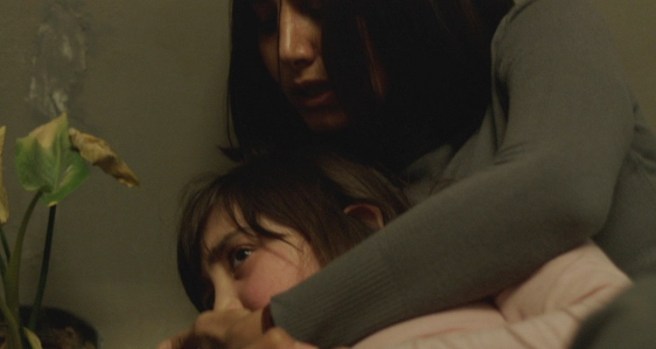
When her husband Iraj (Bobby Naderi) receives his draft notice, Shideh is left with her young daughter Dorsa (Avin Manshadi) as, one by one, all her neighbours pack up and move onto safety. The exacerbating factor a shell crashing through the roof of their building, killing the elderly resident within and leaving a gaping hole. The hole is covered with a sheet which appears to undulate in the wind like a bodily organ, flapping in and out like a heartbeat. A visual metaphor of a damaged culture, while the cracks in the ceiling – it can be argued – relate to Shideh’s psyche. Ever increasingly isolated, Shideh and Dorsa begin to experience things which may be the product of a child’s imagination or something altogether more supernatural.

Djinn is a malevolent spirit which has its history in Early Arabia and then later in Islamic mythology and theology. An entity that travels on the wind until it finds somebody to possess. Often dismissed as a superstitious belief, the spirit is reported to enjoy the souls of children (much like Krampus in European culture, or el Cuco in Latin America). It may explain Dorsa’s fever or not, after all Shideh was also once a child. Evil wants to hurt them alleges one neighbour while another, Mrs. Fakur (Soussan Farrokhnia), attempts to allay her friend’s fear: “people can convince themselves of anything if they want to”.

Tight framing adds to the oppressive atmosphere as mother and daughter’s fear and anxiety builds. Tension is slow-burning, and jump scares are few and far between yet effective when they do occur. There’s no score (music is only played during opening and closing credits) so is reliant upon diegetic noise and whistling winds. We’re never sure of the time of day given the constantly closed curtains and disturbed sleep patterns.

What appears to be mere moments gives the impression of hours. As people leave we can assume the passing of days and weeks yet the costumes of the leads mostly remain the same. Natural and artificial also play havoc with this, along with the production design: one location, open doors, hallways, and reflections in the television mean the constantly moving camera plays tricks with the eyes – was that something moving or not? Shideh’s lip is bruised from the constant biting, insecurity, anxiety, stress. Like all amazing genre films – nothing is ever quite how they appear and this film is all the better for it building beautifully the general sense of unease.

It seems apt that when she is preparing to fight, Shideh’s weapon of choice is a pair of scissors – as if tethered to a more domesticated past, her own mother’s apron strings or the chador in this instance. While the malevolent being appears to be set on persecution – even referring to the character as a ‘whore’ and ‘bad parent’ – it’s important to remember that Djinn is not inherently evil or good, and this entity could, at some point, be Shideh’s mother from beyond the grave.

A matriarch disappointed that her daughter will no longer practice medicine but needs to save her by forcing her to leave the building. Think back to the picture frame which houses Shideh’s mother’s portrait, the fractured glass obscuring the image within, it now laying down on the shelf hidden from view – but before that, the draped material serving as a backdrop in the photo is identical to the chador the entity embodies itself within. This reading further strengthens the mother-daughter links throughout, and the expectations a patriarchy levels at women, generally, but more so during the kind of regime in Tehran of the 80s.

As a first feature, Under the Shadow wears its influences well: Polanski’s apartment trilogy (Repulsion [1965], Rosemary’s Baby [1969], The Tenant [1976]) with a sprinkling of Hideo Nakata’s Dark Water via a domestic social realist drama in the ilk of Abbas Kiarostami and Asghar Farhadi. It’s a rich and visually arresting film which checks all of the above as well as featuring, at its heart, a really affecting horror fable. A 1980s Tehran-set horror film filmed entirely in Farsi – the first of its kind.

Finally, it has been given the kind of release it deserves courtesy of Second Sight that includes plenty of extra features, including five new interviews with the filmmaker, cast and crew, as well as a lively commentary between Director Anvari and film critic Jamie Graham, in which every aspect of the film’s genesis, production and release is covered.

Extras

Two & Two (8:48) – Babak Anvari’s BAFTA-nominated short film shown in its entirety. It’s the one extra which can be watched before the main feature.

Escaping the Shadow (23:53) – A long interview with Anvari who begins with his own childhood nightmares growing up in 80s Iran before his move to Britain. He talks at length about the filmmaking process, his cast, shooting in Jordan and expands upon things mentioned in the commentary. He’s a delightful interviewee, and while it is not the most imaginatively filmed featurette, Anvari’s charisma shines through.

Within the Shadow (12:52) – Star of Under the Shadow, Narges Rashidi discusses her own childhood in Iran and Germany and career now she is LA based. She describes the film as a ‘beautiful gift’, and again, static camera and a by-the-book interview reveals an excitable and rather lovely person.

Forming the Shadow (16:11) – Lucan Toh and Oliver Roskill talk all things ‘producer’, how they met Babak, the script, the film’s potential and their brief disappointment at not having to sell the film when it premiered at Sundance. A lot of their anecdotes are repeated in the commentary track.

Shaping the Shadow (13:29) – Anvari’s close collaborator and DoP Kit Fraser talks about his involvement from before the script was even written.

Limited Edition Contents – This set is limited to just 2000 copies, comes in a rigid slipcase featuring new artwork by Christopher Shy and with a soft cover book with new essays by Jon Tovison and Daniel Bird (unavailable at time of review). Plus behind-the-scenes photos, concept illustrations, and a poster with new artwork.

Categories
Blu-ray film review

Candyman (Dir. Bernard Rose, 1992)

It is interesting to note that the titular character of Bernard Rose’s 1992 film Candyman was a painter, an artist determined to leave behind a legacy; never to be forgotten: “I am the writing on the wall, the whisper in the classroom. Without these things, I am nothing…” The myth – dating back to 1890 – surmises that Daniel Robitaille (although we wouldn’t learn his name until the first sequel) was educated and enslaved, on account of his father’s invention which assisted in the mass production of shoes after the Civil War.

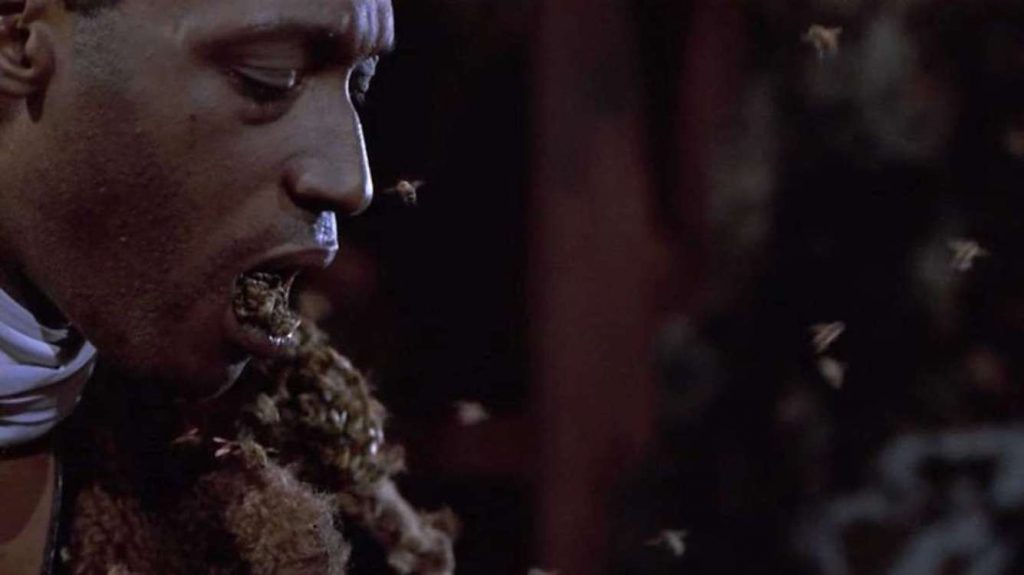
Robitaille was commissioned to paint the portrait of a wealthy landowner’s daughter. The two fell in love and when a child was conceived, fear of miscegenation led to a mob chasing the artist from town to the outskirts where his hand was sawn off, and his body smothered in honeycomb for bees to devour. 100 plus years later and, according to folklore, his soul and bloody hooked stump continues to haunt Cabrini Green, now home of the projects.

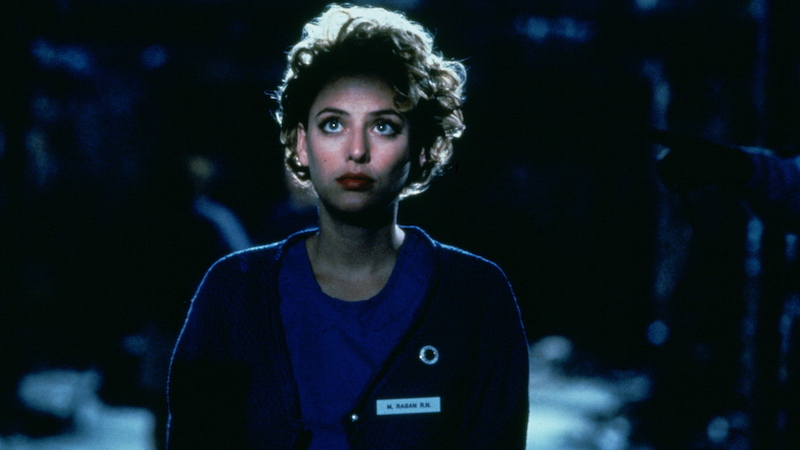
At least that’s what the legend suggests as it is told and retold, embellished by the storyteller, and those who believe in the Candyman (Tony Todd). For Helen Lyle (Virginia Madsen), the myth becomes a major part of her research. She and colleague Bernadette (Kasi Lemmons) are students at the University of Illinois researching urban legends as part of their thesis, within an academic department where being smug, white and male is a given. None more so than Helen’s own husband Trevor (an immensely slippery Xander Berkeley).

Helen discovers that there is a connection between her building and the apartments at Cabrini Green, after looking into the unexplained death of Ruthie Jean – a woman of colour who was mutilated in her bathtub by a killer who allegedly burst through her wall brandishing a hook. Helen interrogates the myth, and through her investigation we see just how limited her perspective is (in both literal and cultural terms), she is oblivious to anything outside of her area of interest until the myth has been appropriated. Only then does she (figuratively) wake up.

Rose – not unfamiliar with literary adaptations – has given audiences variations on numerous works of literature including his Tolstoy quintet of Anna Karenina (1997), Ivans XTC (2000), The Kreutzer Sonata (2008), Boxing Day (2012), Two Jacks (2012), and more recently his take on Frankenstein (2015). Candyman was his first authored screenplay, based on Clive Barker’s short story The Forbidden (which can be found within volume five of his seminal anthology Books of Blood). The Faustian-inspired story transposed Liverpool to Chicago, Helen’s surname became Lyle (from Buchanan), her thesis – which once centred around graffiti – now concentrated on urban legends, and class and race became intertwined in Rose’s vision. He kept the thematic material of the story but made it very much his own.

While the film is grounded in horror, part ghost story, part unconventional slasher by way of arthouse cinema. It plays with the tonal and generic shifts between the story and its retelling, building ambiguity before Candyman’s first full reveal to Helen (it’s well worth the wait), and their relationship as the film progresses.

Some have commented upon the fact that the film’s “villain” is a man of colour. True, however, he is not a typical “monster” (just like Helen is not a victim, despite his imploring her to be). Candyman is a tragic and romantic anti-hero, an eloquent and beautiful phantom who is seeking retribution from those who have wronged him. It’s an elegant performance by Todd who elicits as much empathy as scares, it’s hard to imagine anybody else embodying the handsome hook-man (although, what if the next is a white iteration or Yahya Abdul Mateen II*). He is led by an equally wonderful Virginia Madsen.

Her Helen is intelligent, determined and flawed, perhaps even unhinged. The line between the real world and the nightmare is completely blurred by the film’s midpoint. Is she responsible for the kidnapping of Anne-Marie McCoy’s (Vanessa Williams) baby boy? Is Candyman a figment of her imagination or is he the man who assaulted her? Has Helen lost her mind? There’s an old Hollywood glamour to Madsen/Helen, and yet she’s completely ordinary and easy to identify with. The choice of lighting her across the eyes is genius on the part of DoP Anthony B. Richmond (Don’t Look Now). It enhances those huge green windows especially when she appears in a trance, passively hypnotised by Todd’s velvet voice (in actuality, it was her director who was doing the mesmerising).

Richmond’s cinematography and Jane Ann Stewart’s production design have aged well. The graffiti and murals adorning the walls of Cabrini Green are still as effective – made all the more so by the careful 2K restoration from a new 4K scan of the original negative (supervised and approved by Rose and Richmond). Grain is kept to a minimum and the picture is perfect. Reds and petrol blues particularly bright and eye-catching along with that all important artwork on the walls leading to Candyman’s lair.

Bob Keen’s make-up FX is just as accomplished in a film that really was multi-layered and ahead of its time, (and still as timely today) even the bees are analogue with Todd pheromoned-up, standing in for the Queen. Apiculture has been practiced for a millennia, and given that bees are the creatives of the nature world, it’s a perfect extension of the art present. Philip Glass’ haunting, melancholic and melodic score brings the religious themes to the fore and is the aural icing on the cake.

By placing the film within a racial context, it polarises the worlds as they are depicted; white, middle-class academia and the poverty of the inner city African-American experience. Helen even spells it out: “A black woman is murdered and the police do nothing, a white woman gets attacked and they’re all over it.” However, as the film progresses it is evident that Helen and Daniel are linked rather than opposed. The racial and social commentary, however dated, opens up dialogue, not only holding up a mirror to an America of the past but what the future holds for people still living as a consequence of segregated housing. It will be fascinating to see how Nia DaCosta approaches the material in her version of the film.

Candyman continues to be an ambivalent and ambiguous arthouse horror film which depicts oppression and transgression, and manages to sustain the scares, even after 26 years. Bernard Rose and Tony Todd have created a legacy which will continue long after they depart.

Sadly, one of them now has… Rest peacefully Tony Todd (4/12/1954 – 6/11/2024)

Extras

Disc 1: US R-Rated Version

Audio Commentary with Bernard Rose and Tony Todd – The disc boasts not one but two audio commentaries. The first is provided by writer-director Rose and star Todd (his introduction is a particularly nice touch). The pair are obviously close, having reunited for Frankenstein, and cover a whole host of topics. Todd reviews Infinity War, A Quiet Place, and Halloween. We hear Rose’s opinion on sequels, the new Halloween and his favourite horror films (he has excellent taste). The two men tend not to pay much attention to what’s onscreen, choosing instead to talk about the cinematic essence of the horror genre, offer occasional anecdotes re: filming, what constitutes as “American”, politics and social media, and the notion of fear. This is highly entertaining and well worth listening to.

Audio Commentary with Stephen Jones and Kim Newman – The second places the film within critical context by writers/critics Jones and Newman. They discuss their friendship with Clive Barker and his stories which have been made into memorable films. They analyse the cast and their respective performances. Theirs is actual commentary accompanying the film as it unfolds and they offer several readings of the film and briefly consider the logic of nightmares (which allows for plot holes).

Be My Victim: Interview with Tony Todd ©2018 (9:38) – Todd discusses how he got the role, the romantic gothic horror elements of the film, and his approach to the role which included ballroom dancing. He likens Candyman to the Phantom of the Opera and speaks positively, not only, of the experience but of Rose who he describes as a “highly intelligent” filmmaker. He touches upon his costume, location shooting including the active gang members who agreed to be on film, and facing his fear of bees. It is evident that he has a great deal of affection for both Rose and the character. The racial aspects of the film are still open for discussion and Todd welcomes the conversation.

It Was Always You, Helen: Interview with Virginia Madsen ©2018 (13:00) – Madsen talks about her first action(s) following getting the role; going for tests as she was allergic to bee stings and eating a lot of pizza as Bernard wanted her a little rounder as Helen. It’s a lively and informal discussion, much like Todd, Madsen is clearly comfortable talking about the film, the experience and having a close working relationship with he cast/crew. She’s incredibly proud of the film, it remains one of the best experiences she has ever had, particularly enjoying waltzing with the “beautiful and gentle” Todd.

The Writing on the Wall: Interview with Jane Ann Stewart ©2018 (6:10) – Stewart worked as Production Designer on the film, and here discusses scouting for locations, basing her designs on truth and just how much fun she had working on Candyman, especially as a student of Art History.

Forbidden Flesh: The Make-up FX of Candyman ©2018 (7:49) – This featurette interviews (albeit separately) Bob Keen, Gary J. Tunnicliffe and Mark Coulier the three British make-up artists who were responsible for the FX of Candyman.  This is interesting especially as they describe “making” excrement for the walls of the public bathroom from a selection of biscuits, and the forging of the hook. “Proud” is definitely the verb of choice from everyone interviewed about this film.

A Story to Tell: Clive Barker’s The Forbidden ©2018 (18:28) – Critic/writer Douglas E. Winter critiques Barker’s seminal Books of Blood and original source story The Forbidden. Winter is an adorer of Barker whom he describes as the “finest horror writer of the [80s]”. He also discusses Rose as author and artist and briefly touches on the feminist aspects of the Candyman sequels: Farewell to the Flesh (1995) and Day of the Dead (1999).

Urban Legend: Unwrapping Candyman ©2018 (20:21) – This critical analysis of the film by UCLA Lecturer/writer Tananarive Due and author/screenwriter Steven Barnes is the highlight on the disc. They consider the film from a Black historical context and gaze. Their analysis is invaluable, intelligent and allows for the viewer to reconsider a film text they think they know. Subjectivity is a fascinating tool and representation matters, as well as diversity behind the camera. This is essential viewing, not least because, Madsen aside, Due is the only woman involved in this boxset as a whole.

Bernard Rose’s Short Films – Three films – newly restored in HD – which cement Rose’s filmmaking prowess. Fans will see techniques, themes, and motifs which continued through his entire oeuvre to date.

  • A Bomb With No Name On It [1975] (3:34) – Terrorism is approached with horror elements and a classical score (he had to start somewhere). The action takes place in a busy London restaurant with the bomb maker, a white middle-class male. Perhaps an allusion to the IRA bombings of the seventies.
  • The Wreckers [1976] (5:54) – A film depicting ‘youth’ and more specifically a teenage boy and the party he throws when parents his head out for a dinner party amongst their peers. The generational divide is seen through the juxtaposing of the two soirées. Sparkling water is the adult’s drug of choice as the teens spark up their joints. It’s brilliantly created, mixing contemporary music with classical before the evening descends into coloured-filtered horrific chaos.
  • Looking At Alice [1977] (27:24) – This is Rose’s black and white avant garde film (every director has one). He plays with voyeurism as his protagonist watches and stalks the object of his affection through her love and conquests. Rose, once again, utilises classical music, jump cuts and repetitive dialogue. All three films are a welcome extra on the the film that many consider Rose’s masterpiece.

Theatrical Trailer (1:59)

Image Gallery – A slideshow continuing 40 images including film posters from across the world, VHS covers, film stills, publicity stills and lobby cards. It’s interesting to note the different studios that have historically owned the rights to Candyman.

Disc 1: Original UK Theatrical Version

The Cinema of Clive Barker: The Divine Explicit ©2018 (28:00) – This in depth interview with author/director/visual artist Barker, who discusses his literary work and the subsequent film adaptations, including Rawhead Rex, Hellraiser (with his old school chum Doug Bradley), the connoted homosexuality of Nightbreed and, of course, Candyman. He talks about horror and what it does to us as a film audience, finding beauty in the darkest of things, celebrating difference, and his childhood. It’s a fascinating interview. Barker looks gaunt, ageing following operations to remove polyps from his throat. As Americanised as his accent is now, the Liverpudlian is still evident to the trained ear. On a personal note, it’s heartwarming to see and hear someone with a huge talent be a success in a field you love who also happened to go to your old school and sound a bit like you.

As if that wasn’t enough, there’s also:

  • Exclusive packaging featuring newly commissioned artwork by Gary Pullin (although, it appears that his hook in is the wrong hand).
  • 6 lobby card reproductions
  • Reversible fold-out poster featuring two artworks
  • Fully illustrated collector’s booklet featuring new writing on the film by festival programmer Michael Blyth (unavailable for review).
  • Limited Edition bound booklet reproducing the original hand-painted storyboards by Bernard Rose

Yes, it’s a little odd that Philip Glass isn’t featured amongst the extras at all, a copy of the score would have rounded off the boxset nicely. The severe lack of women is also disappointing, specifically in a critical capacity or interviews with the other women in the cast.

That said, Arrow Films courtesy of their Video label have immortalised Candyman and his mythology in a stunning limited edition box set, packed with extra features that will make any film lovers cling to their rapture. Buy it, if you dare, just avoid mirrors.

Categories
Essay film review

Boys Will Be Boys: Violent Masculinities and Warrior (2011)

A predestined aspect of the construct of masculinity has always been associated with violence. Many critics and theorists have always maintained that violence is innately male, that to be a man is to be in charge[1] and to be masculine is “quite literally, to embody force”[2], while others have seen it as an action of the male in crisis, a loss of control and “a cultural construct [which] is a site of both struggle and resistance[3]. There is no definitive biological truth to substantiate that aggression and violence is more inherent to the male sex as opposed to the female but the depictions on film do lean more towards the former and perhaps serve as either commentaries on the act of violence itself or catharsis for the de-sensitised viewer[4].

In the seventies and eighties the ‘hard body’ films showcased the activity and sinew of the male form, depicted an increase in the level of screen violence and resulted in the birth of the boxing/fight movie. A genre which valorised the sport and yet depicted the brutality inside of the ring, films like Raging Bull (Martin Scorsese, 1980) and the Rocky franchise[5]. This genre has seen a resurgence over the years following the success of Fight Club (1999, dir. David Fincher) where bodies are instruments – “flesh in the service of an objective or a desire”[6] and the induction of the professional wrestler into the world of cinema; Terry ‘Hulk Hogan’ Bollea, Dwayne ‘The Rock’ Johnson and Jon Cena, to name but a few, are names synonymous with wrestling and the movies – hyper-masculine individuals who carry the “ideal of toughness and dominance”[7]. Their sport offering, as Kath Woodward ascertains “a space in which masculinities are very visible and invoke associations with physicality, risk taking and even violence, [a place where] those who wish to buy into that masculinity but who are not participants in the sport have to accommodate in other ways”[8].

This ‘aggressive masculinity’ was made ever more visible in the 2009 Darren Aronofsky film The Wrestler and depicted the aftermath of a life after the fight. A visually and hearing impaired Randy ‘The Ram’ Robinson (Mickey Rourke), who aside from a body that is failing him at a rapid rate, has very little else in the world beside his fighting maleness that is in constant conflict with his role as a wrestler, father and lover. This filmic text has given way to a plethora of fight movies[9] including a foray into the world of female boxing[10]. It is, however, the male fight (connotations of which are vast) I am particularly enthused with exploring and I will consider a number of Twentieth Century theorists and apply them to the 2011 text Warrior. Specifically, in relation to the male-oriented sports arena and argue that the masquerade of masculinities is still a speculative subject and very much prevalent in the Twentieth First Century.

It is especially interesting to me that the A-Team [11] remake of 2010 chose to cast a former Ultimate Fighting Champion™, Quinton ‘Rampage’ Jackson as the stoic Mr ‘T’ who is so paralysed by a fear of flying and enclosed spaces, his comrades choose to knock him unconscious than attempt to wrestle him into submission. UFC as it is commonly referred is the more extreme equivalent of championship wrestling insofar as any Mixed Martial Arts move is allowed, gum shields and groin protectors must be worn and all footwear and hand-wear is prohibited.[12] Like boxing, the sport takes place within a ring usually encased in a metal cage and each competitor must compete in bouts and beat his opponent fairly; a would-be brutal spectacle without the flamboyancy or showmanship of wrestling. “If,” as Dane Miller writes in his 2007 article, “violence and brutality are inherent traits of the male gender, as they appear to be, then society, especially contemporary American society, has implemented significant sanctions to discourage these traits from being actively expressed”[13]. By definition, then, the cage allows these constraints, including “associated primal masculinity”[14] to be expressed in an established forum and by conclusion “[contain] the [same] traits [so that they] remain associated with masculinity but also become praiseworthy”.[15]

Warrior opens in Pittsburgh with Paddy Conlon (Nick Nolte) leaving an AA meeting and arriving home to find his youngest son Tommy (Tom Hardy) sat on his stoop. Estranged father and son have not seen each other for fourteen years and while Paddy may welcome a reunion, Tommy is only interested in his father’s previous incarnation as his wrestling trainer. Tommy has returned from Afghanistan, AWOL from his unit and, seemingly, dependent on prescription drugs needing money to provide for the family of his fallen ‘brother-in-arms’. Tommy fled, as a teenager, with his mother from abusive, drunk Paddy and his flying fists and is incredulous at his father’s sobriety and awaits a slip.

Meanwhile, in Philadelphia, Physics teacher Brendan Conlon (Joel Edgerton) is at the bank attempting to re-mortgage his family home, again, the payment of his youngest daughter’s medical bills proving too vast for the family to cope with financially. The bank manager simply tells Brendan that their house will be foreclosed upon in ninety days. With his wife working two jobs, Brendan tells his wife that he will take some evening shifts as a club bouncer to help pay the bills and only when he arrives home with bruised ribs and a black eye does she realise that he is fighting again, for cash, in the club parking lot. Unfortunately, Brendan is unable to cover up the bruises and the truth when he returns to his day job and is suspended without pay. Principal Zito (Kevin Dunn) explains that he cannot be seen to advocate such violence, and tells Brendan “you’re a teacher; you have no business being in the ring with those animals”. Brendan responds with “actually, I used be one of those animals, I fought for a living. I guess I forgot to put that on my application”. Brendan is the ‘big brother’ who abandoned Tommy as a teenager and the unfolding narrative sees both travel, separately, to Atlantic City to compete in the Sparta MMA tournament; the prize $5,000,000 and eventually, perhaps predictably, ‘face off’ in the final match.

Writing about organised sporting events, Michael A. Messner and Donald F. Sabo argue that “male aggression varies from individual to individual, within situations, and across cultures”[16]. The men depicted in this film text are both individuals and physically different, neither are particularly large or over-developed. They are white[17] have pretty, boyish, faces which do not hint at a violent past nor resemble the broken noses or swollen eyelids of the seasoned fighter, however, Tommy appears the physically stronger and more aggressive, with his dark clothing, swagger and shifty stance and yet for all the seething rage, he only ever chooses to unleash his demons in the ring. He is shot, for the most part, in close up so he fills the screen and the over-the-shoulder shots enhance his bulk.

The establishing shot of Brendan shows a family man at a birthday party, wearing a bonnet having his face painted “becoming a princess”. He appears slighter than his younger brother and by the fact that he is a Physics teacher he is almost immediately deemed as ‘less-than-manly’. His occupation is used to incite the wrath of his ring opponents and push them to beat the “physics teacher!” This is in addition to his choice of entrance music – Beethoven’s Ode to Joy ensures he is ridiculed by the ringside commentators. Brendan is further fetishised[18] by the use of the close-up. For the first part of the film Brendan is shown in medium shot in an attempt to make him appear smaller in relation to his brother and opponents and the close up makes to enhance his beaten face, the healing cuts and swollen bruises or perhaps serve as viewer manipulation. Tommy shuts down when confronted (apart from in the ring) while Brendan is an open book – his motives clear, it could be suggested that by making the viewer empathise more it facilitates identification.

Messner continues to describe the ‘Televised Sports Manhood Formula’ which not only teaches boys to pay the price “be it one’s body [but] gives one access to the privileges that have been historically linked to hegemonic masculinity – money, power, glory and women [and] provides a remarkably stable and concrete view of masculinity as grounded in bravery, risk-taking, violence, bodily strength and heterosexuality”.[19] This statement is directly conflicting with Messner and Sabo’s earlier observation, how can male aggression vary from man to man yet be combined to depict a uniformed hegemonic masculinity? Surely it is to suggest that masculinities also vary from man to man; that while there may be some similarity in the privileges and hegemonic history, each man is fighting for a goal known only to him.

This interrelation between the ‘action man’ and ‘real man’ is explored in Yvonne Tasker’s 1996 Spectacular Bodies… [20] and is present in Warrior. Tommy and Brendan are two ‘every-men’ who must overcome extraordinary odds to show their activity and solve their individual problems whilst addressing some of their shared emotional damage. I would further suggest that the man of the twentieth first century is a masculine and feminine amalgam, possessing attributes which have been historically linked to hegemony and patriarchy including domesticated and embodied masculinity, passivity and activity, crisis and transgression. “If the body drives the ‘action man’ of the 80s then the face, it would appear, drives the ‘new man’ of the 00s [and beyond] […] there has to be an acceptance of male power and powerlessness and a general recognition of the ambivalence surrounding masculinity and femininity in the male figure”.[21] This film text attempts to depict each protagonist’s ambivalent and transcendence from patriarchy, specifically, through the father figure of Paddy Conlon.

Conlon Snr., belongs to the era that Susan Faludi describes as, “manhood after victory […] the prevailing American image of masculinity”[22]. He is an ex-Marine who has seen war, perhaps, in active duty during Vietnam (1959-1975). The world Paddy imparted to his sons is one of hurt; he drank heavily and was abusive to both his sons and wife, womanised and eventually pushed his family away. The man introduced in the diegesis is a God-fearing man who has a thousand days sobriety under his belt and, aside from his Moby Dick[23] audio book, very little else. Even Tommy describes him as a castrated man – sexless, sober, sensitive and caring and wishes he had experienced this version of his father when he was a child. As an adult, Tommy has no need for this man, or so he claims.

Warrior-1

Fatherhood is another construct of masculinity upon which patriarchal authority is born, an additional performance to, ultimately, fail at and Paddy Conlon is no exception. He is the protector and teacher of violence to two sons, they wrestle and compete and when they, or their mother, step out of line he beats them. Lynne Segal sums up the role of the father quite beautifully when she writes, “[those] gods that fail us bequeath diverse legacies to their sons and daughters”.[24] On the surface Paddy does appear to have failed his sons, he did not nurture and rather encouraged the kind of violence which has continued to encroach upon Brendan and Tommy’s lives in one form or another. Both men are controlled in their aggressive forum and yet while Brendan appears the more secure brother, Tommy is the one who is continually running away from the fierce situations he finds himself in, his childhood, his mother’s death and the violence of the war. He will fight but when he finds the fight is over, not necessarily on his terms, he flees.

The irony is Tommy is the most like his father – the epitome of Ronald Levant’s “angry white male”[25], specifically with his choice of occupation in the Marine Corp. He is also the only son who actually needs his father, despite his protestations; Paddy’s presence exacerbates Tommy’s rage and furthers his preparation training. Brendan, on the other hand, trains and wins his place in Sparta without the assistance of Paddy. We, the viewer are never party to the Paddy of old and yet draw the conclusion of the monstrous male; controlling, aggressive, violent and cruel. Upon the realisation that he has harmed his youngest child by his behaviour, Paddy grants Tommy’s wish and begins drinking again. Only this time, no violence ensues but deep sorrow and emotional regret and the father is able to admit his love for his son(s) and is cradled, like a child, in Tommy’s arms, mourning his failure, fear, vulnerability and “the lost opportunity to be loved by his children […][26]. As a side note, while Nolte gives a performance of American masculinity, Hardy and Edgerton’s performances can be called into question. That is not to say that they are not convincingly ‘American’ but the fact that they give such gravitas to the masculinity debate as non-Americans speaks volumes, perhaps American males have to fight harder to give performances of note while the ‘Aussie’ or ‘Brit’ have little difficulty in portraying amid poignancy, vulnerability and affect without speculation arising about their masculinity or sexuality.

Warrior, like many similar films is set within the realm of organised sports, a forum where men are almost exclusively the victims or perpetrators of violence and as Connell theorises there have always been more than one kind of masculinity[27] thus concluding that within the ring or cage there is not only competing men but masculinities. However, this is problematic as many of these sports are deep-rooted in preserving the hegemonic masculinity, specifically, in its gendered combatants and marginalisation of women[28]. Fighters embrace their masculine identity and some believe that affirming this masculinity is by and large rejecting the feminine and the norms of society.[29] By extension, there can be no pathos or empathy in a fight and yet when Tommy and Brendan step into that cage to fight each other that is all there is. These men have been conflicted since childhood – conflicted about their family life, the aggression and violence that was learned and duplicated and above all else their masculinity. Interestingly, both are shot through a ‘Lacanian’ mirror[30] reflecting upon their totality and identity before their final bout. I would argue that these men in taking in their reflection are accepting that their individual ‘wholeness’ will only occur in their sibling unity.

The beauty of this film text is that the final fight between the two brothers is gut-wrenching and really duly succeeds through viewer identification. Dane Miller maintains that these competitors have been ‘normalised’ and by accepting these ‘every-men’ as merely earning a living then, ideologically, the audience’s sins and guilt can also be purged[31]. The fighter is the viewer’s scapegoat and “[we] are vicariously vindicated and achieve redemption through the performance of the fighter”[32]. By the final scene there is little vindication, these men beat each other while crying in physical and emotional pain, they love each other and yet know that this was how love and masculine affirmation was instilled in their childhood. Only when one begs the other to yield, and acknowledge their mutual love for each other is a winner announced. As the crowds erupt both brothers refuse medical treatment or to speak, instead they stumble back to the dressing room, arms protectively around each other. At the final frame they resemble two bruised and devastated little boys. The viewer gains little redemption, there are no winners here only a resounding realisation of the performance(s) men have to sustain inside and outside of the ‘ring’; the conflict and ambivalence faced in today’s society.

Afterthought

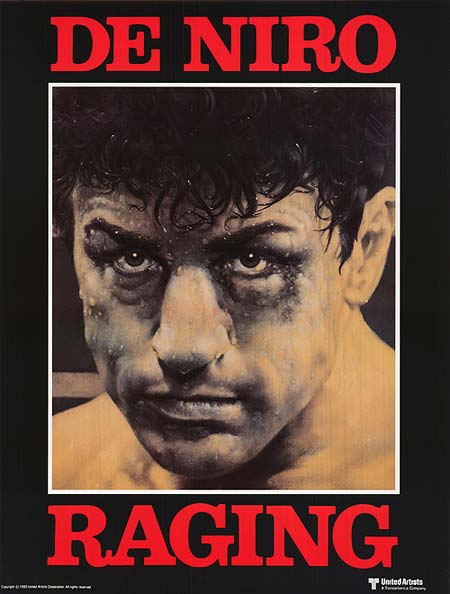
I like to think these movie posters depict the male of the 20th and 21st century – the ‘raging bull’ battling with his exteriority and self-destruction. The male in crisis.  While the ‘warrior’, contemplative and more accepting of his ambivalence and conflicting emotions. At first glance a male face similar to the previous, a second look depicts the duplicitous male – the male-female amalgam, the ‘action’ man and ‘real’ man binary; an indication that there is far more to ‘masculinity’ than meets the eye.


[1] Michelle Toomey, “The Price of Masculinity based on Violence” in Education Digest 58 (4) (1992) p44.

[2] R. W. Connell, Masculinities, 2nd Edn, Cambridge: Polity Press (2005) p87.

[3] Suzanne E. Hatty, Masculinities, Violence and Culture, Sage Publications Inc (2000) p12.

[4] Ibid, p52.

[5] Rocky (1976, dir. John G Avildsen), Rocky II, Rocky III and Rocky Balboa (1979, 1982, 2006, dir. Sylvester Stallone)

[6] Victor Siedler, Man Enough: Embodying Masculinities, London: Sage Publications Inc (1997) p21.

[7] R W Connell, Gender and Power: Society, the Person, and Sexual Politics, Cambridge: Polity Press (1987) p4.

[8] Kath Woodward, Boxing, Masculinity and Identity: The ‘I’ of the Tiger, UK/USA: Routledge (2007) pp14-15. One of these ‘other ways’ is through spectatorship, either through live events or through fight-films.

[9] Never Back Down (2008, dir. Jeff Wadlow), Fighting (2009, dir. Dito Montiel) and The Fighter (2010, dir. David O. Russell) to name but a few.

[10] Million Dollar Baby (2004, dir. Clint Eastwood) and Girlfight (2000, dir. Karyn Kusama).

[11] The A-Team (2010, dir. Joe Carnahan).

[13] Dane Miller “A Real Man’s Game: Manipulations of Guilt and Rhetorical Displays of Masculinity by the UFC” in Comm-entary – The UNH Student Journal of Communication 2010-2011 p94.

[14] Ibid, p94.

[15] Ibid, p94.

[16] Michael. A. Messner & Donald. F Sabo, Sex, Violence and Power in Sports: Rethinking Masculinity, USA: The Crossing Press (1994) p71.

[17] “The hero’s body is superior, but his skin colour – […] white – also signals him as an everyman”. Richard Dyer, White, London and New York: Routledge (1997) p162.

[18] Steve Neale would argue that by eroticising Brendan, he is automatically ‘feminised’ cited in Yvonne Tasker, Spectacular Bodies: Gender, Genre and the Action Cinema, London: Routledge (1996) pp118-119.

[19] M Messner, M Dunbar and D Hunt “The Televised Sports Manhood Formula” in Journal of Sport and Social Issues 24 (4) (2000) p392.

[20] Tasker (1994) p117.

[21] Helen Jones, “The Male Body and Conan the Barbarian” (2011)

[22] Susan Faludi, Stiffed: The Betrayal of the American Man, Vintage Publishing (2000) pp5-10.

[23] Moby Dick by Herman Melville.

[24] Lynne Segal, Slow Motion: Changing Masculinities, Changing Men, UK: Palgrave Macmillan (2007) p24.

[25] Ronald Levant cited in Peter Lehman, Running Scared: Masculinity and the Representation of the Male Body, USA: Wayne State University Press (2007) p14.

[26] Segal (2007) p25.

[27] Connell, (1987) p4.

[28] Woodward (2007) pp10-11.

[29] Magnus Stenius “Shoot-Fighting, Bodies in Emotional Pain: A Translocal Study in Masculine Gendering of Violence, Aggression and Control” (2007) p43.

[30] Jacques Lacan cited in Segal (2007) p73.

[31] Miller (2010) p99.

[32] Ibid, p99.

Categories
film review

Untouchable (Dir. Eric Toledano and Olivier Nakache, 2011)

In the same vein of adapted memoirs, The Sea Inside (Alejandro Amenábar, 2004) and The Diving Bell and the Butterfly (Julian Schnabel, 2007), Untouchable (AKA The Intouchables) too portrays a male protagonist living with a severe disability. While the aforementioned films attempted to encapsulate the struggle of locked-in syndrome, and a fight to end a life with dignity, this light comedy-drama provides the affecting story of two men trying to re-start their lives in light of personal circumstance. It is a surprising movie with a simplistic narrative and two great lead performances.

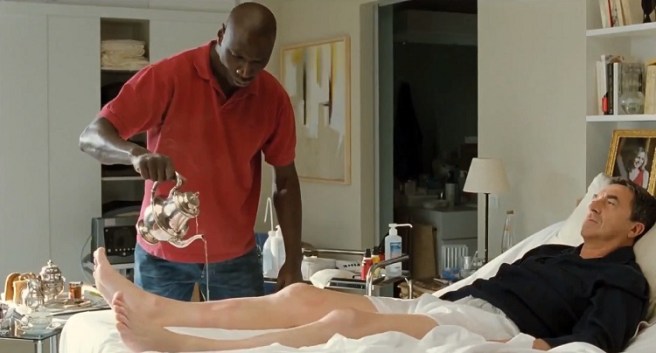
Widower, Philippe played by Dustin Hoffman-döppelganger François Cluzet (Little White Lies) lives an aristocratic lifestyle surrounded by staff on the outskirts of cosmopolitan Paris. Left quadriplegic after a paragliding accident he is without a male carer and has to interview for help several times a year, as no employee stays longer than a matter of weeks. Enter Senegalese-born ex-convict Driss (Omar Sy, Micmacs) from the projects; the only applicant in jeans, trainers and without experience or formal qualifications. The city’s Benefit Agency has organised a series of interviews as a formality; if Driss is refused three positions then, and only then, will they consider his claim and he can be supported by the state. He is large, loud and brash, in complete contrast to the staid Philippe, not least in class, race and musical taste.

When Driss returns to the rich man’s home the following day after their first meeting, he finds the necessary paperwork signed and the offer of a place to live and gainful employment; all he has to do is choose which and take the chance to make something of his rudimentary and, seemingly, directionless lifestyle. While Driss has to make these kind of decisions, in contrast, Philippe has not missed out on any aspect of his life. He has had no previous pecuniary restrictions but now his body and physical limitations have left him a prisoner, unable to do very little for himself. His most useful and powerful attribute is his mind and his articulation of language and expertise in the cultural arts has cemented a long-distance relationship with a woman in Brittany, albeit through the penmanship of another.

Driss, fabulously, dismisses aspects of Philippe’s disability which can be interpreted as both ignorance and innocence. He does not view the world as others do and often “forgets” his employer/friend is without the use of limbs and functions many take for granted. His pragmatism not only educates him but softens Philippe whose insistence on “no pity” is completely embraced by the younger man and it is this which charms most around him.

Chance is a recurring theme throughout this remarkable film, specifically, grabbing any and all that present themselves; this film depicts the opportunity to take a walk in a stranger’s shoes and touch their life, however briefly, is a rewarding endeavour. That said, this film never feels manipulative or overtly sentimental, it is a poignant reflection on living to the fullest, beyond mere existence and is portrayed through two extraordinary performances by the two leading actors, who manage to shatter any stereotype pertaining to class and race.

Cluzet is, as ever, outstanding as Philippe; the French veteran has, over the years, consistently proven his acting mettle. It is, however, relative newcomer Omar Sy (a 12-year-long career in comparison to his co-star’s 30 plus) who shines. His luminous grin lights up the screen and, along with his honesty, comedic timing, dreadful singing ability and love of 70s disco, is infectious. I defy anybody not to leave the cinema without a smile upon their face – in addition to damp cheeks – and a warm feeling in their heart; life affirmed, however briefly, from this inspiring, feel-good, crowd pleaser.