Categories
Blu-ray film review

Monkey Shines (Dir. George A. Romero, 1988)

Following his death in July of 2017, George A. Romero’s back catalogue has been made more readily available and given the ‘label’ treatment. The Criterion Collection released Night of the Living Dead (1968), Arrow Video curated Before Night After Dawn – a boxset containing a trio of his more obscure titles – while Eureka Entertainment released a limited edition Dual Format disc of his 1988 film Monkey Shines as part of their Classics range.

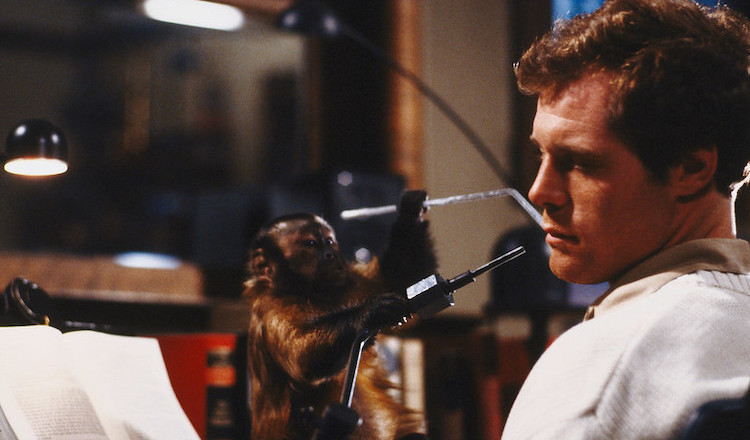
Law student and athlete Allan Mann (Jason Beghe) – A. Mann, get it? – is involved in a life-changing accident which leaves him paralysed from the neck down. Growing increasingly frustrated within his newly adapted home, overbearing mother and (Joyce Van Patten) and dwindling personal relationships, he attempts to take his own life. His despair and cry for help is heard by closest friend Geoffrey (John Pankow), a scientist (with an increasing addiction to speed) who has, not only, been injecting himself but primates with a serum containing human tissue. In an act of generosity, Geoff donates one of his Capuchins to service monkey trainer Melanie Parker (Kate McNeil) who trains Ella (Boo) to assist Allan, and hopefully lift his spirits by restoring some of his independence. Over time, Ella becomes a loyal and affectionate companion, however, their bond starts to take a sinister turn when Ella starts to act out.

Based upon Michael Stewart’s novel of the same name, Monkey Shines was Romero’s first – and subsequently last – foray into working with a studio. The fact that he returned to independent projects after this experience speaks volumes. As does the film itself, or at the very least the way it has been put together. There are multiple subplots over the course of the lengthy 113-minute duration which don’t always work but nearly always feel one too many. The pacing, however, is purposeful, allowing the audience time to empathise with Beghe’s Mann. The ‘horror’ is internalised, tension implied yet rarely seen with an overarching and prevalent theme of mental health.
The thing about Romero’s films is that while they are weighted in the horror genre, they tend to be far richer and allegorical in tone, beyond the odd scare, which make them all the more intelligent and effective. However interesting this film appears though, it never feels like a complete Romero, and certainly not that ending. When Ella’s ‘instinct’ kicks in and goes full throttle – combined with the inexplicable score – it becomes laughable. Riffing off Alien (1979) feels like a huge misstep. Thankfully, the alternate ending – George’s ending – is included in the disc extras. Spoiler: it works so much more convincingly (and satisfyingly) than the one the studio insisted on.

Studio interference aside, this is Romero at his most Hitchcockian, reminiscent of something his Creepshow collaborator Stephen King would write with shades of Rear Window and hues of Vertigo, and yet still feels somewhat original. There is plenty of merit outside of those last ludicrous moments, and fans of the Pittsburgh-native filmmaker will lap up this presentation, especially Tom Savini’s FX. Those monkey-point-of-view shots are inspired and Beghe’s simian teeth prosthesis so subtle few will spot them.

Though it may not be one of Romero’s more thoughtful pieces of work, somewhat neutered thanks to the studio, Monkey Shines is highly entertaining. A melodrama-horror about a man and the literal monkey on his back, played here by the remarkable capuchin Boo.

We still miss you, George.
Categories
Blu-ray film review

Multiple Maniacs (Dir. John Waters, 1970)

He is regarded as The Pope of Trash and now John Waters’ third feature film, unavailable for decades, has been “restored, remastered and re-vomited” by premium label The Criterion Collection, following a limited release in arthouse theatres.

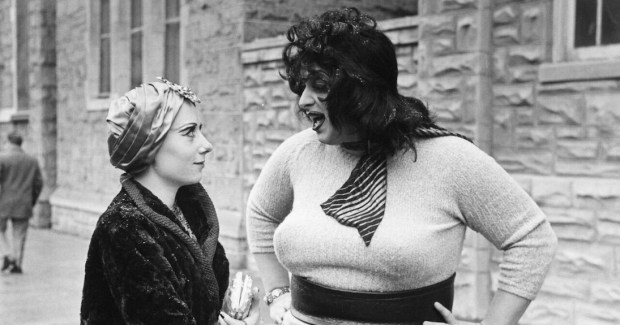
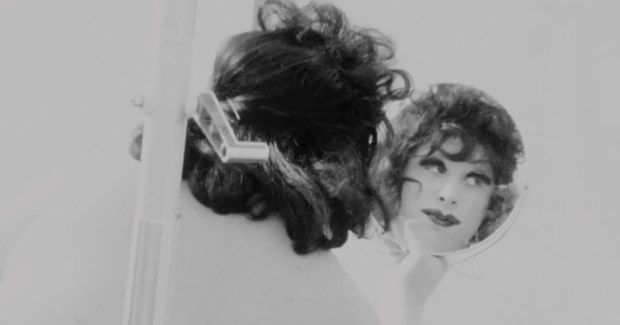
Multiple Maniacs stars Waters’ merry band of misfits, including David Lochary, Mink Stole, Mary Vivian Pearce, and Edith Massey. Those who would appear in most of his subsequent films, and led by the Queen: Miss Lady Divine, who we first see lying naked on a chaise longue, her Rubenesque derrière framed and in close-up. She leads the sideshow of “freaks” within Lady Divine’s Cavalcade of Perversion, a travelling band of “real, actual filth”. There’s a naked human pyramid, bra fetishist, a women giving oral pleasure to a bicycle saddle, a Jonesing addict, “actual queers kissing” and a bonafide puke-eater. Of course this is all a ruse, a front to house psychotic kidnappers and murderers. The brains (and beauty) of the outfit is Lady Divine. She’s the leader, the matriarch, think Ma Barker by way of a transgressive Elizabeth Taylor, who will do right by her people if they do right by her. Woe betide anybody who, for example, cheats or betrays.

Shot on 16mm and made with a $5000 budget – via a loan by Waters’ father – Multiple Maniacs is deliberately offensive and grotesque. It has an avant garde sensibility, with low contrast grainy black and white film stock, which makes the sprawling chaos, horrible camerawork and zoom abuse more bearable. For all its gleeful delinquent subversion, it actually has a lot of charm. Sure, it glorifies carnage and wears its anti-establishment, anti-bourgeois respectability, and sacrilegious, cannabilistic heart on its sleeve but it does so with such veracity, it’s admirable. Disgusting and atrocious, it may be but it’s also hilarious.

Hippy values take a few knocks, there’s a definite anti-war vibe to the denouement but it celebrates art via the Warhol and Lichtenstein pictures on an interior wall, its Czech New Wave style, and even surrealism – it’s hard not to think of Dalí when Lobstora rears its rapey pincers. Nothing is sacred. Least of all Catholicism. There is religious iconography dotted amongst the mise-en-scène, and The Stations of the Cross is even recreated as Divine receives a seemingly never-ending “rosary job” from Mink Stole, in a Church pew. All to the strain of He’s Got the Whole World in His Hands.

Waters and his maniacs deliver on the blackest of comedies. All dialogue is frantic, emphatic and, at times, stilted and a little repetitive but that’s the Waters way. He and his friends, some from childhood, some dropouts from NYU created a filmmaking family which celebrated difference, embraced outsiders and misfits, and forged an artistic front for freaks. Divine was the heartbeat; loud, brash, crude, angry and trashy. She didn’t give two flying kitten heels what people thought of her, she knew she was beautiful.

In the words of the great auteur himself (oh, he’d hate that): “To understand bad taste one must have very good taste. Good bad taste can be creatively nauseating but must, at the same time, appeal to the especially twisted sense of humour, which is anything but universal.” Multiple Maniacs is a transgressive, blasphemous, and iconic piece of celluloid. It won’t be for everyone, but for those of us with a wicked sense of humour and good bad taste, it will be a religious experience.

Categories
film review

Selah and The Spades (Dir. Tayarisha Poe, 2020)

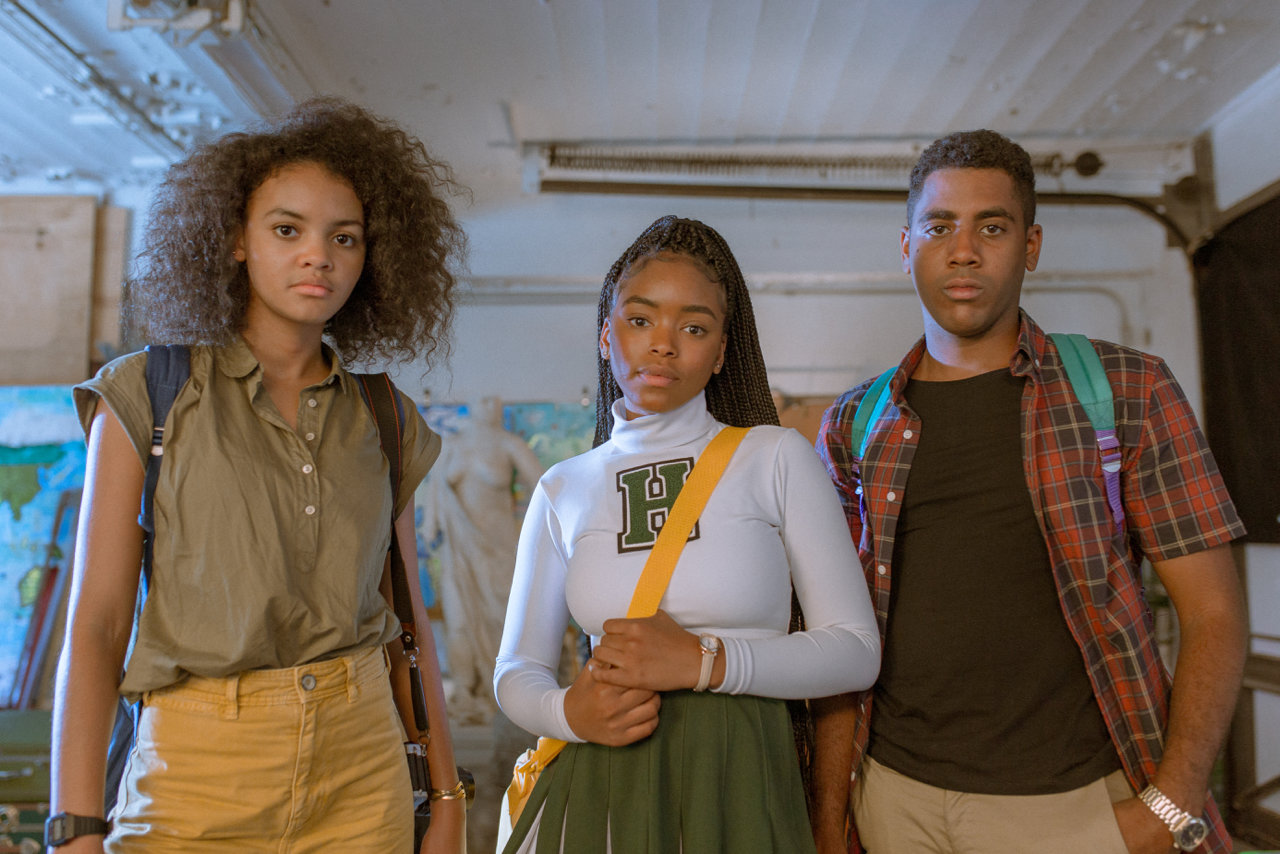
Pennsylvania’s Haldwell School sits on vast green grounds on the edge of a wooded area, away from civilisation and governance – although, bless his heart Headmaster Banton (Jesse Williams) tries. He attempts to push School Policy and assert authority but tends to, more often than not, falls short. The elite boarding school is in the hands of five factions (gangs are against the rules): The Sea, The Skins, The Bobbies, The Prefects, and The Spades. The Spades provide the ‘booze, pills and powders’ and business is booming. They all run the school but the most power appears to be in the hands of Queen bee Selah Summers (Lovie Simone) and her closest ally and associate Maxxie Ayoade (Jharrel Jerome).

Selah is in her senior year and should be thinking of college. It turns out it’s only her mother (Gina Torres) with whom she has a terse relationship who actually is, seeking an institution which will “keep you in your place, save you from yourself. Something has to.” The young entrepreneur would rather concentrate on her business and leaving it to a worthy protégée. Enter new scholarship student and keen photographer Paloma Davis (Celeste O’Connor) who appears to take it al in her stride and quickly aligns herself as a Spade.

Near the film’s beginning, The Spirit Squad (cheerleaders) perform one of their routines and it is here that several facts are laid out for us. “They never take the girls seriously… when you’re 17, everybody is telling you what you do with your bodies…” The crux of it is, The Spirit Squad took back that power, they decide the uniforms, routines and how much skin to show. Selah uses that power and runs with it. The control intoxicates with a fine line drawn between leaving behind a legacy and being erased from history, and it during those moments of fear that Selah exhibits the real darkness of her character, and where Lovie Simone comes into her own as we start to see that perfect façade begin to crack.

First time writer/director Tayarisha Poe makes an impressive and memorable feature debut – and a perfect jumping-off point for an original TV series (handy since one has already been commissioned). Selah… is an extraordinary and unique look at young adult life encapsulating satire, surrealism and style in a world of teen politics with razor-sharp dialogue and noir character study. It’s part Lord of the Flies, and Brick (ish) by way of Dear White People, Heathers and Ozma of Oz – that opening quote and the world it belongs to is hinted at throughout via the ruling princess (AKA the one true monarch), school colours, props, costumes even the location within the mise-en-scène, the Factions stand-ins for the Land of Oz’s quadrants.

Certainly Haldwell gives off the feeling of a world far from the emotional ties of home. This is thanks mainly to Jomo Fray’s hypnotic cinematography and Aska Matsumiya’s eclectically composed soundtrack replete with contemporary music and mystical dreamcatcher-like chimes adding an ethereal quality to an already uncanny setting. Colour is vibrant and varied, the use of light sublime and heightened. Make no mistake everything here is, it’s school (eye roll) – despite never actually depicting any lessons or classrooms. While the almost bored-sounding voiceover narratives ground in verisimilitude.

However, the film’s strength lies in its ensemble of characters – “a film by us all” as the credits declare – from poised perfectionist Selah to diet-Margo Tenenbaum Bobby (Ava Mulvey Ten), peacekeeper Paloma, loved-up Maxxie (Jerome continuing his run of multi-faceted characters and solid performances), and immaculate, yet inept, Headmaster. Whether these characters and their respective players turn up in the TV series remains to be seen but Selah and The Spades is an impressive, if fraught, first term in the halls of Haldwell.

Selah and The Spades is available now to stream through Amazon Prime Video.

Categories
DVD film review

A Wrinkle in Time (Dir. Ava DuVernay)

Word of mouth can make or break a film and (some) reviews have been less than kind about Ava DuVernay’s A Wrinkle in Time. Her earlier work has consisted of documentaries This is the Life (2008), and 13th (2016), indie drama I Will Follow (2010) and romance Middle of Nowhere (2012) before using the historical biopic to really make her mainstream mark with Selma (2014). Her current Netflix smash is the absolutely stunning mini-series When They See Us (2019). Aside from the occasional repeat casting (namely David Oyelowo who voices The It here) the commonality of these films is their setting deep within the African American experience – and this is only set to continue as Hollywood has the overhaul it so desperately needs, and the world gets to embrace the work of Barry Jenkins, Ryan Coogler, Jordan Peele and DuVernay.

Tackling Madeleine L’Engles much loved children’s novel of the same name and deemed unfilmable (though attempted for TV in 2003), DuVernay brings it to the big screen – with a reported $100 million budget – amid fantastical imagery and visual effects (and some occasionally weak CGI), however, the themes it tackles feel particularly relatable and relevant regardless of the fifty-six year old story.

Meg (Storm Reid) is a social outcast at school, made all the weirder by her father’s disappearance four years previously. Dr. Alex Murry (Chris Pine) in his search of travel via a Tessaract vanished without a trace leaving fellow physicist (and wife) Dr. Kate Murry (Gugu Mbatha-Raw) to raise their children – Meg and her brother Charles Wallace (Deric McCabe) – alone. However, upon a visit from Mrs. Whatsit (Reese Witherspoon), encouragement from Mrs. Which (Mindy Kaling) albeit through inspirational guidance from Mrs. Which (Oprah Winfrey), Meg decides to take Charles Wallace and school pal Calvin (Levi Miller) and go look for her Dad and bring him back home if she can. She only needs to journey across time, space and several dimensions, and most importantly believe in herself.

Okay, so there’s little here that you haven’t seen in some form before – not least that television adaptation from 2003. There are some nice touches, Paco Delgados’ costumes for one and it certainly looks pretty, reminiscent of The Wizard of Oz/The Wiz. Definitely a personal preference but André Holland as Principal James Jenkins (a possible reference to activist/writer Baldwin and filmmaker Barry) isn’t in it nearly enough, nor Michael Peña (sporting splendiferous facial hair as Red). For all the lack of subtlety, it wears its heart on its sleeve – a very simple, powerful message at its core.

It seems a shame that Jennifer Lee and Jeff Stockwell’s screenplay includes such heavy handed bombastic dialogue (along with some meandering camera work which can prove distracting), I’m sure its genus has likely come from the pages of the book but one wonders if small children would grasp some of the more complicated terminology. There’s little doubt that its scientifically viable, there was even a scientific advisor – Dr. Stephon Alexander – on set, but the film is so thematically broad that it ambles to a conclusion which feels more like the end of a series of visually impressive vignettes rather than one completed feature.

Much like that other big budget Disney production Black Panther, it takes its cues from the Afro-futurism genre, vibrant in colours and thematic similarities like the absentee father and embracing the warrior within. It is after all a Disney film so there are certain expectations. While it may not be to the taste of the adults, there’s plenty for children to enjoy not least the “greatest mind of our time” belonging to the squeaky voiced six-year-old Charles Wallace. Deep and meaningful monologues seek to empower the tween generation and why not? Love triumphs over evil, facing darkness can bring the light, a young person embraces their inner strength to rescue their missing parent… certainly plenty of films check this list, however, few of these young protagonists look like Storm Reid and Deric McCabe.

A Wrinkle in Time is nowhere near as dire as you may have been made to believe – despite its budget and subsequent box-office loss – the second half improves on the first, just suspend your disbelief a smidge more. A young girl who realises her strength, intellect, courage and beauty, ignores the bullies and believes in herself is to be celebrated.

Be a warrior.

Categories
film review

Blancanieves (Dir. Pablo Berger, 2012)

blancanieves-2012_71735

The tale of Snow White was published by Grimm brothers Jacob and Wilhelm in their Hausmärchen collection and has seen many a filmmaker make attempts to adapt the classic fairy tale to the big screen including Walt Disney, Michael Cohn and most recently Tarsem Singh and Rupert Sanders. Both directors released, respectively, very different versions, however, since literary publication in 1812 it has taken some 200 years for a truly original retelling to be produced and Blancanieves (2012, dir. Pablo Berger) not only pays tribute to silent cinema but also serves as a love letter to Hispanic culture and historiography.

apple

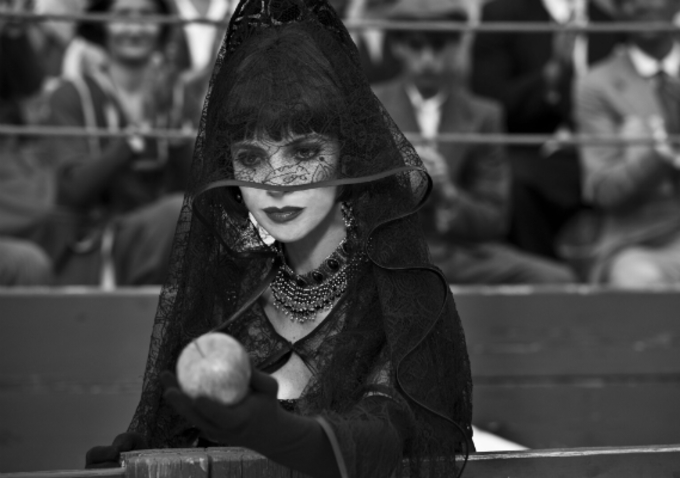
In 1910 Andalucia, Antonio Villata (Daniel Giménez Cacho) is at the height of his profession as a matador. His beautiful wife, and one time recording artist/flamenco dancer, Carmen (Inma Cuesta) watches from the crowd cradling their unborn child in her bulging belly. Tragedy strikes during the estocada and Antonio is gored by his opponent; the shock of which induces labour and baby Carmencita is born into the world motherless with a disinterested and bereaved father who, unable to fend for himself, soon remarries Nurse Encarna (Maribel Verdú). The woman’s disdain of the infant is apparent and her intentions clear from the moment she flutters her heavy kohled lashes at the fallen toreros and thus Carmencita (played in childhood by Sofia Oria) is raised by her grandmother Dõna Concha (Ángela Molina). When her grandmother passes away on the child’s Holy Communion day Carmencita is returned to her father and they can, albeit in secret, renew their relationship. A decade passes and Encarna’s villainy drives the adult Carmen (Macarena Garcia) out of the family home world and into the collective bosom of six bull-fighting dwarves, one of whom doubles, wonderfully, as Prince Charming.

Blancanieves-wallpaper-pic-05

This production was reportedly in development for several years before director-screenwriter Pablo Berger started shooting and nothing is left to chance. Verdú (Y tu Mamá También; Pan’s Labyrinth) who was Berger’s first choice to play Encarna clearly revels in the role; an evil stepmother she was born to play even sans magic mirror (here an artist’s interpretation of the wicked woman on canvas, in a multitude of costume changes, replaces the reflection motif). While this film takes the majority of its cues and sway from the Snow White tale – Blancanieves’ literal translation is SnoWhite – there are also intertextual signifiers to other Grimm tales along the way including Little Red Cap, Cinderella and The Sleeping Beauty via Tod Browning’s Freaks (1932). The mise-en-scène, as a whole, is an eclectic homage to the silent era of European cinema and the drama of the bullfight which includes the over-elaborate traje de luces (suit of lights) and black montera (hat), however, it is Alfonso De Vilallonga’s lush score, heavy on the flamenco beats, which is the real joy and builds emotion, tension and crescendo with each hand-clap of the non-diegetic sound.

In spite of the evidentiary early-20s influence Berger delivers a fresh spin on a female protagonist – often celebrated for her passivity and reliance upon a prince – which gives Carmen/Snow the edge needed for a 21st century heroine and reinforces this masterpiece’s declaration: that Blancanieves is, in fact, the fairest of them all.