It was announced in early October that Viggo Mortensen would be delivering the final Screen Talk at the 56th BFI London Film Festival, in part, to discuss his new film Everybody Has a Plan (2012, dir. Ana Piterbarg), while also revisiting his time in the film industry and on his birthday no less. Some will know him as Aragorn from The Lord of the Rings; a testament to his memorable turn – thanks to a last minute casting decision – in Peter Jackson’s Middle-Earth saga, while most will recognise him from his recent David Cronenberg collaboration, A History of Violence (2005), Eastern Promises (2007) and A Dangerous Method (2011). Throughout a twenty-eight year career, his first film role was as blink-and-you-miss-him Moses Hochleitner in Peter Weir’s Witness (1985); Mortensen, who appears more youthful than his fifty-four years, has been far from predictable with his film choices. This is an actor who has numerous award nominations and wins under his belt including Oscars, BAFTAs, Golden Globes, even a Goya and was inducted into the Empire Icon Hall-of-Fame years before the acting powerhouse that is Gary Oldman.
Born to a Danish father and American mother in Manhattan, New York Viggo Jr. spent several years in South America and, then later, Denmark culminating in a degree in Government and Spanish and linguistic fluency in the Danish, Spanish and French language. A man of many talents he owns Perceval Press, writes poetry, is a celebrated artist/photographer and an accomplished musician. Everybody Has a Plan is his second starring role in a Spanish-speaking film following 2006’s Alatriste (and fourth to date); his enigmatic and introspective performances are inherent with the hope that his pensive, dimple-chinned, splendour continues to grace the big screen for the foreseeable future. Certainly, with releases of On the Road (2012, dir. Walter Salles) and The Two Faces of January (2013, dir. Hossein Amini) to come that will surely be the case. Mortensen has worked with directors of every genre, from Jane Campion to the late Tony Scott and he is responsible for some truly memorable performances:

The Indian Runner (1991, dir. Sean Penn)
As black sheep Frank Roberts in Sean Penn’s directorial debut, Mortensen exudes danger, melancholic misunderstanding and self destruction in equal measure in this accomplished and brooding, if overwrought, commentary on the Vietnam War.

Carlito’s Way (1993, dir. Brian De Palma)
On screen for barely four minutes and looking a little rough around the edges as former playboy now paraplegic Lalin; it is an affecting cameo, in a critically acclaimed Hitchcockian-Gangster film, made unforgettable for the delivery of the ‘cocksucker’ line.
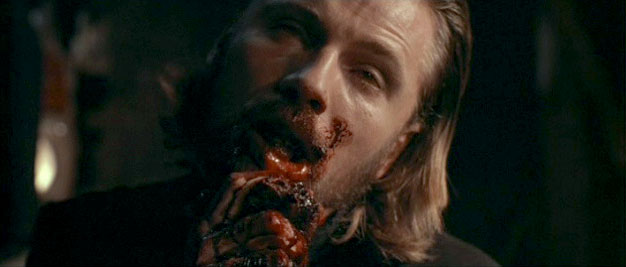
The Prophecy (1995, dir. Gregory Widen)
Again, an incredibly short time on screen – here Mortensen is a deliciously camp Lucifer with a penchant for dip-dye hair and taste for human hearts in this average sci- fi/religious thriller hybrid where angels wage war on “God’s favourite” humans.
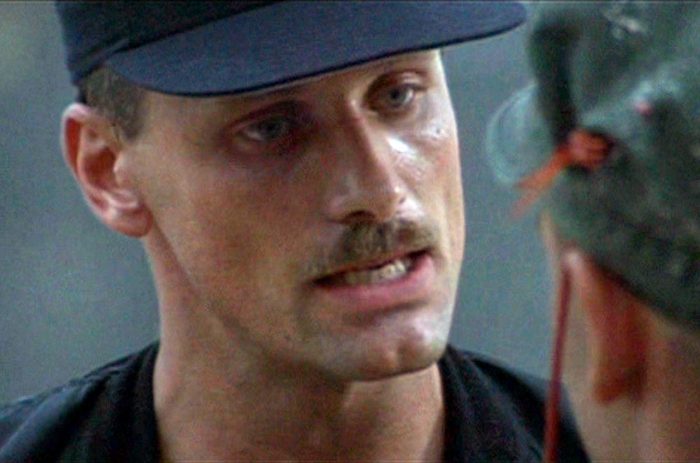
G I Jane (1997, dir. Ridley Scott)
Few remember this flawed film save for Demi Moore’s head-shaving and one-armed push-ups but Mortensen delivers a solid, and largely overlooked, performance as Master Chief John James Urgayle. A beguiling bastard who recites Walt Whitman, teaches that “pain is [ones] friend” and gets the best Navy Seal out of Lt. Jordan O’Neill (Moore) irrespective of gender or political ideology.
A Perfect Murder (1998, dir. Andrew Davis)
The second Hitchcock remake to bear the Mortensen name (best we forget the other one). He plays struggling artist David Shaw enjoying an extra-marital affair with millionaire’s wife and U.N. alum Emily (Gwyneth Paltrow). Torn between blackmail, lust and greed Viggo’s David could have been lacking and tawdry in the hands of another actor but he brings a real depth to ‘the other man’. And yes, we would want to leave Michael Douglas for him too…

LOTR: The Two Towers (2002, dir. Peter Jackson)
Difficult to choose from this trilogy given that he is the titular King of the third instalment, however, it is in this film that Aragorn truly comes into his own as warrior and leader of the Rohirrim and Fairies alike, during the epic battle of Helm’s Deep. It is also the text which cements Mortensen has a honest-to-goodness action hero; combat ready whilst never losing the emotional gravitas of the character despite being knee deep in mud and soaked in rain.

A History of Violence (2005, dir. David Cronenberg)
Based upon the John Wagner and Vince Locke graphic novel of the same name, this film saw the first teaming of Cronenberg and Mortensen and surprisingly the first real leading role for the now well-known Danish-American. He plays Tom Stall, a small town diner owner who is hailed a local hero when he kills two armed thugs in self defence. After playing such a recognisable character of literature Mortensen proves that he can play average-Joe-Bloggs-with-a-past with equal vigour. His performance is excellent in a thrilling film which boasts the most convincing marital chemistry since Sutherland and Christie in Don’t Look Now (1973, dir. Nicholas Roeg).

Eastern Promises (2007, dir. David Cronenberg)
As Nikolai, the driver and surrogate son to Russian Semyon (Armin Mueller-Stahl) who may or may not have links to the Vory v Zakone, Mortensen plays it mysterious and alarmingly charming as the fetishised tattooed driver who first dominates the screen by cutting the fingertips off a corpse and stubbing out a cigarette on his tongue.

The Road (2009, dir. John Hillcoat)
Whilst it could never match the sheer brilliance of Cormac McCarthy’s Pulitzer-Prize winning novel upon which it is based, this faithful adaptation comes very close. Mortensen delivers a haunting and devastating performance as The Man facing a post-apocalyptic world determined to keep his son alive. It is a harrowing and, at times, traumatic watch made all the more emotive by the beautifully portrayed relationship between Mortensen’s father and Kodi Smit-McPhee’s son.
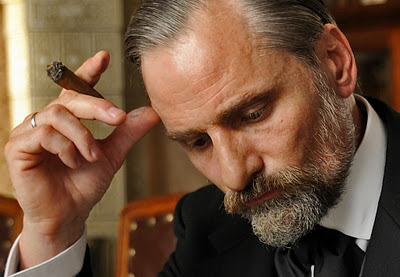
A Dangerous Method (2011, dir. David Cronenberg)
In his third outing with director Cronenberg, Mortensen adorns a prosthetic nose and brown contact lenses to play the founding father of Psychoanalysis and purveyor of repressive sexuality Sigmund Freud; acerbic and utterly charismatic as the elder statesman to Fassbender’s youthful Carl Jung in this intellectual costume-drama romp tinged with black comedy.
 The Framing Device