The Coens have, since their feature debut Blood Simple in 1984, been blessing audiences with their onscreen Americana-drama amid whimsy and quirk for the past three decades. Their latest offering Inside Llewyn Davis expands upon the musical odyssey started in O Brother Where Art Thou? What began with 1930s Bluegrass ends with the Greenwich Village folk scene of the sixties.
Llewyn, a blue-collar ex-Marine – a dead-pan, sardonic Oscar Isaac – is attempting to carve out a decent solo musical career (following the death of his singing partner) whilst living hand-to-mouth, surviving dangerously close to the bread line. He relies upon friends and acquaintances to provide him with a place to rest his head in between gigging and navigating a semblance of a career. He is supported by a cast of memorable characters including Jean and Jim, played by a less insipid Carey Mulligan who is extraordinary as the epitome of the angry young woman alongside her apple-pie husband Jim (Justin Timberlake); The Gorfeins: Lillian and Mitch (Robin Bartlett and Ethan Phillips), Al Cody (Adam Driver), Troy Nelson (Stark Sands), Roland Turner (John Goodman) and Johnny Five (Garrett Hedlund) – all wonderfully weird in their own way and beautifully rendered, only Sands’ Troy stumbles into caricature territory with his cardboard portrayal.
…Llewyn is Oscar Isaac’s first leading role and one the Julliard-educated actor was destined to play, his vocals are phenomenal. Although a collaborative effort by T-Bone Burnett, Marcus Mumford, and the supporting cast, all of whom sing their own song too, it is Isaac who shines; Llewyn is unlucky and not particularly likeable but as soon as he opens his mouth, (almost) all is forgiven. There is so much empathy to be felt for the character and the moment he utters the line, “I’m so fucking tired. I thought I just needed a goodnight’s sleep but it’s more than that.” Well, I challenge anybody who claims to have never felt that before.
While O Brother… was sepia in visuals, Inside Llewyn Davis’ palette is greys and greens offsetting a snow-kissed Greenwich Village, New Jersey, and Chicago. There is a melancholy to the visual aesthetic, thanks to Bruno Delbonnel’s cinematography who replaces Coen regular Roger Deakins. Although, an original screenplay, it is clear that inspiration was taken from the story of Dave Van Ronk, a struggling musician around the same time as the setting of the film, and his 2005 biography The Mayor of MacDougal Street, even down to the inclusion of the cat (see album cover above).
Ah, the cat. *Everybody* has a theory about the domesticated mammal. The Gorfein’s ginger tabby, Ulysses (*other Homeric signifiers include: Troy, the gate of [the polished] horn, the fact that Llewyn is a sailor and on an existential odyssey and also the notion of music and muses. There were nine muses and coincidentally, a cat is said to have nine lives) escapes the apartment while under Llewyn’s watch and much of the film is spent searching for the escapee. What the feline symbolises is open to conjecture with only the filmmakers knowing the real answer and refusing to share. At one point a disembodied character mishears dialogue and declares, “Llewyn is the cat.” Personally, I interpreted the cat as an extension of Llewyn’s heart – missing-in-action a lot of the time -and the plot as depicting a lost soul in purgatory; stuck in limbo, fighting to make amends and yet forever doomed to remake the same mistakes, perform at the same dives, etcetera.
Following a beating after playing Pappi Corsicato’s ‘joint’, Llewyn awakens in a blindingly white apartment (the Gorfein’s) and eats eggs whilst perusing their record collection. He is head-to-toe in white and pulls out a copy of If I Had Wings, his duet with Mike, there is an ethereal quality to the image. Later, his car journey with Johnny and Roland can be read as on the Road to Hell; underworld bound, with the final destination: The Gate of Horn a further allusion, Bud Grossman (F. Murray Abraham) can be seen as a St. Peter figure that will either welcome or refuse a entry into ‘heaven’. Redemption is often referred to as the ‘bosom of Abraham’ and the casting of an Abraham in this instance, in the form of F. Murray cannot be an accident. The Coen’s Jewish farce, A Serious Man (2009) deals with the crumbling life, both personally and professionally, of the title character leading him to question his faith. Llewyn Davis is of Welsh/Italian parentage, it is not too much of a stretch of to suggest Catholicism, however here, rather than question his faith, he merely ponders the transitional (and possibly the transcendental) aspect of his life.
It is interesting to further note that a lot of the songs used in the film, for example, Hang Me (Oh Hang Me),Fare Thee Well (Dink’s Song), The Death of Queen Jane, Five Hundred Miles all deal with themes of journey; of departure and/or death, and the fact that the last words of the film are au revoir as Llewyn lies in an alley having been beaten by a Grim Reaper-like figure (who also sounds suspiciously like Coen regular Sam Elliott) adds weight to the argument. Or perhaps, these words bid a final farewell to Van Ronk who died in 2002.
Whatever your interpretation, Inside Llewyn Davis is a wonderful homage to a bygone era, and a musical scene which not only continued long after 1961 but one that has seen somewhat of a resurgence over the last few years. It depicts the harshness and loneliness reality can have on your dreams and aspirations; for me one of the Coen’s finest.
I critique The Littlest Rebel in relation to the ideological ancestor of the American Civil War on film. This is, for me, one of Shirley Temple’s most memorable performances.
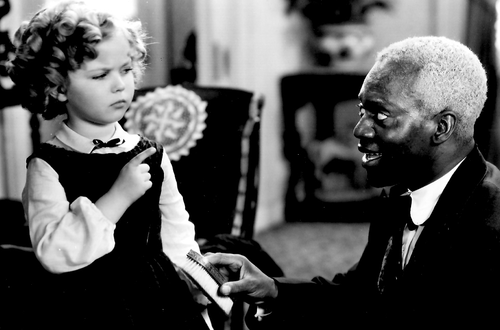
Described by the New York Times in 1935 as “an eventful slice of meringue and quite the most palatable item in which the baby has appeared recently [while continuing] to be the most improbable child.”[1]The Littlest Rebel (David Butler, 1935) is a rather unusual Civil War film as one often thinks of men in boots and beards rather than six year old girls with perfectly formed ringlets and dimples. To utilise a phrase by Will Kaufman, it can be described as a film which “regenders”[2] the Civil War. Like So Red the Rose (King Vidor, 1935) and Gone With the Wind (Victor Fleming, 1939) Rebel initially takes place on a Southern plantation and also has a family at the forefront of its narrative. Mrs (Karen Morley) and Captain Cary (John Boles) idolise their daughter Virginia ‘Virgie’ (Shirley Temple) and the film opens with a dinner party all guests adorned in fine dresses and dinner jackets. It is only upon closer inspection when the camera moves in for a medium shot does the viewer realise that these are children; extremely civilised and polite adolescents uttering ‘please’ and ‘thank you’ to their gracious hostess. Virgie is tenacious and independent, sacrificing her own ice-cream in order to ensure that her guests are content and full – she is also white. The Cary’s own slaves, each defined by a stereotype included in Donald Bogle’s pantheon[3]; Uncle Billy (Bill Robinson) is the “Uncle Tom”[4] amiable and protective of his ‘honey-child’ ward. James Henry (Willie Best) is evidently the “Coon”[5], his lack of intelligence and naivety used for comic effect and to incite irritability in Miss Virgie, who at six is his intellectual superior. A secondary character can also be clearly defined as the “Mammy”[6] a robust woman complete with an Aunt Jemima handkerchief around her head.
The news that there have been shots fired at Fort Sumter breaks up the party and sends families back to their homes, Captain Cary must report for duty as rebel scout for the Confederate army and leaves his family. This is a prospect Virgie seemingly relishes as she declares that her “daddy is the best soldier in the whole army”, however, her views change when she realises that her father will be kept away from the plantation for long periods of time. The fighting escalates and the Union army take the Cary land for their own, looting the property under the supervision of Sergeant Dudley (Guinn Williams) who is searching for absent patriarch Cary. Fearing for Virgie’s safety, Uncle Billy hides the little girl away in a secret wall space while the aggressive ‘Yankees’ ransack the house. When Virgie is found she is mistaken for a slave child as she has painted her face and hands with black boot polish in an attempt to conceal her whiteness and remain safe. This ‘blackening’ of Temple’s skin is also repeated in The Little Colonel (David Butler, 1935) when her character recreates a black riverside baptism in a muddy puddle. Lori Merish in her “Cuteness and Commodity Aesthetics” article states that Temple “purge[s] the cute of its unsettling racial resonances, performing an absorption and domestication of comic styles associated with blackness”[7], a term Richard Dyer describes as “binarism”[8]. She further describes Temple’s temporary ‘blackness’ as “racial hybridisation”[9] which forces the audience to view Temple and Robinson as the visual equivalents of each other. I would disagree; despite concealment beneath mud or boot polish the star persona and ‘whiteness’ is reinforced, there is no ambiguity. Virgie and Uncle Billy are not equivalents of each other but binary opposites: female/male, mature/adolescent, white/black and free/enslaved, a relationship that is described as “safe” by Benshoff and Griffin[10]. Certainly, the two are rarely seen embracing or are physically close with one another and it is Virgie’s relationships with the other male characters that are more compelling. She appears to be somewhat manipulative, particularly, with her affection and happily kisses men on the mouth and climbs into their lap; Virgie lacks no confidence in standing up for her beliefs.
A few weeks (this is a presumed timeframe as the viewer is never aware of days and dates) after her father’s departure, Virgie is playing ‘soldiers’ with a group of slave children and James Henry; leading the way wearing a Confederacy cap while they wear white hats reminiscent of Klu Klux Klan hoods. A Union soldier rides onto the land and the other children run away but Virgie stands her ground and fires a slingshot at Colonel Morrison (Jack Holt), marching in front of him singing ‘Dixie’ and declaring proudly “I’m a Confederate”. The Colonel likes her honesty and finds the ‘little rebel’ amusing. Not long after, following the death of his wife Captain Cary attempts to cross enemy-lines to get his daughter to safety in Richmond and with the assistance of Colonel Morrison he almost makes the journey, unfortunately they are both captured and sentenced to death by firing squad. Virgie comes to the rescue when she is granted an audience with President Lincoln to beg for clemency for the two men she considers her ‘daddies’.
The Littlest Rebel presents itself as a generic hybrid, while it has clear melodramatic indicators not least in the acting styles within the mise-en-scène. Virgie/Temple is often displaying facial expressions of an over-exaggerated nature and, at times, when emphasising her point out tends to pout and put her hands on her hips. When she cries, she has to point out the tears in an effort to reiterate the emotion of the scene, Molly Haskell describes her as the following:
[Virgie’s] flirtatiousness with her daddy [is] outdone, in precociousness, only by the patronizing way in which she [treats] her contemporaries. She [is] not only a little lady, advanced in social etiquette beyond her years, but a little mother, assuming the maternal role with [the] older men [in the movie][11]
Morley’s Mrs Cary delivers a more-understated performance; however, her death allows Virgie to usurp her in the family unit becoming a little mother/housewife and child all the while reinforcing Temple as the star of the show. A non-diegetic score, usually found in the melodrama is seconded to diegetic music in the form of songs sung by Virgie to her father at the film’s conclusion. The musical scene between Virgie and her father also reiterates the North/South dichotomy and in particular the masculine Northerner and the effete Southerner, here personified by Colonel Holt and Captain Cary; their star personas played up to maximum effect; John Boles was a silent star who became a Broadway regular and Jack Holt was a stalwart of the Western genre and favourite of John Ford. This information is not meant to imply that Boles any ‘less masculine’ than Holt, however, Boles’ visage is certainly softer, complete with long eyelashes and dimpled chin, he is often filmed in close up or medium shot and clinched in an embrace with his daughter. Holt on the other hand, much like Rhett Butler, is more stoic with his prominent jaw and monotone drawl.
As with other Civil War melodrama there are ideological messages which are present in Rebel. These suggest that it right to protect your kin – dishonesty is acceptable when for an honourable cause – embrace the beauty in death and show mercy to oppressors. In addition to ideological messages, Jenny Barrett suggests that protagonists within the Civil War melodrama complete three stages: old morality, transformation and new morality with “the civil war thus operat[ing] as a tool for the narrative structure, allowing the moral development of the central characters”[12]. Whether Virgie completes this moral journey is open to conjecture, she starts and ends the film as a six year old, yet in between loses her family home and mother. She is a child who does not know war but learns tolerance of her Northern Oppressors, gains a little independence while trying to save her father’s life and to reiterate Sennwald – an improbable child indeed. Rebel is similar to The Drummer of the 8th (Thomas H. Ince, 1913) in its generic hybridity and child-as-protagonist attempting to reconcile the turmoil of war with family life, however, while Virgie never sees any action (unlike Billy) she knows death.
Historically, The Littlest Rebel was released at Christmas, 1935 to a country in the middle of the Great Depression (1933-1940) two years after the commencement of President Roosevelt’s New Deal[13]. After the release of Rebel Roosevelt made the following statement “when the spirit of the people is lower than at any other time during this Depression, it is splendid thing that for just fifteen cents an American can go to a movie and look at the smiling face of a baby and forget his troubles”[14]. It shows the power of cinema if a film trying to depict the ‘lighter’ side of a war can make an audience forget poverty, mass unemployment and the worst economic crash of the decade. Little change was made to Civil Rights[15] so one has to wonder whether the black community were able to ‘forget their troubles’ by watching their ancestors on screen or whether the ideological white, patriarchal antecedent, evidently celebrated, is nearer to the ‘he’ that Roosevelt is addressing.[16]
Robert Brent Toplin has argued that cinematic history is also a generic category and that an audience is able to recognise the historical genre by the casting of certain actors[17]. However, I would suggest that by default all cinema, by production alone, has a history and to describe ‘cinematic history’ as a generic category is problematic; more viewers are likely to recognise the historical context of films through more obvious indicators like the biopic, war film, Western, etcetera. To think that viewers freely associate actors with a history film in this modern age is somewhat naïve, specifically the actors he uses as examples[18], not to mention highly subjective – one person’s President Roosevelt may be another’s Midnight Cowboy (John Schlesinger, 1969)[19]. Shirley Temple is not usually an actress associated with historical films, her oeuvre consists of more generic recognisable labels like the musical, and is not therefore a principal characteristic by Toplin’s theory. The fact that Abraham Lincoln is present within the diegesis would suggest that Rebel is allied, with cinematic history along side the melodrama and musical.
It would be imprudent to accept The Littlest Rebel as an interpretation of historical fact and would be more appropriate to describe it as an interpretation of historical truth. Fort Sumter was, indeed, fired open and is widely regarded as the place where the war began and not, as suggested by this picture as the North attacking the South, nor did the fighting cease after two soldiers are granted clemency as depicted at the film’s conclusion. Certain artistic liberties have been taken as with the majority of motion pictures, just as Toplin freely admits in his thesis[20], not least in the depiction and representation of the African American male(s) featured, however minimally. They are all slaves and not soldiers which history informs us was not the case. Rebel states, quite categorically, within the opening sequences that the cause of the Civil War was the emancipation of slavery, Virgie asks Uncle Billy what a war is and after he tells her about men killing each other he adds, “A white man says that there is a gentleman up North who wants to free the slaves”.
The ‘man’ he refers to is, of course, Abraham Lincoln and I would suggest that it is through his presence that may shape a historical truth certainly surrounding his Presidency and the time of war. This would substantiate Toplin’s statement that “Hollywood’s interpretations of American history can make a significant impact on the public’s thinking about the past[21], Lincoln’s mythology lend itself to TheBirth of a Nation, Young Mr Lincoln (John Ford, 1939) and Rebel amongst others. All attempt to depict the sixteenth President of the United States as the father of the nation – specifically in the latter picture where fatherhood is a metaphor heavily relied upon throughout – a man who was a friend of the people, as wholesome as the apple shared and eaten with Virgie (or the pie judged at competition in Young Mr Lincoln). A confidant who shows clemency to a chosen few – the issue of the 620,000 deaths he helped contribute to with his political decisions is rarely commented upon – instead he is martyred on screen and his antebellum memory is romanticised thereby allowing both filmmakers and audiences alike to avoid serious questions about Lincoln’s character and legacy. This is not a man torn by real indecision (peach or apple pie preference not included[22]), as suggested in the letter to Horace Greeley in 1862[23], but a gentleman who exuded confidence and was fair to the Southern people and indifferent to race – he shakes both Virgie and Uncle Billy’s hand without hesitation and it would seem that the mythology of Mr Lincoln informs both the historical truth and interpretations of the past on the present.
The Littlest Rebel attempts to correct the ruin, death and unhappiness[24] of Sothe Red the Rose and Gone With the Wind with its romanticised innocence, musical melodrama and racist undertones. The film depicts (circa) 1861 as a time of continuing racism and poverty during war. Its production in 1935 (also a time of continuing racism and poverty[25]) suggests that the historical context of production and finished aesthetics add authenticity to the Hollywood version of history. Shirley Temple coquettishly straddles childhood and adulthood like the improbable child described in Sennwald’s 1935 review. She does, however, surrender her active independence to the hegemonic white, patriarch who continues to inform the ideological American ancestor.
[1] Andre Sennwald, New York Times Reviews The Littlest Rebel, 20 December 1935.
[2] Will Kaufman, The Civil War in American Culture, UK: Edinburgh University Press (2006) pp92-109.
[3] Donald Bogle, Toms, Coons, Mulattoes, Mammies and Bucks: An Interpretive History of Blacks in American Films USA: Continuum (1991).
[7] Lori Merish, “Cuteness and Commodity Aesthetics” in Rosemarie garland Thomson (ed) Freakery: Cultural Spectacles of the Extraordinary Body, New York: New York University Press (1996) p198.
[8] Richard Dyer, The Matter of Images: Essays on Representation, London & New York: Routledge (1993) p133.
[10] Harry M. Benshoff and Sean Griffin, America on Film:Representing Race, Class, Gender, and Sexuality at the Movies, UK: Blackwell Publishing (2004) p81.
[11] Molly Haskell, From Reverence to Rape: The Treatment of Women in the Movies 2nd Edition, Chicago: The University of Chicago Press (1987) p123.
[13] Roosevelt created the New Deal and the 3 Rs – relief, reform and recovery in order to bring the USA through the greatest economic crash of the decade.
[14] Shirley Temple, Child Star, New York: McGraw (1988) p59.
[15] Anthony J. Badger, The New Deal: The Depression Years, 1933-1940, London: Macmillan (1989) p252.
[16] Anne Edwards, Shirley Temple: American Princess, New York: William Morrow (1988) p85 – in 1935 black men were still not treated as equals to the white man and Bill Robinson, reportedly, had to enter by the rear of the studio lot, could not share his meals with white cast members or use the same bathroom facilities.
[19] Jon Voight played Roosevelt in Pearl Harbor (Michael Bay, 2001) and Joe Buck in Midnight Cowboy – two roles which are widely diverse. One would not necessarily associate him with a history picture with these multi-faceted performances.
Literature has, for the longest time, been considered the intellectually superior medium in opposition to cinema. This consensus (which is largely ill conceived) proves problematic when the two mediums are joined in the form of film adaptation. When a text is transferred to the screen, the fidelity of the adaptation is often utilised as the sole way in which to critique the altered work of literature. “[F]idelity criticism” according to Brian McFarlane, “depends on the notion of the text as having and rendering up to the (intelligent) reader a single, correct ‘meaning’ which the film-maker has either adhered to or in some sense violated or tampered with.”[1]This assumption proves problematic as no two people read a novel (or film) in the same way and there is no way to differentiate and announce that ‘the book was better than the film’ because each medium is separate and both remain autonomous, and “[…] characterised by unique and specific properties.”[2] Bluestone phrases adaptation best when he states:
What happens […] when the filmist undertakes the adaptation of a novel, given the inevitable, mutation, is that he does not convert the novel at all. What he adapts is a kind of paraphrase of the level – the novel viewed as raw material. He looks not to the organic novel, whose language is inseparable from its theme, but to characters and incidents which have somehow detached themselves from language and, like the heroes of folk legends, have achieved a mythic life of their own.[3]
However, Bluestone’s “paraphrasing or two ways of seeing” is not the only methodology of adaptation. There are many – more appropriate – modes to consider when looking to an adaptation, some of which will be explored in this essay. The intention of which is to analyse the adaptation of The Odyssey which was re-presented in the film form of O,Brother Where Art Thou?[4] Some may regard Homer’s poetic prose as a canonical piece of literature and by adapting it there is the suggestion that Ethan and Joel Cohen can re-acquaint the poem with those who have read it and thus forgotten it, or a new generation; those who are not as familiar with the original epic. By their admissions they saw to “retell The Odyssey” which they describe as the “funniest book ever chanted”, they believe that the finished product is “epic in scale, classic in scope, with dumb guys acting stupid” (Ethan and Joel Coen, 2002)[5]. On the simplest level they have fulfilled their expectations. Using Bluestone’s methodology as a starting point, the two mediums will be considered in their own right as poem and film, this will hopefully culminate in similarities and differences and how certain aspects of the book’s episodes are enunciated in the movie. Those elements that Brian McFarlane asserts are “intricate processes of adaptation […] [whose] effects are closely tied to the semiotic system on which they are manifested […]”[6].
The Odyssey’s narrative is told over twenty-four books and describes the saga of Odysseus in his quest for home. Books 1-4[7] (known as the Telemachid) introduce the reader to Odysseus’ son Telemachus who is campaigning for his father’s return to Ithaca. Following the Trojan War, Odysseus has been imprisoned on the island of Ogygia by the nymph Calypso and it is in a council of the Gods that Odysseus’ fate will be decided. Athene, the goddess of wisdom (and daughter of Zeus) implores the assembly to allow him safe passage from the island. Granted freedom, the poem’s hero builds a raft and drifts away from Ogygia, consequently he suffers Poseidon’s wrath, the god is still furious following the blinding of his son Polyphemus the Cyclops, at the hands of Odysseus and his men. Sent adrift by the storm Odysseus is rescued by Nausicaa, daughter of King Alcinous of Phaeacia who nurses him back to health and invites him to dine with the populace that evening. After arriving at the banquet Odysseus is asked to recount his narrative through ellipses and analepses (this is the section of the poem which most readers associate with The Odyssey). In these accounts he recalls the Lotus Eaters and the Cyclops (Book 9)[8]; Aeolus, the Laestrygonians (cannibalistic giants) and Circe (Book 10)[9]; Teiresias and his prophecies (Book 11[10]; the Sirens, Scylla and Charybdis, the killing of the Oxen of the sun occurs in Book 12[11] and sees Zeus destroying Odysseus’ sailing vessel, whereby Odysseus’ men die and shipwrecked, he washes up on the island of Ogygia (thereby returning to the present time). The remaining twelve episodes[12] present Odysseus in disguise as a beggar allowing him to return to Ithaca. Once there he is reunited with his son Telemachus and sets about the removal of Penelope’s suitors; these numerable men are murdered and Odysseus attempts to become master of his own home once more. However, before she completely trusts her husband’s true identity, Odysseus must complete Penelope’s test. Upon completion Odysseus is attacked by the vengeful Poseidon, until Zeus and Athene intervene (once again) and declare peace in Ithaca.
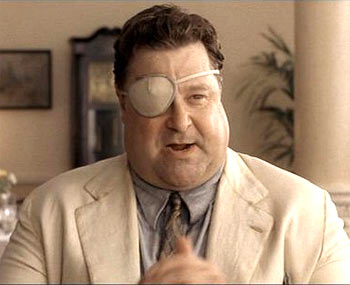
In Sullivan’s Travels[13] John Lloyd Sullivan (Joel McCrae) wishes to make his dream movie in Depression-era America, its title is O, Brother Where Art Thou? which the Coen brothers borrow wholesale. Their movie follows Ulysses Everett McGill (George Clooney) – Ulysses the Latin name for Odysseus – and his escape from a chain gang in Mississippi. Attached to his shackles are fellow prisoners Delmar (Tim Blake Nelson) and Pete (Coens regular John Turturro). Everett assigns himself leader of the outfit as “the man with the capacity for abstract thought” and leads them on a collective odyssey to unearth buried treasure. Their first stop is at Hogwallop farm in which Pete’s cousin Wash (Frank Collison) – perhaps a character allusion to Menelaus, as his wife Cora has “r-u-n-n-o-f-t” to “find answers” much like Helen of Troy. He removes their shackles and provides them with clean clothes, a hot meal and for Everett, hair pomade and a hair net. Attracted by Sheriff Cooley’s (Daniel Van Bargen) reward, Wash turns the trio over to the law and the three are on the run once more. Along the road the men pick up a Blues guitarist Tommy Johnson (Chris Thomas King) who is standing at crossroads having sold his soul to the devil. With Tommy’s help and accompaniment ‘Jordan Rivers and the Soggy Bottom Boys’ are formed and together they sing ‘into a can for $10 a-piece’ this song, it is later revealed becomes the hit of the thirties. The Sheriff thwarts their plan a second time, but this time they are ‘saved’ by an unlikely adversary, in the form of George “Baby Face” Nelson (Michael Badalucco). Two days into their journey they meet three brunettes (“Sireens”), one of whom allegedly transforms Pete into a toad, and then at a “fine eating establishment” Delmar and Everett meet Big Dan Teague (John Goodman), a salesman/conman who wears an eye patch. Eventually, after numerous mishaps Everett finds his way home and attempts to win back his wife Penny (Holly Hunter). Ancient Greece, Rome and Africa of the 1270s (these dates can be refuted) are shifted to Depression-era Deep South, the auditory channel of the film enunciates through visual codes the division of white and black, specifically on the chain gang at the film’s opening. Everett, Delmar and Pete are seemingly the only white prisoners in the hard labour prison but throughout the film allude to the notion of racial assimilation. They sing “negroe” songs, welcome musician Tommy Johnson into their fold without judgement (Johnson happens to be black) and are even mistaken for “miscegenated folk” when their identity is exposed as The Soggy Bottom Boys. In the literary text, there is a sea of great change following the aftermath of the Trojan war which is eventual peace. There is, however, still a democratic governing force in place, allowing the higher powers to dictate the impending future of Odysseus. Visually, this change is signified through the modification of the prison system. Pete, the second time around is able to remain unshackled and is even taken to a picture show. In addition, Menelaus “Pappy” O’Daniel (Charles Durning) and Homer Stokes (Wayne Duvall) are the candidates for Southern reform, and no, their names are not accidental. Their characterisations are intertextual links to The Iliad[14] and the battle between Sparta and Troy in which Agamemnon and Piriam battled for power. Troy’s secret weapon was the wooden horse, inside of which Odysseus and his army were contained ready to strike and defeat the Spartans. Pappy through his affiliation with Agamemnon (Menelaus was brother to Agamemnon) welcomes his ‘secret weapon’ to his political campaign as The Soggy Bottom Boys (Everett, Delmar, Pete and Tommy in disguise), the act which secures his stay in office as Governor.
The inclusion of Southern accents suggests the stereotype of socially backward Southerners. Delmar’s accent is soft and warm, he is the sensitive and thoughtful character and a direct link to Eumaeus, Odysseus’ faithful steward. Pete is the least intelligent of the trio and conforms to the Southern stereotype, he has bad teeth, drools and is a potential enunciation of Laertes, Odysseus’ father. This lonely, impotent character is restored to activity near the poems end, as is Pete when Everett and Delmar break him out of prison again. Everett has a less pronounced accent and his eloquence is noted because his associates lack it, however, he is a fast-talker a man blessed with the “gift of gab” and whose intelligence is shadowed by his utter lack of common sense and obvious narcissism. Much like the texts of the musical genre, diegetic music (in the form of songs) become narrative voices in their own right, they initiate sequences and scenes, and articulate that which cannot be seen. The songs themselves bear evidence of enunciation in that they attempt to preserve the musical rhythm in which Homer presents the episodic poem and the saga of Odysseus. These pieces of neo-traditional narrative country music and song, produced by another Coen collaborator T Bone Burnett also serve as cultural aspects of the movie. The film text depicts the way in which people lived at a specific point in history. A definitive time is never established, (although it is hinted at sometime in the thirties) signifiers place it around 1937-1938. Pete (now with an added fifty years on his prison sentence) mentions his release date now being 1987, while the real Robert Lee ‘Pappy’ O’Daniel (1890-1969) ran for Governor of Texas in 1938. The South, depicted in O, Brother Where Art Thou? juxtaposes the poor and middle classes’ lack of education with the crime wave of the 30s, while emphasising Southern hospitality (Mississippi is know as ‘the hospitality State’) and the importance of family.
The visual channel asserts the notion of self-reflexive story telling, the establishing and ending shots of the movie are filmed in black and white, as if to ascertain the story’s age and fiction, while the main body of the text sequences manipulate colour saturation. Every scene is sepia in tone supplementing the era in which it is set as well the state’s climate. Mississippi is a hot, humid and dusty State and the colour wash reiterates this and as much of the picture is filmed on location, there is an abundance of natural lighting and trees in the background and foreground of shots. While The Odyssey tells of Odysseus’ journey by boat and the sea, so O, Brother WhereArt Thou? uses character names as signifiers to reference the water theme: Jordan Rivers, The Soggy Bottom Boys, and Vernon T. Waldrip. Pete may even be an allusion to St. Peter, who was a fisherman and of course, there is Delmar, his name translated from the original Spanish is “of the sea”. These are described as intertextual “connectives” (Riffaterre, 1990, p58) and will be discussed in more detail momentarily, first, to Wagner’s approach to adaptation.
Geoffrey Wagner’s “taxonomic approach” to adaptation relies upon three modes: transposition, commentary and analogy. Analogies, suggests Wagner, are films “that shift a fiction forward into the present, and make a duplicate story”[15]. It is also considered a measurement of the filmmaker’s skills, analogous attitudes and whether analogous rhetorical techniques are found within the text at hand. O, Brother Where Art Thou? follows the narrative of The Odyssey fairly closely (although there is a re-structuring of the plot events) and relies upon Ethan and Joel Coen’s skill as directors and screenwriters to incite rhetorical techniques in order to instil the films analogous form of adaptation. As two separate and different mediums, there is an inability to transpose fully a text to the screen. Instead there are a number of parallelisms in which character names and traits, even narrative events and themes can be preserved. For example, both poem and film commence in media res with Odysseus and Ulysses Everett McGill, men who are established as the hero and given narrative perspective within their own respective stories:
A hero [who] ventures forth from the world of common day into a region of supernatural wonder: fabulous forces are there encountered and a decisive victory is won: the hero comes back from this mysterious adventure with the power to bestow boons on his fellow man.[16]
Each story tells of an individual odyssey, one fraught with peril and innumerable obstacles on the way home. While neither character seeks fame nor fortune (Everett finds fortune three times but promptly loses it shortly thereafter), they both (eventually) find and sustain it. Odysseus through his storytelling and Everett through his singing talent. The character of Penelope is preserved in the form of Penny. Both characters are long-suffering wives to the protagonist(s) and initially expect their husbands to return to them, yet both characters grow tired of waiting and entertain the idea of re-marriage, together they are constructed as intelligent, astute and shrewd – the ideological “threat of woman”, which is scattered through signifiers in the diegesis. In one scene Everett calls his wife a “lying succubus” which is enunciated through Penny’s daughters – she has seven. In having her children, Penny is able to secure marriage to her “suitor” Vernon T. Waldrip (Ray McKinnon) who will support the family with his “bonafide” prospects. This “threat” of females is also expressed in the Sirens satellite, there are three in all (one serves as reference to Circe, and supposedly transforms Pete into a toad). Other recurring themes include the element of masquerade, Odysseus and Everett must disguise themselves as beggars in order to win back their wives. Odysseus attempts to avoid confrontation with Poseidon, Everett on the other hand has escaped from the chain gang and is hotly pursued by Sheriff Cooley who is a possible Poseidon/Zeus/Hades amalgam. While there is never an allusion to a son, Cooley’s anger stems from the transgression of law, a human institution which he is affiliated with and one he believes in. He appears to conjure forks of lighting in the darkness, like Zeus, and the flames of fire that are reflected in his dark lenses suggests an affinity with the underworld. A further exploration is the notion of hospitality – this is a fundamental feature of Homeric society, while Odysseus is welcomed into Phaecia with open arms, so Everett and his friends are treated to Southern hospitality, warm food, fresh clothes and even invited along to a bank robbery, during the satellite in which they meet George ‘Baby Face’ Nelson.
“Commentary”, states Wagner is “where an original is taken and purposely altered in some respect [perhaps] a re-emphasis or re-structure”[17]. What is commented upon in both texts is the opening dialogue (the intertitle in the film quotes) “Oh Muse! / Sing in me, and through me tell the story / Of that man skilled in all the ways of contending / A wanderer, harried for years on end”. This narrative immediately sets the scene for the odyssey of a simple man returning home after a prolonged absence, a man who is the driving force of the narrative with hubris (great pride and vanity) – enunciated as Dapper Dan hair pomade and Everett’s obsession with his hair. What is most commented upon in the film (and poem) is the fight of oppression – sexual, racial and social, the upholding of a democratic society and a world attempting to cope with the affects of post-war, the Trojan War (approximate end, 1250) is re-emphasised as World War I (1914-1919).
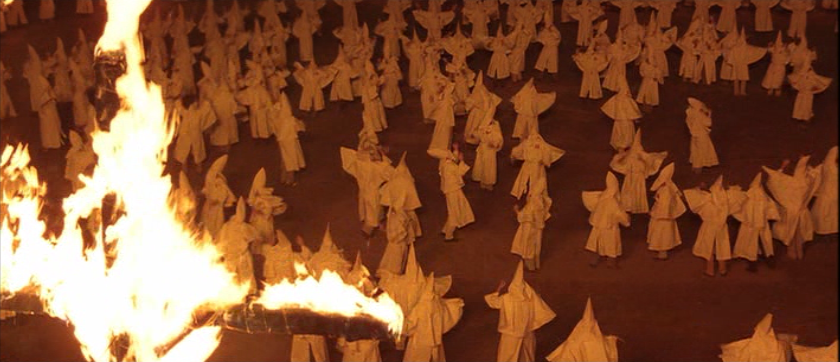
There are, however elements of this adaptation which can be regarded as analogous started with the complete reworking (and re-structuring) of Odysseus’ epic nine year saga, from thirteenth century Greek mythology to the South of twentieth century America in which the narrative episodes unfold over four days. Here, multiple characters are given subjectivity rather than the extradiegetic and intradiegetic narrators of Homer and Odysseus or the heterodiegetic narrator(s) embedded within the tales of the Lotus-Eaters, the Cyclops and the Sirens. Each of these stories serves as hypodiegetic narratives, “below the diegesis”[18] in order to supplement the overarching story of the Odysseus/Everett’s safe passage home – although this is not actually revealed until near the movie’s climax as a satellite. Pete has now informed the Sheriff of their plan to “seek the treasure” leaving Everett safe to confess the treasure’s lack of existence, this minor plot event serves the proceeding kernel. Everett and Pete fight culminating in a fall which leads to the discovery of Charybdis (the many headed monster of Book 12) pronounced as a Klu Klux Klan mob. This kernel re-establishes ties to certain characters and re-introduces them into the diegesis. Homer Stokes is the leader of the KKK and intends to lynch Tommy Johnson, an attempt at ethnic cleansing (or allusion to the Holocaust, perhaps), Everett, Delmar and Pete have to save to him, forgetting that they faces are camouflaged in dirt. This is also the scene in which source intertexuality is utilised, specifically the return of “Big Dan” – his initial introduction is a narrative kernel and major plot event in the poem – Odysseus in his blinding of Polyphemus angers the giant’s father Poseidon, The God of the Sea’s wrath causes Odysseus to land on Phaeacia, the place where his odyssey is recounted. As the film is based within a verisimilar environment, “Big Dan” of course is a “regular” sized man, but camera angles (low and tilted) defy logic and represent him as “larger-than-life”, while his limbs are manipulated by diegetic sound effects which add weight and gravitas to Goodman’s performance as an ironized form of the “con-man”. The implied author of his film is the director and screenwriter (in this case they are two and the same) the narrator on the other hand is “a heterogeneous mechanical and technical instrument constituted by a large number of different components”[19]. The filmmakers’ use of dissolves, fades and wipes (which often resemble the turning of a page) are to offer visual punctuation, as well as display a cinematic technique of storytelling.
In Book 9, Odysseus utters the following: “Nothing so sweet is as our country’s earth / And joy of those from whom we claim our birth”[20] – these lines are enunciated through the cultural context of art, film to be precise. The three heroes stare down on the configuration of KKK members and seizing the opportunity they knock three guards unconscious and procure their attire. This scene is taken from The Wizard of Oz[21], in which Scarecrow, Lion and Tin-Man rescue Dorothy from the clutches of the Wicked Witch, Dorothy’s mantra of “there’s no way place like home” is signifier of this parody. Big Dan eventually sniffs out the trio, in a reference to Jack and the Beanstalk, Dan can literally smell the hair pomade of a vain man and a fight ensues, Everett, Delmar and Pete are successful in their rescue of Tommy and victorious over the “Cyclops” (Big Dan). Their black faces cause confusion and this scene serves as another satellite when Homer Stokes is exposed as the racist pig he is (Wayne Duvall is porcine in appearance as Stokes and serves as an allusion to Book 10, in which Circe transforms Odysseus’ men into swine[22].
O, Brother… appears to be one large fabula interwoven with a vast selection of intertextual references and allusions, parodies and transformations, some of which have been discussed thus far. However, to completely understand an adaptation is to recognise and potentially comprehend how intertexuality can enhance literary understanding. Homer’s Odyssey makes several allusions to the Trojan War and its casualties, this is a fragile intertextual connective as there is little clarification to be made (The Iliad precedes The Odyssey in time and space, its narrative – the Trojan War). With O, Brother Where Art Thou? the reader perceives that something is missing from the text and checks the reference As previously discussed, there is a high level of source intertexuality and context intertextuality, this may label the movie as a bricholage but does not aid in a final conclusion: the film as commentary or analogy. The film technique is quintessentially ‘Coen’ and this is signposted through the use of camera (via director of cinematography, Roger Deakins), mise-en-scène, the actors who have collaborated with the filmmakers before: John Goodman (The Big Lebowski, Joel Coen, 1998), Holly Hunter (Raising Arizona, Joel Coen, 1987) and John Turturro (Barton Fink, Joel Coen, 1991) and the performances they evoke, all are exaggerated, mythic and surreal in characterisation.
As a conservative state, the Mississippi depicted in the film is particularly religious which may offer an explanation for the “Lotus-Eaters” enunciation, in which a congregation are baptised, their sins and transgressions are washed away. Baptism, according to the Coens, is the holy Lotus-Flower. This sequence is a narrative satellite which is introduced by a gospel chorus who sing ‘Down to the River to Pray’. This spiritual aspect to the film (the poem did contain many Gods in many forms) is also seen in a recurring cross motif displayed within the diegesis, one of these crosses is presented in the form of crossroads. At them the trio of protagonists pick up guitarist Tommy Johnson, Tommy is a reference to historical Blues guitarist Robert Johnson, who performed the following lyrics “[…] standing at the crossroads I tried to flag a ride […] I said, hello, Satan, I believe it’s time to go” (Cline)[23]. Tommy’s introduction into the mythic discourse, acts as a narrative kernel integral to the overall sjuzet, without Tommy the trio would not have become The Soggy Bottom Boys at WEZY station, and preventing his death ultimately leads to a pardon from the Governor.
According to tradition, Homer was a wandering blind poet and is alluded to at the narrative’s beginning and conclusion of the film, in the form of the blind seer who prophesises the odyssey. He helps commence the story and plot as well as closure, conforming to the Aristotelian notion of narrative, in which a third person narrator initiates a story. In this case the seer/Homer withdraws and allows the characters to interact with each other and ultimately tell the story[24]. The radio controller at WEZY radio station (Aeolus) is also blind, he ‘composes’ just like the bard, and aids in the success of Jordan Rivers and the Soggy Bottom Boys and the recording of their iconic song ‘Man of Constant Sorrow’. This acknowledges the Mississippi patron saint (Our Lady of Sorrows) and even references autobiographical information of George Clooney (he too bid “farewell to old Kentucky where he was born and raised”) – although, this may be taking intertexuality a tad too far. After surviving the damming of the Mississippi, the film’s narrative draws to a close, ending Everett’s odyssey. He has overcome many obstacles including ‘Penny’s test’, in which he has to recover her wedding ring from the drawer in her bureau (in the middle of the damming). He remarks that ‘all’s well that ends well’, an obvious Shakespearean reference which is best enunciated in the following lines from the play; “[…] when thou canst get the ring upon my finger, which never shall come off, and show me a child begotten of thy body that I am father to, then call me husband […].[25]
Film adaptations, as this project has attempted to show, is a complex process, one which cannot be explained away by fidelity criticism. In taking Homer’s Odyssey, the Coen brothers have created a commentary (with a questionable analogous rhetoric) of the epic poem; a ‘paraphrase’, one rich in source and contextual intertextuality as well as hypodiegetic narratives and enunciation which makes for a memorable film, from beginning to end. The adaptation improves (visually) upon the initial work in its transference of setting and ultimately makes the saga much more accessible to a modern audience while restoring the pathos and irony of the original, Odysseus enthrals an audience with his words, while Ulysses Everett McGill beguiles with his music. Homer draws the most appropriate conclusion to this essay, “[…] You move our eyes / With form, our minds with matter, and our ears / With elegant oration, such as bears / A music in the order’d history […]” (Book 11, p220: 493-496).[26]
[1] McFarlane, B. Novel to Film: An Introduction to the Theory of Adaptation. UK: Clarendon Press. (1996, p8).
[2] Bluestone, G. Novels Into Film. USA: John Hopkins University ([1957] 2003, p6).
[24] Berger, A. A. Narratives in Popular Culture, Media and Everyday Life. USA: SAGE Publications (1997, p20).
[25] Shakespeare, W (1603) All’s Well That Ends Well In: Proudfoot, Thompson & Kastan (eds) The Arden Shakespeare Complete Works. London: The Arden Shakespeare, (2005, pp89-119).
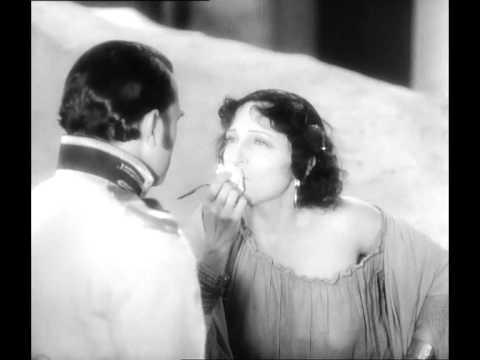
Pre-production code females were given carte blanche when it came to committing their ‘crimes’ against men/society, without veritable punishment, leaving the likes of Theda Bara, Pola Negri and Ida Lupino free to vamp it up, transgress, and use their feminine wiles as they chose, with little condemnation or repercussion. Post-code ladies like Marguerite Namara, for example, in 1931’s Gipsy Blood (aka Carmen), is not quite so lucky. Adapted from the novel Carmen by Prosper Mérimée and informed by the subsequent opera, Gipsy Blood tells the tale of a cigarette factory worker caught up in a love quadrangle. Directed by Cecil Lewis and music arranged and conducted by Malcolm Sargent, this Elstree Studios production is the first filmic rendering of Georges Bizet’s libretto.
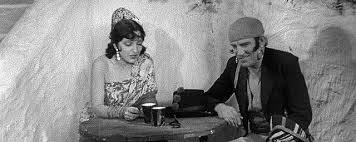
Set in Seville, ‘betrayer of all men’, Carmen (American soprano Namara) is striking and clearly, the star, with her alabaster skin, black hair and saucer-like eyes framed with dark lashes. She’s the quintessential Spanish woman in her flamenco dress, hooped earrings and headscarf, standing with her hands on her hips, emitting an air of authority and accentuating her breasts and hip. She’s a seducer, capricious, even duplicitous and when stiff upper-lipped, innocent (and quick tempered) officer Don Josè (Thomas Burke), caddish, lecherous moustachioed corporal Zuniga (Lester Matthews) and charming Toreador Escamillo (Lance Fairfax) fall for her ample charms, it can’t end well. It’s the usual story: woman wrongly labelled ‘harlot’ because she exudes passion, sexuality and confidence leads to murderous jealousy all the while depicting the proletarian life amid immorality, and lawlessness (and xenophobic/sexist stereotyping).
Displaying stark cinematography, replete with chiaroscuro tones, Gipsy Blood is a delight albeit archaically put together. It won’t be for everyone, especially given the histrionic acting and, at times, stilted, awkwardly delivered dialogue. Sadly, the singing ability from the main mezzo-soprano, baritone and tenor does not quite match the acting style but in its deliciously camp and melodic story there is joy to be found. Granted, you probably have heard the arias sung far more proficiently in the 70 years since but Sargent’s arrangements still shine, no mean feat given the audio recording limitations of 30s cinema. A word of advice, never trust a dark, exotic temptress; they’ll break your heart!
During the first ten years of the Showa period (1926-1989) in Japanese history, the Militant Faction of the Army staged a coup. This endeavour to overthrow Imperial power resulted in the assassination of Finance Minister Takashasi Korekiyo and after a three day revolt the military rebellion ended. An incident that would coincide with the rebellion was of individual magnitude – three months after the failed coup, a prostitute named Sada Abe was apprehended by Japanese authorities for her role in the death of Kichizo Ishida. Upon her person were Kichizo’s severed penis and bloody testicles, organs she had removed after he was dead. Her personal rebellion and revolt also lasted three days.
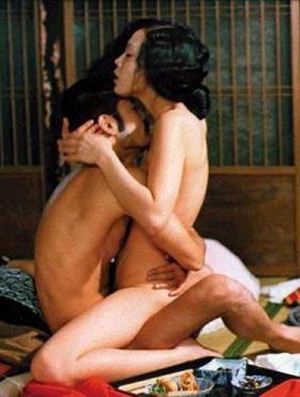
Forty years later, filmmaker Oshima Nagisa whose oeuvre consists of many keiko-eiga films, produced and subsequently released Ai no corrida [In the Realm of the Senses] (1976). Its suji (described in its crudest form) is based upon Abe’s exploits of 1936 and her sexual affair with former master Ishida. Oshima was regarded as a New Wave filmmaker, iconoclastic with his subject matter and techniques and had a tendency to establish a strong correlation between political and sexual repression, Ai no corrida is no exception. In creating the film text, Oshima rebels against Japanese tradition, not least the cinematic conventionality which viewers of Japanese narrative cinema had grown to expect; a veritable representation of what it was like to be truly ‘Japanese’.
These new stories could not be told in the old ways; new content demanded new forms. Traditional forms – the old classical style of conventional studio filmmaking – reflected the political and cultural status quo. To critique and reform a corrupt society, to change the way people think and act, would require a change in how they see and hear. (Nelson Kim, Senses of Cinema, 2004)[1]
In order to accomplish what Kim describes – the art of the New Wave filmmaker – the director must rebel. This is clearly evident in the film’s form and content, namely its transgression and explicit depictions of sexuality. Ai no Corrida in its entirety sees scene-upon-scene of penetrative sex, fellatio, autoeroticism, rape and abjection; taboos which are rarely broken in mainstream, progressive cinema. Sexual activity is, universally a private activity, one which is usually performed behind closed doors; an act of intimacy which is played out, much like a theatrical performance and one which is central to the film’s mise-en-scène (Turim, 1998)[2]. Oshima invites the spectator into the couple’s clandestine domain, their ‘realm’ and encourages voyeurism alongside unequivocal exhibitionism. With his use of tight framing and enclosed, claustrophobic settings and locations, the viewer has no choice but to look; to embrace the visuals and read-between-the-sex, as it were, for a deeper political reading. Pornography it is not, as no frame serves for pleasure or titillation.
Ultimately, it is the objectification of the representational – both vigorous and at times inventive – sex which functions in alienating and distancing the viewer. This can be read as both an element of political modernism or a clever and distinct filmmaking technique in which the spectator experiences the same isolation and disjunction Sada (Matsuda Eiko) and Kichi (Fuji Tatsuya) are subjected to. Perhaps it is both or neither, one thing is clear and that is the protagonists’ segregation, from themselves, from thirties’ militant Japan and complete rejection of the ideological hegemonic structure which threatens to oppress them.
To dismiss Ai no corrida as a film about sex is an injustice. Granted, Sada and Kichi do spend the majority of their time (and film) inside four walls and each other’s body and mind and it would appear that they are incapable of any other form of communication, however, there is so much more beyond their passion. During their brief excursions in the outside world, Sada and her lover are set against Japan’s industrialisation. The sterility of the landscape of ‘new’ Japan is juxtaposed with their outdated kimono dress cut in garish colour set against the grey, sterile landscape. Children are visual representations of the future and can be seen carrying the new design of national flag, thereby indicative of the difference between militarist and imperialist Japan. A division which was in existence at the time of 1936 and, by extension, the Japan Oshima was attempting to unburden in the mid seventies at the time of production. The children throw snowballs (another indication of the politically ‘cold climate’) at the elderly – here, in the form of a male suffering from erectile disfunction. This, while depicting the cruelty of youth also symbolises how the aged are now ineffective within society, aided further by the old(er) geisha’s incontinence later on in the film.
Every individual has character duality, something Nelson Kim describes as ‘the social being and the ‘ everyday self’ and these aspects of character allow Sada and Kichi to ‘fuck their way to freedom’. This idea of sexual liberation was very much a Western ideology culminating in a sexual revolution which ran from the mid-sixties through to the mid-seventies. A movement which coincided with the production of this film and, it would seem, influenced it with other imported Western ideals including those contributing to values governing sexuality. If this modernity of the West did in fact influence Japanese values; specifically those associated with sexuality, then Oshima’s influence in depicting his iconoclastic vision of Japan clearly came from the West – namely France, a country which provided finance for the film’s production and a safe haven for editing.
In a Japan, which is seen as destructive and offering little in the way of liberation, Sada and Kichi, in their activity articulate their emancipation through their sexual desire, “[a] desire [which] mocks the notion of will and rationality”.[3] Kichi, however mocking is repression personified, walks in the opposite direction to marching soldiers in one of the film’s iconic moments. While many critics have interpreted this as rebellion, another perspective may suggest defeat. He will never be a part of the society they represent and, just like them, he is destined to die, at the hands of an oppressor no less. For that is what Sada essentially becomes, her activity and aggressiveness relegates Kichi to submissive male; provider of pleasure. He is no longer a man but sexual object, while it is the female who is the dominant and controlling one. Furthermore, the last scene in which Sada chokes him can be read as suicide; he cannot sustain or fulfil his lover’s voracious sexual appetite and his death which occurs in the midst of performing his duty causes him to surrender. Only in death is Kichi truly free.
Ai no corrida remains a timeless, highly stylised and transgressive critique of the corruptive influence of patriarchal ideology and of its implications on Japanese society. Oshima maintained that a film can only be truly political when it moves the spectator and his direction and style is certainly persuasive in altering viewer perception, even evoking attributes of the Lacanian model. In this case a piece of filmic art which is particularly acquiescent in its keiko-eiga ideal, yet at its heart displays a representation of civilisation and the oppresive hegemonic structures which allegedly keeps the human race ‘civilised’. Running deeper than its political theme, however, is a depiction of Eros and Thanatos and a fight for freedom – some may say the human condition.














 The Framing Device