Categories
Blu-ray film review

Man of a Thousand Faces (Dir. Joseph Pevney, 1957)

Man of a Thousand Faces begins with the following cue: “On August 27 1930, the entire Motion Picture industry suspended work to pay tribute to the memory of one of its great actors. This is his story.” Except, well, it’s not. It’s the ‘Hollywood’ version steeped in melodrama and all a little dull.

At the Universal studio lot, the flag flies at half-mast as Irving Thalberg (played by the late Robert Evans, sans perma-tan) makes his own tribute to “The phantom of the opera.” In actuality, work was not suspended but a two minute silence was conducted in the wake of Lon Chaney’s death – nor were his most successful films made at Universal… This film starts as it means to go on, dramatising and conflating the life of an extremely private man who, if history books are to be believed, would have shunned even this mediocre production.

The biopic begins with the obligatory flashback which will serve the overarching narrative and then loop back around; aligning childhood, trauma and tragedy which is seemingly how it wants to establish Chaney (James Cagney). It traces his career from the Vaudeville stage to the cinema screen and admirably attempts to squeeze 30 years into 122 minutes, perhaps had the film been cast differently it may just have worked.

As talented as Cagney arguably was, there’s no way he can pull off aged 22 at 56 convincingly. Not to mention the physical limitations; a tall sinewy figure with a distinctive growl never really translates to a chipper Irish-American barely reaching 5’7”. Star personas were prevalent during the studio system and it’s fair to say, Cagney was horribly miscast nor did he have the lithe grace Chaney exhibited or the creepy melancholy.

If there’s one word used to describe the tone of the film, it is tragedy, as it prefers to add weight to the man’s alleged suffering than his film career. Hammering home his deaf-mute parents, hitting child abandonment and the dissolution of his marriage along the way, to having to place son Creighton in an orphanage and then, well, death. It’s all rather dreary; at odds with the sweeping epic soundtrack and the man whose early career began in Vaudeville and making people laugh. Why his parents’ deafness defines him or them, for that matter, appears to be a sign of the times – as for when that is the film does little to quantify. Creighton (he who would become Lon Chaney Jr.) is the only real evidentiary passage of time as the part is split between four actors (Dennis Rush, Rickie Sorensen, Robert Lydon and Roger Smith) each older than the next. None of which is helped by the occasional fifties-looking costuming.

Before his ‘big break’ as a lead, Chaney worked tirelessly and took every job he could, often making himself over and disguising his natural attributes depending on what was required on the call sheet. His ground-breaking make-ups led the way for the likes of Jack Pierce. Bud Westmore, Dick Smith, and, of course, Rick Baker among many, many others. It was then that casting agents began to take notice and he was cast in The Miracle Man thanks to his ability to twist and coil his body into unnatural positions. This would lead to arguably his greatest roles: The Phantom of the Opera and The Hunchback of Notre Dame in which he gravitated, yet again, to the tortured and afflicted depicting the tormented empathy of Quasimodo. Cagney tries but it’s hard not to see Cagney playing ‘Cagney’ imitating Chaney, or ‘Chagney’ if you will.

Obviously, given the decades between meant different make-up processes and evolution of the prosthetic. The make-up recreations in Man of a Thousand Faces are pretty awful given that Westmore et al would have used more modern supplies and they are still nowhere as convincing as Chaney and his ‘crude’ materials. Eagle-eyed viewers will also notice that camera-angles vary in relation to the original films, they’re not quite as polished.

It’s not all terrible, there are some high points. The father-son relationship shines and the performances from the actors who played the young(er) Creighton are lovely. These moments highlight Chaney’s love of mime and character, donning wigs and a false nose to “show” his son a bedtime story. The use of sign language is refreshingly brilliant for a film as old as this, when communicating it’s all about the face which for Lon Chaney it was. His.

He worked in cinema from 1914-1930 with 100 of his 157 films either lost or destroyed. It’s a missed opportunity that the 2000 documentary, The Man of a Thousand Faces narrated by Sir Kenneth Branagh isn’t included in the extras here. However, if Chaney holds an interest for you, seek it out, it’s really informative and one gets to see the original performer rather than a shallow impersonation. While the film never quite reaches the heights expected, the transfer is stunning. It is clear and crisp with very little residing grain which serve the make-up replicas and those stark chiaroscuro shadows which ‘Chagney’ often lurks within.

Lon Chaney died from a throat haemorrhage brought on my complications from the cancer that he was diagnosed with years earlier. An almost karmic fate for a versatile entertainer who sought silence both on stage and screen – his last film (a remake of Browning’s The Unholy Three) was his only speaking role – and has been revered ever since.

Disc Extras

Commentary by Tim Lucas – this is highly informative and provides great education for those unfamiliar with Chaney and his work and those that are interested in their broadening their knowledge. Lucas provides lots of information and titbits, paying particular attention to historical context – something the film sorely lacks.

The Man Behind a Thousand Faces: Kim Newman on Lon Chaney (20:52) Filmed in a cluttered room full of DVDs and books, Kim in his signature red waistcoat and cravat discusses the silent stars of Hollywood’s heyday including Chaplin, Garbo, Valentino and of course Chaney. Newman’s brief foray into the topic is not overly focussed and feels more conversational in tone which is a great contrast to the slightly more scripted and academic commentary. He maintains that Chaney lingers long in the cultured memory “and without Chaney’s make up Karloff and Lugosi would have contrived to play gangsters, and never Universal monsters (though, I’m sure Jack Pierce would have argued with that). He also thinks Cyrano de Bergerac was the role Chaney was made for but never got the chance to play. The chat is intercut with clips from the films and sadly, ends rather abruptly.

Theatrical Trailer (1:33) – It’s always worth watching the film’s theatrical trailer if only to see the original footage prior to the restoration process, and the extent of the transfer and clean up.

Image Galleries – These include 82 slides of production stills which show the costumes and make-ups in greater detail (not always a pro) and give more opportunity to see Bud Westmore’s clunky recreations albeit all in black and white. In addition to the slides, there are 18 posters and lobby cards in both monochrome and colour from all over the world including France, Spain, Germany and Russia.

Categories
Film Festival film review

Babyteeth (Dir. Shannon Murphy, 2019)

LFF 2019

Small-time drug dealer Moses (Toby Wallace) literally barges his way into Milla’s life while she is standing on the platform awaiting her train home from school. In the following moments, the jittery off-his-face-on-pharmacuticals nervous energy of the scruff-bag almost guarantees he won’t be going anywhere soon. He “saves her life” by stemming a sudden nosebleed with the shirt off his back. She offers to give him fifty bucks if he’ll do something for her, and as Moses hacks off her long hair with dog clippers, Milla (Eliza Scanlen) is smitten.

Meanwhile, across town (still in Sydney), therapist Henry Finlay (Ben Mendelsohn) is listening to Anna (Essie Davis) who is laying on an ottoman in the middle of the floor while he devours a sandwich. Only when they begin to awkwardly orchestrate sex on Henry’s desk do we realise that they are husband and wife and Milla is their daughter. Oh yes, and Milla has – although the word is never uttered once during the film’s 118-minute duration – a form of cancer.

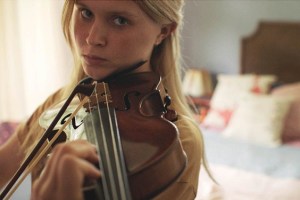
Surrounding the Finlays – and Moses – are a cast of memorable and wonderful characters. There’s heavily pregnant Toby (Emily Barclay) who has recently moved into the house across the street, Latvian music teacher Gidon (Eugene Gilfedder) – he teaches Milla violin and was once Anna’s musical touring partner, Tin Wah (Edward Lau) – an accidental truant who’s a musical prodigy in the making, and Zachy (Zack Grech) Moses’ little brother. Each flesh out the story in their own memorable way but the film belongs to the four leads: Scanlen, Wallace, Davis and Mendelsohn.

To reveal more about the plot would spoil but suffice to say Shannon Murphy’s directorial debut feature is a little beauty. Based on Rita Kalnejais’ 2012 play – she adapts her own work for the screen – it thankfully has kept all the descriptors from the stage version. The film is chopped up into vignettes, each given a title which don’t always work, often only serving as a distraction, however, here are edited together flawlessly. They even help create a laugh before any action unfolds.

Murphy’s direction is subtle and natural – nothing feels forced. Light floods every frame even during night-time sequences, this is not a film about death despite its looming scythe but a celebration of life, first love and family achieved in such a beautiful way. Babyteeth is a bittersweet comedy and utterly unique. It’s not quite a coming-of-age story nor is it one of those heinous last-chance-at-love stories where the dying girl lies pale and clammy in her bed, or is accompanied by an oxygen tank in every scene. There is hope, joy and teen angst everywhere, and yes, the sobering fact that Milla may die is never far from the audience’s minds but her illness doesn’t define her.

Eliza Scanlen more than proved her acting mettle in Sharp Objects (a penchant for teeth too it seems) and creates a fully-rounded character in Milla. She’s not always likeable (what teenage girl is?) but we empathise with her, and can’t help but love her. Toby Wallace is brilliant as (almost) complete loser, Moses, who’s not beyond redemption, and nowhere near boyfriend material. Yet, there’s something so sweet and tragically melancholic about him. Which leaves the ‘olds’. If you’d like to see a masterclass in acting from two Australian legends of the large and small screen, look no further than Essie Davis and Ben Mendelsohn. They’re fabulous in most things individually but together something else entirely.

That’s one of things this film does so well, it’s not just about a diagnosis or how it effects the sick but those around them, and Davis and Mendelsohn convey so much with very little. It’s in the nuance of a sigh, a look, a nudge of affection, a kiss on the forehead, or getting exasperated at your wife’s ‘shower move’ just so she can get you naked. Let’s just say, Moses isn’t the only one self-medicating and dulling the pain, Anna hasn’t been able to play the piano at all since Milla’s news.

Music plays a huge part of this film, it’s what opens it – a string quartet hammer out a gorgeous version of “Golden Brown” while the remainder of the soundtrack – wonderfully put together by Amanda Brown – varies from electro, soul, cheesy pop to Mozart and Bach. Each piece conveys emotional heft and given that music means so much to the mother and daughter onscreen, it’s a really lovely way of exploring their relationship without unnecessary exposition.

Milla still has one of her baby teeth – hence the title – the perfect symbol for the childhood she wants to be free of and the adulthood she may never encounter. As a film, Babyteeth is a glorious joy from beginning to end; heart-aching and hilarious with an immensely talented cast who genuinely make this a special experience.

Quoted in the trailer! :)
Categories
Film Festival film review

Burning Cane (Dir. Phillip Youmans, 2019)

LFF 2019

Much will be made of Phillip Youmans’ age when the writer, director, DoP, and camera operator made, this, his first film. Just look at Xavier Dolan following his debut, the ‘wunderkind’ label was bandied round for at least five years of the last decade. However, that surliness and juvenile (albeit brilliant) edge to I Killed My Mother is largely missing from Youmans’ debut Burning Cane; a mature Southern Gothic drama which belies the (then) High Schooler’s age (he’s 19 now).

Set in rural Louisiana, our leading lady Helen (Karen Kaia Livers) sits on her stoop smoking, her voiceover discusses her dog Giorgio. It has the ‘mange’ and she is attempting to prolong its life anyway she can. Helen has been surrounded by ‘diseased mutts’ most of her life – her late husband succumbed to an AIDS-related illness while her Pastor Reverend Tillman (Wendell Pierce) and only son Daniel (Dominique McClellan) are fighting with alcoholism. Tillman continues to drink on the job following the death of his wife and won’t accept any help, least of all from his flock, choosing instead to drive home each night after sermons, inebriated, his car swerving all over the road.

Daniel, on the other hand, has to contend with keeping house while his partner (Emyri Crutchfield) goes to work and supports their family. He cooks, cleans, and fixes things around the place but it’s taking its toll. He’s questioning his masculinity and is steadily on self-destruct mode; he’s the man and should be the one providing, not staying at home looking after son Jeremiah (Braelyn Kelly).

‘Looking after’ may be somewhat of a stretch, the boy is mute – presumably a nod to the weeping prophet he is named for – unable (or choosing not) to talk and accepts his father’s love in the form of an occasional meal and glasses of milk laced with whatever liquor the older male is guzzling down. There’s a hint at something darker going on between father and son but the level of abuse remains at the booze-pushing and never leads anywhere else, beyond the steady decline of a man who would rather use his fists in a drunken stupor than work through any of his issues.

Youmans utilises a number of camera angles and shots which suit the oblique storytelling, however, at times poor lighting and a literal lack of focus feel unnecessary especially when considered alongside the already slow pace. Being unable to see much within the frame is problematic, however intentional but it does help build mood with the extreme dichotomy of light and dark. As the claustrophobia hits its peak, the humidity and sweat are palpable. It’s a pensive narrative, and while its foundations are embedded within the art film, it is largely raw, grass roots filmmaking.

This is Helen’s struggle to reconcile her faith alongside her relationship with her son. It’s a film about sin, despair, drink and poverty. One which examines a mother’s love for her child, deep-rooted toxic masculinity – the definition of what it means to be a man – and the role religion plays within the black community onscreen. Many pray to a Father for guidance, and yet few have fathers to guide them. There is condemnation of the Church and yet at no point does the institution feel demonised.

Colours are kept to a minimum too, greys, greens, browns with the occasional flash of orange (courtesy of the fruit trees Jeremiah finds solace in or the burning umber of a lit cigarette). Daylight is also a rarity – while we’re so used to the depiction of a light, bright sunny South on film, in Helen’s world, everything is tinged with a dismal grey while heavy clouds hang in the sky. The film’s title relates to the annual process of harvesting sugar cane; fields are set alight before the valuable part of the crop is harvested, an apt metaphor for the film’s narrative.

While as a whole, the film never feels completely cohesive and ends somewhat abruptly, it is a promising vérité style debut which feels reminiscent of early Burnett and Malick. Following its trifecta of wins at this year’s Tribeca Film Festival, It’s safe to say there will be plenty of interest in what Youmans creates next.

Categories
Film Festival film review

Judy and Punch (Dir. Mirrah Foulkes, 2019)

LFF 2019

Despite origins in 16th century Italy and containing a character named Pulcinella, the concept of the traditional puppet show Punch & Judy would eventually make its home in Britain during the 17th century – historians say 1662, thanks to a diary entry by the Bridget Jones of his day, Samuel Pepys.

Within a hundred years ‘Pulcinella’ was anglicised to the much snappier and succinct ‘Mr. Punch’ and Joan, his wife also had a name change and took on the moniker ‘Judy’. Puppets on strings would pull a Pinocchio, only rather than becoming ‘real’ they would adorn the hands of the hidden human and entertain adults and children alike for more than 350 years – regardless of form or plot-line – usually at the seaside. Perhaps it was the sea air which rendered audiences immune to the repugnancy of the insidious Mr. Punch.

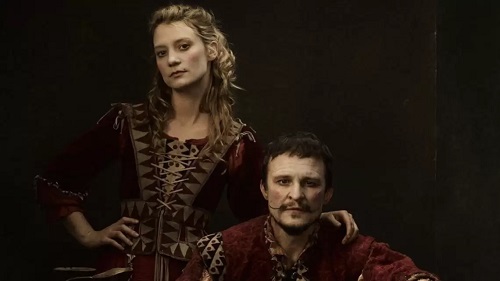
‘Seaside’ is the locale of Mirrah Foulkes’ debut feature, ‘somewhere in England’ and ‘nowhere near the sea’. A small cloaked figure steals into town to sneak into the evening’s show. Bottler Judy (Mia Wasikowska) shakes a tankard for coinage and entertains the crowd before announcing the main event: Professor Punch (Damon Herriman) and his puppets. He appears through crimson velvet drapery with a bang and cloud of smoke; caked in face-paint, jester-like in his stage costume complete with twirled moustache. Make no mistake, this – debatable when we see Judy’s puppeteering skills – is the star of the show. By the end of the elaborate opening credits we, just like the rowdy audience onscreen, are hooked.

Punch and Judy live in a beautiful home with their daughter, Baby (the cheek pinchingly adorable Scarlett and Summer Dixon), maid Maud (Brenda Palmer) and her husband Scaramouche (Tony Norris). They await the day that scouts arrive in Seaside to discover the magic of their talent and transplant it to The Big Smoke. He wants more fame and fortune – swanning around Seaside as a minor celeb is not quite enough for his ego – while she seems fairly content with their lot. Although, she does seek to tone down the ‘punchy and smashy’ aspect of the show, while imploring him to stop frequenting local watering hole McDrinkie’s, and ideally would like the community around her to be a little less… judgemental.

Townspeople are banished as heretics to the Black Forest, others are publicly hanged, and women are stoned daily for reasons that are utterly ridiculous but are, of course, to the folk of Seaside signs of witchcraft and (obviously) the work of The Devil. Leading the charge is the simpering and sneering Mr. Frankly (Tom Budge) who rewards the important men of town with casting the first stone and brings actual fanfare to the Gallows. New Constable Derrick (Benedict Hardie) has his work cut out; crimes and grievances bypass his office and result in quick confessions and executions. Then there’s his crush on Judy… while local prostitute Polly (Lucy Velik) only has eyes for Punch. Maud’s job is becoming harder as hubby Scaramouche’s memory worsens but as long as her master gets his sausages before Toby the dog gets his paws on them, all should be well.

Plot-wise, if you’re at all familiar with the show, then you can rest assured it’s all here. Foulkes gives us a bit of an origin story – albeit a subverted one – which looks at the historical context and celebration of (gendered) violence, as well as the notion of oral histories and storytelling in its earliest form, idiom and allegory. The film is darkly comic from the very beginning with a never-faltering tone which is perfectly pitched and often black. It’s hard to find the humour in heavy hitting themes such as domestic violence, alcoholism, adultery, murder, early onset dementia, and misogyny but writer-director Foulkes finds that twisted balance perfectly. Assisting her in some lovely cinematography is seasoned DoP Stefan Duscio, gorgeous period costumes designed by Edie Kurzer and a gloriously bizarre soundtrack courtesy of composer François Tetaz – there’s a theatricality to his music which simultaneously feels dated and contemporary when accompanied with the action onscreen.

Performances are solid from Hardie’s drippy Derrick to Gillian Jones’ dark, mysterious – and possibly necromantic – Dr. Goodtime. Terry Norris’ bumbling Scaramouche is a delight, Wasikowska is always worth the price of admission, and the currently ubiquitous Herriman is suitably deranged as maniacal Punch. It’s a charming collective of Australian actors – including Foulkes behind the camera (she can be seen in front of it in The GiftThe Turning, and Animal Kingdom) albeit with a multitude of British and Irish accents. Not every single one is convincing but it often adds to the hilarity – Herriman’s is of course flawless.

Astonishingly, the entire film was filmed on location in Australia and yet is so authentically ‘English-looking’. It all works brilliantly. As an origin story, comedy, and dark drama Judy & Punch is an assured, astute and compelling film. It’s one which offers up a lot and delivers on everything – History becomes Herstory and brava to that.

Categories
Blu-ray film review

The Bells of St. Mary’s (Dir. Leo McCarey, 1945)

It was the film listed on the marquee of the local cinema as George Bailey (James Stewart) ran through a snow-covered Bedford Falls, and back into the bosom of his family. It was also the picture that Michael Corleone (Al Pacino) took Kay Adams (Diane Keaton) to see at Radio City Music Hall on their first date. Aside from being dearly beloved by filmmakers named Francis, The Bells of St Mary’s does what very few films have been able to do, and that is out-charm its cinematic predecessor (despite Bosley Crowther’s 1946 claims in The New York Times).

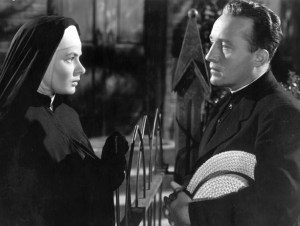
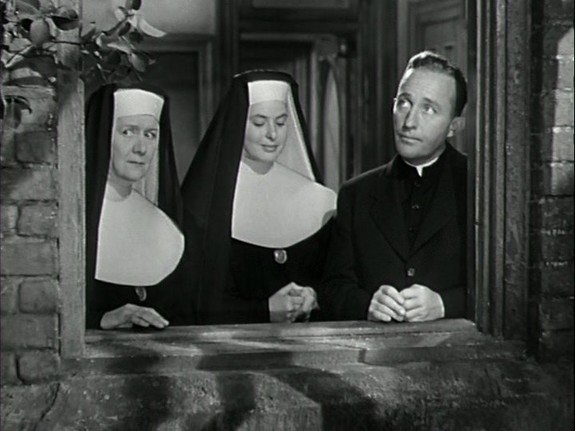
Father ‘Chuck’ O’Malley (Bing Crosby) was first seen in Leo McCarey’s 1944 hit Going My Way and is reintroduced here – wearing his straw boater on a jaunty angle – arriving at St. Mary’s in order to help Sister Superior Mary Benedict (Ingrid Bergman). She, who is fighting to keep the Parochial school open and out of local businessman Horace P. Bogardus’ hands. Bogardus (Henry Travers) has already purchased the adjacent building to St. Mary’s but is determined to secure the school grounds for his parking lot.

In the beginning, Father and Sister clash – albeit with a twinkle of the eye and a sly smile on the face, alongside quips like: “Did anyone ever tell you, you have a dishonest face? For a Priest, I mean.” Somewhat predictably, they – the American Priest and European Nun – realise they must come together to fight a common goal. Sound familiar? Okay, so it’s not fascism per se but the film was released in December of 1945 so it’s hardly a stretch to see its themes set against the war effort.

Director McCarey had a somewhat varied career, dabbling in slapstick (Duck Soup, 1933), melodrama (Make Way For Tomorrow, 1937), screwball comedy (The Awful Truth, 1937) and romance (An Affair to Remember, 1957). He would make four Priest-led films (Going My Way…St. Mary’sMy Son John in ’53 and The Devil Never Sleeps in ’62), which for a devout Catholic is hardly surprising, but in all and especially in this film he managed to humanise both Priests and Nuns, depicting them as flawed individuals and, crooner Crosby and the radiant Bergman take Dudley Nicholls’ script and run with it.

There are no villains of this piece – Travers best known for playing angel Clarence in Capra’s It’s a Wonderful Life is probably the most antagonistic, however, manages to convey sincerity and humour all the while attempting to chuck the Sisters and their young wards out of their school. While this is the overarching plot, there are minor, almost irrelevant arcs which provide the gentle comedy and at times offer the most laughs, which go to the heart of the film and viewer alike. Like, flunking student Patsy Gallagher (Joan Carroll) who leans on Father Chuck to help her pass the school year.

Patsy is left at St. Mary’s while her mother Mary (Martha Sleeper) weighs up giving caddish pianist Joe (William Gargan) – who left her pregnant and alone – another chance. Or, bullied Eddie Breen (Richard Tyler) who has been “turning the other cheek” as per Sister Superior’s advice until she decides to teach him, in one memorable and hilarious scene, to box. Even when Chuck and Mary Benedict do have a difference of opinion, it is all decidedly good natured.

It is these threads, and elements within the mise-en-scène, which show the passing of time as the seasons change and the school year progresses, culminating in the most adorable Nativity performance, in the history of Nativities. McCarey was all about improvisation and naturalism in his actors’ performances, and it is no more apparent than in the recreation of “Jesus’s birthday”. It was reportedly shot in just one take with the children encouraged to ignore the camera and crew, and approach their material as they saw fit.

This is an aspect of McCarey’s work ethic which admirer Yasujirō Ozu emulated in Tokyo Story – the 1953 retelling of Make Way For Tomorrow. It is a characteristic which make this film so utterly charming. There are of course – given Crosby’s presence – musical numbers, courtesy of composer Robert Emmett Dolan, such as the delightful “Aren’t You Glad You’re You?” and even Bergman stretches her vocal chords in her native Swedish for “Varvindar Friska” (Spring Breezes) and while musicals are not everybody’s cup of tea (I know, who doesn’t love a bit of Bing?) there are ample numbers to enhance the narrative yet few enough not to put people off completely.

Drill deeper and there are interesting depictions of the gendered approach to conflict which one may argue are outdated, however, some still ring true even today. Yes, it may offer an idealised, even sweet depiction of Catholic schooling but this assertion of patriarchal power is more than still relative especially in the institution of the Roman Catholic Church, and indeed, as discussed by Revd Steve Nolan’s analysis in the disc extras – the notion of paternalism. Made obvious in the way Dr. McKay (Rhys Williams) decides to withhold vital information of and from a (female) patient but discusses freely with ‘a man of the cloth’.

Although not necessarily a Christmas film, you can do a whole lot worse than including this film on your festive watchlist (if not before). It’s the perfect addition containing humour, charm and sincerity, and one which warms the cockles in much the same way as The Shop Around the Corner or Remember the Night. It may not be regarded as McCarey’s most cinematically satisfying film but its popularity is evident and understandable.

The performances are natural, subtle and nuanced especially Bergman who was rarely seen onscreen less than glamorous, and was loaned by David O. Selznick as part of a deal he struck with McCarey. Here she shines, quite literally, from the glow of her unmade-up face to the luminosity of her smile and the clever use of lighting which flawlessly renders her, hitting the eyes perfectly within her wimple. Made all the more noticeable here thanks Paramount’s restoration process which still contains some grain but which creates a beautiful monochromatic sheen to each frame, set within a 1:37:1 aspect ratio.

The Bells of St. Mary’s will charm your socks off – and it’s a well-known fact that this writer watches it every Christmas Eve without fail. It just ain’t Noël without that little boy, Bobby (Dolan Jr), knocking on a curtain introducing himself in one breath, “This is Mary and I’m Joseph, and we came to Bethlehem to find a place to stay.”

Special Features

It’s almost a given now that if it’s an Arrow Films release, the Academy label in this instance, there are always a few extras to enjoy after the credits have rolled… and only then.

Up to His Neck in Nuns (22 mins) – This visual essay by David Cairns is entertaining and informative as the writer dips into Leo McCarey’s filmmaking history, his early life, Catholicism and heavy drinking. It switches from film clips, stills, photos, archival interview quotes, and Cairns’ lovely Scottish lilt ensures it’s never boring.

Analysing O’Malley (19:48) – This appreciation by the Chaplain of Princess Alice Hospice, film academic, and author of Film, Lacan and the subject of Religions: A Psychoanalytic Approach to Religious Film Analysis, Revd Dr. Steve Nolan is a little dry in comparison to the previous essay. Nolan sits to the right of the frame and narrates; reading an essay from an autocue. It’s a fascinating analysis but one which would have worked just as well as a commentary (surprisingly lacking here).

You Change the World (32:07) – This short religious propaganda film was shot by Director McCarey in 1949 and features appearances by Bing Crosby, Bob Hope, Irene Dunne, William Holden, Loretta Young, and Jack Benny – all regarded at the time as ‘super Catholics’. It’s arguably some of the best acting any of them have ever done, and they’re playing themselves! It’s preachy, condescending, cringeworthy hypocrisy at its finest (and I say this as a Catholic). The purpose of the film was to persuade “good, decent, normal people” to join The Christophers. I stopped counting how often “The Declaration of Independence” is mentioned when I reached ten.

Two Screen Guild Theater Radio Adaptations: One from August 26th, 1946 (29:52) and the other recorded October 6th, 1947 (28:59). Both star Bing Crosby and Ingrid Bergman reprising their roles as Fr. Chuck O’Malley and Sister Superior Mary Benedict. The radio programmes are played over a slide show of film stills.

Musical Score Featurette produced by RKO Radio (22:28) – This was made to promote the film’s original release in December 1945, and is played over the same film stills as the radio adaptations.

Theatrical Trailer (1:51) – A perfect way to compare the film against this trailer and see the amount of work that has gone into the restoration process.

Image Gallery – This is slideshow of 35 images. There are gorgeous chiaroscuro snaps, candids, as well as magazine covers, set images and colour posters.

First pressing only: Fully illustrated booklet containing new writing on the film by Ronald Bergen.

Reversible sleeve featuring original and newly commissioned artwork by Jennifer Dionisio.