Categories
Essay film review

Storytelling and Reality in The Fall and The City of Lost Children

The power of fairy tales and stories in childhood can impact a lifetime not least due to the bedtime story whereby the adult attempts to lull the child to sleep with tales of wonder, and aid in the creation of dreams. Dreams, according to Freud, unconsciously assist with the resolution of a conflict and will be considered later, in greater detail, through an analysis of The City of Lost Children (1995). However, it is the action itself of storytelling which is intriguing, specifically between the adult, the child and the space they commune or what Maria Tatar refers to as a “contact zone”[1], a place of mutual meeting and experience as depicted in a film like The Fall (2006).

By distinguishing between the adult and child Tatar creates ambivalence, how can these two individuals share a mutual experience when she herself sets them apart from each other? Not to mention their individual reader identification and expectation[2]. The contact zone can be said to exist but it is not more likely a mutual meeting of contradictory experience (or even be described as repellent)? A story’s narrative sets both adult and child onto different paths. Adam Gopnik suggests that “the grown up wants a comforting image of childhood”[3] and is driven by nostalgia while the child uses the tales to move beyond childish things, a way of bypassing childhood and venturing out, albeit figuratively, into the world. There is even a suggestion that this contact zone/story space may extend to the dream-world specifically when considering Jeunet & Caro’s The City of Lost Children.

Fairy tales have, over the years, been the cause of much debate. Psychoanalyst Bruno Bettelheim stated that the tales speak directly to children[4] while Danish Folklorist Bengt Holbek maintained that fairy tales were written for an adult audience with children occasionally listening to narratives not meant for their ears[5]. What if they were written with both in mind? After all children are small(er) adults and adults are grown up children. Why should the listener or audience miss out on revisiting an aspect of childhood by vacating the realm of youth? It is the intention of this article to examine two original screen fairy tales in relation to the dual protagonists depicted, the notion of storytelling and the distinction of the ambivalent “contact zone”. The use of this concept, has been renamed the “story space” and may be a basis for the adult/child casting, however, this doubling or duality of character representation offers other possibilities, some of which will be explored.

In Tarsem Singh’s The Fall the protagonists consist of an adult and a child, strangers brought together by accidental circumstances. The film opens with an intertitle: “Los Angeles, long long ago” and scenes from the opening sequence quickly establish the setting in circa. 1915 California. Stuntman Roy Walker (Lee Pace) is languishing on the male ward of a picturesque hospital, confined to his bed after a stunt fall ends badly. Walker is a broken man in more ways than one, he has, not only, lost the use of his legs but the love of his life to the film’s leading man. Romanian immigrant Alexandria (Catinca Untaru) is on the other side of the compound in the children’s ward, her left arm in plaster following her fall from the top of a fruit picking ladder. Neither is necessarily destined to meet but both are isolated with few visitors. One day the wind blows Alexandria’s note to Sister Evelyn (Justine Waddell) out of her hands, into an open window and onto Roy’s lap.

So begins two exposition stories, one weighted in reality the other in an alternative world where the outcome is dependent upon how the real infiltrates the imaginary. Roy’s epic tale is a story of six unlikely companions; buccaneer and explosives expert Luigi (Robin Smith), ex-slave Otta Benga (Marcus Wesley), Charles Darwin (Leo Bill), The Indian (Jeetu Verma), a Mystic (Julian Bleach) and The Blue Bandit (Emil Hostina) and follows their quest to defeat the evil Governor Odious (Daniel Caltagirone).

From the start there is an indication that the visuals are formed through Alexandria’s imagination, elements within the fantastical realm are linked to the sights she sees around the hospital. She is providing the pictures while Roy creates the words. For example, much like The Wizard of Oz (1939), characters are drawn from the real world and find their way into the imaginary, Otta Benga is played by the man who delivers ice to the hospital and Odious’ henchman are costumed to closely resemble the Radiographer Alexandria is afraid of. Often the images and description do not correspond with each other, and the Indian of Alexandria’s mind is a man from India who wears a turban and who is mourning the death of his wife while Roy’s, unreliable, narration describes the man living in a wigwam and marrying a squaw[6].

The inclusion of the villainous Odious in the form of Sinclair (Caltagirone) the actor who has stolen the heart of Roy’s actress girlfriend once again confuses the narrative and thus the cinematic narrator[7] has to take over. It is also following this first segment of story that the audience is aware of the real reason behind Roy’s affection of Alexandria’s company. He is using the story space to manipulate the small girl and will only continue the tale after she has located a bottle of morphine for him so he can finally “sleep”.
1.1
1.2

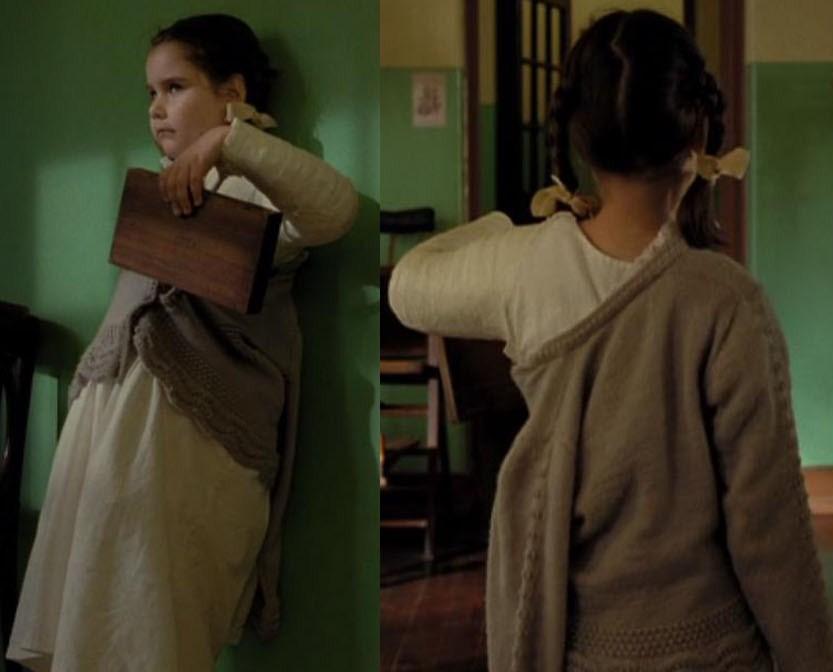
Alexandria is dark-haired and adorably plump and when she is first shot, she is framed within a doorframe, a crucifix mounted on the wall above her thus suggesting that she is inextricably linked with the divine. She has a special relationship with the hospital’s priest and even steals the Eucharist from the chapel and shares it with Roy who asks her if she is trying to save his soul. Her green eyes, missing teeth[8] and stilted English make for an engaging and naturalised performance not least because the audience can occasionally miss snatches of dialogue. Her left arm is perpetually outstretched away from her body for the majority of the film’s runtime and she is almost always dressed in a white nightgown and taupe cardigan which she cannot wear properly due to the frame of the plaster cast. The wooden box she carries, which looks like a book, contains items she “likes”, photographs of her family, a spoon, small toys; a nostalgia box of memories.

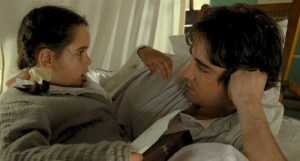
Roy is also a brunette and despite their gender difference they are often clothed the same and often mimic each other’s body language (see images below). This may be an attempt by the adult to place the child at ease or perhaps is the visual depiction of the contact zone / story space previously discussed. Roy and Alexandria’s mutual experience of a fall, hospitalisation and subsequent isolation is the meeting place for them both. The story they both appear to enjoy, whether Roy wishes to return to his childhood or Alexandria wants to surpass hers, as Gopnik ascertains, remains to be seen.
1.5

On the surface, it can be argued that the girl represents the child Roy may never have. He has lost the love of life and the severity of his injury is never fully explored. For Alexandria, he may be a replacement father-figure having lost her father in a house fire. These are easy summations to make, however, another reading may suggest that Alexandria is Roy’s repressed inner child, or as described in Jungian theory, the Divine Child[9] who has manifested through his suicidal despair. This archetype, according to Jung, is weak by design, under developed but one which can bring happiness and instil hope when it has been lost.

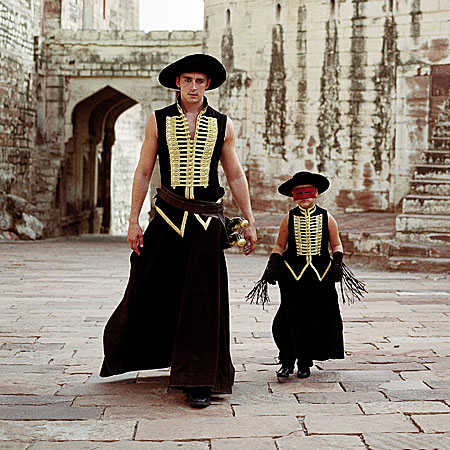
While this, in part, is true, Alexandria is stronger and more mature, even at six, than the infant images which are associated with the Divine Child. She is just as manipulative as Roy and changes the narrative at will, even inserting herself into the story when it looks like the original narrator is close to death. Rather than embodying the child archetype she can be read as Roy’s shadow, quite literally becoming his double once she is a part of the narrative and injects herself into the imaginary world, referring to herself as the Bandit’s daughter, stronger than ever, with two perfectly formed front teeth.
3.1

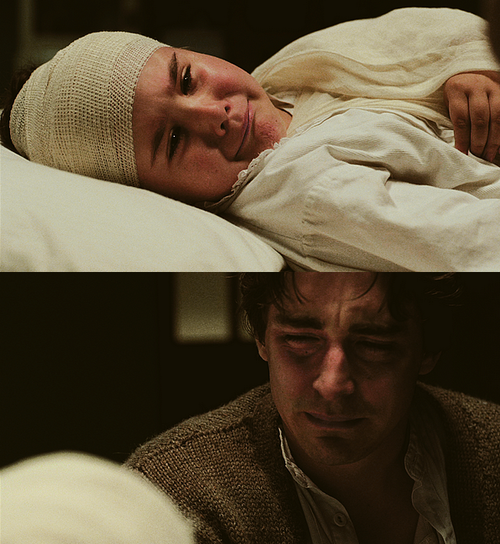
In reality, the roles have reversed in the sense that it is Roy who is now visiting a prostrate Alexandria. She has made a second attempt at getting the bottle of morphine pills, broken into the dispensary and fallen again which has resulted in a serious head injury and Roy is visibly distraught at what he has caused. It is worth noting that after her fall, Alexandria’s recovery is seen through a series of cinematic stills whereby her back-story is shown through live action images and animatronics. Her life literally flashes before her and this sequence is much darker than Roy’s beautifully invented panorama suggesting a real ambivalence between experience and innocence.

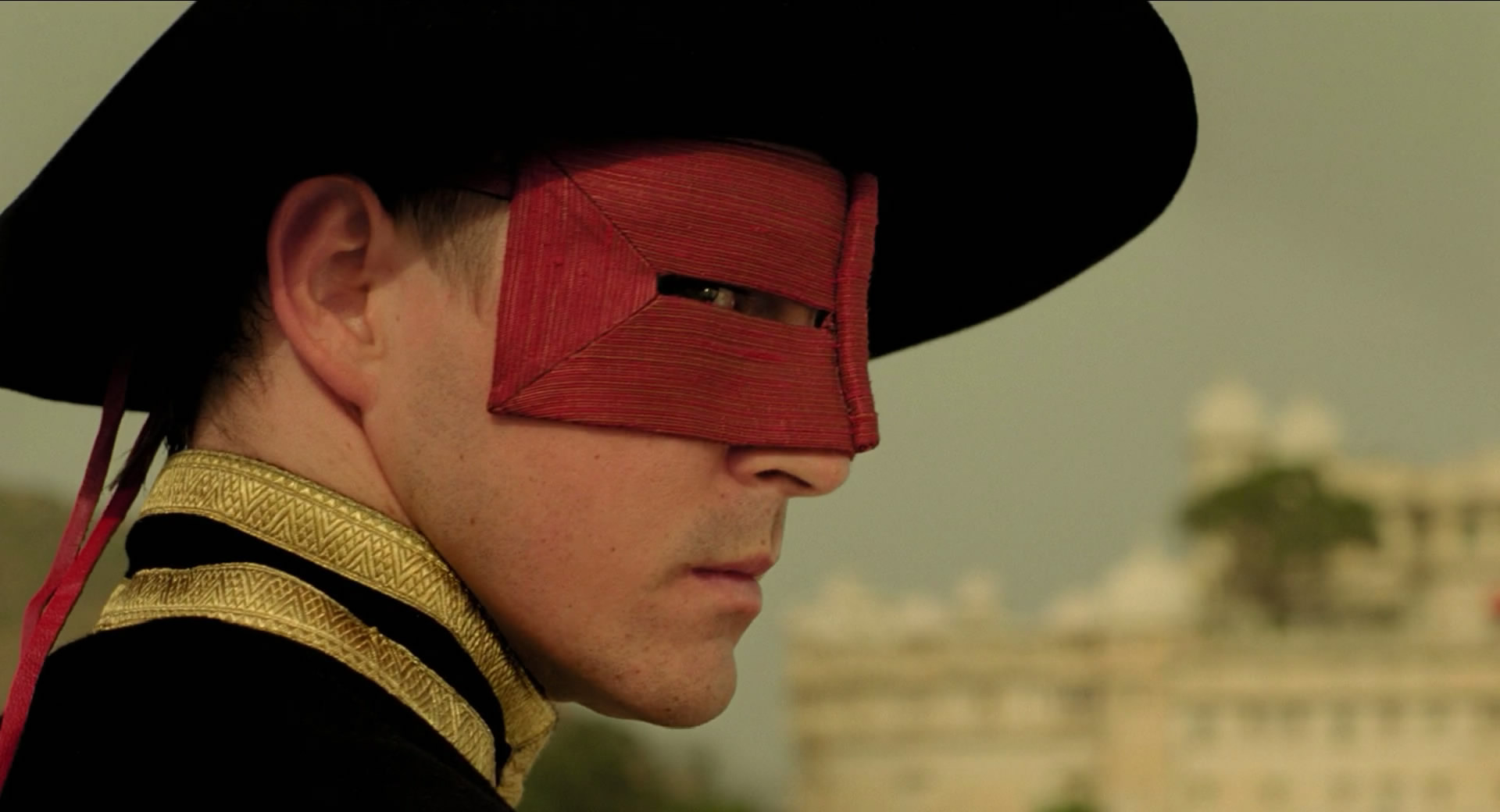
Roy admits that the story was a subterfuge to push the girl into assisting his suicide but Alexandria stubbornly refuses to believe this, even after Roy begins murdering the tale’s protagonists one by one. She begs him to stop and he tells her that it is his story, to which she answers “mine too”. Roy, who was also inserted into the fantasy after the death of the Blue Bandit and is now personifying the vengeful Black Bandit, allows Odious to drown him while his double-in-miniature looks on. Back in the hospital, both Alexandria and Roy are in tears and she begs him “Please. Don’t kill him I don’t want him to die. She loves him”.

Alexandria then makes an admission, she has known all along what Roy intended to do with the morphine pills “I don’t want you to die”. In preventing Alexandria’s despair, Roy has to save himself and in the fairy tale world he bursts through the water, re-born, and saved by his blessing in disguise[16]. This confirmation of mortality, as experienced through Alexandria, is further explained by Bettelheim “[the] psychosocial crises of growing up are imaginatively embroidered and symbolically represented in fairy tales […] but the essential humanity of the hero, despite his strange experiences, is affirmed by the reminder that he will have to die like the rest of us”[10].
lp
The-Fall-0661

In The City of Lost Children, one character who is in denial about death is Krank (Daniel Emilfork). He is ageing at a progressive rate because he cannot dream; a lack of imagination is slowly killing him and so, he kidnaps children against the backdrop of a timeless, surrealist, Paris in order to extract their dreams and manipulate them as his own. He does this without realising that in his company they too cannot dream only produce nightmares which terrorise the thief in slumber.

Visually this text is very different from The Fall, where there was a palette abundant in colours and light, here there is limited light and the dominant colours are (as in Jeunet’s later film Amélie [2001]) red and green. This lack of light is metaphorical of the disorientating struggle displayed in the mise-en-scéne; this is a place where babies are left out in rubbish bins and not missed. Krank’s “uncle” Irvin is a disembodied brain which survives in a tank and in the opening twenty minutes serves as the intradiegetic narrator and sets the scene:

brain

“Once upon a time, there lived an inventor with a gift for giving life. […] Having neither wife nor child, he decided to make them himself. His wife’s gift was to be the most beautiful princess in the world. Alas a bad fairy gene cast a spell on the inventor so that when the princess was born, she was only three inches tall. He cloned six children in his own image, so similar you could hardly tell them apart but the bad spell meant that they all had the sleeping sickness. He needed a confidant, so, inside a fish tank, he grew a brain that had many migraines. Finally, he created his masterpiece, a man more intelligent than the most intelligent men. Alas, the inventor also gave him a flaw. He couldn’t dream […] it made him so unhappy that he grew old unimaginably fast [and then] died in dreadful agony, having never had a single dream.”

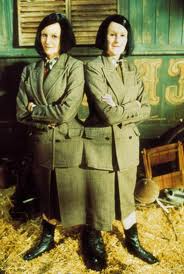
This is hardly the ideological filmic representation of hopes, wishes and desires that Jack Zipes describes when he is discussing the screen fairy tale[11] but a social commentary on the complex use of technology versus religious fundamentalism. The inventor creates his family through technology and essentially ‘plays God’ only to be worshipped by a cult of Cyclops who, in return for their sight, kidnap the children Krank requires for his dream-catching. The messianic figure of One (Ron Perlman) whose back story is linked with other fairy tales (Jonah and the Whale and Pinocchio[12]) enlists the help of an alluded-to Wendy[13], Miette (Judith Vittet) and her gang of Lost Boys/ urchins to rescue One’s little brother Denrée (Joseph Lucien). Miette and her fellow orphans work for The Octopus (Geneviève Brunet and Odile Mallet) identical twin sisters who dress, function, speak and work as one entity, conjoined at the leg.

4.2
4.3

While these dual characters are literally mirrored in their representation there are other characters which are connected subconsciously. Krank is beyond childhood without having actually experienced one and yet acts like a child, prone to tantrums and crying fits. Miette, on the other hand, is still physically in childhood but has the demeanour of an adult. Her orphaned abandonment has enabled her to mature quickly and her instinct for survival has her resorting to any means necessary to live, she is wise and tough far beyond her years. Miette and Krank are, in essence, two facets of the same person.

As described by Gopnik in his 1996 New Yorker article, Krank wants a way back into childhood while Miette wishes to embrace adulthood, even envisioning a relationship with the man-child strongman, One. When Miette and Krank come together in their contact zone/story space it is not through traditional storytelling but a dream in which they get to embrace their shadow selves and share a mutual experience.

dream-device

Jung articulated this exchange in this way, “beneath the social mask we wear every day we have a hidden shadow side, an impulsive, wounded, sad or isolated part that we generally try to ignore. The Shadow can be a source of emotional richness and vitality, and acknowledging it can be a pathway to healing and an authentic life. We meet our dark side, accept it for what it is and we learn to use its powerful energies in productive ways […] By acknowledging and embracing The Shadow as deeper level of consciousness and imagination can be experienced.” [14]

Krank is dispossessed of a soul, an imagination and empathy and upon sharing consciousness with Miette – the girl who does not dream – can finally experience what he has been missing. In the same token, Miette can embrace her youth and rescue the man she loves. The child in the crib is dressed in pyjamas which are the same colour and style and the boy’s hair has been reddened, he resembles a young One, this is evidently how she reconciles the contact zone.
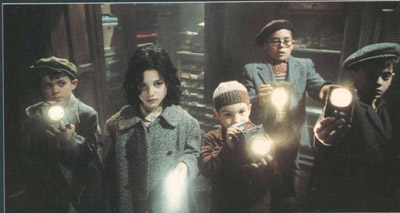
4.1

Interestingly, only when the child starts to morph into Krank does the ageing process begin, the Shadow selves meet. Unlike The Fall, where assumptions are made regarding Alexandria and Roy’s future selves, here Krank accepts his Shadow and so begins his regression. In opposition, Miette begins to wither and age until the demented dream-catcher is a baby. Miette must embrace her biggest fear so she can move forward and that is imagining One dead. This interchange of dreams kills Krank in reality thus substantiating the importance of imagination, use of enchantment and originality.

Fairy tales give the adult reader a re-presented imagination. Understandably, the physical child may have evolved but these screen tales enable the repressed child to re-emerge through viewer identification. Perhaps, just like the children in these texts they enforce a sense of hope, strength and resilience which has long been forgotten.

The inclusion of a child within an adult diegesis serves more than just viewer manipulation[15]. This division of realities and mirroring of locations, narratives and characterisations is an integral part of the postmodern film and more specifically this dual nature is present in screen fairy tales. While the texts that have been considered here have a very distinct separation between the real and imaginary, it would be worth considering the screen fairy tale which is based in reality and consider what purpose they may serve for an adult audience.

Sources

[1] Maria Tatar, Enchanted Hunters: The Power of Stories in Childhood (New York/London: W. W. Norton & Company, 2009). A term borrowed from Mary Louise Pratt. Tatar changes the context of the original contact zone and sets about making her own.

[2] Ibid. p242. “The power of reading together derives in part from the fact that it involves a transaction between more than a single reader and a text. The dialogue that takes place between the [storytelling] partners fuels the transformative power of the story, leaving both the child and adult altered in ways they might never have imagined. [Mary Louise] Pratt found in contact zones a process of transculturation, with colonizer and colonized entering into lively, two-way cultural exchanges”.

[3] Adam Gopnik, “Grim Fairy Tales”, The New Yorker (November 18, 1996) p96. http://www.newyorker.com/archive/1996/11/18/1996_11_18_096_TNY_CARDS_000376397 [accessed 10 January 2012].

[4] Bruno Bettelheim, The Uses of Enchantment: The Meaning and Importance of Fairy Tales, (UK: Penguin, 1991).

[5] Bengt Holbek, Interpretation of Fairy Tales: Danish Folklore – A European Perspective, (Denmark: Suomalainen tiedeakatemia, 1987).

[6] These differences can also be examples of Pratt’s ‘contact zone’ specifically with the cross-cultural experience between American Roy and Romanian Alexandria.

[7] Seymour Chatman, Story and Discourse: Narrative Structure in Fiction and Film, (USA: Cornell University Press, 1980).

[8] Missing teeth as a motif are used throughout the picture. Roy tells Alexandria that power is symbolically associated with teeth and that she is currently “missing some strength”. Upon further investigation, however, teeth can be associated with illness and death and even a lack of faith (Greek) and in Chinese culture missing teeth symbolise telling lies. Some cultures believe that losing teeth can be sign that an individual has placed more faith in the word of man and has lost trust in God.

[9] Carl G. Jung, Essays on a Science of Mythology: The Myth of the Divine Child and the Mysteries of Eleusis, (USA: Princeton University Press, 1969).

[10] The movie’s tagline is quite apt here. Only at Roy’s lowest ebb did she manifest.

[11] Bettelheim, 1978 pp39-40.

[12] Jack Zipes, Happily Ever After: Children and the Culture Industry, (New York/London: Routledge, 1997) p9.

[13] One is an ex-whaler and following the loss of this job is hired by a travelling circus, of sorts, as a strongman. Aside from size he is for all intents and purposes a boy.

[14] J M Barrie, Peter Pan, (UK: Puffin [Re-issue], 2014).

[15] Jung, cited in Connie Zweig and Steve Wolf, Romancing the Shadow: A Guide to Soul Work for a Vital Life, (UK/USA: Random House Publishing 1999) p21.

[16] Karen Lury, The Child in Film: Tears, Fears and Fairy Tales (UK: I B Tauris & Co Ltd, 2010). Lury likens the child to a pet and even refers to both as ‘it’, she ascertains that the inclusion of children within a narrative is merely to serve an emotional purpose for the viewer.

Categories
Essay film review

Boys Will Be Boys: Violent Masculinities and Warrior (2011)

A predestined aspect of the construct of masculinity has always been associated with violence. Many critics and theorists have always maintained that violence is innately male, that to be a man is to be in charge[1] and to be masculine is “quite literally, to embody force”[2], while others have seen it as an action of the male in crisis, a loss of control and “a cultural construct [which] is a site of both struggle and resistance[3]. There is no definitive biological truth to substantiate that aggression and violence is more inherent to the male sex as opposed to the female but the depictions on film do lean more towards the former and perhaps serve as either commentaries on the act of violence itself or catharsis for the de-sensitised viewer[4].

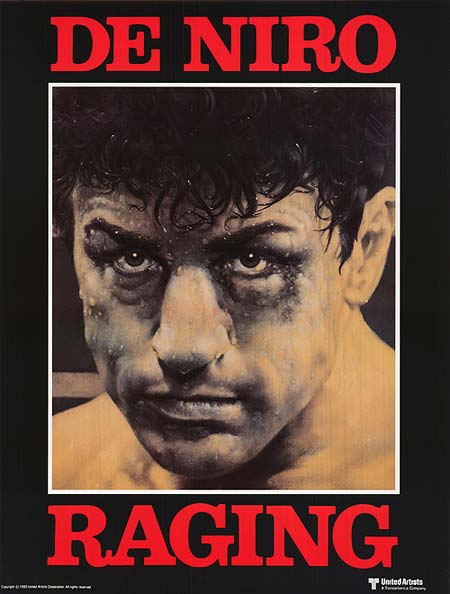
In the seventies and eighties the ‘hard body’ films showcased the activity and sinew of the male form, depicted an increase in the level of screen violence and resulted in the birth of the boxing/fight movie. A genre which valorised the sport and yet depicted the brutality inside of the ring, films like Raging Bull (Martin Scorsese, 1980) and the Rocky franchise[5]. This genre has seen a resurgence over the years following the success of Fight Club (1999, dir. David Fincher) where bodies are instruments – “flesh in the service of an objective or a desire”[6] and the induction of the professional wrestler into the world of cinema; Terry ‘Hulk Hogan’ Bollea, Dwayne ‘The Rock’ Johnson and Jon Cena, to name but a few, are names synonymous with wrestling and the movies – hyper-masculine individuals who carry the “ideal of toughness and dominance”[7]. Their sport offering, as Kath Woodward ascertains “a space in which masculinities are very visible and invoke associations with physicality, risk taking and even violence, [a place where] those who wish to buy into that masculinity but who are not participants in the sport have to accommodate in other ways”[8].

This ‘aggressive masculinity’ was made ever more visible in the 2009 Darren Aronofsky film The Wrestler and depicted the aftermath of a life after the fight. A visually and hearing impaired Randy ‘The Ram’ Robinson (Mickey Rourke), who aside from a body that is failing him at a rapid rate, has very little else in the world beside his fighting maleness that is in constant conflict with his role as a wrestler, father and lover. This filmic text has given way to a plethora of fight movies[9] including a foray into the world of female boxing[10]. It is, however, the male fight (connotations of which are vast) I am particularly enthused with exploring and I will consider a number of Twentieth Century theorists and apply them to the 2011 text Warrior. Specifically, in relation to the male-oriented sports arena and argue that the masquerade of masculinities is still a speculative subject and very much prevalent in the Twentieth First Century.
It is especially interesting to me that the A-Team [11] remake of 2010 chose to cast a former Ultimate Fighting Champion™, Quinton ‘Rampage’ Jackson as the stoic Mr ‘T’ who is so paralysed by a fear of flying and enclosed spaces, his comrades choose to knock him unconscious than attempt to wrestle him into submission. UFC as it is commonly referred is the more extreme equivalent of championship wrestling insofar as any Mixed Martial Arts move is allowed, gum shields and groin protectors must be worn and all footwear and hand-wear is prohibited.[12] Like boxing, the sport takes place within a ring usually encased in a metal cage and each competitor must compete in bouts and beat his opponent fairly; a would-be brutal spectacle without the flamboyancy or showmanship of wrestling. “If,” as Dane Miller writes in his 2007 article, “violence and brutality are inherent traits of the male gender, as they appear to be, then society, especially contemporary American society, has implemented significant sanctions to discourage these traits from being actively expressed”[13]. By definition, then, the cage allows these constraints, including “associated primal masculinity”[14] to be expressed in an established forum and by conclusion “[contain] the [same] traits [so that they] remain associated with masculinity but also become praiseworthy”.[15]

Warrior opens in Pittsburgh with Paddy Conlon (Nick Nolte) leaving an AA meeting and arriving home to find his youngest son Tommy (Tom Hardy) sat on his stoop. Estranged father and son have not seen each other for fourteen years and while Paddy may welcome a reunion, Tommy is only interested in his father’s previous incarnation as his wrestling trainer. Tommy has returned from Afghanistan, AWOL from his unit and, seemingly, dependent on prescription drugs needing money to provide for the family of his fallen ‘brother-in-arms’. Tommy fled, as a teenager, with his mother from abusive, drunk Paddy and his flying fists and is incredulous at his father’s sobriety and awaits a slip.

Meanwhile, in Philadelphia, Physics teacher Brendan Conlon (Joel Edgerton) is at the bank attempting to re-mortgage his family home, again, the payment of his youngest daughter’s medical bills proving too vast for the family to cope with financially. The bank manager simply tells Brendan that their house will be foreclosed upon in ninety days. With his wife working two jobs, Brendan tells his wife that he will take some evening shifts as a club bouncer to help pay the bills and only when he arrives home with bruised ribs and a black eye does she realise that he is fighting again, for cash, in the club parking lot. Unfortunately, Brendan is unable to cover up the bruises and the truth when he returns to his day job and is suspended without pay. Principal Zito (Kevin Dunn) explains that he cannot be seen to advocate such violence, and tells Brendan “you’re a teacher; you have no business being in the ring with those animals”. Brendan responds with “actually, I used be one of those animals, I fought for a living. I guess I forgot to put that on my application”. Brendan is the ‘big brother’ who abandoned Tommy as a teenager and the unfolding narrative sees both travel, separately, to Atlantic City to compete in the Sparta MMA tournament; the prize $5,000,000 and eventually, perhaps predictably, ‘face off’ in the final match.

Writing about organised sporting events, Michael A. Messner and Donald F. Sabo argue that “male aggression varies from individual to individual, within situations, and across cultures”[16]. The men depicted in this film text are both individuals and physically different, neither are particularly large or over-developed. They are white[17] have pretty, boyish, faces which do not hint at a violent past nor resemble the broken noses or swollen eyelids of the seasoned fighter, however, Tommy appears the physically stronger and more aggressive, with his dark clothing, swagger and shifty stance and yet for all the seething rage, he only ever chooses to unleash his demons in the ring. He is shot, for the most part, in close up so he fills the screen and the over-the-shoulder shots enhance his bulk.

The establishing shot of Brendan shows a family man at a birthday party, wearing a bonnet having his face painted “becoming a princess”. He appears slighter than his younger brother and by the fact that he is a Physics teacher he is almost immediately deemed as ‘less-than-manly’. His occupation is used to incite the wrath of his ring opponents and push them to beat the “physics teacher!” This is in addition to his choice of entrance music – Beethoven’s Ode to Joy ensures he is ridiculed by the ringside commentators. Brendan is further fetishised[18] by the use of the close-up. For the first part of the film Brendan is shown in medium shot in an attempt to make him appear smaller in relation to his brother and opponents and the close up makes to enhance his beaten face, the healing cuts and swollen bruises or perhaps serve as viewer manipulation. Tommy shuts down when confronted (apart from in the ring) while Brendan is an open book – his motives clear, it could be suggested that by making the viewer empathise more it facilitates identification.

Messner continues to describe the ‘Televised Sports Manhood Formula’ which not only teaches boys to pay the price “be it one’s body [but] gives one access to the privileges that have been historically linked to hegemonic masculinity – money, power, glory and women [and] provides a remarkably stable and concrete view of masculinity as grounded in bravery, risk-taking, violence, bodily strength and heterosexuality”.[19] This statement is directly conflicting with Messner and Sabo’s earlier observation, how can male aggression vary from man to man yet be combined to depict a uniformed hegemonic masculinity? Surely it is to suggest that masculinities also vary from man to man; that while there may be some similarity in the privileges and hegemonic history, each man is fighting for a goal known only to him.

This interrelation between the ‘action man’ and ‘real man’ is explored in Yvonne Tasker’s 1996 Spectacular Bodies… [20] and is present in Warrior. Tommy and Brendan are two ‘every-men’ who must overcome extraordinary odds to show their activity and solve their individual problems whilst addressing some of their shared emotional damage. I would further suggest that the man of the twentieth first century is a masculine and feminine amalgam, possessing attributes which have been historically linked to hegemony and patriarchy including domesticated and embodied masculinity, passivity and activity, crisis and transgression. “If the body drives the ‘action man’ of the 80s then the face, it would appear, drives the ‘new man’ of the 00s [and beyond] […] there has to be an acceptance of male power and powerlessness and a general recognition of the ambivalence surrounding masculinity and femininity in the male figure”.[21] This film text attempts to depict each protagonist’s ambivalent and transcendence from patriarchy, specifically, through the father figure of Paddy Conlon.

Conlon Snr., belongs to the era that Susan Faludi describes as, “manhood after victory […] the prevailing American image of masculinity”[22]. He is an ex-Marine who has seen war, perhaps, in active duty during Vietnam (1959-1975). The world Paddy imparted to his sons is one of hurt; he drank heavily and was abusive to both his sons and wife, womanised and eventually pushed his family away. The man introduced in the diegesis is a God-fearing man who has a thousand days sobriety under his belt and, aside from his Moby Dick[23] audio book, very little else. Even Tommy describes him as a castrated man – sexless, sober, sensitive and caring and wishes he had experienced this version of his father when he was a child. As an adult, Tommy has no need for this man, or so he claims.

Warrior-1

Fatherhood is another construct of masculinity upon which patriarchal authority is born, an additional performance to, ultimately, fail at and Paddy Conlon is no exception. He is the protector and teacher of violence to two sons, they wrestle and compete and when they, or their mother, step out of line he beats them. Lynne Segal sums up the role of the father quite beautifully when she writes, “[those] gods that fail us bequeath diverse legacies to their sons and daughters”.[24] On the surface Paddy does appear to have failed his sons, he did not nurture and rather encouraged the kind of violence which has continued to encroach upon Brendan and Tommy’s lives in one form or another. Both men are controlled in their aggressive forum and yet while Brendan appears the more secure brother, Tommy is the one who is continually running away from the fierce situations he finds himself in, his childhood, his mother’s death and the violence of the war. He will fight but when he finds the fight is over, not necessarily on his terms, he flees.

The irony is Tommy is the most like his father – the epitome of Ronald Levant’s “angry white male”[25], specifically with his choice of occupation in the Marine Corp. He is also the only son who actually needs his father, despite his protestations; Paddy’s presence exacerbates Tommy’s rage and furthers his preparation training. Brendan, on the other hand, trains and wins his place in Sparta without the assistance of Paddy. We, the viewer are never party to the Paddy of old and yet draw the conclusion of the monstrous male; controlling, aggressive, violent and cruel. Upon the realisation that he has harmed his youngest child by his behaviour, Paddy grants Tommy’s wish and begins drinking again. Only this time, no violence ensues but deep sorrow and emotional regret and the father is able to admit his love for his son(s) and is cradled, like a child, in Tommy’s arms, mourning his failure, fear, vulnerability and “the lost opportunity to be loved by his children […][26]. As a side note, while Nolte gives a performance of American masculinity, Hardy and Edgerton’s performances can be called into question. That is not to say that they are not convincingly ‘American’ but the fact that they give such gravitas to the masculinity debate as non-Americans speaks volumes, perhaps American males have to fight harder to give performances of note while the ‘Aussie’ or ‘Brit’ have little difficulty in portraying amid poignancy, vulnerability and affect without speculation arising about their masculinity or sexuality.

Warrior, like many similar films is set within the realm of organised sports, a forum where men are almost exclusively the victims or perpetrators of violence and as Connell theorises there have always been more than one kind of masculinity[27] thus concluding that within the ring or cage there is not only competing men but masculinities. However, this is problematic as many of these sports are deep-rooted in preserving the hegemonic masculinity, specifically, in its gendered combatants and marginalisation of women[28]. Fighters embrace their masculine identity and some believe that affirming this masculinity is by and large rejecting the feminine and the norms of society.[29] By extension, there can be no pathos or empathy in a fight and yet when Tommy and Brendan step into that cage to fight each other that is all there is. These men have been conflicted since childhood – conflicted about their family life, the aggression and violence that was learned and duplicated and above all else their masculinity. Interestingly, both are shot through a ‘Lacanian’ mirror[30] reflecting upon their totality and identity before their final bout. I would argue that these men in taking in their reflection are accepting that their individual ‘wholeness’ will only occur in their sibling unity.

The beauty of this film text is that the final fight between the two brothers is gut-wrenching and really duly succeeds through viewer identification. Dane Miller maintains that these competitors have been ‘normalised’ and by accepting these ‘every-men’ as merely earning a living then, ideologically, the audience’s sins and guilt can also be purged[31]. The fighter is the viewer’s scapegoat and “[we] are vicariously vindicated and achieve redemption through the performance of the fighter”[32]. By the final scene there is little vindication, these men beat each other while crying in physical and emotional pain, they love each other and yet know that this was how love and masculine affirmation was instilled in their childhood. Only when one begs the other to yield, and acknowledge their mutual love for each other is a winner announced. As the crowds erupt both brothers refuse medical treatment or to speak, instead they stumble back to the dressing room, arms protectively around each other. At the final frame they resemble two bruised and devastated little boys. The viewer gains little redemption, there are no winners here only a resounding realisation of the performance(s) men have to sustain inside and outside of the ‘ring’; the conflict and ambivalence faced in today’s society.

Afterthought

I like to think these movie posters depict the male of the 20th and 21st century – the ‘raging bull’ battling with his exteriority and self-destruction. The male in crisis.  While the ‘warrior’, contemplative and more accepting of his ambivalence and conflicting emotions. At first glance a male face similar to the previous, a second look depicts the duplicitous male – the male-female amalgam, the ‘action’ man and ‘real’ man binary; an indication that there is far more to ‘masculinity’ than meets the eye.


[1] Michelle Toomey, “The Price of Masculinity based on Violence” in Education Digest 58 (4) (1992) p44.

[2] R. W. Connell, Masculinities, 2nd Edn, Cambridge: Polity Press (2005) p87.

[3] Suzanne E. Hatty, Masculinities, Violence and Culture, Sage Publications Inc (2000) p12.

[4] Ibid, p52.

[5] Rocky (1976, dir. John G Avildsen), Rocky II, Rocky III and Rocky Balboa (1979, 1982, 2006, dir. Sylvester Stallone)

[6] Victor Siedler, Man Enough: Embodying Masculinities, London: Sage Publications Inc (1997) p21.

[7] R W Connell, Gender and Power: Society, the Person, and Sexual Politics, Cambridge: Polity Press (1987) p4.

[8] Kath Woodward, Boxing, Masculinity and Identity: The ‘I’ of the Tiger, UK/USA: Routledge (2007) pp14-15. One of these ‘other ways’ is through spectatorship, either through live events or through fight-films.

[9] Never Back Down (2008, dir. Jeff Wadlow), Fighting (2009, dir. Dito Montiel) and The Fighter (2010, dir. David O. Russell) to name but a few.

[10] Million Dollar Baby (2004, dir. Clint Eastwood) and Girlfight (2000, dir. Karyn Kusama).

[11] The A-Team (2010, dir. Joe Carnahan).

[13] Dane Miller “A Real Man’s Game: Manipulations of Guilt and Rhetorical Displays of Masculinity by the UFC” in Comm-entary – The UNH Student Journal of Communication 2010-2011 p94.

[14] Ibid, p94.

[15] Ibid, p94.

[16] Michael. A. Messner & Donald. F Sabo, Sex, Violence and Power in Sports: Rethinking Masculinity, USA: The Crossing Press (1994) p71.

[17] “The hero’s body is superior, but his skin colour – […] white – also signals him as an everyman”. Richard Dyer, White, London and New York: Routledge (1997) p162.

[18] Steve Neale would argue that by eroticising Brendan, he is automatically ‘feminised’ cited in Yvonne Tasker, Spectacular Bodies: Gender, Genre and the Action Cinema, London: Routledge (1996) pp118-119.

[19] M Messner, M Dunbar and D Hunt “The Televised Sports Manhood Formula” in Journal of Sport and Social Issues 24 (4) (2000) p392.

[20] Tasker (1994) p117.

[21] Helen Jones, “The Male Body and Conan the Barbarian” (2011)

[22] Susan Faludi, Stiffed: The Betrayal of the American Man, Vintage Publishing (2000) pp5-10.

[23] Moby Dick by Herman Melville.

[24] Lynne Segal, Slow Motion: Changing Masculinities, Changing Men, UK: Palgrave Macmillan (2007) p24.

[25] Ronald Levant cited in Peter Lehman, Running Scared: Masculinity and the Representation of the Male Body, USA: Wayne State University Press (2007) p14.

[26] Segal (2007) p25.

[27] Connell, (1987) p4.

[28] Woodward (2007) pp10-11.

[29] Magnus Stenius “Shoot-Fighting, Bodies in Emotional Pain: A Translocal Study in Masculine Gendering of Violence, Aggression and Control” (2007) p43.

[30] Jacques Lacan cited in Segal (2007) p73.

[31] Miller (2010) p99.

[32] Ibid, p99.

Categories
Essay film review TV

I Am Woman Hear Me Roar: Gender Representation in Sex and the City

satc

Sex and the City (SATC) came to our small screens in 1997, based upon the novel of the same name by ex-New York Observer columnist Candace Bushnell. This television series and its depiction and ‘celebration’ of women not only appealed to a mass female audience but attempted to dispel the so-called – thanks to Betty Friedan -“feminine mystique” by dismissing repressive female stereotypes which had seemingly dogged popular culture in the years before. These were (white) women talking, writing about, and more importantly, having sex (as they maintained from the very first episode) “like men”[1]. At the heart of this series was the feminist ideology that all women have a right to sexual pleasure and live in a place of complete independence where women have ownership of the, albeit narcissistic, ‘gaze’ and men are the sex objects.

Quite simply, without second wave feminism, a show like Sex and the City would fail to exist and creator Bushnell describes the Foucaultian confessional as depicting “female choice, not female rejection […] women viewers get the naughty thrill of seeing their gender portrayed for once as sane, sentient, and decent.”[2] With this sweeping statement there is an implication that all television and/or film texts gone before had negatively depicted women and that by seeing this positive, even verisimilar portrayal, the female population are engaging in illicit activity. Bushnell never considers the representation of women within the text or the fact that the characters have been rewritten by a man. An audience requires more than gender in order to negotiate identification and, unfortunately, for the female viewer there is little to identify with. SATC depicts women as over-consumers and seems to believe its own propaganda; that in order to be liberated and successful, a woman has to be white, heterosexual, rich, thin, and self-obsessed. Is this really what modern womanhood has been reduced to? The representation of women and the evolution of these characters have enforced further limitations and new stereotypes that women are measured against. The motion pictures which were born from the success of the series have taken the ‘sane, sentient and decent women’ with choice and replaced them with four dolls bridging the gap between feminine and sexy, artificial and empowered. It utilises the Beauty Myth[3] and defines a woman’s sexuality against the clothes (and shoes) she wears to create a Serious/Sexual dichotomy[4] in which liberation and promiscuity merge. A woman’s voice has now been replaced with a body, however, because these women choose sexual freedom and choose to “act like men”, we find ourselves in a culture which appears to resurrect stereotypes of female sexuality that feminism endeavoured to banish.[5]

satc3

In a term coined by Feona Attwood (2009) Sex and the City ‘mainstreamed’ sex and used it ‘as a source of self-definition and a means of self-expression’[6]. They were, in accordance to Rosalind Gill, sexually confident and autonomous – “knowing, active and desiring subjects”[7] but as the series progressed the women chose their respective Mr. Rights over their independence and sexual freedom and this has, since, been repeated within the narratives of the first and second film[8]. Despite, second wave feminism informing women that Prince Charming is a patriarchal fiction designed to render them passive and in need of rescue. It went on to furthermore state that they did not need him to define their happiness or create the so-called “happily-ever-after”. Sex and the City chose to perpetrate the myth and reinforce, as David Greven argues, “the ideology that heterosexual sex is forever [while homosexual] sex is transitory, fleeting, [and] intangible.”[9] The filmmakers response to this was to take the two male homosexual characters and marry them off. To each other. With Liza Minnelli officiating! So, if the whole purpose of Sex and the City was to make these women sexually independent and to break stereotypes, why then do we see three out the four characters re-enforcing patriarchal ideology by getting hitched?

Samantha-Jones

The last beacon of hope is Samantha Jones (Kim Cattrall), who, on the surface, appears to be the exception to the ‘Mr Right’ rule, preferring to settle for ‘Mr Right-Now’ (conveniently, she is potentially too old to procreate). Her views on marriage, monogamy and sex transgress the heteronormative ideologies, she truly believes she can do anything a man can do, even experimenting with Viagra[10]. Like most transgressive women before her she is ‘punished’ with the discovery of breast cancer.[11] There has even been a suggestion by some critics that she transgresses the female gender altogether given that she is encoded as a homosexual, Greven writes,

[…] Samantha, most explicitly of all the women, acts, speaks and cavorts like a stereotypical gay man, her femaleness a safeguard against both homophobic retaliation and an explicit admission of a gay agenda, to use this cruelly overused phrase only to suggest that the show about sex in Manhattan has to use female characters as a cover […][12]

If a woman is sexually confident, even aggressive, successful, ambitious, and appears to not require a man ‘she’ of course must be a ‘he’! Once again, female sexuality is defined by patriarchy. Interestingly, Candace Bushnell, in 2001 agreed with Greven and declared that Samantha is, in fact, a gay man[13]. So, are women getting the ‘naughty thrill’ from seeing their gender portrayed as ‘sane’ or as a gay man?

Sex and the City: The Movie saw Carrie – the woman without the bride gene[14] – agreeing to marry ‘Big’, now known as the less phallically aggressive John. The proposal of marriage is a business transaction to ensure that, should their relationship fail, Carrie will not be left with nothing. Charlotte has the ‘; perfect’ marriage to Harry and in addition to their adopted daughter she finds herself defying medical odds and falling pregnant. Miranda is coping with Steve’s infidelity and Samantha finds she is rapidly falling out of love with Los Angeles and being in a relationship with a man whose name she says more times a day than her own.[15] John, then jilts* Carrie on their wedding day and the girls accompany her on the honeymoon to Mexico; a suite she booked in the names of Mr and Mrs Preston – a thrill which made her forget her ‘true self’.[16]

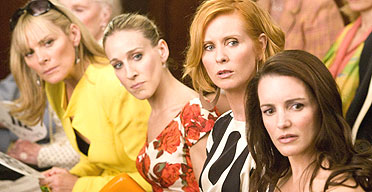
The Beauty Myth informs is that there is ‘no right way to look’[17], however, SATC (a programme that Wolf endorses as “funny, clever and thinks women are important[18]) portrays a uniformity in women, they may have different hair-styles but essentially all the attributes they own, situations they find themselves in, men they deem attractive can be applied to just one woman; in fact one could argue that Miranda, Carrie, Charlotte and Samantha are the four (patriarchal and ideologically enforced, of course) facets of one woman; the cynic, the optimist, the Madonna and the whore. This uniformity is ever more prevalent in the racial make-up of the cast.

sex_and_the_city07
jennifer-hudson-sex-and-the-city

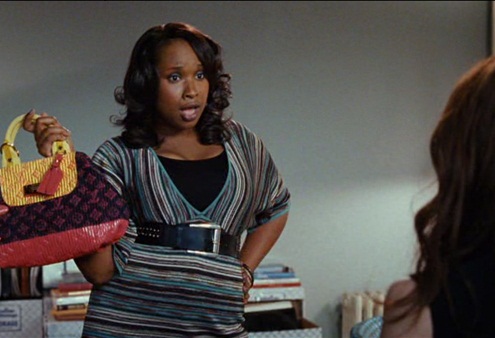
Carrie hires an assistant to help her ‘come back to life’ (because obviously, losing a man brings serious health risks, one is suddenly are unable to open mail, unpack, etc.) after the ‘devastation’ and ‘humiliation’ of being jilted. Louise (Jennifer Hudson) is a curvaceous black woman from St. Louis who is never legitimised with a surname, and only in her depiction as the single African-American character does the viewer realise the full extent of Sex and the City’s whiteness.[19] She is immediately encoded as the social minority because she is a St. Louis native and subverts the whiteness/virtuousness ideology[20] because Louise is the innocent, naïve in her pursuit of love, even crossing state lines to seek out the love of her life.

jennifer-hudson

Louise starts out, albeit tenuously, with similarities to Donald Bogle’s ‘Mammy’ character; “she is sweet, jolly and good tempered”[21] and serves Carrie, helping her complete the most basic tasks – answering letters and e-mails, replacing a mobile phone and unpacking boxes and boxes of clothes. She does, however, evolve from the stereotype – although one could argue she becomes the “Magical Negress” bringing Carrie back to life and all – and gains some autonomy just in time for her ex-boyfriend to propose marriage. She begins to show more flesh, specifically cleavage, her clothes become tighter and more streamline, slimming her down; the voice is replaced by the body. Although, her screen-time is not sufficient enough to explore the character in depth, it is hinted at that her change in physicality does have the desired effect on men (coincidentally, Hudson herself lost a substantial amount of weight and married and gave birth following her role in SATC). Louise’s curly natural hair is straightened and coloured a lighter brown, and it can be argued that she, essentially, is white(r) when she leaves New York, complete with a diamond engagement ring and Louis Vuitton handbag hanging from her wrist. Using Dyer’s model she becomes colonised; from St. Louis to Manhattan – black to white(r). Dyer writes that, “white women are [after all] constructed as the apotheosis of desirability, all that a man could want, yet nothing that can be had, nor anything that a woman can be [an] everything-and-nothing quality.”[22]

Sex-and-the-City-2

Racial difference is also explored in the sequel, its release date in 2010 to coincide with the football World Cup – another occasion in which there is a divide the sexes; all women HATE football, obviously. Samantha is invited to a Sheik’s private hotel in Abu Dhabi on a PR trip and extends the invitation to her three friends. This trip is used as a distraction from the womens’ respective problems at home. Carrie and ‘Big’ are married (following a vomit-inducing Cinderella-alluding proposal at the end of the last film) and ‘making their own rules’ but according to Carrie, their relationship is getting ‘too Mr-and-Mrs-Married’. Charlotte is felling oppressed by the demands of motherhood and is beginning to obsessively believe that Harry is having an affair with their twenty–something Irish nanny, Erin (the girl doesn’t wear a bra so of course, she must be sleeping with her boss). Miranda, having no inclination to confront her sexist boss, quits her position at the law firm, an action which is completely inexplicable and out-of-character.

Throughout the scenes shot in Morocco (doubling for Abu Dhabi), the Americans, understandably, never fully assimilate into Middle Eastern society; their ignorance seemingly the main problem. Miranda is constantly berating Samantha for leaving her shoulders or legs bare and on display. Even after her arrest she falls foul of a group of Muslim men on their way to prayer. Her bag then bursts during an altercation and condoms are scattered at the men’s feet and then, as this is Samantha, the prophylactics are waved in the crowds’ faces and thus as Lindy West so eloquently writes in her scathing review:

Traditional Middle Eastern sexual mores are upended and sexism is stoned to death in the town square. At sexism’s funeral (which takes place in a mysterious, incense-shrouded chamber of international sisterhood), the women of Abu Dhabi remove their black [burkas] and [niqabs] to reveal – this is not a joke – the same hideous, disposable, criminally expensive shreds of cloth and feathers that hang from Carrie et al’s emaciated goblin shoulders. Muslim women, under those craaaaaaaa-zy robes, they’re just as vapid and obsessed with physical beauty and meaningless marital concerns! Feminism! Fuck yeah![23]

Sex-and-the-City-2-001

West is a Seattle-based film critic who despised the movie with every fibre of her being, it would seem. She describes SATC2 as “tak[ing] everything I hold dear as a woman and as a human […] and rapes it to death with a stiletto that costs more than my car.”[24] A horribly violent, almost anti-feminist metaphor but she really hated it…

Georgina Isbister, on the other hand, writes, that the reason that SATC resonates with an audience is that “its narratives are dominated by the challenges faced by protagonists in achieving their ideals and the subsequent anxieties surrounding them […] trying to conform to an expectation that women can have it all.[25] This is not so much an expectation as patriarchy rearing its ugly head again. Women are lead to believe that they can have liberation and everything that men are entitled to as long as they revert back to the patriarchal ideal of ‘wifedom’ and motherhood. SATC not only highlights the anxieties and challenges but exacerbates them.

Sex and the City has shamed women into believing that acquisition is the pathway to freedom. While the post-modern feminist text contains heroines who are much more active than the bygone eras of the 70s and 80s and, as Rosalind suggests,

[they] value autonomy and bodily integrity and the freedom to make individual choices […] [Yet] they seem compelled to use their empowered positions to make decisions that would be regarded by many feminists as problematic located as they are in normative notions of femininity.[26]

Carrie chooses marriage with the man who treated her badly for ten years. She and Miranda changed who they were for men, the latter hell-bent on a career kept her hair short and dressed in power-suits in order to make it in a ‘man’s world’ only to fall pregnant, marry and throw her career away for a family-life. Charlotte also gave up a career and her single independence for a husband and children while Samantha maintained she had sex like a man, believing that behaving as a man provided liberation and empowerment whereas sex as a woman does not. For her trouble, she is described as channelling as ‘homosexual man’. These successful women have, over the last decade, communicated that a career, financial security, looks and ostensibly, intelligence are nothing compared to doing anything to get (and keep) a man, including compromising the essence of who you are in order to secure the man you love.

There is little doubt that SATC made a cultural impact; yet at no point is there an attempt at a realistic portrayal of a modern-day woman. She has been thwarted by product placement and shoe iconography and manipulated into thinking that because she is privileged over the male(s) in the diegesis she has been gifted with choice. The film texts, in particular, are responsible for repackaging the patriarchal ideology of normative femininity in shinier, more expensive wrapping, marketed to the richest, skinniest and whitest women; content to allow Capitalism’s oppression keep them content and submissive.[27]

girls

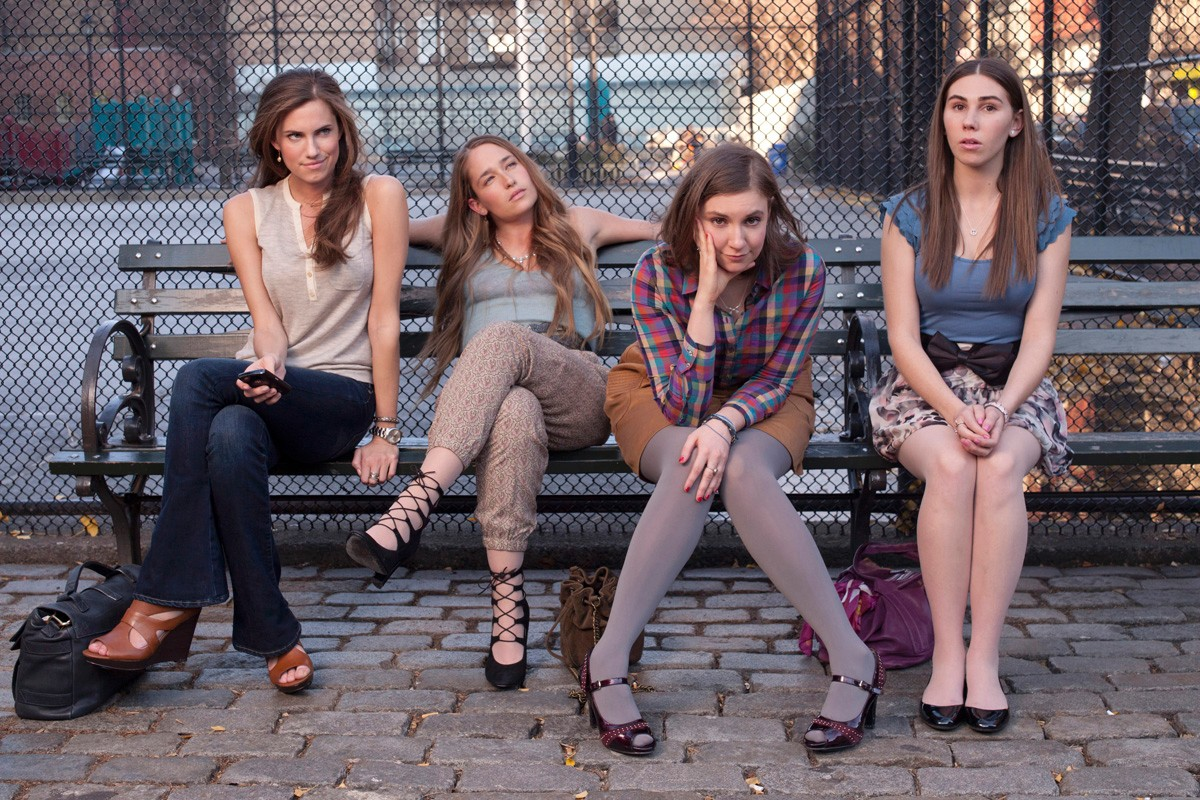
In an attempt to implore sexual freedom the text(s) reaffirms the male – female divide and this apparently gives the cast and writers’ license to incite sexism, misogyny and female chauvinism[28]. Sex and the City appears to return to a repressed state – it is still men who rule their world. Mr. Big allows Carrie to believe that they are creating their own rules and sharing the relationship power, when, in fact, she always compromises herself and comes around to his way of thinking, in the end, even without realising it. This may be somebody’s reality but please do not attempt to use it as a form of celebrating the twenty-first century woman. She is, one would like to think, less-consumer obsessed and vacuous. Her right is not only to shoes but to a voice, freedom, power and to transgress male notions of femininity. Within the media forum would seem like the ideal vehicle for such a premier, however, given the complexities and humanity of the female gender would anybody be up to the task. Lena Dunham has taken up the mantle with Girls[29], a series not unlike SATC which deals with four friends and their quest for all the things that the former programme initially set out to do – a survivable place in the world. She has full creative control, stars, writes, produces, directs and while Ms. Dunham has given a voice to the younger woman, one who is not preoccupied with becoming a wife, mother or trying to ‘take over’ from men, these ladies are still white and privileged.

[1] SATC Season 1: Episode 1 ‘Sex and the City’ Samantha insists the girls try “Hav[ing] sex like men, you know, without feeling.” HBO, 1997-2003.

[2] Candace Bushnell cited in Leupold, Julie “Sex and the City Screw with Feminism” (2003). http://journalism.nyu.edu/publishing/archives/portfolio/leupold/Sex_and_the_City.html

[3] Wolf, Naomi, The Beauty Myth: How Images of Beauty Are Used Against Women (Vintage Books, [1992] 2007).

[4] Ibid. 1992, p273.

[5] Levy, Ariel, Female Chauvinist Pigs: Women and the Rise of Rauch Culture (Pocket Books, 2005) pp4-5. Levy suggests that not all women of this generation are imbued with the feminist agenda and “if this bawdy world of boobs and gams we have resurrected reflects how far we’ve come, or how far we have left to go.”

[6] Attwood, Feona, Mainstreaming Sex: The Sexualisation of Western Culture (I B Tauris, 2009).

[7] Gill, Rosalind, Gender and the Media (Polity Press, 2006) pg103.

[8] Samantha finally chooses herself over a man at the end of film one.

[9] Greven, D “The Museum of Unnatural History: Male Freaks and Sex and the City in Akass, Kim. & McCabe, Janet. (eds) Reading Sex and the City (I B Tauris, 2003) p42.

[10] SATC Season 3: Episode 7, ‘Drama Queens’.

[11] SATC Season 5 Episode 15 Catch 38.

[12] Greven, D (2003) p44

[13] Declared during an interview in The Independent, 5 February 2001.

[14] SATC Season 4: Episode 15 ‘Change of a Dress’.

[15] SATC: The Movie. Samantha ends her relationship with Smith by telling him that although she loves him, “I love me more, I’ve been in a relationship with myself for 52 years and that’s the one I need to work on.”

[16] Ibid. “If I met myself ten years ago, I wouldn’t know me.”

[17] Wolf (1993), p275

[18] Naomi Wolf cited in Wignall, Alice “Can a Feminist Really Love Sex and the City” (2008)http://www.guardian.co.uk/lifeandstyle2008/apr/16/women.film

[19] Dyer, R. The Matter of Images: Essays of Representation (London: Routledge [1993] (2002) p128.

[20] Ibid. Dyer examines silent star Lillian Gish and her screen whiteness to argue his case for superiority on screen for white stars.

[21] Bogle, D. Toms, Coons, Mulattoes, Mammies and Bucks: An Interpretative History of Blacks in American Films, Continuum (1991) p9.

[22] Dyer [1993] (2002) p146.

[23] West, Lindy “Burkas and Birkins” (2010) http://www.thestranger.com/seattle/burkas-and=burkas/Content?oid=4132715

[24] Ibid.

[25] Isbister, Georgina, “ Sex and the City: A Post-Feminist Fairy Tale” http://www.unisa.edu.au/cil/minisites/csaa/files/Isbister_edited_version.pdf p11

[26] Gill, R (2006) p269

[27] As suggested by Eliza Tozzi in her article “Sex and the City: Feminism and Mass Culture (Empowerment & Consumerism) “[SATC] suggests that empowerment is attainable through consumption” p64

[28] A term used by Ariel Levy and described as “women who make sex objects of other women and [them]selves” 2006, p4.

[29] Girls premiered on HBO in 2012 and is now on its fourth season.

Categories
Essay film review

Guillermo del Toro and his Fairy Tales

Fairy tales have been a part of oral and literary tradition for centuries providing society with entertainment, history and ambivalent moral life lessons. These have assisted, according to those within the psychoanalytical space (Bettelheim, 1978) (Von Franz, 1995, 1996), (Cashdan, 1999), with psyche development, often in children, and the use of enchantment.[1] The cinema has been pioneering in producing film versions of these tales, the first version of Cinderella was produced in 1899 (dir: Georges Mèliés) displaying what Ridvan Şentürk calls “the transition from textual culture to visual culture and the accompanying transition in the transformation of reality”.[2] This renovation of reality does attempt to encapsulate a sense verisimilitude within this real world and if an imaginary world exists within the diegesis there is some element of mimesis. These films juxtapose the real and fantastical and while it is clear that these screen fairy tales are made for adults with their dark visuals and themes of murder, sacrifice, fear and death, the use of the child protagonist is intriguing. If these stories told in childhood do provide psychological maturity to children too immature to deal with the situations around them then what purpose does the casting of a child in an adult version serve, if any, to the narrative? Perhaps it is as Bruno Bettelheim determines that “[e]ach fairy tale is a magic mirror which reflects some aspects of our inner world, and of the steps required for our evolution from immaturity to maturity. For those who immerse themselves in what the fairy tale has to communicate, it becomes a deep, quiet pool which at first seems to reflect only our own image; but behind it we soon discover the inner turmoil of our soul – its depth and ways to gain peace within ourselves and with the world, which is the reward of our struggles.”[3]

The screen fairy tale acts in much the same way bringing together elements of the fantastical and projecting them within a social setting which will allow for an ideological reading and therefore aid identification. Some screen tales which are aimed at young children contain clearly defined adult/child relationships whereas the texts explored in this project are more ambivalent. It can even be suggested that these characters are in fact mirror representations of the other; their individual anxieties, qualities, even physical features and respective journeys are transposable (see fig1.1-4).

fig 1.1 Mirror images: Kym (Katie Holmes) and Sally (Bailee Madison) in Don’t Be Afraid of the Dark.
fig 1.2 Jesus (Federico Lippi) and Aurora (Tamara Shanath) in Cronos.
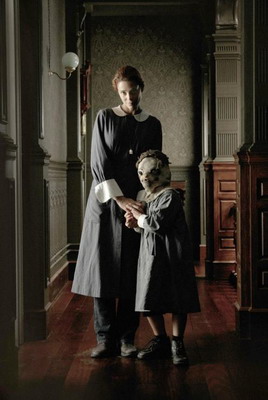
fig 1.3 Laura (Belén Rueda) and Tomás (Óscar Casas) in The Orphanage.
fig 1.4 Santi (Junio Valverde) and Jacinto (Eduardo Noriega) in The Devil’s Backbone.

On some level these adult characters who share screen time with their counterpart have lost a part of themselves; some innocence or element of imagination associated with their youth and now have the opportunity to embrace their ‘inner child’ in order to survive their current situation. In order to do so they must allow the child or shadow to impart the wisdom forgotten through maturation. In Jungian theory, fairy tales are regarded as symbolic representations of problems associated with adults and thus describes the shadow as the part of the psyche that the individual would rather not acknowledge. The greatest power is to accept the shadow parts (or daemons) and integrate them as components of the self.[4] These relationships are prevalent in adult fairy tales, and will be referred to as the shadow-child, this article aims to look specifically at Guillermo del Toro’s oeuvre and his vision of the fairy tale.

gdt

Guillermo del Toro’s first foray into Hollywood filmmaking was with Mimic (1997) in which an entomologist (Mira Sorvino) creates a genetically modified insect-human hybrid to save the nation’s children from deadly disease.[5] This mediocre sci-fi/horror text was not a commercial success, yet it enabled del Toro to make more “personal”[6] films, those which depict recurring themes related to the concept of childhood all present and displayed with visual relish in a very obvious adult diegesis and through the juxtaposition of beauty and the macabre. These dichotomous themes become more prevalent following Cronos (1993) and The Devil’s Backbone (2001), in which these horror texts, crucially, also contain young children despite the narrative(s) aim at an adult audience. These films still contain a certain mythology associated with the adult fairy tale and the adult/child pairing. However, it is in del Toro’s later work in the guise of writer, producer or director that greater encompasses the ambiguity of the adult fairy tale specifically alongside the film texts and his directorial works Pan’s Labyrinth (2006) and Hellboy II: The Golden Army (2008) that the extent of the screen fairy tale and the adult-child dual relationship will be explored. These films contain individual and distinctive aesthetics which make for some of the most memorable fairy-tales-for-adults in modern cinema.

Born in Guadalajara, Mexico on October 19, 1964 to Federico and Guadalupe and raised in a strict Catholic household the young Guillermo developed an early interest in the fantastical, monsters, make-up and special effects[7]. As a child, by his own admission, del Toro became enthralled with both bible stories and fairy tales and found what he refers to as “equal spiritual illumination”[8] in both sets of parables. Interestingly, now fifty, del Toro has rendered his religion indefinable and is now a self-proclaimed “lapsed Catholic”. He does, however, still believes in fairies and continues to avidly collect books and anthologies on the subject as well as incorporate traditional tales within the mise-en-scène of the filmic frame.[9]

Visually, Pan’s Labyrinth’s palette of colours are tonally neutral and cold (greens, greys, blacks and blues) in the real world; displaying the darkness of a country following a civil war. The fantasy world’s range of colours, in contrast, are reds and gold, warm inviting and what del Toro refers to as “uterine” in shape and density; this is, after all, a tale of a defiantly imaginative girl in her pursuit of re-birth.[10] Few scenes are shot in natural light and the majority of action occurs during dusk or deep into the hours of darkness when the world is asleep and twelve year old Ofelia (Ivana Banquero) can complete her quest. At the film’s opening a blackout slowly reveals a close-up image of a child which fills the frame, blood is pouring from her nose and she is gasping for breath, close to death. Intertitles set the scene, it is 1944 and following the devastation and stasis of the Spanish Civil War, guerrillas of the resistance are attempting to regain control of their country; rescuing it from the iron fist of Fascism left in the wake of General Francisco Franco’s reign. A fairy tale-style narration begins detailing the story of a curious princess named Moanna who escaped from her kingdom to quench her thirst for adventure. Over time Moanna loses her memory, forgets her true identity and eventually succumbs to the austerity of the real world and dies. Her father, the King, believes his daughter’s soul will return incarnated in another body and will await her. There is a sense of foreboding within Ofelia’s death scene, a child’s death is difficult to comprehend, perhaps due to their free association to innocence and mythology which surrounds childhood and suggests that children are inextricably linked to purity and are therefore to remain untouched. “[Y]ou do not”, according to psychoanalyst Serge Leclaire “single them out for hatred”.[11] Leclaire argues that through the stages of “primary narcissism” the individual must unconsciously and repeatedly kill and destroy the phantasmal image of a child projected onto them by their parents.[12] Surely then, the inference of death in the child is not quite as traumatic as he suggests but a projection of the spectator’s primary narcissism. The audience could ideologically view Ofelia as the ghost child of the individual psyche; she is an embodiment of the delusion which would render her death of little consequence in the opening segment. The fact that she is dying strengthens her humanity, interpellates subjectivity and thus facilitates viewer identification. Within minutes of this, however, the blood pool reverses and begins to seep back into the child and the next shot indicates the commencement of Ofelia’s journey.

The voice-over narration stops and an inlay of a volume of fairy tales fills the frame and then Ofelia. She is sat in the back of a car with her pregnant mother Carmen (Ariadna Gill) who is incredulous at the amount of books her daughter insisted upon bringing; tales that, according to her mother, Ofelia is too old for. Carmen, having spent a number of years as a widow, did not wish to succumb to loneliness and has married Captain Vidal (Sergi Lòpez) with whom she is now expecting a child. The depiction of the older female staving off pregnancy-induced illness and the young girl’s fascination with her stories shows the distinction between adult and child. Carmen becomes exasperated by the muddiness of her daughter’s shoes while Ofelia is excitable because she believes she has seen a fairy.

faun

Vidal is cold, calculating and unapproachable. His only interest is his firstborn son, the older female is merely a vessel for his heir and the younger is an unnecessary inheritance from his marriage; women in his world are expendable. As long as Ofelia remains impassive and invisible, he is happy to ignore her: the disdain is mutual, made evident with the child’s stubborn refusal to call the man ‘father’. While Carmen wishes for her daughter to cast aside the childish fairy tales and books the act of storytelling itself is the way in which the two siblings, who have yet to meet, bond. Ofelia tells her brother tales of wonder while he is in utero and it is during this sequence that del Toro utilises one of many visual effects to show the unborn child and the response he has to his sister’s voice which carries tales of wonder and imagination. After showing the unborn son safe in the cocoon of the amniotic sac, the filmmaker cuts to Vidal – the opposing force to his child – he is the active, experienced adult who is far removed from innocence. He tortures and murders a father and son whose only transgression is killing hares for food; the violence displayed is unflinching as the Captain obliterates the younger man’s face with a glass bottle. This dichotomy of beauty and horror is essential to the on-screen fairy tale. Not least, according to del Toro, but to instil fear while some foster hope and magical wonder. All “have a quotient of darkness because the one thing alchemy understands, is that you need the vile matter for magic to flourish”.[13] Certainly, Ofelia’s world contains an element of darkness complete with a dying mother and a wicked stepfather. Her tales have honed an already active imagination yet precipitates her demise.

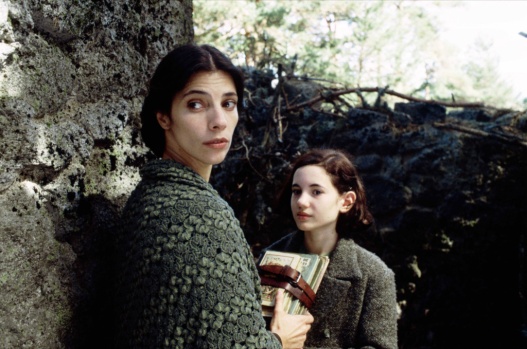
Ofelia is neither adult nor child in totality, she resembles a child on the cusp of sexual maturity and yet her experiences to date are perhaps limited to an association with an adult world: endurance of hardship, upheaval, heartbreak and death are difficult for any soul to bear regardless of their age. She follows her heart and while this may be construed, at times, as disobedience it is more accurate to describe her as independent. The child is, after all provided with copious amounts of freedom. Mercedes (Maribel Verdú), on the other hand, is subservient. She continues to serve Vidal and run the household; she may occasionally sneak out at night and visit her younger brother Pedro who is part of the resistance but her true defiance only occurs after, her shadow-child, Ofelia has paved the way. Interestingly, the items which Ofelia rescues during her trials: the key and the dagger find their way into Mercedes’ possession in the real world. In a sense the girl, in her ambivalent child state completes her tasks with determination and self-sufficiency and this, in turn, enables Mercedes to gain strength and daring. The self-proclaimed “coward” then rises up to Vidal to become a hero of her own making. There is an indication that Ofelia’s presence brings about a change to Mercedes within moments of arrival. When the girl chases the cricket, the woman watches intently, perhaps the presence of a child stirs maternal instincts or there is still some dormant magic within Mercedes. When Ofelia asks her if she believes in fairies, Mercedes answers that she used to, “I used to believe in a lot of things when I was a girl”. Ofelia confides in her new friend that she has met a faun and Mercedes tells her to be wary of it, there is no attempt to oppress the girl’s imagination but a voice of experience that could perhaps hint at previous dealings with the magical creature. The duality in representation of the two does not end there as costumes and colours remain similar in cut, style and tone of the two characters and they are often shot next to or in front of each other; an extension of the body (see fig2.1-3 ). The woods also hold great significance for both. The forest is a site of indifferent nature, a place where the two worlds (real and fantastic) merge, a location to both hide and get lost in.[14] this is the place where they are safest; where they are active, princesses of their own destiny.

fig2.1
fig2.2
fig2.3

Pan’s draws readers’ attention to intertextual signifiers throughout the mise-en-scène and the individual instinctively associates it with a fairy tale narrative that is innately familiar[15] and continues the fairy tale tradition. These signifiers are evident through allusions to Alice in Wonderland[16] (fig3.1), specifically through the style of the silk dress Ofelia is made to wear just prior to her first trial[17]. The Wizard of Oz is hinted at during the film’s finale when the princess finally gets home[18] and knocks her red booted heels together and lastly with her alabaster skin and ebony hair Ofelia resembles Snow White[19]. It is, however, at the commencement of her second task after rescuing a key from the stomach of a giant toad when intertextual layering is displayed to full visual effect in the Pale Man’s lair.

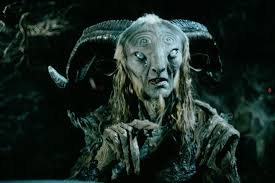
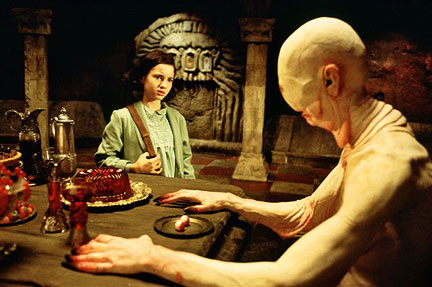
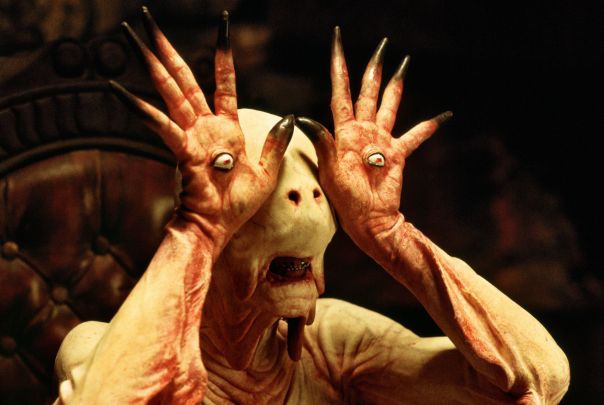
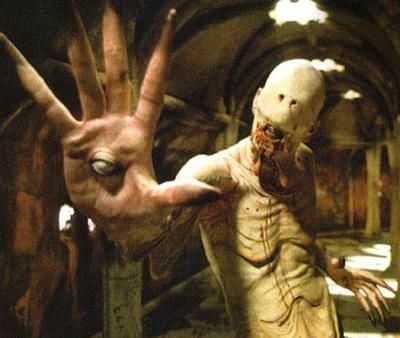
Ofelia is warned by the faun, before she leaves her bedroom, not to touch anything. The ogre sits at the head of a decadent banquet table with his palms pressed on the table top. Although alone Ofelia is Hansel and Gretel;[20] abandoned by her parents and trapped by a blind witch (the Pale Man has no eyes or sockets). She rescues a gilded dagger from one of the lock boxes on the wall and starts to leave. Here, religion and fairy tales meet within the mise-en-scène, del Toro hinting that despite his lapse of faith there are some aspects he remembers. There are murals and paintings across the wall reminiscent of the stained glass interpretations in any church, the Pale Man, however, does not display the Stations of the Cross but stations of his repugnancy as it were; the tens of small shoes in a pile by the fire makes clear the monster’s intentions. The ogre’s stigmata is in the form of sockets on both palms his eyes sit next to him on a saucer, an allusion to St. Lucy[21] and when Ofelia gives into temptation and steals a luscious-looking grape she is evocative of Eve stealing the forbidden fruit. Her transgression facilitates the fight for her life, the Pale Man’s eyes are popped into the sockets and his fingers act as surreal lashes. This marriage of religion and fairy tales links back to del Toro’s childhood and the age of enlightenment and furthers the angelic and demonic dichotomy which is scattered throughout each of his films (fig4.1-3).

fig4.1
fig4.2
fig4.3

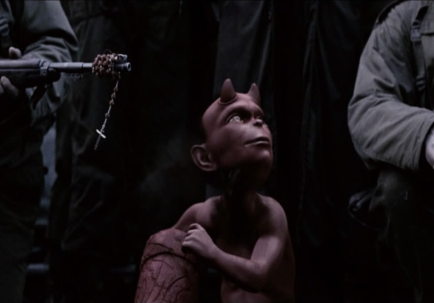
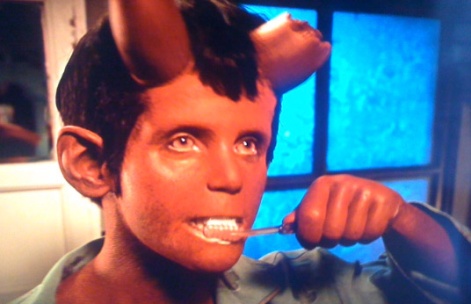
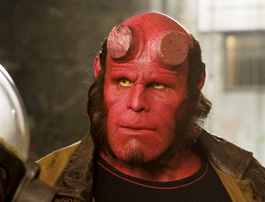
Who is more of an angel and demon amalgam than the character of Hellboy? In the second of the current franchise, The Golden Army, del Toro yet again screens the fairy tale through an adult world and repeats many of the rules displayed in Pan’s; the underworld, the king, a war with humans and all in a social setting which is identifiable and recognisable. The main character’s name is no accident – Hellboy is exactly that, a boy, albeit in an adult demon’s body. His childlike qualities are made more apparent by the fact that the audience view him as a child in the opening sequence, getting ready for bed, brushing his teeth and excitably awaiting a bedtime story from his father. These images can serve to assist with identification, after all, as adults the audience have one thing in common; they have experienced a childhood in one form or another. In later life, his love of candy, television and petulant, often simplistic way of viewing the world make him the innocent living “outside of society, pre-historical, pre-social, instinctual, creatures of unreason, primitive, kin to unspoiled nature”.[22] Del Toro describes the character as “a child [who] defines himself by choosing who he is and not who he is meant to be”[23] (fig5.1-3).

fig5.1
fig5.2
fig5.3

Following on from sequel and the loss of his father Professor Broom (John Hurt), Hellboy is now in a serious relationship with pyro-telekinetic Liz Sherman (Selma Blair) and they along with Abe Sapien (Doug Jones) continue to solve supernatural crime in the Bureau of Paranormal Research Defense (BPRD) and fight the creatures of the Underworld at odds with humanity rather than take their place among them. Elf-prince Nuada (Luke Goss) is discontent with humankind particularly with their treatment of his world. He is angry that his father refuses to act and that the King insists upon maintaining the armistice, signed centuries ago, between the Elves and humans. Nuada thus murders his father to initiate his rise to the throne and sets about collecting the three pieces of the crown which will grant him ruler and therefore enable him to awaken the golden army and destroy humans. Nuada’s twin sister Nuala (Anna Walton) becomes an unlikely source of resistance and seeks refuge from the BPRD to prevent Nuada’s quest. He awakens the army but Nuala ends his reign by making the ultimate sacrifice.

nuala

Nuala and Nuada are the literal double of each other with the two actors wearing prosthetic pieces to ensure their facial blemishes match. The subtle colour-difference in their make-up symbolising their juxtaposing natures, Nuala’s golden eyes and mouth soften her features, hinting at her warmth while Nuada’s severe black eyes harden him and the audience is left with little doubt who the ruthless twin is; the one with the darker soul. Like with Pan’s this duality of representation suggests that they are essentially the same person with Nuada symbolising Nuala’s Shadow which she has always accepted as a part of her personality before his murderous killing spree. Unable to fully accept her Shadow there is resistance. He awakens the army but Nuala ends his reign by making the ultimate sacrifice. Their bond is not only telepathic but biological and she drives a dagger into her heart knowing that it will surely end his life also.

The character of Hellboy is what Marie-Louise Von Franz calls a “shadow-hero”[24] and therefore offers a more complex reading. He is the aspect of the archetype which has been rejected by the collective consciousness, in this case read through literal societal rejection but also that he is “more primitive and more instinctive than the hero but not necessarily morally inferior. In some fairy tales, the hero […] has no shadow companion but displays himself with positive, negative [and sometimes] demonic traits”.[25] I would suggest, however, that there is a shadow-child within his psyche, in the figurative sense, especially in those moments when he forlornly pines his father. He displays a need to return to childhood or at the very least the return to dependency and being cared for while, in the same token, yearns for attention and general acceptance from the world he has not only attempted to save but assimilate into (as much as a six feet tall, bright red, hornless demon can). Certain aspects of Hellboy’s psyche are more complex than that of Ofelia, he is repressing the demon, his birthright, an evil he keeps at bay with religious iconography – another recurring del Toro motif – ethereal images in his abode and rosary beads around his wrist and waist. He and Liz share a similar relationship in that they have had little in the way of a regular childhood. Given their, respective, extraordinary abilities they measure each other through the how the other sees them. They too have transcended the first mirror phase and now their illusions are met with similarity and reciprocity. Most couples strive for alike-mindedness; however, Liz can control fire while it just so happens that Hellboy was born in a pit of it.

Hellboy is the embodiment of the imagination, hope, death and destruction (he is destined to destroy humankind and the world, after all) and can be read as the ambivalent, often ideological, identifier sought and found in the screen fairy tale. Or perhaps the creature is a visual signifier for the film’s author. In his 2011 interview, with Daniel Zalewski of The New Yorker, del Toro claimed that some his characters are auto-biographical and that he was not only the Pale Man in Pan’s but “I am Hellboy”.[26]

The imaginative adult screen fairy tale is a sanctuary for all shadow-children to dwell, a place where they can connect and seek hope from the brutality of reality. We should all strive to be a bit Ofelia and Hellboy.
[1] Child psychoanalysis Bruno Bettelheim conducted an in-depth study of fairy tales and used case studies of the children he was treating and applied Freudian theory to produce an understanding of the uses of enchantment and how these cautionary tales can assist with the psychological development of children.

[2] Ridvan Şentürk “Anxiety and Fear in Children’s Films” http://marmara.academia.edu/HalilEksi/Papers/1523461/Anxiety_and_Fear_in_Childrens_Films [accessed 1 April 2012].

[3] Bruno Bettelheim, The Uses of Enchantment: The Importance of Fairy Tales in Childhood (UK: Penguin Books, [1978] 1991) p309.

[4] Marie-Louise Von Franz, The Interpretation of Fairy Tales, (Boston and London: Shambhala: 1996) pp114-197.

[5] The film’s premise of ‘saving the children’ culminates in the death of many adults. The hybrid continues to evolve and by the text’s conclusion resembles a human and must be destroyed. It can, perhaps, be read alongside the body of this thesis – survival of an innocent is dependent upon the sacrifice of the more experienced; the acceptance of one’s shadow.

[6] Del Toro regards his personal films as those which relate directly to him i.e. The Devil’s Backbone, Pan’s Labyrinth and the Hellboy franchise.

[7] This culminated in del Toro completing a make-up course under the tutelage of Oscar winning Dick Smith. Following this, del Toro worked as a make-up supervisor before creating his own production company Necropia in 1985 – see Andrea Sabbadini, El laberinto del fauno [Pan’s Labyrinth], 6 August 2011 http://internationalpsychoanalysis.net/wp-content/uploads/2011/11/PansLabyrinth.pdf p2 [accessed 10 March 2012].

[8] Rebecca Murray, “Guillermo del Toro Talks Pan’s Labyrinthhttp://movies.about.com/od/panslabyrinth/a/pansgt122206.htm September 6 2006 [accessed 16 Nov 2011].

[9] Daniel Zalewski, “Show the Monster” in New Yorker, http://www.newyorker.com/reporting/2011/02/07/110207fa 7 February 2011 [accessed 2 February 2012] p.

[10] Mark Kermode, “Girl Interrupted” in Sight and Sound, December 2006, http://www.bfi.org.uk/sightandsound/feature/49337 [accessed January 14 2012] p4.

[11] Serge Leclaire, A Child is Being Killed: On Primary Narcissism and the Death Drive (Stanford: Stanford University Press, 1998) p2.

[12] Ibid.

[13] Murray, 2006.

[14] Karen Lury, The Child in Cinema: Tears, Fears and Fairy Tales, (United Kingdom: I B Tauris, 2011) p109.

[15] Jack Zipes, Happily Ever After: Fairy Tales, Children and Culture, (United Kingdom: Routledge 1996) p1.

[16] See Lewis Carroll, Alice in Wonderland, 1865.

[17] Alice wears a dress underneath a white pinafore apron, has knee socks, Mary Jane shoes on her feet and a headband in her hair. While the dress is traditionally blue, Ofelia’s is emerald green in keeping with the palette of colours utilised through the real world’s mise-en-scène.

[18] Home is the kingdom of heaven where she becomes Princess Moanna once again taking her throne alongside her father and mother.

[19] Rather than an evil stepmother, Ofelia has a stepfather whose early morning shaving ritual involves staring into a mirror. In a subversion of the traditional tale, however, it is Ofelia who tries to poison him when she attempts to escape with her younger brother.

[20] This is not the only allusion to the fairy tale siblings – Pedro and Mercedes are parentless siblings abandoned following the war, making the woods their temporary home. Vidal’s food store could possibly be read as a gingerbread house of sorts.

[21] Saint Lucy (Santa Lucia) is venerated as the patron Saint of the blind. Upon her execution her captors, unable to burn her to death, plucked out her eyes with a fork. She is often depicted holding her eyes upon a plate or flat receptacle; del Toro makes reference to this statue which “freaked him out as a child” (New Yorker, 2011 p10).

[22] Marina Warner, Six Myths of Our Time: Little Angels, Little Monsters, Beautiful Beasts and More, (UK: Vintage, 1996) p57.

[23] Brent Simon, “Guillermo del Toro Talks Hellboy II” http://www.reelz.com/article/635/guillermo-del-toro-talks-hellboy-ii/ [accessed 5 February 2012].

[24] Von Franz 1996, p114.

[25] Ibid.

[26] Zalewski, 2011 p11.

Categories
Essay film review

The Littlest Rebel (Dir. David Butler, 1935)

rebel5

I critique The Littlest Rebel in relation to the ideological ancestor of the American Civil War on film. This is, for me, one of Shirley Temple’s most memorable performances.

Described by the New York Times in 1935 as “an eventful slice of meringue and quite the most palatable item in which the baby has appeared recently [while continuing] to be the most improbable child.”[1] The Littlest Rebel (David Butler, 1935) is a rather unusual Civil War film as one often thinks of men in boots and beards rather than six year old girls with perfectly formed ringlets and dimples. To utilise a phrase by Will Kaufman, it can be described as a film which “regenders”[2]  the Civil War. Like So Red the Rose (King Vidor, 1935) and Gone With the Wind (Victor Fleming, 1939) Rebel initially takes place on a Southern plantation and also has a family at the forefront of its narrative. Mrs (Karen Morley) and Captain Cary (John Boles) idolise their daughter Virginia ‘Virgie’ (Shirley Temple) and the film opens with a dinner party all guests adorned in fine dresses and dinner jackets. It is only upon closer inspection when the camera moves in for a medium shot does the viewer realise that these are children; extremely civilised and polite adolescents uttering ‘please’ and ‘thank you’ to their gracious hostess. Virgie is tenacious and independent, sacrificing her own ice-cream in order to ensure that her guests are content and full – she is also white. The Cary’s own slaves, each defined by a stereotype included in Donald Bogle’s pantheon[3]; Uncle Billy (Bill Robinson) is the “Uncle Tom”[4] amiable and protective of his ‘honey-child’ ward. James Henry (Willie Best) is evidently the “Coon”[5], his lack of intelligence and naivety used for comic effect and to incite irritability in Miss Virgie, who at six is his intellectual superior. A secondary character can also be clearly defined as the “Mammy”[6] a robust woman complete with an Aunt Jemima handkerchief around her head.

The news that there have been shots fired at Fort Sumter breaks up the party and sends families back to their homes, Captain Cary must report for duty as rebel scout for the Confederate army and leaves his family. This is a prospect Virgie seemingly relishes as she declares that her “daddy is the best soldier in the whole army”, however, her views change when she realises that her father will be kept away from the plantation for long periods of time. The fighting escalates and the Union army take the Cary land for their own, looting the property under the supervision of Sergeant Dudley (Guinn Williams) who is searching for absent patriarch Cary. Fearing for Virgie’s safety, Uncle Billy hides the little girl away in a secret wall space while the aggressive ‘Yankees’ ransack the house. When Virgie is found she is mistaken for a slave child as she has painted her face and hands with black boot polish in an attempt to conceal her whiteness and remain safe. This ‘blackening’ of Temple’s skin is also repeated in The Little Colonel (David Butler, 1935) when her character recreates a black riverside baptism in a muddy puddle. Lori Merish in her “Cuteness and Commodity Aesthetics” article states that Temple “purge[s] the cute of its unsettling racial resonances, performing an absorption and domestication of comic styles associated with blackness”[7], a term Richard Dyer describes as “binarism”[8]. She further describes Temple’s temporary ‘blackness’ as “racial hybridisation”[9] which forces the audience to view Temple and Robinson as the visual equivalents of each other. I would disagree; despite concealment beneath mud or boot polish the star persona and ‘whiteness’ is reinforced, there is no ambiguity. Virgie and Uncle Billy are not equivalents of each other but binary opposites: female/male, mature/adolescent, white/black and free/enslaved, a relationship that is described as “safe” by Benshoff and Griffin[10]. Certainly, the two are rarely seen embracing or are physically close with one another and it is Virgie’s relationships with the other male characters that are more compelling. She appears to be somewhat manipulative, particularly, with her affection and happily kisses men on the mouth and climbs into their lap; Virgie lacks no confidence in standing up for her beliefs.

rebel3

A few weeks (this is a presumed timeframe as the viewer is never aware of days and dates) after her father’s departure, Virgie is playing ‘soldiers’ with a group of slave children and James Henry; leading the way wearing a Confederacy cap while they wear white hats reminiscent of Klu Klux Klan hoods. A Union soldier rides onto the land and the other children run away but Virgie stands her ground and fires a slingshot at Colonel Morrison (Jack Holt), marching in front of him singing ‘Dixie’ and declaring proudly “I’m a Confederate”. The Colonel likes her honesty and finds the ‘little rebel’ amusing. Not long after, following the death of his wife Captain Cary attempts to cross enemy-lines to get his daughter to safety in Richmond and with the assistance of Colonel Morrison he almost makes the journey, unfortunately they are both captured and sentenced to death by firing squad. Virgie comes to the rescue when she is granted an audience with President Lincoln to beg for clemency for the two men she considers her ‘daddies’.

The Littlest Rebel presents itself as a generic hybrid, while it has clear melodramatic indicators not least in the acting styles within the mise-en-scène. Virgie/Temple is often displaying facial expressions of an over-exaggerated nature and, at times, when emphasising her point out tends to pout and put her hands on her hips. When she cries, she has to point out the tears in an effort to reiterate the emotion of the scene, Molly Haskell describes her as the following:

[Virgie’s] flirtatiousness with her daddy [is] outdone, in precociousness, only by the patronizing way in which she [treats] her contemporaries. She [is] not only a little lady, advanced in social etiquette beyond her years, but a little mother, assuming the maternal role with [the] older men [in the movie][11]

Morley’s Mrs Cary delivers a more-understated performance; however, her death allows Virgie to usurp her in the family unit becoming a little mother/housewife and child all the while reinforcing Temple as the star of the show. A non-diegetic score, usually found in the melodrama is seconded to diegetic music in the form of songs sung by Virgie to her father at the film’s conclusion. The musical scene between Virgie and her father also reiterates the North/South dichotomy and in particular the masculine Northerner and the effete Southerner, here personified by Colonel Holt and Captain Cary; their star personas played up to maximum effect; John Boles was a silent star who became a Broadway regular and Jack Holt was a stalwart of the Western genre and favourite of John Ford. This information is not meant to imply that Boles any ‘less masculine’ than Holt, however, Boles’ visage is certainly softer, complete with long eyelashes and dimpled chin, he is often filmed in close up or medium shot and clinched in an embrace with his daughter. Holt on the other hand, much like Rhett Butler, is more stoic with his prominent jaw and monotone drawl.

As with other Civil War melodrama there are ideological messages which are present in Rebel. These suggest that it right to protect your kin – dishonesty is acceptable when for an honourable cause – embrace the beauty in death and show mercy to oppressors. In addition to ideological messages, Jenny Barrett suggests that protagonists within the Civil War melodrama complete three stages: old morality, transformation and new morality with “the civil war thus operat[ing] as a tool for the narrative structure, allowing the moral development of the central characters”[12]. Whether Virgie completes this moral journey is open to conjecture, she starts and ends the film as a six year old, yet in between loses her family home and mother. She is a child who does not know war but learns tolerance of her Northern Oppressors, gains a little independence while trying to save her father’s life and to reiterate Sennwald – an improbable child indeed. Rebel is similar to The Drummer of the 8th (Thomas H. Ince, 1913) in its generic hybridity and child-as-protagonist attempting to reconcile the turmoil of war with family life, however, while Virgie never sees any action (unlike Billy) she knows death.

Historically, The Littlest Rebel was released at Christmas, 1935 to a country in the middle of the Great Depression (1933-1940) two years after the commencement of President Roosevelt’s New Deal[13]. After the release of Rebel Roosevelt made the following statement “when the spirit of the people is lower than at any other time during this Depression, it is splendid thing that for just fifteen cents an American can go to a movie and look at the smiling face of a baby and forget his troubles”[14]. It shows the power of cinema if a film trying to depict the ‘lighter’ side of a war can make an audience forget poverty, mass unemployment and the worst economic crash of the decade. Little change was made to Civil Rights[15] so one has to wonder whether the black community were able to ‘forget their troubles’ by watching their ancestors on screen or whether the ideological white, patriarchal antecedent, evidently celebrated, is nearer to the ‘he’ that Roosevelt is addressing.[16]

Robert Brent Toplin has argued that cinematic history is also a generic category and that an audience is able to recognise the historical genre by the casting of certain actors[17]. However, I would suggest that by default all cinema, by production alone, has a history and to describe ‘cinematic history’ as a generic category is problematic; more viewers are likely to recognise the historical context of films through more obvious indicators like the biopic, war film, Western, etcetera. To think that viewers freely associate actors with a history film in this modern age is somewhat naïve, specifically the actors he uses as examples[18], not to mention highly subjective – one person’s President Roosevelt may be another’s Midnight Cowboy (John Schlesinger, 1969)[19]. Shirley Temple is not usually an actress associated with historical films, her oeuvre consists of more generic recognisable labels like the musical, and is not therefore a principal characteristic by Toplin’s theory. The fact that Abraham Lincoln is present within the diegesis would suggest that Rebel is allied, with cinematic history along side the melodrama and musical.

littlest_rebel_lg-1893ecc

It would be imprudent to accept The Littlest Rebel as an interpretation of historical fact and would be more appropriate to describe it as an interpretation of historical truth. Fort Sumter was, indeed, fired open and is widely regarded as the place where the war began and not, as suggested by this picture as the North attacking the South, nor did the fighting cease after two soldiers are granted clemency as depicted at the film’s conclusion. Certain artistic liberties have been taken as with the majority of motion pictures, just as Toplin freely admits in his thesis[20], not least in the depiction and representation of the African American male(s) featured, however minimally. They are all slaves and not soldiers which history informs us was not the case. Rebel states, quite categorically, within the opening sequences that the cause of the Civil War was the emancipation of slavery, Virgie asks Uncle Billy what a war is and after he tells her about men killing each other he adds, “A white man says that there is a gentleman up North who wants to free the slaves”.

The ‘man’ he refers to is, of course, Abraham Lincoln and I would suggest that it is through his presence that may shape a historical truth certainly surrounding his Presidency and the time of war. This would substantiate Toplin’s statement that “Hollywood’s interpretations of American history can make a significant impact on the public’s thinking about the past[21], Lincoln’s mythology lend itself to The Birth of a Nation, Young Mr Lincoln (John Ford, 1939) and Rebel amongst others. All attempt to depict the sixteenth President of the United States as the father of the nation – specifically in the latter picture where fatherhood is a metaphor heavily relied upon throughout – a man who was a friend of the people, as wholesome as the apple shared and eaten with Virgie (or the pie judged at competition in Young Mr Lincoln). A confidant who shows clemency to a chosen few – the issue of the 620,000 deaths he helped contribute to with his political decisions is rarely commented upon – instead he is martyred on screen and his antebellum memory is romanticised thereby allowing both filmmakers and audiences alike to avoid serious questions about Lincoln’s character and legacy. This is not a man torn by real indecision (peach or apple pie preference not included[22]), as suggested in the letter to Horace Greeley in 1862[23], but a gentleman who exuded confidence and was fair to the Southern people and indifferent to race – he shakes both Virgie and Uncle Billy’s hand without hesitation and it would seem that the mythology of Mr Lincoln informs both the historical truth and interpretations of the past on the present.

The Littlest Rebel attempts to correct the ruin, death and unhappiness[24] of So the Red the Rose and Gone With the Wind with its romanticised innocence, musical melodrama and racist undertones. The film depicts (circa) 1861 as a time of continuing racism and poverty during war. Its production in 1935 (also a time of continuing racism and poverty[25]) suggests that the historical context of production and finished aesthetics add authenticity to the Hollywood version of history. Shirley Temple coquettishly straddles childhood and adulthood like the improbable child described in Sennwald’s 1935 review. She does, however, surrender her active independence to the hegemonic white, patriarch who continues to inform the ideological American ancestor.


[1] Andre Sennwald, New York Times Reviews The Littlest Rebel, 20 December 1935.

[2] Will Kaufman, The Civil War in American Culture, UK: Edinburgh University Press (2006) pp92-109.

[3] Donald Bogle, Toms, Coons, Mulattoes, Mammies and Bucks: An Interpretive History of Blacks in American Films USA: Continuum (1991).

[4] Ibid. pp4-5

[5] Ibid. pp5-6

[6] Ibid. p6

[7] Lori Merish, “Cuteness and Commodity Aesthetics” in Rosemarie garland Thomson (ed) Freakery: Cultural Spectacles of the Extraordinary Body, New York: New York University Press (1996) p198.

[8] Richard Dyer, The Matter of Images: Essays on Representation, London & New York: Routledge (1993) p133.

[9] Merish, (1996) p199.

[10] Harry M. Benshoff and Sean Griffin, America on Film:Representing Race, Class, Gender, and Sexuality at the Movies, UK: Blackwell Publishing (2004) p81.

[11] Molly Haskell, From Reverence to Rape: The Treatment of Women in the Movies 2nd Edition, Chicago: The University of Chicago Press (1987) p123.

[12] Barrett, (2009) p53

[13] Roosevelt created the New Deal and the 3 Rs – relief, reform and recovery in order to bring the USA through the greatest economic crash of the decade.

[14] Shirley Temple, Child Star, New York: McGraw (1988) p59.

[15] Anthony J. Badger, The New Deal: The Depression Years, 1933-1940, London: Macmillan (1989) p252.

[16] Anne Edwards, Shirley Temple: American Princess, New York: William Morrow (1988) p85 – in 1935 black men were still not treated as equals to the white man and Bill Robinson, reportedly, had to enter by the rear of the studio lot, could not share his meals with white cast members or use the same bathroom facilities.

[17] Toplin, (2002) p14.

[18] Ibid.

[19] Jon Voight played Roosevelt in Pearl Harbor (Michael Bay, 2001) and Joe Buck in Midnight Cowboy – two roles which are widely diverse. One would not necessarily associate him with a history picture with these multi-faceted performances.

[20] Toplin, (2002) p59.

[21] Toplin, (2002) p1.

[22] As visual metaphor to depict Lincoln’s ever-changing min over saving the Union or abolishing slavery.

[23] New York Tribune, 22 August 1862.

[24] New York Times review, 1935.

[25] Badger (1989), p3