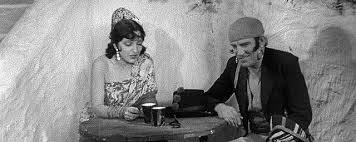
Pre-production code females were given carte blanche when it came to committing their ‘crimes’ against men/society, without veritable punishment, leaving the likes of Theda Bara, Pola Negri and Ida Lupino free to vamp it up, transgress, and use their feminine wiles as they chose, with little condemnation or repercussion. Post-code ladies like Marguerite Namara, for example, in 1931’s Gipsy Blood (aka Carmen), is not quite so lucky. Adapted from the novel Carmen by Prosper Mérimée and informed by the subsequent opera, Gipsy Blood tells the tale of a cigarette factory worker caught up in a love quadrangle. Directed by Cecil Lewis and music arranged and conducted by Malcolm Sargent, this Elstree Studios production is the first filmic rendering of Georges Bizet’s libretto.
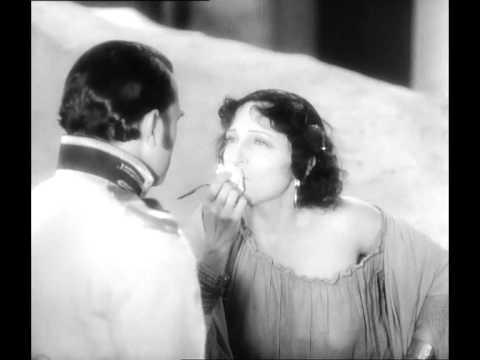
Set in Seville, ‘betrayer of all men’, Carmen (American soprano Namara) is striking and clearly, the star, with her alabaster skin, black hair and saucer-like eyes framed with dark lashes. She’s the quintessential Spanish woman in her flamenco dress, hooped earrings and headscarf, standing with her hands on her hips, emitting an air of authority and accentuating her breasts and hip. She’s a seducer, capricious, even duplicitous and when stiff upper-lipped, innocent (and quick tempered) officer Don Josè (Thomas Burke), caddish, lecherous moustachioed corporal Zuniga (Lester Matthews) and charming Toreador Escamillo (Lance Fairfax) fall for her ample charms, it can’t end well. It’s the usual story: woman wrongly labelled ‘harlot’ because she exudes passion, sexuality and confidence leads to murderous jealousy all the while depicting the proletarian life amid immorality, and lawlessness (and xenophobic/sexist stereotyping).
Displaying stark cinematography, replete with chiaroscuro tones, Gipsy Blood is a delight albeit archaically put together. It won’t be for everyone, especially given the histrionic acting and, at times, stilted, awkwardly delivered dialogue. Sadly, the singing ability from the main mezzo-soprano, baritone and tenor does not quite match the acting style but in its deliciously camp and melodic story there is joy to be found. Granted, you probably have heard the arias sung far more proficiently in the 70 years since but Sargent’s arrangements still shine, no mean feat given the audio recording limitations of 30s cinema. A word of advice, never trust a dark, exotic temptress; they’ll break your heart!
The old adage, “you can never have too much of a good thing” would appear to be the mantra of Hollywood horror producers – excellence being sporadic and fleeting. Friday the 13th tops the list of saturated horror franchises with twelve movies, followed by Halloween with ten and then there are the seven Saws. The next dire instalment of mediocrity is probably not too far behind.
It has been thirty-nine years since Tobe Hooper’s seminal family horror, The Texas Chain Saw Massacre (1974) and over the years viewers have been party to sequels, new generations, prequels and remakes – “Chain Saw Massacre” became “Chainsaw Massacre” and then no “Massacre” at all – none of which have even come close to the first. Part of what made Hooper’s original so influential was its stark cinematography, verisimilitude and its “true story” marketing (based loosely on the exploits of real-life serial killer Ed Gein) with a documentary-style voiceover and photographic stills filmed on 16mm. Its narrative and plot were, of course, entirely fictional but the finished film serves as a subtle commentary on the political climate and symptomatic of the era; something of worth created within budgetary constraints. The US was still knee-deep in the Vietnam War and this affecting horror visualised an apocalyptic landscape, sparse and abandoned through industrial capitalism (Robin Wood). It depicted a non-traditional, perhaps arguably degenerate, familial homestead transgressing the boundaries of the norm and surviving via cannibalistic insanity. As a movie, it stays with you long after viewing and its esteemed standing in the horror genre a testament to director Hooper and writer Kim Henkel, who created an influential piece of frightening art in spite of a profound lack of blood, guts and gore.
A whole decade has passed since Marcus Nispel’s futile remake starring Jessica Biel and seven years since …The Beginning which tried to explain away all elements which made the original so groundbreaking and yet still the unnecessary franchise additions keep coming. The latest attempt, Texas Chainsaw is released on DVD from the 27 May 2013 through LionsGate. The film begins moments after the 1974 release and condenses its pioneer into a few short frames culminating in Sally Hardesty’s (Marilyn Burns) bloodied and hysterical escape. A Hatfield and McCoy type battle ensues between the Sawyers and Hartmans which leaves the old farmhouse burned to the ground, several members of each party dead and a small child ripped from the arms of her mother. Flashforward to present day and Heather Miller (Percy Jackson’s Alexandra Daddario) learns of her adoption and her biological grandmother Verna who has left her a significant inheritance. She jumps into a Volkswagen with her boyfriend Ryan (Tremaine ‘Trey Songz’ Neverson) and friends Nikki (Tania Raymonde) and Kenny (Keram Malicki-Sanchez) to learn her true identity. They pick up a drifter along the way in the form of Darryl (Shawn Sipos) and arrive in Texas to revel in her new-found wealth and meet her birth family, of which there is only one surviving member.
Regurgitating elements of horror films including Psycho (1960), Halloween (1978) The Funhouse (1981), I Know What You Did Last Summer (1997) (there’s even a cheesy nod to Saw), this film lacks any of the originality, atmosphere, zeal or purpose of those previously mentioned. Its director John Luessenhop has, by his own admission, never directed horror before and it shows. He has attempted to make a film comprising mainly of replicated shots, imitating but never matching the original source material. The mise-en-scène is coaxed to the point of contrivance, resulting in no scares and making for dull, and insulting, viewing especially for a fan of the genre. The decision to discount the franchise instalments which have been made since ’74 is certainly an interesting one from writers Debra Sullivan, Adam Marcus and Kristen Elms, especially in the introduction of the extended Sawyer clan (the Sawyer family name was not introduced until the 1986 sequel).
Unfortunately, this lack of research and attention to detail is evident throughout the 90 minutes and, for a film selling itself as a saga continuation, is problematic. There is an attempt to humanise the psychopath to almost Frankensteinian level asking the audience to illicit empathy for a character that back in the day was motiveless and incapable of remorse and one who should be close to retirement age by now. The recurring motif of meat has all but been removed, here “flesh” obviously connoted through its Abercrombie-&-Fitch-alike cast of characters, all of whom are underdeveloped, and a leading lady who blatantly and irritatingly defies the timeline the writers and director are attempting to evoke. Throw in a few derivative proverbs regaling family, highlight vigilantism and have at least three cameo appearances that only draw attention to the shortcomings and you have got yourself a wholly atrocious and (un)bloody waste of time.
The Chernobyl disaster of April 1986 is considered to be the worst nuclear power plant accident in history and its alienation zone in Pripyat is the setting for Brad Parker’s, distasteful, Chernobyl Diaries.
Following a tour of Europe, friends Chris (Jesse McCartney), Natalie (Olivia Taylor Dudley) and Amanda (Devin Kelley) travel to Kiev to visit Chris’ older brother Paul (Jonathan Sadowski). After sampling the nightlife and encountering some contrived Russian male stereotypes, Paul persuades his kid brother to sample “extreme tourism” and along with Michael (Nathan Phillips), Zoë (Ingrid Bolsø Berdal) and their tour guide Uri (Dimitri Diatchenko), they try their luck through the guard-patrolled Pripyat exclusion zone.
When they are refused entry, the tourists choose an alternative route and soon find themselves stranded, trapped in a van, surrounded by the vast, desolate waste ground. Predictably, they are not alone, the only sound breaking the silence – aside from their occasional yells – is a Geiger-counter that crackles within the diegesis reminding them, and the audience, that they are inhaling radioactive fumes. This narrative may have had the potential to be a rational premise if, in fact, the “othered” being (in addition to the invisible, ionizing radiation) that is tracking them is actually revealed at a reasonable moment. Alas, it is not and we have to wait until the last five minutes and by this time any interest has completely waned. The premise of a horror film usually is for it to actually scare, or at the very least, make a viewer’s heart-rate pulsate – again, something which is severely lacking here.
It is increasingly difficult to summon enthusiasm for films such as this one especially since the runaway success of [Rec] (2007, dir(s). Jaume Balagueró and Paco Plaza), which was excellent and clearly the inspiration for this, with its handheld cinematography, low-key lighting and similar plotline. Unfortunately, an aspect within the mise-en-scène is where the similarity ends. This film is just 84 minutes which should give some indication as to how woefully under-developed the screenplay is (co-written by Paranormal Activity’s writer / director Oren Peli; Carey and Shane Van Dyke – grandsons of Dick). Perhaps, had the audience been made to care for these characters then greater empathy would have been experienced when they are picked off one-by-one. Or perhaps not, as the case may be.
There is nothing new here just more clichéd drivel which Hollywood insists on recycling – specifically using found footage as a plot reveal (a mobile phone fills in the gaps when two characters disappear) if this mode of representation is to be utilised then at least make it somewhat credible and not as a further display of writing limitations. At one point a main protagonist actually narrates so, it would appear, to avoid confusion.
This film is dull, tedious and despite its generic label of horror it is anything but scary. All moments which are included to make the audience react are cued so minutely that predictability and mediocre acting prevent any viewer participation or interaction.
Chernobyl Diaries is about as authentic as the Van Dyke Snr’s Cockney accent in Mary Poppins (1964, dir. Robert Stevenson).


 The Framing Device