Categories
Blu-ray film review

Les Combattants (Dir. Thomas Cailley, 2014)


Somebody once sang that love was a battlefield (okay, it was Pat Benatar in 1983) and it immediately sprung to mind when watching Thomas Cailley’s feature debut survivalist melodrama Les Combattants, as it has moments in which it is quite literally the case. This multi César award winning film is a surprising delight and one surely to feature on many a film-fan’s end of year list.  The film opens in a small French coastal town with brothers Manu (Antoine Laurent) and Arnaud (Kévin Azaïs) incredulously arguing with an undertaker about the inferior grade of wood used and extortionate price of their father’s coffin. Although Manu is older, he looks to his younger sibling for help and at times guidance but it would appear that Arnaud is just as lost; unsure what his future holds but happy to help out in the family carpentry business over the summer. Apparently, in France following the recession the second largest recruiter (after McDonald’s™) is the Army. Cue stoic men in fatigues setting up their mobile office and offering anyone who will listen to their drafting spiel, an inflatable lilo and tips on focus and self-defence. During these beach combat sessions, Arnaud is pitted against Madeleine (Adèle Haenel) whom he initially refuses to fight because she’s a girl. He needn’t worry for she can handle herself.

A chance shed-building leads Arnaud to the Beaulieu’s home and their daughter… Madeleine is an only child; an avid swimmer who drinks raw mackerel smoothies for breakfast and is determined to join the army. Her view of the world and its eventual destruction is rational and profound but labels her ‘weird’ and yet her preoccupation with survival attracts Arnaud and in true romantic fashion, he attempts to impress her by impulsively signing up to the Army training camp she is enlisted on. If Madeleine is impressed she makes it impossible to tell with her increasing deadpan expression. There is something incredibly convincing about both characterisations but it is Madeleine who produces the laughs, much like a 30s film dame only quirkier. Sensitive, nature-loving, amiable Arnaud and sullen, sporty, survivalist Madeleine make a strong team. The camp comes as a surprise to both of them and their capabilities.

Cailley’s film is an unusual one in the sense that it doesn’t quite fit a genre; to call it a romantic-comedy is to do it a disservice. Nothing is forced. It is slight, wry and a little odd but wholly persuasive in not only its gender roles but resounding in its depiction of a country coming out of a recession, heading for ruin and a race of people to (eventual) extinction. The cinematography provided by David Cailley (brother of Thomas) is beautifully simple and while he manages to depict so much physical gorgeousness, there is always a sense of foreboding present, an atmosphere which pays off strikingly pre-denouement. Its electro soundtrack by Hit ‘n’ Run keeps things relatively upbeat amidst the threat of melancholia and existential crisis.

Visually, it has a very simplistic palette; mostly greens, greys and muted blues which is complimentary to not only the camouflage colours of the army uniform but also the organic elements of nature which are so often shot – water, sky and foliage with occasional sunshine yellow warmth. Cailley’s direction, his brother’s cinematography and Lilian Corbeille’s almost carefree editing serves the narrative well; natural lighting gives way to gloomy grey by the end. Given the integral use of colour, a Blu-ray release of the film would serve it greatly especially enhancing the already picturesque mise-en-scéne. Sadly, there are no extras on the disc either.

Les Combattants makes for an intelligent, sweet-natured, amusing film. Figuratively speaking, Madeleine and Arnaud could be the last two humans on earth (or indeed animals), passing the time without thinking, engaging in aggression and affection of equal measure and above all surviving but when you’re in the early throes of love, isn’t that how it’s supposed to be?

*sings* Heartache to heartache we stand…

Categories
Blu-ray film review

Stage Fright (Dir. Jerome Sable, 2014)

Stage-Fright-2014

It seems almost apt that the man who declared ‘hot patootie bless my soul, really like that rock and roll’ would wind up playing the director of a musical summer camp for kids. For Meat Loaf Aday – his film roles seemingly have come full circle from his Rocky Horror days and his theatrical stage performances – as his Roger McCall nurtures and mould the little darlings for their annual show in Jerome Sable’s directorial debut Stage Fright.

DAY_001-00354.CR2

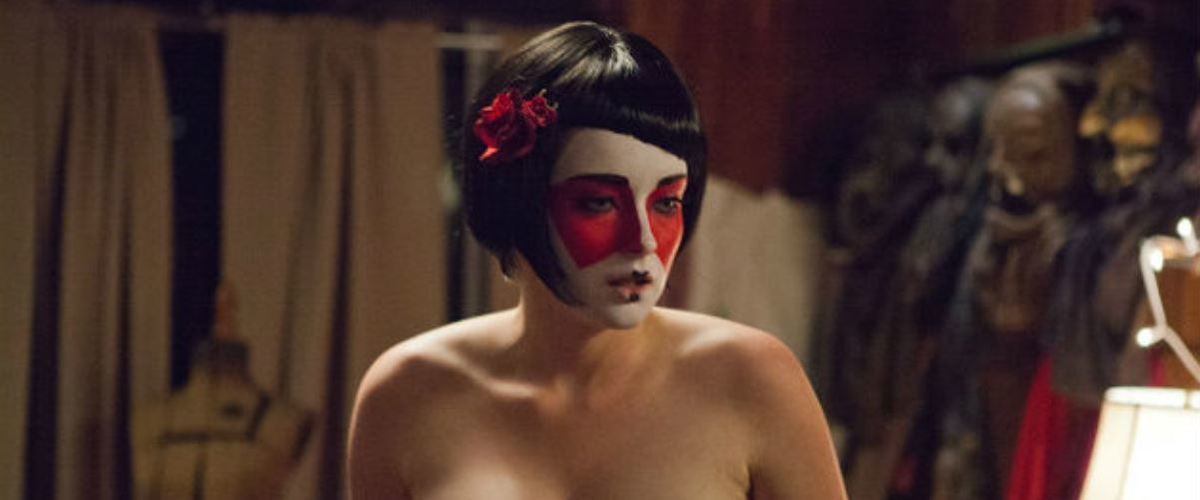
The film opens with the Minnie Driver’s primadonna Kylie Swanson ending her performance in The Haunting of the Opera to rapturous applause, her twins Buddy and Camilla take a tour of the auditorium, while their mother preens in front of her dressing room mirror. She is then savagely hacked to death by an unknown assailant wearing the mask of the Opera’s villain. Ten years later, the twins work at Center Stage Camp, a place where all misfits/theatre geeks love, laugh, sing, dance and, best of all, fit in. The Haunting of the Opera is chosen to be the musical book restaged (in keeping with the tragic anniversary), albeit relocating setting to Japan and replacing the plain white mask with that of a Kabuki, complete with top-knot. Camilla (Ally MacDonald) has always wanted to perform on the stage and despite being kitchen staff and not a student is allowed to audition. As pre-production begins, one-by-one cast and crew are picked off.

StageFright-2014-1

Okay, so it is not extremely difficult to see what, who, or how this film was inspired, it is painting a rock-horror-musical-by-numbers. It is an extended Glee episode (although the cast is by and large far more likeable) via The Phantom of the Opera and Friday the 13th. The score and song list is, however, original and fluctuate between eye-rollingly naff and grin-inducing, especially those songs sung by the supremely camp, foul mouthed villain who is, typically, dressed heed-to-toe in black brandishing a knife and electric guitar with murderous aplomb. In fact, one criticism is that he is not on screen nearly enough and an audience has to sit through more teen-angst than is absolutely necessary; where is the slicing and dicing?

There are enough sly allusions to other horror films to keep the seasoned genre-crowd satisfied (the sight of a twelve-year-old set designer wearing an apron whirling a hand-saw around made me chortle) and for those with a hatred or largely indifferent view of musicals there is a splendid rock and roll slayer to empathise with. Anyone with a sense of humour and a 90-minute window to fill should enjoy Stage Fright. It does exactly what it sets out to do, perhaps not quite frighten but it certainly entertains for the most part.

Categories
Blu-ray film review

Keeping Rosy (Dir. Steve Reeves, 2014)

Keeping-Rosy

Charlotte (Maxine Peake) is having a bad day. Not only has she been passed over for partner in her job but then she returns home to find her cleaner smoking and potentially stealing from her; an altercation ensues and triggers a catastrophic turn of events which has things going from bad to so much worse and in real time too.

British thriller, Keeping Rosy is a highly televisual affair and would work well as an ITV drama due to its episodic editing, this is not necessarily a bad thing; it just lacks a certain filmic quality. Peake is a fantastic actress and her performance really gives pause for thought, her Charlotte begins the film as a brittle, uptight career woman with a pinched face who physically flinches at the prospect of holding a colleague’s new baby. Yes! That gendered caricature; however, she makes the very best of the material at her disposal and is extremely engaging, even making the character more likeable as desperation takes hold. That said, as her controlling workaholic unravels it does make it impossible not to notice plot-holes and makes it increasingly difficult to reconcile character motivations. Throw in an annoying younger sister Sarah (Christine Bottomley) and a quite inexplicable performance by Blake Harrison (The Inbetweeners) as security guard, Roger and it is easy for interest to be all but diminished by the third act.

Keeping-Rosy_Maxine_

Roger Pratt’s cinematography is grimly effective – especially the shots within Charlotte’s sterile, open-plan apartment which overlooks a building site – in its depiction of London; the City divides and rules, and this is reinforced by the inclusion of some rather crass stereotyping ; Northerners, Southerners, Poles, they are all expendable it would seem albeit by a really implausible denouement.

By the end, the audience is left unsure as to what the film is trying to say specifically in relation to gender politics, class, crime and punishment. There are hints but it never fully commits.

Categories
Blu-ray film review

The Congress (Dir. Ari Folman, 2013)

congress header

Robin Wright (the actress playing a version of herself) has made some lousy choices when it comes to her film career and men, or so she is forcefully told by her agent Al (Harvey Keitel) at the beginning of Ari Folman’s The Congress.

congress

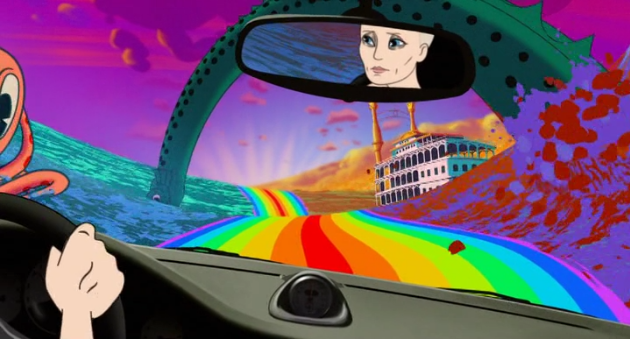
Her son Aaron (Kodi Smit-McPhee) has health problems, her daughter Sarah (Sami Gayle) thinks she should ‘do’ a Holocaust film as she can perfectly encapsulate ‘Nazi and victim’. These chalk-and-cheese children are just two of the reasons listed why character Wright ultimately chose life over the film offers and now Miramount Studio executive Jeff (Danny Huston) wants to offer her the chance to sign away the pressure. They wish to own “[the] thing called Robin Wright”; to create an image they manipulate and render in any filmic form as long as she retires from acting altogether. Any initial reluctance is given way to an affirmative and Wright is scanned; every emotion , every line, twinkle and wrinkle (a sequence that is particularly breath-taking, if completely isolating). The viewer is then transported twenty years into the future and the pension-age Wright is thrust into Abrahama City – the animated zone where she meets a 2D Disney-fied Jon Hamm.

The Congress, based upon a Stanislaw Lem story, is relevant, provocative, thematically rich – often to its detriment – and is almost impossible to categorise; part sci-fi, fantasy, family drama, there’s even some speculative dystopian fiction thrown in for good measure. However, what begins as a stinging critique and almost sly satire aimed primarily at the commodification of celebrity disappointingly loses its anger and gestates into something else entirely. The animated world is hallucinatory and disconcerting, a sinister Disney World™ where eagle-eyed viewers can spot Michael Jackson as a restaurant waiter, Grace Jones as a nurse or an exaggerated toothsome caricature of Tom Cruise. It is exhilarating, mesmerising and a little tiresome but perhaps this is the point in a post-avatar, digital-obsessed world? The questions of mortality our protagonist faces are replicated in our own manipulated interpretation; we should beware of the image. While its plethora of ideas and ambition feels relentless and even a little confusing, The Congress finally finds its humanity amid an existential denouement.

congress2

In any other actor’s hands, The Congress could have been a huge failure but the luminous Robin Wright delivers a stunning performance thanks, in part, to an excellent supporting cast of Keitel, Hamm, Huston and Paul Giamatti but mainly due to the fact that she is just that damn good. There is one scene in which the forty-plus Wright gazes at herself as Buttercup on a Princess Bride film poster, perhaps nostalgic for youth or the career she might have had, yet aside from the hair and the odd wisdom line, she appears exactly the same. If this film is one of her lousy choices, let’s hope she keeps on making them.

Categories
Blu-ray film review

One Eyed Jacks (Dir. Marlon Brando, 1961)

OneEyedJacks-posterb

The name Marlon Brando is not necessarily one synonymous with the Western genre and yet he made three of them throughout his illustrious career, The Missouri Breaks (1976, Arthur Penn), The Appaloosa (1966, Sidney J. Furie) and the first, One-Eyed Jacks (1961), which also happens to be the only film he directed. A one-time vehicle for Stanley Kubrick, it was fraught with problems pre and post-production, the budget reportedly grew from $1.8 to $6 million when Brando took over and its eight week shooting time was extended to six months while the film’s finished edit had an original running time of five hours. This was before a Paramount executive made the decision to remove Brando’s creative authority and heavily cut the duration for release. It may have had its issues behind the scenes, but onscreen it remains one of the most memorable, and visually masterful Westerns ever produced.

This quirky revenge-Western, based upon Charles Neider’s The Authentic Death of Hendry Jones, tells the story of partners-in-crime; bank robbers Dad Longworth (Karl Malden) and The Rio Kid (Brando). It is 1880 and they are running from the law in Sonora, Mexico when Dad double-crosses Kid following their latest heist, and leaves him to be captured. Kid then spends five years in prison plotting his revenge before he can make his escape. When he does finally run into his old mentor, vengeance of the gun-toting variety is problematic, as Dad is now law-abiding, the local Sheriff, and married to Maria (Katy Jurado) with a step-daughter, Louisa (Pina Pellicer), towards whom Dad displays an obvious attraction. Rio, noticing the stolen, lustful glances, seeks retribution via seduction. Although never the intention, The Kid and Louisa fall in love and must, in Rio’s case, survive Dad’s wrath in doing so; a rage which involves a very public, painful flogging and brutal trigger-finger breaking.

brandomalden

Malden and Brando collaborated on three projects in a friendship that latest five decades, arguably some of their best work: Elia Kazan’s A Streetcar Named Desire (1951) and On the Waterfront (1954), and Brando’s baroque Western. Here, some may say cast against type (oh, and Baby Doll), Malden displays a repugnancy and cruelty in his performance as well-spoken Dad, a man dripping in piety and sanctimony. He exudes the seductive and paralysing power of the father figure within the diegetic space; the surrogate patriarch to The Kid – a young man putting a hard, obstinate face on his sensitivities in order to defeat the self-righteous and judgemental Longworth. This aspect of the script seemingly resonated with actor-director Brando, whose contentious and volatile relationship with his own father was reputed to be part of his motivation for making the film. Allowing the transposition of feelings or ‘emotional mechanics’ onscreen in keeping with his (and Malden’s) erudition as a student of the Constantin Stanislavski Method. Brando’s performance combines the manipulative, impulsive traits of a child while oozing his usual ambivalent sexuality. Rio is relatively non-violent as cowboys go, polished and clean shaven, one who would rather exert his virility by spending time with women than attend the saloon with his compadres. He is internally emotive and visibly tough; the explosive and volatile temper can dissolve as quickly into tears or laughter.

brando

Visually, the film employs a lot of fluid camera movement and some of the tracking and panning shots are simply beautiful – courtesy of Brando’s eye and Charles Lang Jnr’s cinematography – in a film which relies upon John Ford-esque framing and takes evident inspiration from Sam Peckinpah. One-Eyed Jacks is replete with Brando’s over-indulgent and meticulous eye. Legend has it that the first-time director would delay filming until the right kind of waves hit the shore – it pays off too. It is one one of the most enthralling and visually captivating films of the Western genre committed to celluloid, and clearly a passion project. Steven Spielberg is a big fan. Martin Scorsese lauds it as one of the greatest Westerns ever made – in fact, they both were consultants on the restoration. Personally, it has always been at the very top of my favourite Westerns list and Brando performances but then, you’re more likely to listen to Marty.

Extras listed below are from the 4K restoration by Universal Pictures and The Film Foundation which was released by Arrow Academy in Dual-format DVD and Blu-ray.

Disc Extras
Introduction by Martin Scorsese (2:51)
In this brief introduction , Scorsese lauds One-Eyed Jacks as a masterpiece, not only as a fan but as a person interested in film history. He commends its representation as the “bridge between the emotional values of New Hollywood and the moviemaking sensibilities of Old Hollywood.” Quite the endorsement.

Marlon Brando: The Wild One (53:33)
Written and directed by Paul Joyce, this programme was originally aired on TV on August 11th 1996. Joyce interviews numerous subjects about their dealings with Brando, including co-stars, friends, famous fans, and directors int he forms of: Dennis Hopper, Shelley Winters, Kevin McCarthy, Arthur Penn, Peter Bart, Martin Sheen, Francis Ford Coppola and Anthony Hopkins. All, except Bart, revered the actor and his enthralling screen magnetism. These interviews are intercut with clips and images from some of the Brando greats; Viva Zapata! (1952), On the WaterfrontLast Tango in Paris (1972), The Missouri BreaksThe Young Lions (1958), One-Eyed JacksThe Chase (1966), Burn! (1969), The Godfather (1972) and Apocalypse Now (1979). While some of the anecdotes seem impersonal, some are touching, and many speak of Brando with genuine affection. Brando’s love of children, his weight problems, and his approach to fatherhood, which Martin Sheen claims had a huge influence of the way he raised his own children. This is a perfect, albeit very male-centric, introduction to the star, for those who know little about Brando. It is interesting to note that both Malden and Brando were still living at this point and either chose not to take part in this or were not asked.

Francis Ford Coppola on Brando (43:46)
This rather tedious segment is the extended interview from the Paul Joyce documentary. Despite a 2017 edit, the interview is (as was the doc itself) twenty-plus years old. Yes, Coppola talks of Brando’s genius, and brandishes him the easiest actor to work with, and is awed by his intelligence, talent and physical beauty etcetera. It’s very repetitive as it regurgitates a lot of the footage and dialogue we’ve already seen and heard. As a super-fan of Brando – he was the subject of my Undergrad dissertation – none of the anecdotes or film trivia are new. It’s understandable why Coppola was asked to participate, he worked with Brando twice, but none of it has much to do with One-Eyed Jacks. Martin Scorsese discussing the film’s history, production, or restoration process would have made more sense and had have been welcome.

Arthur Penn on Marlon Brando (44:48)
Again, the same as Coppola’s segment, this is the extended interview with Penn. Another male director that worked with Marlon on two occasions, at least one of the Penn/Brando collaborations was a Western! Similarly to the Coppola footage, it’s monotonous as a second man recounts similar anecdotes and experiences when he worked with the actor twenty years previous. Penn is more articulate than Coppola so parts of this are interesting although, he does offer history which is, not only, not specific to Brando but also little by way of One-Eyed Jacks. What is evident is Penn’s love for the man, the enigma, the “irreverent adolescent” whose devotion to his art made audiences believe in the film’s narrative and character before them. About OEJ, Penn states “If you want to [experience] the real artistry of the man, go see One-Eyed Jacks.”

I would implore anybody to do the same.